
A complete issue · 40 pages · 1921
Life — August 11, 1921
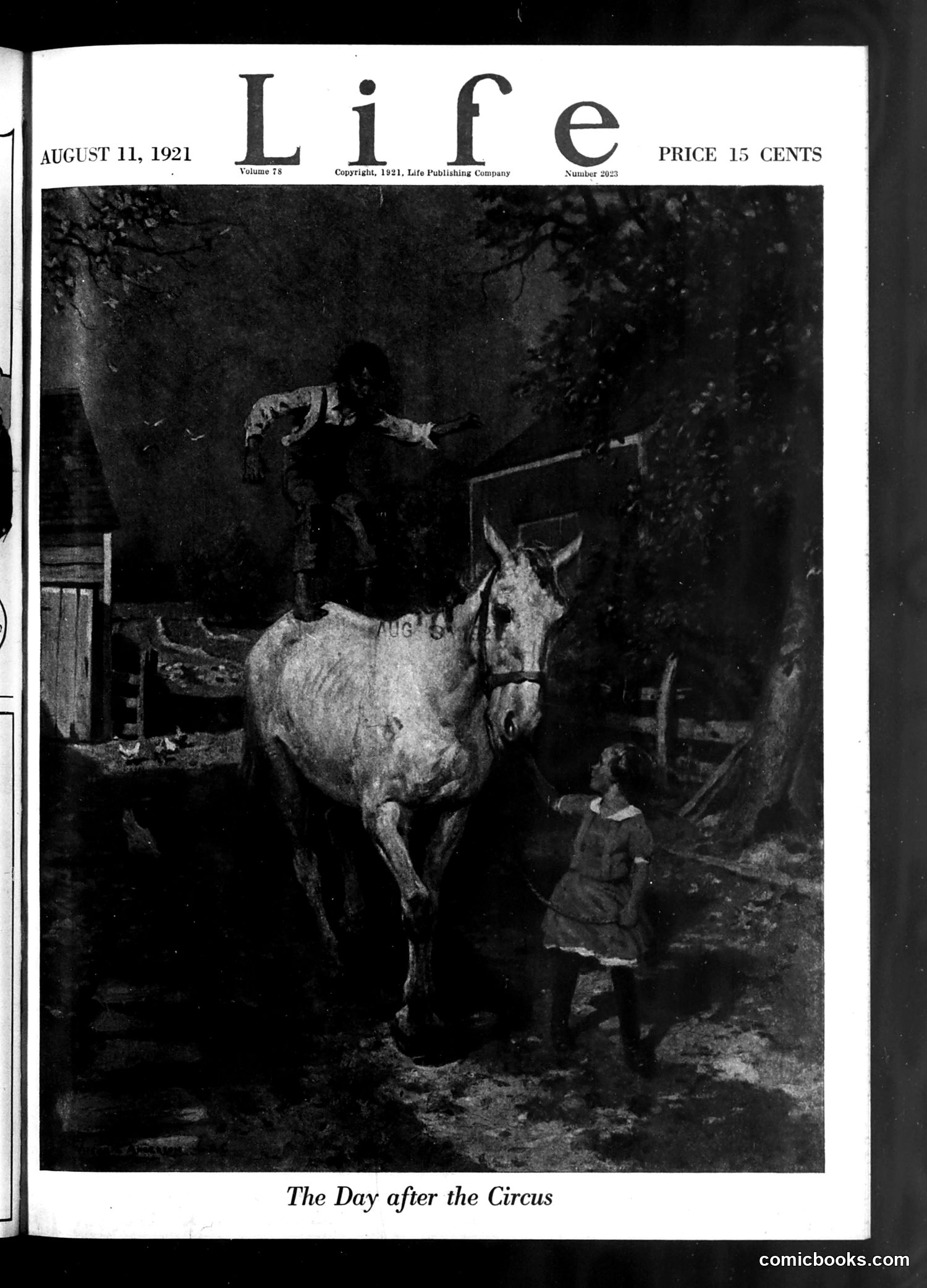
This appears to be a humorous domestic scene rather than political satire. The photograph shows a man standing on a horse indoors (likely in a barn or stable), with a child below, apparently recreating circus acts from a performance the family recently attended. The joke is straightforward: after visiting the circus, the man is enthusiastically imitating the acrobatic feats he witnessed, using whatever props are available—in this case, his own horse. It's gentle satire of how circus performances inspire audience members (particularly men and children) to attempt dangerous stunts at home. The title makes the humor explicit: the circus has so captivated them that "the day after" they cannot resist trying the acts themselves.
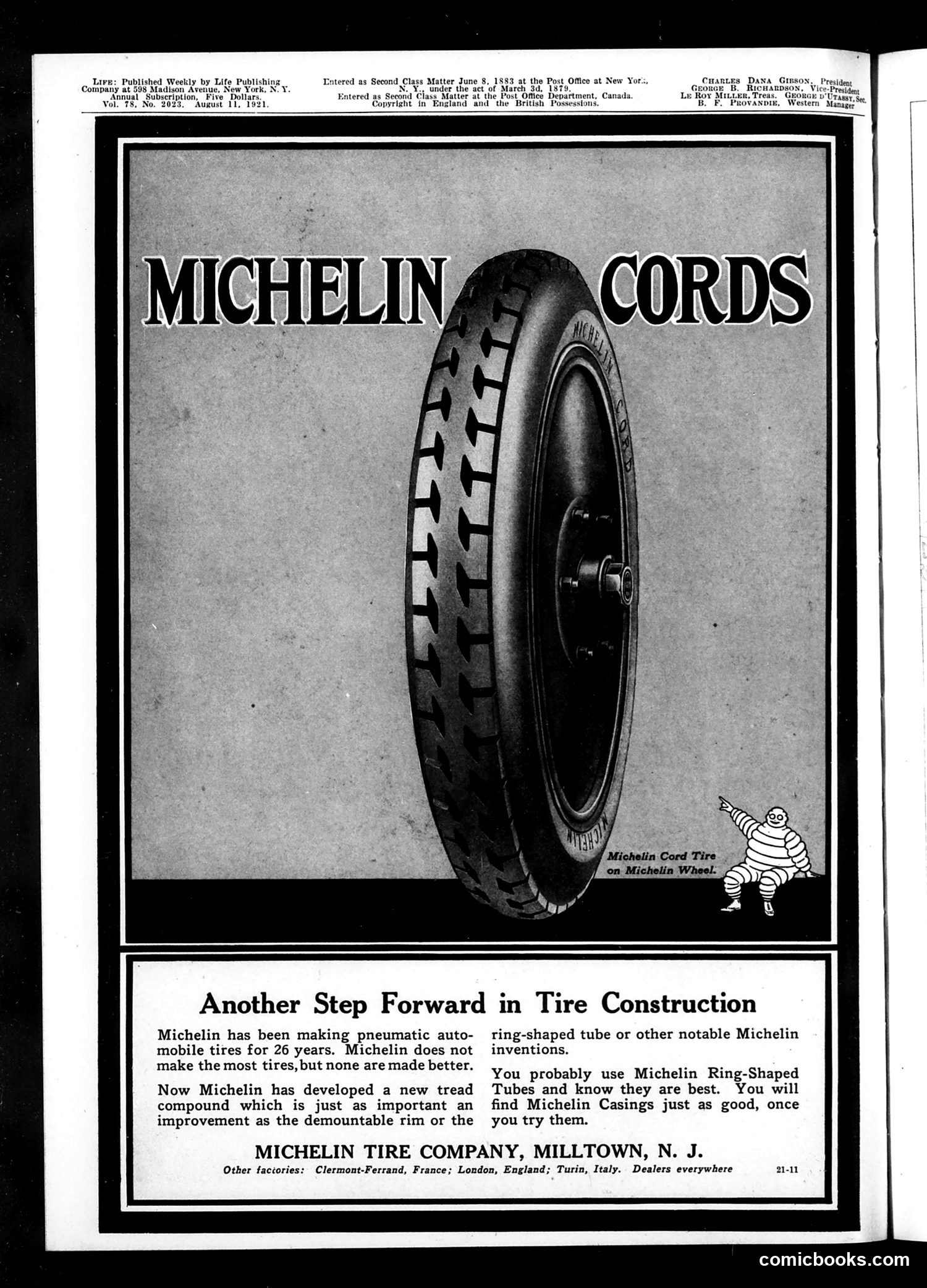
This page is primarily **advertising, not satire or political commentary**. It's a full-page advertisement for Michelin Cords tires from the Michelin Tire Company in Milltown, New Jersey. The ad features a large photograph of a tire with visible tread pattern and a dark wheel rim, alongside Michelin's famous mascot—Bibendum, the rotund figure made of tire rings (visible in the lower right). The copy emphasizes Michelin's innovation in tire construction, claiming they've developed a "new tread compound" that represents "another step forward in tire construction." The ad promotes both Michelin pneumatic tires and their ring-shaped tubes and casings as superior products. This is straightforward early-20th-century product advertising, not editorial content with political or social satire.
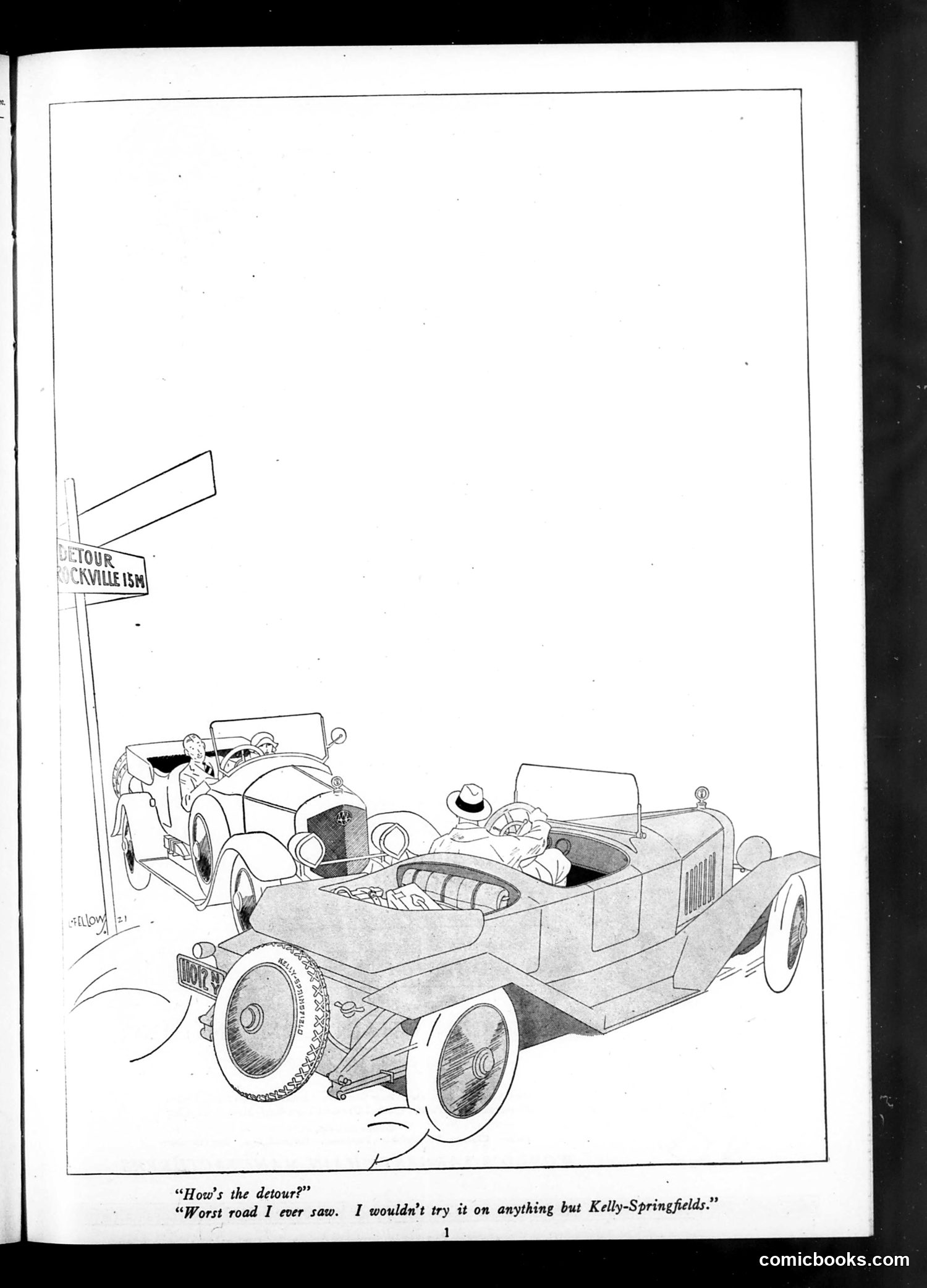
This cartoon depicts two early automobiles on a road beneath a "Detour—Eckville 15M" sign. The dialogue reads: "How's the detour?" "Worst road I ever saw. I wouldn't try it on anything but Kelly-Springfields." This is an advertisement disguised as humor. Kelly-Springfields were a tire brand, and the joke promotes their durability by suggesting these tires are robust enough to handle the worst possible road conditions—a detour on a poor-quality route. The cartoon uses the common satirical device of product placement through comic dialogue, implying that Kelly-Springfields are so reliable they can withstand punishment that would damage competitors' tires. This was typical early-20th-century advertising strategy in satirical magazines like *Life*, blending commercial messaging with comedic content.
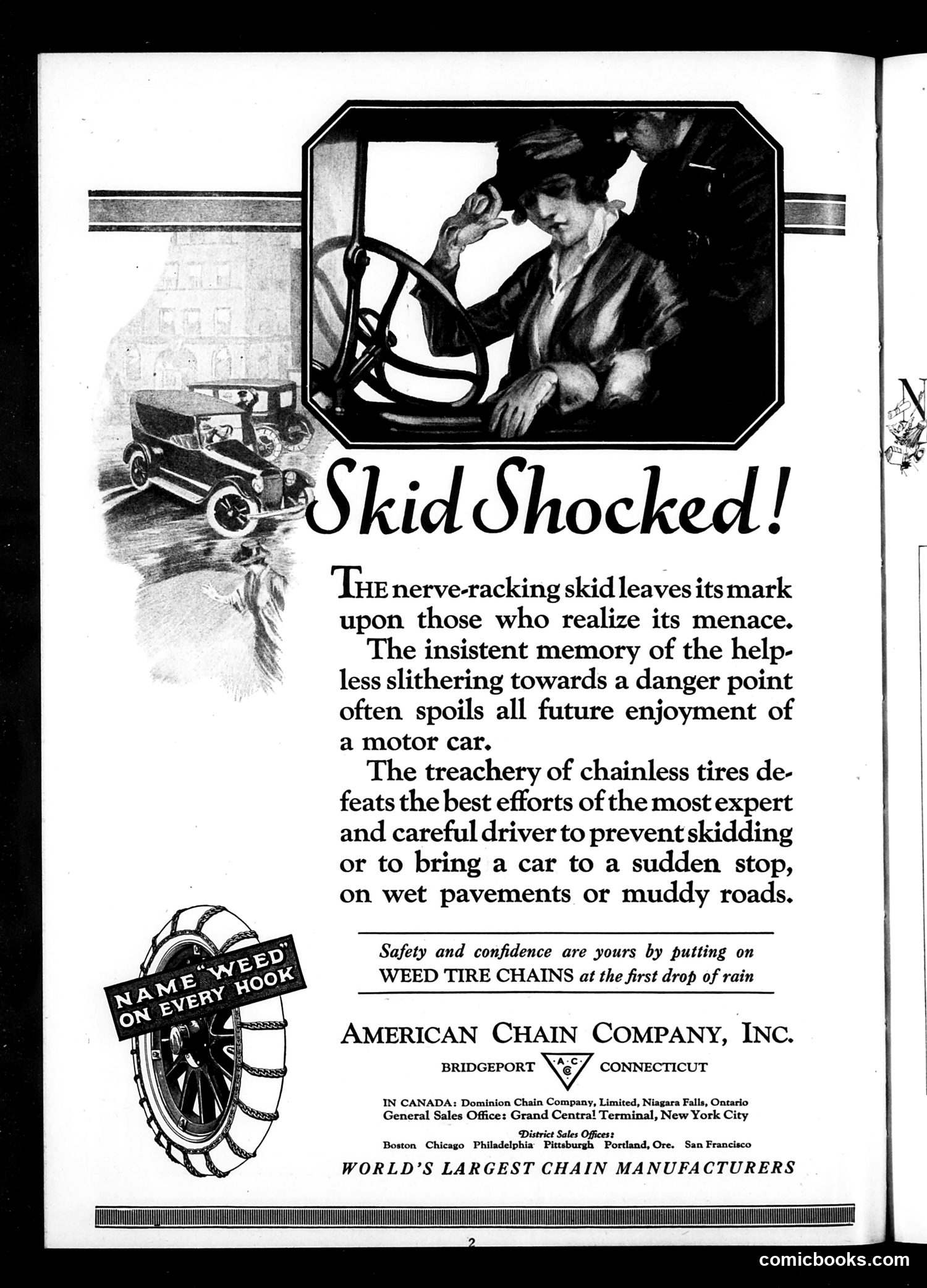
This is a **commercial advertisement**, not satirical content. The American Chain Company promotes "Weed Tire Chains" — metal devices attached to vehicle tires for traction on wet or icy roads. The ad's dramatic headline "Skid Shocked!" depicts a frightened female driver experiencing loss of control. The narrative warns that tire skids on slippery surfaces create traumatic memories that harm future driving confidence. The copy emphasizes how chainless tires fail even careful drivers. The solution: install Weed Tire Chains "at the first drop of rain." The advertisement targets early-automobile owners unfamiliar with winter driving hazards, using fear and social pressure (emphasizing driver competence) to sell a practical safety product. This reflects early-1900s automotive safety concerns before modern tire technology.
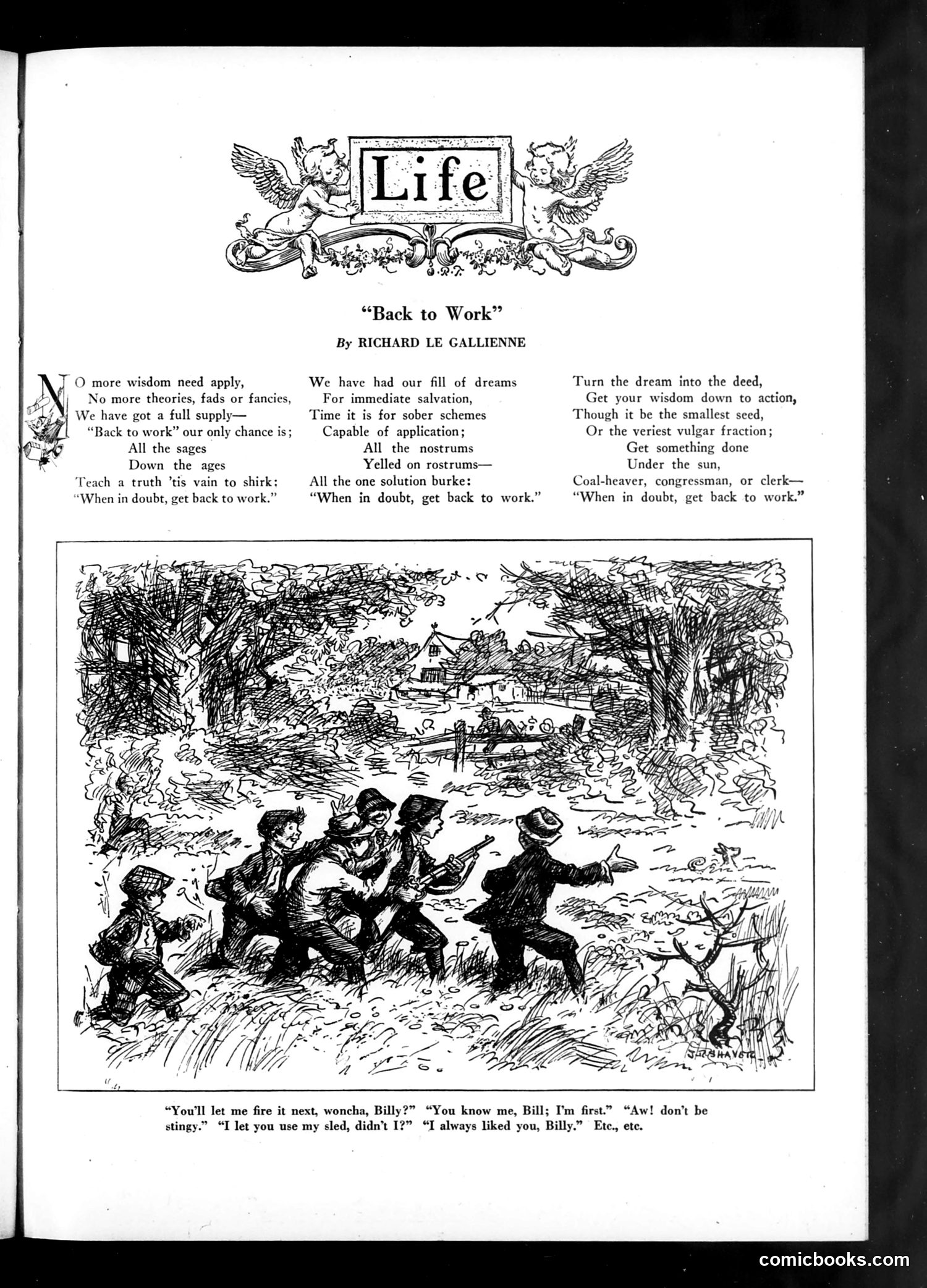
This Richard Le Gallienne poem and cartoon satirize post-WWI American society's obsession with productivity and work as a cure-all solution. The verse mocks idealistic dreamers and theorists, insisting that practical action—"getting back to work"—is the only answer to social problems. The illustration depicts children playing or loafing outdoors, seemingly avoiding labor. The dialogue below ("You'll let me fire it next, woncha, Billy?") suggests children mimicking adult work culture and competitiveness, even in play. The satire targets how early 20th-century America elevated work to almost religious status, promoting it as civilization's remedy for everything from social unrest to moral decay—a critique of capitalist ideology that reduced human value to productivity.
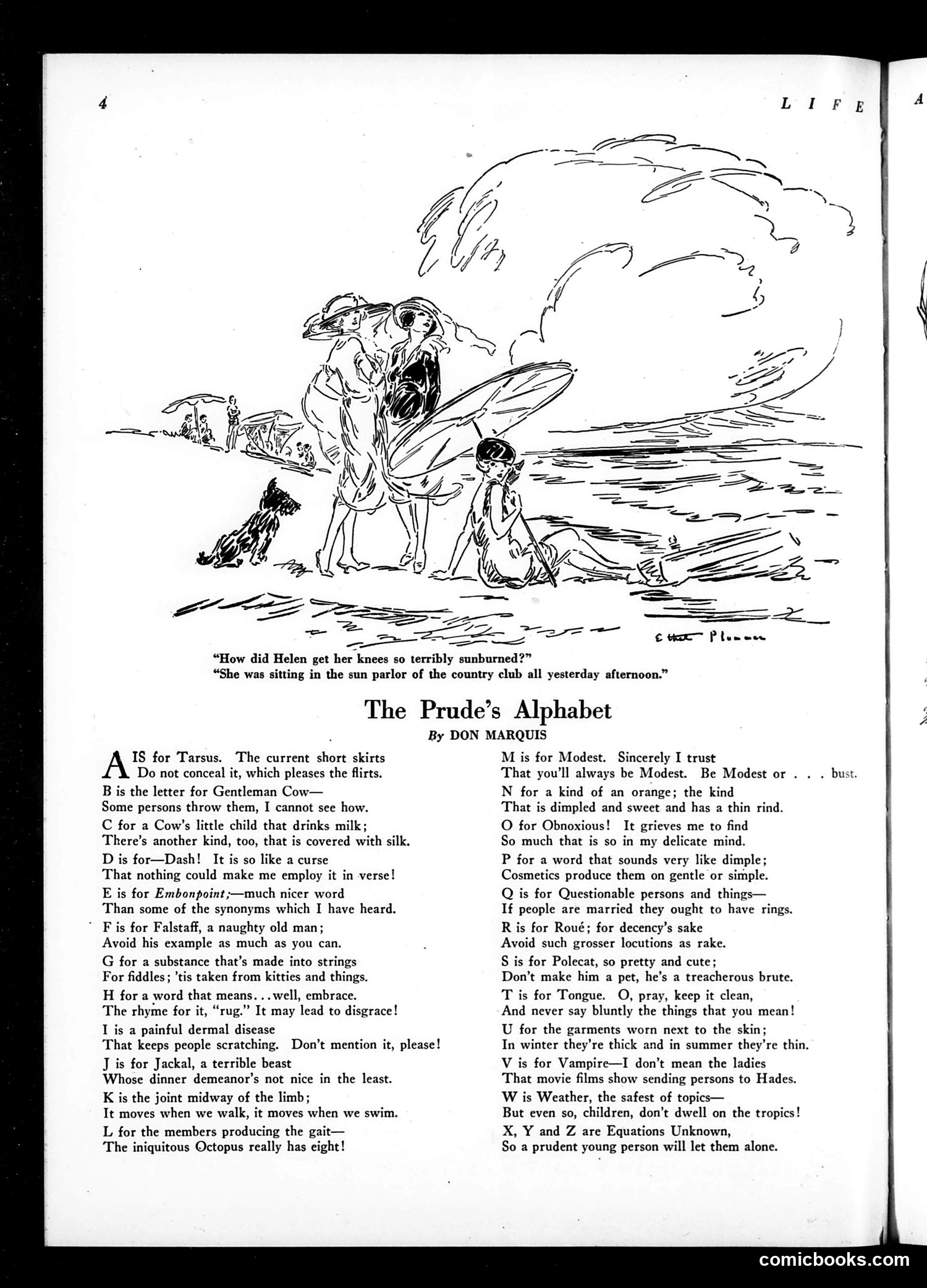
This page contains "The Prude's Alphabet," a satirical poem by Don Marquis mocking Victorian social conventions and propriety. The cartoon above illustrates one entry—a woman's sunburned knees—treating this as scandalous. The satire targets excessive prudishness: the poem humorously presents topics that would have mortified proper Victorian society (bare knees, cosmetics, questionable women, vampires, weather discussion) as ridiculous to worry about. Each letter entry ridicules some aspect of overstated modesty or social anxiety. The cartoon shows well-dressed figures reacting with apparent shock to Helen's sunburned knees—a trivial physical consequence presented as a major social concern. This visually embodies the poem's central joke: the absurdity of extreme prudishness in modern (1920s) life.
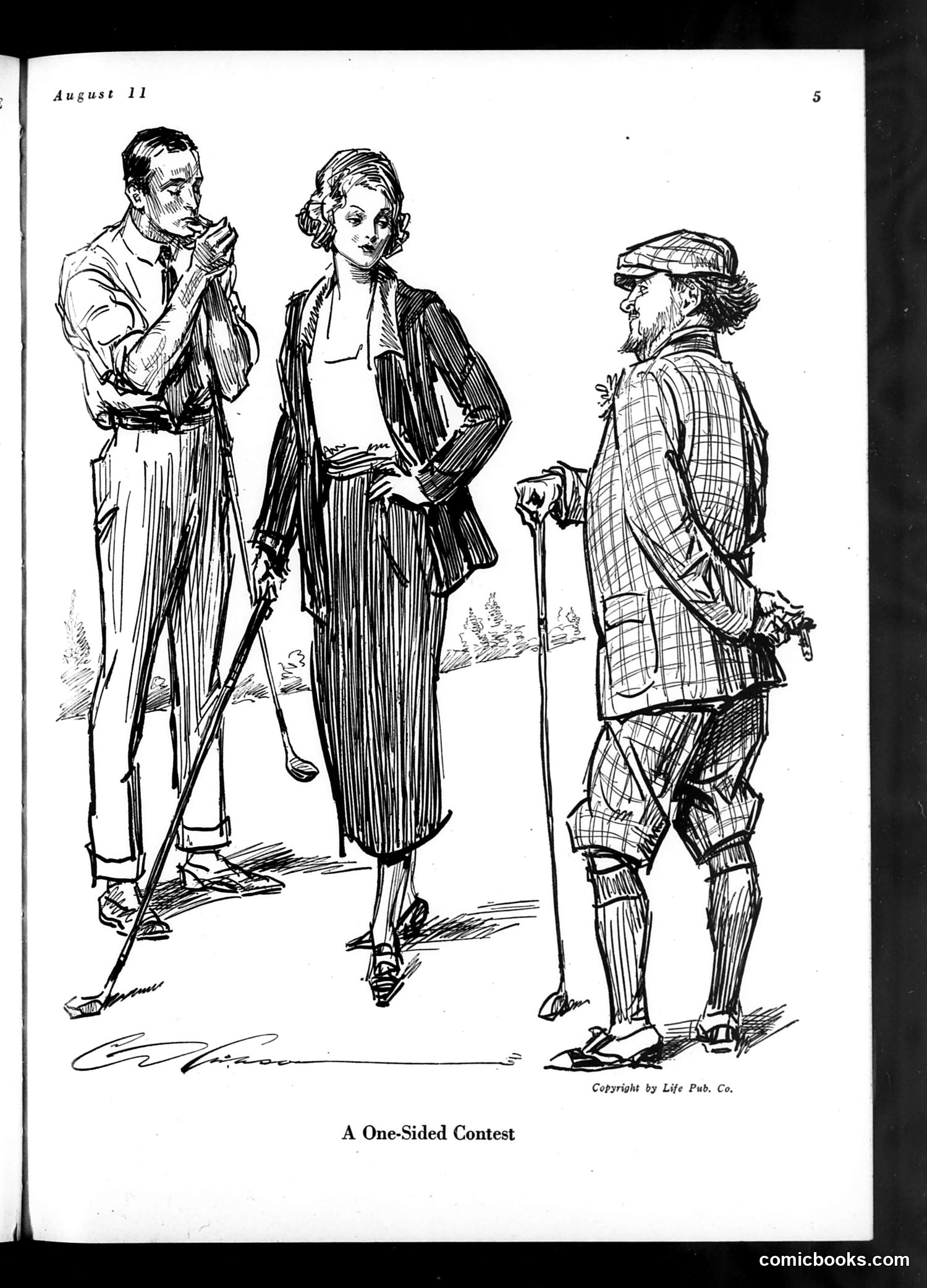
This cartoon depicts three golfers on a course. The title "A One-Sided Contest" suggests an unequal competition. Two figures on the left—a man in formal attire and a woman in a tailored suit—appear to be skilled golfers holding their clubs with confidence. On the right stands a man in plaid knickerbockers and a cap, depicted in a notably different style, appearing less polished or competent. The satire likely comments on gender or class dynamics in golf during the early 20th century, when the sport was exclusive. The "one-sided contest" may reference women entering a traditionally male domain, or possibly the inclusion of working-class players in an elite sport. The visual contrast between the formally dressed pair and the casually dressed man on the right suggests social hierarchy or competition across class lines in this leisure activity.
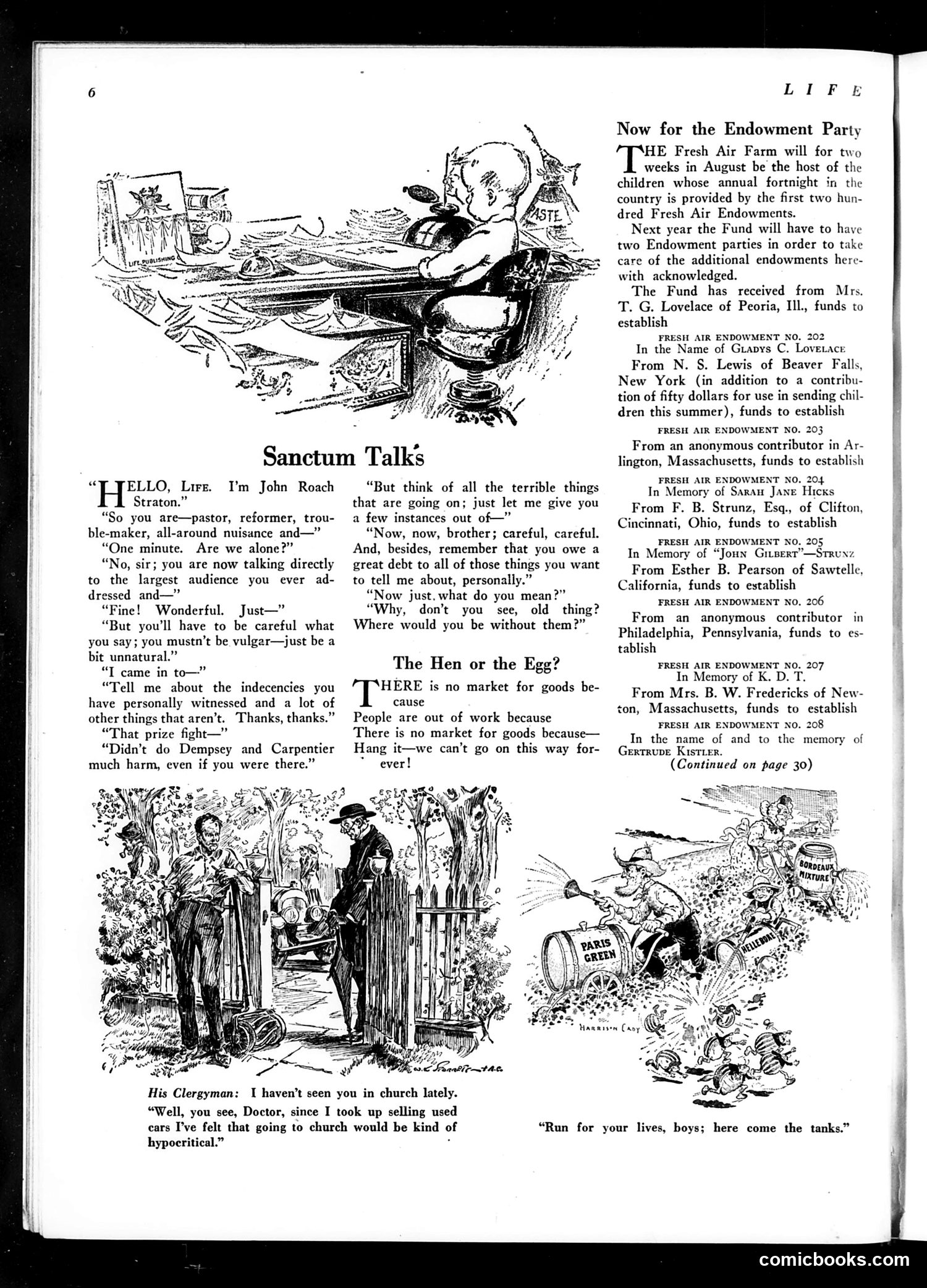
This page contains two distinct satirical pieces: **"Sanctum Talks"** features John Roach Straton, a real reform-minded pastor and "trouble-maker," discussing social problems with "Life" (personified). Straton criticizes both secular indulgences and religious hypocrisy, warning against vulgar language and personal moral failings. The satire targets reformers who advocate for others while living questionably themselves. **"The Hen or the Egg?"** presents economic paradox: goods can't be marketed because people lack work, yet work can't continue without market demand. This circular logic critiques Depression-era economic collapse and business inability to break the cycle. The cartoon below shows a clergyman admitting he skips church since becoming a used-car salesman—satirizing commerce-driven morality and those who abandon principle for profit.
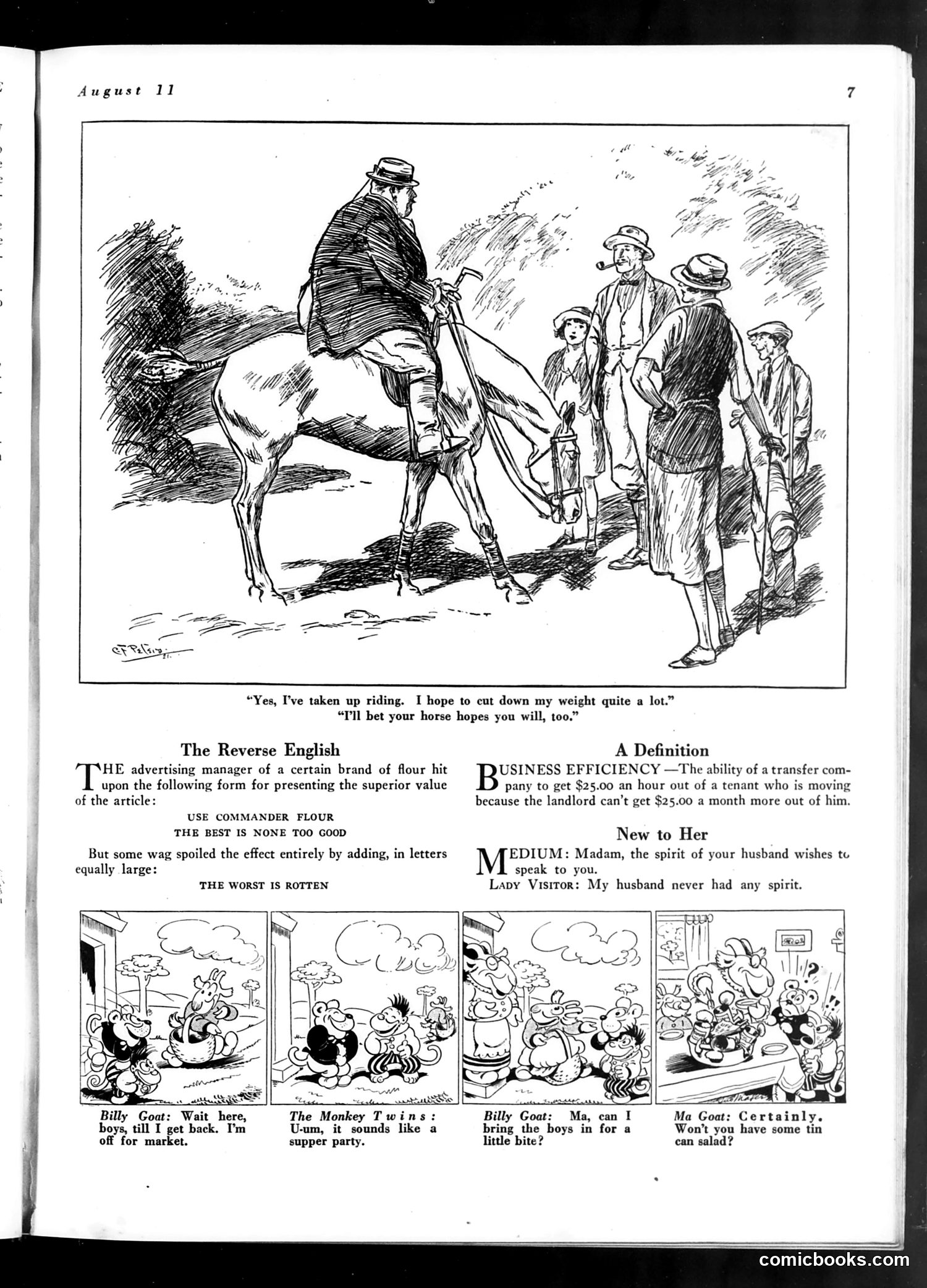
This page contains three unrelated humor pieces: 1. **Top cartoon**: A man on horseback tells pedestrians he's taken up riding to lose weight. The joke plays on the physical exertion required, with a bystander quipping that "your horse hopes you will, too"—implying the horse will also benefit from the weight loss. 2. **"The Reverse English"**: Satirizes deceptive advertising. A flour brand advertised itself as "THE BEST IS NONE TOO GOOD," but someone vandalized it by adding letters to read "THE WORST IS ROTTEN"—mocking how advertising claims can be inverted to reveal opposite meanings. 3. **"Billy Goat" comic strip**: A four-panel sequence featuring animal characters (a goat and monkey) planning a social gathering, likely a children's humor piece playing on animal behavior. The page reflects early 20th-century satirical humor about advertising and consumer culture.
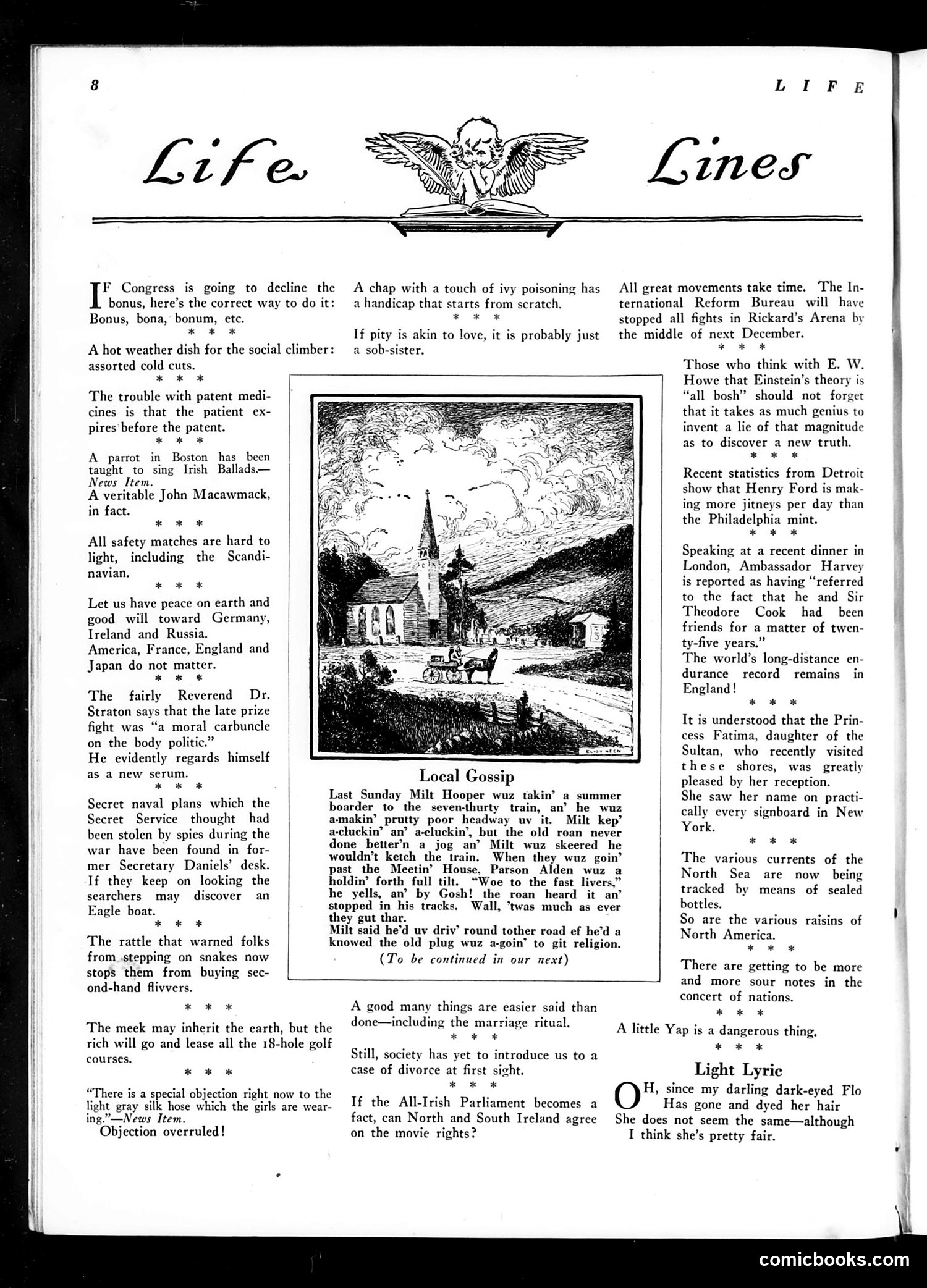
This page contains brief satirical commentary and social observations rather than political cartoons. The single illustration shows a rural church scene labeled "Local Gossip," accompanying a humorous anecdote about Milt Hooper's misadventure on a train—he dozed off and ended up at the wrong destination, creating awkwardness at a meeting house. The "Life Lines" section offers short witticisms on contemporary topics: patent medicines, safety matches, prize fighting, naval espionage, golf courses, and women's fashion (gray silk hose). References include Dr. Straton (a public figure), Ambassador Harvey, and the "All-Irish Parliament," suggesting this is from the early 1920s. The humor is gentle social satire typical of Life's era—poking fun at modern inconveniences, class pretensions, and marital complications rather than attacking specific political targets.
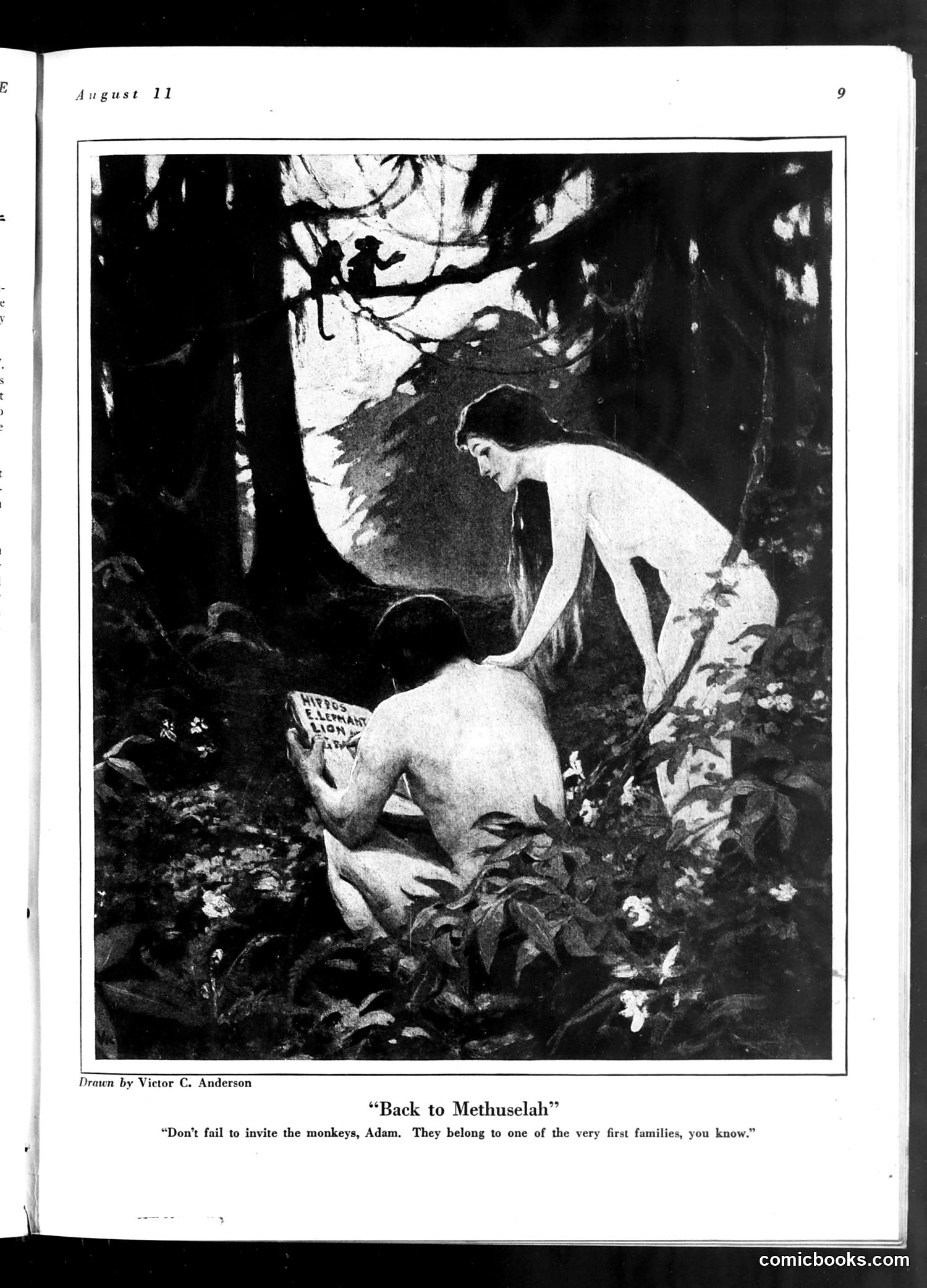
This is an illustration by Victor C. Anderson for "Back to Methuselah," a play by George Bernard Shaw. The artwork depicts two nude figures in a garden setting with foliage and a monkey visible in the tree above. The caption reads: "Don't fail to invite the monkeys, Adam. They belong to one of the very first families, you know." The satire references Shaw's play, which explores human evolution and longevity. The joke plays on the biblical Adam and Eve narrative while invoking evolutionary theory—suggesting that monkeys are ancestrally related to humans and thus part of humanity's "family tree." The comment about "very first families" appears to mock social pretension by treating evolutionary ancestry as a matter of aristocratic lineage.
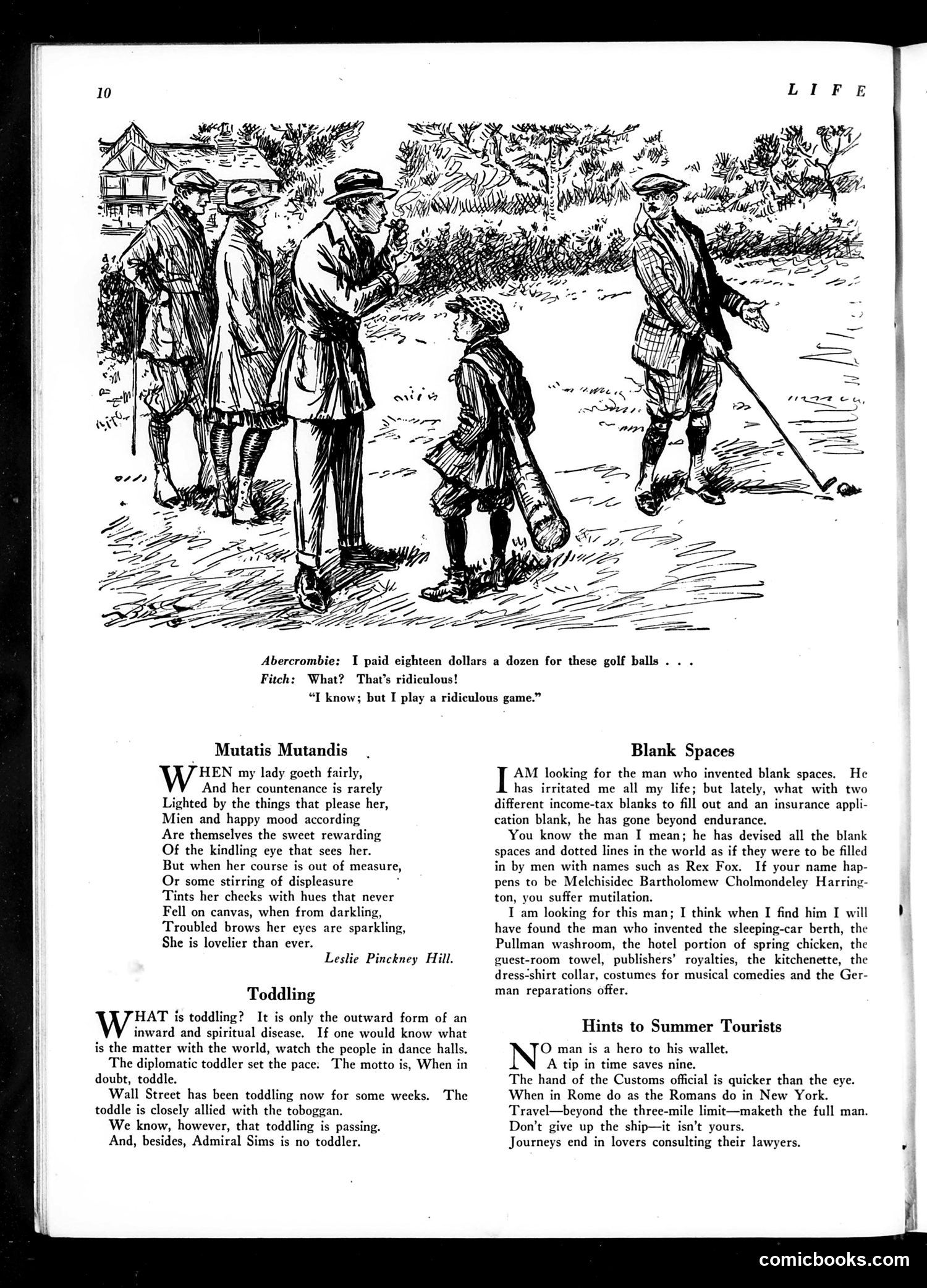
The top cartoon depicts a golf scene where a man named Abercrombie complains to Fitch about paying eighteen dollars per dozen for golf balls, calling the price ridiculous. Fitch's response—"I know; but I play a ridiculous game"—is the joke's punchline, suggesting golf itself is an absurd pastime worthy of ridicule. This satirizes golf as an expensive, time-wasting hobby pursued by wealthy men. The cartoon mocks both the sport's inherent absurdity and the financial extravagance required to play it. The elegant clothing and pastoral setting emphasize that golf was an upper-class pursuit in this era, making it ripe for satirical commentary on frivolous spending and leisure activities among the affluent.
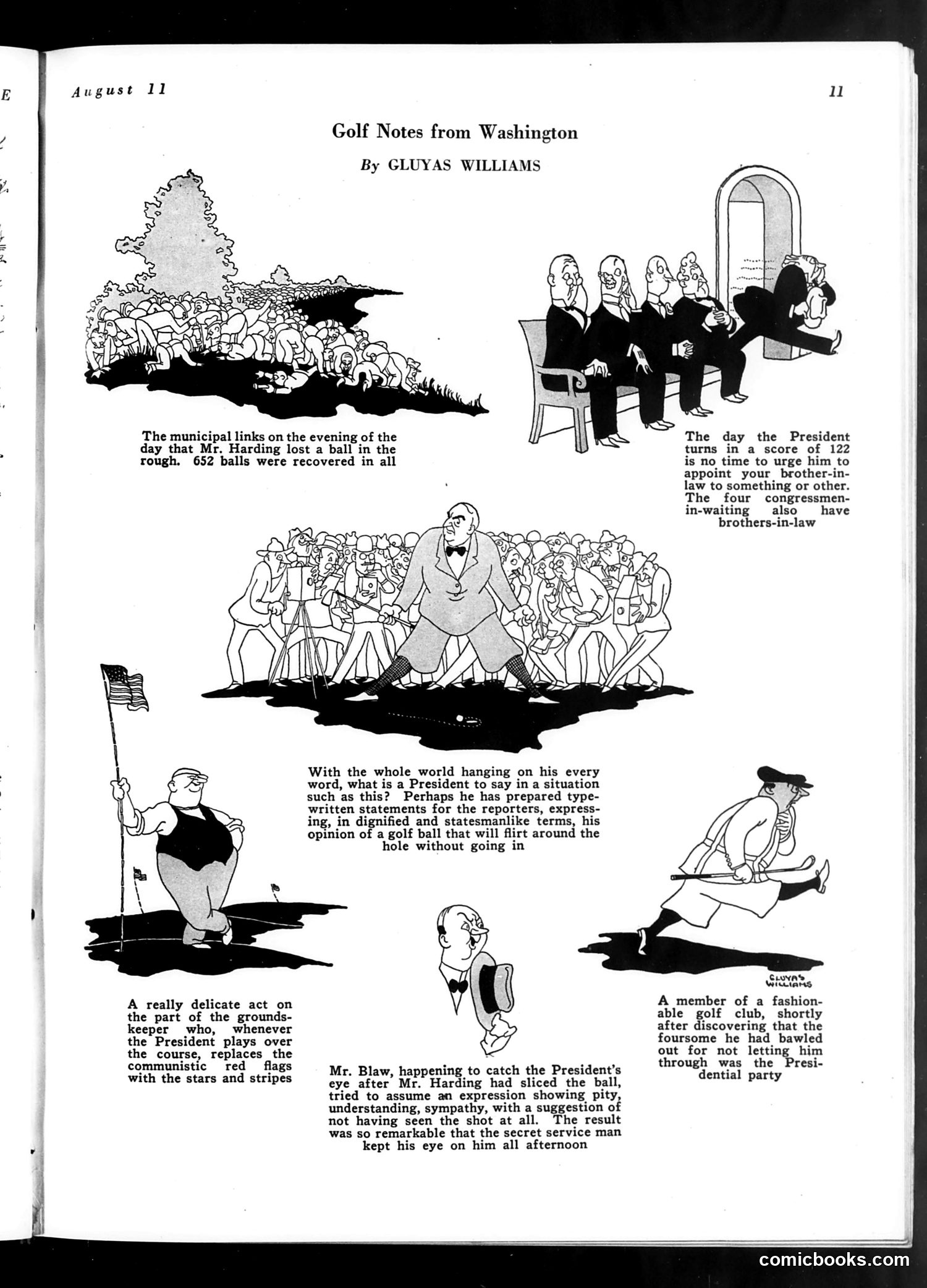
This satirical page by Gluyas Williams mocks President Harding's devotion to golf despite serious national responsibilities. The cartoons depict: **Main joke:** While "the whole world hanging on his every word," Harding prioritizes golf, making absurd diplomatic pronouncements about a lost golf ball instead of addressing real issues. **Specific scenes:** - 652 golf balls recovered from the municipal links after Harding lost one - Congressmen waiting while the President plays - A groundskeeper replacing American flags with communist red ones (dark commentary on Harding's inattention to threats) - A club member expelled for the "presidential party" discovering his foursome included the President The satire attacks Harding's perceived neglect of governance for leisure, suggesting his distraction endangers the nation during a tense post-WWI era.
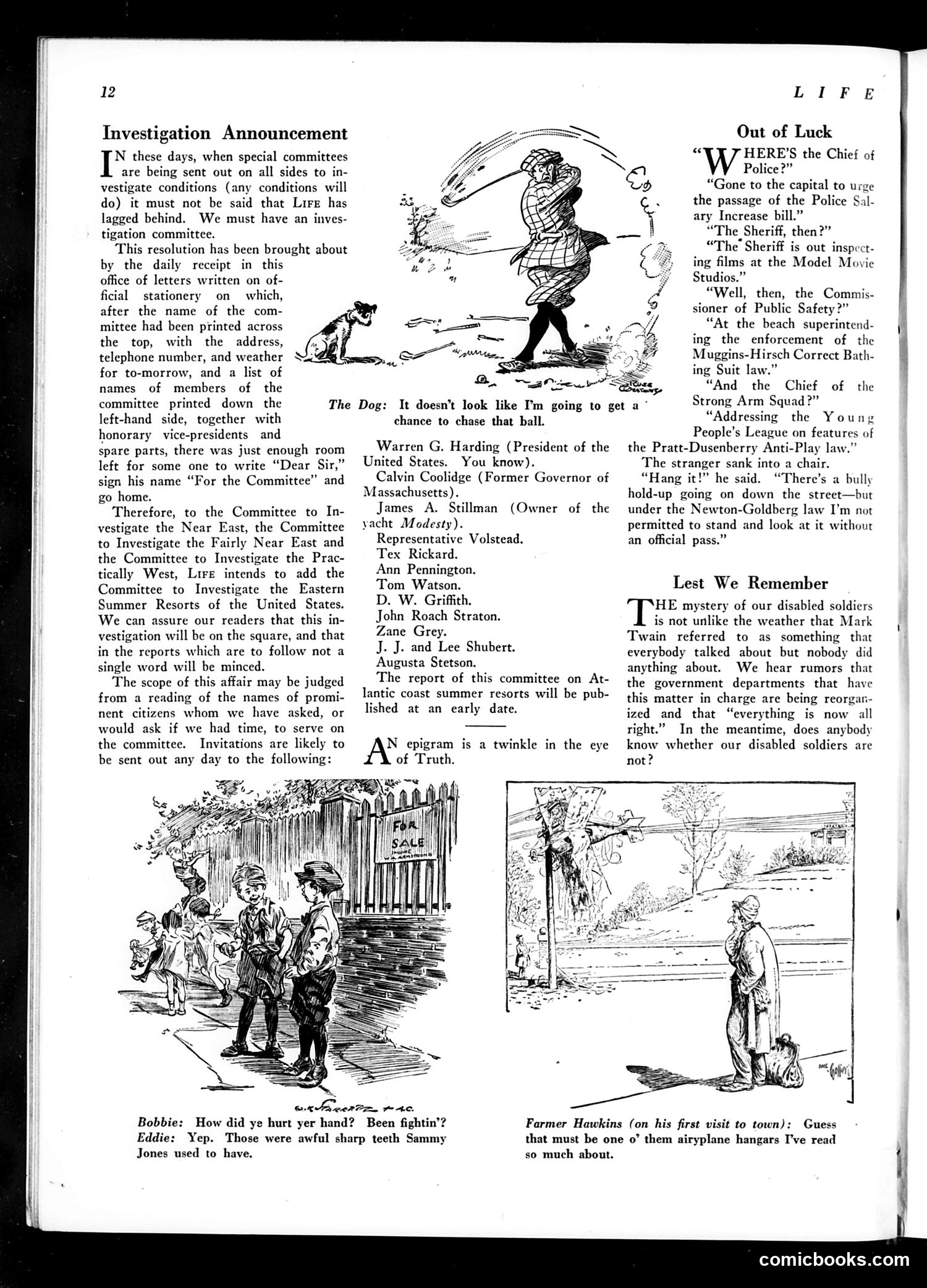
**"Investigation Announcement"** satirizes the era's proliferation of government committees investigating various issues. The text lists prominent figures—including President Warren G. Harding and former Massachusetts Governor Calvin Coolidge—being asked to serve on committees investigating everything from "Near East" affairs to Atlantic coast resorts. The satire's point: there are so many overlapping investigations that the actual work gets lost in bureaucratic excess. **"Out of Luck"** cartoon depicts a job-seeker unable to find work because every government position is occupied by someone serving on investigation committees. The two cartoons below illustrate working-class scenes with humorous captions about children and former soldiers, offering lighter social commentary on everyday life during the early 1920s Harding administration.
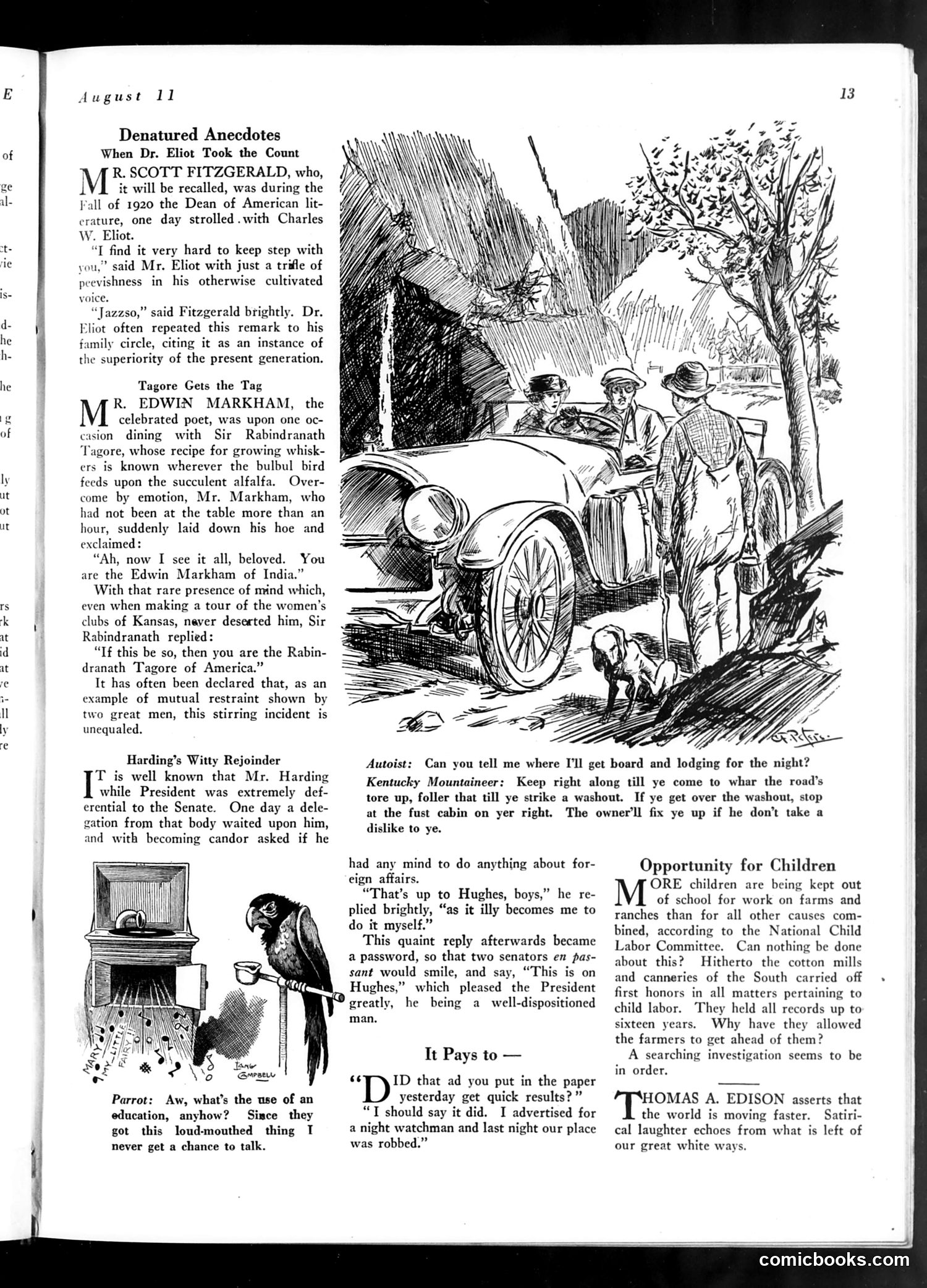
This page contains three satirical anecdotes with accompanying illustrations: 1. **"When Dr. Eliot Took the Count"**: Mocks Dr. Eliot (Dean of American Letters, Fall of 1920) for his difficulty keeping pace with Charles W. Eliot's rapid speech, attributed to "a trifle of perviousness." 2. **"Tagore Gets the Tag"**: Features poet Edwin Markham dining with Sir Rabindranath Tagore. The joke involves Markham's sudden recognition of Tagore as "the Edwin Markham of India"—a humorous moment of mutual flattery between literary figures. 3. **"Harding's Witty Rejoinder"**: A political anecdote about President Harding responding to a Senate delegation's request regarding foreign affairs, eventually becoming a "passport" between two senators. The bottom section includes unrelated short items about farm labor and Thomas Edison, plus an illustration satirizing a parrot's uselessness as "education."
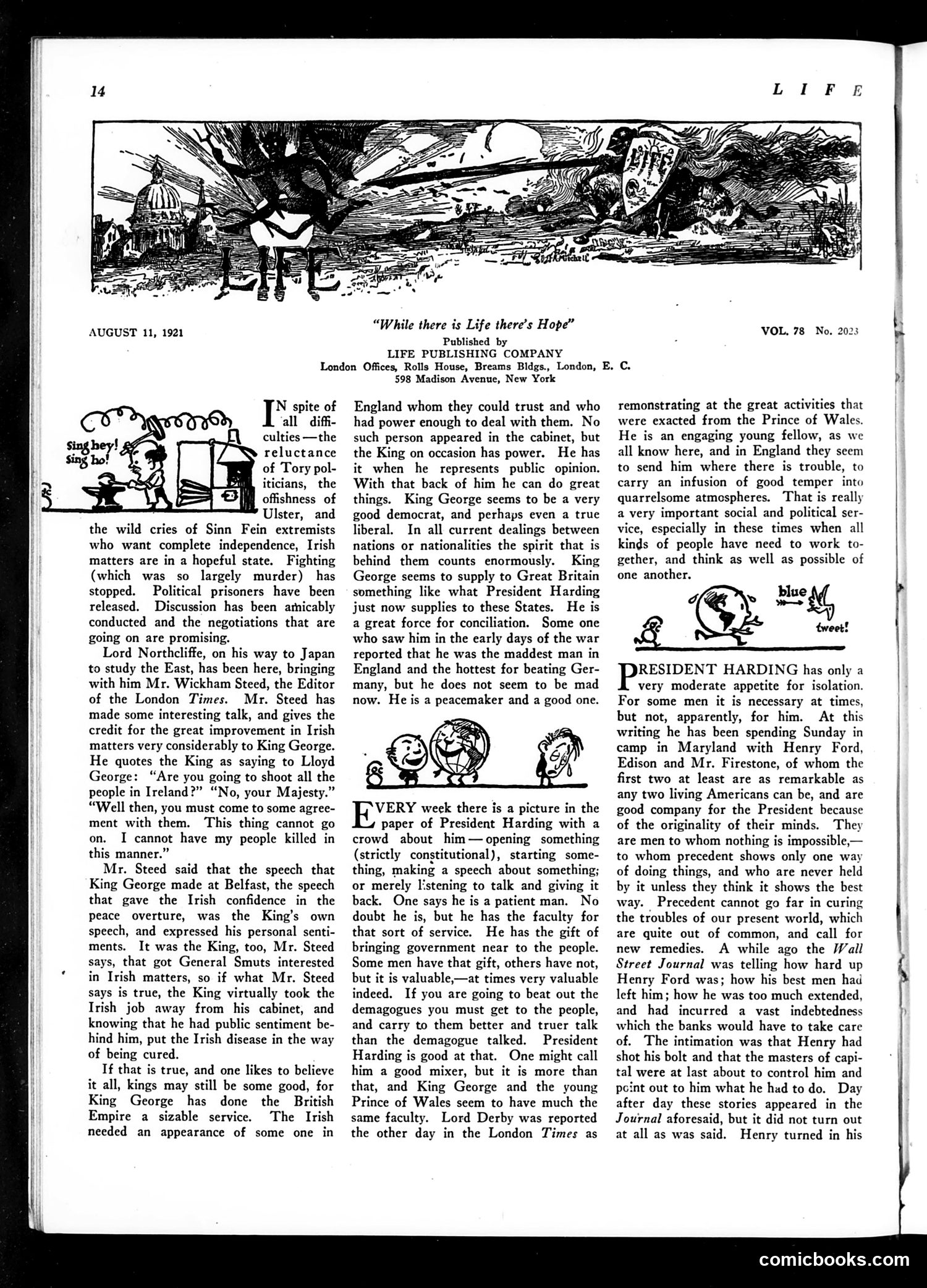
This page contains editorial commentary rather than cartoons. The main illustrated elements are small decorative vignettes accompanying text about contemporary political figures. The article discusses **King George V** and his relationship with Irish independence movements, referencing **Sinn Féin** and political prisoners. It praises the King's democratic character and mentions Lord Northcliffe's (newspaper publisher) involvement in Irish negotiations. The piece also addresses **President Harding's** modest public profile compared to predecessors, noting his low-key personality and preference for private company over public spectacle. The text contrasts this favorably with Henry Ford's public prominence. The overall tone is supportive of both leaders' restraint and pragmatism in handling complex political situations during the post-WWI era.
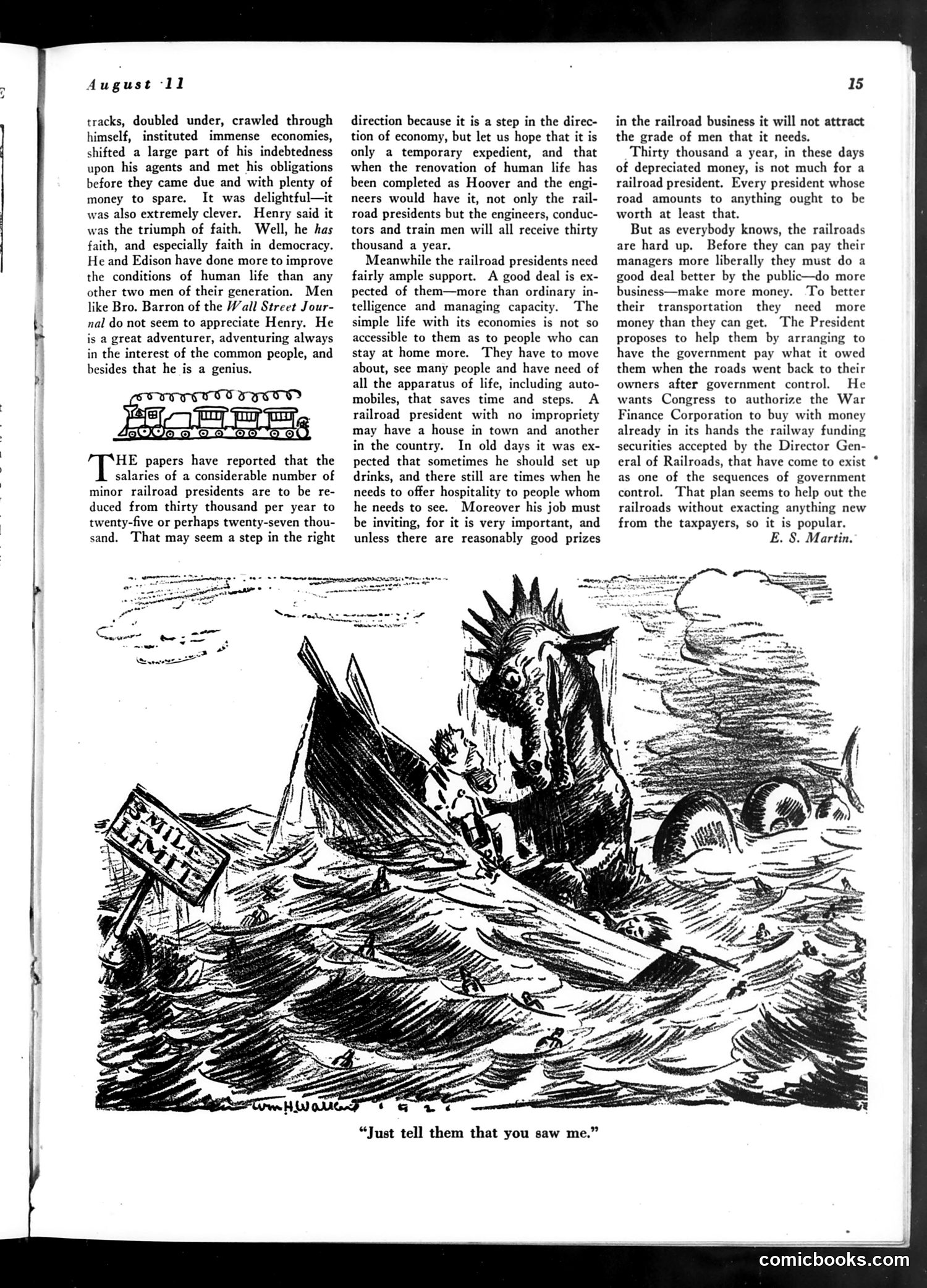
This 1911 *Life* magazine page contains editorial commentary on railroad economics and a political cartoon. **The text** praises Henry Ford (implied by references to his economic innovations and association with Edison) while defending railroad presidents' high salaries ($30,000/year). The author argues they need substantial compensation to attract capable managers, despite economic pressures forcing salary cuts. **The cartoon** depicts a disheveled horse emerging from turbulent waters labeled "PANIC," speaking the caption "Just tell them that you saw me." This illustrates the railroad industry in crisis—the horse represents the railroads themselves, nearly drowned by economic panic. The message suggests the industry is struggling and barely surviving. **The satire's point**: There's tension between the text's defense of executive compensation and the cartoon's depiction of industry distress. The page argues railroads need money and good management while the visual evidence shows them failing—a contradiction highlighting the absurdity of prioritizing executive salaries during economic crisis.
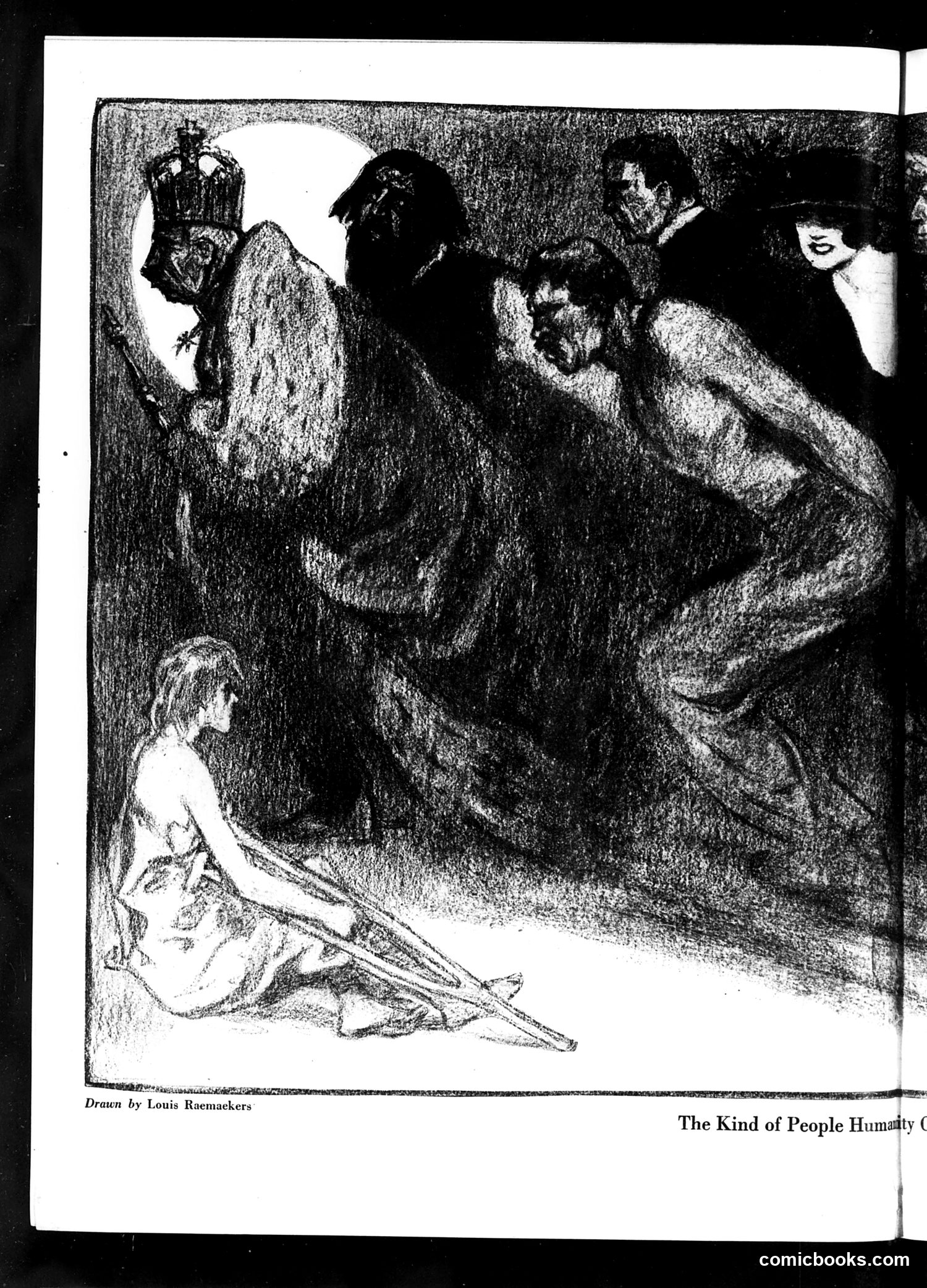
This is a satirical drawing by Louis Raemaekers titled "The Kind of People Humanity..." The sketch depicts a scene of apparent moral degradation or social commentary. A nude or partially-clothed figure sits alone in the foreground, while in the background, several figures in formal dress (including what appears to be someone wearing a crown) engage in shadowy, ambiguous activities. The composition suggests Raemaekers is contrasting innocence or vulnerability (the solitary figure) against corruption or depravity represented by the powerful figures behind. The ornate crown visible suggests royalty or authority is implicated in whatever moral failing the cartoon critiques. Without the complete title or publication date visible, the specific political or social target remains unclear, though Raemaekers was known for anti-war and anti-establishment commentary.
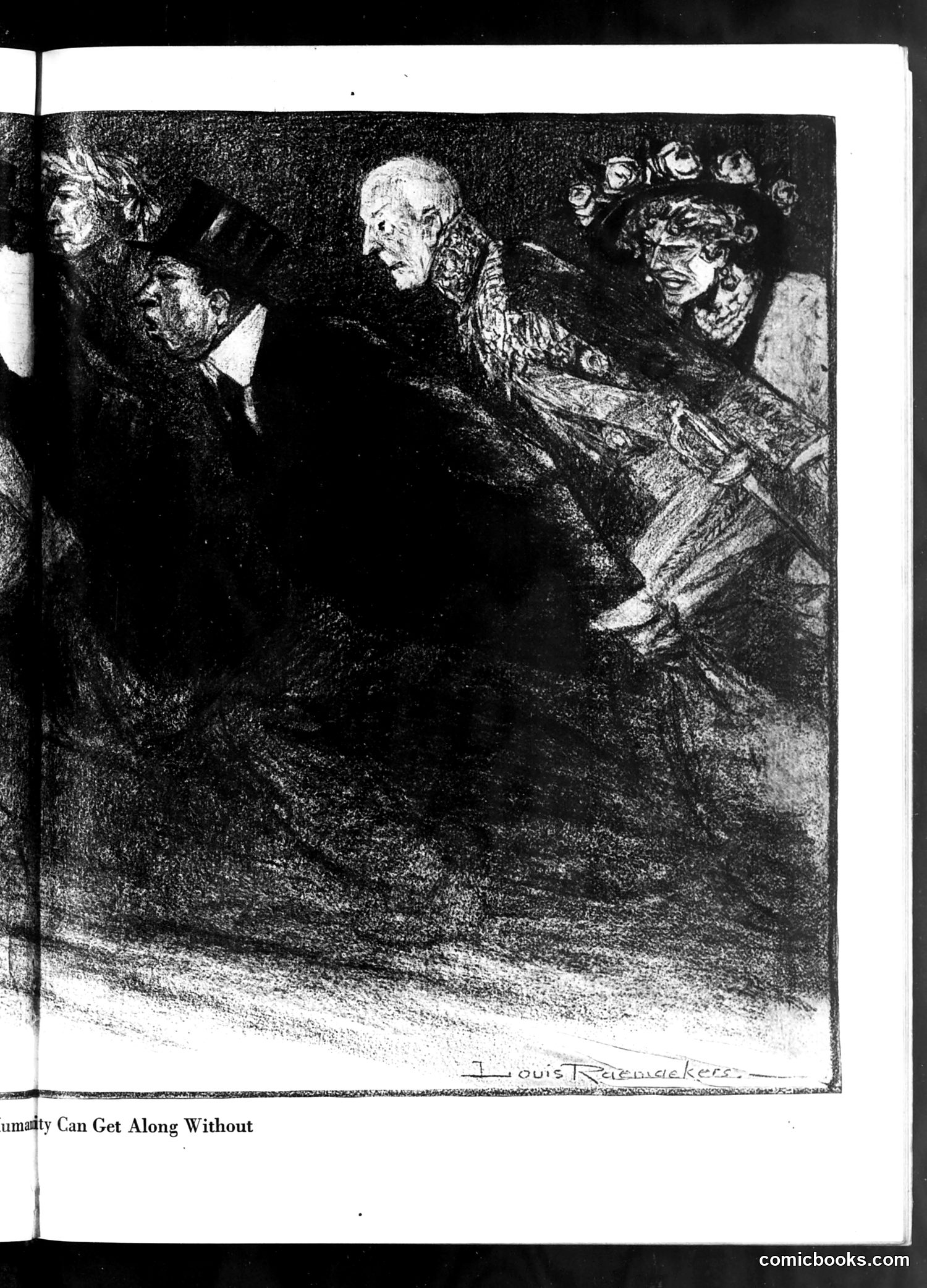
This appears to be a dark, expressionistic etching or print signed "Louis Remmaekers" (a Belgian political cartoonist). The image depicts several grotesque figures in shadow—caricatured faces showing distress or anguish, rendered in heavy cross-hatching. The partial text at bottom reads "umanity Can Get Along Without" (likely "Humanity Can Get Along Without"), suggesting social satire about something society deems unnecessary or harmful. Without the complete caption or full publication date visible, the exact target is unclear. However, given Remmaekers' known work criticizing militarism and social vices, this likely satirizes some contemporary vice, institution, or practice the artist viewed as destructive to human society. The grotesque style emphasizes moral degeneracy of the subject matter.
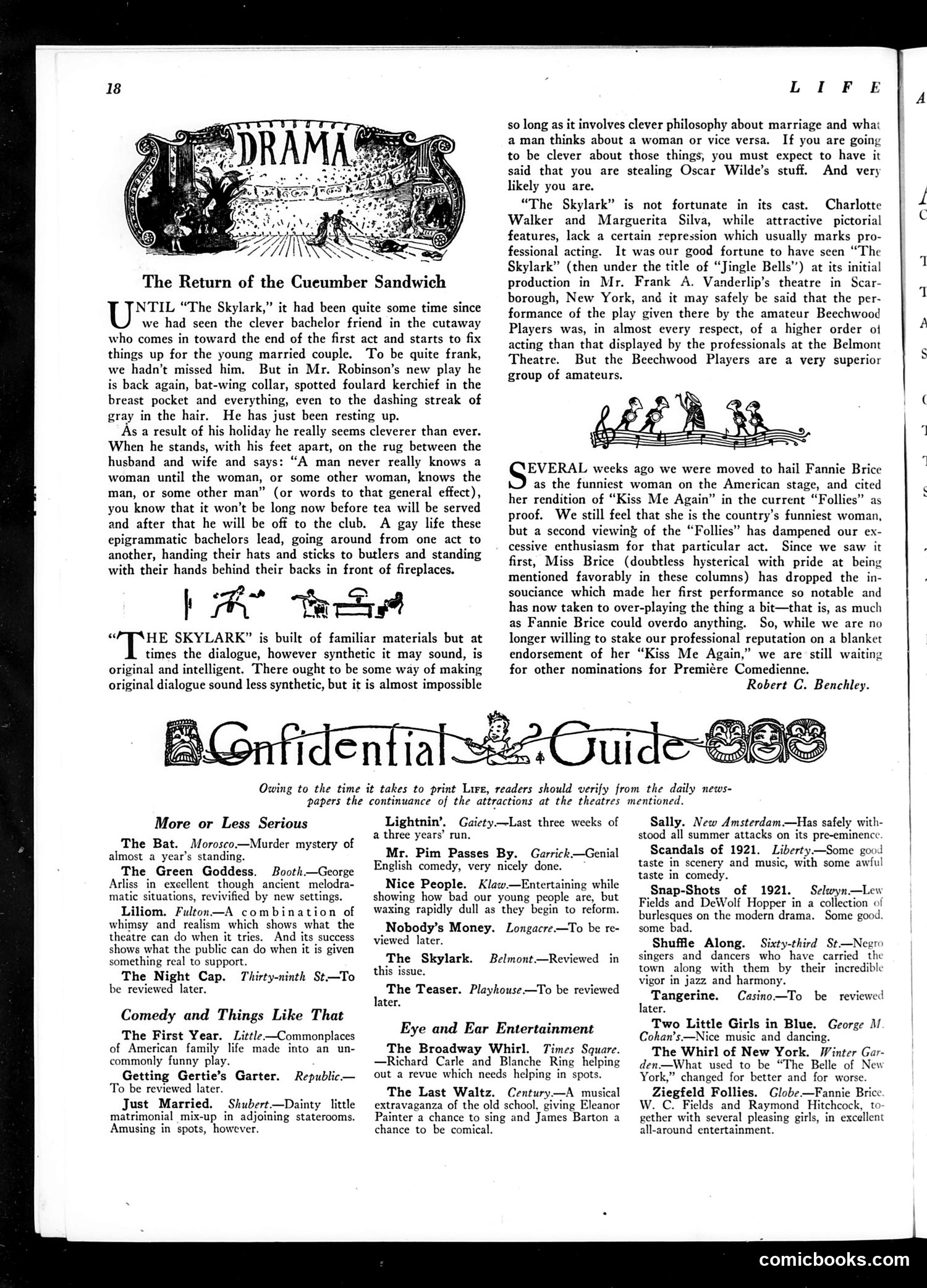
This theater review by Robert C. Benchley (a prominent humorist) mocks a recurring stock character in 1920s comedies: the witty bachelor who appears in the final act to dispense clever marital advice while wearing a bat-wing collar and spotted kerchief. Benchley satirizes how these characters spout pseudo-philosophical quips about marriage—indistinguishable from Oscar Wilde's wit—before exiting to the club. The review critiques the Broadway production of "The Skylark," noting that its professional leads (Charlotte Walker, Marguerita Silva) lack the restraint of *amateur* actors who performed it earlier in Scarborough, New York. Benchley also downgrades his earlier praise of Fannie Brice's comedic timing in the "Follies," suggesting she's begun over-playing her act since receiving his favorable mention. The piece exemplifies Life magazine's satirical theater criticism targeting both predictable dramatic conventions and performers' egos.
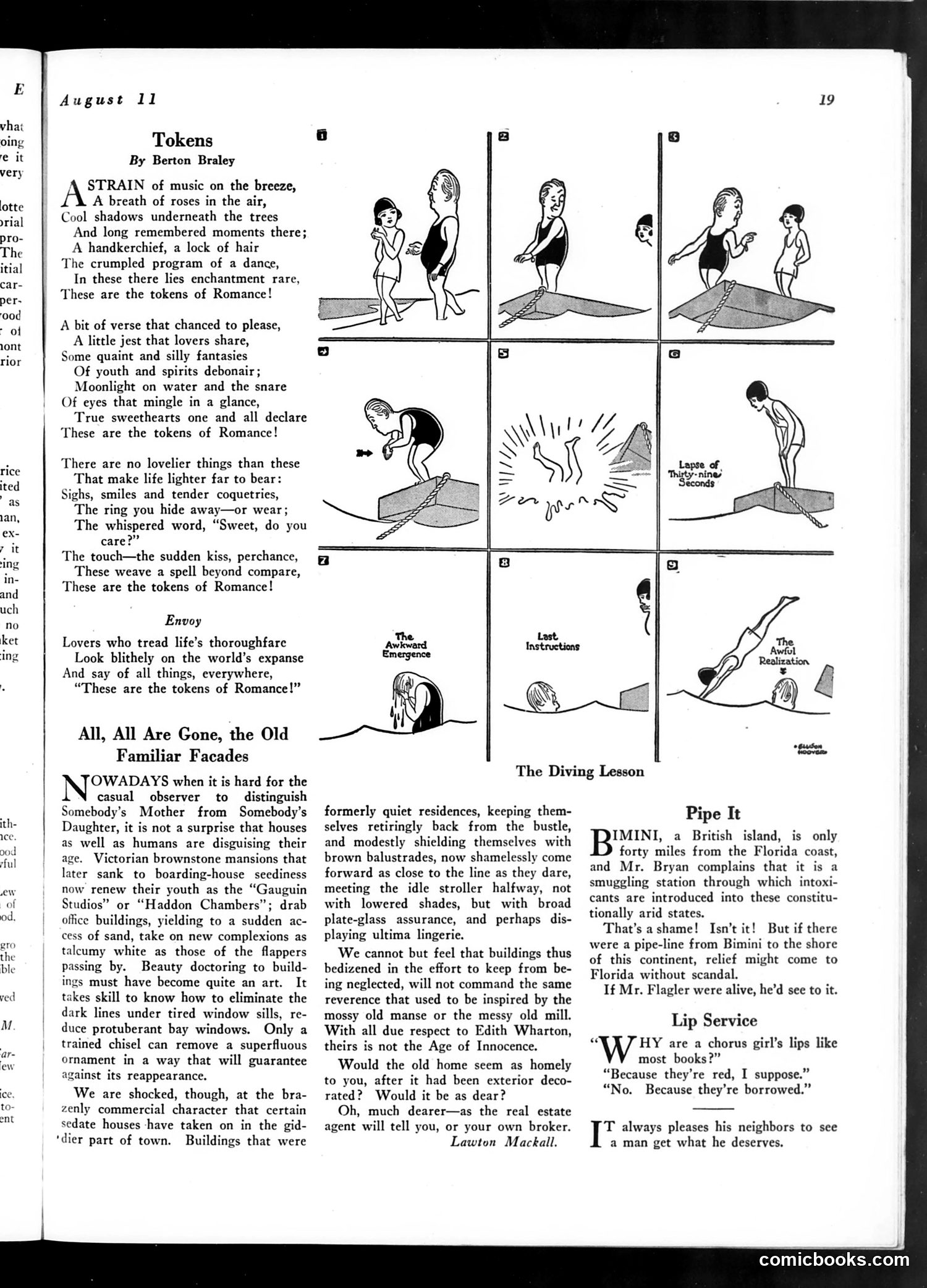
This page contains satirical commentary on 1920s American life alongside comic illustrations and poetry. **"Tokens" (poem by Berton Braley):** A sentimental poem celebrating romantic gestures—letters, locks of hair, handkerchiefs, kisses—as expressions of romance. The accompanying six-panel cartoon illustrates these tokens humorously, showing couples exchanging physical affection and mementos. **"All, All Are Gone":** Social satire mocking the modernization of old Victorian homes. The author criticizes the conversion of respectable brownstone residences into commercial spaces (studios, offices) and their cosmetic "beauty doctoring." The piece laments how dignified old buildings now display window merchandise (lingerie) to attract customers, abandoning their former modest restraint—a commentary on commercialism encroaching on traditional domestic values. **"Pipe It":** Political satire referencing Prohibition-era smuggling. William Jennings Bryan had complained that Bimini (Bahamas) functioned as an illegal liquor pipeline into Florida. The author sarcastically suggests a literal pipeline would solve Florida's "scandal" problem, and references Henry Flagler's development projects, implying infrastructure solutions exist if someone with means pursued them.
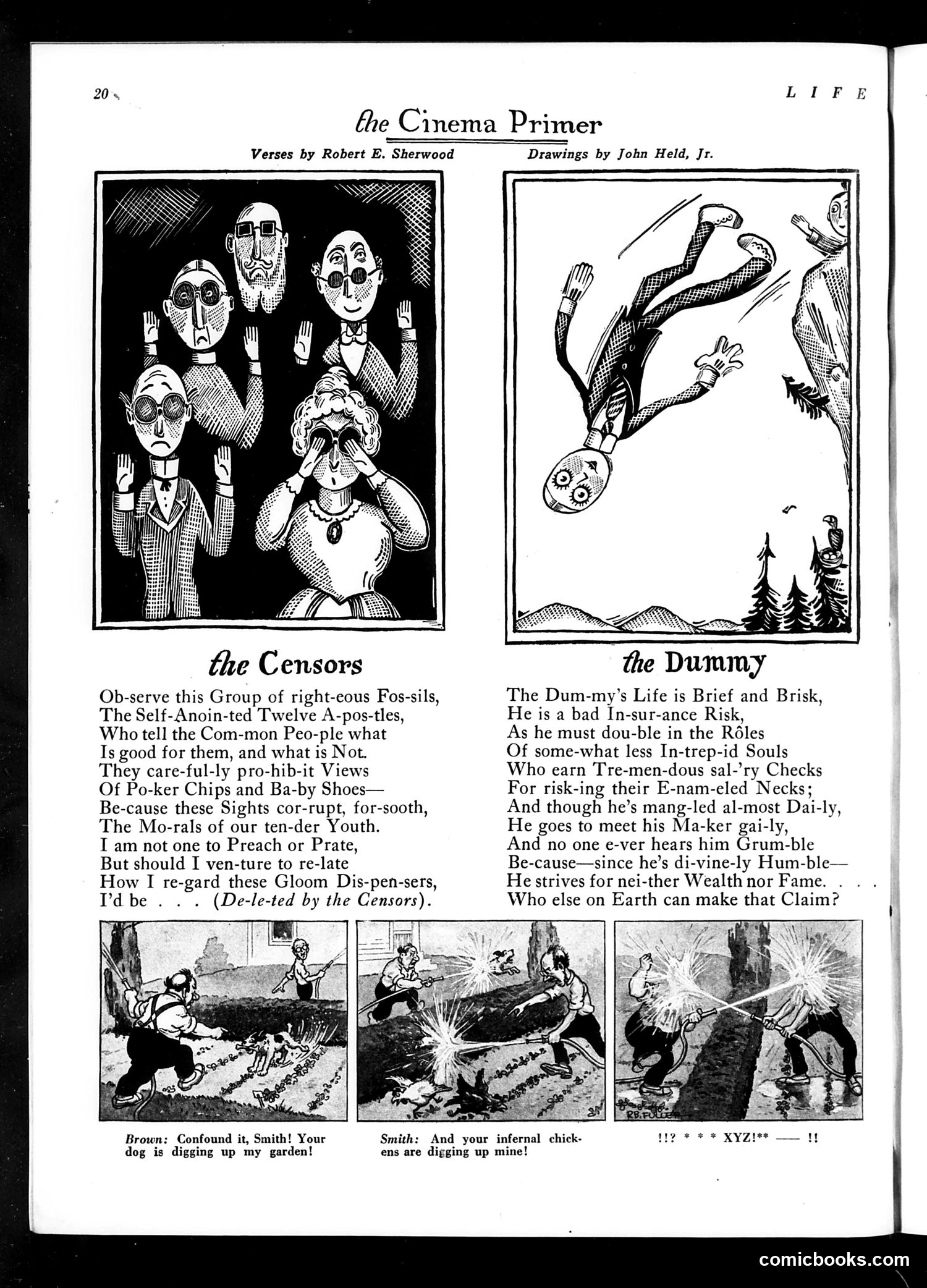
This page satirizes early cinema and film censorship through humorous verses by Robert E. Sherwood with illustrations by John Held, Jr. **"The Censors"** mocks film boards that regulated movie content, portraying them as self-righteous "fossils" who protect youth from corrupting imagery (poker chips, baby shoes). The poem itself gets "deleted by the Censors"—a joke about censorship's absurdity. **"The Dummy"** celebrates stunt doubles in silent films who perform dangerous stunts for low pay and no recognition, yet remain humble and uncomplaining. The irony: they deserve fame more than celebrities. **Bottom comics** show slapstick action typical of silent comedy—two men fighting over their pets damaging gardens, likely illustrating physical comedy's appeal. The page critiques film industry hypocrisy: censors claim moral protection while exploiting vulnerable workers, and celebrates the anonymous craftspeople enabling cinema's thrills.
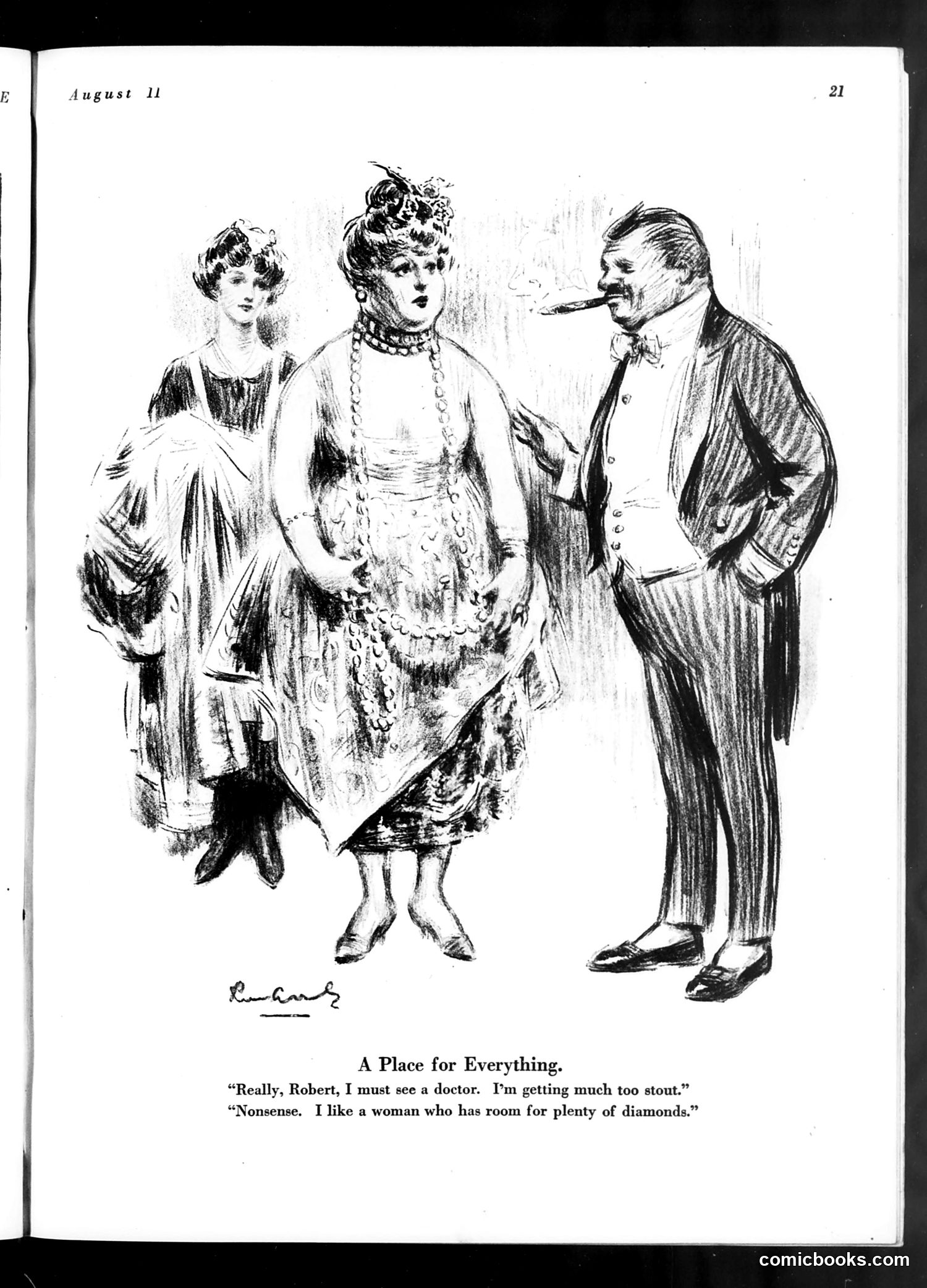
This satirical cartoon depicts a wealthy man (Robert) dismissing his wife's health concerns about weight gain. When she expresses worry about becoming overweight and wanting medical attention, he responds that he actually prefers her larger physique—not out of affection, but because it provides more surface area to display expensive diamonds and jewelry. The joke mocks both the materialism of wealthy society and the commodification of women's bodies as display cases for a husband's wealth. It satirizes how upper-class men valued their wives primarily as ornaments to showcase their financial status and possessions, rather than as individuals with legitimate health concerns. The cartoon critiques the shallow priorities of the Gilded Age elite.
This page contains film reviews from *Life* magazine's "The Silent Drama" column, critiquing contemporary silent films. The reviews are straightforward entertainment criticism rather than political satire. Key reviews include: - **"Moonlight and Honeysuckle"**: Criticizes actress Mary Miles Minter for attempting comedy, arguing beautiful women shouldn't try to be funny—they become "incongruous." - **"The Journey's End"**: Praises director Hugo Ballin's innovative approach: a feature film with virtually no title cards (extremely unusual for silent cinema), told entirely through visual storytelling. - **"The March Hare"**: Dismisses Bebe Daniels' repetitive formula of playing mischievous girls in disguise across all her films. - **Christie Comedies**: Reviews four short comedies, praising actress Vera Steadman as "the best actress appearing in any comedies of any description, anywhere." The tone is witty and sardonic—particularly the aside: "(Take that down, Hawkins; we shall use it at dinner to-night.)"—typical of *Life*'s satirical magazine voice.
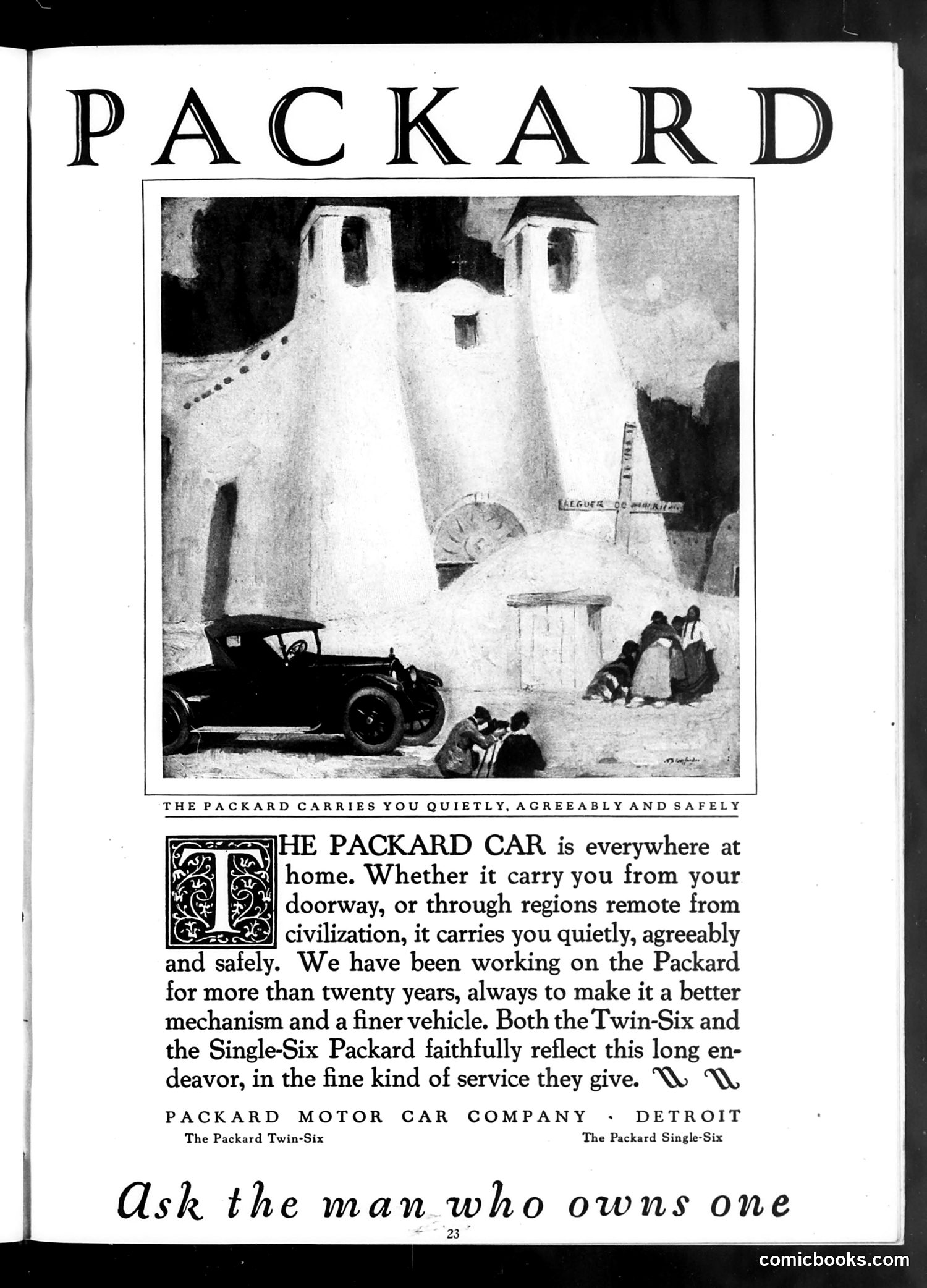
This is a **full-page advertisement**, not satire or political commentary. It's a Packard Motor Car Company advertisement promoting their automobiles. The illustration shows a Packard automobile parked near what appears to be a Southwestern pueblo or adobe structure, with Native American figures visible. The image emphasizes the car's capability to travel through "regions remote from civilization"—suggesting reliability and durability for adventure. The tagline "Ask the man who owns one" was Packard's actual historical advertising slogan, implying owner satisfaction. For modern readers: this represents early automotive advertising's appeal to luxury, pioneering spirit, and social status. The imagery exoticizes Native American settings as destinations for affluent leisure travel—reflecting 1920s attitudes about tourism and American frontier mythology. The advertisement positions the Packard as suitable for both urban use and wilderness exploration, a common marketing strategy of the era.
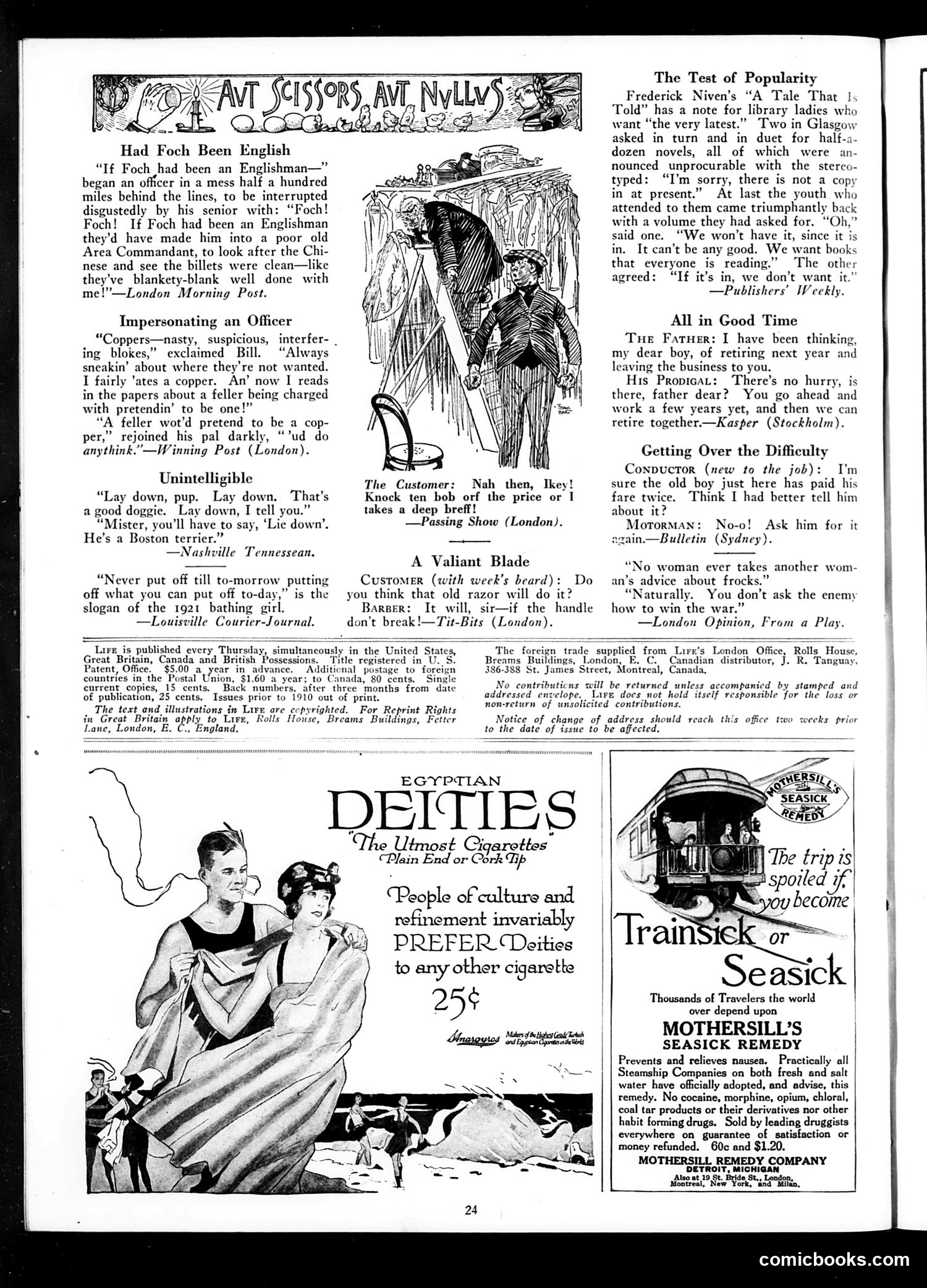
This page from *Life* magazine (a satirical weekly) contains brief humorous anecdotes rather than political cartoons. The jokes reflect post-WWI British and American sensibilities: **Key content:** - Military humor about Field Marshal Foch, a French WWI commander, contrasting how the French and British promoted their generals - Working-class British comedy about police, barbers, and street vendors (reflecting class-conscious humor common to the era) - American observations about Boston terriers, bathing girls, and business culture **The satire targets:** - Military bureaucracy and mediocrity - Class pretension and social hypocrisy - Gender stereotypes (women's vanity about books and fashion) The page also includes period advertisements for Egyptian Deities cigarettes and Mothersill's Seasick Remedy—products now obsolete or notorious (seasickness remedies from that era often contained cocaine or morphine, as the ad awkwardly disclaims). This is primarily a humor/advertising page rather than political commentary, reflecting early 1920s popular entertainment.
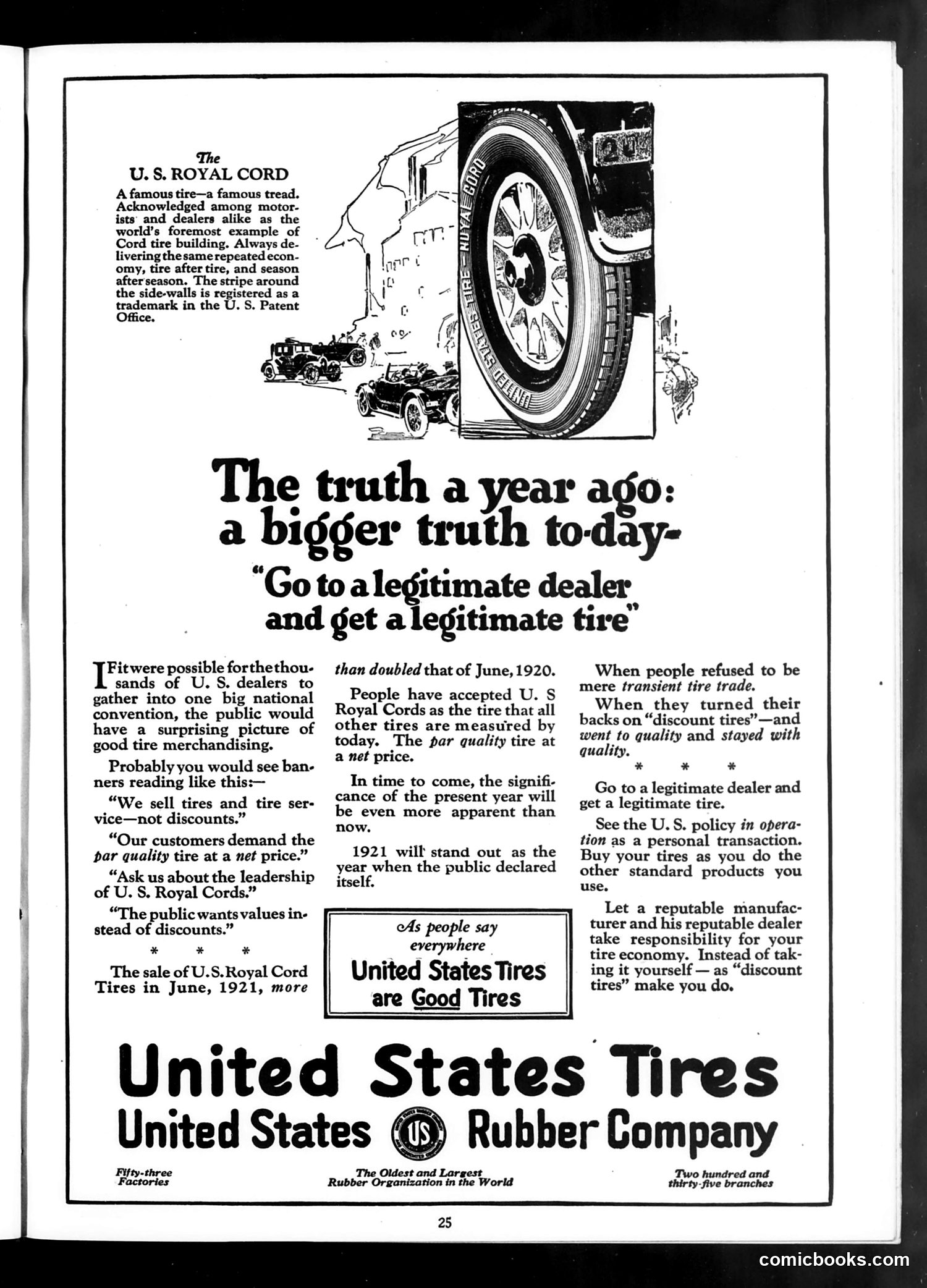
This is primarily a **tire company advertisement**, not political satire. United States Rubber Company promotes its U.S. Royal Cord tires by positioning them as quality products sold through legitimate dealers at fair prices. The ad's central argument addresses a real 1920s market problem: the proliferation of cheap "discount tires" sold through unauthorized channels. The company claims that in June 1921, Royal Cord sales doubled compared to 1920—allegedly because consumers rejected discount alternatives and chose quality instead. The headline's paradox ("truth a year ago" / "bigger truth today") suggests that prior messaging about buying from legitimate dealers has now proven correct through market success. The small car illustrations and large tire image are period-standard advertising design. This reflects genuine tension in 1920s retail: manufacturers trying to maintain distributor networks and prices against discount competition and gray-market sales. There is **no political cartoon or satire present**—only commercial messaging.
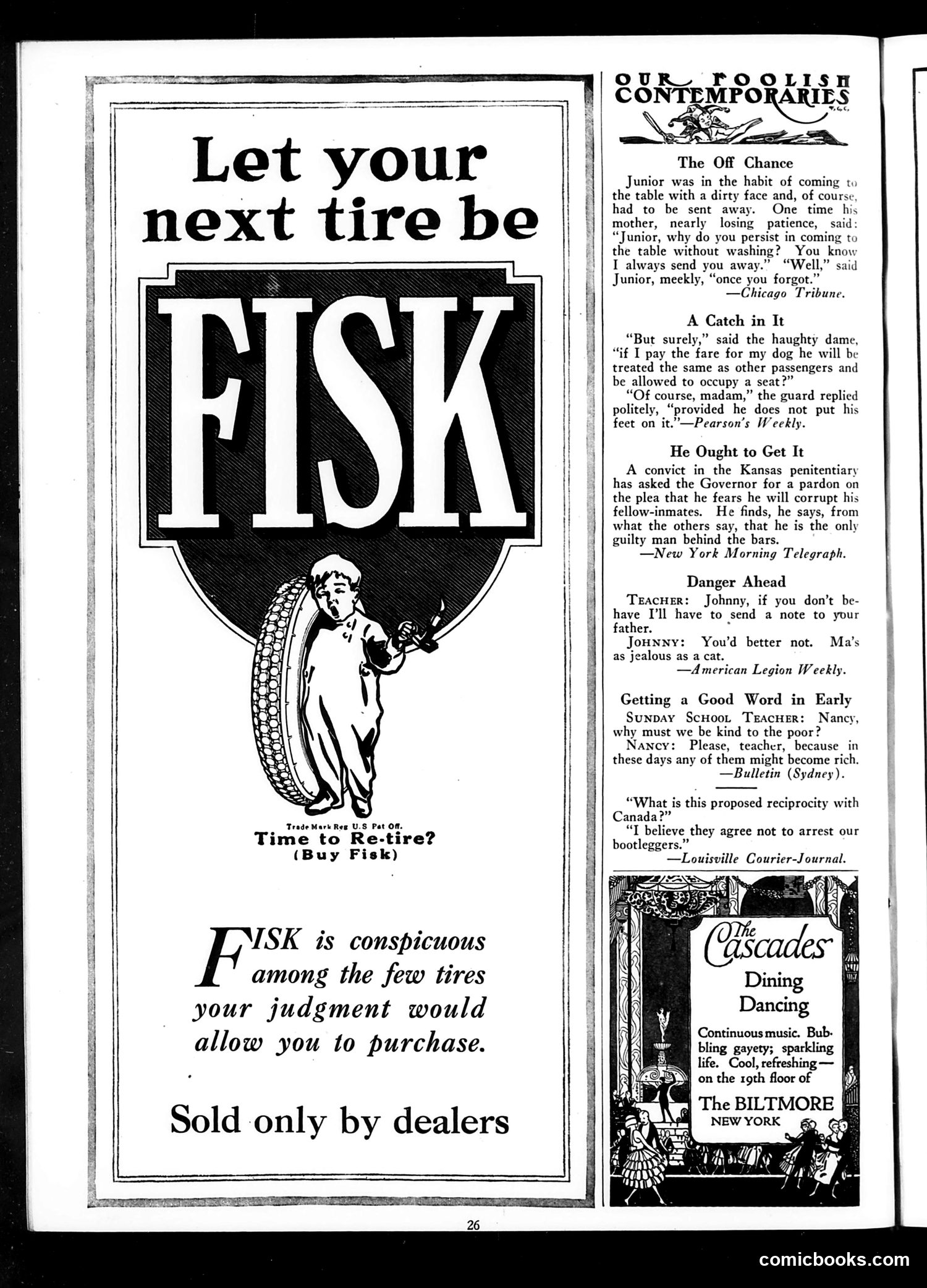
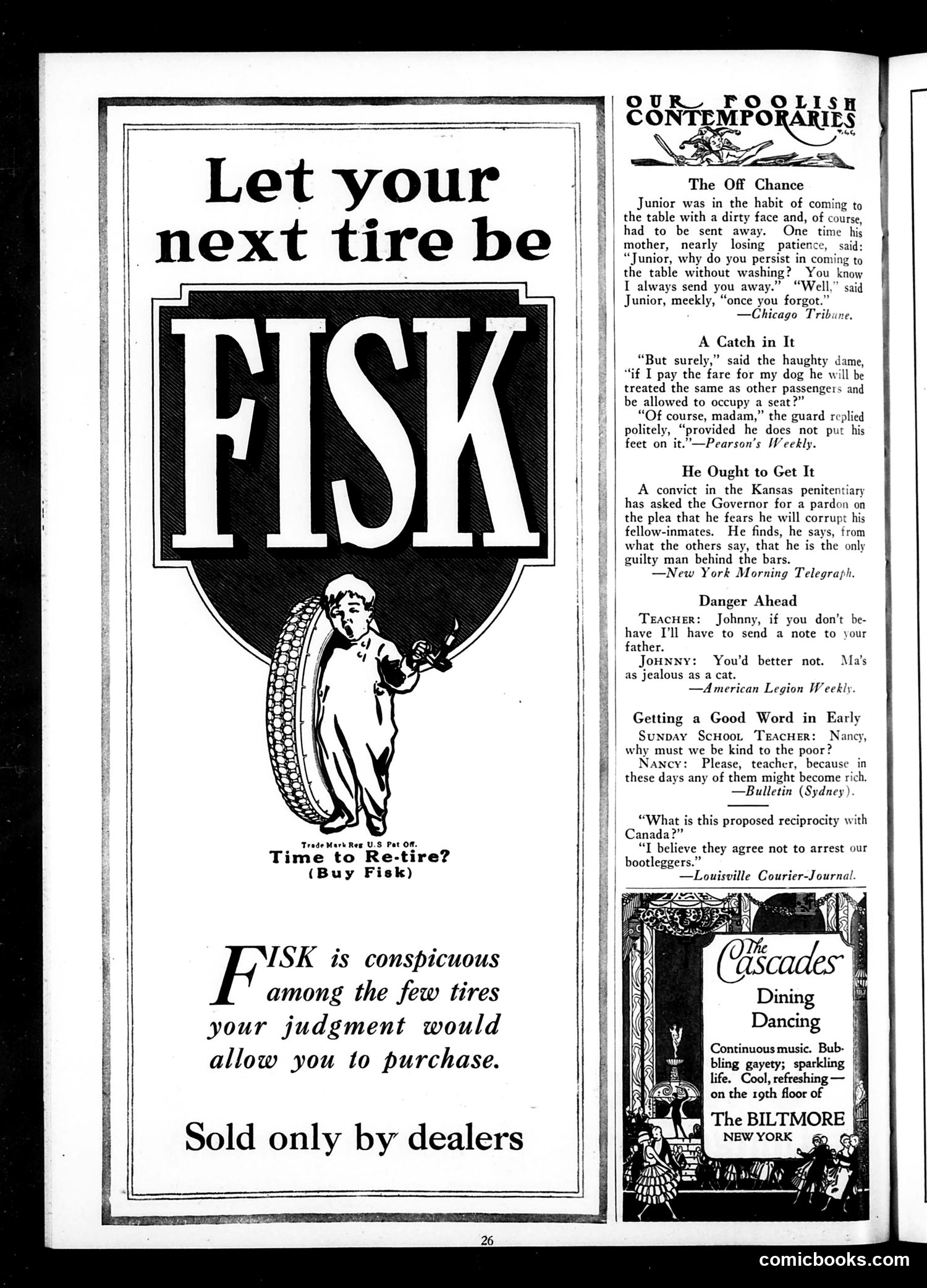
This page combines a **Fisk tire advertisement** (left) with a humor section titled "Our Foolish Contemporaries" (right). The **Fisk ad** features the famous Fisk Tire mascot—a sleepy cherub or baby figure holding a tire. The slogan "Time to Re-tire? (Buy Fisk)" is a pun playing on "retire" (rest/sleep) and "re-tire" (replace your tires). The copy emphasizes Fisk's quality as a premium brand "among the few tires your judgment would allow you to purchase." The **humor section** collects brief anecdotes from various newspapers, satirizing human folly: a child's logic about getting sent from the table unwashed, a dog's legal ambiguities regarding train seats, a convict's paradoxical claim of moral corruption, and children's innocent materialism regarding charity. These are gentle social satires typical of 1920s family magazines. The **Cascades nightclub advertisement** at bottom right promotes dining and dancing at a Manhattan venue. Overall, this is a typical Life magazine page blending commercial advertising with light satirical humor aimed at middle-class readers.
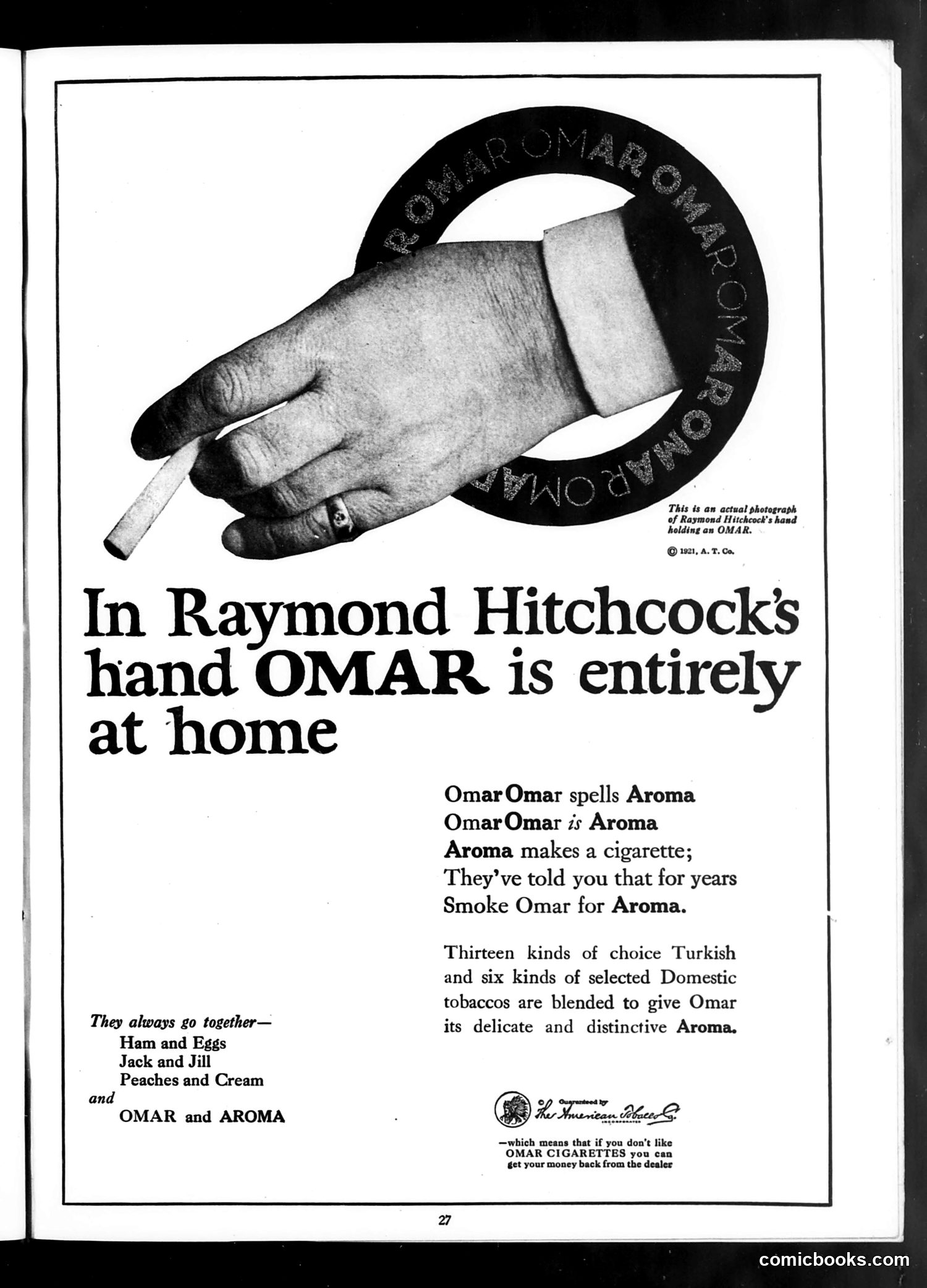
This is a cigarette advertisement, not satire. It features an actual photograph of Raymond Hitchcock (a popular vaudeville performer of the era) holding an Omar cigarette to promote the brand. The ad uses wordplay: "Omar Omar spells Aroma / Omar Omar *is* Aroma," emphasizing the cigarette's distinctive flavor from blended Turkish and domestic tobaccos. The "They always go together" section lists classic pairs (ham and eggs, Jack and Jill, peaches and cream) to suggest Omar and aroma are an inseparable, natural combination. The money-back guarantee at bottom was a common sales tactic of the period to build consumer confidence. Modern readers should note this represents pre-warning-label tobacco marketing, when cigarettes were actively promoted using celebrity endorsements and appealing to lifestyle and taste rather than health concerns.
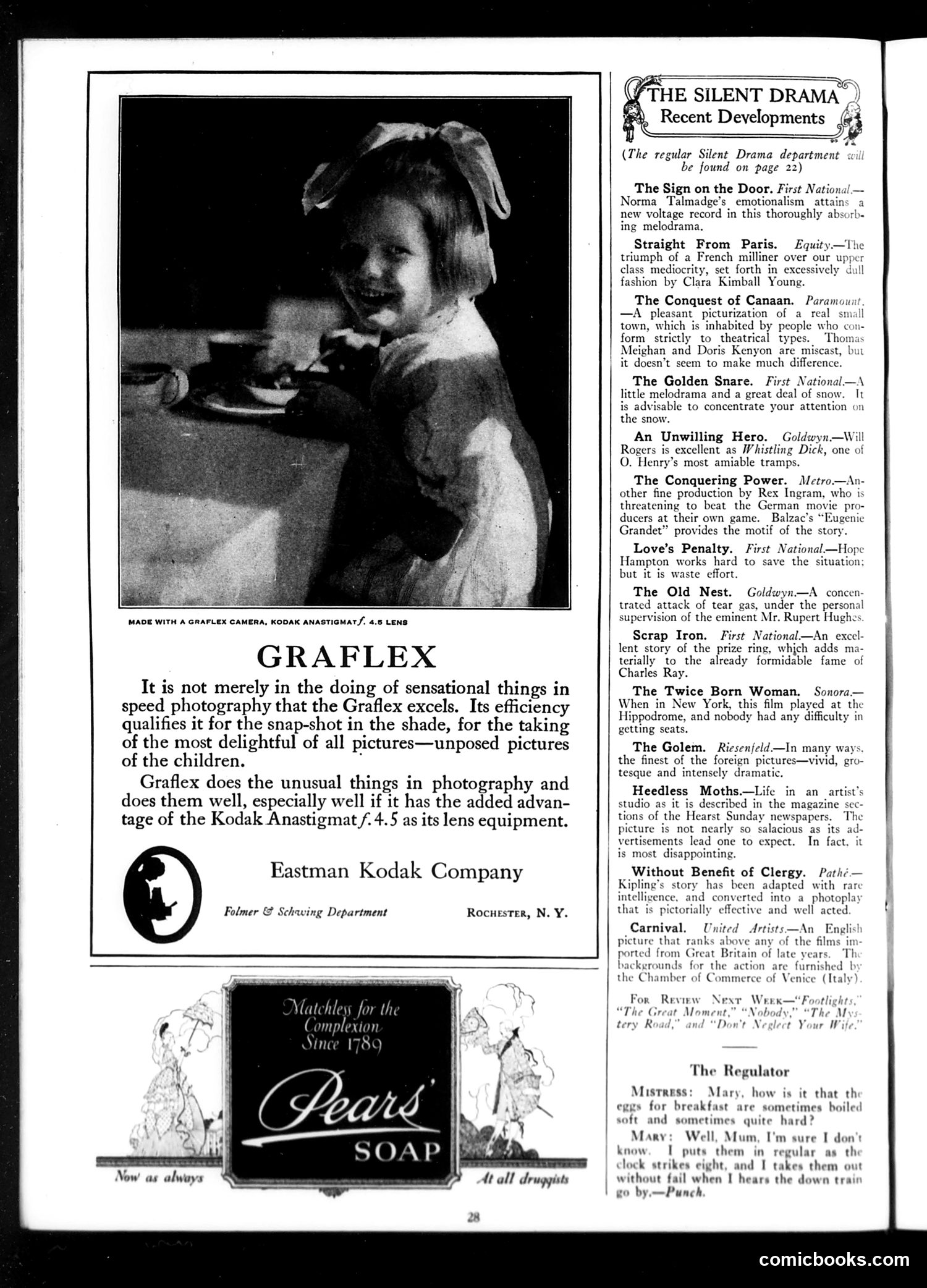
This page is primarily a **film review section** from Life magazine, not a political cartoon. It contains short critiques of silent films then in theatrical release, including titles like *The Sign on the Door* (starring Norma Talmadge) and *The Conquering Power* (directed by Rex Ingram). The page also features **two advertisements**: Graflex cameras (emphasizing their capability for candid children's photography) and Pears Soap (established 1789). At the bottom is **"The Regulator,"** a brief humorous dialogue in which a mistress questions her maid Mary about inconsistent egg-boiling. Mary explains she times them the same way each morning but attributes variations to unmeasurable factors—a gentle joke about domestic service and the unpredictability of household tasks. The content reflects 1920s popular entertainment and consumer culture with no evident political satire.
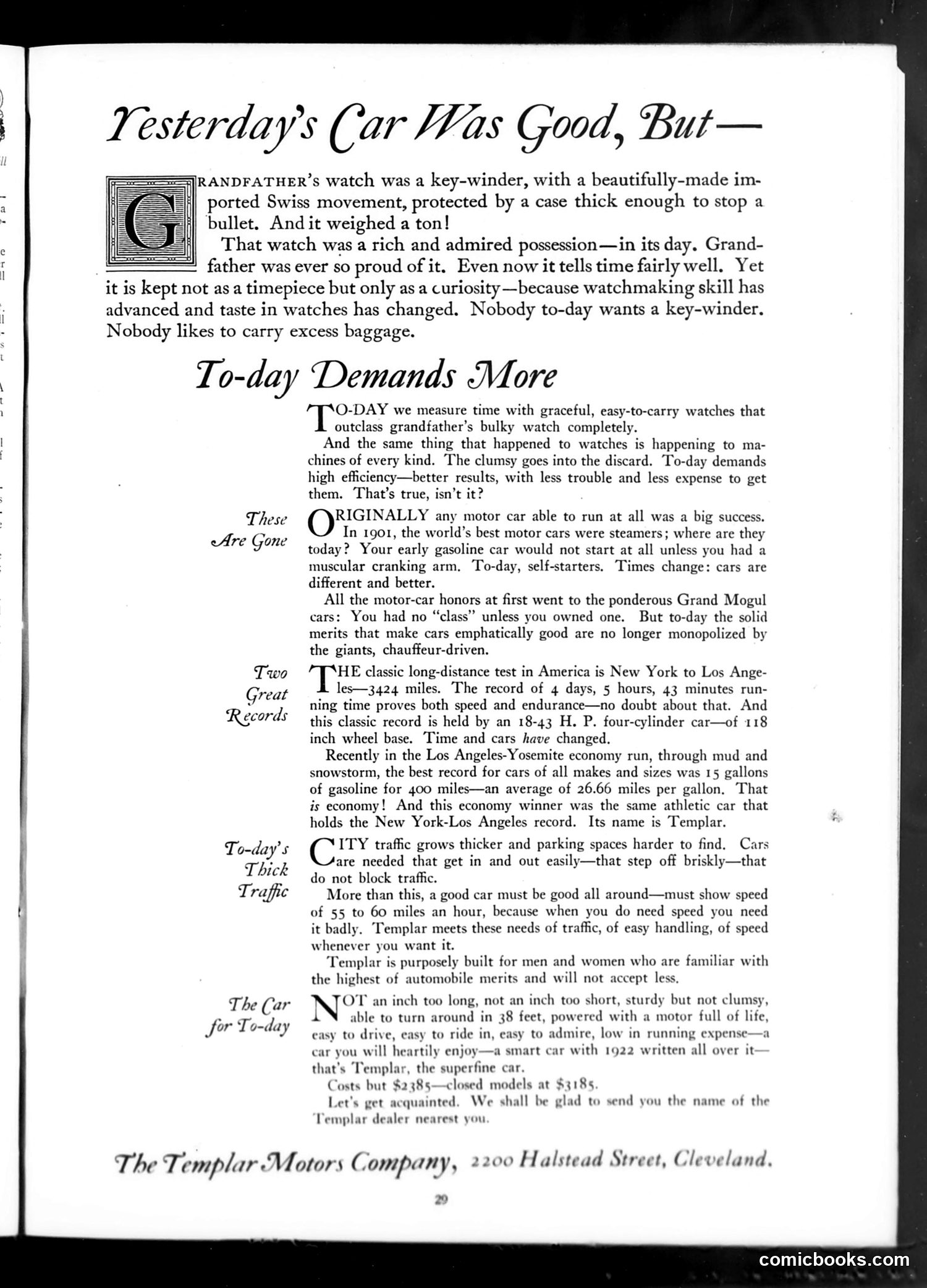
This is primarily a **car advertisement for the Templar Motors Company**, not a political cartoon. The page uses an extended metaphor comparing technological progress. **The Core Argument:** The ad opens with a grandfather's antique Swiss watch—once a prized possession, now merely a curiosity because watchmaking has advanced. The piece then applies this logic to automobiles: just as no one wants cumbersome key-winder watches anymore, outdated car designs (steamers from 1901, hand-crank starters, massive "Grand Mogul" luxury cars) are obsolete. **The Sales Pitch:** Modern times demand efficiency and practicality. The Templar embodies this new standard: it holds distance records, achieves excellent fuel economy (26.66 mpg), navigates city traffic easily, reaches 55-60 mph, and costs a reasonable $2,385 ($3,185 for closed models). **Social Context:** This reflects the 1920s transition from mechanical complexity to user-friendly efficiency. The ad targets educated buyers who appreciate engineering merit over ostentatious luxury—"men and women who are familiar with the highest of automobile merits." The satirical framing isn't about mocking anyone but using gentle obsolescence humor to position the Templar as the inevitable modern choice.
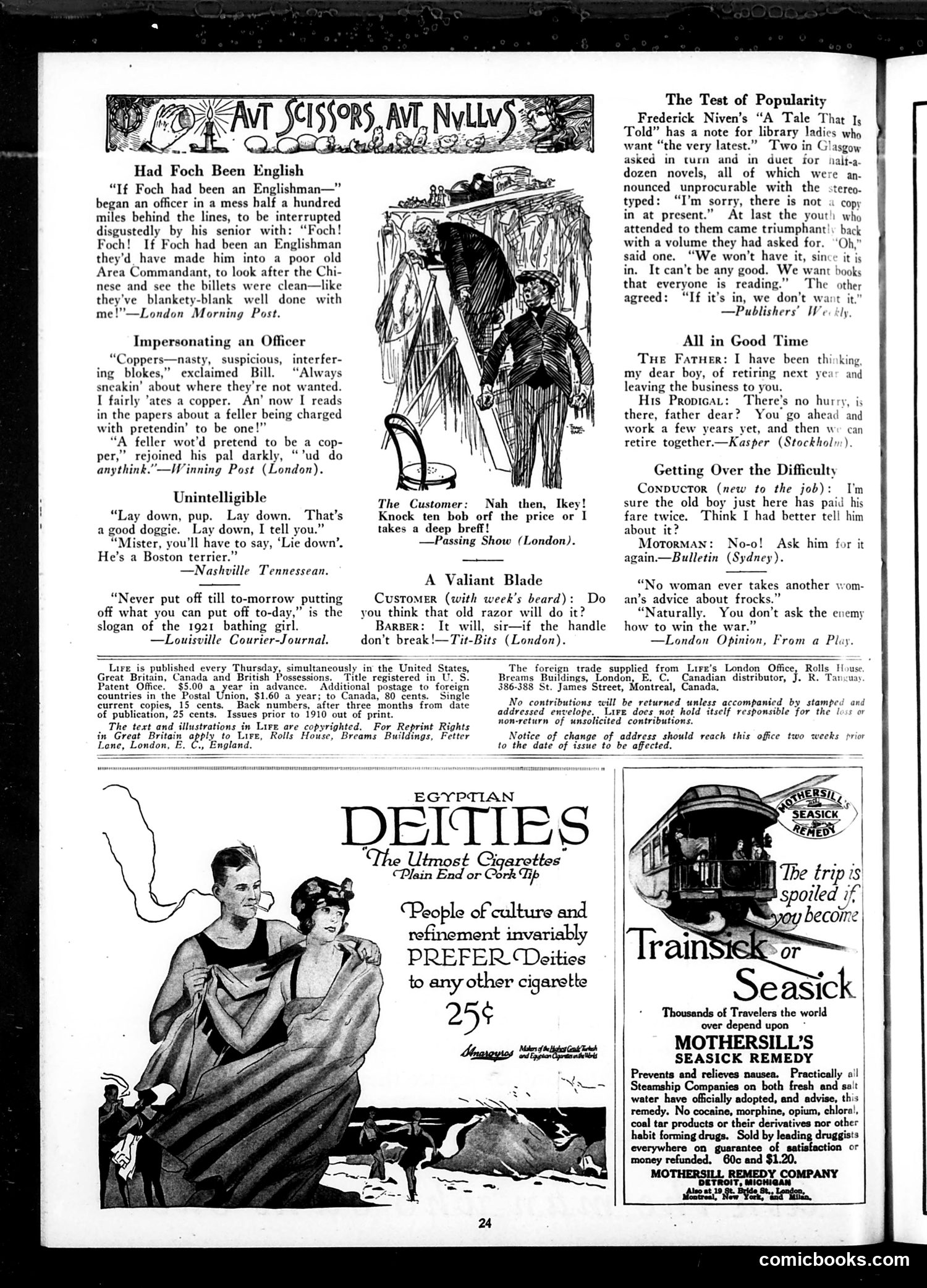
This page contains **humorous short anecdotes** rather than political cartoons. The jokes satirize early 1920s British and American society: **"Had Foch Been English"** mocks British military bureaucracy—Marshal Foch (French WWI commander) would have been wasted in an administrative desk job rather than active command. **"Impersonating an Officer"** and other brief jokes satirize contemporary concerns: police suspicion of imposters, language barriers (Boston terriers understanding only American English), and social anxieties about fraud. **"The Test of Popularity"** critiques library patrons' backwards logic—they won't read books *because* they're available, wanting only scarce titles, treating books as status symbols rather than reading material. The page also includes **period advertisements** (Egyptian Deities cigarettes, Mothersill's Seasickness Remedy) reflecting 1920s consumer culture. The humor is gentle, class-conscious satire typical of Life's comedic style—targeting British pomposity, modern absurdities, and human contradiction rather than serious political critique.
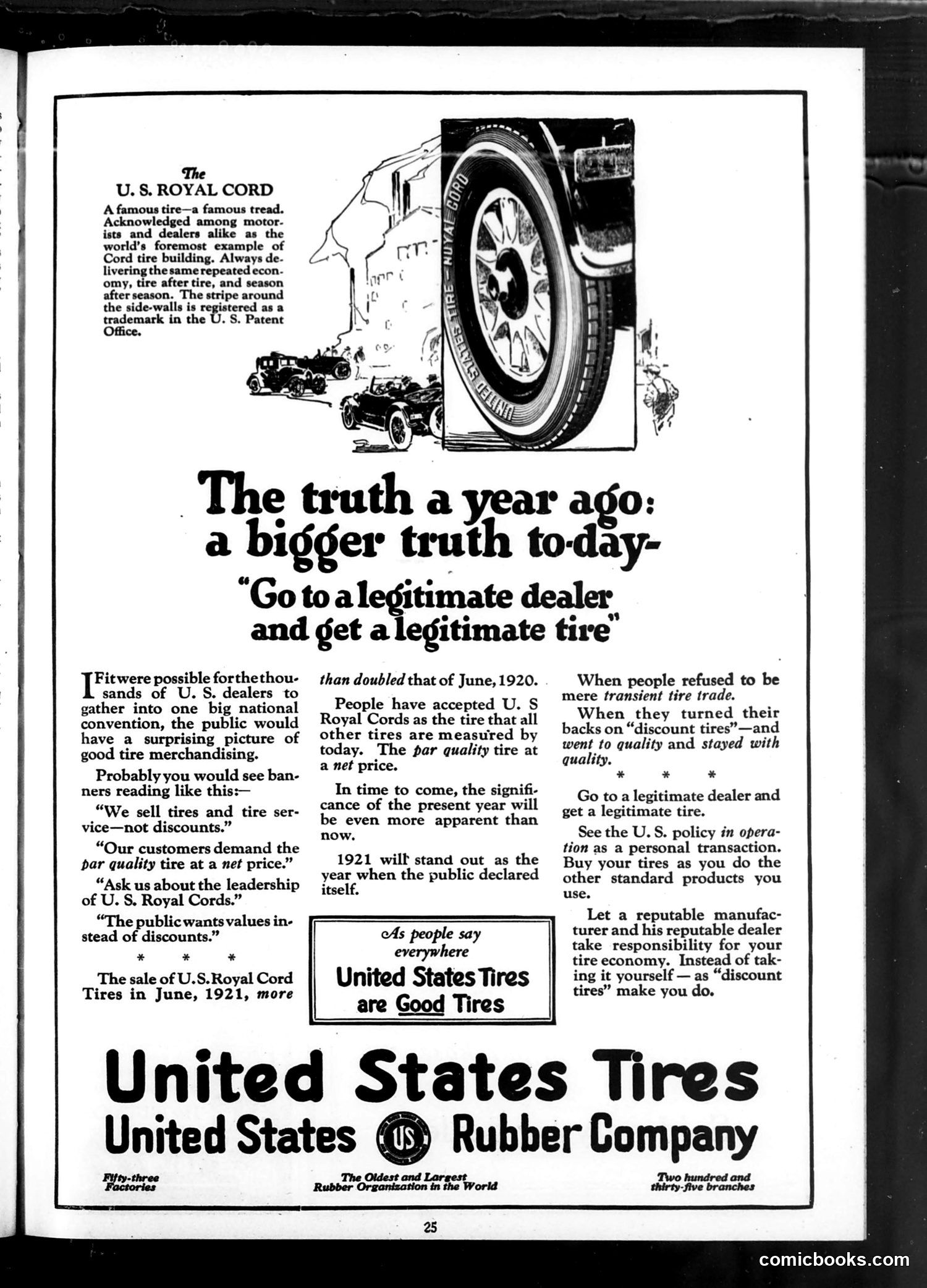
This is primarily **advertising copy**, not satire. United States Tires promotes the U.S. Royal Cord tire by positioning quality products sold through legitimate dealers against cheap "discount tires." The message reflects post-WWI consumer anxieties: the ad warns against bargain tires, framing them as false economy. It claims 1921 marks a turning point when consumers rejected discount merchandise and embraced trusted brands and reputable dealers instead—positioning quality as moral choice, not luxury. The small illustrations show vintage automobiles and a tire cross-section, emphasizing the product's superior construction. The repeated slogan "Go to a legitimate dealer and get a legitimate tire" suggests discount tires were widely sold through questionable channels, a problem the company frames as consumers' responsibility to resist. This reflects 1920s consumer culture emerging after wartime shortages, when brand reputation became a selling strategy.
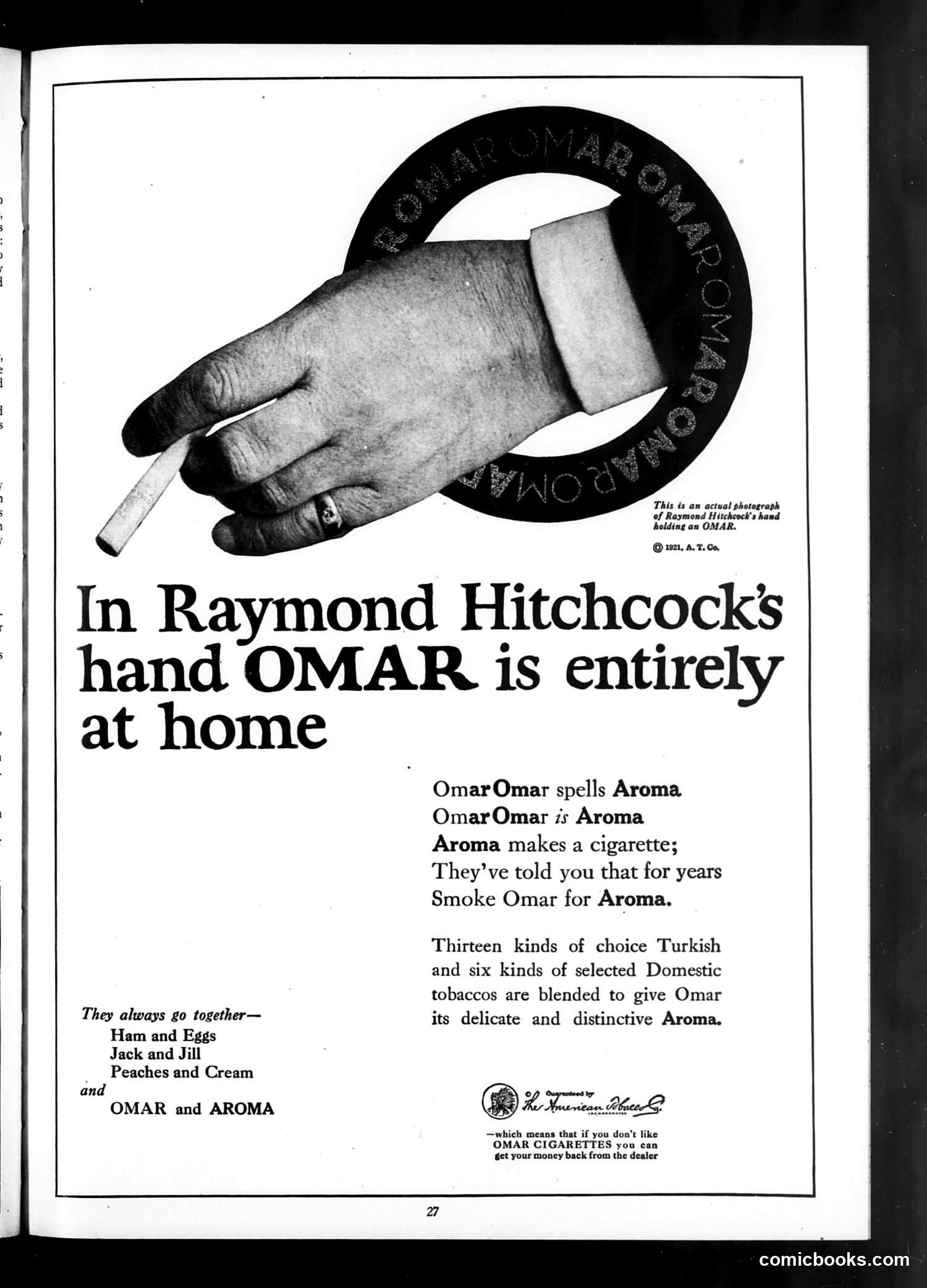
This is a **cigarette advertisement**, not political satire. It features Raymond Hitchcock, an American stage actor and comedian popular in the 1920s, endorsing Omar cigarettes. The ad uses wordplay: "Omar Omar spells Aroma / Omar Omar *is* Aroma," emphasizing the cigarette's supposedly distinctive scent from its blend of Turkish and domestic tobaccos. The photograph of Hitchcock's hand holding the cigarette serves as celebrity endorsement—his appearance lends prestige to the product. The pairing device ("Ham and Eggs, Jack and Jill, Peaches and Cream, and OMAR and AROMA") presents complementary things that "always go together." The money-back guarantee at bottom was a common marketing tactic of the era, suggesting consumer confidence. This reflects early-20th-century advertising practices: celebrity endorsement, lifestyle association, and product differentiation through claimed sensory qualities. Modern readers should note the frank cigarette promotion—advertising tobacco to the general public was entirely legal and common in 1921.
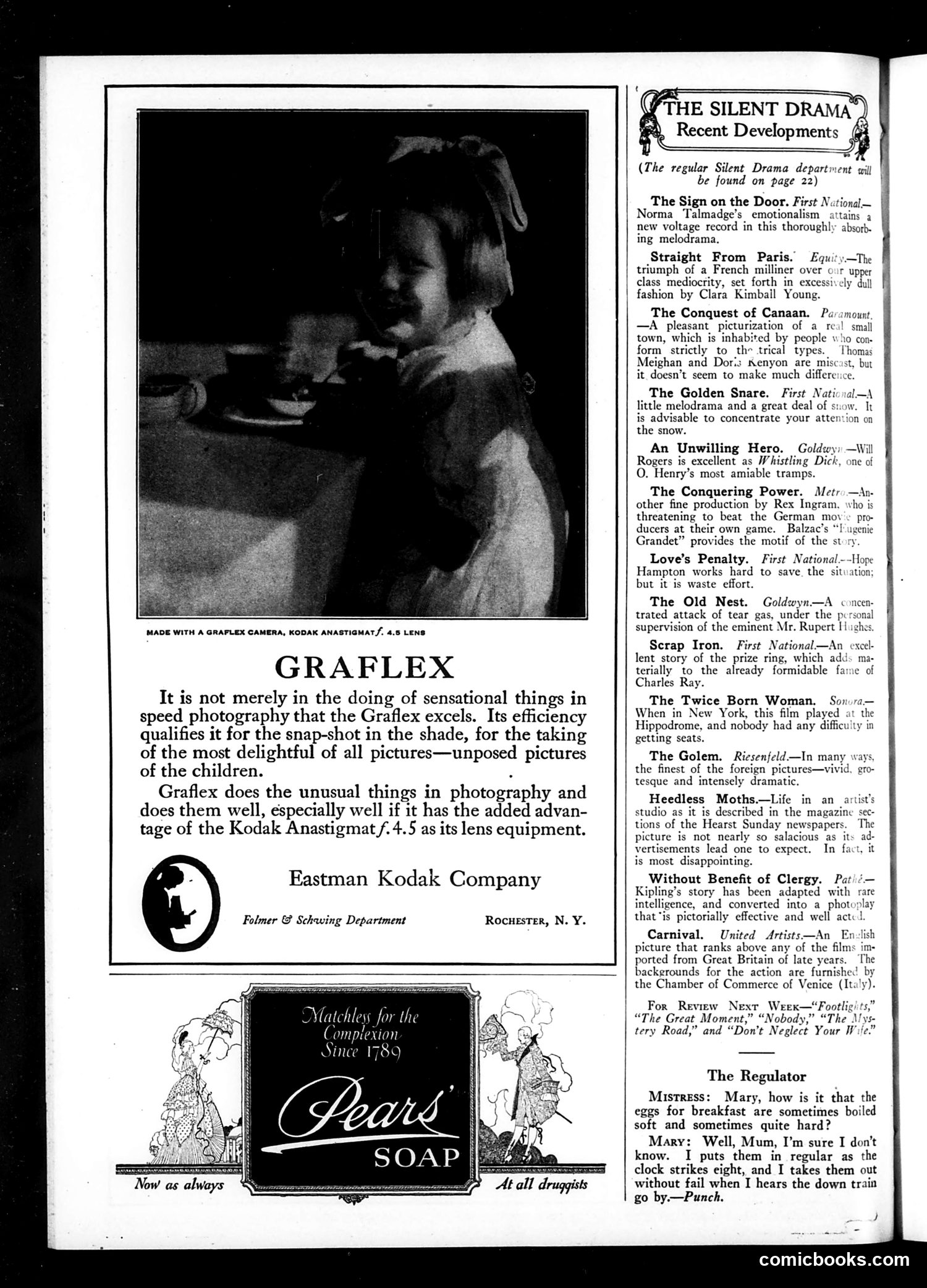
This page is primarily **advertising and entertainment reviews**, not political satire. The left side features a Graflex camera advertisement emphasizing its capability for candid photography of children. The right side contains "The Silent Drama" — a film review column covering silent movies from 1920s studios (First National, Paramount, Goldwyn, etc.). The reviews discuss now-obscure films and actors like Norma Talmadge and Will Rogers, rating their melodramas and productions. A small humor piece titled "The Regulator" (from *Punch* magazine) jokes about a maid's egg-cooking method: she times eggs by a train whistle rather than properly. **No political commentary or caricature is present.** This is a straightforward entertainment and advertising page typical of *Life* magazine's commercial content, contrasting with its satirical editorial sections found elsewhere in the publication.
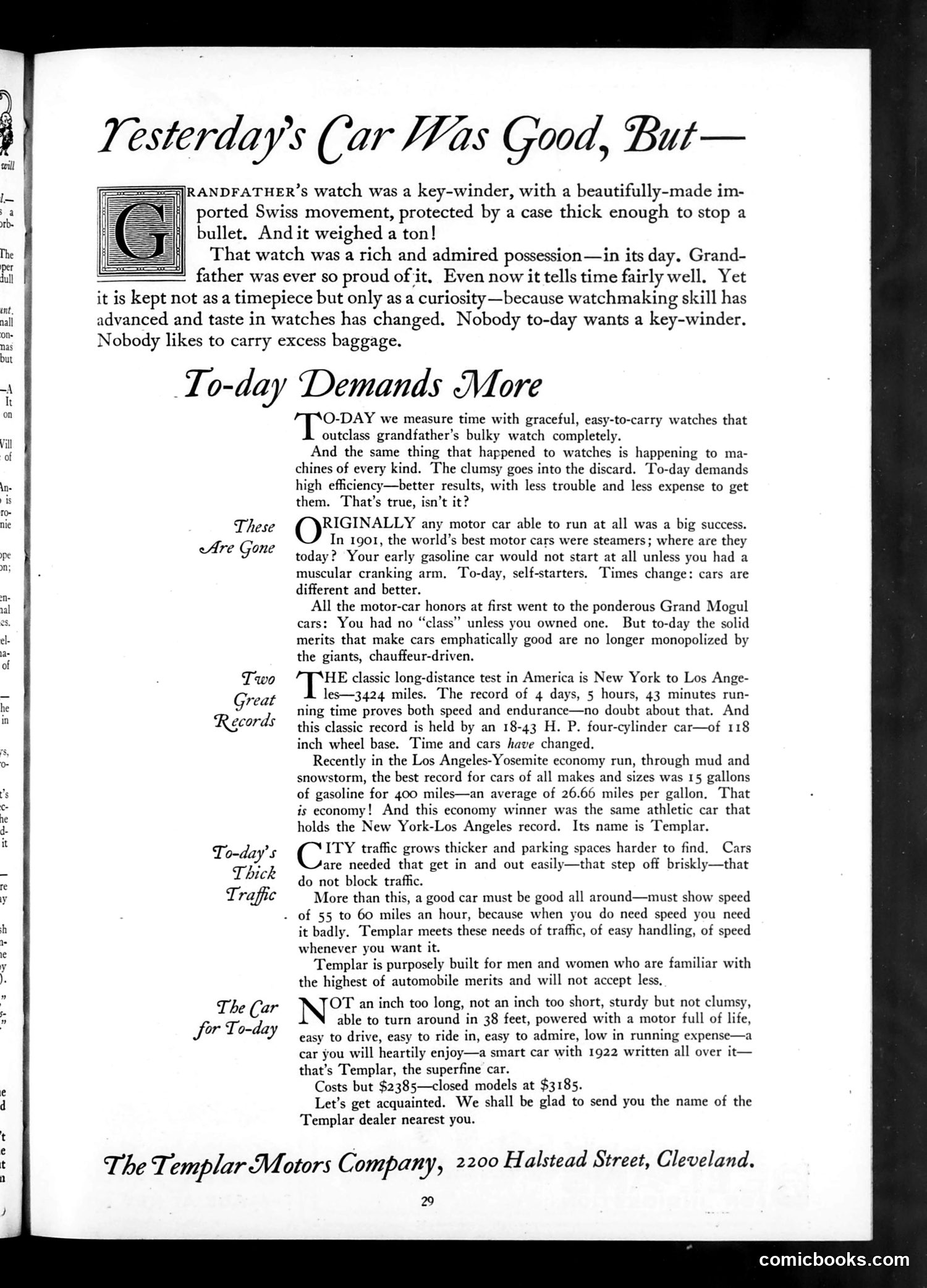
This is **not a political cartoon but a full-page advertisement** for the Templar automobile, circa 1922. The ad uses an extended metaphor: just as grandfather's ornate, heavy pocket watch has become obsolete despite working fine, yesterday's cars are now outdated. The piece argues that modern times demand efficiency, not excess baggage. The ad contrasts old automotive technology (steamers from 1901, hand-crank starters, massive "Grand Mogul" cars requiring chauffeurs) with modern improvements (self-starters, compact designs). It cites performance records—the New York-to-Los Angeles run and a fuel-economy test—to position the Templar as the car for "to-day's thick traffic." The pitch: the Templar is practical, maneuverable, economical, and designed for educated buyers "who will not accept less." Priced at $2,385, it represents progress and modernity rather than ostentatious wealth. The message reflects 1920s optimism about technological advancement and the democratization of automobiles.
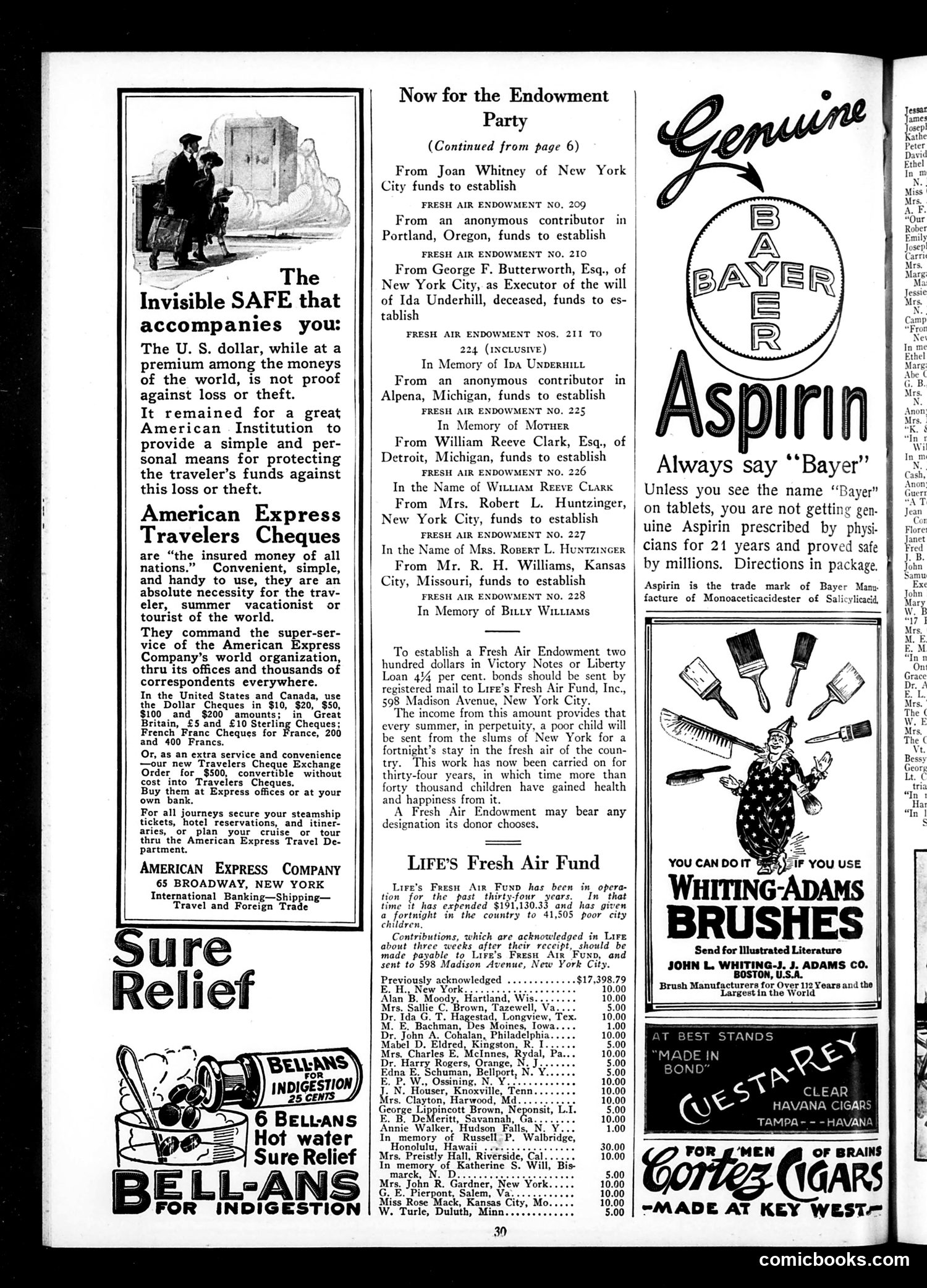
This page is primarily **advertisements and charitable announcements**, not political cartoons or satire. The left side features ads for American Express Travelers Cheques (emphasizing financial security for travelers) and Bellans antacid for indigestion. The right side advertises Genuine Bayer Aspirin, Whiting-Adams brushes, and cigars. The main editorial content concerns **Life Magazine's Fresh Air Fund**—a charity providing poor urban children respite in the countryside. The text lists donors and endowments (named funds providing ongoing support). This reflects early-20th-century Progressive Era charity work, addressing urban poverty and poor children's health. The repeated phrase "Fresh Air Endowment" indicates donors could create named perpetual funds; contributions went to the Fund's 34-year operation, which had sent 41,505 children to the country by publication date. The page demonstrates how magazines mixed editorial causes with commercial advertising to fund their operations.
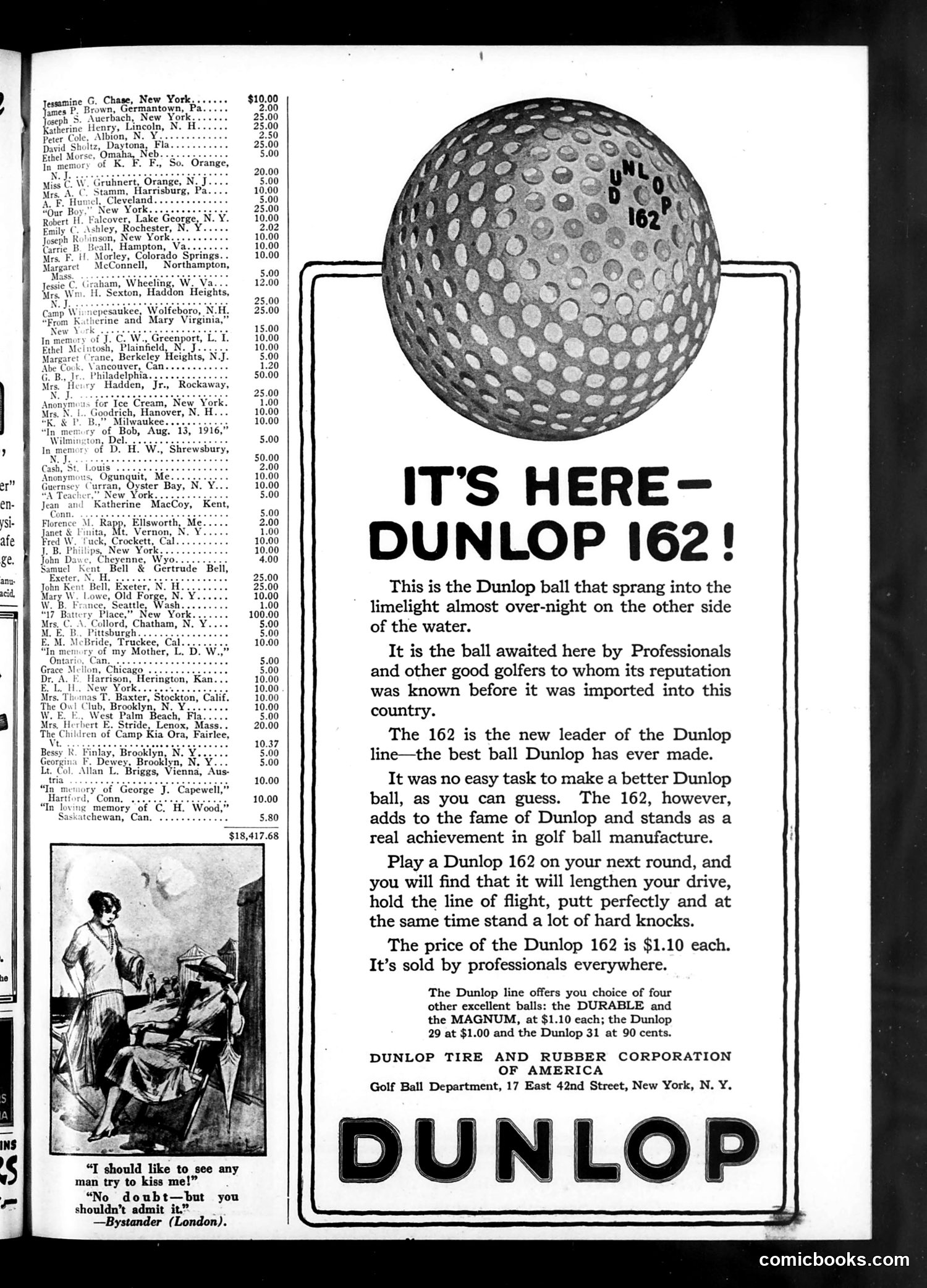
This page is primarily a **commercial advertisement** for Dunlop golf balls, not political satire. The main content promotes the new Dunlop 162 model, marketed as superior to previous Dunlop balls and already popular in Britain ("the other side of the water"). The left side lists charitable donations to Life magazine, totaling $18,417.68. Below that is a small cartoon captioned with dialogue from the *Bystander* (a British publication): a woman says "I should like to see any man try to kiss me!" and a man replies "No doubt—but you shouldn't admit it." This is mild romantic humor, typical of period magazines. The advertisement emphasizes the 162's performance (driving distance, flight consistency, putting, durability) and price ($1.10), positioning it as the premium option in Dunlop's product line. No political or satirical content is present on this page.
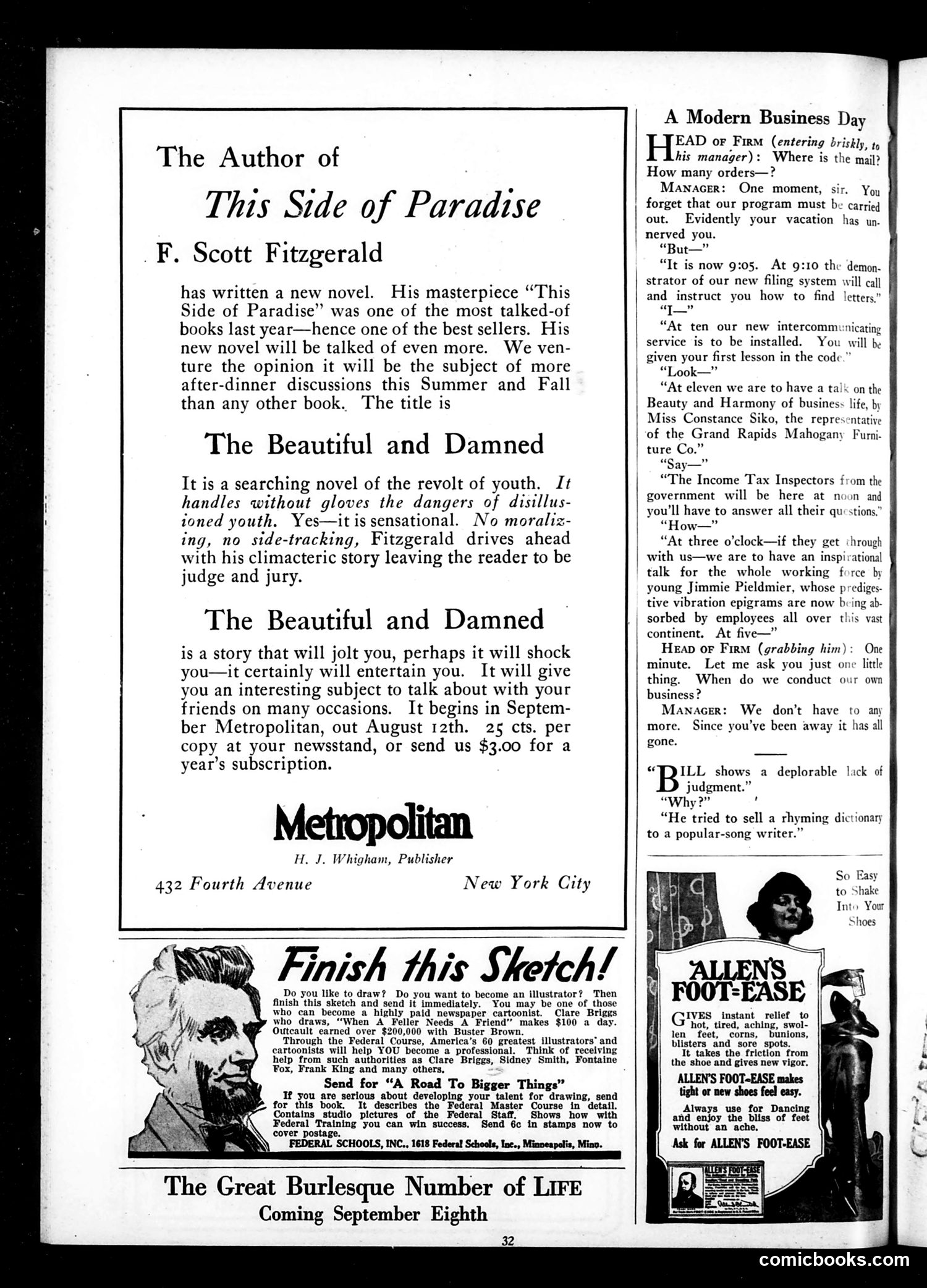
This page comprises advertising and editorial content rather than political cartoons. **Left side**: Promotional material for F. Scott Fitzgerald's novel *The Beautiful and Damned*, published by Metropolitan Magazine. The text emphasizes the book's sensational treatment of youth's disillusionment, marketed as conversation-worthy and shocking. **Right side**: "A Modern Business Day" is a satirical sketch mocking excessive workplace efficiency systems. A harried manager schedules the company head through an absurd gauntlet of mandatory activities—filing system demonstrations, intercommunicating service training, motivational talks, tax inspections—leaving no time for actual business. The punchline: while the boss was on vacation, the company collapsed anyway, rendering all these "efficiency" measures pointless. This satirizes the era's obsession with scientific management and productivity systems that ironically prevent productive work. **Bottom**: Advertisements for illustration courses and foot products. The page also announces Life's upcoming "Great Burlesque Number."