
Life, 1921-08-11 · page 20 of 40
Life — August 11, 1921 — page 20: what you’re looking at
What you’re looking at
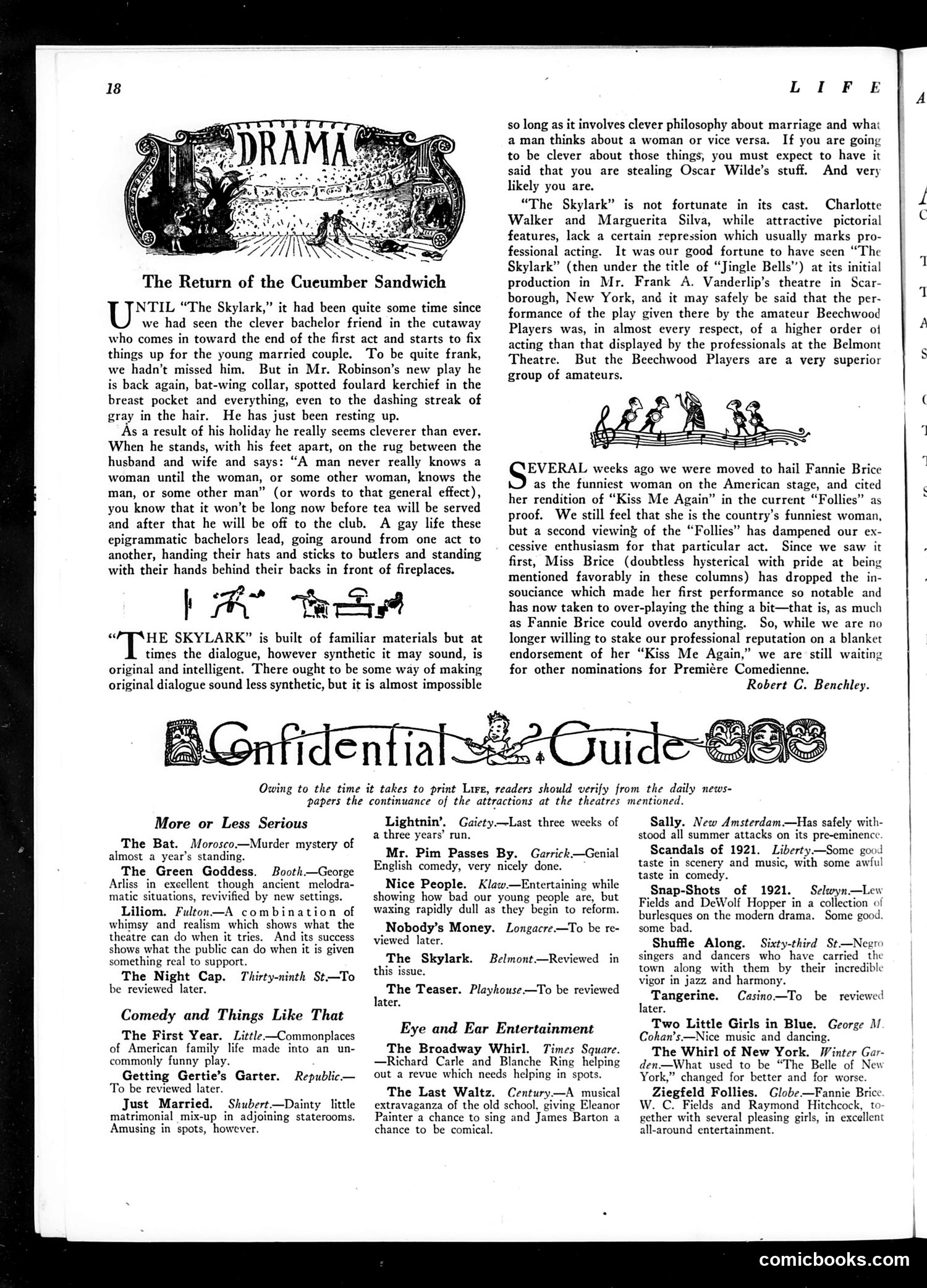
This theater review by Robert C. Benchley (a prominent humorist) mocks a recurring stock character in 1920s comedies: the witty bachelor who appears in the final act to dispense clever marital advice while wearing a bat-wing collar and spotted kerchief. Benchley satirizes how these characters spout pseudo-philosophical quips about marriage—indistinguishable from Oscar Wilde's wit—before exiting to the club. The review critiques the Broadway production of "The Skylark," noting that its professional leads (Charlotte Walker, Marguerita Silva) lack the restraint of *amateur* actors who performed it earlier in Scarborough, New York. Benchley also downgrades his earlier praise of Fannie Brice's comedic timing in the "Follies," suggesting she's begun over-playing her act since receiving his favorable mention. The piece exemplifies Life magazine's satirical theater criticism targeting both predictable dramatic conventions and performers' egos.
📄 Transcribed text from this page (OCR, searchable)
Machine-transcribed from the original scan — historical spelling and the odd misread are preserved.
The Return of the Cueumber Sandwich NTIL “The Skylark,” it had been quite some time since we had seen the clever bachelor friend in the cutaway who comes in toward the end of the first act and starts to fix things up for the young married couple. To be quite frank, we hadn’t missed him. But in Mr. Robinson’s new play he is back again, bat-wing collar, spotted foulard kerchief in the breast pocket and everything, even to the dashing streak of gray in the hair. He has just been resting up. As a result of his holiday he really seems cleverer than ever. When he stands, with his feet apart, on the rug between the husband and wife and says: “A man never really knows a woman until the woman, or some other woman, knows the man, or some other man” (or words to that general effect), you know that it won’t be long now before tea will be served and after that he will be off to the club. A gay life these epigrammatic bachelors lead, going around from one act to another, handing their hats and sticks to butlers and standing with their hands behind their backs in front of fireplaces. | A? tect cS HE SKYLARK” is built of familiar materials but at imes the dialogue, however synthetic it may sound, is original and intelligent. There ought to be some way of making original dialogue sound less synthetic, but it is almost impossible LIFeE so long as it involves clever philosophy about marriage and what aman thinks about a woman or vice versa. If you are going to be clever about those things, you must expect to have it said that you are stealing Oscar Wilde’s stuff. And very likely you are. “The Skylark” is not fortunate in its cast. Charlotte Walker and Marguerita Silva, while attractive pictorial features, lack a certain repression which usually marks pro- fessional acting. It was our good fortune to have seen “The Skylark” (then under the title of “Jingle Bells’) at its initial production in Mr. Frank A. Vanderlip’s theatre in Scar- borough, New York, and it may safely be said that the per- formance of the play given there by the amateur Beechwood Players was, in almost every respect, of a higher order oi acting than that displayed by the professionals at the Belmont Theatre. But the Beechwood Players are a very superior group of amateurs. EVERAL weeks ago we were moved to hail Fannie Brice as the funniest woman on the American stage, and cited her rendition of “Kiss Me Again” in the current “Follies” as proof. We still feel that she is the country’s funniest woman, but a second viewing of the “Follies” has dampened our ex- cessive enthusiasm for that particular act. Since we saw it first, Miss Brice (doubtless hysterical with pride at being mentioned favorably in these columns) has dropped the in- souciance which made her first performance so notable and has now taken to over-playing the thing a bit—that is, as much as Fannie Brice could overdo anything. So, while we are no longer willing to stake our professional reputation on a blanket endorsement of her “Kiss Me Again,” we are still waiting for other nominations for Premiére Comedienne. Robert C. Benchley. Owing to the time it takes to print Lire, readers should verify from the daily news- papers the continuance of the attractions at the theatres mentioned. More or Less Serious three years’ run. The Bat. Morosco.—Murder mystery of sir Nae Lightnin’. Gaiety—Last three weeks of Sally. New Amsterdam.—Has safely with- stood all summer attacks on its pre-eminence. almost a year’s standing. The Green Goddess. Booth.—George Arliss in excellent though ancient melodra- matic situations, revivified by new settings. Liliom. Fulton—A combination of whimsy and realism which shows what the theatre can do when it tries. And its success shows what the public can do when it is given something real to support. The Night Cap. Thirty-ninth St—To be reviewed later. Comedy and Things Like That The First Year. Little —Commonplaces of American family life made into an un- commonly funny play. Getting Gertie’s Garter. To be reviewed later. Just Married. Shubert—Dainty little matrimonial mix-up in adjoining staterooms. Amusing in spots, however. Republic — Mr. Pim Passes By. Garrick—Genial English comedy, very nicely done. Nice People. Klaw.—Entertaining while showing how bad our young people are, but waxing rapidly dull as they begin to reform. Nobody’s Money. Longacre—To be re- viewed later. The Skylark. this issue. The Teaser. Playhouse —To be reviewed later. Belmont.—Reviewed in Eye and Ear Entertainment The Broadway Whirl. Times Square. —Richard Carle and Blanche Ring helping out a revue which needs helping in spots. The Last Waltz. Century—A musical extravaganza of the old school, giving Eleanor Painter a chance to sing and James Barton a chance to be comical. Scandals of 1921. Liberty—Some goo taste in scenery and music, with some awful taste in comedy. Snap-Shots of 1921. Selwyn—Lew Fields and DeWolf Hopper in a collection of burlesques on the modern drama. Some good. some bad. Shuffle Along. Sixty-third St—Negro singers and dancers who have carried the town along with them by their incredible vigor in jazz and harmony. Tangerine. Casino—To be reviewed later. Two Little Girls in Blue. George M. Cohan’s—Nice music and dancing. The Whirl of New York. Winter Gar- den —What used to be “The Belle of New York,” changed for better and for worse. Ziegfeld Follies. Globe—Fannie Brice. W. C. Fields and Raymond Hitchcock, to- gether with several pleasing girls, in excellent all-around entertainment. comicbooks.com s