
Life, 1921-08-11 · page 17 of 40
Life — August 11, 1921 — page 17: what you’re looking at
What you’re looking at
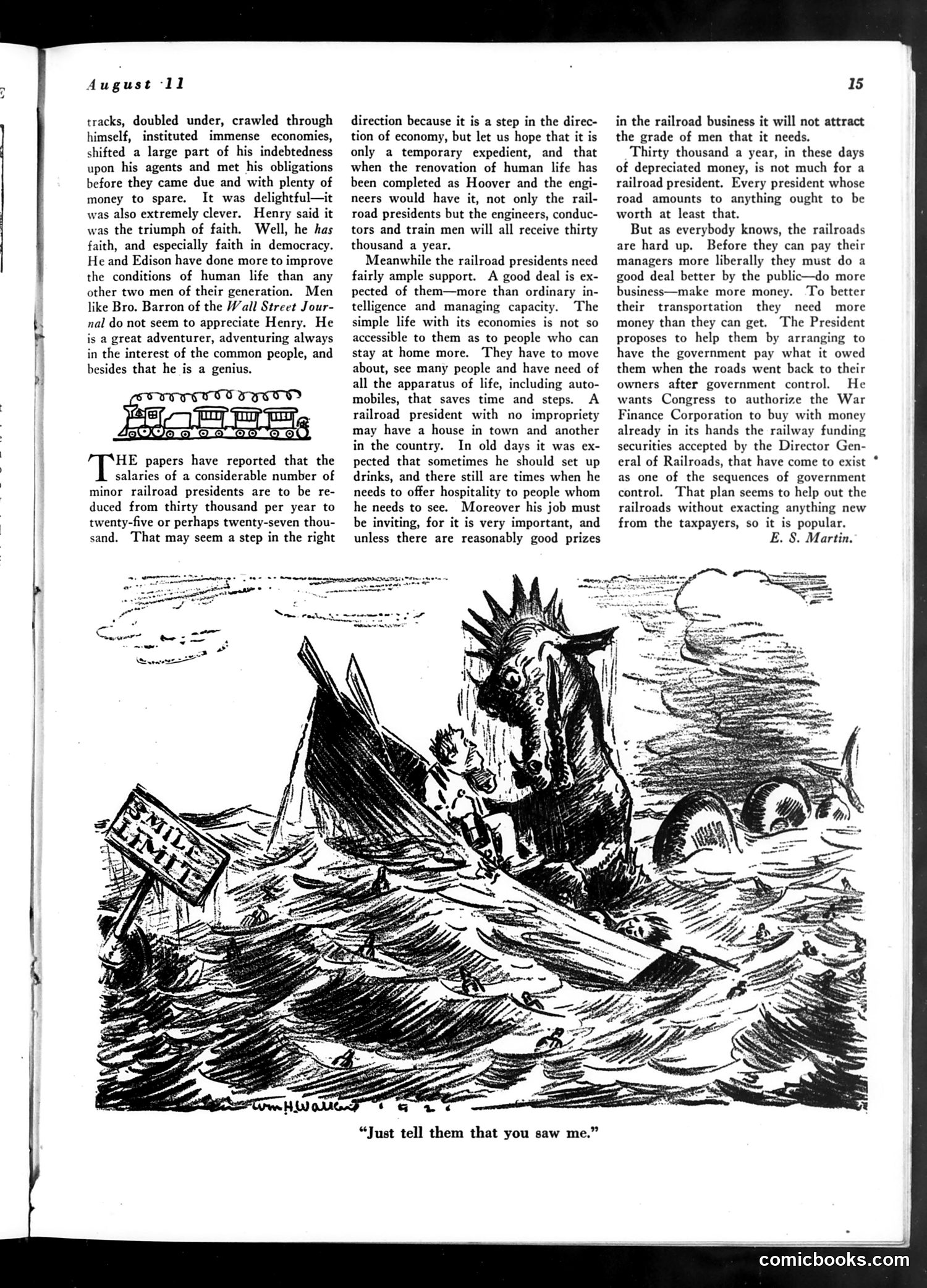
This 1911 *Life* magazine page contains editorial commentary on railroad economics and a political cartoon. **The text** praises Henry Ford (implied by references to his economic innovations and association with Edison) while defending railroad presidents' high salaries ($30,000/year). The author argues they need substantial compensation to attract capable managers, despite economic pressures forcing salary cuts. **The cartoon** depicts a disheveled horse emerging from turbulent waters labeled "PANIC," speaking the caption "Just tell them that you saw me." This illustrates the railroad industry in crisis—the horse represents the railroads themselves, nearly drowned by economic panic. The message suggests the industry is struggling and barely surviving. **The satire's point**: There's tension between the text's defense of executive compensation and the cartoon's depiction of industry distress. The page argues railroads need money and good management while the visual evidence shows them failing—a contradiction highlighting the absurdity of prioritizing executive salaries during economic crisis.
📄 Transcribed text from this page (OCR, searchable)
Machine-transcribed from the original scan — historical spelling and the odd misread are preserved.
aes, A August ‘11 tracks, doubled under, crawled through himself, instituted immense economies, shifted a large part of his indebtedness upon his agents and met his obligations before they came due and with plenty of money to spare. It was delightful—it was also extremely clever. Henry said it was the triumph of faith. Well, he has faith, and especially faith in democracy. He and Edison have done more to improve the conditions of human life than any other two men of their generation. Men like Bro. Barron of the Wall Street Jour- nal do not seem to appreciate Henry. He is a great adventurer, adventuring always in the interest of the common people, and besides that he is a genius. HE papers have reported that the salaries of a considerable number of minor railroad presidents are to be re- duced from thirty thousand per year to twenty-five or perhaps twenty-seven thou- sand. That may seem a step in the right Svea direction because it is a step in the direc- tion of economy, but let us hope that it is only a temporary expedient, and that when the renovation of human life has been completed as Hoover and the engi- neers would have it, not only the rail- road presidents but the engineers, conduc- tors and train men will all receive thirty thousand a year. Meanwhile the railroad presidents need fairly ample support. A good deal is ex- pected of them—more than ordinary in- telligence and managing capacity. The simple life with its economies is not so accessible to them as to people who can stay at home more. They have to move about, see many people and have need of all the apparatus of life, including auto- mobiles, that saves time and steps. A railroad president with no impropriety may have a house in town and another in the country. In old days it was ex- pected that sometimes he should set up drinks, and there still are times when he needs to offer hospitality to people whom he needs to see. Moreover his job must be inviting, for it is very important, and unless there are reasonably good prizes “Just tell them that you saw me.” 15 in the railroad business it will not attract the grade of men that it needs. Thirty thousand a year, in these days of depreciated money, is not much for a railroad president. Every president whose road amounts to anything ought to be worth at least that. But as everybody knows, the railroads are hard up. Before they can pay their managers more liberally they must do a good deal better by the public—do more business—make more money. To better their transportation they need more money than they can get. The President proposes to help them by arranging to have the government pay what it owed them when the roads went back to their owners after government control. He wants Congress to authorize the War Finance Corporation to buy with money already in its hands the railway funding securities accepted by the Director Gen- eral of Railroads, that have come to exist as one of the sequences of government control. That plan seems to help out the railroads without exacting anything new from the taxpayers, so it is popular. E. 8. Martin. comicbooks.com