
Life, 1921-08-11 · page 24 of 40
Life — August 11, 1921 — page 24: what you’re looking at
What you’re looking at
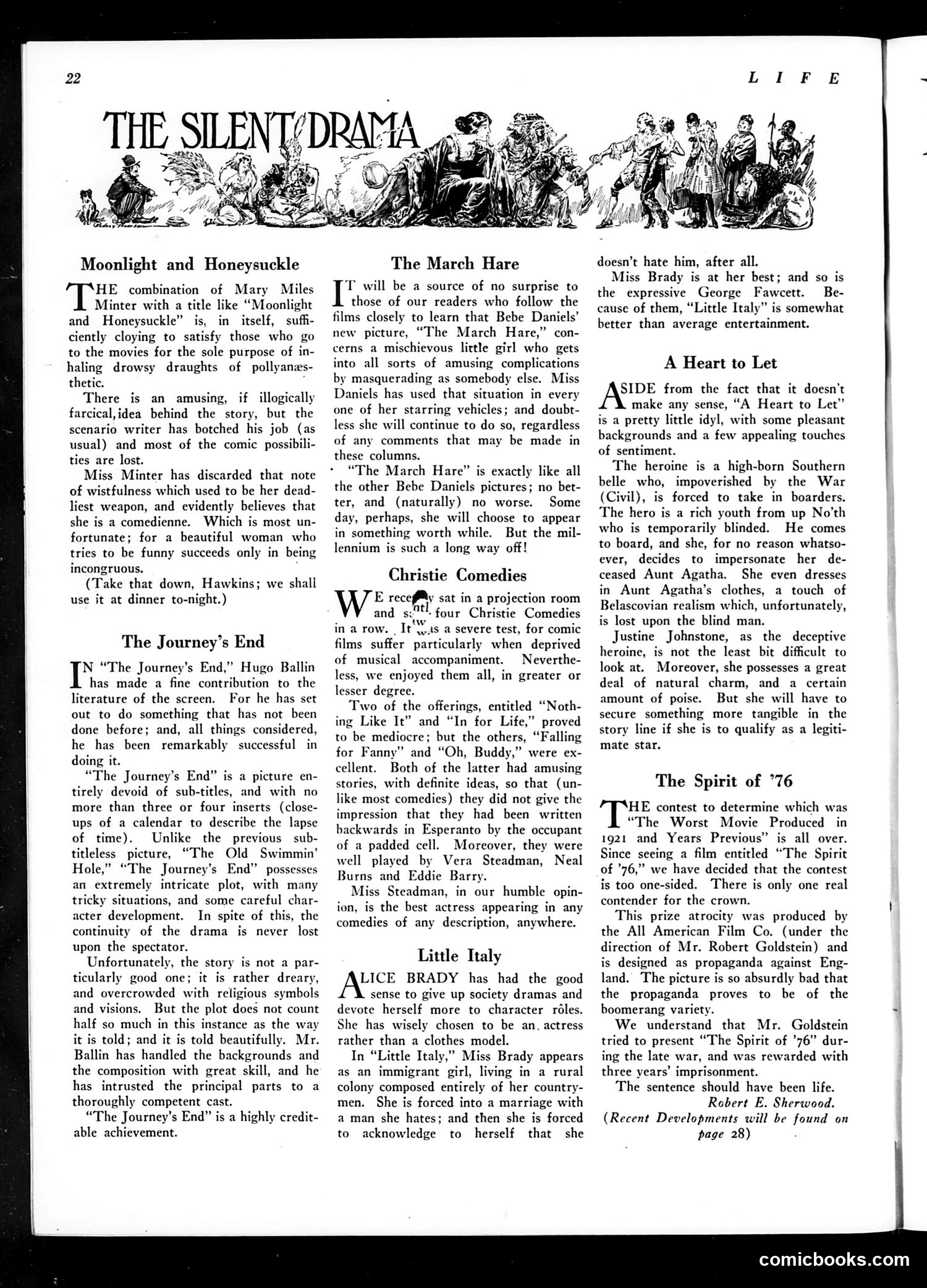
This page contains film reviews from *Life* magazine's "The Silent Drama" column, critiquing contemporary silent films. The reviews are straightforward entertainment criticism rather than political satire. Key reviews include: - **"Moonlight and Honeysuckle"**: Criticizes actress Mary Miles Minter for attempting comedy, arguing beautiful women shouldn't try to be funny—they become "incongruous." - **"The Journey's End"**: Praises director Hugo Ballin's innovative approach: a feature film with virtually no title cards (extremely unusual for silent cinema), told entirely through visual storytelling. - **"The March Hare"**: Dismisses Bebe Daniels' repetitive formula of playing mischievous girls in disguise across all her films. - **Christie Comedies**: Reviews four short comedies, praising actress Vera Steadman as "the best actress appearing in any comedies of any description, anywhere." The tone is witty and sardonic—particularly the aside: "(Take that down, Hawkins; we shall use it at dinner to-night.)"—typical of *Life*'s satirical magazine voice.
📄 Transcribed text from this page (OCR, searchable)
Machine-transcribed from the original scan — historical spelling and the odd misread are preserved.
Moonlight and Honeysuckle HE combination of Mary Miles Minter with a title like “Moonlight and Honeysuckle” is, in itself, suffi- ciently cloying to satisfy those who go to the movies for the sole purpose of in- haling drowsy draughts of pollyanes- thetic. There is an amusing, if illogically farcical,idea behind the story, but the scenario writer has botched his job (as usual) and most of the comic possibili- ties are lost. Miss Minter has discarded that note of wistfulness which used to be her dead- liest weapon, and evidently believes that she is a comedienne. Which is most un- fortunate; for a beautiful woman who tries to be funny succeeds only in being incongruous. (Take that down, Hawkins; we shall use it at dinner to-night.) The Journey’s End N “The Journey’s End,” Hugo Ballin has made a fine contribution to the literature of the screen. For he has set out to do something that has not been done before; and, all things considered, he has been remarkably successful in doing it. “The Journey’s End” is a picture en- tirely devoid of sub-titles, and with no more than three or four inserts (close- ups of a calendar to describe the lapse of time). Unlike the previous sub- titleless picture, “The Old Swimmin’ Hole,” “The Journey’s End” possesses an extremely intricate plot, with many tricky situations, and some careful char- acter development. In spite of this, the continuity of the drama is never lost upon the spectator. Unfortunately, the story is not a par- ticularly good one; it is rather dreary, and overcrowded with religious symbols and visions. But the plot does not count half so much in this instance as the way it is told; and it is told beautifully. Mr. Ballin has handled the backgrounds and the composition with great skill, and he has intrusted the principal parts to a thoroughly competent cast. “The Journey’s End” is a highly credit- able achievement. The March Hare T will be a source of no surprise to those of our readers who follow the films closely to learn that Bebe Daniels’ new picture, “The March Hare,” con- cerns a mischievous little girl who gets into all sorts of amusing complications by masquerading as somebody else. Miss Daniels has used that situation in every one of her starring vehicles; and doubt- less she will continue to do so, regardless of any comments that may be made in these columns. “The March Hare” is exactly like all the other Bebe Daniels pictures; no bet- ter, and (naturally) no worse. Some day, perhaps, she will choose to appear in something worth while. But the mil- lennium is such a long way off! Christie Comedies WE recefMy sat in a projection room and s:"tl four Christie Comedies in a row. _ It'Was a severe test, for comic films suffer particularly when deprived of musical accompaniment. Neverthe- less, we enjoyed them all, in greater or lesser degree. Two of the offerings, entitled “Noth- ing Like It” and “In for Life,” proved to be mediocre; but the others, “Falling for Fanny” and “Oh, Buddy,” were ex- cellent. Both of the latter had amusing stories, with definite ideas, so that (un- like most comedies) they did not give the impression that they had been written backwards in Esperanto by the occupant of a padded cell. Moreover, they were well played by Vera Steadman, Neal Burns and Eddie Barry. Miss Steadman, in our humble opin- ion, is the best actress appearing in any comedies of any description, anywhere. Little Italy LICE BRADY has had the good sense to give up society dramas and devote herself more to character réles. She has wisely chosen to be an. actress rather than a clothes model. In “Little Italy,” Miss Brady appears as an immigrant girl, living in a rural colony composed entirely of her country- men. She is forced into a marriage with a man she hates; and then she is forced to acknowledge to herself that she doesn’t hate him, after all. Miss Brady is at her best; and so is the expressive George Fawcett. Be- cause of them, “Little Italy” is somewhat better than average entertainment. A Heart to Let SIDE from the fact that it doesn’t make any sense, “A Heart to Let” is a pretty little idyl, with some pleasant backgrounds and a few appealing touches of sentiment. The heroine is a high-born Southern belle who, impoverished by the War (Civil), is forced to take in boarders. The hero is a rich youth from up No’th who is temporarily blinded. He comes to board, and she, for no reason whatso- ever, decides to impersonate her de- ceased Aunt Agatha. She even dresses in Aunt Agatha’s clothes, a touch of Belascovian realism which, unfortunately, is lost upon the blind man. Justine Johnstone, as the deceptive heroine, is not the least bit difficult to look at. Moreover, she possesses a great deal of natural charm, and a certain amount of poise. But she will have to secure something more tangible in the story line if she is to qualify as a legiti- mate star. The Spirit of °76 HE contest to determine which was “The Worst Movie Produced in 1921 and Years Previous” is all over. Since seeing a film entitled “The Spirit of ’76,” we have decided that the contest is too one-sided. There is only one real contender for the crown. This prize atrocity was produced by the All American Film Co. (under the direction of Mr. Robert Goldstein) and is designed as propaganda against Eng- land. The picture is so absurdly bad that the propaganda proves to be of the boomerang variety. We understand that Mr. Goldstein tried to present “The Spirit of ’76” dur- ing the late war, and was rewarded with three years’ imprisonment. The sentence should have been life. Robert E. Sherwood. (Recent Developments will be found on page 28) comicbooks.com