
A complete issue · 38 pages · 1921
Life — April 7, 1921
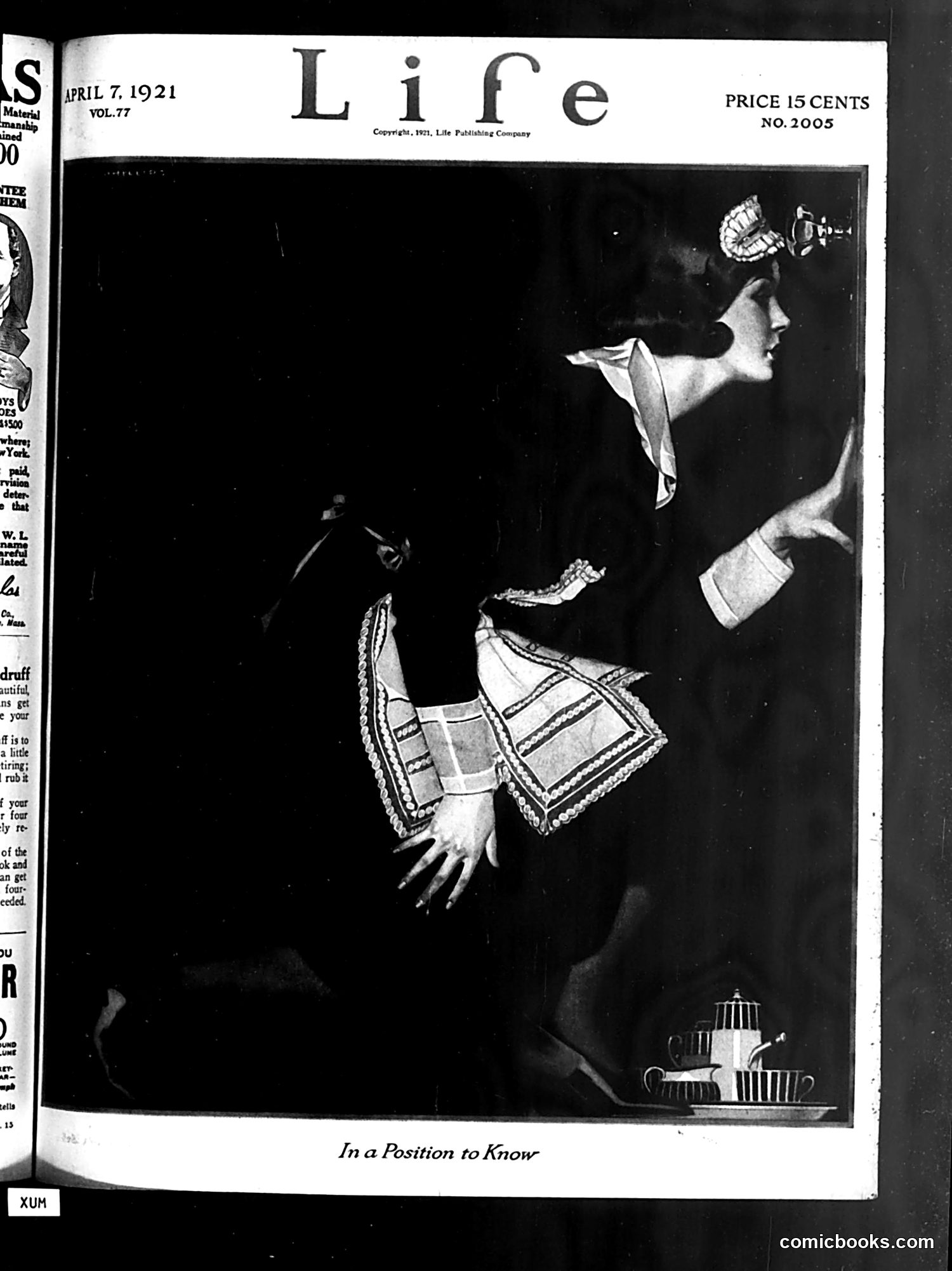
This satirical illustration depicts a fashionably dressed woman in an elegant, provocative pose wearing decorative arm cuffs and an ornate headpiece. The caption "In a Position to Know" suggests commentary on women's social status or authority during the early 1920s. The image likely critiques either women's evolving social roles post-WWI or satirizes feminine vanity and display. The deliberate pose and luxurious accessories may mock the idea that fashionable appearance confers knowledge or credibility—a common theme in 1920s satire about the "modern woman" and changing gender dynamics. Without additional context from the magazine's articles, the precise target of satire remains unclear, though it appears to address women's social positioning during this transitional era.
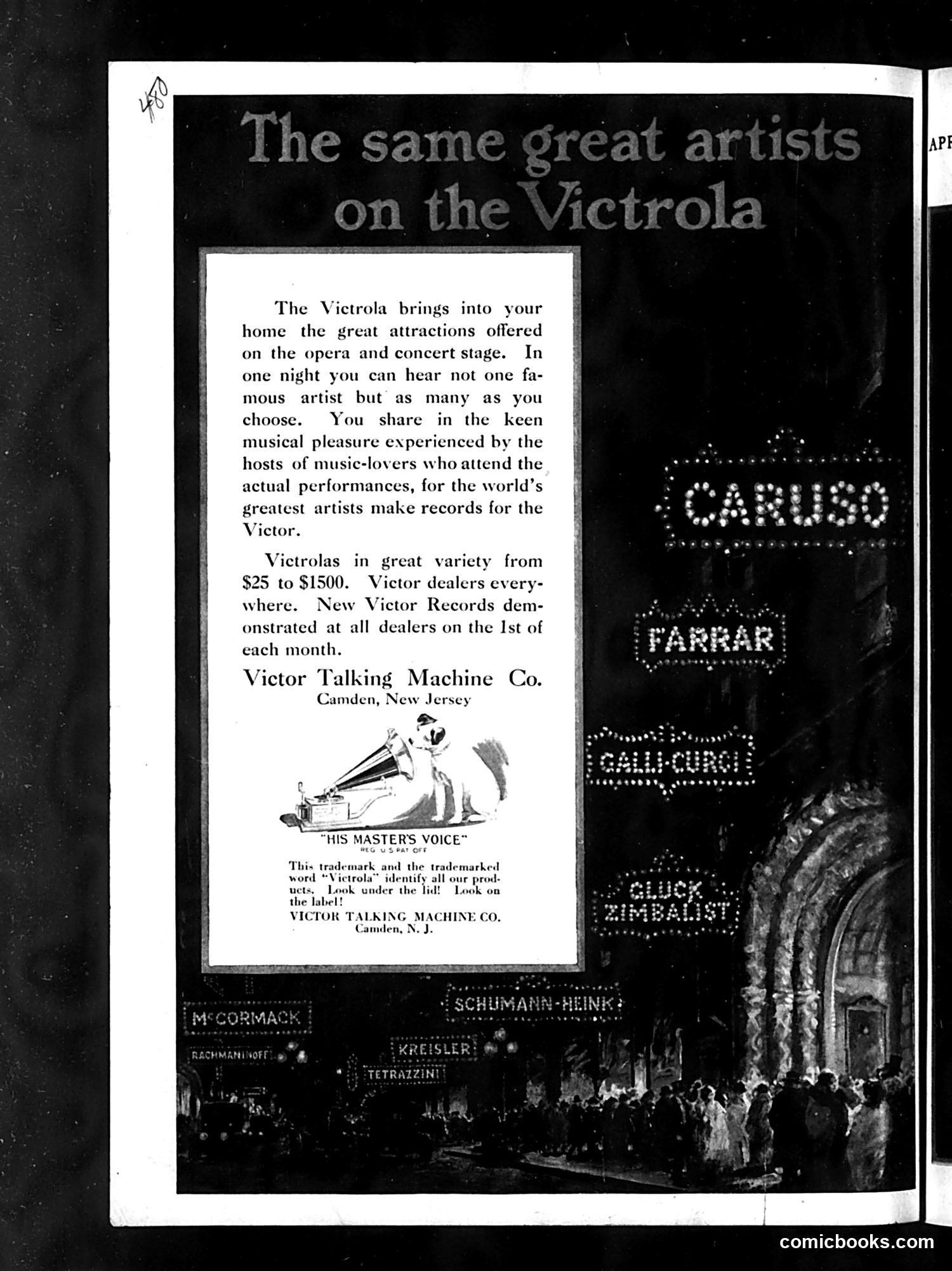
This page is primarily **advertising**, not satire or political commentary. The main content is a Victor Talking Machine Company advertisement promoting Victrola phonographs (priced $25-$1500). The ad emphasizes that Victrola records feature famous opera and concert singers—listing names like Caruso, Farrar, Galli-Curci, and Zimbalist (all renowned classical performers of the era). The pitch is that listeners can enjoy multiple world-class artists in one evening at home. The small "His Master's Voice" trademark image (the dog listening to a phonograph) appears at bottom. This is consumer advertising targeting affluent households interested in classical music and opera—not political satire or editorial commentary.
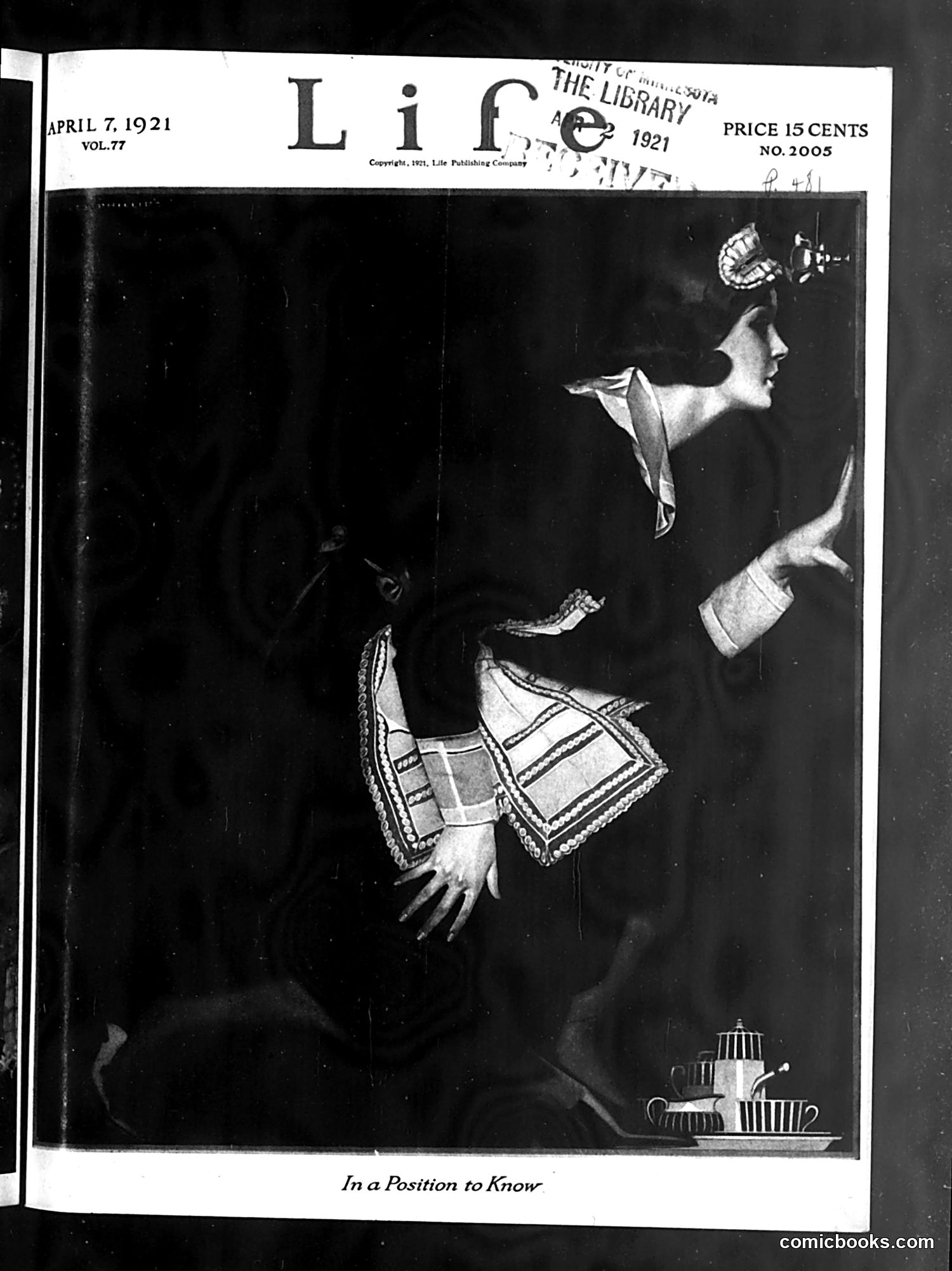
This Life magazine cover from April 7, 1921 uses satirical visual language typical of the era. The illustration depicts a fashionably dressed woman in profile, adorned with expensive jewelry and decorative accessories including ornate cuffs and a decorative headpiece. The title "In a Position to Know" suggests she possesses insider knowledge or social authority. The satire likely targets wealthy women's fashion culture or their claims to social expertise during the 1920s. The elaborate, somewhat exaggerated ornamentation may mock pretension or conspicuous consumption. The decorative teapot illustration at the bottom suggests domestic or social-sphere concerns, implying commentary on women's traditional roles versus their aspirations to broader authority or knowledge.
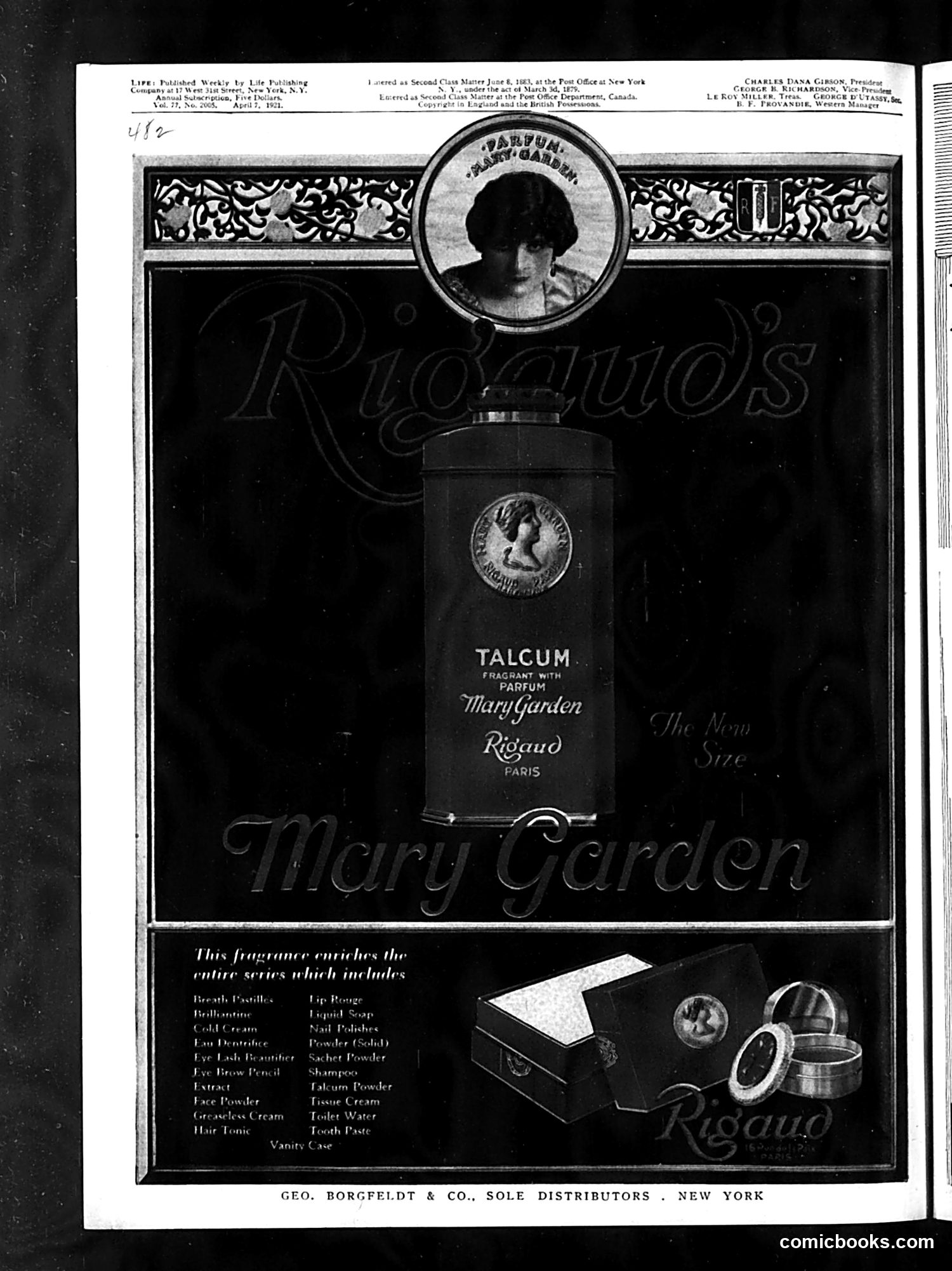
This page is **primarily an advertisement**, not political satire or editorial cartooning. It advertises Mary Garden Talcum by Rigaud, a French fragrance product distributed by Geo. Borgfeldt & Co. in New York. The advertisement features a photograph of a woman (appearing to be Mary Garden, likely the famous opera singer) in a circular portrait at the top, with her name prominently displayed. Below is the talcum powder container itself. The bottom section lists the complete "Mary Garden" product line, including various cosmetics and toiletries (face powder, lip rouge, nail polish, shampoo, etc.). The ornamental border and layout are typical of early 20th-century luxury product advertising in *Life* magazine, targeting affluent consumers through celebrity endorsement.
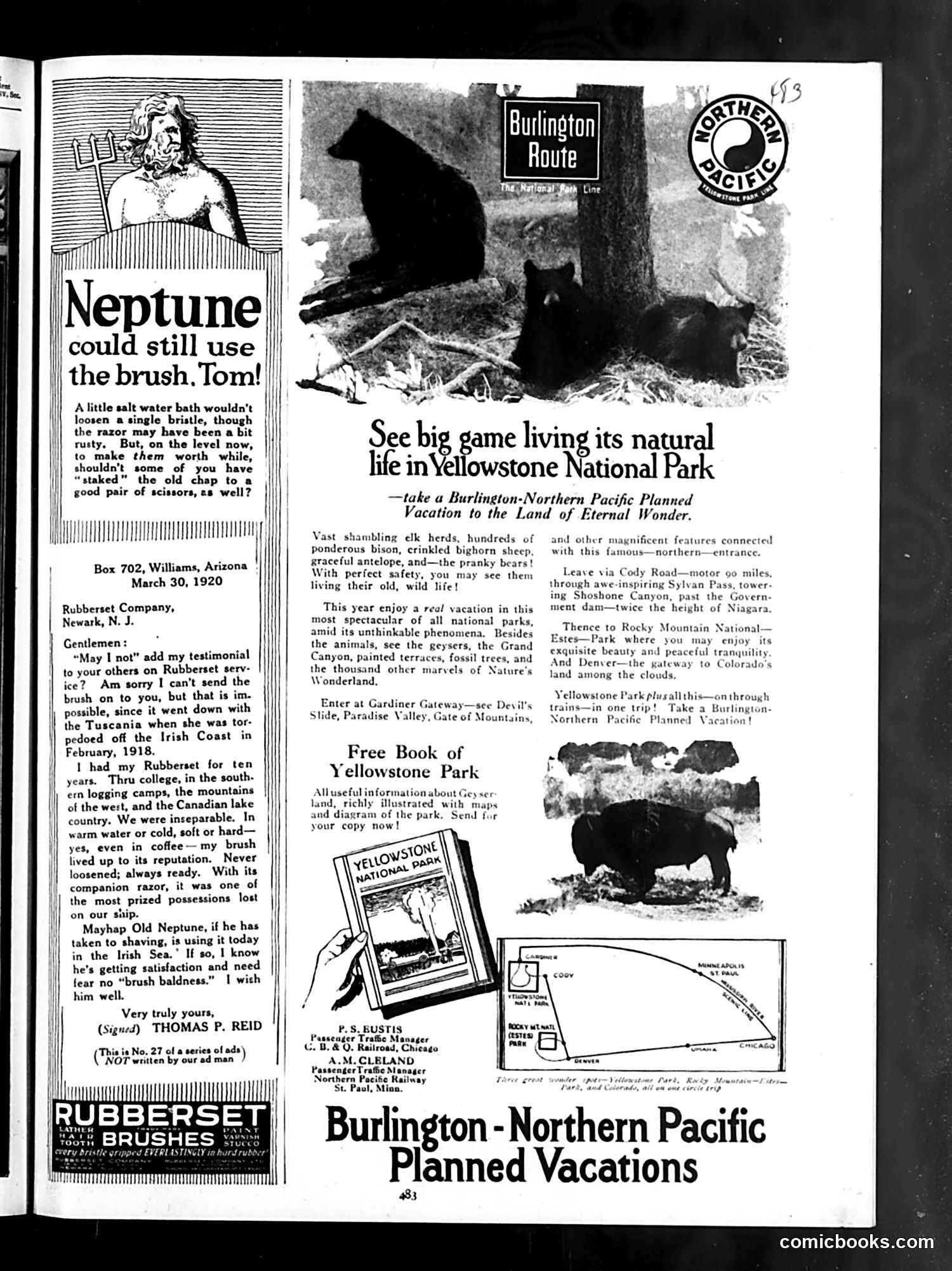
This page is primarily **advertising**, not satirical content. The left side features a Rubberset Brushes ad with a testimonial letter from Thomas P. Reid (Box 702, Williams, Arizona, March 30, 1920) praising the durability of Neptune brushes used during Irish Coast logging work. The letter humorously suggests Neptune "could still use the brush, Tom!"—a pun playing on the Roman god's trident. The right side advertises Burlington-Northern Pacific railroad vacations to Yellowstone National Park, featuring wildlife photography (bears, elk) and a free park guidebook. The ad emphasizes seeing "big game living its natural life" and lists scenic attractions like the Grand Canyon and Niagara Falls accessible via the railroad. Both sections are straightforward commercial promotions targeting early 1920s consumers and travelers—no political satire is present.
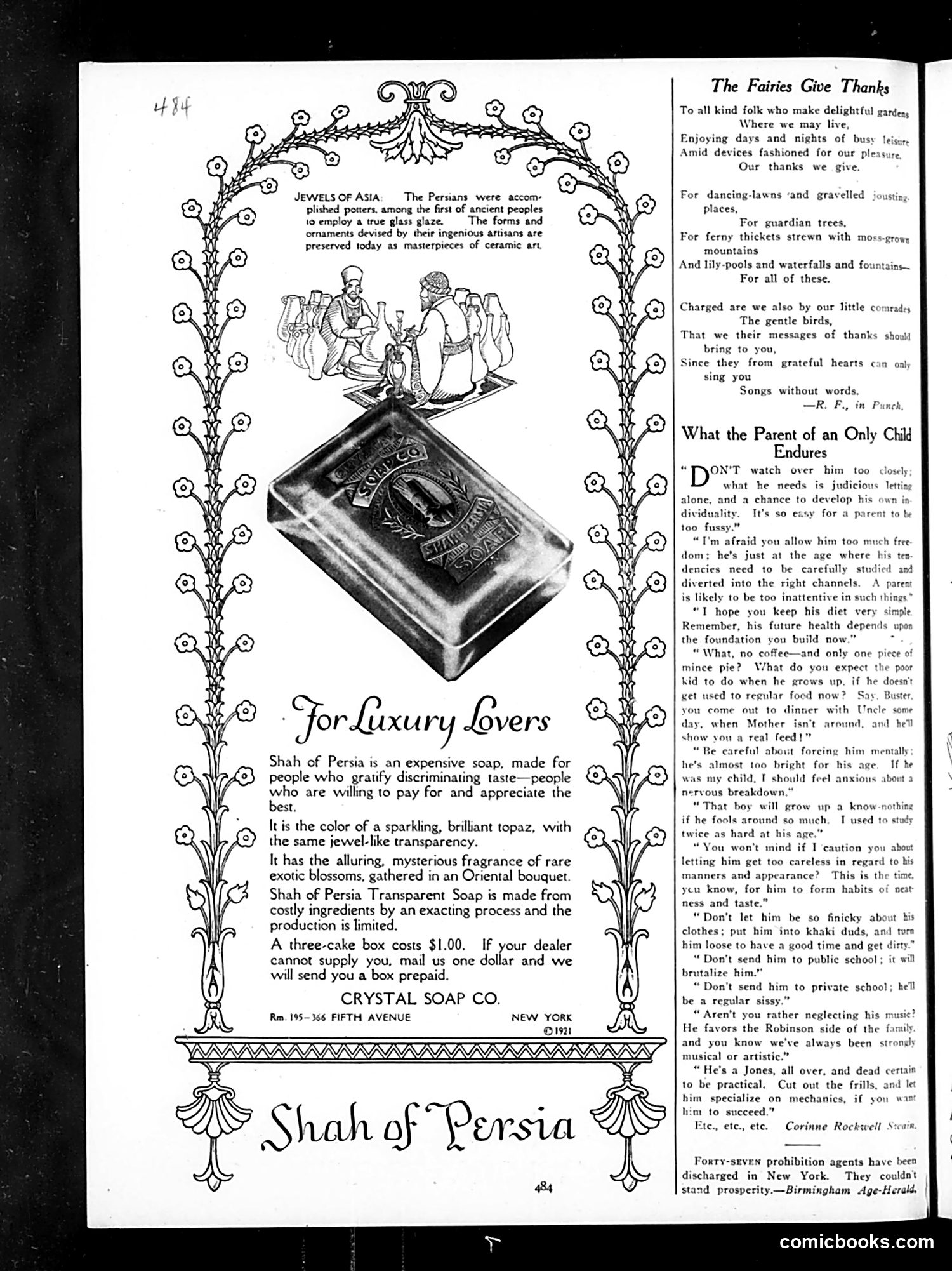
This page is primarily **advertising** rather than political satire. The central content promotes Shah of Persia transparent soap by Crystal Soap Co. (New York), positioned as a luxury product for discriminating buyers. The decorative Persian-inspired borders and illustration of Persian figures establish an exotic, upscale aesthetic. The right column contains unrelated editorial content: "The Fairies Give Thanks" (a whimsical poem about nature) and "What the Parent of an Only Child Endures" (parenting advice by Corinne Rockwell Norris discussing child discipline and education choices). A brief news item notes forty-seven Prohibition agents were discharged in New York for failing to maintain proper conduct—a reference to early Prohibition era (1920s) enforcement corruption.
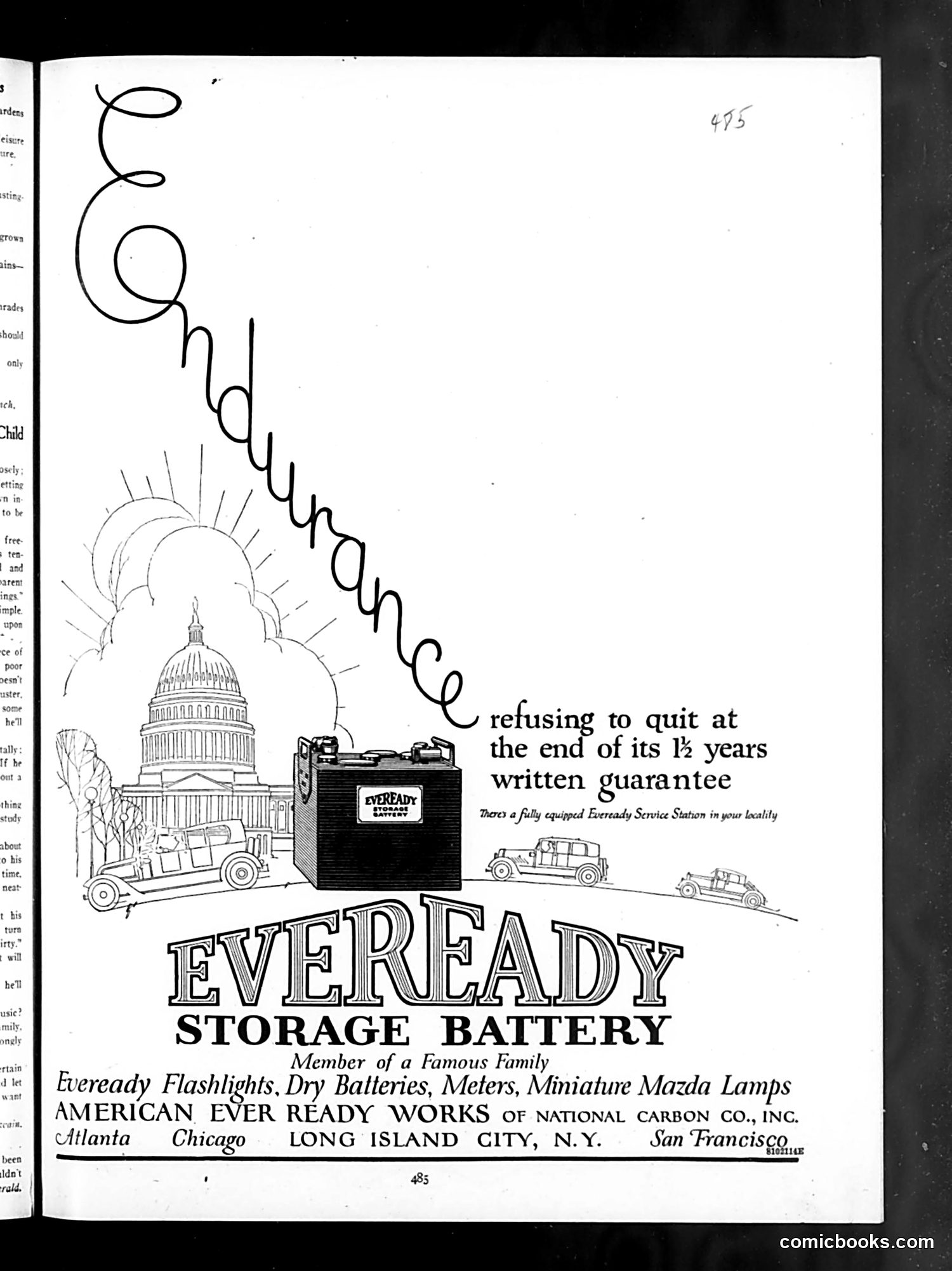
This page is primarily an **advertisement for Eveready Storage Battery**, not a political cartoon. The ad features an illustration of the U.S. Capitol building with a large battery, cars, and a radiating sun or light effect above it. The advertising copy uses playful wordplay: "Endurance refusing to quit at the end of its 1½ years written guarantee." This anthropomorphizes the battery as something persistently durable, with the Capitol building suggesting American reliability and national infrastructure. The ad emphasizes Eveready's product line (flashlights, dry batteries, meters, miniature Mazda lamps) and lists manufacturing locations including Atlanta, Chicago, Long Island City, and San Francisco—emphasizing broad national distribution and the company's status as part of "a Famous Family" (National Carbon Co., Inc.). It's straightforward commercial promotion with no satirical content.
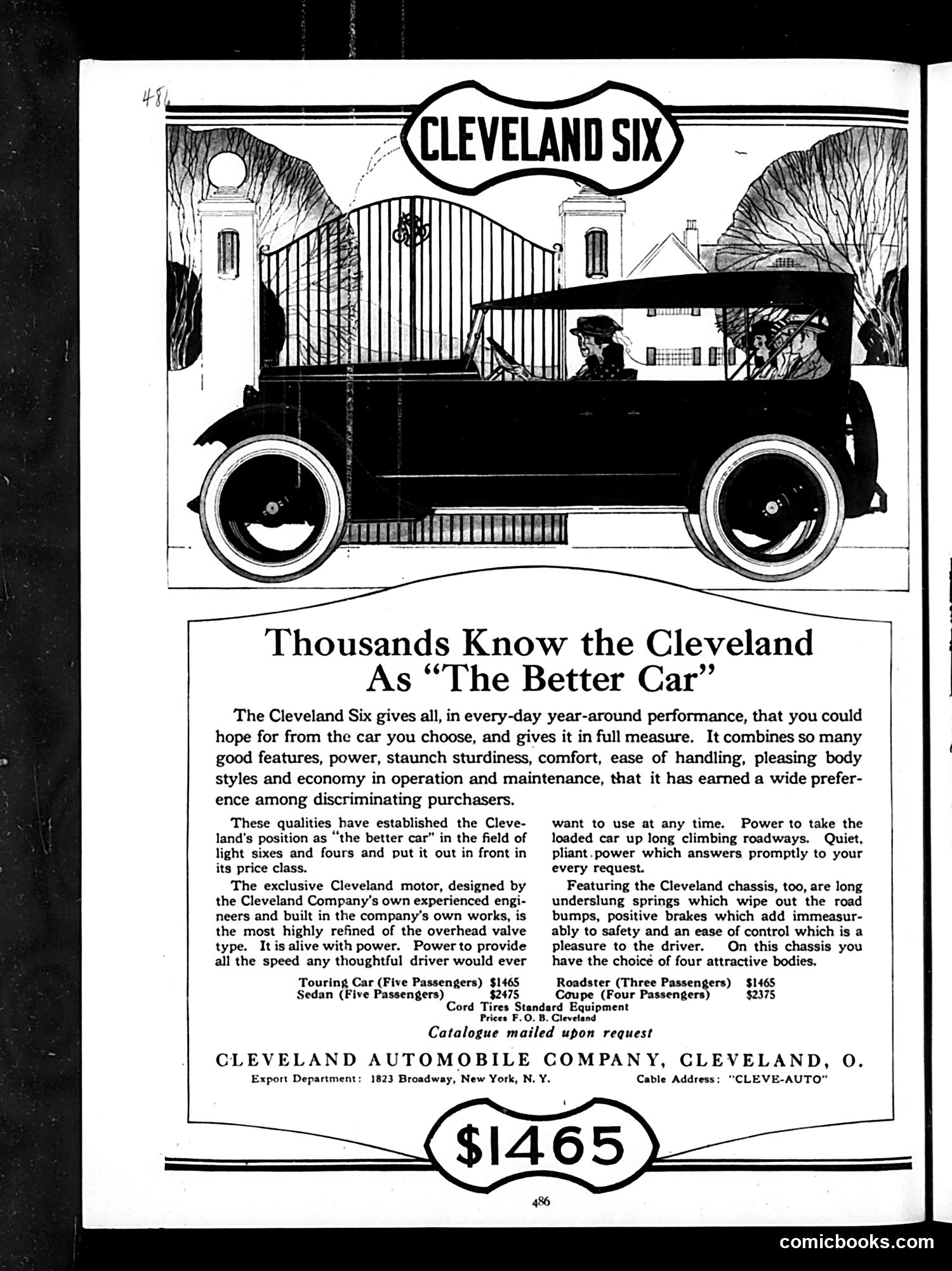
This is a straightforward **automobile advertisement**, not political satire. It promotes the Cleveland Six automobile manufactured by the Cleveland Automobile Company in Cleveland, Ohio. The ad's central claim—that thousands recognize the Cleveland as "The Better Car"—emphasizes reliability, performance, comfort, and affordability. It highlights the car's exclusive overhead valve motor design, undersung springs, and safety features. The illustration shows a well-dressed couple in an open-air touring car, parked before an elegant gated estate, suggesting the vehicle appeals to middle-to-upper-class buyers seeking practical luxury. **Pricing information** is provided: the Touring Car cost $1465, with various body styles available. The ad includes contact details for the Cleveland Automobile Company's Export Department in New York.
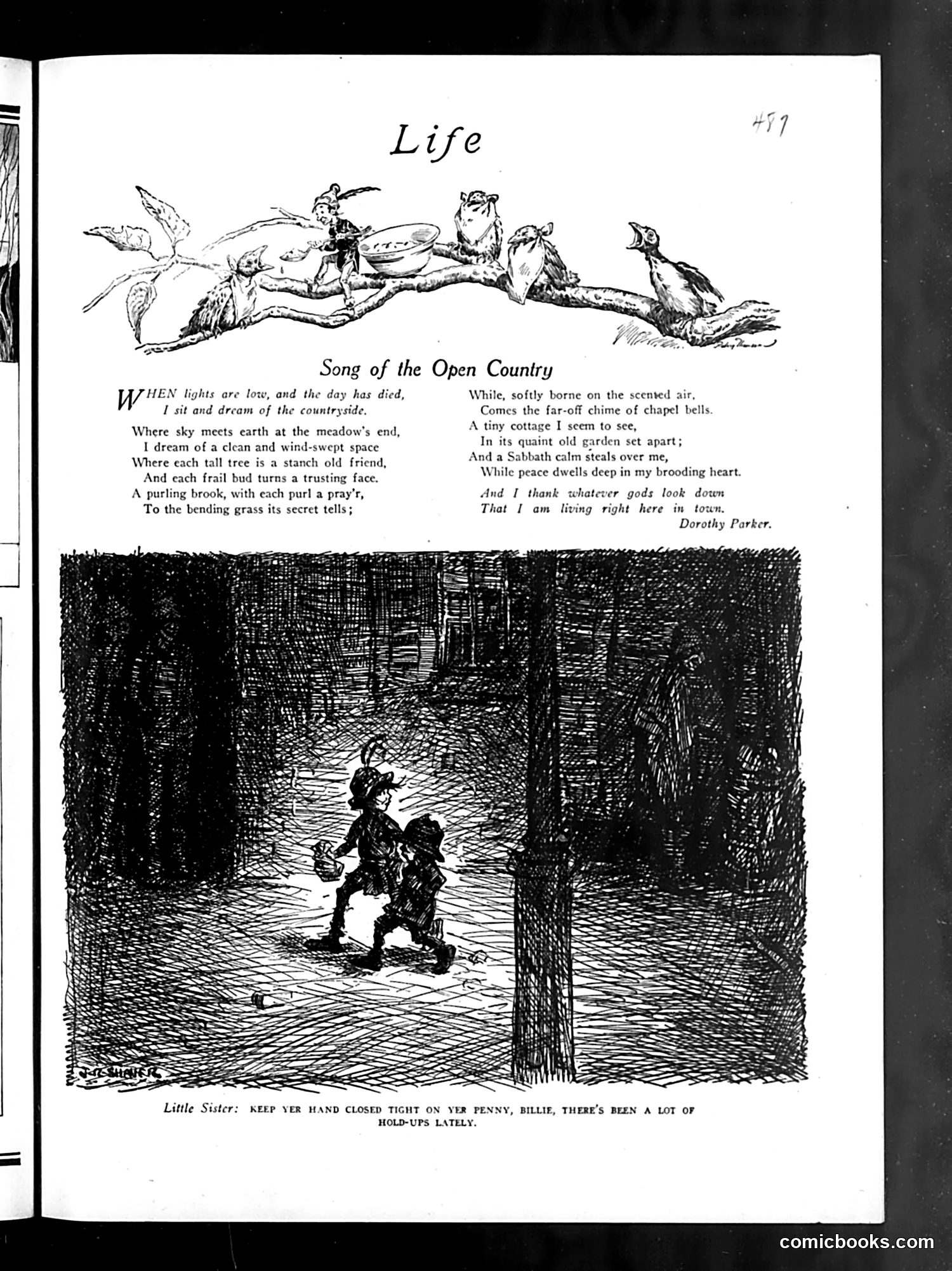
This page features "Song of the Open Country," a poem by Dorothy Parker celebrating rural life and nature. The illustration depicts a figure (appearing to be a child or youth) walking through a dark forest corridor. The satirical element becomes clear in the caption below the sketch: "Little Sister: KEEP YER HAND CLOSED TIGHT ON YER PENNY, BILLIE, THERE'S BEEN A LOT OF HOLD-UPS LATELY." The joke contrasts Parker's romantic celebration of peaceful countryside life—with its "clean and wind-swept space," quiet gardens, and spiritual calm—against the harsh reality that even rural areas suffer from crime and robbery. The caption deflates the poem's idealization by injecting contemporary urban concerns (muggings/"hold-ups") into the supposedly idyllic countryside setting. This is typical Life magazine satire: puncturing sentimental romanticism with cynical social commentary.
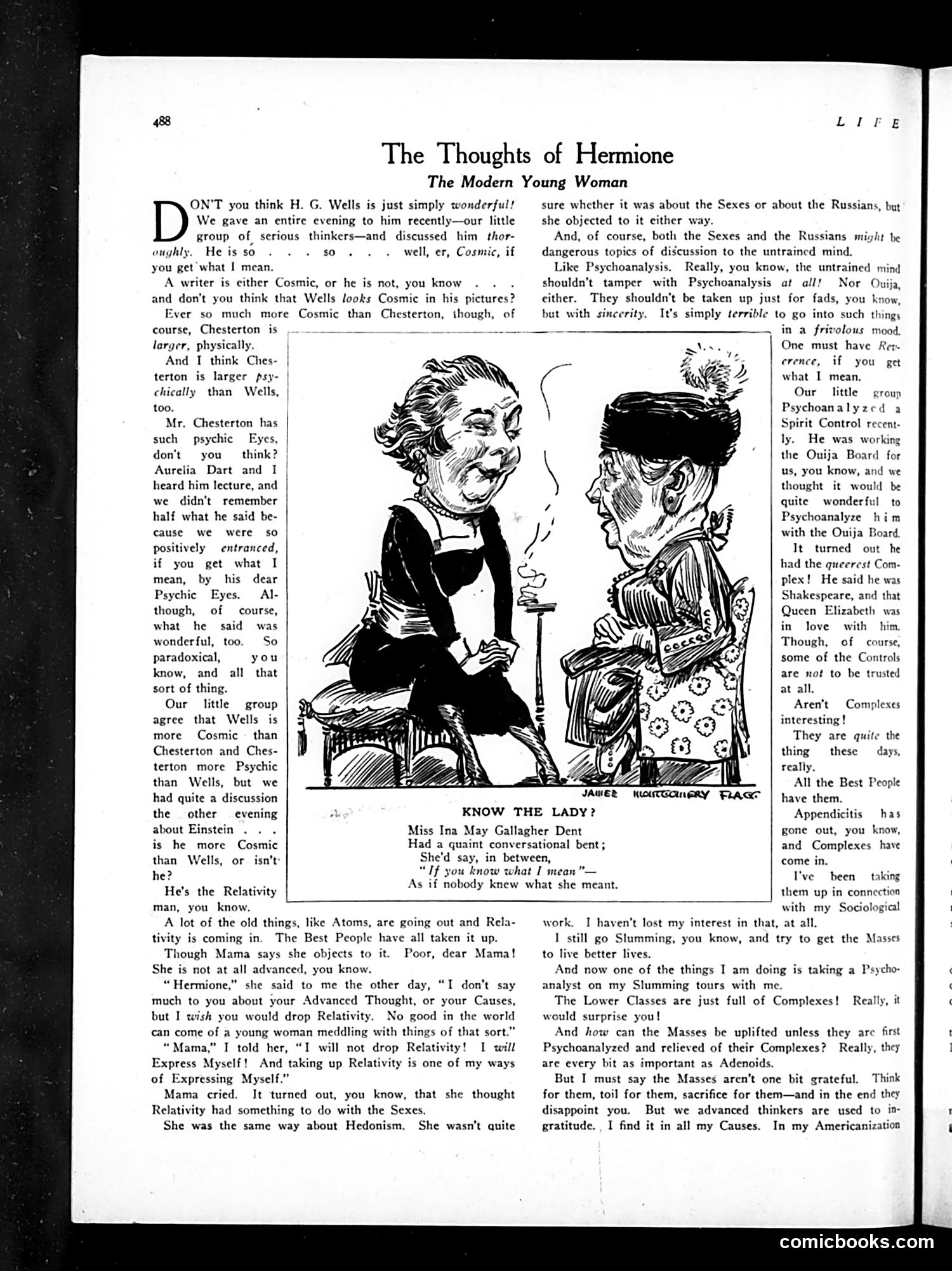
This satirical piece mocks an intellectually pretentious young woman ("Hermione") who adopts fashionable progressive ideas without genuine understanding. The cartoon by James Montgomery Flagg shows her in conversation, illustrating her scattered thoughts about contemporary intellectual trends. The satire targets her casual name-dropping of figures like H.G. Wells and G.K. Chesterton, discussions of Relativity and Psychoanalysis, and enthusiasm for Ouija boards and "Complexes"—all presented as trendy affectations rather than serious engagement. The text ridicules her contradictory positions (claiming to champion the working classes while taking "slumming tours") and her shallow engagement with serious topics like Freudian psychology and social reform. The piece mocks 1920s intellectual fashion among wealthy young women.
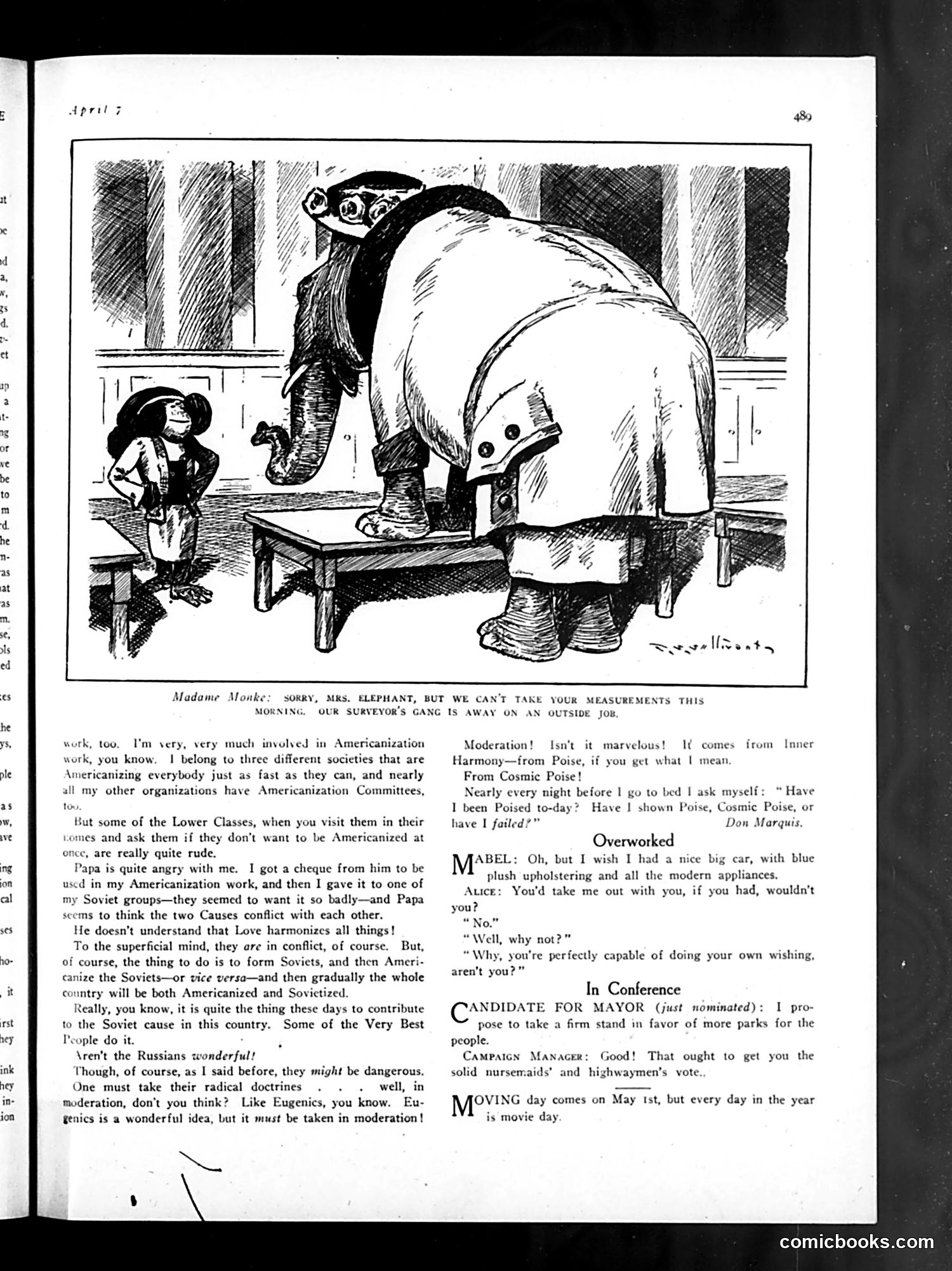
The main cartoon depicts a large elephant being measured by a small woman (labeled "Madame Monke") while a monkey watches from above. The caption reads: "SORRY, MRS. ELEPHANT, BUT WE CAN'T TAKE YOUR MEASUREMENTS THIS MORNING. OUR SURVEYOR'S GANG IS AWAY ON THEIR JOB." This appears to be satire about *Americanization* efforts among immigrant communities. The surrounding text discusses debate over whether to "Americanize" lower-class populations. The elephant likely represents an outsider resisting measurement/assimilation, while the surveyor's absence suggests the measurement/standardization of foreign groups cannot proceed. The cartoon mocks both overzealous Americanization advocates and resistance to such efforts, playing on the absurdity of trying to literally "measure" people into conformity.
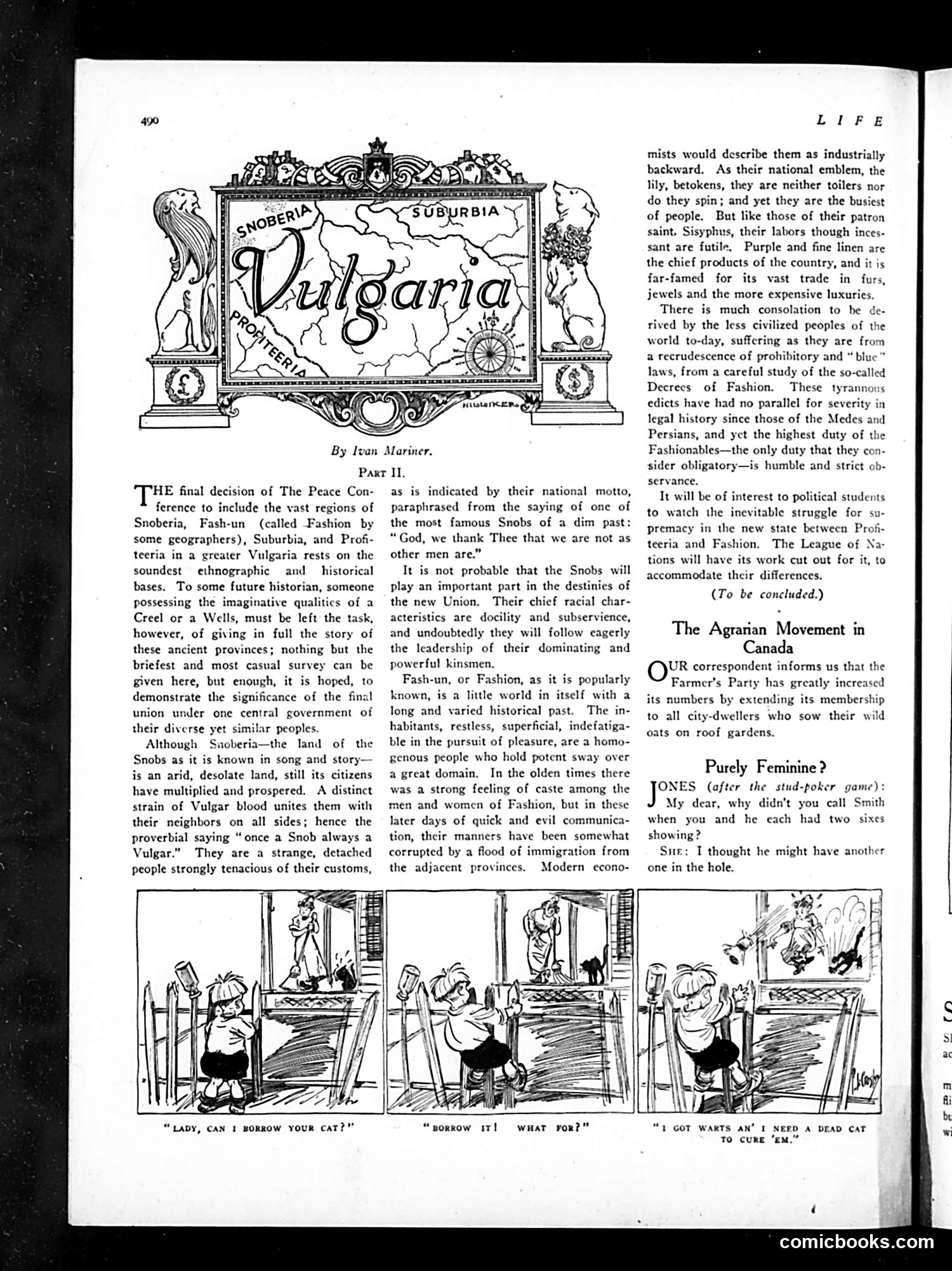
This page contains two separate pieces: **"Bulgaria" (top):** An ornate map illustration by Ivan Mariner describing Bulgaria's geography and people following a Peace Conference decision. The text discusses the Snobs—an ethnic group characterized as docile and subservient—and their role in Bulgaria's future union. It's a serious anthropological/political analysis, not satirical. **"Purely Feminine?" (bottom):** A three-panel comic joke about gender and domestic life. A woman asks to borrow a neighbor's cat; the neighbor asks "what for?"; the woman replies she needs a dead cat to cure something (likely a folk remedy for illness). The humor relies on the absurdity of the request and plays on period stereotypes about women's superstitions or domestic practices.
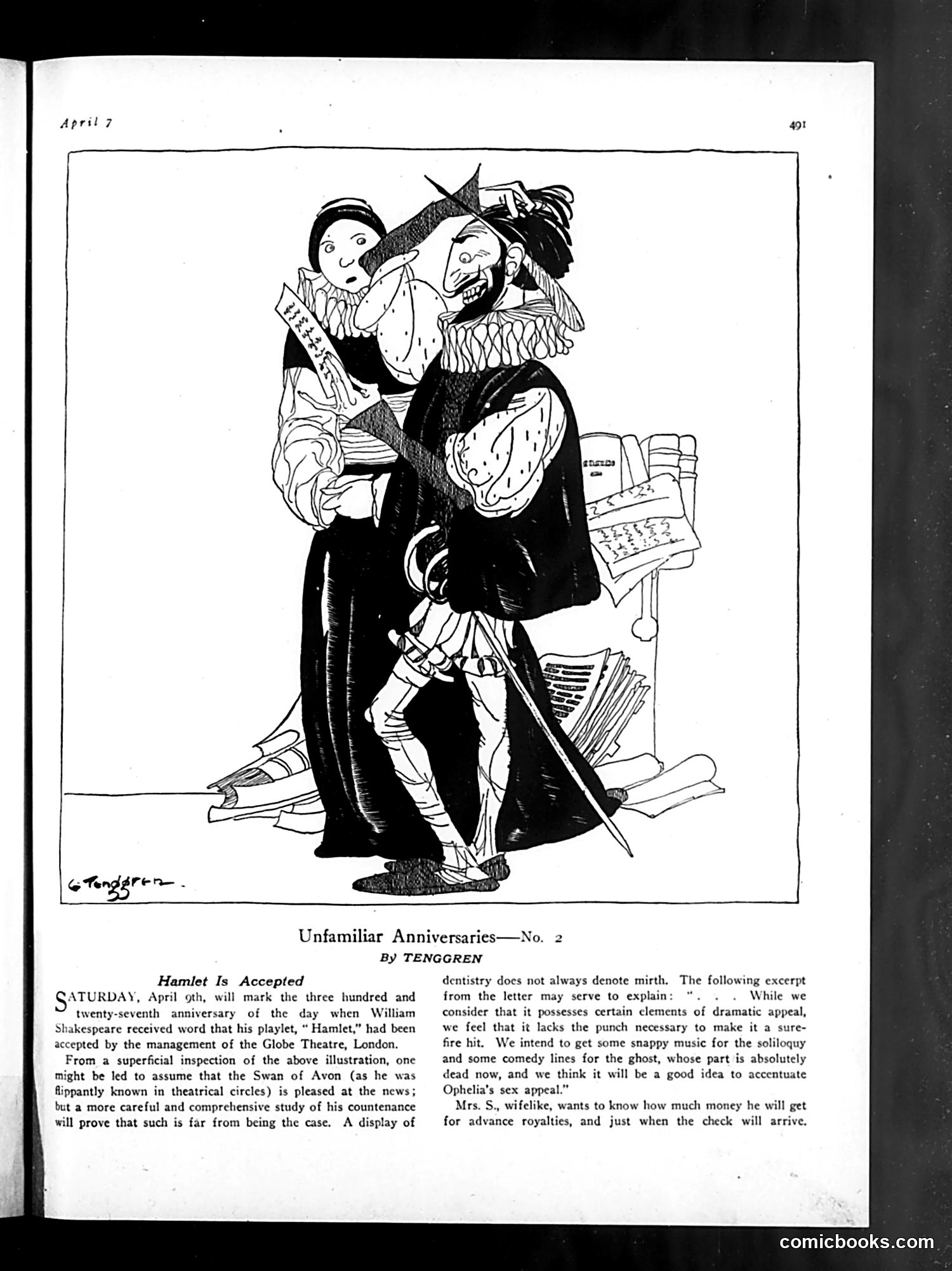
This cartoon satirizes the commercial opportunism surrounding William Shakespeare's 427th anniversary (April 23). The illustration shows a theatrical manager or producer holding a child actor while displaying papers—likely contracts or royalty agreements—surrounded by scattered documents and a sword. The accompanying text mocks how Shakespeare's "Hamlet" was accepted by London's Globe Theatre management, noting the irony that the Swan of Avon (Shakespeare himself) might be displeased by the commercialization. The satire targets producers prioritizing profit over artistic merit, with a wife concerned about "advance royalties" and payment timing rather than honoring the playwright's legacy. The joke critiques how anniversaries become vehicles for financial exploitation rather than genuine artistic commemoration.
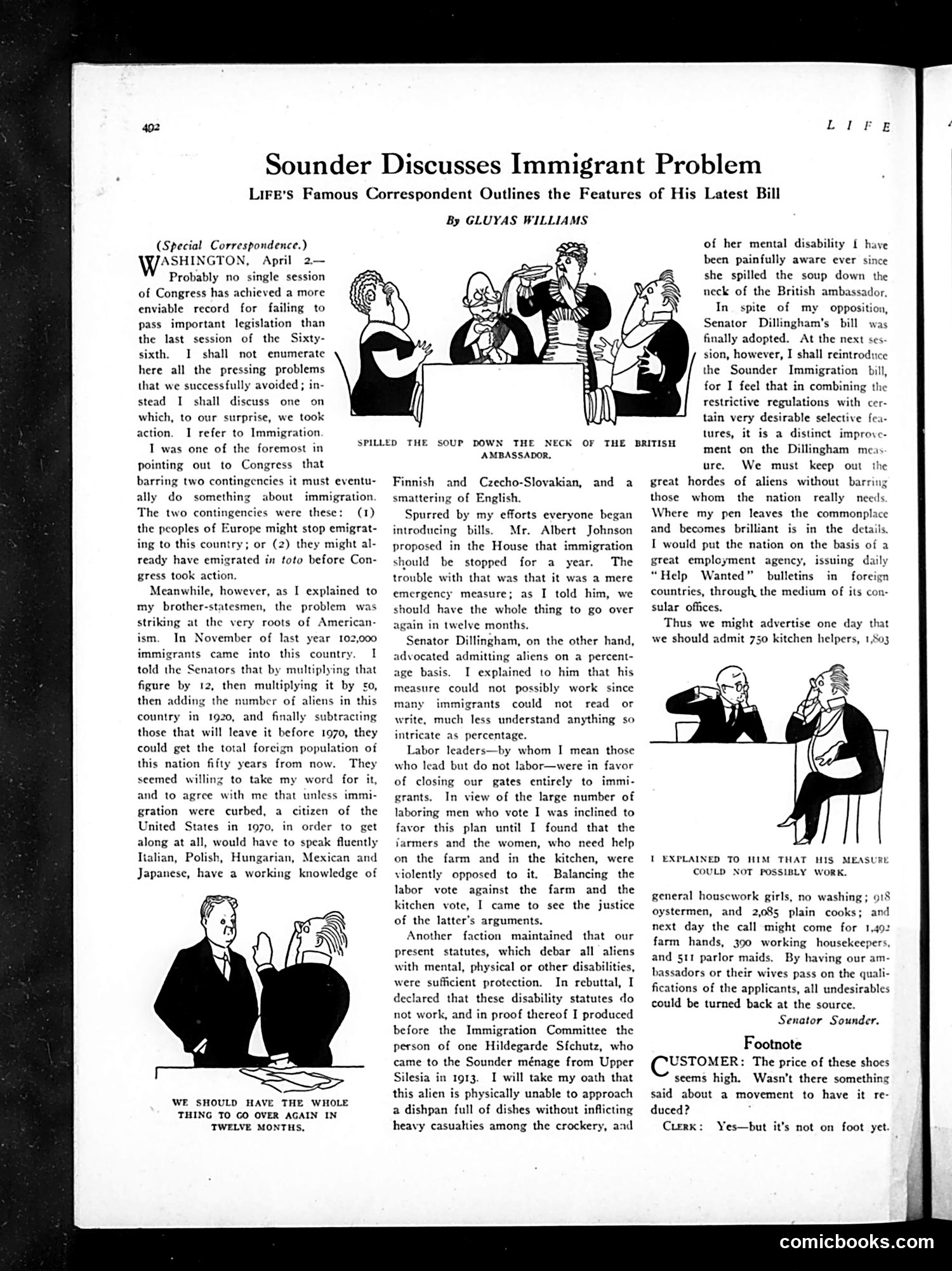
This 1920 Life magazine page features Senator Sounder discussing immigration restriction legislation. The cartoons satirize contemporary anxieties about immigration and labor. The top cartoon shows Sounder "spilling soup down the neck of the British ambassador"—a visual metaphor for diplomatic tensions over immigration policy. The bottom cartoon illustrates Sounder's argument that admitting too many aliens would be problematic, showing him explaining to a labor leader why immigration restrictions are necessary. The article references competing interests: business wanting cheap immigrant labor versus working-class voters opposing immigration. The satire targets politicians like Sounder who navigate these tensions while proposing restrictive quotas based on nationality and ability to read/write. A "footnote" joke about shoe prices adds lighter humor to the serious policy debate.
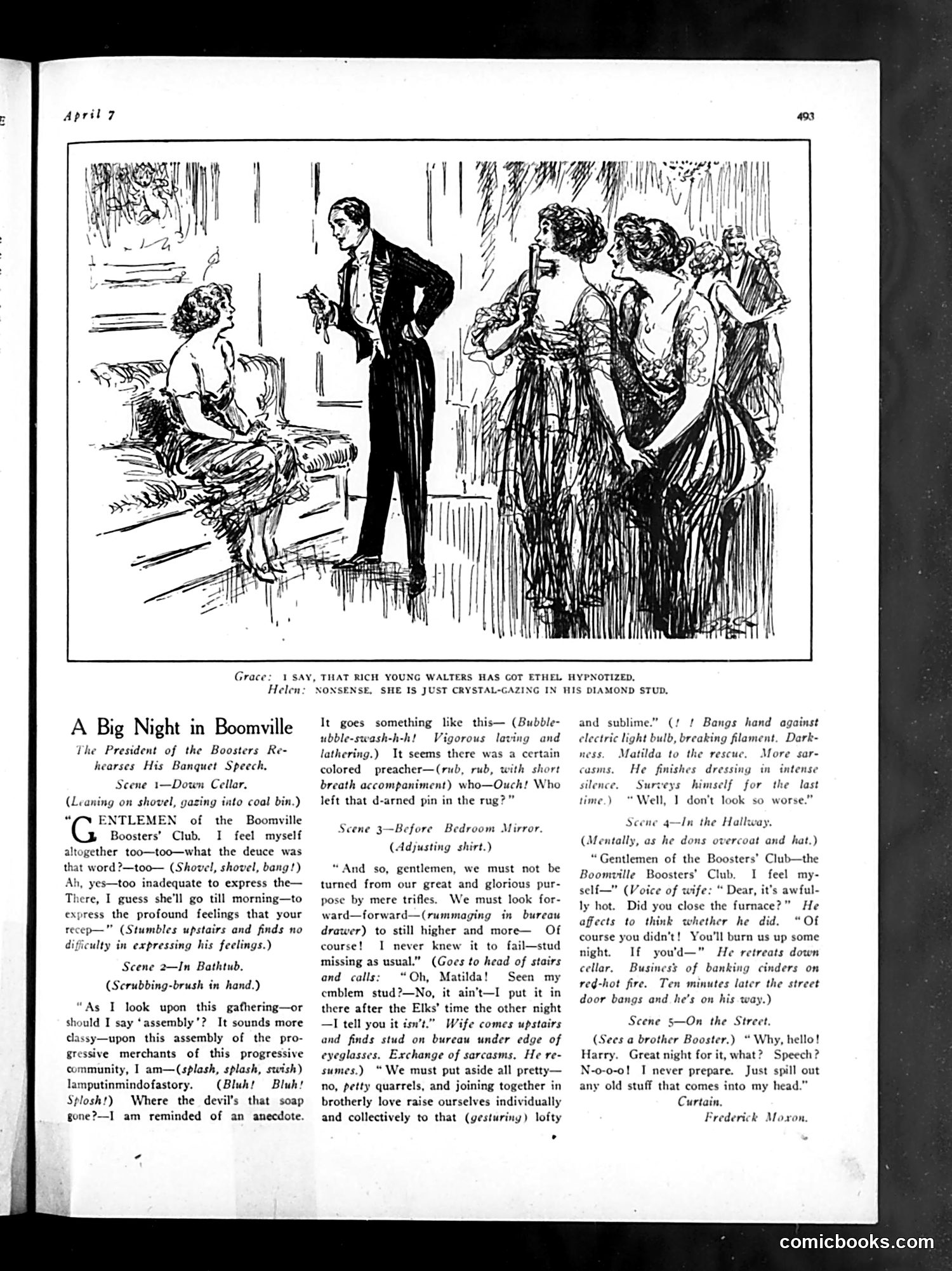
This is a humorous short story illustrated with ink sketches, not a political cartoon. The narrative depicts a banquet scene at the "Boomville Boosters' Club," satirizing small-town civic boosterism and pretentious rhetoric of that era. The story mocks the inflated speeches and grandiose language of local business club leaders ("lofty pose mere titles"), showing contrast between their pompous aspirations and mundane reality (a furnace that won't work, petty squabbles). The multiple scenes—in the cellar, bathroom, bedroom, and street—reveal the gap between the club's self-important public posturing and the chaotic, undignified private reality behind the scenes. The satire targets American small-town culture and its tendency toward self-aggrandizement.
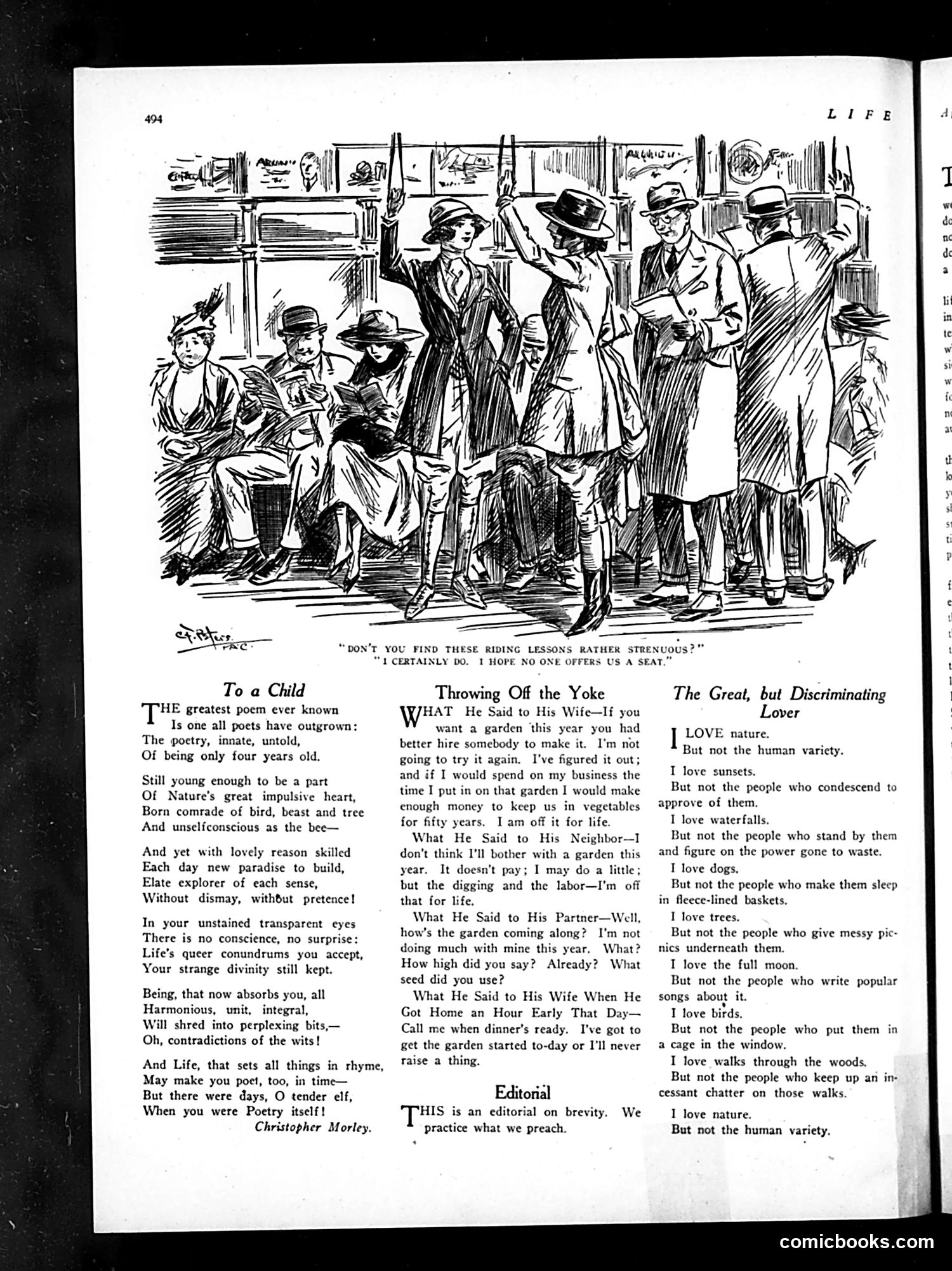
This page from Life magazine contains poetry and an editorial, along with one cartoon illustration at the top. The cartoon depicts a crowded streetcar or train interior with well-dressed passengers. The caption reads: "Don't you find these riding lessons rather strenuous?" "I certainly do. No one offers us a seat." The satire targets urban etiquette and male courtesy norms. The joke appears to center on the irony that despite "riding lessons" (presumably instruction in proper public behavior), men on the streetcar fail to offer their seats to standing women—a basic courtesy expected of gentlemen in this era. It's commentary on the gap between taught social standards and actual behavior, likely poking fun at both women's frustrations and men's inconsistency with chivalric ideals during the early 20th century.
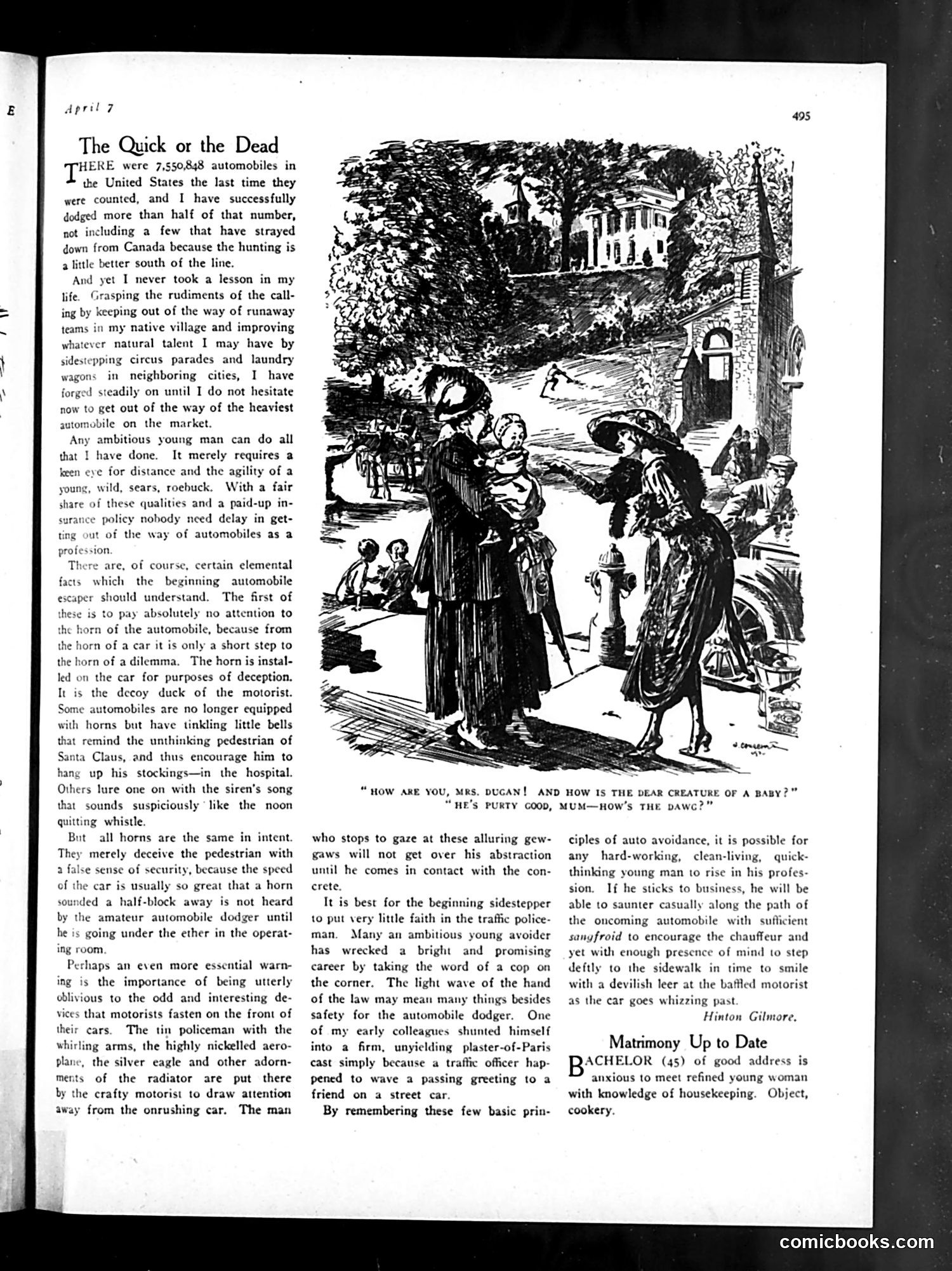
This is a humorous essay mocking the dangers of early automobile traffic. The author satirizes pedestrian culture by positioning "automobile dodging" as a legitimate profession requiring skill and training—a joke about how cars have become so prevalent (over 7.5 million in the U.S.) that avoiding them is practically a full-time job. The accompanying illustration depicts two women in period dress conversing on a street, with a house and vehicles visible in the background. Their dialogue—about Mrs. Dugan's baby—represents ordinary pedestrians oblivious to traffic danger, which the essay warns against. The satire targets both motorists (who use decorative car ornaments and false horn warnings to distract pedestrians) and the inadequate traffic police system. The piece reflects early-20th-century anxieties about rapid automobile proliferation and its threat to traditional street life, when pedestrians had dominated public spaces.
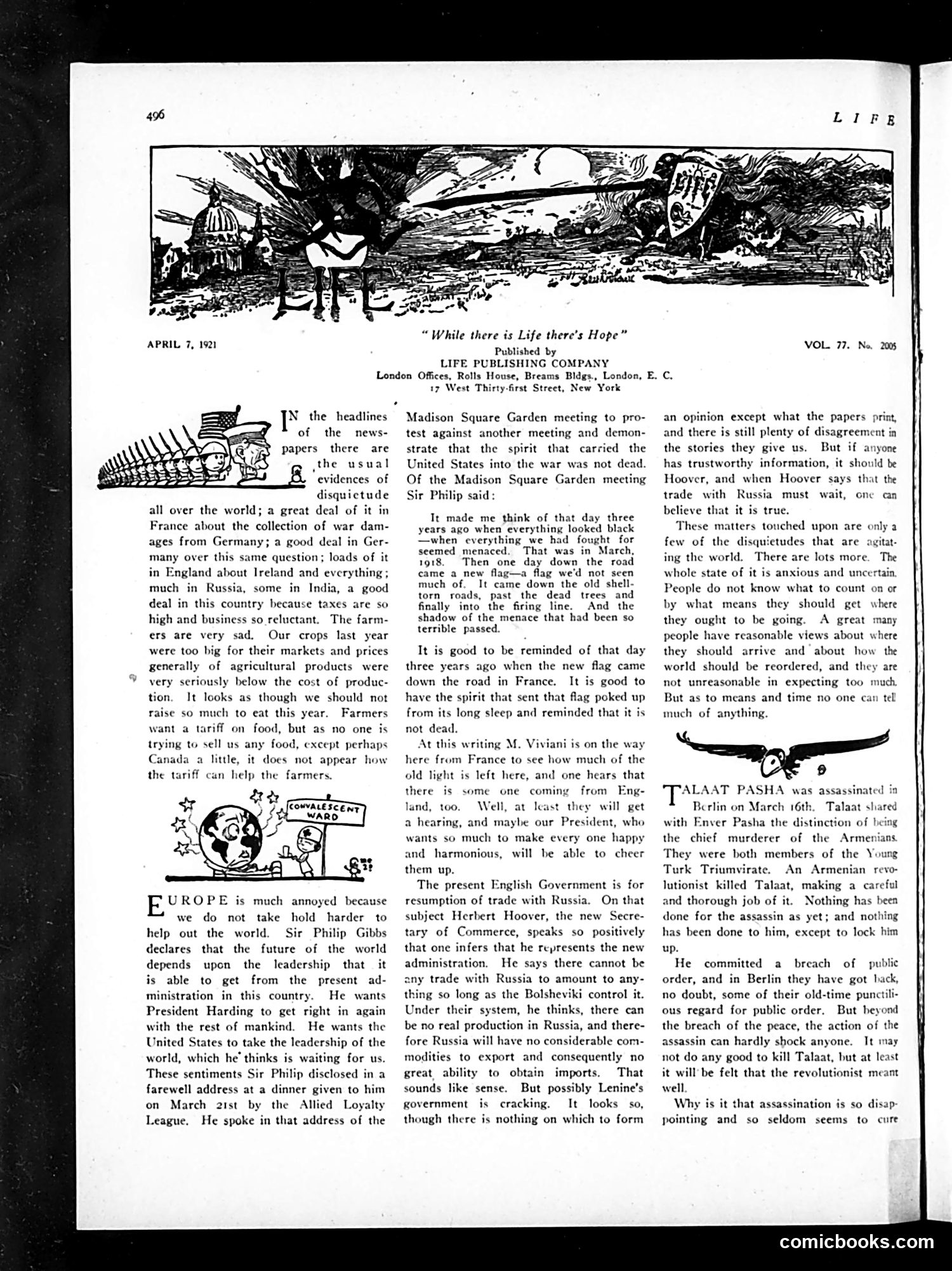
This page contains satirical editorial commentary on post-WWI politics, not primarily cartoons. The main article discusses global unrest: war reparations disputes between France and Germany, Irish troubles in England, Russian instability, and American agricultural depression. The key satire targets Sir Philip Gibbs's recent speech urging President Harding to provide world leadership. The writer skeptically notes that while various nations send delegations seeking American help (French diplomat Viviani, English officials), the real issue is whether America will actually act—or merely "cheer them up" with good intentions. The piece also mocks Secretary of Commerce Hoover's absolute position against Soviet trade, questioning whether his optimism about Russia's government "cracking" is justified. The overall tone: Americans debate grand solutions while practical problems persist unsolved. A small decorative illustration appears (labeled "Comvale Scent Ward"), but its satirical meaning is unclear from this image alone.
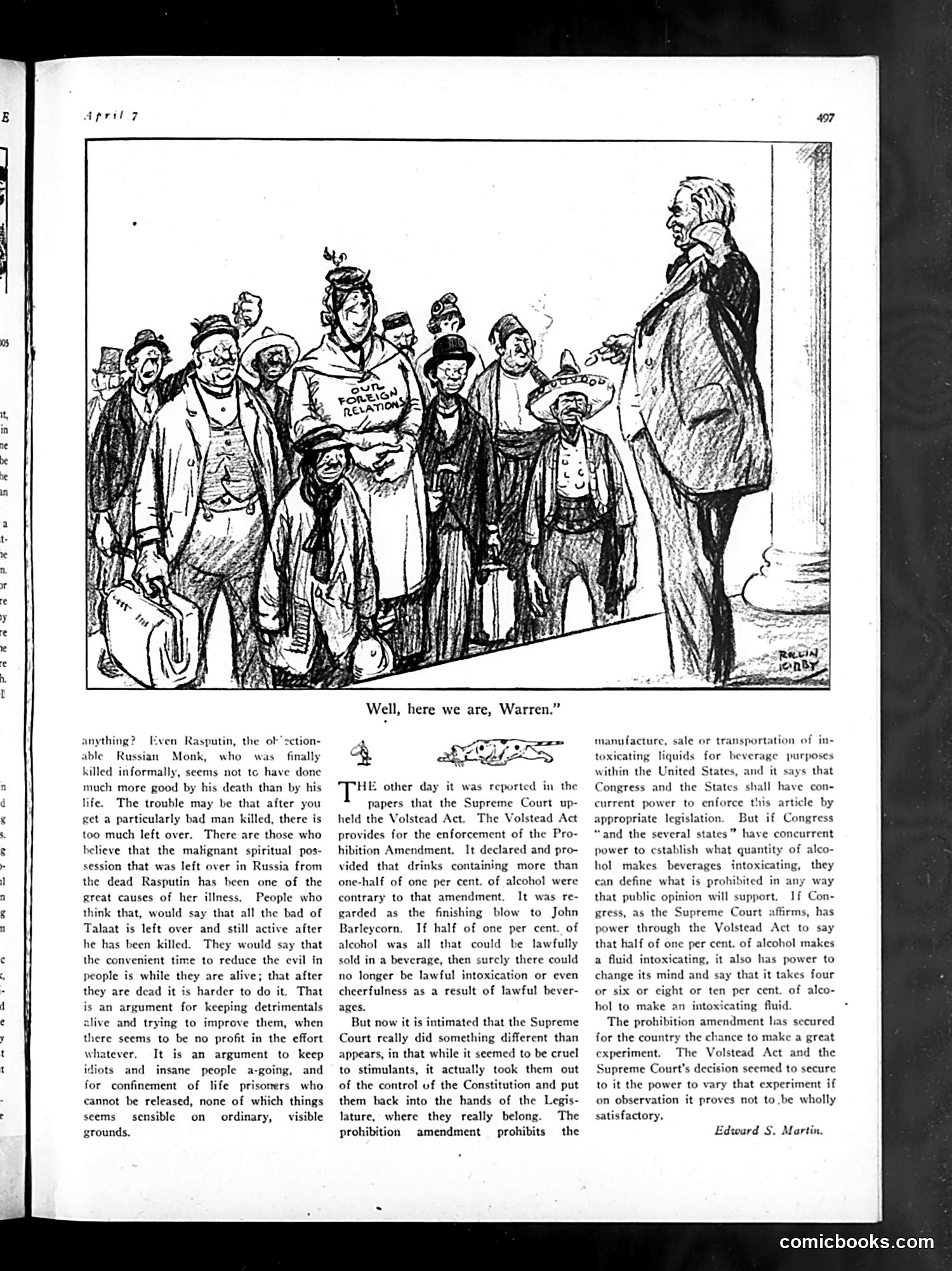
This cartoon critiques the Supreme Court's validation of the Volstead Act (Prohibition enforcement legislation). The illustration shows a well-dressed man addressing a group of poor, downtrodden people, likely representing common citizens or immigrants affected by Prohibition. The accompanying essay by Edward S. Martin explains the irony: while the Court upheld strict Prohibition (limiting alcohol to half of one percent), it simultaneously transferred regulatory power from the Constitution to Congress and state legislatures. This means the government could later redefine what constitutes "intoxicating," effectively allowing them to modify Prohibition standards based on public opinion—without amending the Constitution itself. The cartoon's title sarcastically presents this as presenting citizens with a "solution," when it actually grants authorities flexibility to change Prohibition rules. The satire targets both Prohibition's strictness and the legal sleight-of-hand that undermines its constitutional foundation. "Warren" likely references Warren Harding, the newly elected president associated with Prohibition policy.
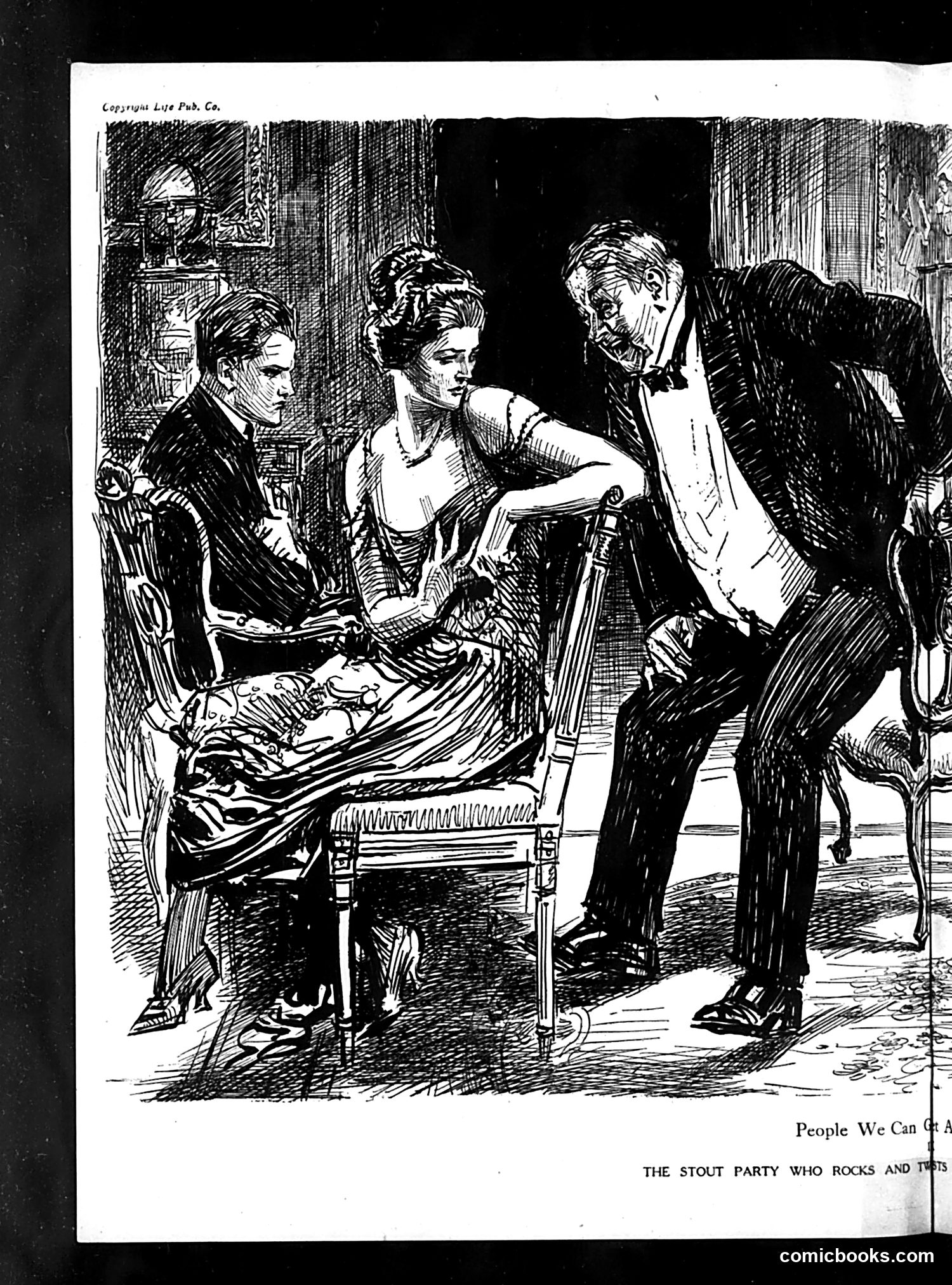
This sketch depicts a social scene from early 20th-century Life magazine. A well-dressed woman sits while three men in formal attire (tuxedos) surround her in what appears to be an elegant interior. The caption refers to "the stout party who rocks and twits," suggesting satire of upper-class social behavior. The humor appears to target either pretentious society gatherings or the awkward dynamics of courtship/socializing among the wealthy. The woman's composed seated position contrasts with the men's animated gestures, possibly mocking male behavior at social events—their attempts to impress or entertain. Without additional context or visible bylines, the specific individuals or events referenced remain unclear, though the style and setting suggest commentary on Gilded Age or Progressive Era social conventions.
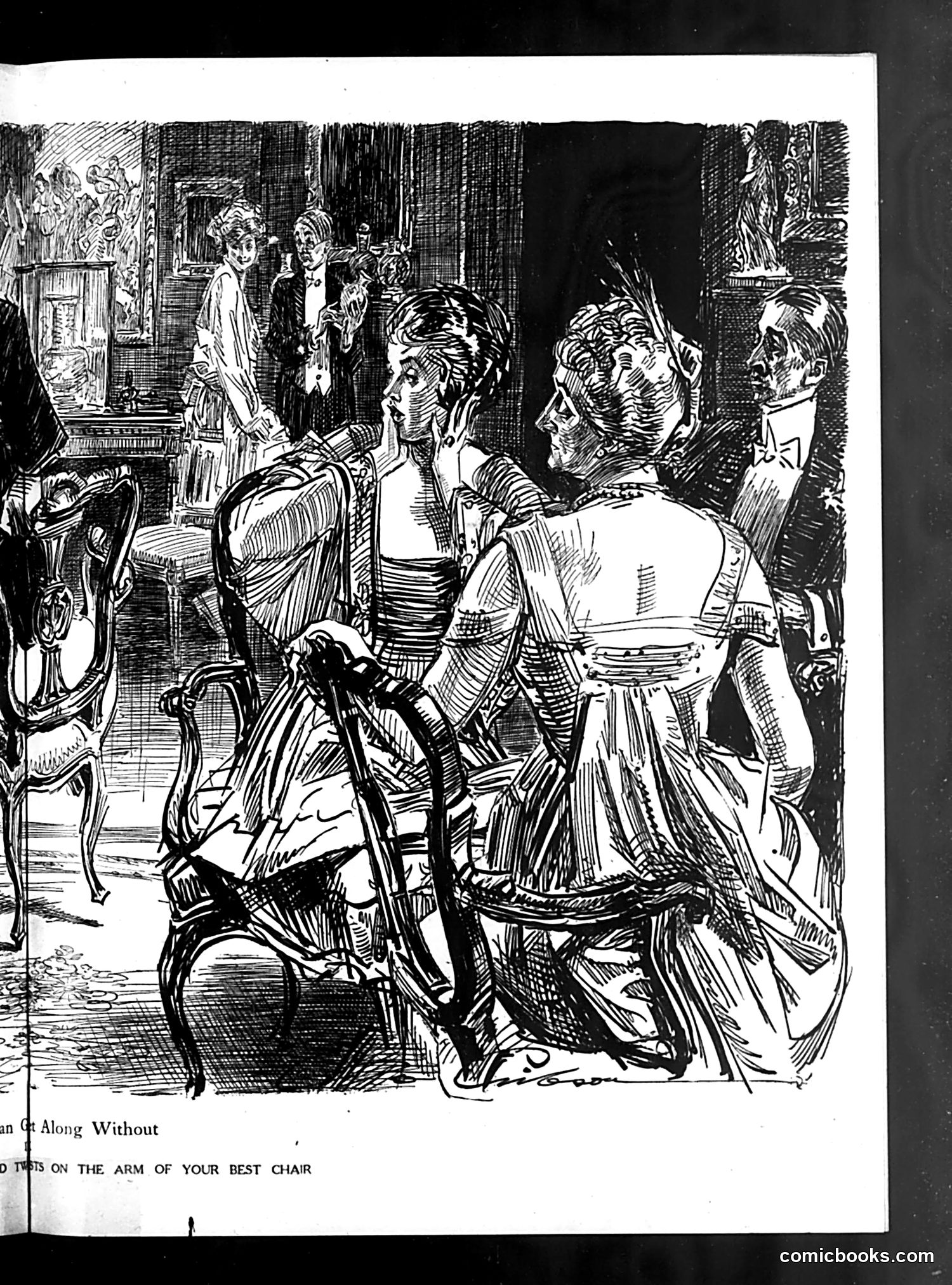
This is an ink illustration depicting an elegant social gathering, likely from the early 20th century based on the style and dress. The scene shows well-dressed figures in formal attire at what appears to be a parlor or drawing room event. The partially visible caption suggests social commentary about etiquette or manners. The phrase about "the arm of your best chair" suggests satire regarding proper behavior in polite society—likely mocking someone's lack of decorum or improper conduct during a social visit. The detailed cross-hatching and character expressions are typical of Life magazine's satirical style, poking fun at upper-class social conventions and the awkwardness of maintaining proper comportment in formal settings. However, without the complete text and caption, the specific satirical target remains unclear.
This is a theater review critiquing John Drinkwater's play *Mary Stuart*, starring actress Clare Eames. The satire is subtle but sharp: the reviewer sarcastically suggests that since Eames is so compelling as historical queens, playwrights should simply cast her in *every* play as either Queen Elizabeth or Mary Stuart—regardless of the actual plot. The joke mocks both the predictability of theatrical stock characters (the "blustering, apoplectic father" recurring endlessly) and Eames' typecast roles. The reviewer praises Eames' performance as genuinely transcendent, noting that her presence elevates an otherwise mediocre play, transforming the tedious prologue into mere "dream" while she becomes theatrical "reality." The piece critiques Drinkwater's flawed premise—the prologue poses whether a woman can love two men simultaneously, but the play offers no real answer—yet acknowledges the work ultimately transcends its own narrative failures through sheer performance quality.
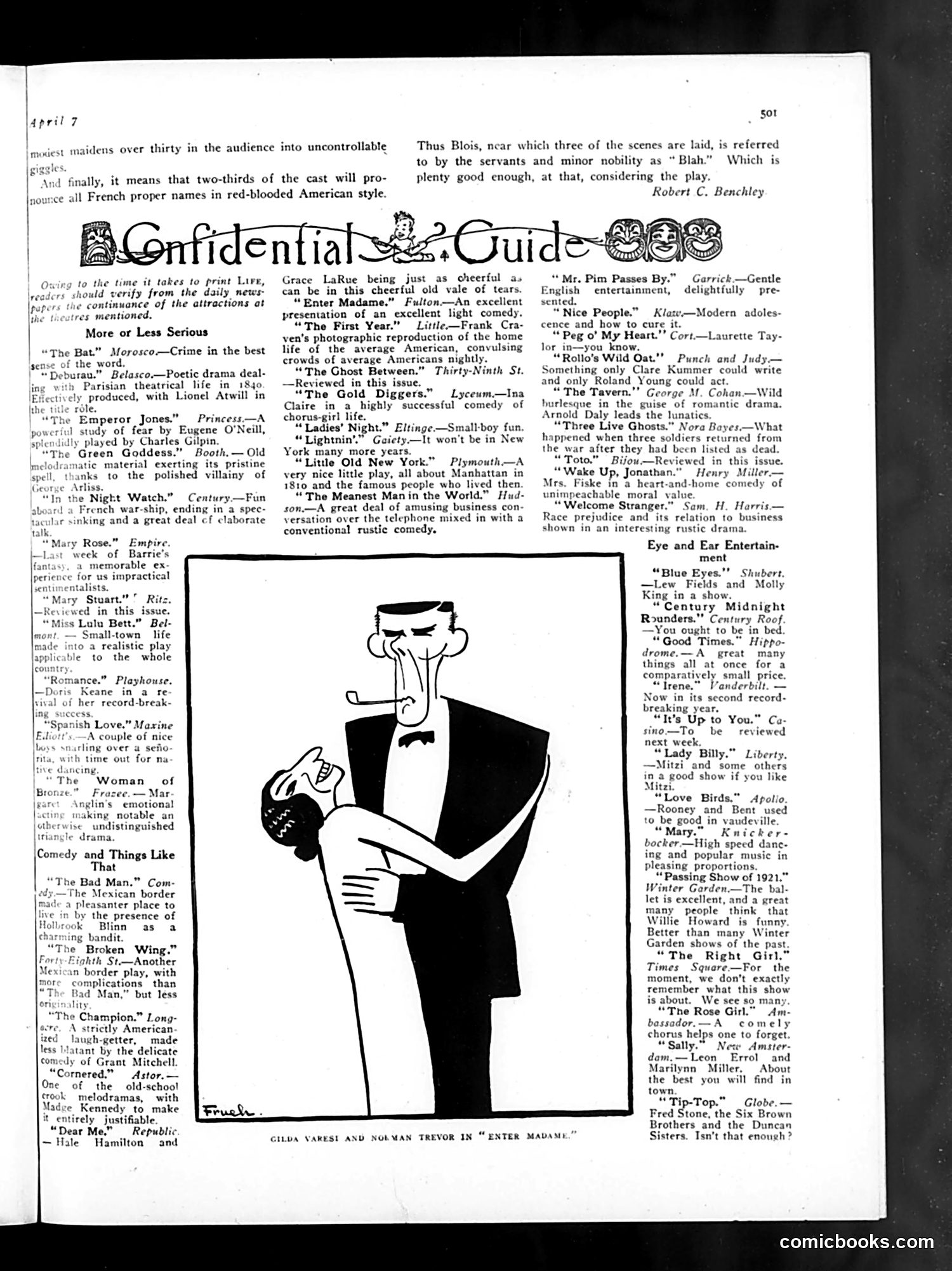
This page from *Life* magazine (April 7, dated at top) is a theater review section called "Confidential Guide," listing Broadway shows with brief critical assessments. The cartoon depicts a formally dressed man in a tuxedo holding what appears to be a telephone or communication device—likely satirizing the theatrical world or a specific performer of the era. The caption credits "Gilda Varese and Norman Trevor in 'Enter Madame,'" suggesting the cartoon illustrates content from that play's review. The surrounding text discusses various Broadway productions, with Robert C. Benchley providing commentary on theatrical presentations and audience reactions. The satire appears aimed at theatrical pretension and the entertainment industry's conventions during the early 1920s. Without clearer visual identification of the caricatured figure, the specific individual being mocked remains unclear, though the formal dress and exaggerated features suggest mockery of theatrical affectation.
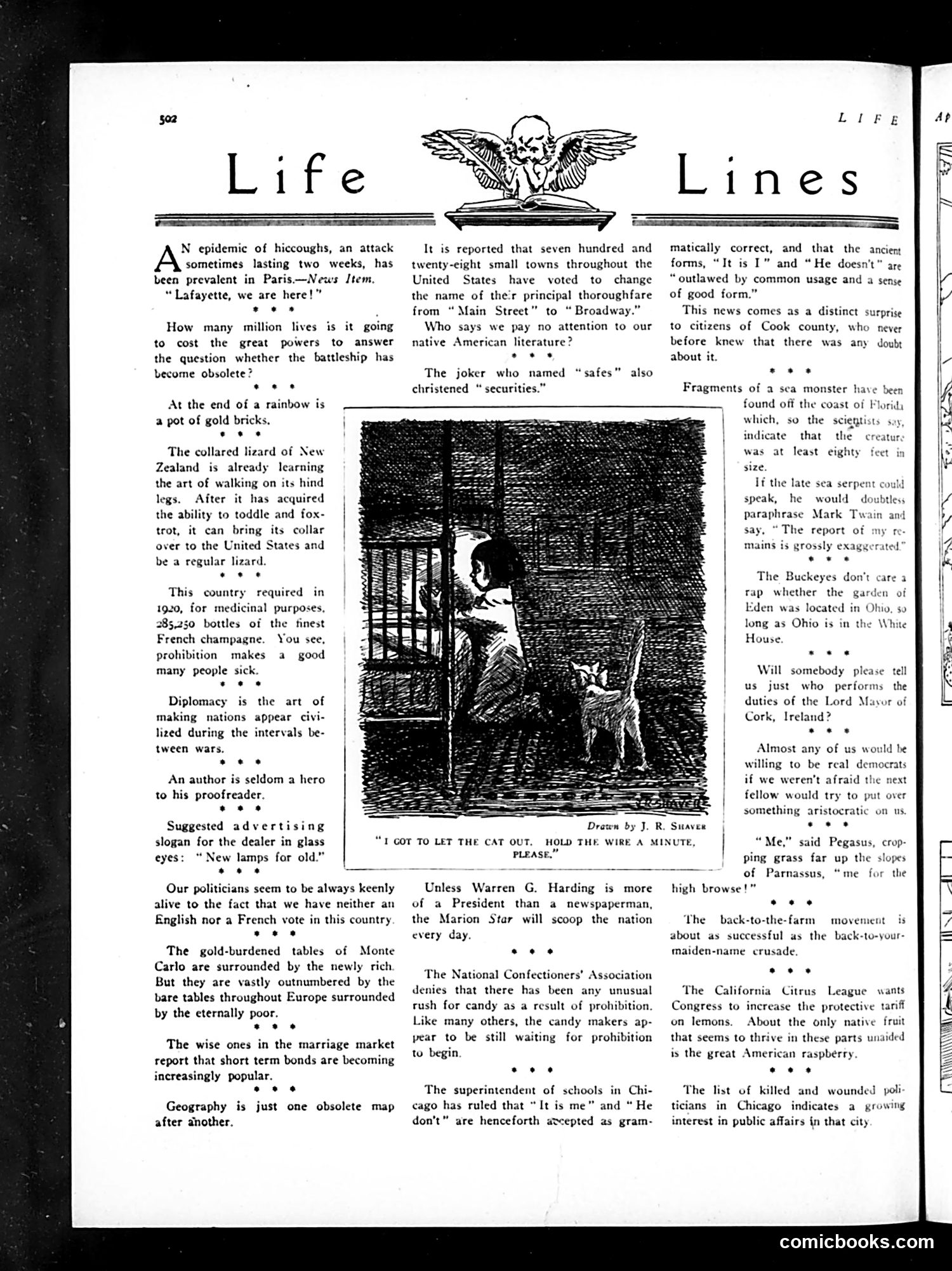
This is a satirical **short-quips column** rather than a political cartoon. The unsigned illustration shows a woman at a window asking a man to hold a wire while she lets her cat out—a domestic scene that anchors the page's humorous commentary. The jokes mock **1920s American life**: prohibition's failure (champagne imports), Warren G. Harding's mediocrity as president, small-town pretension (renaming Main Street to Broadway), and linguistic standardization (Chicago schools accepting "It is me"). References include the Lafayette quote (American WWI service), Monte Carlo wealth inequality, and Ohio's presidential dominance. One joke plays on "safes" and "securities"—wordplay on financial instruments. Another targets the sea-serpent hoax as exaggerated reporting. The tone is gently cynical about American culture, politics, and social pretension—typical of *Life* magazine's witty, cosmopolitan humor during the Jazz Age.
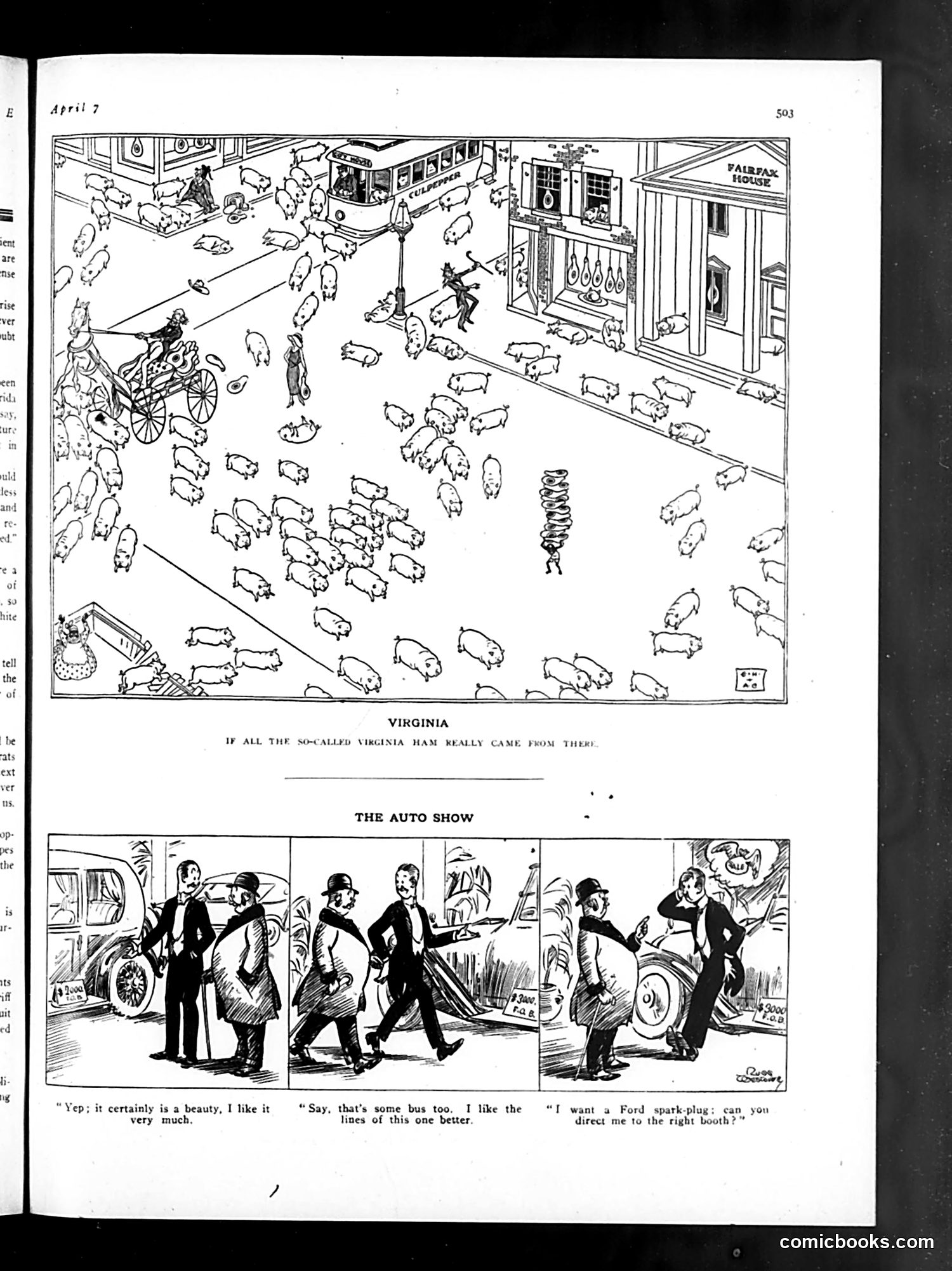
This page contains two satirical cartoons about early automobiles from Life magazine (dated April 7, based on the header). The top cartoon titled "VIRGINIA: If All The So-Called Virginia Ham Really Came From There" depicts a crowded street scene with numerous pigs, suggesting Virginia's ham industry is so massive that pigs would literally flood the streets if all the marketed "Virginia ham" actually originated there. It's a joke about false advertising and regional product claims. The bottom cartoon, "THE AUTO SHOW," depicts three men at an automobile exhibition examining cars. The humor centers on early automobile enthusiasm: one man admires a car's beauty, another prefers a bus's design, and the third seeks a Ford spark plug. The satire mocks the obsessive, detail-focused nature of early auto enthusiasts and the emerging car culture.
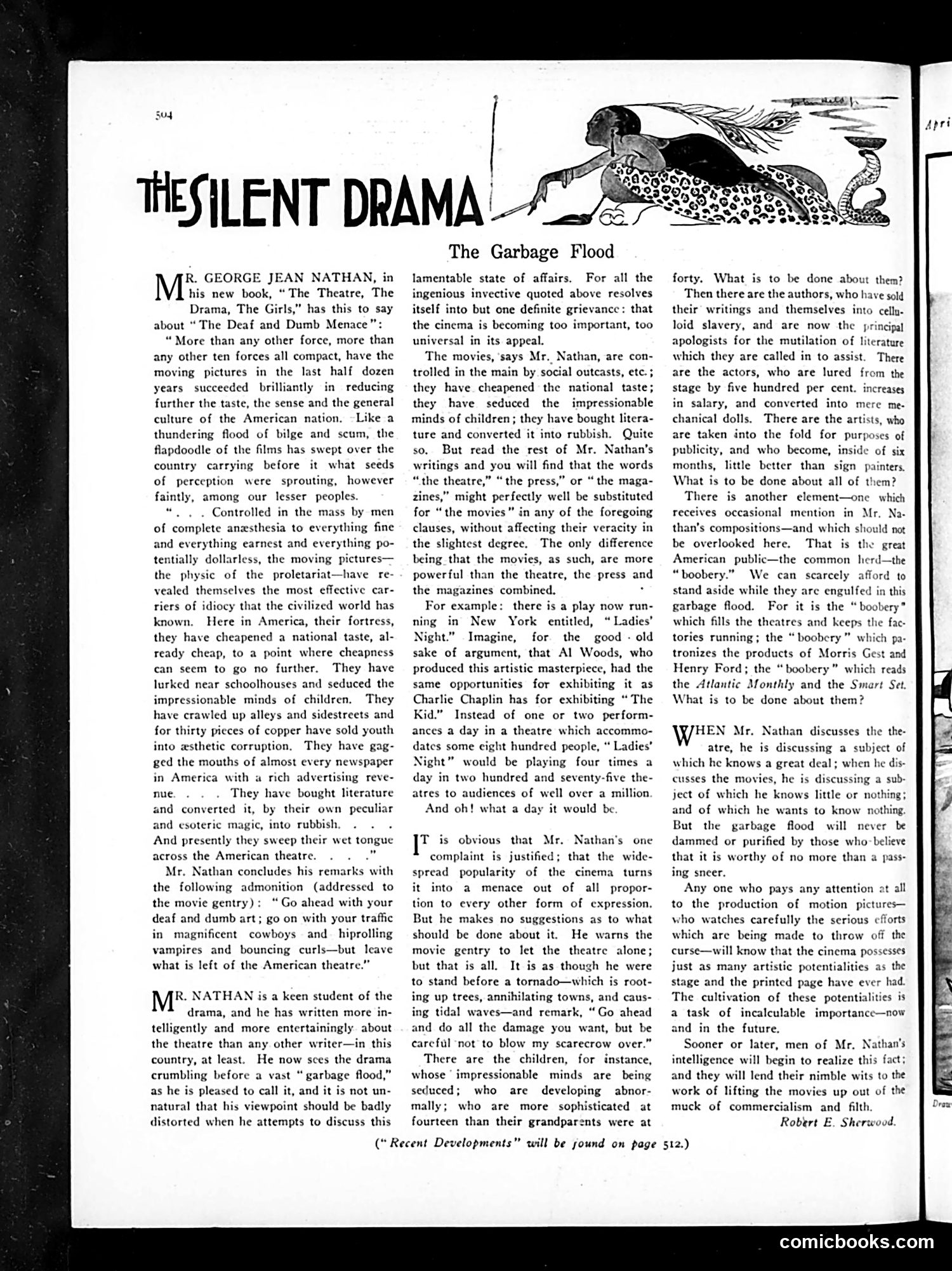
This page presents critic George Jean Nathan's scathing indictment of motion pictures as cultural poison. Nathan argues that movies—controlled by amoral businessmen—have "cheapened" American taste, corrupted children, and are now threatening live theater itself. The article's title, "The Garbage Flood," captures Nathan's apocalyptic view: cinema as a destructive deluge sweeping away legitimate culture. The cartoon at top depicts this literally—a massive wave labeled "garbage" threatening civilization. The author counters Nathan's bias, noting he applies identical criticisms to theater and press, but movies reach vastly larger audiences. The example of "Ladies' Night" illustrates: shown in hundreds of theaters daily versus a stage play's single venue, film's power to influence millions is unprecedented. The underlying debate: is cinema a democratizing art form making entertainment accessible to "lesser peoples," or destructive mass manipulation? Nathan's elitist position—protecting "real" theater from commercial cinema—represents a common 1920s intellectual anxiety about mass media.
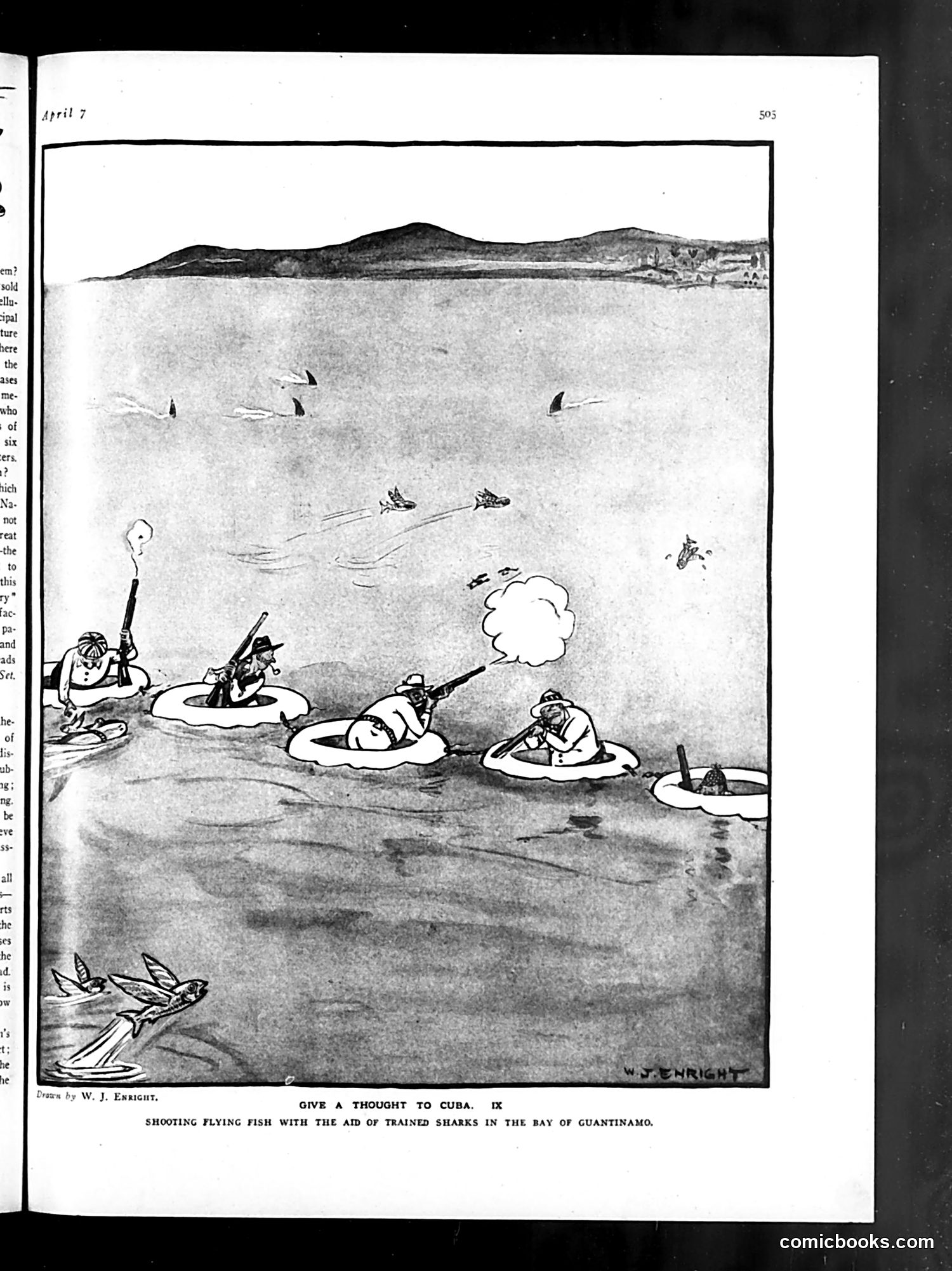
This is a satirical cartoon by W. J. Wright depicting an absurd scene in Guantanamo Bay. The caption sarcastically suggests "shooting flying fish with the aid of trained sharks"—an impossible scenario. The cartoon appears to mock American imperial attitudes toward Cuba, particularly around the U.S. naval base at Guantanamo Bay. The ridiculous premise—using sharks to hunt flying fish—likely satirizes American military presence in Cuba as similarly nonsensical or wasteful. Soldiers are shown in small boats firing guns at flying fish while sharks circle below, a surreal image emphasizing the pointlessness of the enterprise. This was published during a period when American intervention in Cuban affairs was controversial. The cartoon's title, treating Cuba as something to "give a thought to," suggests criticism of how casually Americans viewed Cuban sovereignty while maintaining their military foothold.
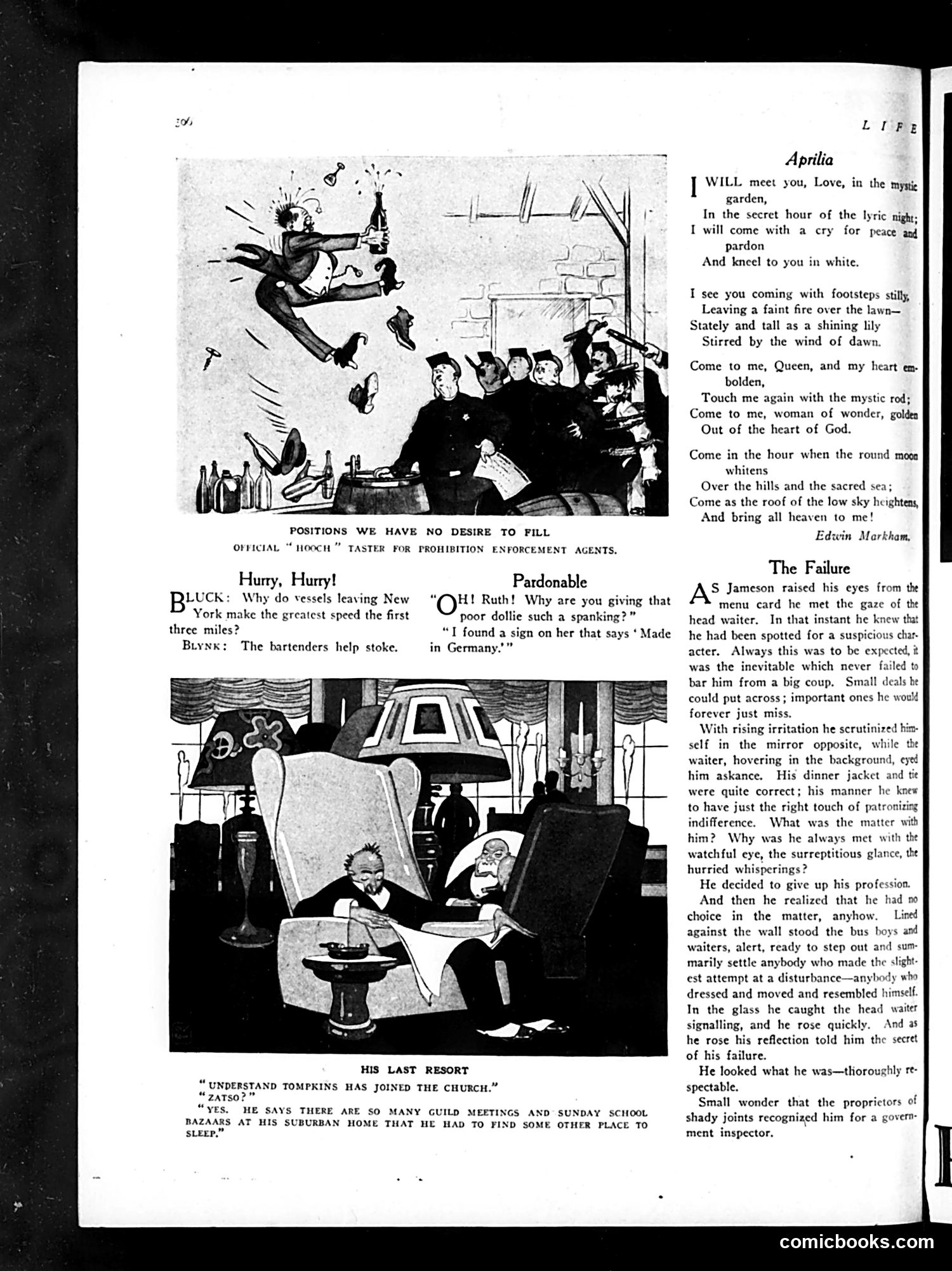
This page contains multiple satirical items from Life magazine's humor section. **Top cartoon**: Shows a chaotic dinner party scene where a figure (appearing to be a ghost or supernatural being) crashes through a window above seated diners. The caption references "Hooch taster for Prohibition enforcement agents"—satirizing Prohibition-era enforcement by suggesting even officials couldn't resist alcohol. **"Hurry, Hurry!" joke**: A pun about ships leaving New York fast because "bartenders help stoke" the engines—mocking Prohibition by suggesting crews were motivated by alcohol-fueled energy. **"Pardonable" joke**: A German-made doll being spanked, playing on anti-German sentiment and post-WWI prejudices common in 1920s America. **"The Failure" story**: A short fiction piece about a waiter who realizes he fails at criminal schemes because he looks "thoroughly respectable"—he's mistaken for a government prohibition inspector, preventing him from illicit work. The page's overall theme satirizes Prohibition enforcement and alcohol culture during the 1920s-30s.
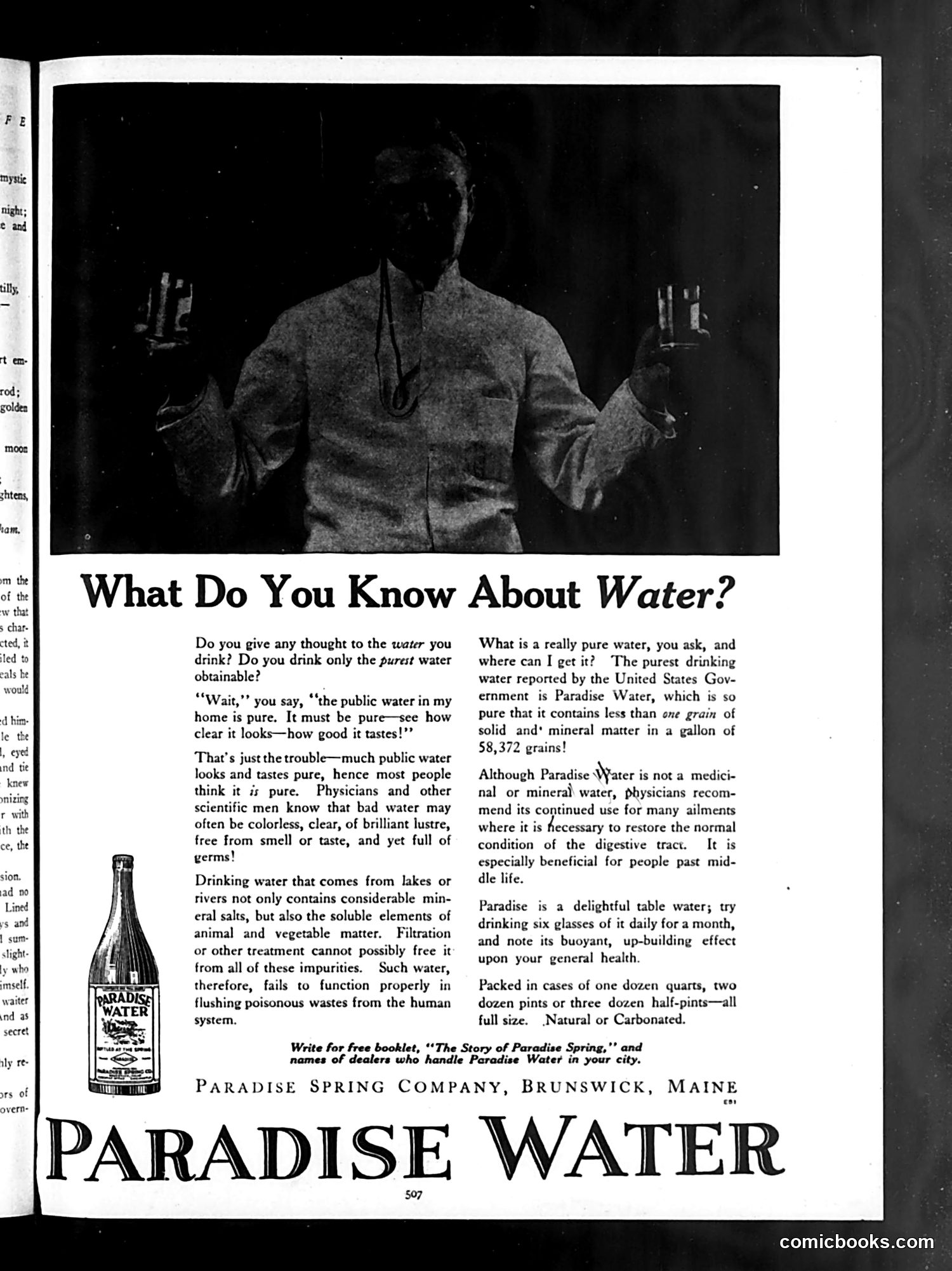
This is primarily a **product advertisement**, not satire or political commentary. The page promotes Paradise Spring Company's bottled water from Brunswick, Maine. The rhetoric reflects early-20th-century health anxieties: the ad claims public tap water—though appearing clear and pure—actually contains dangerous germs and mineral impurities that harm digestion. It positions Paradise Water as the solution, citing government purity standards and physician endorsements. The image shows a man (likely representing a physician or authority figure) gesturing persuasively while holding what appear to be water glasses. **Context for modern readers**: This reflects pre-FDA regulation marketing when bottled water companies made bold health claims without scientific oversight. The "purity" argument and medical endorsements were common advertising tactics to sell premium bottled water to middle-class consumers concerned about contaminated municipal water supplies—a legitimate concern in that era, though the ad exaggerates Paradise Water's superiority.
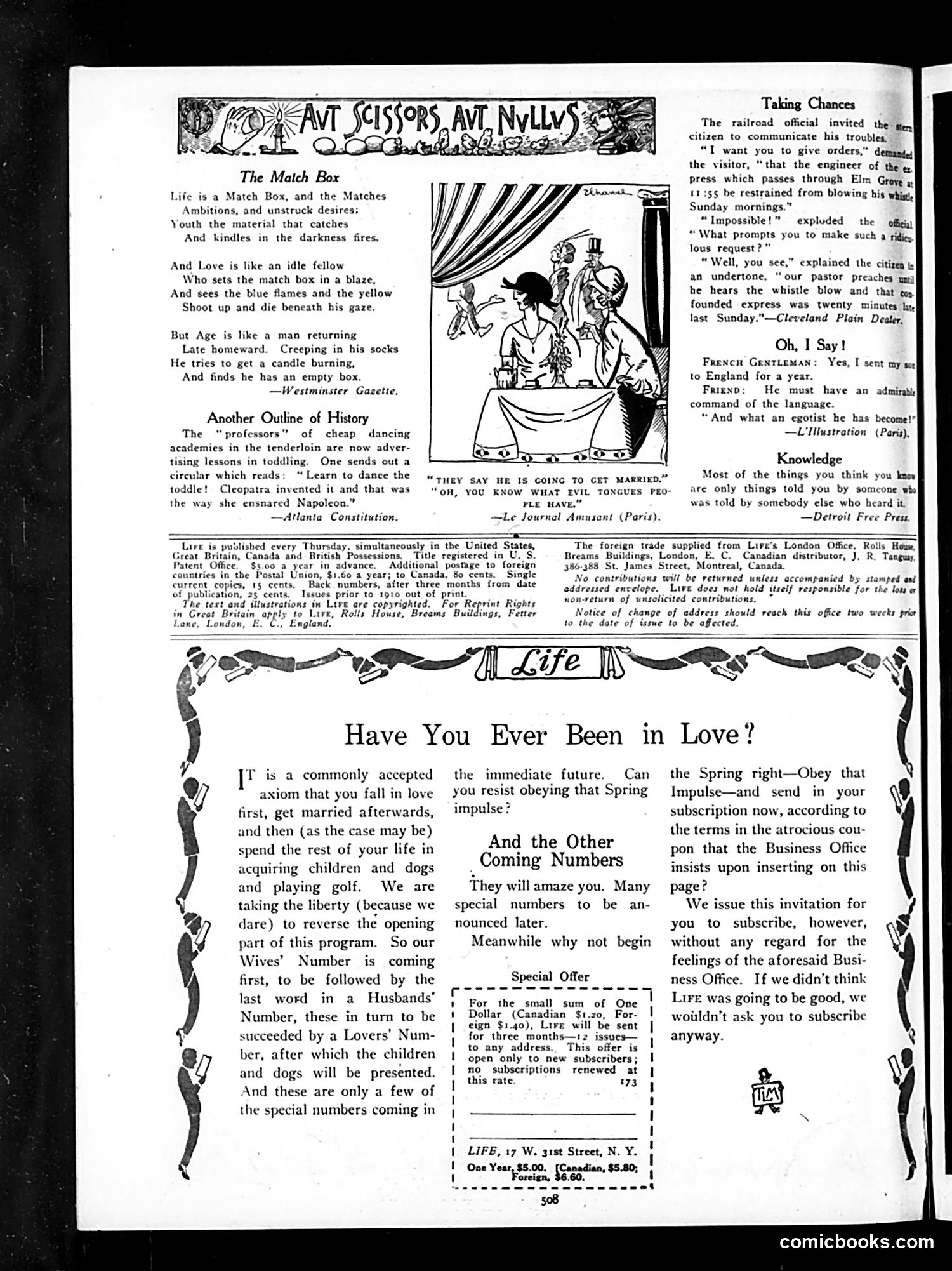
This page from *Life* magazine contains several short satirical pieces and poems typical of early 20th-century humor: **"The Match Box"** is a philosophical poem comparing life stages to matches—youth as kindling fire, age as searching for a spent candle. **"Another Outline of History"** mocks cheap dance academies advertising "toddle" lessons by sarcastically crediting Cleopatra with inventing the dance to seduce Napoleon—absurd historical conflation for comic effect. **The cartoon** depicts a woman telling a man she sent her "set" to England for a year, with the friend remarking she must speak English well and has become an egotist—likely a joke about affectation gained abroad. **"Taking Chances"** is a humorous anecdote about a man asking a railroad to silence its whistle because it prevents his pastor from preaching—satire on both religious obsession and absurd complaints. The page concludes with promotional material for upcoming special *Life* issues targeting wives, husbands, and lovers, using lighthearted copy to solicit subscriptions. The overall tone is genteel, urbane satire aimed at educated readers.
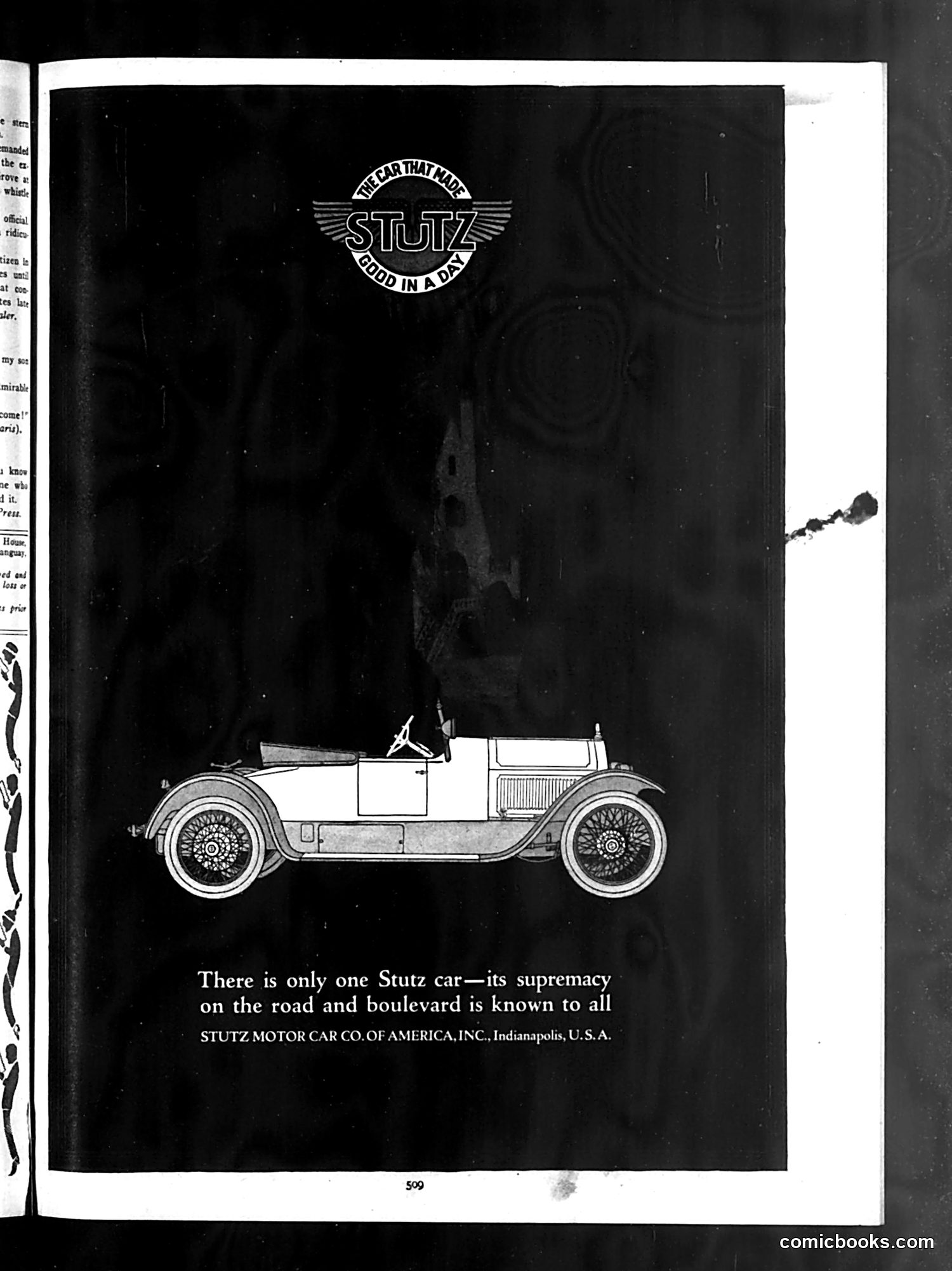
This is a **Stutz automobile advertisement**, not political satire. The page features a side-profile illustration of an early 1920s open-air touring car with the Stutz winged logo at top and the company's motto "Built in a Day" visible in the circular emblem. The ad's text claims the Stutz's "supremacy on the road and boulevard is known to all," positioning it as a prestigious vehicle. The dramatic black background and sleek illustration style were typical of luxury car advertising from this era, emphasizing elegance and performance to appeal to wealthy consumers. The company was based in Indianapolis, Indiana. This appears to be pure product advertising rather than satirical content.
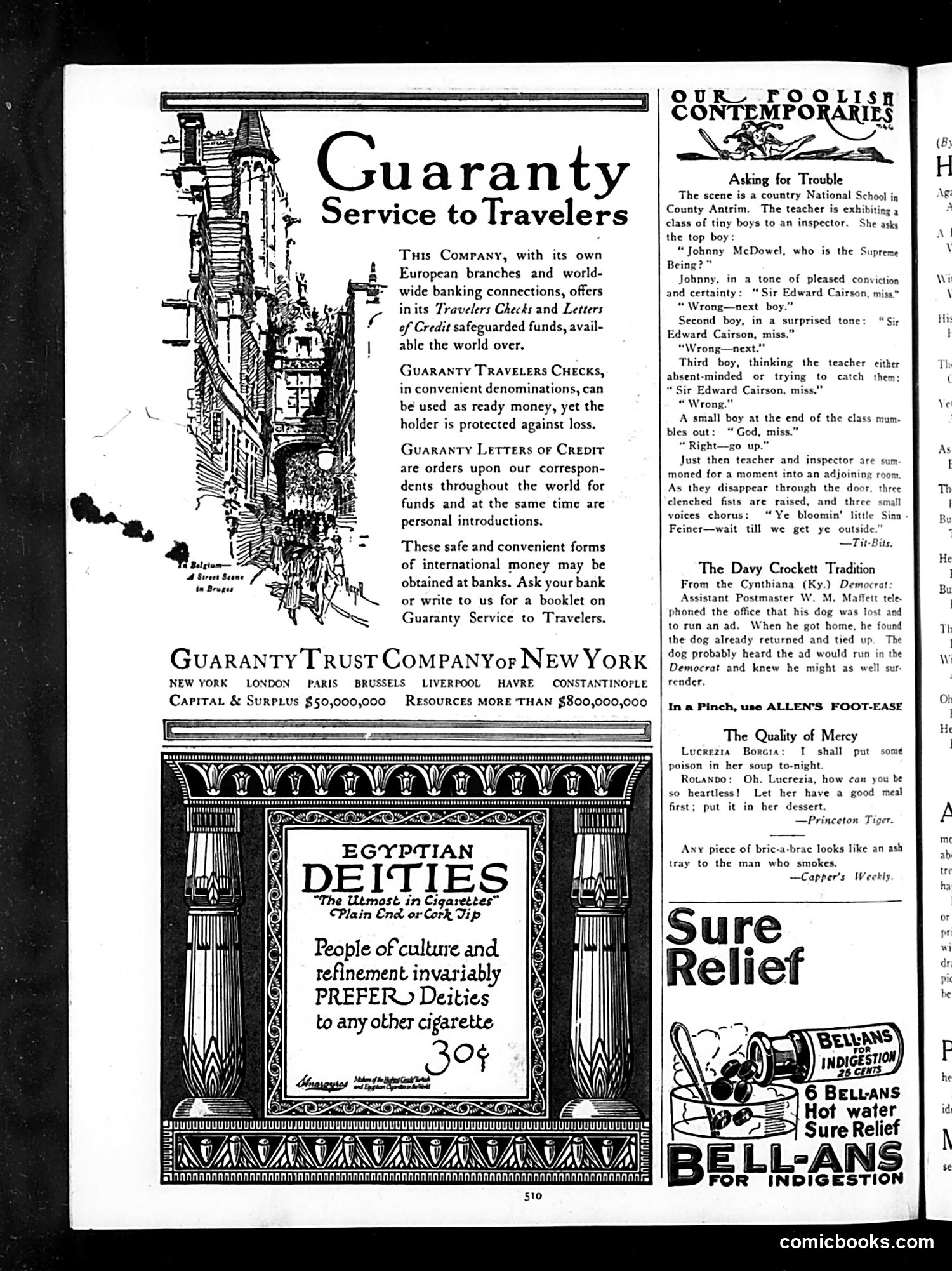
This magazine page is predominantly **advertising** for financial services (Guaranty Trust Company travelers checks) and consumer products (Egyptian Deities cigarettes, Bell-Ans indigestion remedy). However, it includes **humor content** on the right, notably "Asking for Trouble," which is **Irish political satire** from this period. The joke mocks Irish nationalist sentiment during a tense time (likely around WWI-era Irish independence movements). When Northern Irish schoolboys are asked who the "Supreme Being" is, they answer "Sir Edward Carson" (an actual Ulster politician opposed to Irish independence), then reluctantly say "God." In private, they express Sinn Féin sympathies—"ye bloomin' little Sinn Feiner"—suggesting nationalist tensions between generations. The other humor pieces are mild period jokes about courtship, pets, and social customs.
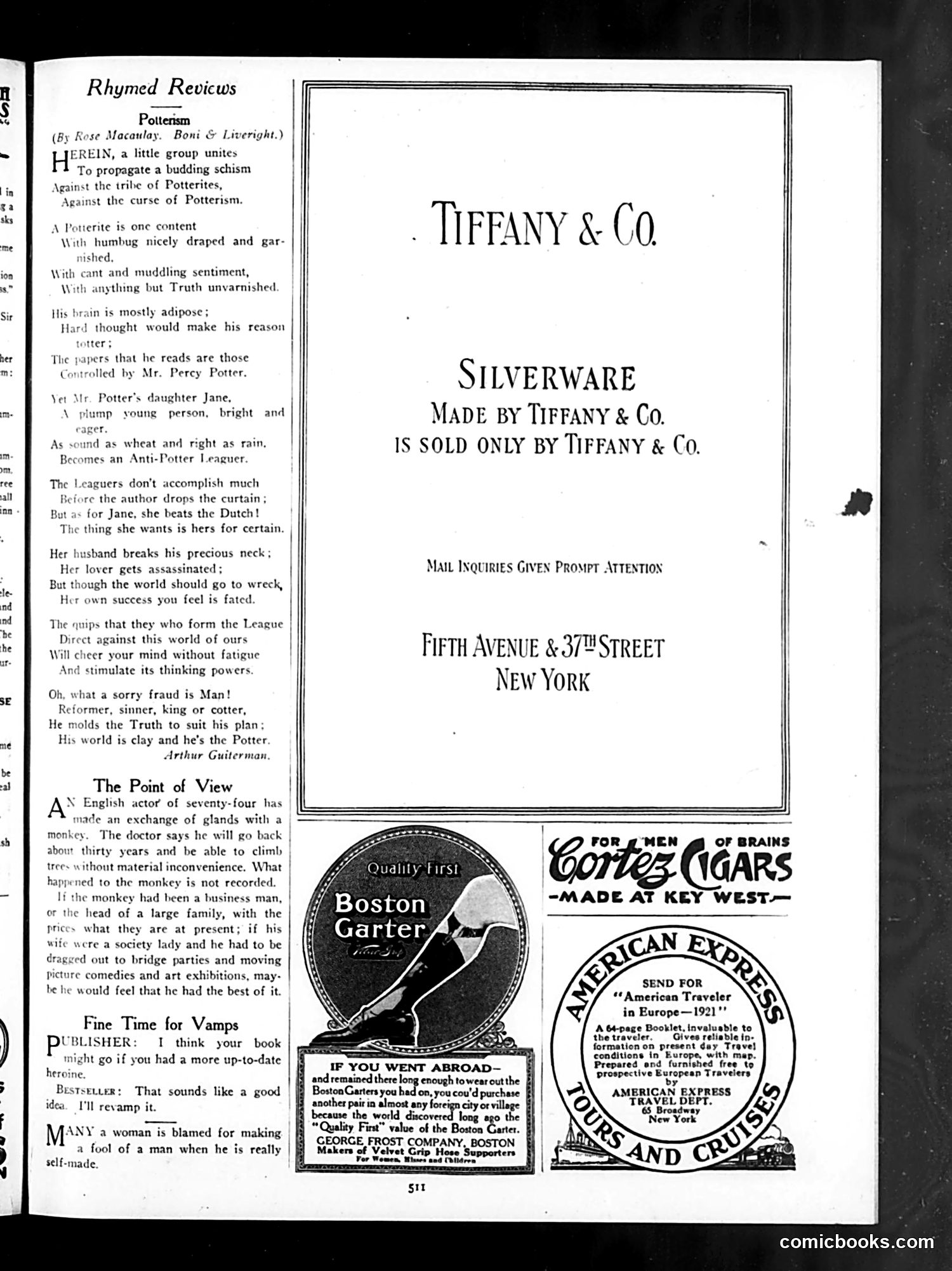
This page primarily contains **book reviews and advertisements** rather than political cartoons. The main satirical content is "Rhymed Reviews" by Arthur Guiterman, critiquing a novel called *Potterism* by Rose Macaulay. The satire targets **intellectual pretension and shallow reformism**: it mocks "Mr. Percy Potter," apparently a character who manipulates truth to suit his worldview, and his followers who form leagues claiming to oppose "Potterism" but accomplish little. Guiterman's closing couplet—"His world is clay and he's the Potter"—sarcastically suggests that fraudulent men of all types remake truth as they please. "The Point of View" offers lighter satire about an elderly English actor who exchanges glands with a monkey, joking that despite the doctor's promise of rejuvenation, modern married life with its social obligations would make even the monkey prefer its original condition. The remainder consists of period advertisements (Tiffany silverware, Boston Garters, American Express travel services, Cortez cigars).
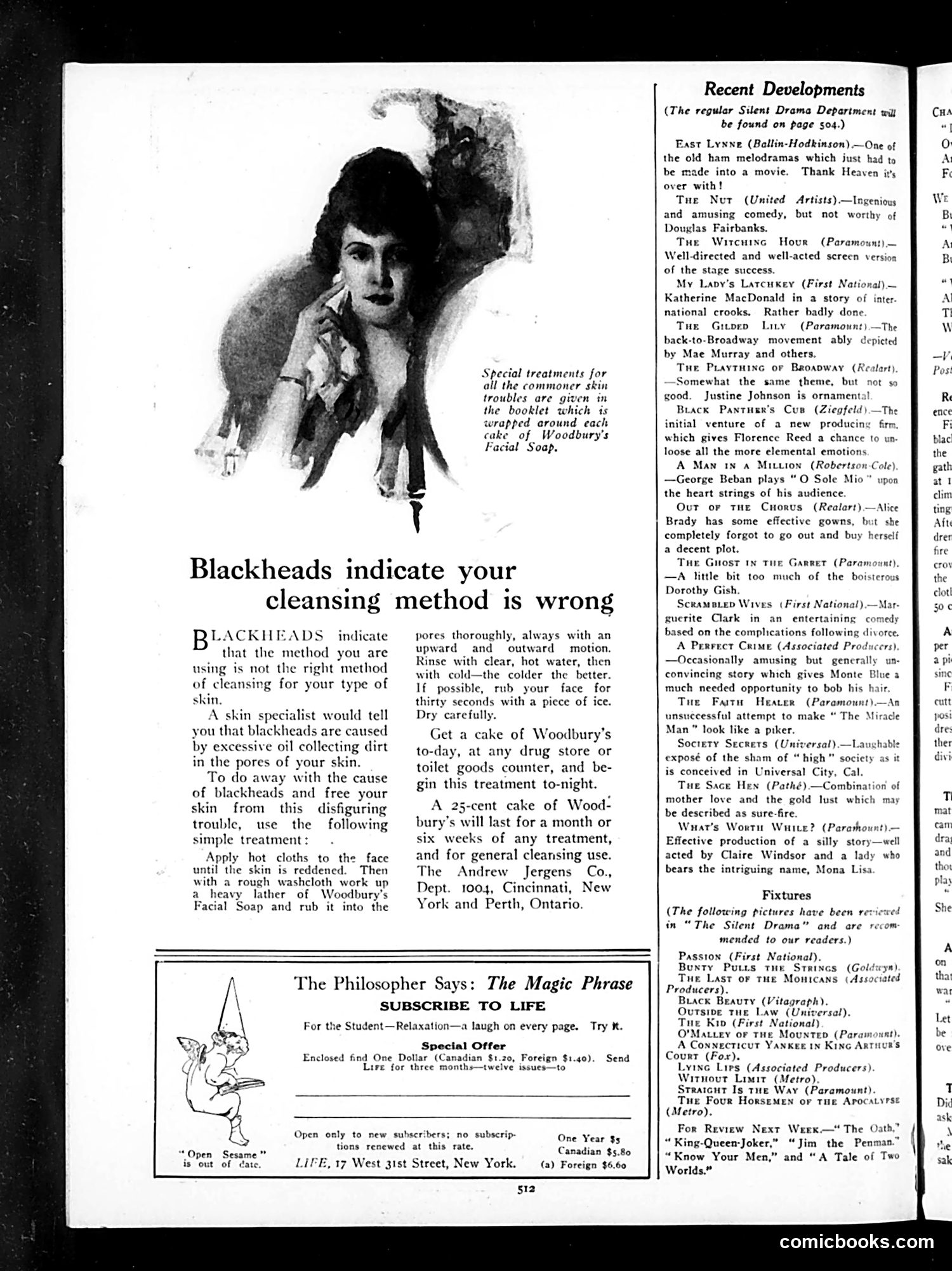
The main image shows a woman's face with visible blackheads, paired with a Woodbury's Facial Soap advertisement. The ad claims blackheads result from improper cleansing and recommends their product—a common early 20th-century skincare marketing strategy using guilt and pseudoscientific explanation to drive sales. The right column contains film reviews from Life magazine's "Silent Drama" section, critiquing contemporary silent movies (circa 1920s). Reviews are brief and sardonic—praising direction and acting while mocking weak plots. Notable is the dismissive tone toward some established stars like Douglas Fairbanks ("not worthy of"). The "Philosopher Says" box advertises Life magazine subscriptions, using a whimsical mascot character ("Open Sesame" reference visible). This represents Life's identity as a humor/satire publication competing for educated, literate audiences during the silent film era. The page essentially blends commercial advertising with entertainment criticism—both targeting the same middle-class readers.
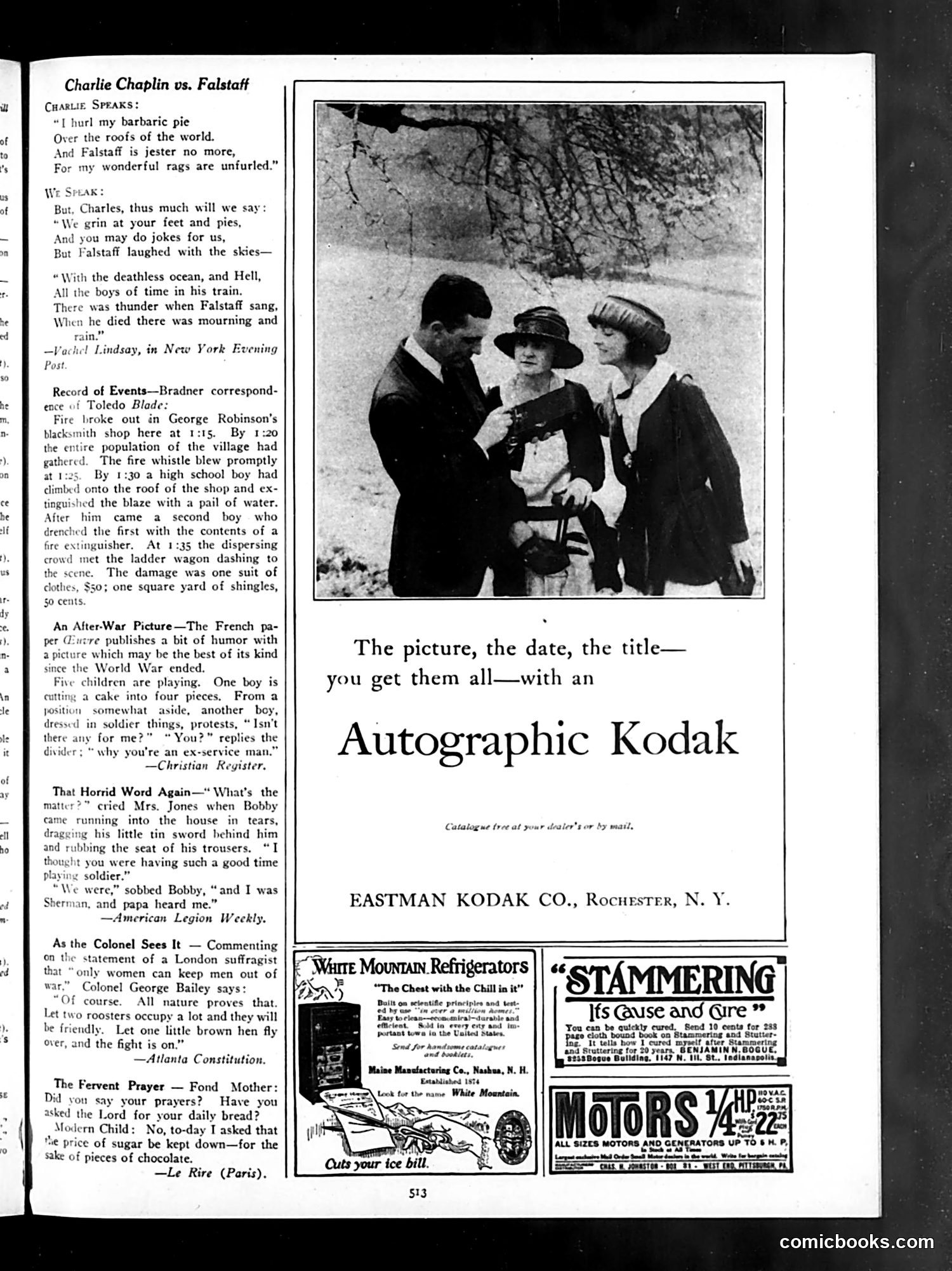
This page presents a literary debate about comedic merit. The text compares Charlie Chaplin—the silent film star famous for physical comedy ("barbaric pie" thrown "over the roofs of the world")—against Falstaff, Shakespeare's comic character. Vachel Lindsay's poem argues that while Chaplin makes audiences "grin at your feet and pies," Falstaff achieved something grander: he "laughed with the skies" and possessed cosmic significance ("thunder when Falstaff sang"). The satire critiques modern entertainment's reliance on slapstick versus classical literature's deeper philosophical comedy. The photograph shows three figures in formal dress outdoors, likely illustrating the Chaplin reference, though exact identification is unclear from the image alone. The remainder of the page consists primarily of advertisements and unrelated humorous anecdotes about everyday life.
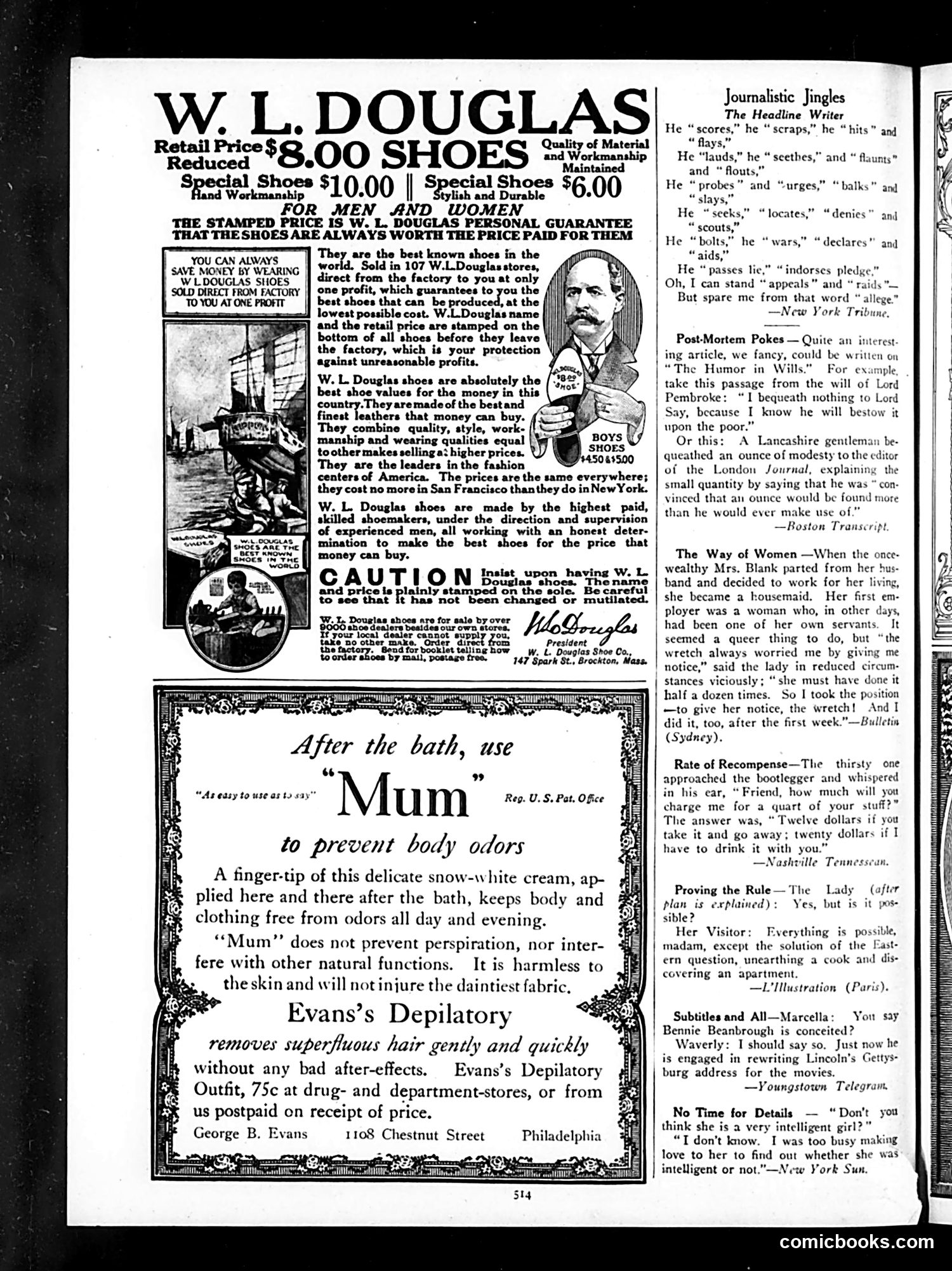
This page is primarily **advertisements** interspersed with a satirical column called "Journalistic Jingles." ## The Satire Section "The Headline Writer" mocks newspaper journalism's clichéd vocabulary. It catalogs overused words that headline writers employ—"scores," "scraps," "probes," "urges," "seeks," "locates"—satirizing how journalists rely on a tired stock of dramatic verbs rather than precise language. A New York Tribune quote complains about the word "allege" particularly. The remaining items are brief humorous anecdotes from various publications poking fun at human behavior: a wealthy woman becoming a housemaid and obsessing over firing her former servant, a bootlegger's pricing scheme, and marital incompetence. ## Advertisements The bulk of the page advertises W.L. Douglas shoes (emphasizing value and factory-direct pricing) and two beauty products: "Mum" deodorant cream and "Evans's Depilatory" for hair removal. The page reflects early 20th-century consumer culture and media criticism.
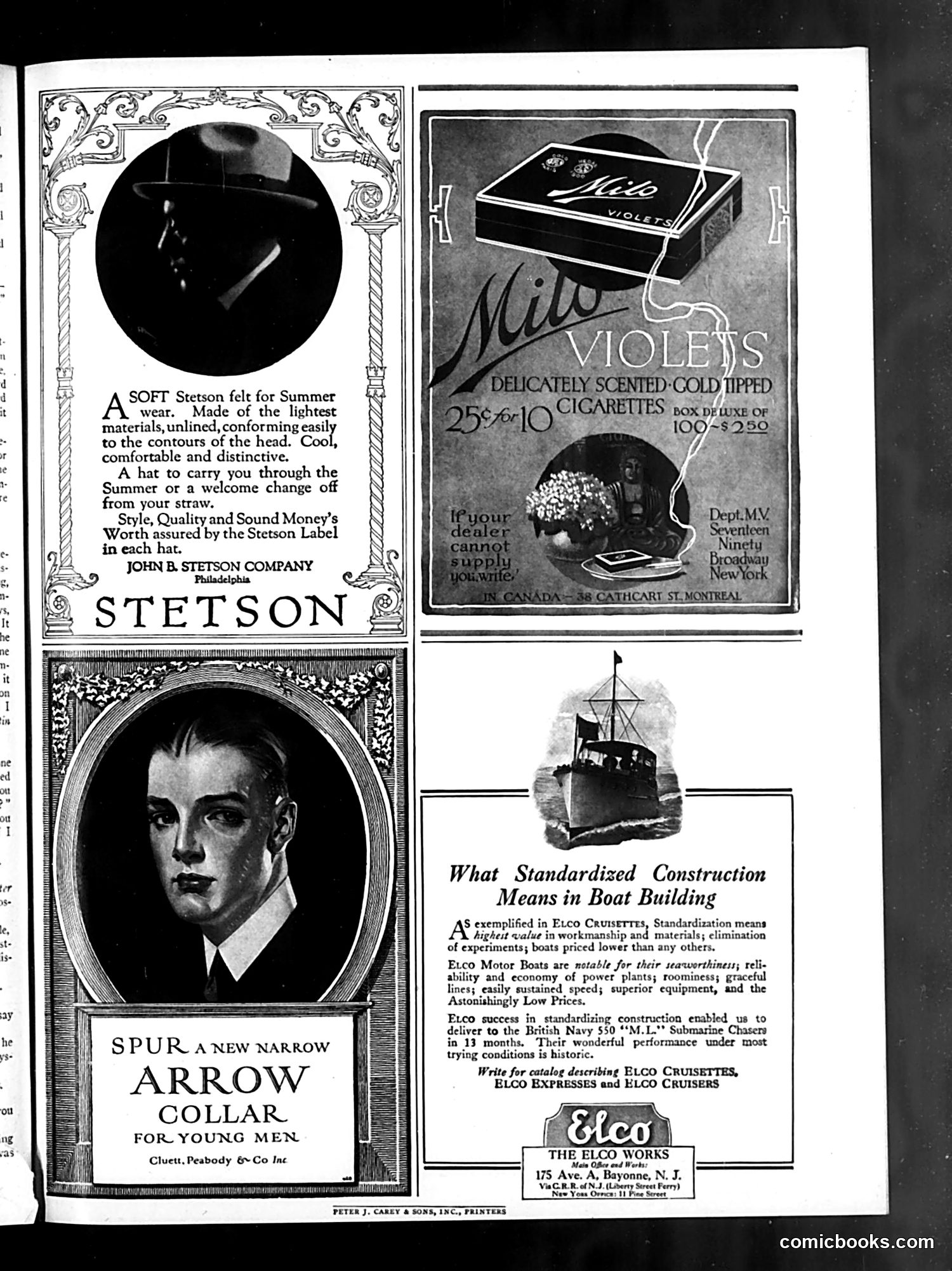
This is primarily an **advertising page**, not a satirical cartoon. It contains four commercial advertisements: 1. **Stetson hats** — promoting lightweight summer felt hats with the company's quality assurance 2. **Milo Violets cigarettes** — delicately scented, gold-tipped smokes priced at 25¢ for a box of 10 3. **Arrow collars** — narrow collar style for young men, by Cluett, Peabody & Co. 4. **Elco Motor Boats** — emphasizing standardized construction, reliability, and their military success building submarine chasers for the British Navy during what appears to be WWI The Arrow collar features a portrait of a young man, likely intended as an aspirational image for the target demographic. **No political satire is present.** This page reflects early 20th-century consumer culture and industrial manufacturing pride, particularly Elco's wartime naval contribution.
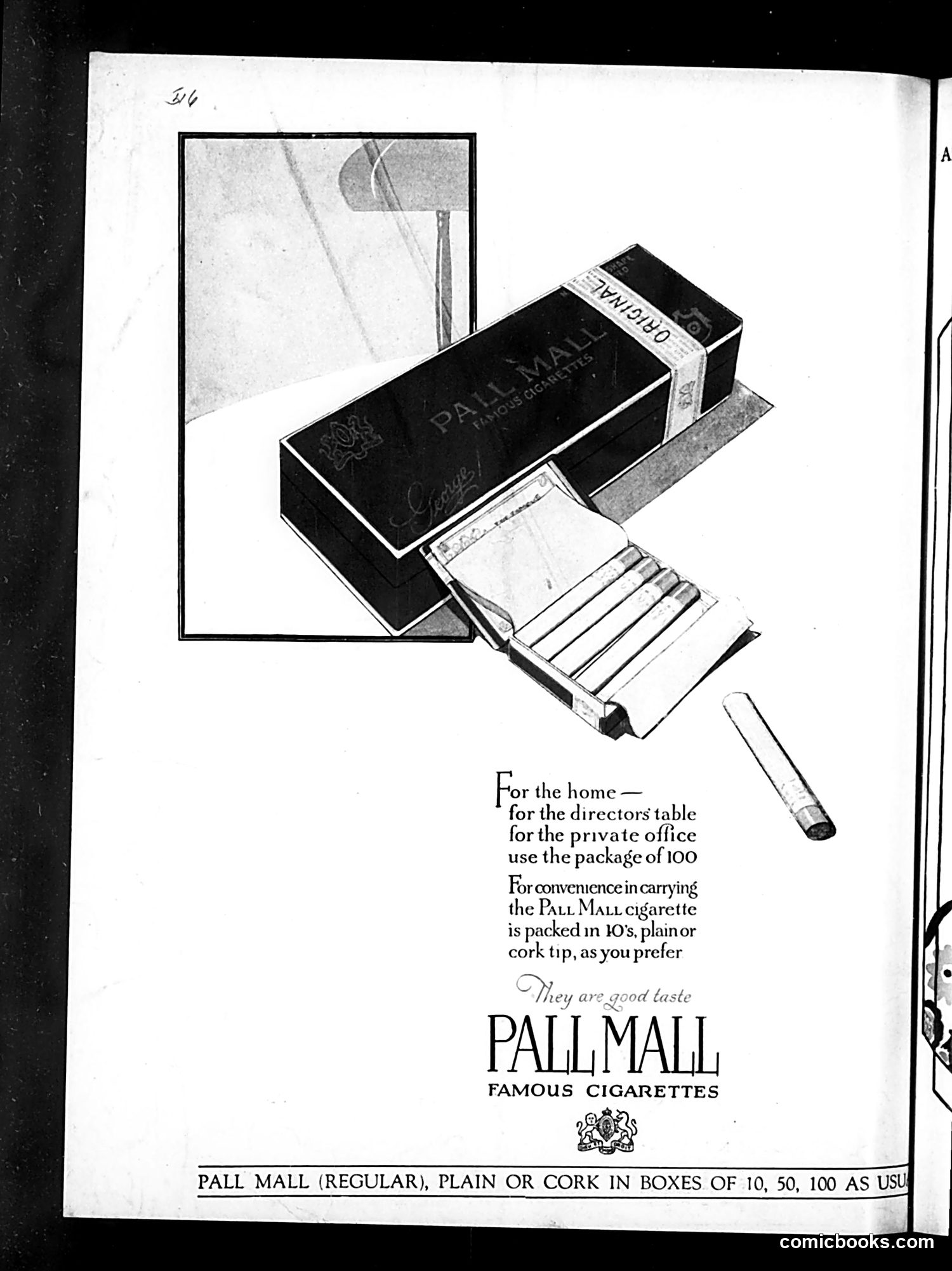
This is primarily a **cigarette advertisement**, not a political cartoon. It's a Pall Mall cigarettes ad from an early 20th-century Life magazine issue. The ad showcases packaging options for different contexts—home use, boardroom/director's table, and office—emphasizing cigarettes as a marker of sophistication and social status. The product is displayed in its various box formats (10s, 50s, 100s) with options for plain or cork-tipped cigarettes. The tagline "They are good taste" links smoking to refined behavior. There's no satire or political content visible—this is straightforward period advertising that normalized cigarette consumption across professional and domestic settings before health concerns became prominent. The approach targets affluent consumers by positioning Pall Mall as appropriate for formal business environments.