
Life, 1921-04-07 · page 16 of 38
Life — April 7, 1921 — page 16: what you’re looking at
What you’re looking at
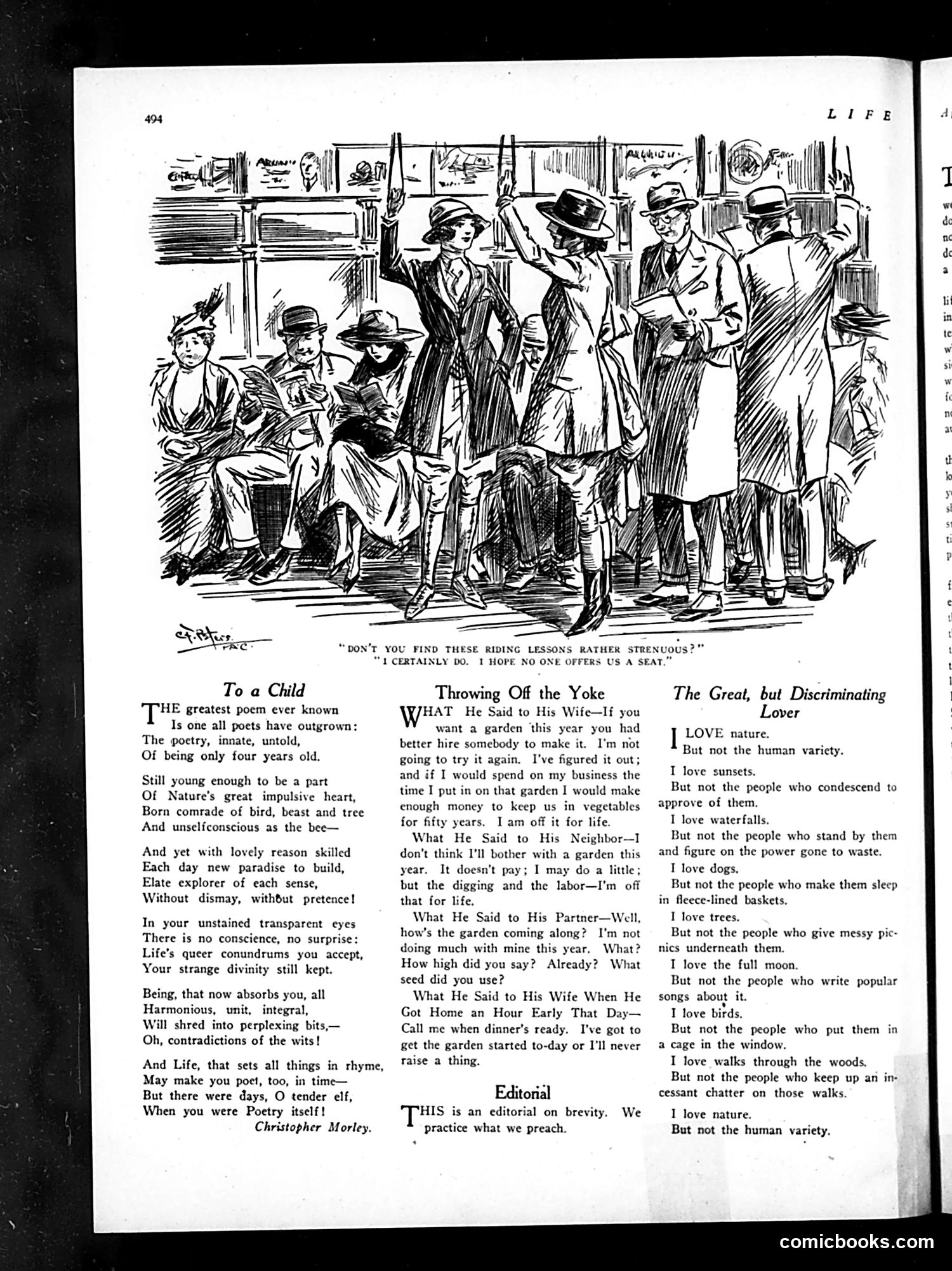
This page from Life magazine contains poetry and an editorial, along with one cartoon illustration at the top. The cartoon depicts a crowded streetcar or train interior with well-dressed passengers. The caption reads: "Don't you find these riding lessons rather strenuous?" "I certainly do. No one offers us a seat." The satire targets urban etiquette and male courtesy norms. The joke appears to center on the irony that despite "riding lessons" (presumably instruction in proper public behavior), men on the streetcar fail to offer their seats to standing women—a basic courtesy expected of gentlemen in this era. It's commentary on the gap between taught social standards and actual behavior, likely poking fun at both women's frustrations and men's inconsistency with chivalric ideals during the early 20th century.
📄 Transcribed text from this page (OCR, searchable)
Machine-transcribed from the original scan — historical spelling and the odd misread are preserved.
“DON’T YOU FIND THESE RIDING LESSONS RATHER STRENUO! “1 CERTAINLY DO. To a Child TH greatest poem ever known Is one all poets have outgrown: The poetry, innate, untold, Of being only four years old. Still young enough to be a part Of Nature's great impulsive heart, Born comrade of bird, beast and tree And unselfconscious as the bee— And yet with lovely reason skilled Each day new paradise to build, Elate explorer of each sense, Without dismay, withtut pretence! In your unstained transparent eyes There is no conscience, no surprise: Life’s queer conundrums you accept, Your strange divinity still kept. Being, that now absorbs you, all Harmonious, unit, integral, Will shred into perplexing bits,— Oh, contradictions of the wits! And Life, that sets all things in rhyme, May make you poet, too, in time— But there were days, O tender elf, When you were Poetry itself! Christopher Morley. Throwing Off the Yoke Wt He Said to His Wife—If you want a garden this year you had better hire somebody to make it. I'm not going to try it again. I've figured it out; and if I would spend on my business the time I put in on that garden I would make enough money to keep us in vegetables for fifty years. Iam off it for life. What He Said to His Neighbor—I don’t think I'll bother with a garden this year. It doesn’t pay; I may do a little; but the digging and the labor—I'm off that for life. What He Said to His Partner—Well, how’s the garden coming along? I'm not doing much with mine this year. What? How high did you say? Already? What seed did you use? What He Said to His Wife When He Got Home an Hour Early That Day— Call me when dinner’s ready. I've got to get the garden started to-day or I'll never raise a thing. Editorial THs is an editorial on brevity. We practice what we preach. 1 HOPE NO ONE OFFERS US A SEAT.” The Great, but Discriminating Lover LOVE nature. But not the human variety. I love sunsets. But not the people who condescend to approve of them. I love waterfalls. But not the people who stand by them and figure on the power gone to waste. T love dogs. But not the people who make them sleep in fleece-lined baskets. I love trees. But not the people who give messy pic- nics underneath them. I love the full moon. But not the people who write popular songs about it. I love birds. But not the people who put them in a cage in the window. I love walks through the woods, But not the people who keep up an in- cessant chatter on those walks. I love nature. But not the human variety. comicbooks.com