
Life, 1921-04-07 · page 22 of 38
Life — April 7, 1921 — page 22: what you’re looking at
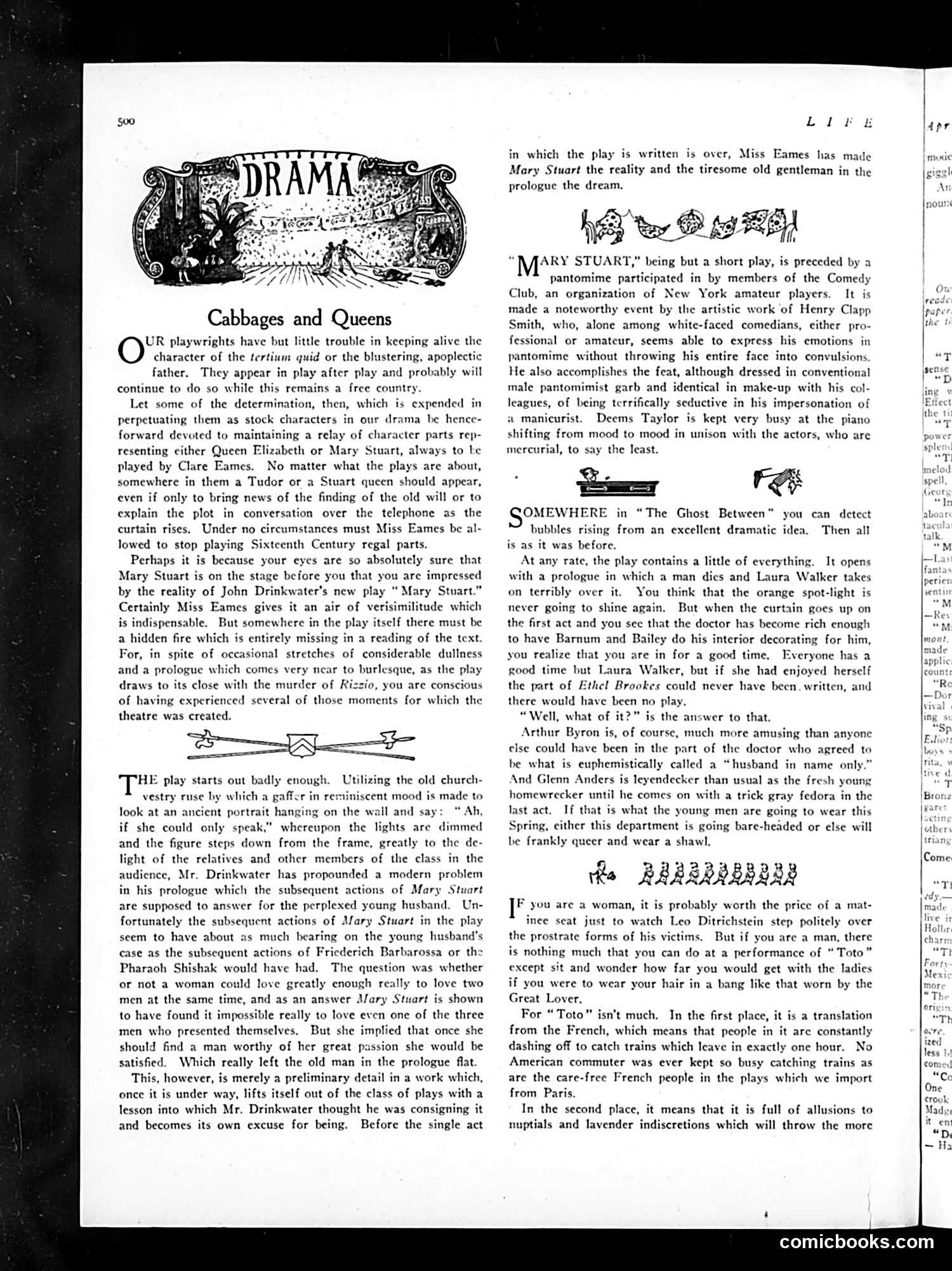
What you’re looking at
This is a theater review critiquing John Drinkwater's play *Mary Stuart*, starring actress Clare Eames. The satire is subtle but sharp: the reviewer sarcastically suggests that since Eames is so compelling as historical queens, playwrights should simply cast her in *every* play as either Queen Elizabeth or Mary Stuart—regardless of the actual plot. The joke mocks both the predictability of theatrical stock characters (the "blustering, apoplectic father" recurring endlessly) and Eames' typecast roles. The reviewer praises Eames' performance as genuinely transcendent, noting that her presence elevates an otherwise mediocre play, transforming the tedious prologue into mere "dream" while she becomes theatrical "reality." The piece critiques Drinkwater's flawed premise—the prologue poses whether a woman can love two men simultaneously, but the play offers no real answer—yet acknowledges the work ultimately transcends its own narrative failures through sheer performance quality.
📄 Transcribed text from this page (OCR, searchable)
Machine-transcribed from the original scan — historical spelling and the odd misread are preserved.
Cabbages and Queens UR playwrights have but little trouble in keeping alive the character of the tertium quid or the blustering, apoplectic father. They appear in play after play and probably will continue to do so while this remains a free country. Let some of the determination, then, which is expended in perpetuating them as stock characters in our drama be hence- forward devoted to maintaining a relay of character parts rep- resenting either Queen Elizabeth or Mary Stuart, always to ke played by Clare Eames. No matter what the plays are about, somewhere in them a Tudor or a Stuart queen should appear, even if only to bring news of the finding of the old will or to explain the plot in conversation over the telephone as the curtain rises, Under no circumstances must Miss Eames be al- lowed to stop playing Sixteenth Century regal parts. Perhaps it is because your eyes are so absolutely sure that Mary Stuart is on the stage before you that you are impressed by the reality of John Drinkwater’s new play “ Mary Stuart Certainly Miss Eames gives it an air of verisimilitude which is indispensable. But somewhere in the play itself there must be a hidden fire which is entirely missing in a reading of the text. For, in spite of occasional stretches of considerable dullness and a prologue which comes very near to burlesque, as the play draws to its close with the murder of R of having experienced several of those moments for which the theatre was created. a Nal Md Bata play starts out badly enough. Utilizing the old church- iscent mood is made to io, you are conscious vestry ruse by which a gaffer in rer look at an ancient portrait hanging on the wall and say: “ Ah, if she could only speak,” whereupon the lights are dimmed and the figure steps down from the frame, greatly to the de- light of the relatives and other members of the class in the audience, Mr. Drinkwater has propounded a modern problem in his prologue which the subsequent actions of Mary Stuart are supposed to answer for the perplexed young husband. Un- fortunately the subsequent actions of Afary Stuart in the play seem to have about as much bearing on the young husband's case as the subsequent actions of Friederich Barbarossa or the Pharaoh Shishak would have had. The question was whether or not a woman could love greatly enough really to love two men at the same time, and as an answer Mary Stuart is shown to have found it impossible really to love even one of the three men who presented themselves. But she implied that once she should find a man worthy of her great passion she would be satisfied. Which really left the old man in the prologue flat. This, however, is merely a preliminary detail in a work which, once it is under way, lifts itself out of the class of plays with a lesson into which Mr. Drinkwater thought he was consigning it and becomes its own excuse for being. Before the single act in which the play is written is over, Miss Eames has made Mary Stuart the reality and the tiresome old gentleman in the prologue the dream, hay er @ 9 2B ARY STUART,” being but a short play, is preceded by a pantomime participated in by members of the Comedy Club, an organization of New York amateur players. It is made a noteworthy event by the artistic work of Henry Clapp Smith, who, alone among white-faced comedians, either pro- fessional or amateur, seems able to express his emotions in pantomime without throwing his entire face into convulsions. He also accomplishes the feat, although dressed in conventional male pantomimist garb and identical in make-up with his col- leagues, of being terrifically seductive in his impersonation of a manicurist. Deems Taylor is kept very busy at the piano shifting from mood to mood in unison with the actors, who are mercurial, to say the least. RE in “The Ghost Between” you can detect OMEWH bubbles rising from an excellent dramatic idea, Then all is as it was before. At any rate, the play contains a little of everything. It opens with a prologue in which a man dies and Laura Walker takes on terribly over it. You think that the orange spot-light is never going to shine again. But when the curtain goes up on the first act and you see that the doctor has become rich enough to have Barnum and Bailey do his interior decorating for him, you realize that you are in for a good time, Everyone has a good time but Laura Walker, but if she had enjoyed herself the part of Ethel Brookes could never have been. written, and there would have been no play. “Well, what of it?” is the answer to that. Arthur Byron is, of course, much more amusing than anyone else could have been in the part of the doctor who agreed to be what is euphemistically called a “husband in name only.” And Glenn Anders is leyendecker than usual as the fresh young homewrecker until he comes on with a trick gray fedora in the last act. If that is wi at the young men are going to wear this Spring, cither this department is going bare-headed or else will be frankly queer and wear a shawl. the BRRSBRERINS IF you are a woman, it is probably worth the price of a mat- inee seat just to watch Leo Ditrichstein step politely over the prostrate forms of his victims. But if you are a man, there is nothing much that you can do at a performance of “Toto” except sit and wonder how far you would get with the ladies if you were to wear your hair in a bang like that worn by the Great Lover, For “Toto” isn’t much. In the first place, it is a translation from the French, which means that people in it are constantly dashing off to catch trains which leave in exactly one hour. No American commuter was ever kept so busy catching trains as are the care-free French people in the plays which we import from Paris. In the second place, it means that it is full of allusions to nuptials and lavender indiscretions which will throw the more melod spell comicbooks.com