
Life, 1921-04-07 · page 14 of 38
Life — April 7, 1921 — page 14: what you’re looking at
What you’re looking at
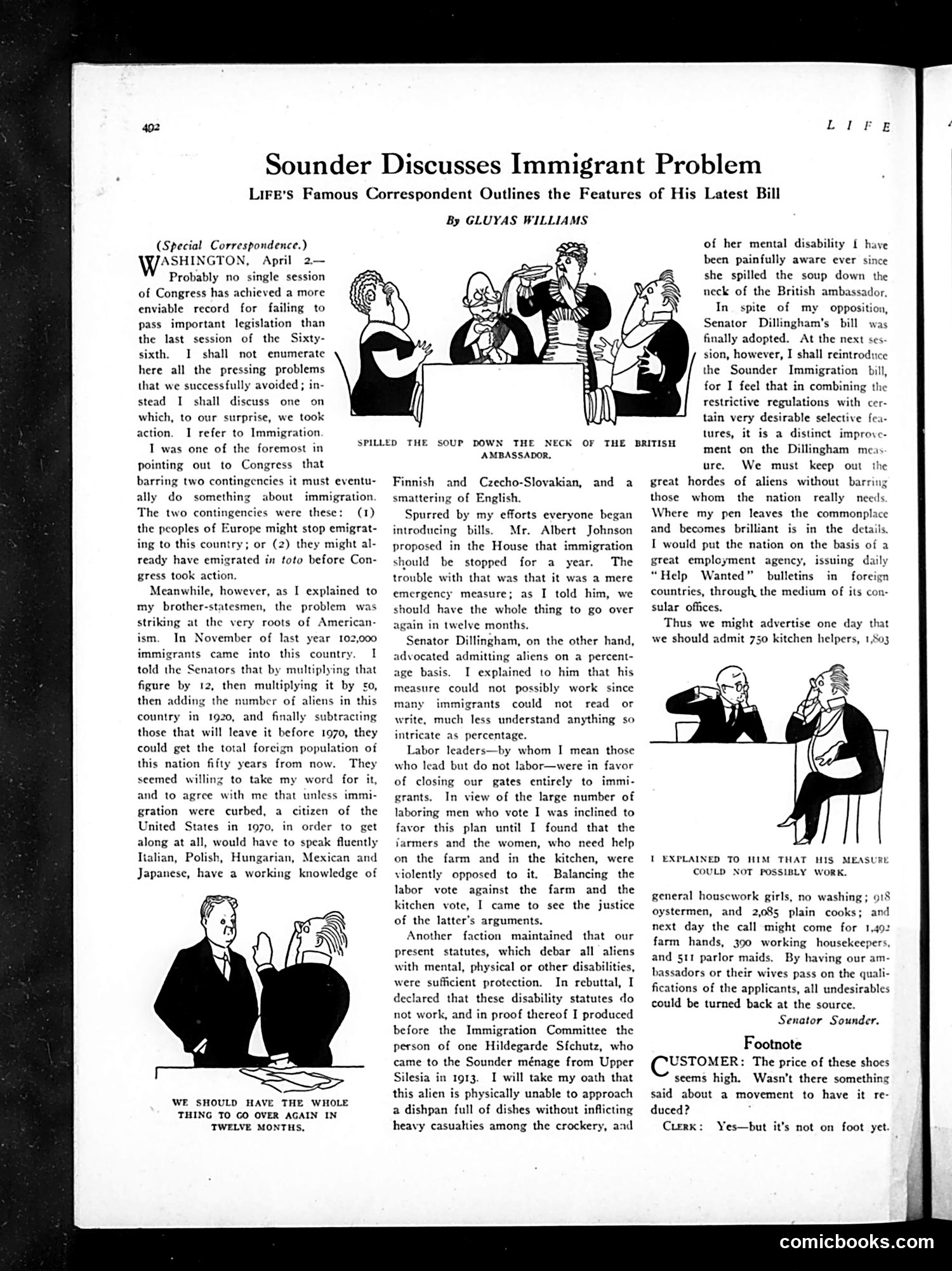
This 1920 Life magazine page features Senator Sounder discussing immigration restriction legislation. The cartoons satirize contemporary anxieties about immigration and labor. The top cartoon shows Sounder "spilling soup down the neck of the British ambassador"—a visual metaphor for diplomatic tensions over immigration policy. The bottom cartoon illustrates Sounder's argument that admitting too many aliens would be problematic, showing him explaining to a labor leader why immigration restrictions are necessary. The article references competing interests: business wanting cheap immigrant labor versus working-class voters opposing immigration. The satire targets politicians like Sounder who navigate these tensions while proposing restrictive quotas based on nationality and ability to read/write. A "footnote" joke about shoe prices adds lighter humor to the serious policy debate.
📄 Transcribed text from this page (OCR, searchable)
Machine-transcribed from the original scan — historical spelling and the odd misread are preserved.
Sounder Discusses Immigrant Problem Lire’s Famous Correspondent Outlines the Features of His Latest Bill (Special Correspondence.) WASHINGTON, April 2— Probably no single session of Congress has achieved a more enviable record for failing to pass important legislation than the last session of the Sixty- sixth. I shall not enumerate here all the pressing problems that we successfully avoided ; in- stead I shall discuss one on which, to our surprise, we took action. I refer to Immigration I was one of the foremost in pointing out to Congress that barring two contingencies it must eventu- about immigration The two contingencies were these: (1) the peoples of Europe might stop emigrat- ing to this country; or (2) they might al- ready have emigrated in toto before Con- gress took action. Meanwhile, however, as I explained to my brother-statesmen, the problem was striking at the very roots of American- In November of last year 102,000 immigrants came into this count I told the Senators that by multiplying that figure by 12, then multiplying it by £0, then adding the number of aliens in this country in 1920, and finally subtracting those that will leave it before 1970, they could get the total foreign population of this nation fifty years from now. They seemed willing to take my word for it, ally do something ism. and to agree with me that unless immi- gration were curbed, a citizen of the United States in 1970, in order to get along at all, would have to speak fluently Italian, Polish, Hungarian, Mexican and Japanese, have a working knowledge of WE SHOULD HAVE THE WHOLE THING TO GO OVER AGAIN IN TWELVE MONTHS, SPILLED THE By GLUYAS WILLIAMS SOUP DOWN THE NECK OF AMBASSADOR. Finnish and Czecho-Slovakian, and a smattering of English. Spurred by my efforts everyone began introducing bills. Mr. Albert Johnson proposed in the House that immigration should be stopped for a year. The trouble with that was that it was a mere emergency measure; as I told him, we should have the whole thing to go over again in twelve months. Senator Dillingham, on the other hand, advocated admitting aliens on a percent- age basis. measure could not possibly work since many immigrants could not read or write, much less understand anything so intricate as percentage. Labor leaders—by whom I mean those who lead but do not labor—were in favor I explained to him that his of closing our gates entirely to immi- grants, In view of the large number of laboring men who vote I was inclined to favor this plan until I found that the farmers and the women, who need help on the farm and in the kitchen, were violently opposed to it. Balancing the labor vote against the farm and the kitchen vote, I came to see the justice of the latter’s arguments, Another faction maintained that our present statutes, which debar all aliens with mental, physical or other disabilities, were sufficient protection. In rebuttal, I declared that these disability statutes do not work, and in proof thereof I produced before the Immigration Committee the person of one Hildegarde Sfchutz, who came to the Sounder ménage from Upper Silesia in 1913. I will take my oath that this alien is physically unable to approach a dishpan full of dishes without inflicting heavy casuahties among the crockery, and THE BRITISH of her mental disability { have been painfully aware ever since she spilled the soup down the neck of the British ambassador, In spite of Opposition, Senator Dillingham's bill finally adopted. At the next ses- sion, however, I shall reintroduce the Sounder Immigration bill, for I feel that in combining the restrictive regulations with cer- tain very desirable selective fea- tures, it is a distinct improve- ment on the Dillingham meas ure. We must keep out the great hordes of aliens without bar those really needs. Where my pen leaves the commonplace and becomes brilliant is in the details. I would put the nation on the basis of a great employment agency, issuing daily “Help Wanted” bulletins in foreign countries, through the medium of its con- sular offices. Thus we might advertise one day that we should admit 750 kitchen helpers, 1,803 vom my was whom the nation 1 EXPLAINED TO HIM THAT HIS MEASURE COULD NOT POSSIBLY WORK. general housework girls, no washing; 918 oystermen, and 2,085 plain cooks; and next day the call might come for 1,492 farm hands, 390 working housekeepers, and 511 parlor maids. By having our am- bassadors or their wives pass on the quali- fications of the applicants, all undesirables could be turned back at the source. Senator Sounder. Footnote USTOMER: The price of these shoes seems high. Wasn't there something said about a movement to have it re- duced? Cterk: Yes—but it’s not on foot yet. comicbooks.com