
Life, 1921-04-07 · page 26 of 38
Life — April 7, 1921 — page 26: what you’re looking at
What you’re looking at
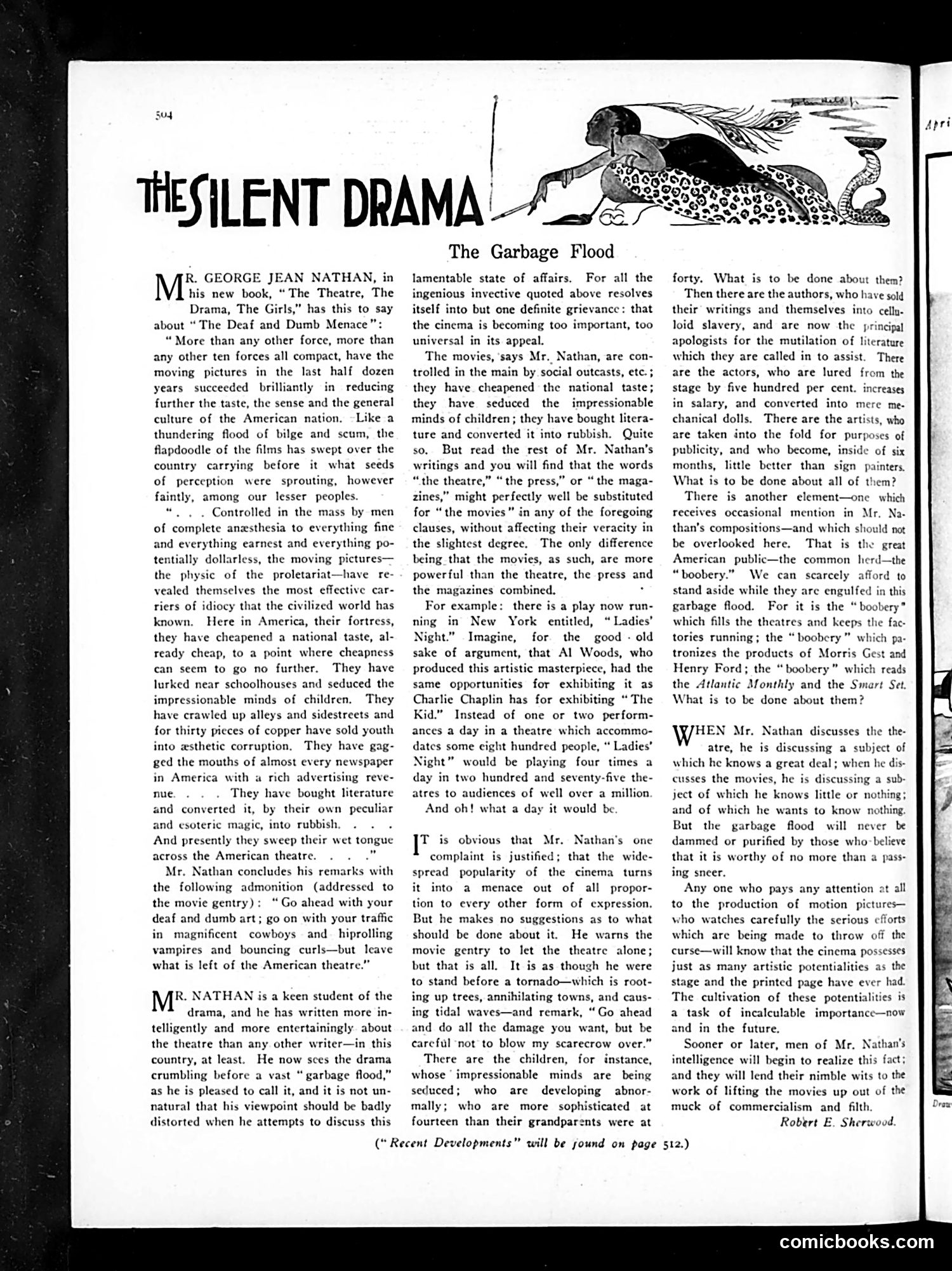
This page presents critic George Jean Nathan's scathing indictment of motion pictures as cultural poison. Nathan argues that movies—controlled by amoral businessmen—have "cheapened" American taste, corrupted children, and are now threatening live theater itself. The article's title, "The Garbage Flood," captures Nathan's apocalyptic view: cinema as a destructive deluge sweeping away legitimate culture. The cartoon at top depicts this literally—a massive wave labeled "garbage" threatening civilization. The author counters Nathan's bias, noting he applies identical criticisms to theater and press, but movies reach vastly larger audiences. The example of "Ladies' Night" illustrates: shown in hundreds of theaters daily versus a stage play's single venue, film's power to influence millions is unprecedented. The underlying debate: is cinema a democratizing art form making entertainment accessible to "lesser peoples," or destructive mass manipulation? Nathan's elitist position—protecting "real" theater from commercial cinema—represents a common 1920s intellectual anxiety about mass media.
📄 Transcribed text from this page (OCR, searchable)
Machine-transcribed from the original scan — historical spelling and the odd misread are preserved.
THESILENT DRAMA: R. GEORGE JEAN NATHAN, in his new book, “The Theatre, The Drama, The Girls,” has this to say about “The Deaf and Dumb Menace”: “More than any other force, more than any other ten forces all compact, have the moving pictures in the last half dozen years succeeded brilliantly in reducing further the taste, the sense and the general culture of the American nation. ~Like a thundering flood of bilge and scum, the flapdoodle of the films has swept over the country carrying before it what seeds of perception were sprouting, however faintly, among our lesser peoples. “. . . Controlled in the mass by men of complete anaxsthesia to everything fine and everything earnest and everything po- tentially dollarless, the moving pictures— the physic of the proletariat—have re- vealed themselves the most effective car- riers of idiocy that the civilized world has known, Here in America, their fortress, they have cheapened a national taste, al- ready cheap, to a point where cheapness can seem to go no further. They have lurked near schoolhouses and seduced the impressionable minds of children. They have crawled up alleys and sidestreets and for thirty pieces of copper have sold youth into esthetic corruption, They have gag- ged the mouths of almost every newspaper in America with a rich advertising reve- nue. They have bought literature and converted it, by their own peculiar and esoteric magic, into rubbish, And presently they sweep their wet tongue across the American theatre. a Mr. Nathan concludes his remarks with the following admonition (addressed to the movie gentry): “Go ahead with your deaf and dumb art; go on with your traffic in magnificent cowboys and_ hiprolling vampires and bouncing curls—but leave what is left of the American theatre.” R. NATHAN is a keen student of the drama, and he has written more in- telligently and more entertainingly about the theatre than any other writer—in this He now sces the drama crumbling before a vast “ garbage flood,” as he is pleased to call it, and it is not un- natural that his viewpoint should be badly distorted when he attempts to discuss this country, at least. The Garbage Flood lamentable state of affairs. For all the ingenious invective quoted above resolves itself into but one definite grievance: that the cinema is becoming too important, too universal in its appeal. The movies, ‘says Mr. Nathan, are con- trolled in the main by social outcasts, ete. ; they have cheapened the national taste; they have seduced the impressionable minds of children; they have bought litera- ture and converted it into rubbish. Quite so, But read the rest of Mr. Nathan's writings and you will find that the words “the theatre,” “the press,” or “ the maga- zines,” might perfectly well be substituted for “the movies” in any of the foregoing clauses, without affecting their veracity in the slightest degree, The only difference being that the movies, as such, are more powerful than the theatre, the press and the magazines combined. * For example: there is a play now run- ning in New York entitled, “ Ladies’ Night.” Imagine, for the good - old sake of argument, that Al Woods, who produced this artistic masterpiece, had the same opportunities for exhibiting it as Charlie Chaplin has for exhibiting “ The Kid.” Instead of one or two perform- ances a day in a theatre which accommo- dates some cight hundred people, “ Ladies’ Night” would be playing four times a day in two hundred and seventy-five the- atres to audiences of well over a million And oh! what a day it would be T is obvious that Mr. Nathan's one complaint is justified; that the wide- spread popularity of the cinema turns it into a menace out of all propor- tion to every other form of expression. But he makes no suggestions as to what should be done about it. He warns the movie gentry to Iet the theatre alone; but that is all. It is as though he were to stand before a tornado—which is root- ing up trees, annihilating towns, and caus- ing tidal waves—and remark, “Go ahead and do all the damage you want, but be carcful ‘not to blow my scarecrow over.” There are the children, for instance, whose impressionable minds are being seduced; who are developing abnor- mally; who are more sophisticated at fourteen than their grandparents were at forty. What is to be done about them? Then there are the authors, who have sold their writings and themselves into cella. loid slavery, and are now the principal apologists for the mutilation of literature which they are called in to assist. There are the actors, who are lured from the stage by five hundred per cent. increases in salary, and converted into mere me- chanical dolls. There are the artists, who are taken into the fold for purposes of publicity, and who become, inside of six months, little better than sign painters. What is to be done about all of them? There is another element—one which receives occasional mention in Mr. Na- than’s compositions—and which should not be overlooked here, That is the great American public—the common herd—the “boobery.” We can scarcely afford to stand aside while they are engulfed in this garbage flood. For it is the “boobery” which fills the theatres and keeps the fac- tories running; the “boobery” w pa tronizes the products of Morris Gest and Henry Ford; the “boobery” which reads the Atlantic Monthly and the Smart Set. What is to be done about them? WHEN Mr. Nathan discusses the the- atre, he is discussing a subject of which he knows a great deal; when he dis- cusses the movies, he is discussing a sub- ject of which he knows little or nothing; and of which he wants to know nothing. But the garbage flood will never be dammed or purified by those who- believe that it is worthy of no more than a pass- ing sneer. Any one who pays any attention at all to the production of motion pictures— who watches carefully the serious efforts which are being made to throw off the curse—will know that the cinema possesses just as many artistic potentialities as the stage and the printed page have ever had. The cultivation of these potentialities is a task of incalculable importance—now and in the future. Sooner or later, men of Mr. Nathan's intelligence will begin to realize this fact; and they will lend their nimble wits to the work of lifting the movies up out of the muck of commercialism and filth, Robert E. Sherwood. (“Recent Developments” will be sound on page 512.) comicbooks.com