
Life, 1921-04-07 · page 23 of 38
Life — April 7, 1921 — page 23: what you’re looking at
What you’re looking at
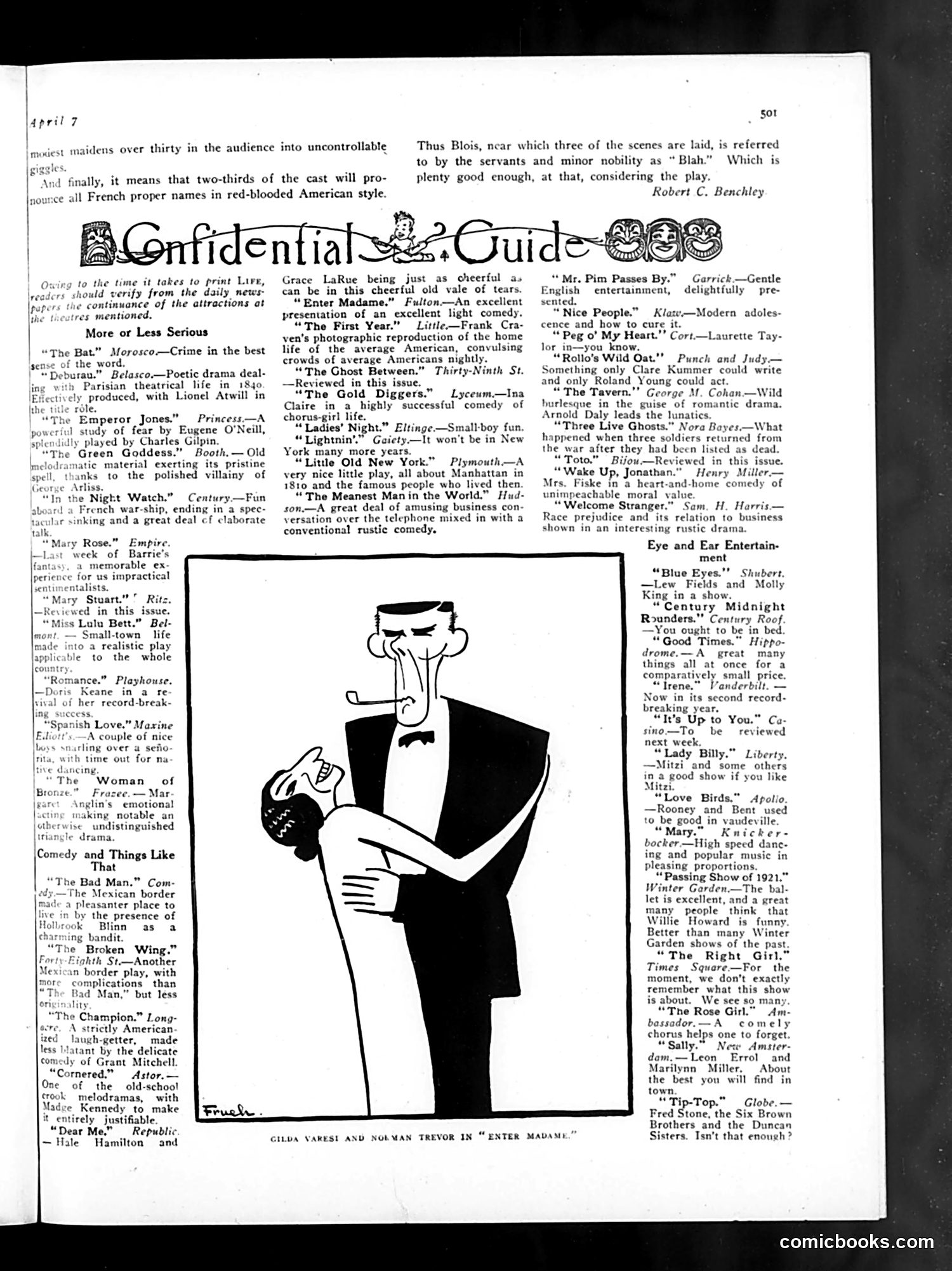
This page from *Life* magazine (April 7, dated at top) is a theater review section called "Confidential Guide," listing Broadway shows with brief critical assessments. The cartoon depicts a formally dressed man in a tuxedo holding what appears to be a telephone or communication device—likely satirizing the theatrical world or a specific performer of the era. The caption credits "Gilda Varese and Norman Trevor in 'Enter Madame,'" suggesting the cartoon illustrates content from that play's review. The surrounding text discusses various Broadway productions, with Robert C. Benchley providing commentary on theatrical presentations and audience reactions. The satire appears aimed at theatrical pretension and the entertainment industry's conventions during the early 1920s. Without clearer visual identification of the caricatured figure, the specific individual being mocked remains unclear, though the formal dress and exaggerated features suggest mockery of theatrical affectation.
📄 Transcribed text from this page (OCR, searchable)
Machine-transcribed from the original scan — historical spelling and the odd misread are preserved.
April 7 nource Owir time it takes to print Lire, \reade rify from the daily news: |pupers the continuance of the attractions at |the es mentioned, More or Less Serious | “The Bat!” Morosco—Crime in the best Poetic drama deal- Parisian theatrical life in 1840 y produced, with Lionel Atwill in le. Emperor Jones.” Princess—A jul study of fear by Eugene O'Neill, lly played by Charles Gilpin. Green Goddess.” Booth, — Old material exerting its pri to the polished villainy of anks © Arliss. ne Night Watch.” Century—Fin rd a French war-ship, ending ir scular sinking and a great deal cf talk Mary Rose.” Empire. j-Last week of Barrie's fantasy, a memorable ex- perience for us impractical lists. Ritz. wed in this issue. s Lulu Bett.” Bel- Small-town life nto a realistic play le to the whole ance.” Playhouse. ris Keane in a re of her record-break- panish Love.” Maxine E.liott’s.—A couple of nice tL rling over a 0 rita, with time out for na \nglin’s emotional making notable an < undistinguished drama, \Comedy and Things Like That “The Bad Man.” Com- —The Mexican border 1 pleasanter place to n by the presence of ok Blinn as a harming bandit. “The Broken Wing.” Forty-Eighth St—Another Mexican border play, with more complications’ than “The Bad Man,” but less originality “The Champion.” Long- A strictly American. ly of Grant Mitchell. Cornered.” — Astor. — One of the old-school crook melodramas, with Madge Kennedy to make it entirely justifiable. “Dear Me.” — Republic. — Hale Hamilton and jest maidens over thirty in the audience into uncontrollable nally, it means that two-thirds of the cast will pro- all French proper names in red-blooded American style. GILDA VARESE AND NOLMAN TREVOR IN Grace LaRue being just as cheerful as can be in this cheerful old vale of tears. “Enter Madame.” Fulton —An excellent presentation of an excellent light comedy. “The First Year.” Little—Frank Cra- ven’s photographic reproduction of the home life of the average American, convulsing crowds of average Americans night; “The Ghost Between.” Thirty Ninth St. —Reviewed in this issue. “The Gold Diggers.” Claire in a_ highly chorus-girl life. “ Ladies’ Night.” “Lightnin’.” Gaiety. York many more years. “Little Old New York.” Plymouth—A very nice little play, all about Manhattan in 1810 and the famous people who lived then. “The Meanest Manin the World.” Hud- son.—A great deal of amusing business con- versation over the telephone mixed in with a conventional rustic comedy. Lyceum—Ina successful comedy of inge-—Small-boy fun. It won't be in New ENTER MADAME.” sot Thus Blois, near which three of the scenes are laid, is referred to by the servants and minor nobility as plenty good enough, at that, considering the play. “Blah.” Which is Robert C. Benchley “Mr. Pim Passes By.” English entertainment, sented. “ Nice People.” cence and how to cure it. “Peg o' My Heart.” Cort. lor in—you know. “Rollo’s Wild Oat." Punch and Judy— Something only Clare Kummer could write and only Roland Young could act. “The Tavern."” George M. Cohan—Wild burlesque in the guise of romantic drama. Arnold Daly leads the lunatics. “Three Live Ghosts.” Nora Bayes—What happened when three soldiers returned from the war after they had been listed as dead. Garrick —Gentle delightfully — pre- —Modern adoles- Laurette Tay- “Toto.” Bijou Reviewed in this issue. “Wake Up, Jonathan.” Henry Miller. Mrs. Fiske les a heart-and-home comedy of unimpeachable moral value. “Welcome Stranger.” Sam. H. Harris — Race prejudice and its relation to business shown in an interesting rustic drama. Eye and Ear Entertain- ment “Blue Eyes.” Shubert. —Lew Fields and Molly King in a show. “Century Midnight Rounders.” Century Roof. —You ought to be in bed. “Good Times.” Hippo- drome.— A great’ many things all at once for a comparatively small price. “Irene.” Vanderbilt. — Now in its second record- breaking year. “It’s Up to You.” Ca- sino—To be reviewed next week. “Lady Billy.” Liberty. —Mitzi and some others in a good show if you like Mitzi. “Love Birds.” A polio —Rooney and Bent used to be good in vaudeville “ Mary. Knicke bocke or High speed dane: ing and popular music in pleasing proportions. “Passing Show of 1921.” Winter Garden.—The bal- let is excellent, and a great many people think that Willie Howard is funny. Better than many Winter Garden shows of the past “The Right Girl.” Times Square—For the moment, we don’t exactly remember what this show is about. We see so many “The Rose Girl.” Am- bassador.—A comely chorus helps one to forget. “Sally.” New Amster- dam.—Leon Errol and Marilynn Miller, About the best you will find in town “Tip-Top.” Globe. — Fred Stone, the Six Brown Brothers and the Duncan Sisters. Isn't that enough ? comicbooks.com