
Life, 1921-04-07 · page 19 of 38
Life — April 7, 1921 — page 19: what you’re looking at
What you’re looking at
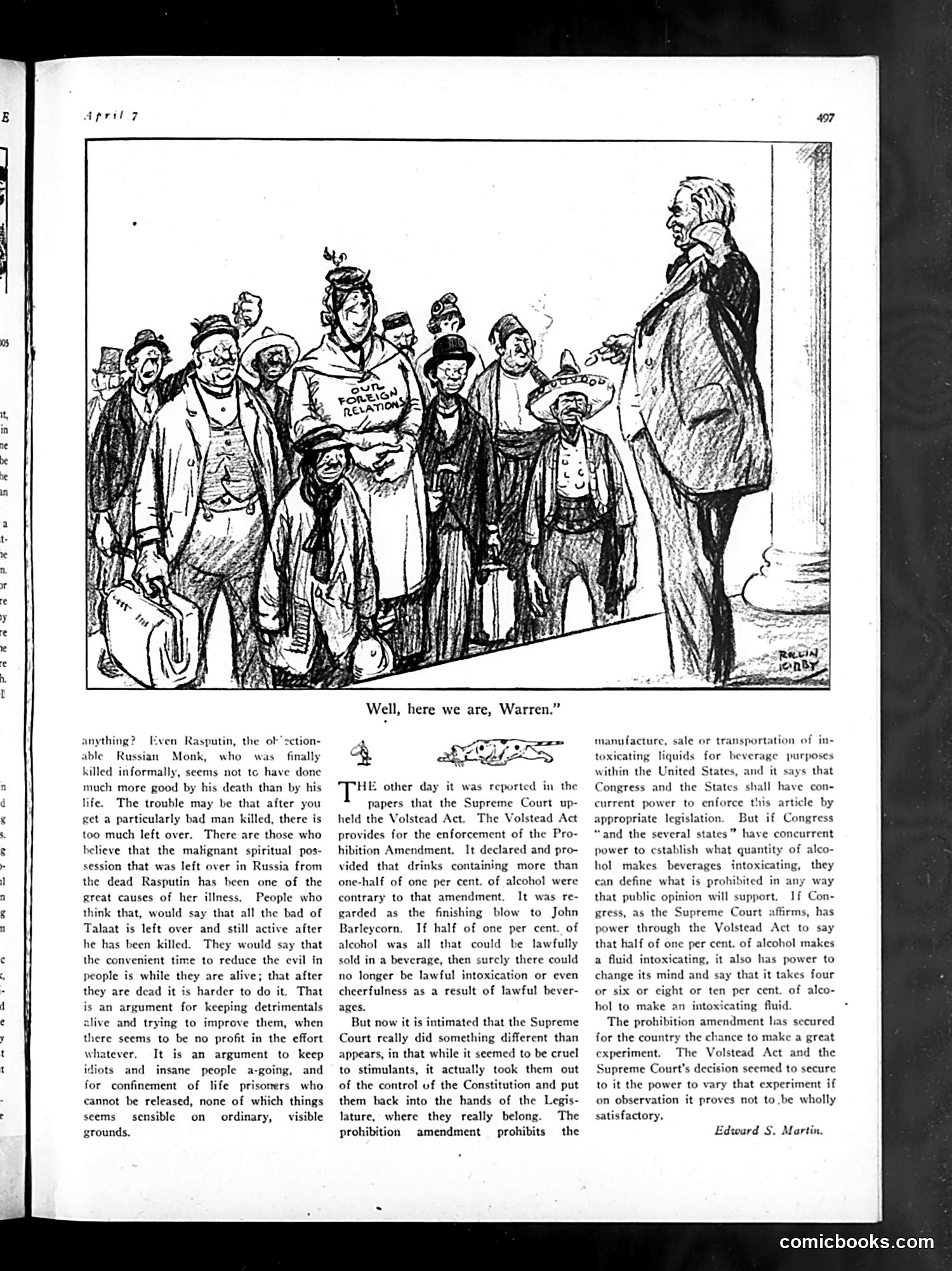
This cartoon critiques the Supreme Court's validation of the Volstead Act (Prohibition enforcement legislation). The illustration shows a well-dressed man addressing a group of poor, downtrodden people, likely representing common citizens or immigrants affected by Prohibition. The accompanying essay by Edward S. Martin explains the irony: while the Court upheld strict Prohibition (limiting alcohol to half of one percent), it simultaneously transferred regulatory power from the Constitution to Congress and state legislatures. This means the government could later redefine what constitutes "intoxicating," effectively allowing them to modify Prohibition standards based on public opinion—without amending the Constitution itself. The cartoon's title sarcastically presents this as presenting citizens with a "solution," when it actually grants authorities flexibility to change Prohibition rules. The satire targets both Prohibition's strictness and the legal sleight-of-hand that undermines its constitutional foundation. "Warren" likely references Warren Harding, the newly elected president associated with Prohibition policy.
📄 Transcribed text from this page (OCR, searchable)
Machine-transcribed from the original scan — historical spelling and the odd misread are preserved.
April 7 anything? able Even Rasputin, the oF’ sction- Russian Monk, finally killed informally, seems not te have done much more good by his death than by his life. The trouble may be that after you get a particularly bad man killed, there is too much left over. There are those who believe that the malignant spiritual pos- session that was left over in Russia from the dead Rasputin has been one of the great causes of her illness. People who think that, would say that all the bad of Talaat is left over and still active after he has been killed. They would say that the convenient time to reduce the evil in people is while they are alive; that after they are dead it is harder to do it. That is an argument for keeping detrimentals alive and trying to improve them, when there seems to be no profit in the effort whatever. It is an argument to keep and insane people a-going, and for confinement of life prisoners who cannot be released, none of which things seems sensible on ordinary, visible grounds. who was idiots Well, here we are, Warren.” HE other day it was reported in the papers that the Supreme Court up- held the Volstead Act. The Volstead Act provides for the enforcement of the Pro- hibition Amendment. It declared and pro- vided that drinks containing more than one-half of one per cent. of alcohol were contrary to that amendment. garded as the finishing blow to John Barleycorn. If half of one per cent. of alcohol was all that could be lawfully sold in a beverage, then surcly there could It was re- no longer be lawful intoxication or even cheerfulness as a result of lawful bever- ages. But now it is intimated that the Supreme Court really did something different than appears, in that while it seemed to be cruel to stimulants, it actually took them out of the control uf the Constitution and put them back into the hands of the Legis- lature, where they really belong. The prohibition amendment prohibits the manufacture, sale or transportation of in- toxicating liquids for beverage purposes within the United States, and it says that Congress and the States shall have con- current power to enforce this article by appropriate legislation. But if Congress “and the several states” have concurrent power to establish what quantity of alco- hol makes beverages intoxicating, they can define what is prohibited in any way that public opinion will support. If Con- gress, as the Supreme Court affirms, has power through the Volstead Act to say that half of one per cent. of alcohol makes a fluid intoxicating, it also has power to change its mind and say that it takes four or six or eight or ten per cent. of alco- hol to make an intoxicating fluid. The prohibition amendment lias secured for the country the chance to make a great experiment. The Volstead Act and the Supreme Court's decision seemed to secure to it the power to vary that experiment if on observation it proves not to.be wholly satisfactory. Edward S. Martin, comicbooks.com