
A complete issue · 32 pages · 1921
Life — February 24, 1921
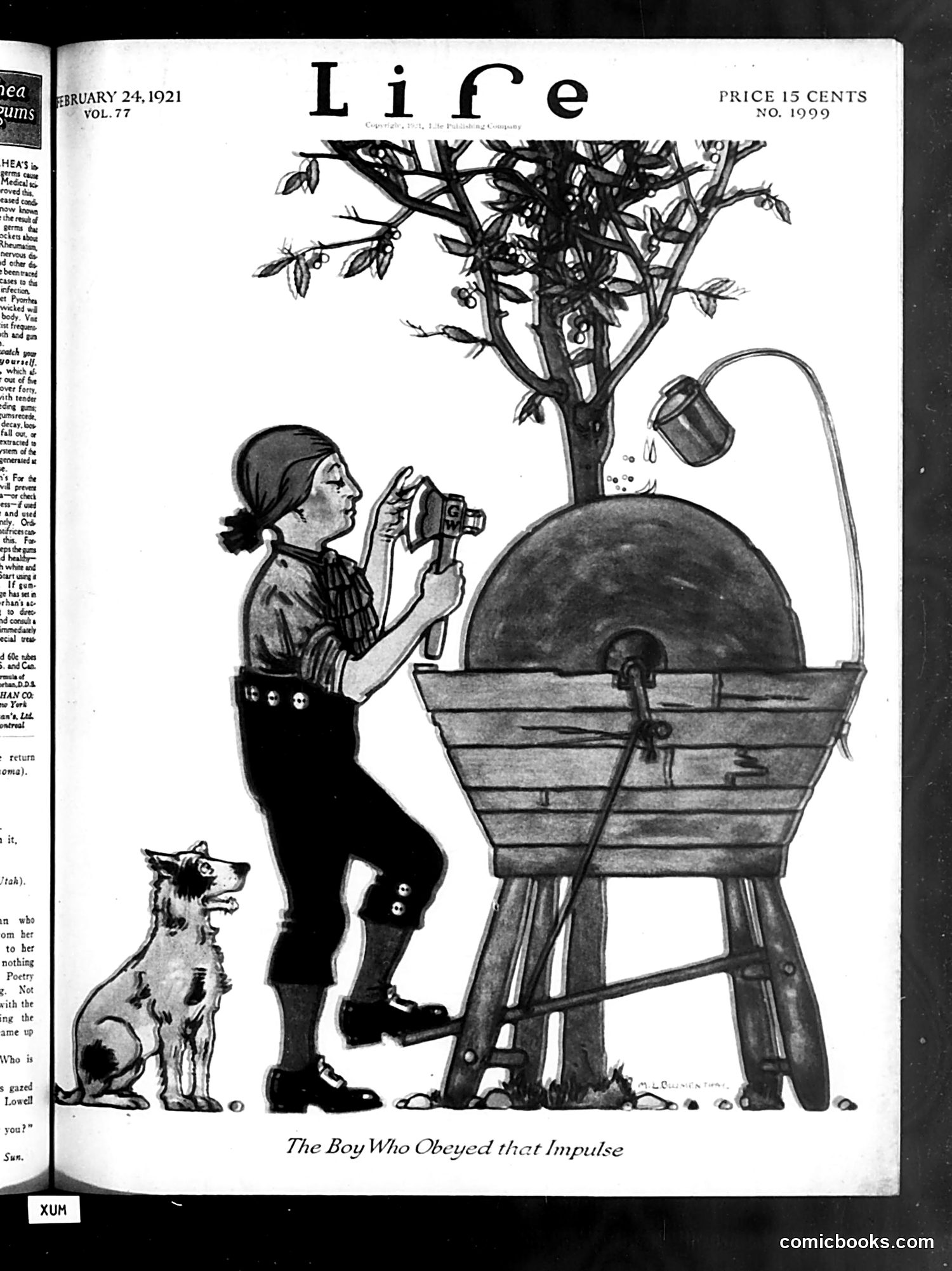
This Life magazine cover (February 24, 1921) shows a young boy with a camera photographing a dead or dying tree in a basket, while a dog watches. The caption suggests satire about impulsive behavior—likely mocking either amateur photography crazes or misguided impulses to document mundane subjects. The withered tree may symbolize something failing or dying that shouldn't be preserved. The "impulse" to photograph trivial or depressing subjects appears to be the joke's target. This reflects 1920s humor about the newly accessible camera technology creating amateur photographers who lacked discernment about worthwhile subjects. The exact satirical point remains somewhat unclear without additional context, though it appears critical of unthinking modern behavior.
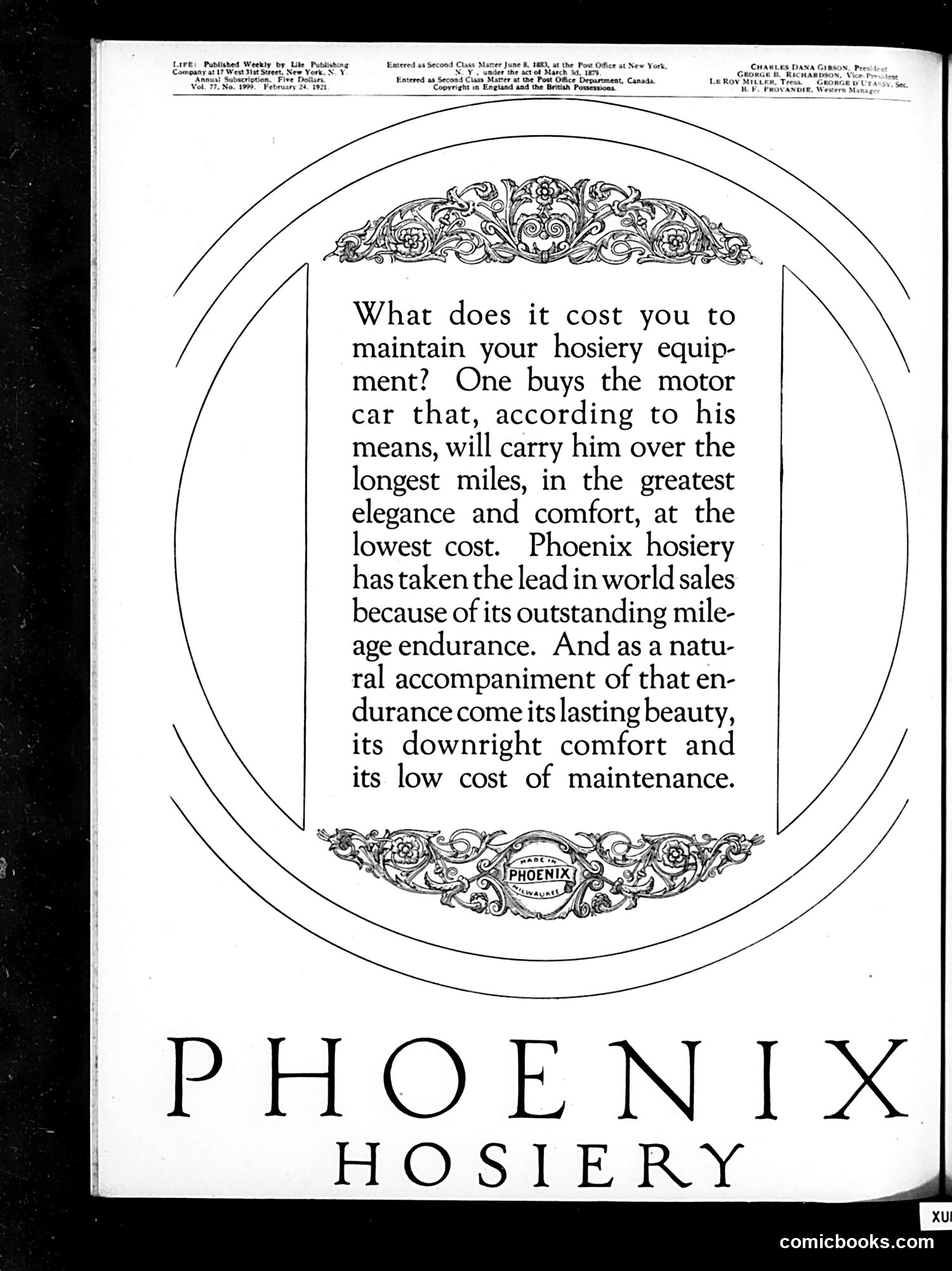
This is a **product advertisement**, not political satire or cartoon content. It's a 1921 advertisement for Phoenix hosiery (stockings) that appeared in *Life* magazine. The ad uses a rhetorical strategy common to early 20th-century marketing: it compares hosiery durability to automobile performance. The copywriter argues that just as one buys a motor car for longevity and low maintenance costs, Phoenix hosiery should be selected for its "mileage endurance," lasting beauty, comfort, and minimal upkeep expenses. The ornamental borders frame the text in a classical style typical of the era's advertising design. There are no identifiable political figures or satirical commentary—this is straightforward commercial messaging targeting consumers concerned with value and economy.
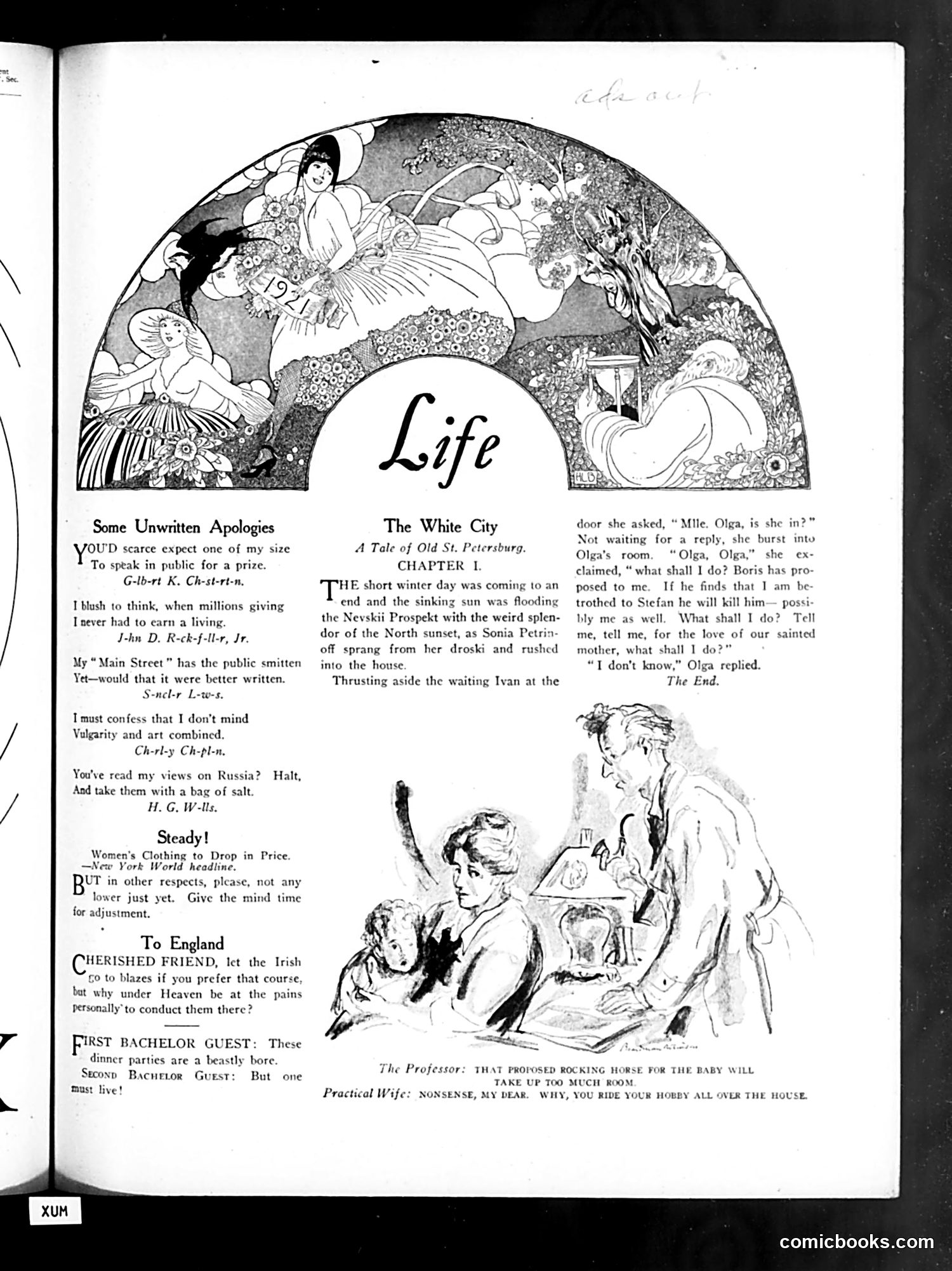
This page combines short satirical poems with an illustrated story opening ("The White City: A Tale of Old St. Petersburg"). **The satirical content** mocks various social conventions: - "Some Unwritten Apologies" criticizes public speakers and wealthy industrialists - "Steady!" jokes about women's fashion and price drops - "To England" uses ethnic humor about Irish immigrants - The bachelor dinner dialogue satirizes domestic life **The bottom illustration** depicts a domestic scene where a professor proposes a rocking horse for a baby, and a practical wife objects that it will take up too much room—a humorous jab at impractical masculine thinking versus pragmatic female reasoning. The overall tone reflects early 20th-century American satirical humor targeting class anxieties, gender roles, and immigrant stereotypes typical of *Life* magazine's editorial voice.
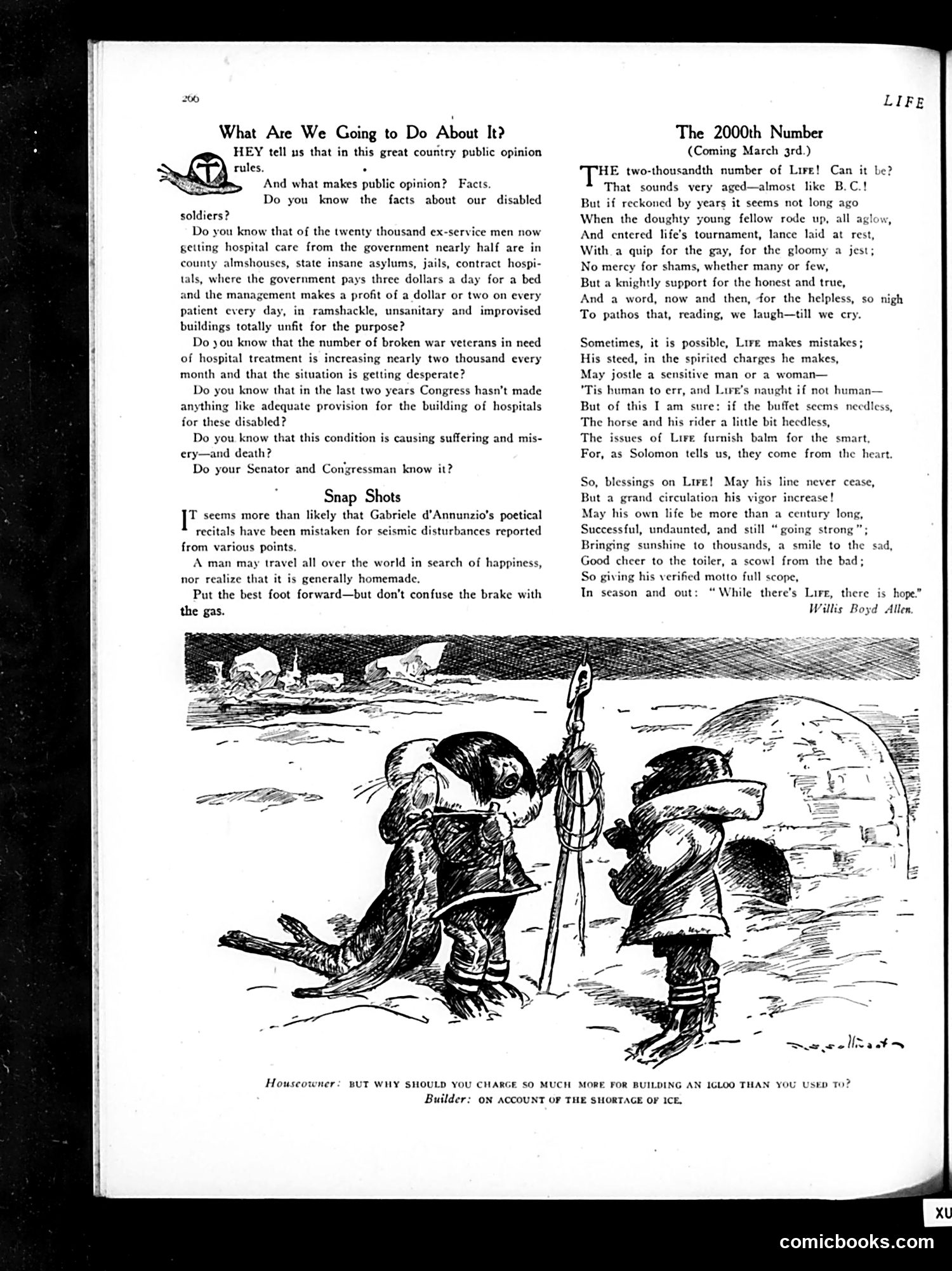
The page contains two distinct sections: **Left column ("What Are We Going to Do About It?"):** A serious editorial criticizing government neglect of disabled WWI veterans. It documents approximately 20,000 ex-servicemen in poor conditions across almshouses and hospitals, receiving only $3 daily while private contractors profit. Congress is criticized for inadequate hospital provisions. **Right column:** A poem celebrating *Life* magazine's 2000th issue (coming March 3rd). **Bottom cartoon:** Shows two men discussing construction costs. The "homeowner" questions why an igloo costs more than the one he built, while the "builder" blames an ice shortage—a humorous non-sequitur about material scarcity affecting prices. This appears unrelated to the serious veteran content above.
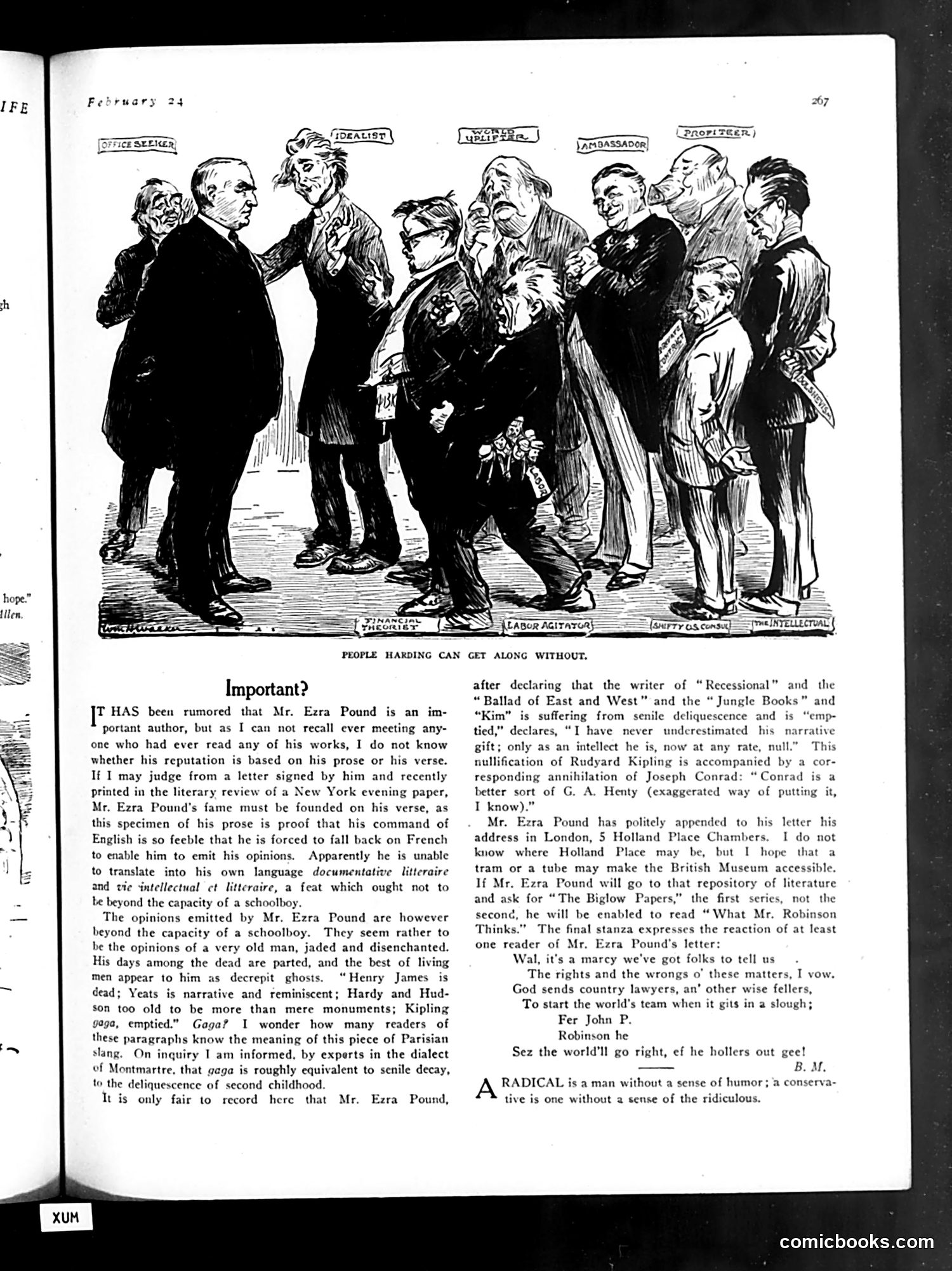
The main cartoon, titled "People Harding Can Get Along Without," depicts various political and social figures labeled with their roles: "Office Seeker," "Idealist," "Inventor," "Ambassador," "Profiteer," "Financial Speculator," "Labor Agitator," and "Intellectual." The satire targets President Harding's administration, suggesting he can function without input from diverse constituencies—idealists, workers, intellectuals, and inventors. The cartoon implies Harding's government operates independently of public interest groups and expert voices. The accompanying article criticizes Ezra Pound's literary reputation, debating whether his fame rests on prose or poetry. The text defends Pound against dismissals of his narrative gift, positioning him as more sophisticated than schoolboy-level writing. This represents early 20th-century literary criticism debates.
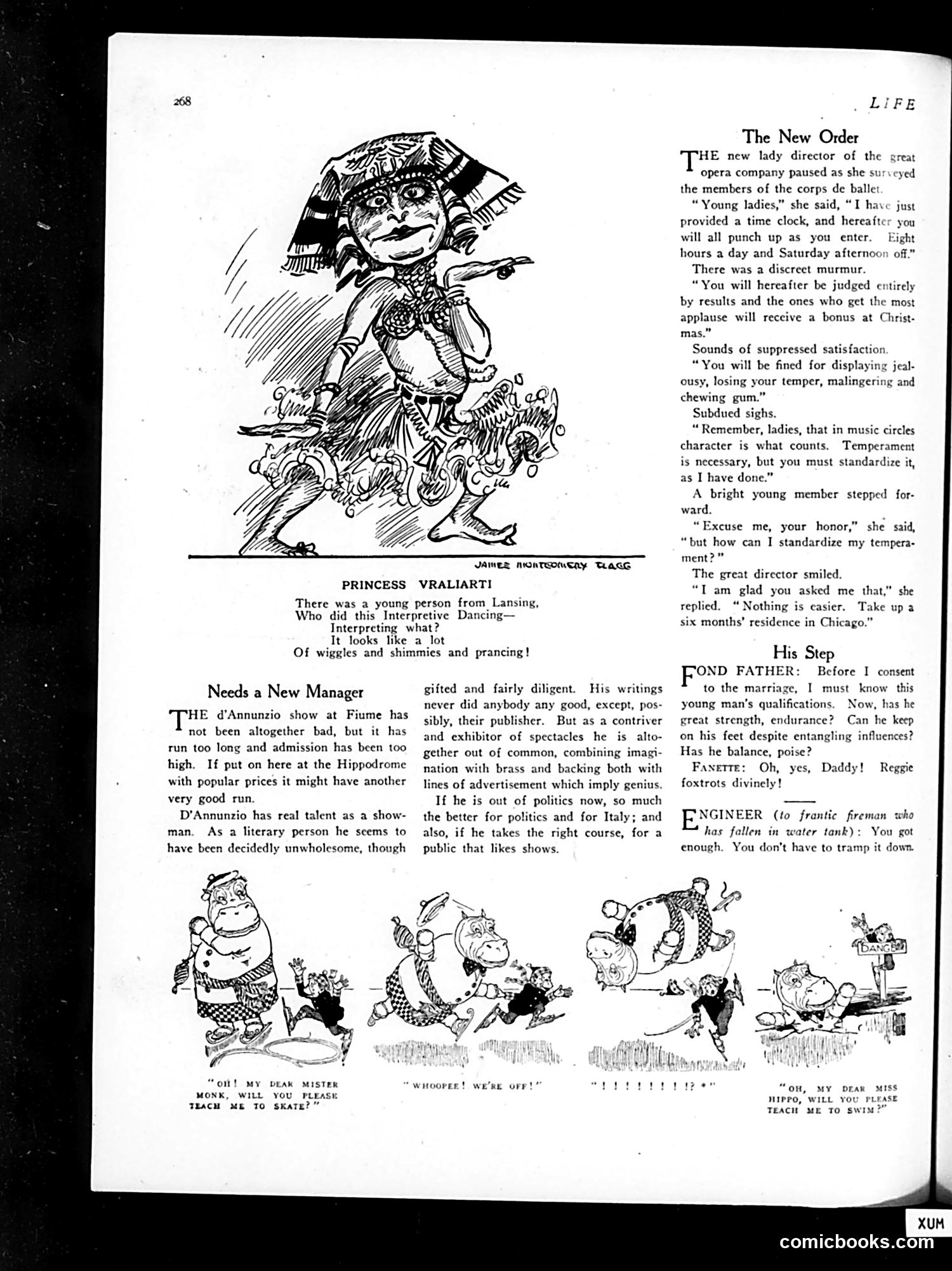
This page contains three distinct pieces of satire: 1. **"Princess Vraliart"** (top): A caricatured figure in elaborate costume, credited to James Montgomery Flagg. The accompanying verse mocks interpretive dancing as pretentious—"wiggles and shimmying" disguised as art. This targets early 20th-century modern dance movements that audiences often found bewildering or ridiculous. 2. **"Needs a New Manager"** (middle): Critiques impresario d'Annunzio's management of the Fiume opera company, suggesting his literary reputation doesn't translate to competent theater administration. 3. **Bottom comic strip**: Four panels showing a hippo attempting to learn skating, ice-skating, and swimming from various instructors—visual gags about an animal comically unsuited to these activities. The page satirizes artistic pretension, incompetent management, and physical absurdity.
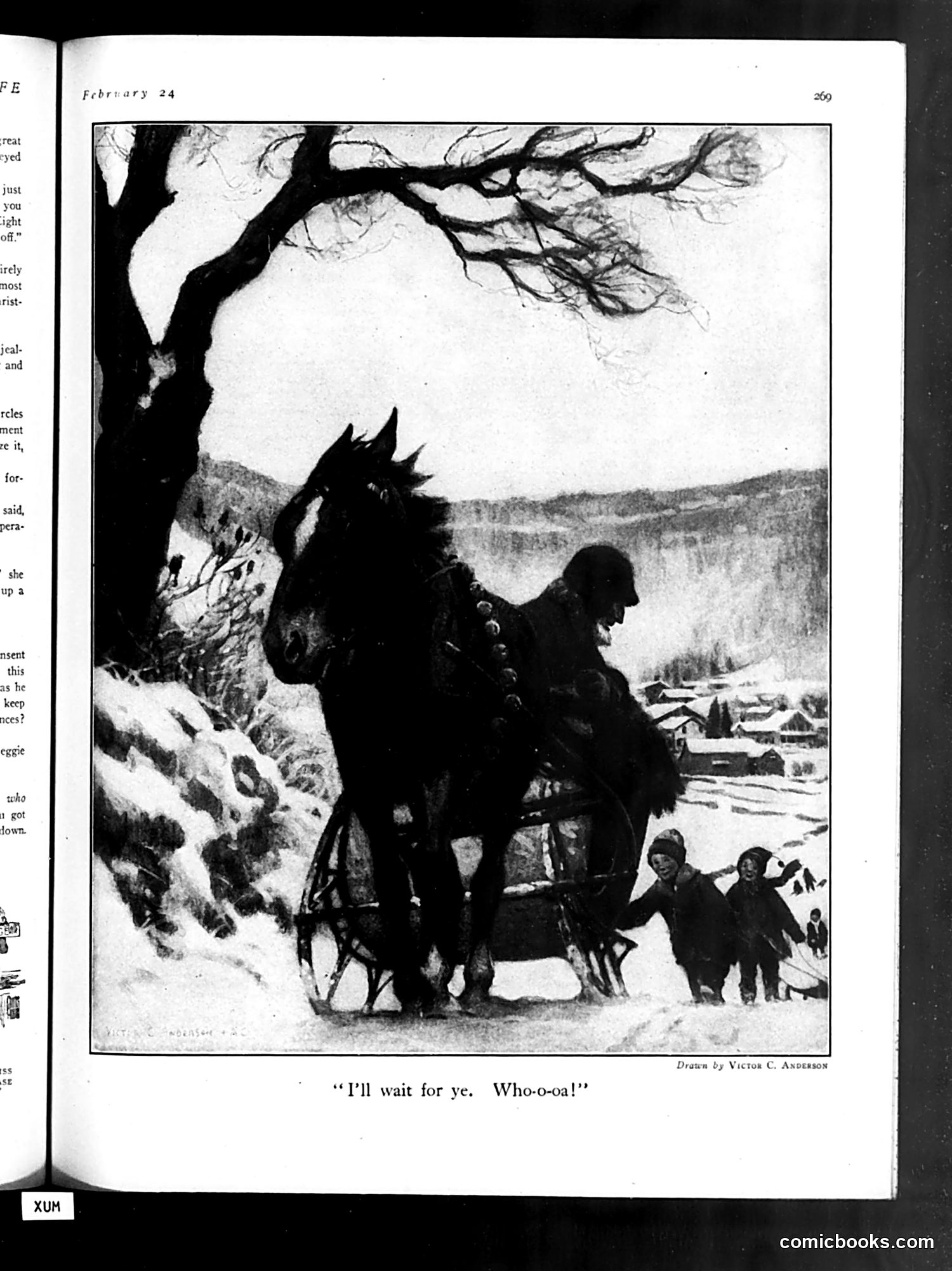
This illustration by Victor C. Anderson appears to be a winter scene showing a man on horseback beneath a gnarled tree, with children visible in the snowy landscape below. The caption "I'll wait for ye. Who-o-al!" suggests dialogue, likely between the mounted figure and the children. The page is dated February 24 and numbered 269. Without additional context from the magazine's text (which is partially cut off in the margins), the specific satirical or political meaning remains unclear. This could reference a folk tale, a current event, or social commentary typical of Life magazine's humor, but the exact reference cannot be determined from the image alone.
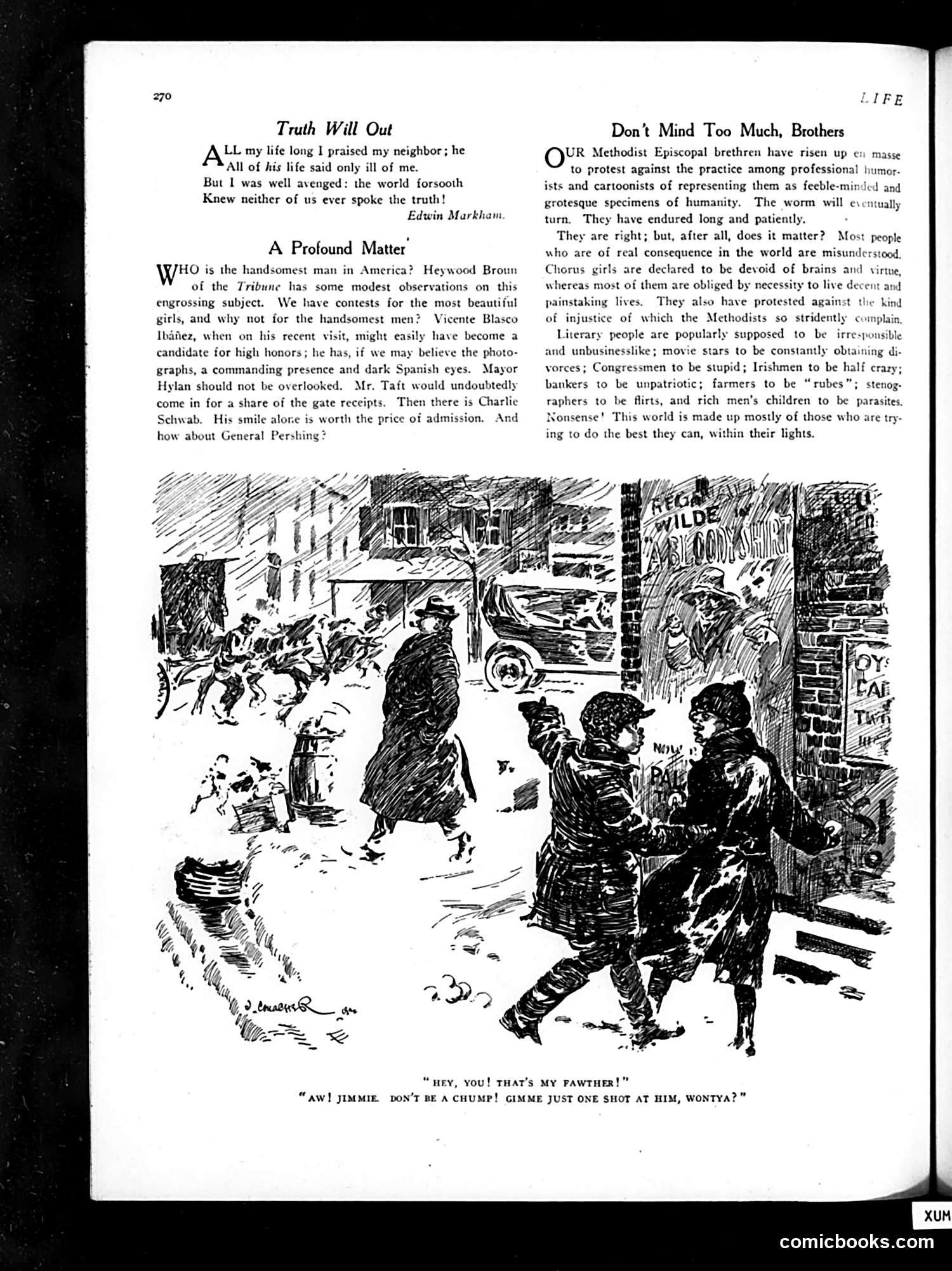
This page contains two satirical pieces from *Life* magazine: **"Truth Will Out"** - A poem by Edwin Markham criticizing a neighbor who praised himself while disparaging others, suggesting hypocrisy inevitably becomes apparent. **"A Profound Matter"** - An editorial by Heywood Broun about beauty contests, discussing handsome men (mentioning Vicenté Blasco Ibáñez and Charlie Schwab) and noting that Mayor Hylan should be overlooked. **The cartoon** depicts a street scene where children appear to be mocking or confronting an adult man, with dialogue suggesting juvenile taunting ("Hey, you! That's my fawther!" / "Aw! Jimmie, don't be a chump! Gimme just one shot at him, Wontya?"). It satirizes urban street life and childhood mischief. The right column's editorial "Don't Mind Too Much, Brothers" mocks Methodist Episcopal protests against professional humorists and cartoonists, arguing that criticism of public figures is inevitable and largely harmless.
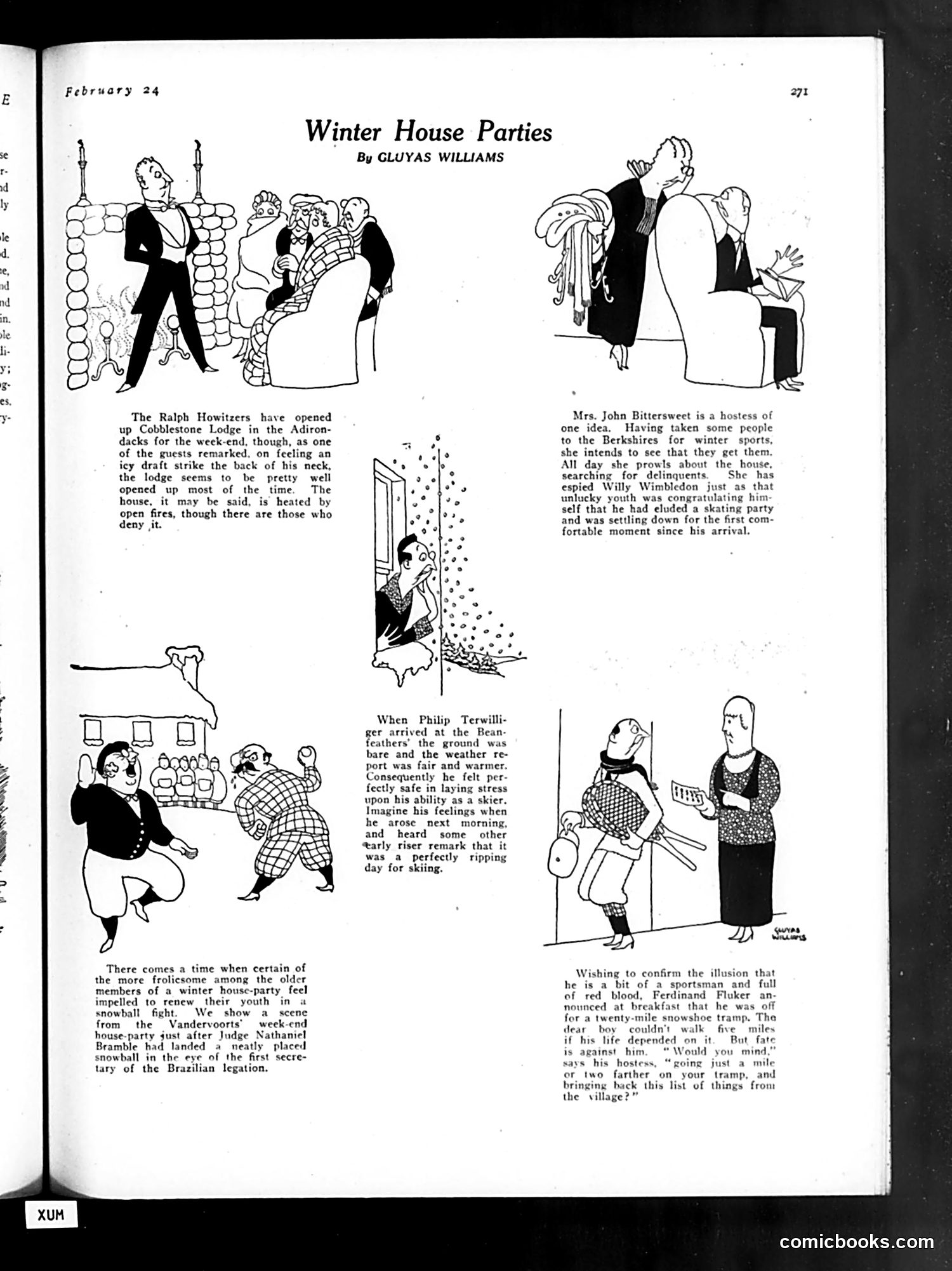
This page by Gluyas Williams presents humorous vignettes of wealthy Americans at winter retreats. The cartoons satirize upper-class social conventions and pretensions: The top left shows guests at "Cobblestone Lodge" in the Adirondacks, mocking how the lodge "seems to be pretty well operated most of the time" despite being heated only by open fires. The top right depicts Mrs. John Bittersweet as an anxious hostess obsessing over guests' comfort at her Berkshires property. Lower panels illustrate specific incidents: a snowball fight at the Vandervoorts' estate and Ferdinand Fluker's exaggerated hunting story about a twenty-mile snowshoe tramp—satirizing the tendency of wealthy men to embellish outdoor exploits. Williams' humor targets the self-importance and social anxiety of the leisure class.
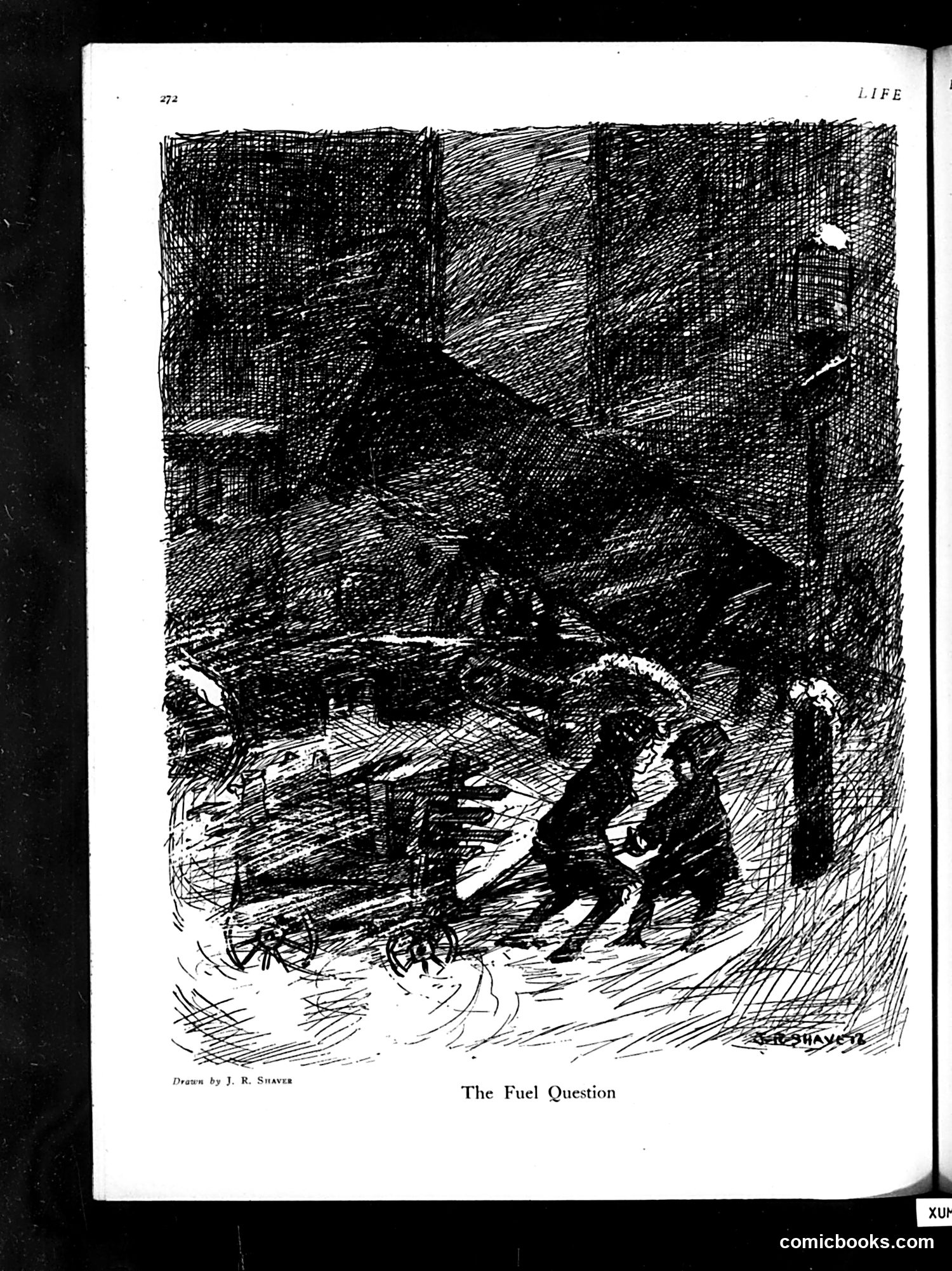
This cartoon by J.R. Shaver depicts a snowy winter scene showing figures struggling with fuel delivery—likely a horse-drawn cart in difficult conditions. The title "The Fuel Question" references a contemporary public concern about heating fuel shortages or high prices during winter. The satirical point appears to address the difficulty citizens faced obtaining adequate fuel for heating homes during cold months—a recurring social problem in early 20th-century America. The harsh winter conditions and struggling delivery suggest commentary on either fuel scarcity or the hardship placed on common people trying to heat their homes affordably. Without the magazine's date visible, the specific historical context remains unclear, though fuel shortages were persistent urban issues throughout this period.
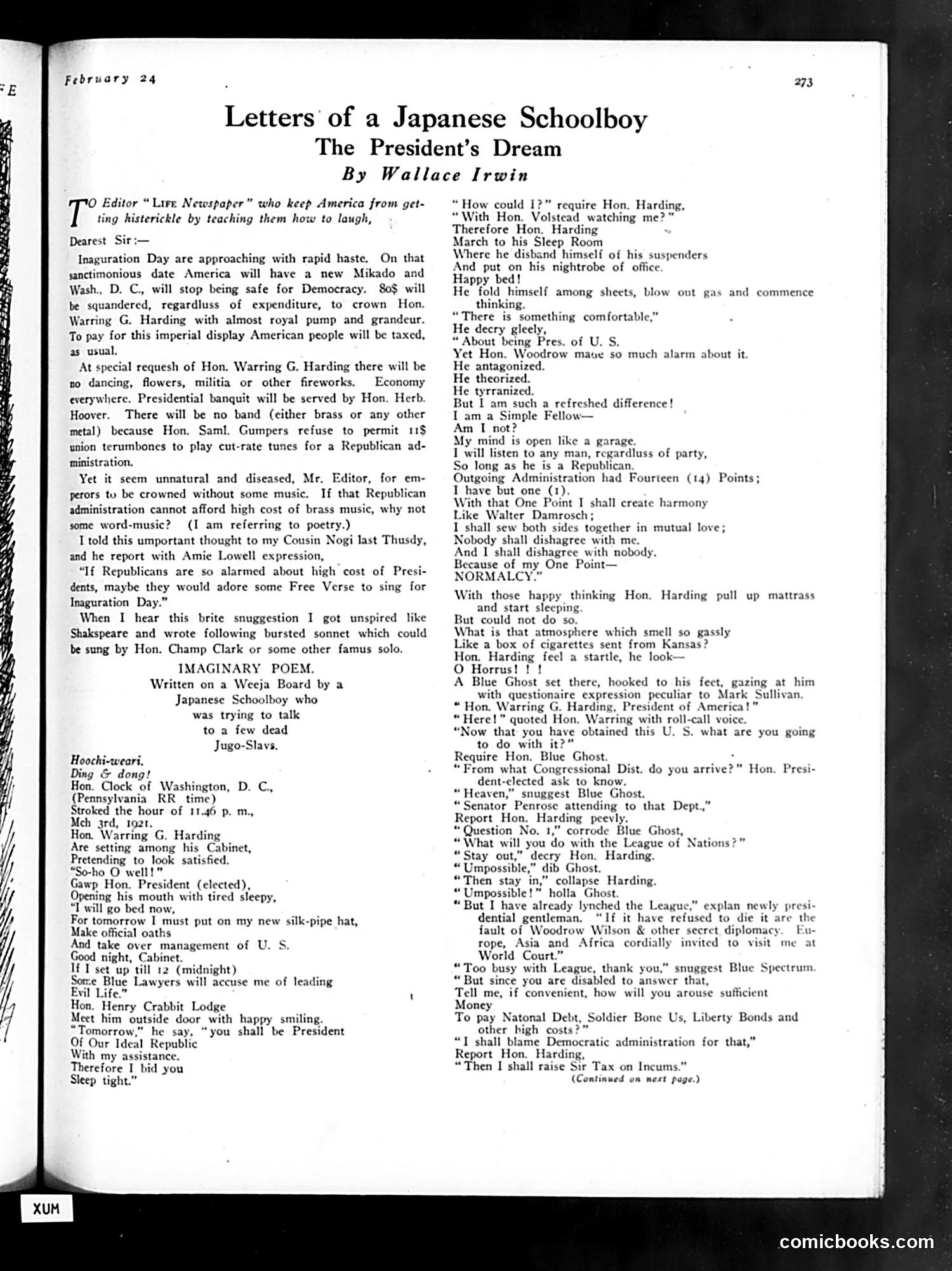
This satirical piece mocks President Warren G. Harding's inauguration preparations. The "imaginary poem" presents a dream where Harding encounters various political figures including Hon. Warring G. Harding, Hon. Herb. Hoover, and a "Blue Ghost" (likely representing Woodrow Wilson). The satire targets Republican anxieties about cost—brass bands, fireworks, and expenses for the inauguration. It ridicules the GOP's complaints about Democratic spending while planning their own costly celebration. The poem pokes fun at Harding's vague policies ("normalcy") and features comic dialogue where figures debate the League of Nations and financial matters, highlighting the era's political tensions and the new administration's uncertain direction.
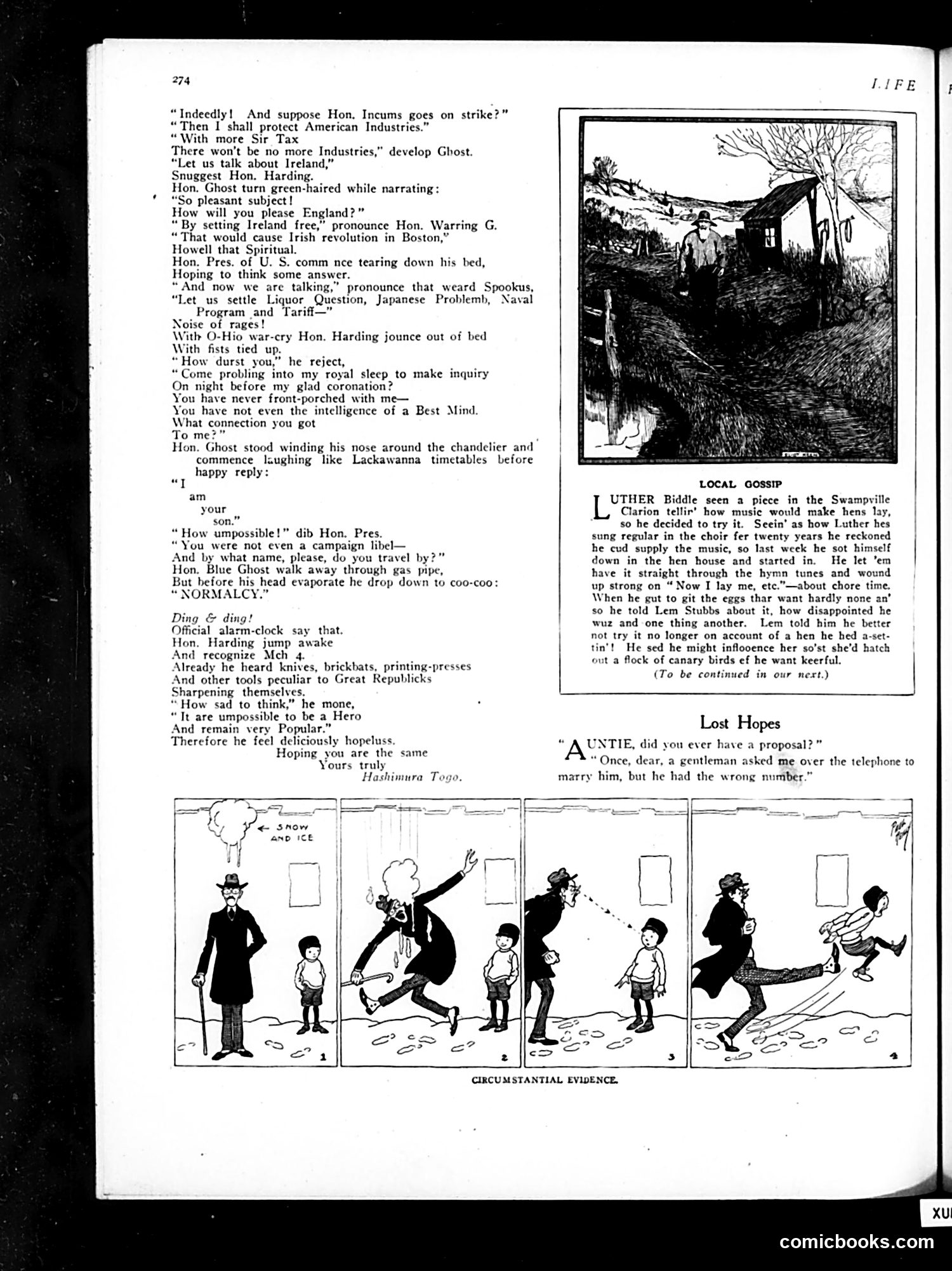
This page contains political satire about American leadership circa World War I era. The left column features dialogue mocking government figures (referenced as "Hon. Incums," "Hon. Harding," "Hon. Ghost") debating Irish independence, tariffs, and naval policy—suggesting incompetent or disconnected politicians. The four-panel cartoon titled "CIRCUMSTANTIAL EVIDENCE" shows a man in formal dress appearing to slip on ice repeatedly while children watch, with the final panel showing him falling. The joke: physical stumbling serves as "evidence" of clumsiness, paralleling how politicians' public gaffes become evidence of their incompetence. The "Lost Hopes" section mentions a woman who received a telephone marriage proposal but rejected it—satirizing changing courtship norms. Without a visible date, the exact political targets remain unclear, though the tone suggests Progressive Era skepticism of government.
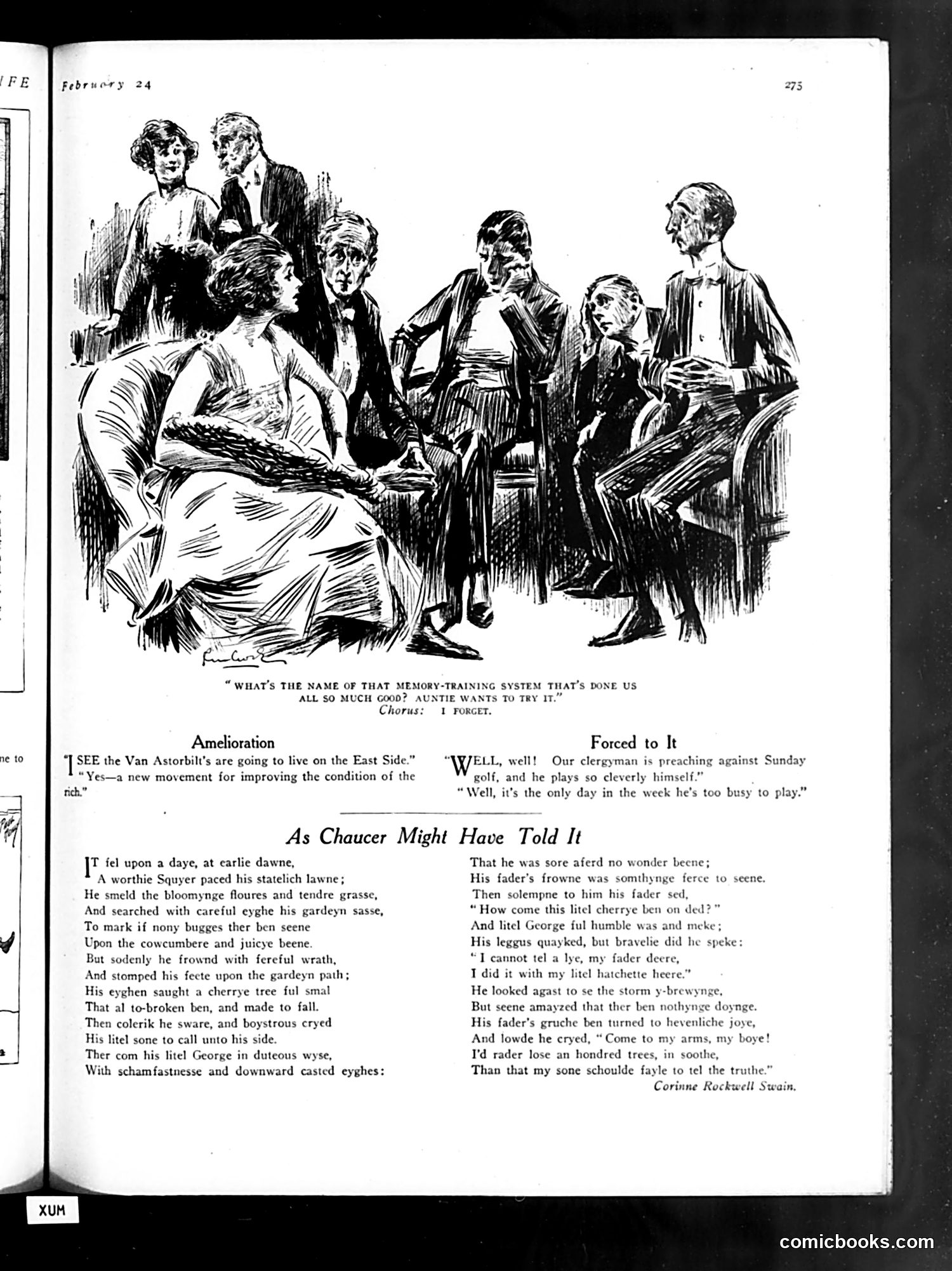
**The Main Cartoon** depicts a social gathering where someone asks about a "memory-training system" that's benefited "Auntie." The humor satirizes self-improvement fads and their dubious effectiveness—the chorus responds "I forget," undermining the system's claimed success. **The Two Brief Jokes Below:** - "Amelioration" mocks the wealthy Van Astorbilt family's plan to move to the East Side, presented as social progress - "Forced to It" jokes about a clergyman preaching against Sunday golf because it's his only free day **"As Chaucer Might Have Told It"** is a literary parody poem (credited to Corinne Rockwell Swain) in Middle English style, humorously recounting a squire's son breaking his father's prized hen—a mock-heroic treatment of mundane domestic mishap. All pieces target upper-class pretension and self-deception.
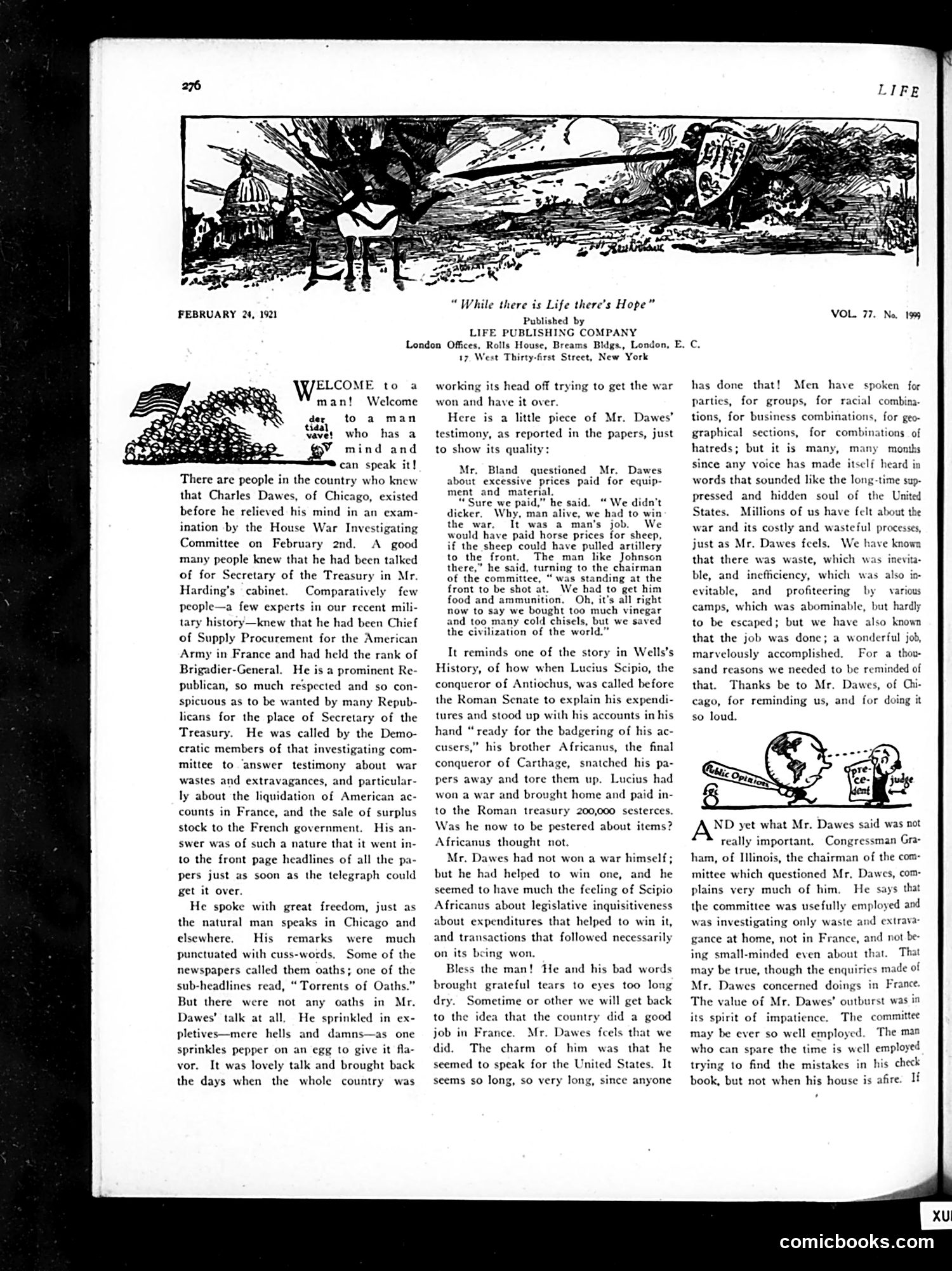
This February 24, 1921 Life Magazine page celebrates Charles Dawes, a prominent Republican who had recently served as Chief of Supply Procurement for the American Army in France and held the rank of Brigadier-General. The text praises Dawes for testifying before a Congressional committee investigating wartime expenditures and waste in France. The article portrays him as a plain-spoken "working man" who directly addressed the committee about inefficiencies and excessive prices for military supplies. The satire appears gentle—praising his candid, colorful language ("Torrents of Oaths") and his willingness to speak truth about government waste. The cartoon's exact meaning is unclear from the image alone, but the overall tone celebrates Dawes as a refreshing voice of accountability in post-war investigations.
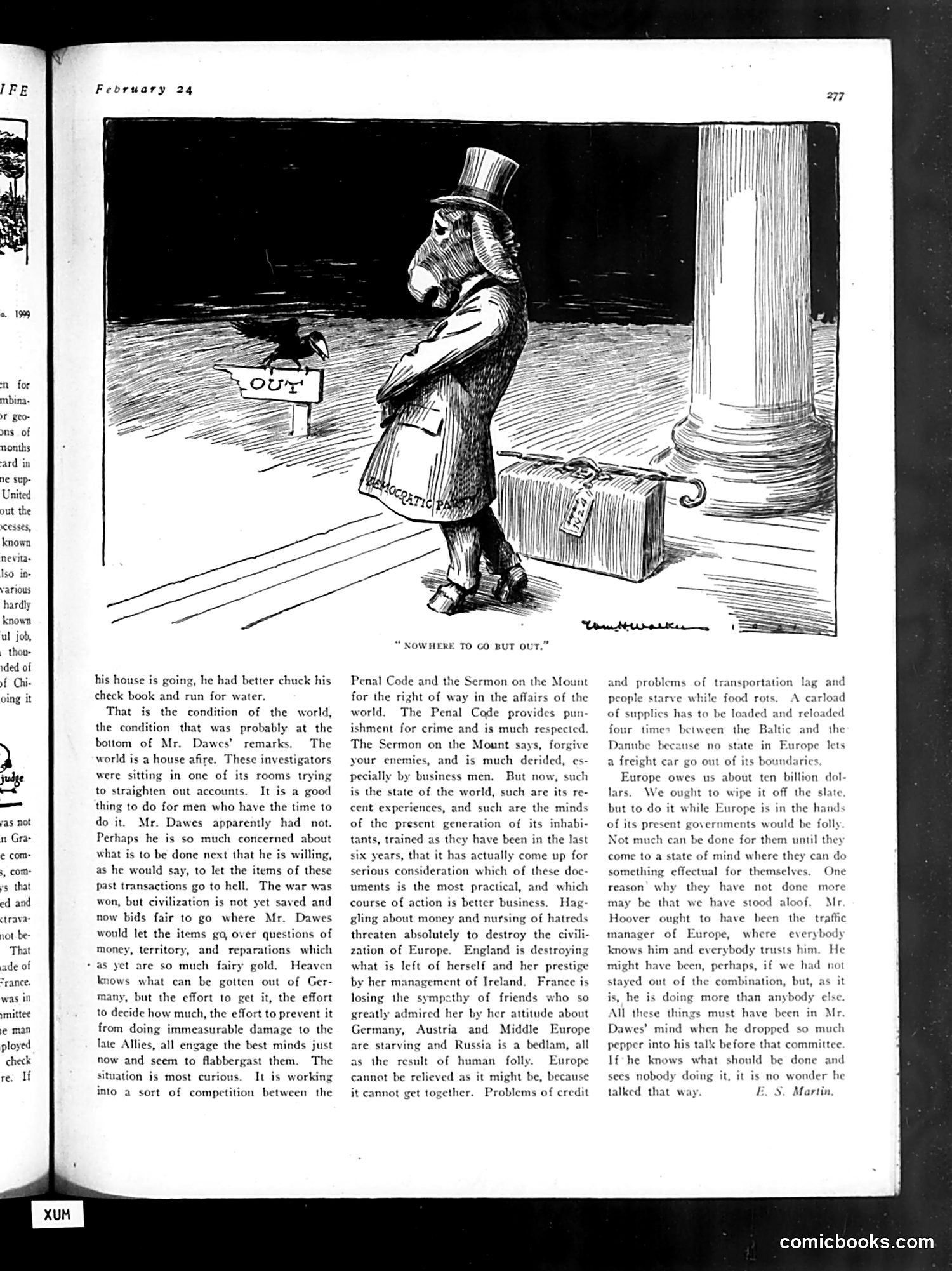
This political cartoon depicts an anthropomorphic ape or monkey in formal dress (top hat, overcoat) holding a sign reading "OUT" while standing beside a suitcase, suggesting forced evacuation or exile. The accompanying article discusses post-WWI European instability—specifically problems with Germany, Austria, and Russia. The text mentions "civilization" being threatened and references efforts to prevent "immeasurable damage" to Europe through reparations disputes. The cartoon likely satirizes a European leader or nation being expelled from international affairs, probably representing either German ambitions being thwarted or commentary on revolutionary upheaval. The "nowhere to but out" caption suggests the figure has exhausted all options and faces only removal from power or influence. The ape imagery reflects period racial/ethnic caricature common in early 20th-century satire.
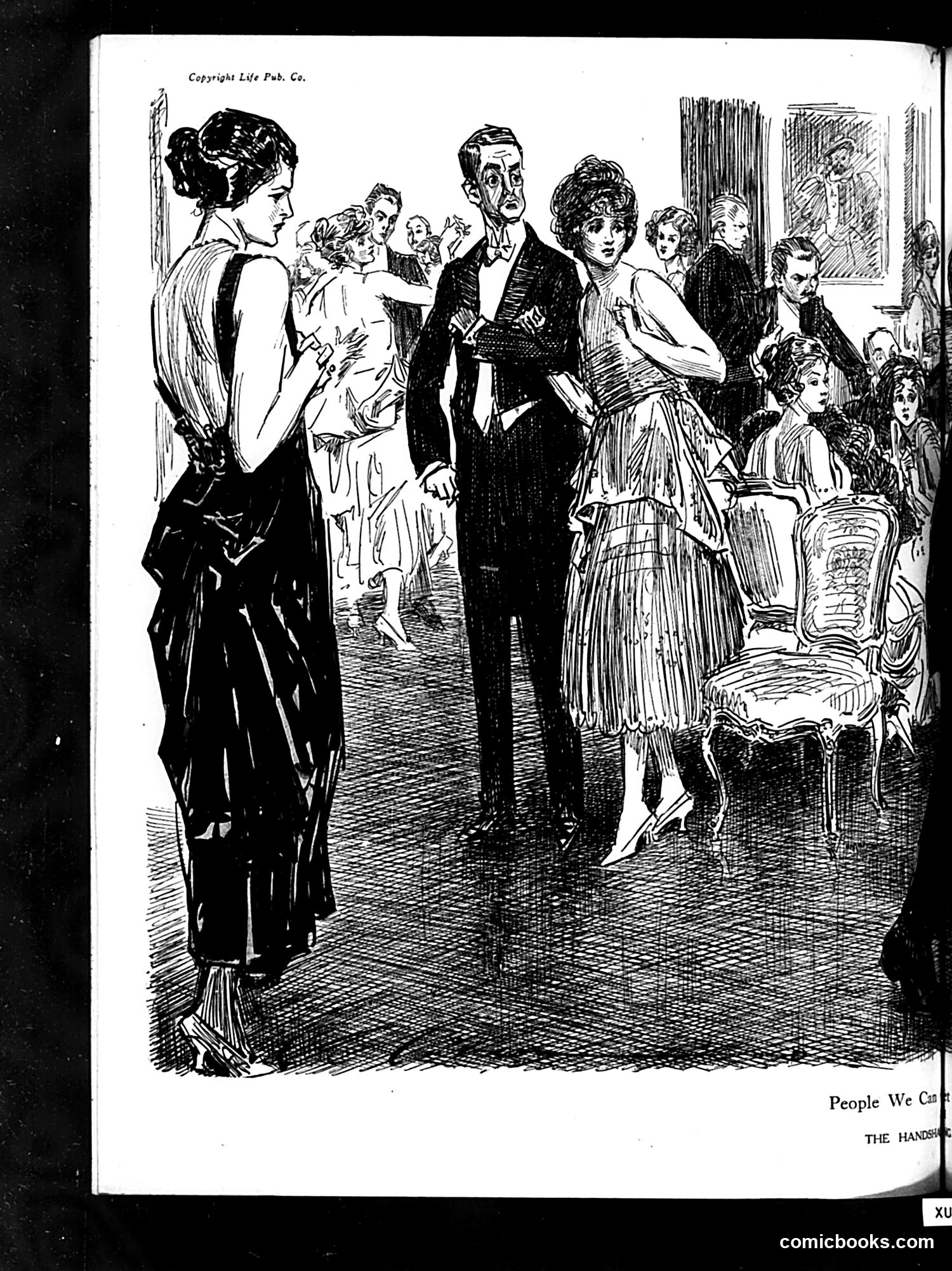
This appears to be a satirical illustration titled "People We Ca[n]..." with "THE HANDSOM[E]..." visible at the bottom (text is cut off). The image depicts a formal social gathering or party scene from the early 20th century. The cartoon shows well-dressed figures in what appears to be an elegant interior, with a distinguished man in formal attire as a central figure. The style and composition suggest social satire about upper-class etiquette or behavior at formal events. However, without complete text visible, I cannot definitively identify the specific individuals being caricatured or determine the precise satirical target. The illustration's humor likely depends on context provided in the full article caption, which is partially obscured in this image.
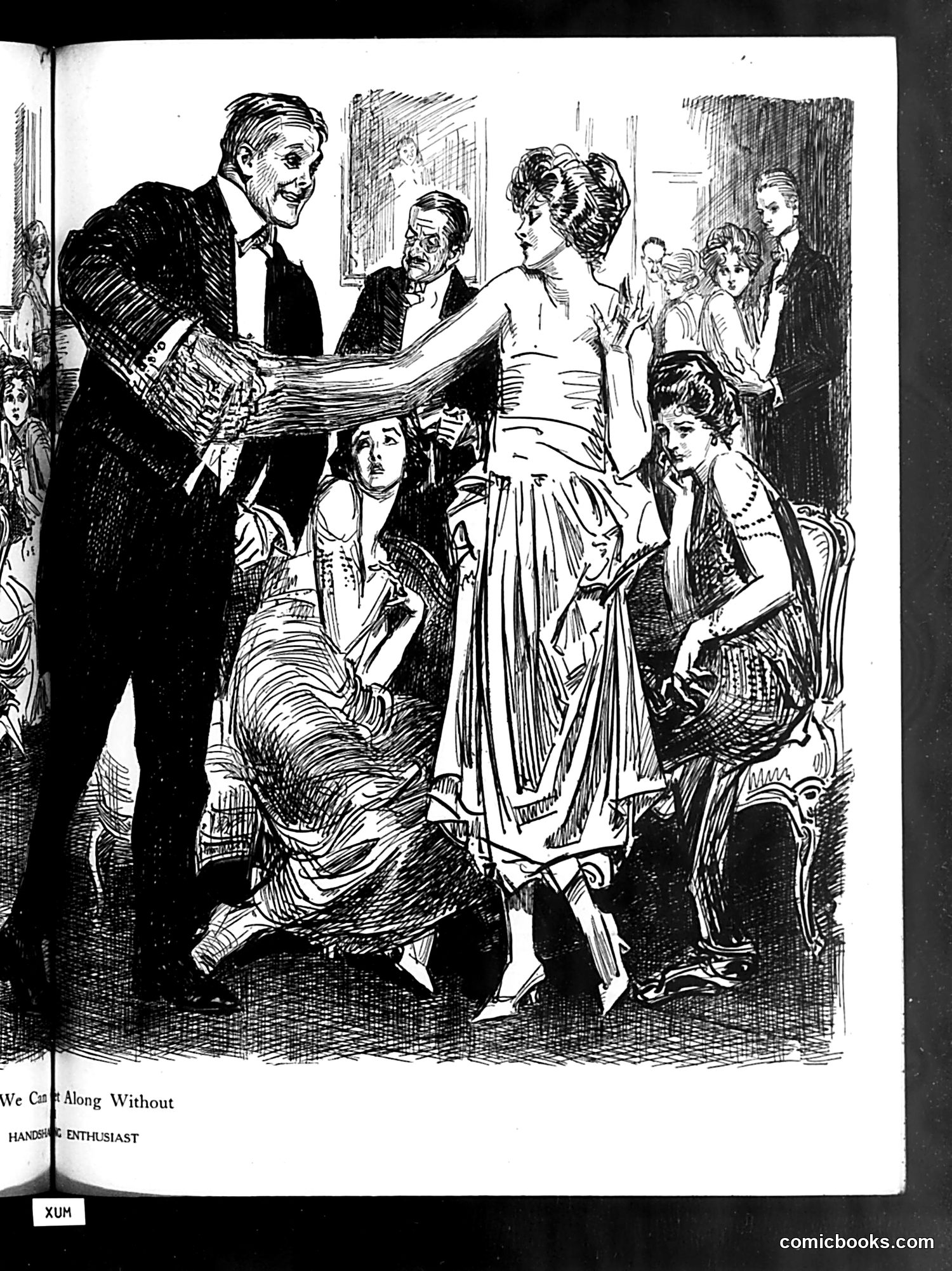
This is a satirical illustration titled "We Can't Along Without" (the full title appears cut off). The caption "Handshake Enthusiast" suggests the cartoon satirizes someone obsessed with handshakes as a political or social tool. The scene depicts a well-dressed man prominently shaking hands with a woman at what appears to be a formal social gathering, while various onlookers observe. The exaggerated style and the man's prominent positioning suggest he's a public figure being mocked for his excessive or performative use of handshakes—possibly as a political strategy or means of gaining favor. Without clearer context about the specific date or historical moment, the exact target remains unclear, but the satire appears directed at a politician or public figure known for emphasizing personal charm through handshakes as a political tactic.
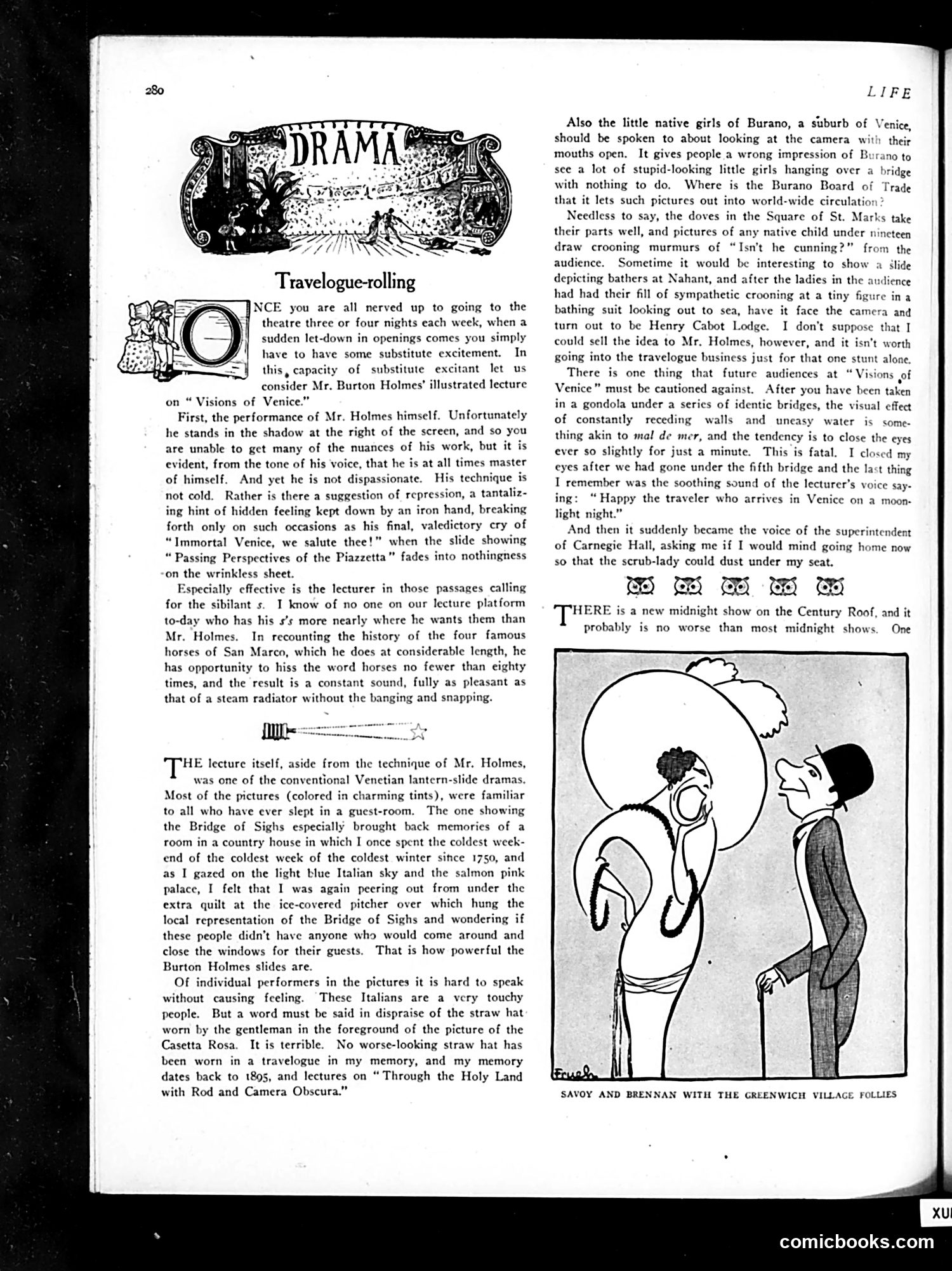
This is satirical commentary on Burton Holmes, a famous early-20th-century travel lecturer who presented illustrated lantern-slide shows about exotic locations like Venice. The article mockingly critiques both Holmes's performance style and the tedious conventions of travelogue entertainment. The cartoon at bottom—captioned "Savoy and Brennan with the Greenwich Village Follies"—depicts a man in formal dress interacting with a rotund figure, likely satirizing theatrical performers or the absurdity of vaudeville entertainment. The text ridicules Holmes's dramatic pretensions while obsessing over trivial details: his pronunciation of "s" sounds (which he allegedly perfects through excessive hissing), a poorly chosen straw hat in one Venice scene, and local girls' unflattering open-mouthed expressions. The author uses exaggerated earnestness to expose how travelogue audiences find entertainment in mundane elements rather than genuine cultural insight. The satire suggests early-cinema culture valued spectacle and emotional manipulation over substance.
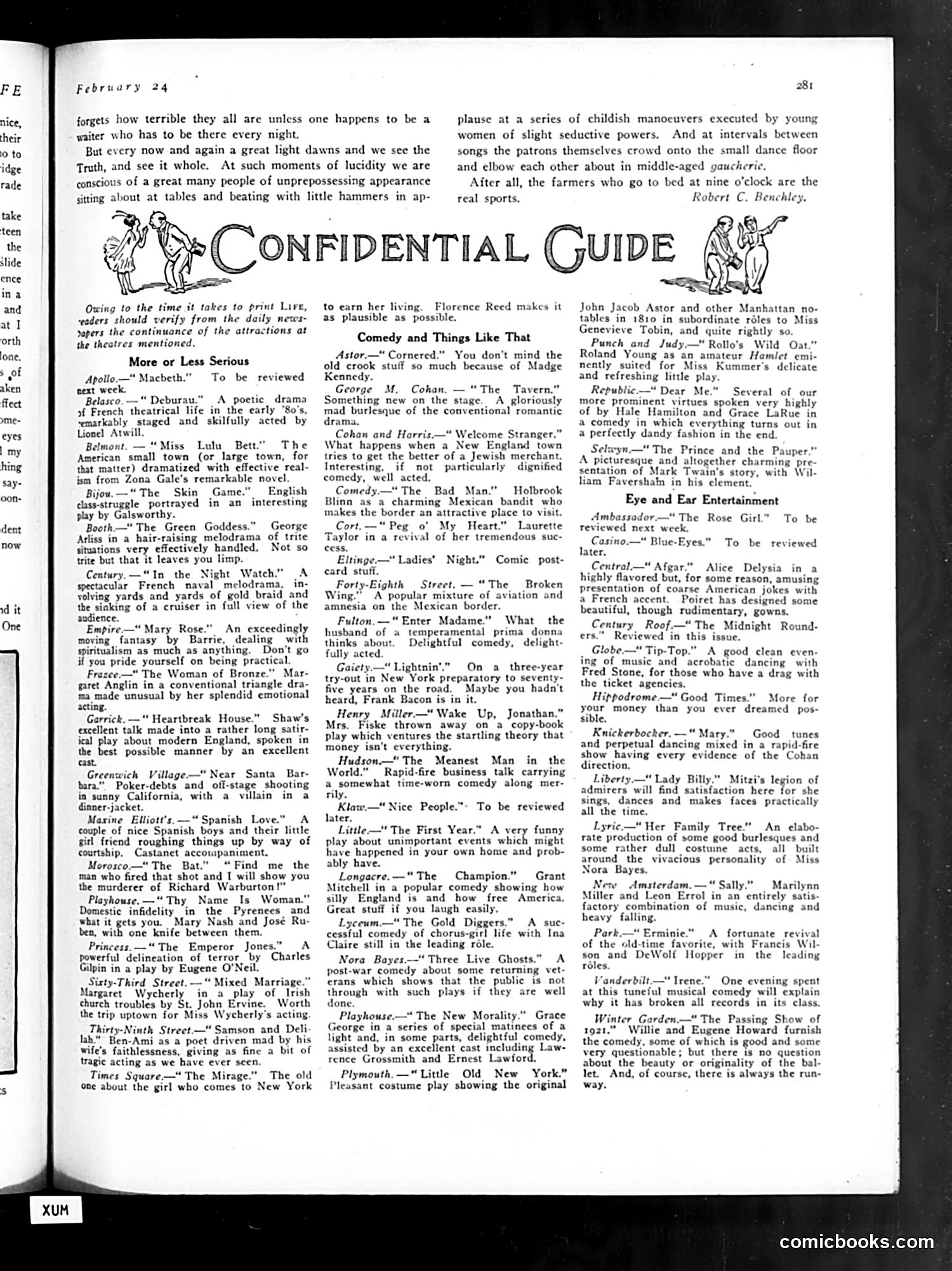
This page is primarily a theater guide—a "Confidential Guide" to Broadway shows—rather than political satire. The header quote by Robert C. Benchley (the famous humorist) opens by mocking nightclub patrons: people who sit at tables "beating with little hammers in applause" at "childish manoeuvres executed by young women," then crowd onto dance floors in "middle-aged gaucherie." Benchley contrasts these absurd urbanites with farmers who sensibly go to bed at nine o'clock. The guide itself lists current theatrical productions, divided into "More or Less Serious" and "Comedy and Things Like That" categories. It reviews plays ranging from Shakespeare's *Macbeth* to lightweight comedies, offering brief judgments on their merit and notable performers like Lionel Atwill and George Arliss. The satire here targets Jazz Age leisure culture—specifically the pretentiousness and excess of New York nightlife—rather than political figures.
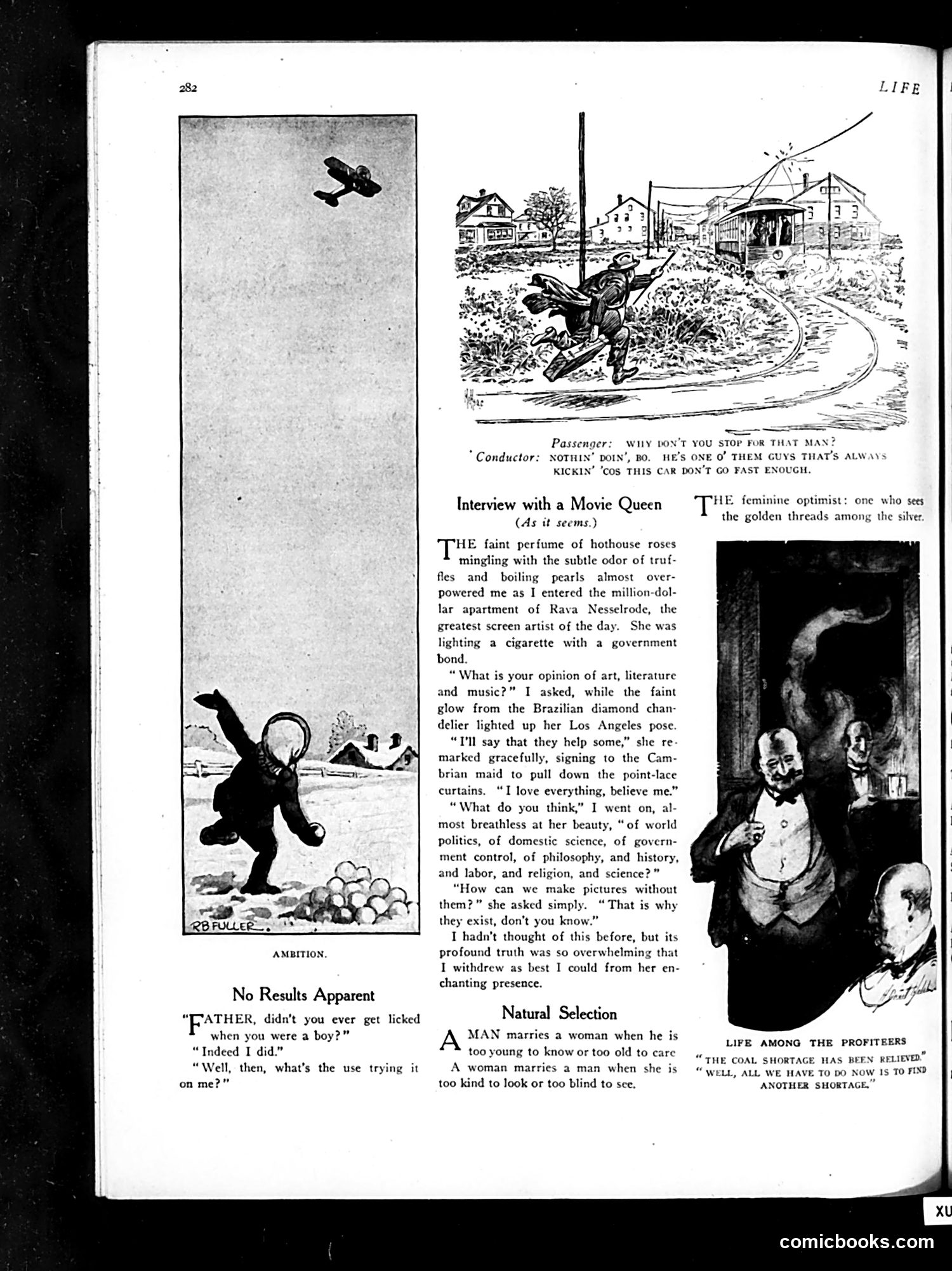
This *Life* magazine page contains several satirical pieces mocking 1920s American society: **"Ambition"** (left cartoon by C.B. Fuller): A child asks his father why trying to fight is worthwhile if the father got beaten as a boy. The joke critiques futile ambition—the generational cycle of struggle without progress. **"Interview with a Movie Queen"**: A parody of celebrity worship. The unnamed actress (likely a composite satire of silent-film starlets) is portrayed as vapid yet treated as profoundly wise. She's absurdly wealthy (lighting cigarettes with government bonds, diamond chandeliers), yet her answer to serious questions about politics, science, and philosophy is that movies need these topics to exist. The satire mocks both celebrity pretension and fan adulation. **"Natural Selection" and "The Feminine Optimist"**: Brief quips about marriage and women's perspectives. **"Life Among the Profiteers"**: A cartoon criticizing wartime profiteers who, having resolved the coal shortage, now seek another shortage to exploit—mocking cynical capitalism. The overall tone ridicules celebrity culture, materialism, and wartime profiteering.
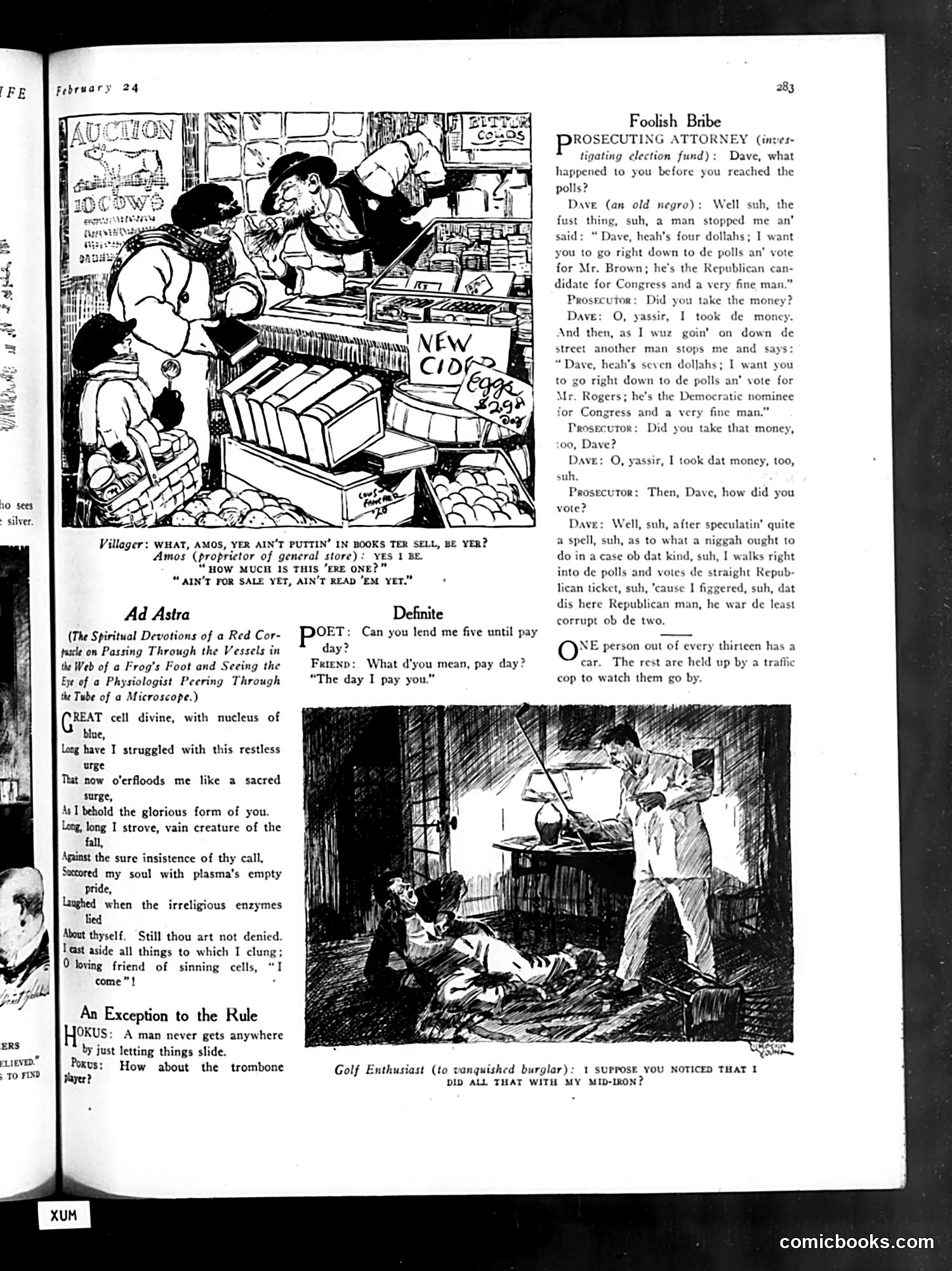
This page contains multiple satirical pieces targeting early 20th-century American politics and society: **"Foolish Bribe"** (main cartoon): A Black voter named Dave describes being offered money by both Republican and Democratic operatives to vote for their candidates. Dave accepts both bribes but votes Republican, reasoning the GOP candidate is "de least corrupt." The satire attacks election fraud and voter bribery as normalized practices, while the dialect and racial caricature reflect the period's offensive conventions. The joke's cynicism suggests widespread corruption across both parties was accepted as inevitable. **Other items** include brief comic exchanges ("An Exception to the Rule," "Definite") and a mock-scientific poem ("Ad Astra") typical of Life's humorous filler content. The cartoon's core commentary: American elections were essentially for sale to the highest bidder, with both parties equally guilty of corruption.
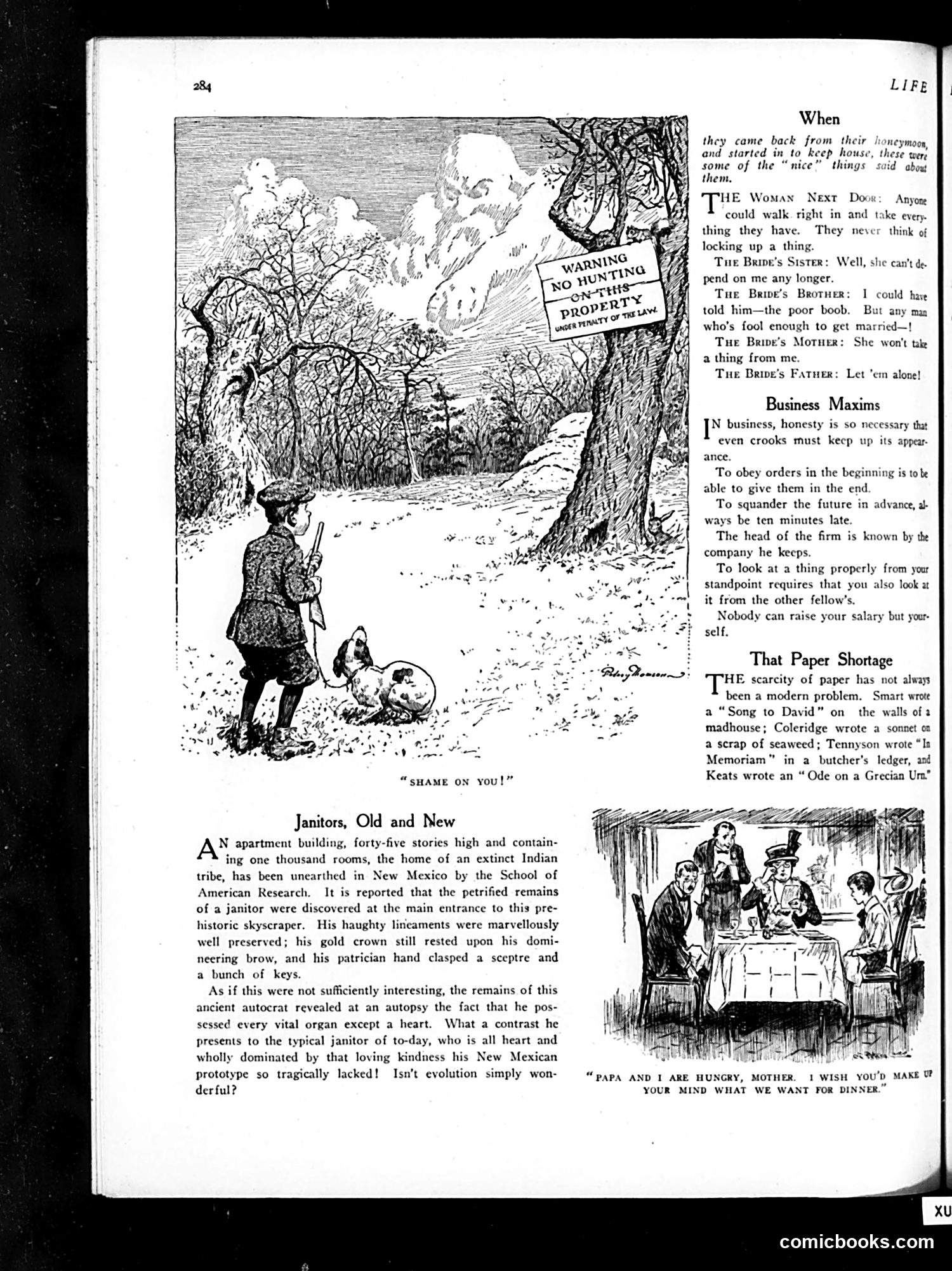
This page contains three satirical pieces typical of Life magazine's humor: 1. **"Janitors, Old and New"**: A mock-serious article "reporting" the discovery of a 45-story prehistoric New Mexico building with a petrified janitor skeleton. The joke satirizes evolutionary progress: the ancient janitor possessed every organ except a heart and wielded absolute authority, while the modern janitor is "all heart and wholly dominated by loving kindness." This inverts typical superiority claims about progress—suggesting modern workers are actually softer and more exploited than ancient ones. 2. **"Business Maxims"**: Cynical aphorisms about workplace conduct, including "even crooks must keep up [honesty's] appearance" and "Nobody can raise your salary but yourself"—satirizing capitalist self-reliance and hypocrisy. 3. **Right panels**: A domestic cartoon mocking a newlywed couple's inconsiderate neighbors and family, and a dinner-table cartoon about indecisive meal planning, typical period humor about modern marriage and household tensions.
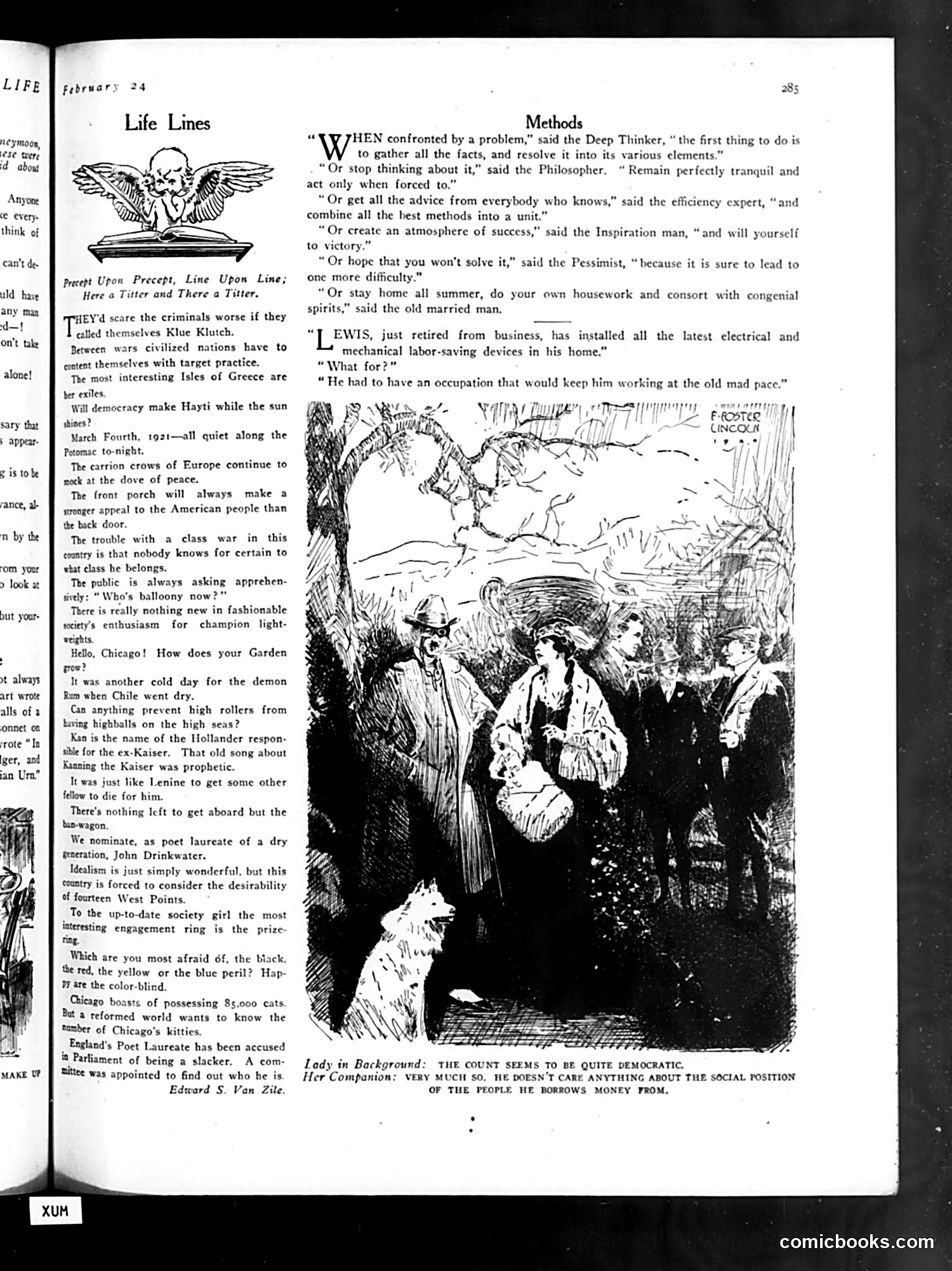
This page contains two distinct satirical sections from *Life*, a prominent American humor magazine of the era. **"Life Lines"** offers brief, cynical quips on contemporary issues: the KKK (referenced as "Klue Klutch"), post-WWI politics, Prohibition (Chile going "dry"), Lenin and the Russian Revolution, and England's Poet Laureate being accused of wartime shirking. These reflect 1921 concerns: labor unrest, international instability, and social upheaval. **"Methods"** satirizes different problem-solving philosophies through character types—the Deep Thinker, Philosopher, efficiency expert, and Pessimist—each offering contradictory advice. This mocks contemporary self-help culture and management trends of the Jazz Age. **The bottom cartoon** depicts a European count borrowing money from society figures without concern for their social standing—satirizing Old World aristocratic indifference to democratic values. The joke: democratic principles apparently don't extend to financial obligation. Together, these pieces reflect *Life's* skeptical, urbane critique of American culture, politics, and pretension during the post-war period.
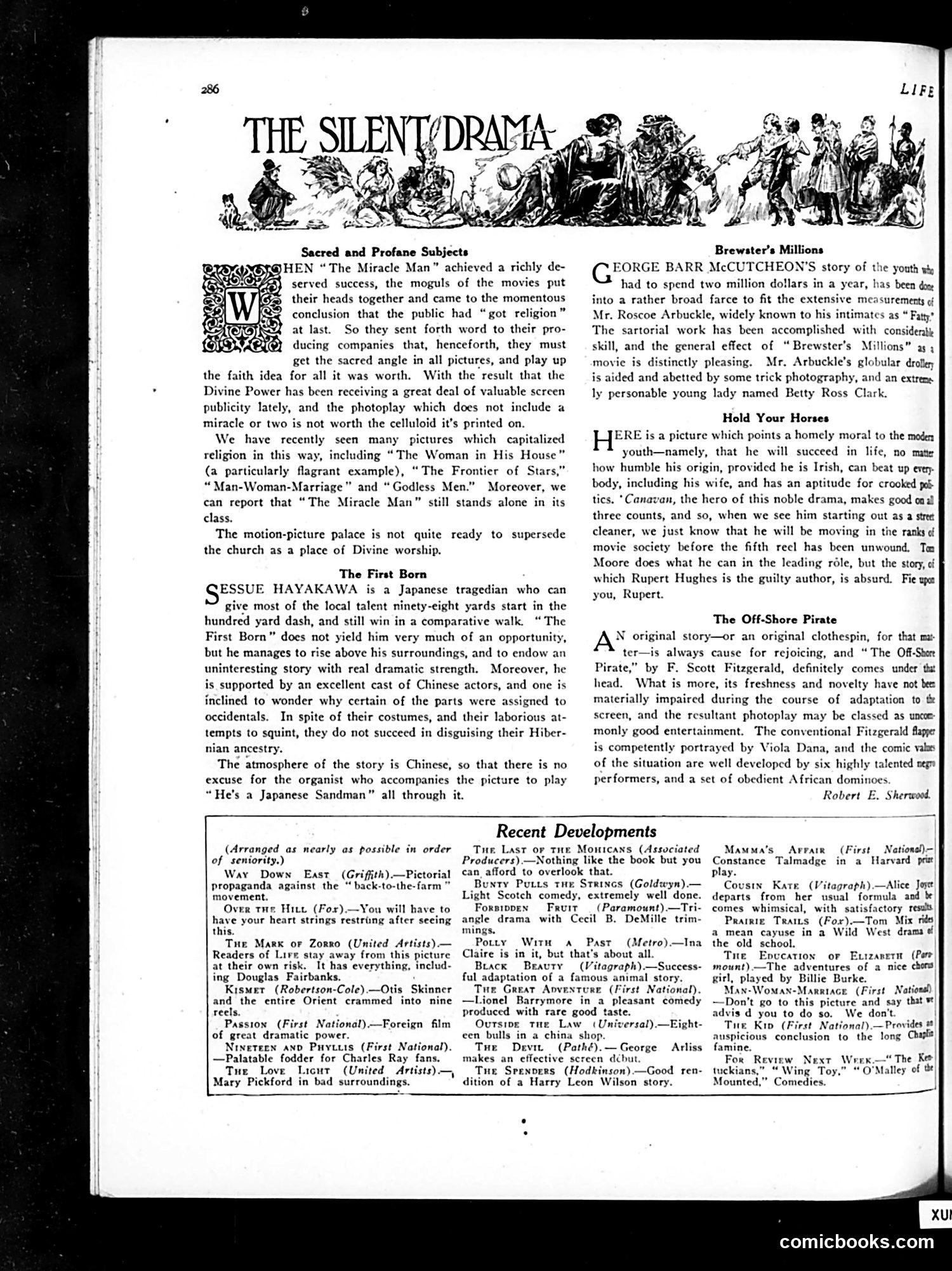
This page contains film reviews from Life's "Silent Drama" section, critiquing recent movie releases. The reviews discuss: **"Brewster's Millions"**: Adapts a novel about spending two million dollars in a year, tailored to showcase comedian Roscoe Arbuckle (nicknamed "Fatty" for his weight), whose physical comedy ("globular drollery") is enhanced by trick photography. **Religious-themed films**: The reviewer satirizes Hollywood's trend of capitalizing on the success of "The Miracle Man" by flooding the market with religion-focused pictures, noting studios now demand "sacred angles" in all productions. The satire's point: movies cannot replace actual churches as places of worship. **Other films reviewed**: "The First Born" (featuring Japanese actor Sessue Hayakawa), "Hold Your Horses" (an Irish-immigrant-success story by writer Rupert Hughes), and "The Off-Shore Pirate" (a F. Scott Fitzgerald adaptation). The reviews employ sardonic wit typical of Life's satirical style, mocking both studio greed and filmmaking trends rather than specific political figures.
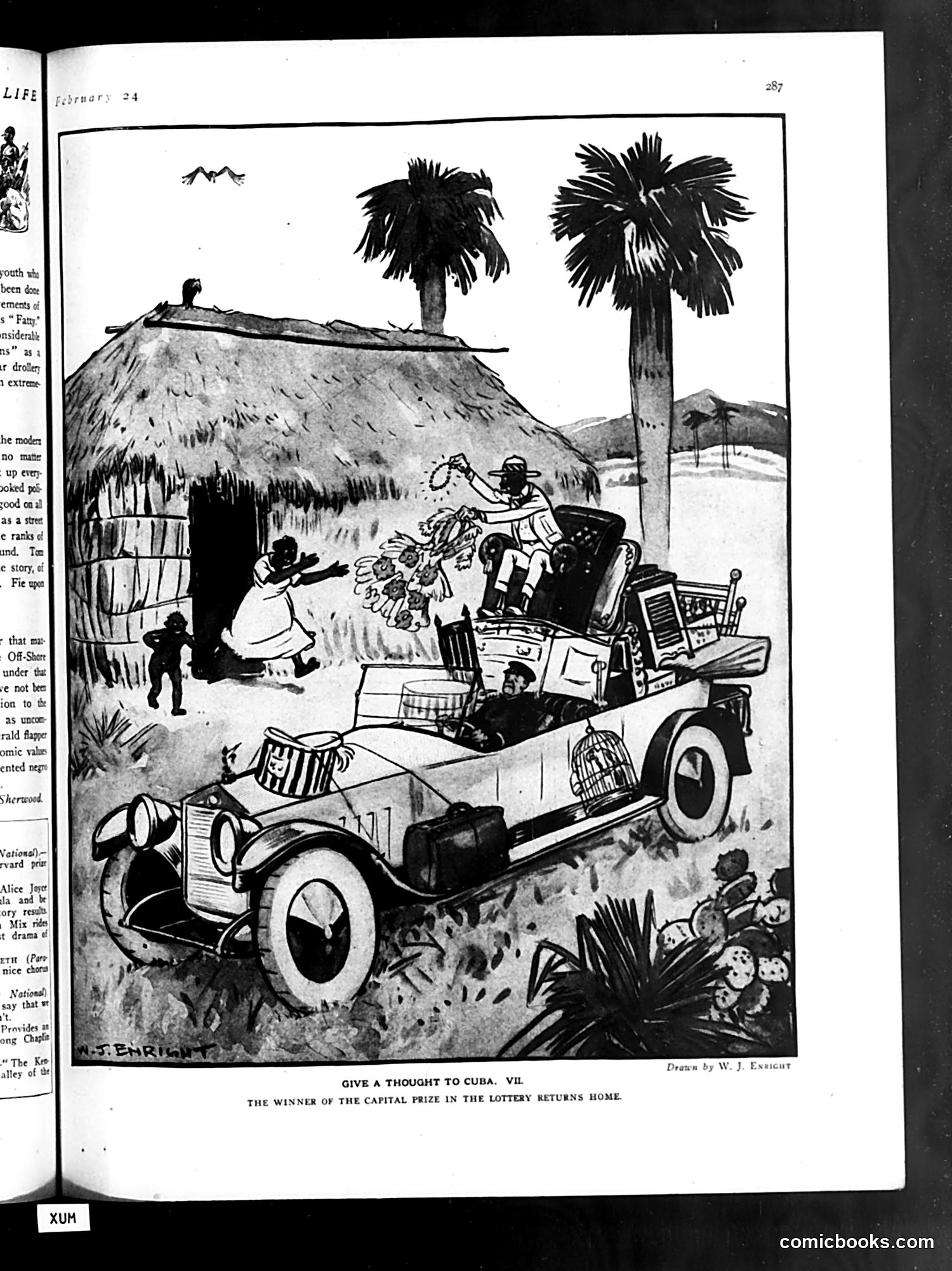
This cartoon depicts someone who won a lottery prize returning home to Cuba, illustrated by a heavily-laden automobile overflowing with possessions and luggage. The scene shows a modest thatched-roof dwelling and palm trees, suggesting rural Cuba. The satire appears to mock the contrast between wealth gained through lottery winnings and the humble circumstances of home. The absurdly overstuffed vehicle—piled with furniture, birdcages, and goods—suggests either the winner's excess or the impracticality of transporting such wealth back to a modest environment. The series title "Give a Thought to Cuba" (numbered VII) indicates this was part of a recurring commentary, likely satirizing either Cuban lottery culture or broader themes about sudden wealth and social status in the Caribbean. The detailed OCR text is too fragmented to identify specific political references with certainty.
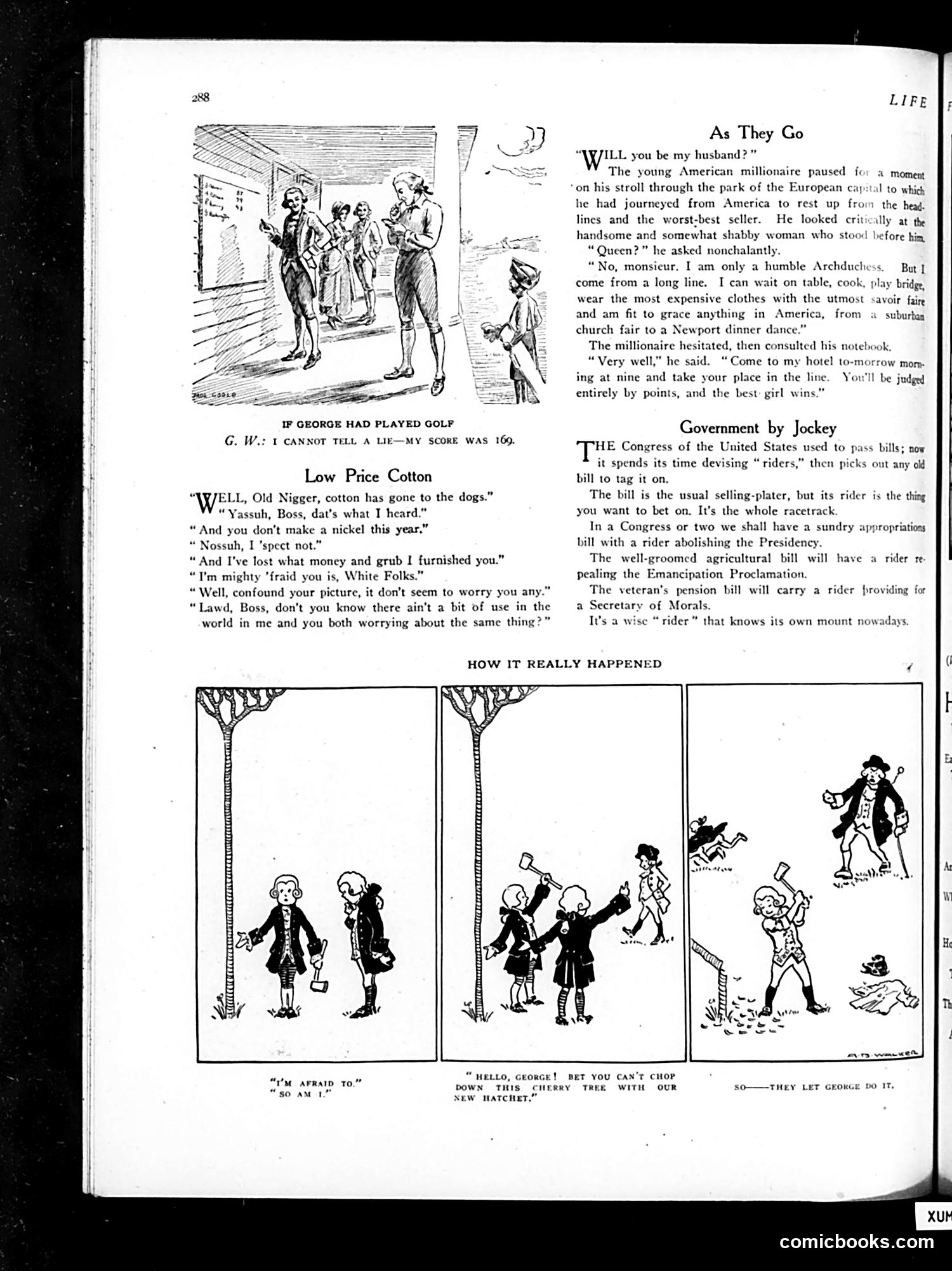
This page contains three separate satirical pieces typical of early 20th-century American humor: **"If George Had Played Golf"** mocks the famous (apocryphal) story of young George Washington confessing to chopping down his father's cherry tree. The joke: if Washington had played golf instead, he'd confess to a terrible score of 169—suggesting even historical icons can't escape modern embarrassments. **"Government by Jockey"** satirizes Congressional practice of attaching "riders" (unrelated provisions) to bills. The author warns this trend will escalate absurdly—imagining riders abolishing the Presidency or repealing the Emancipation Proclamation attached to routine appropriations bills. It critiques legislative corruption and procedural abuse. **"Low Price Cotton"** and **"As They Go"** are shorter comedic sketches about economic hardship and romantic negotiation, using period dialogue conventions. The page reflects Progressive Era concerns: political corruption, economic anxiety, and social change—all delivered through gentle, character-based humor rather than explicit political commentary.
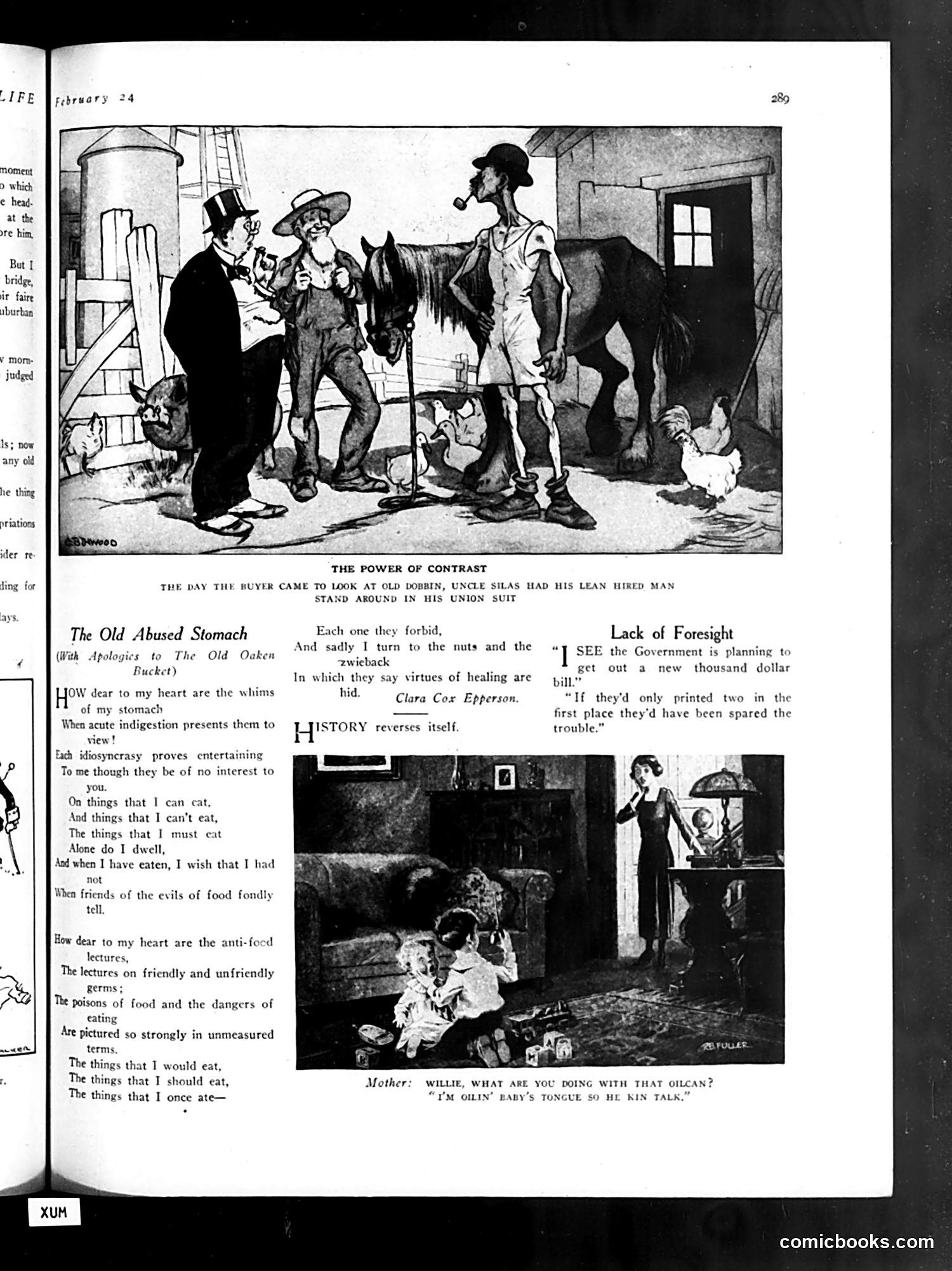
**Top Cartoon ("The Power of Contrast"):** This depicts a horse-trading scene where a buyer inspects a skinny horse while the seller's hired man—deliberately dressed in a union suit (underwear) to appear equally lean—stands beside it. The joke: the contrast makes the horse look better by comparison. This satirizes deceptive sales tactics and the phrase "power of contrast" as a sales strategy. **Left Column ("The Old Abused Stomach"):** A humorous poem parodying "The Old Oaken Bucket," complaining about contradictory dietary advice. It mocks health-conscious lectures about "friendly and unfriendly germs" and food dangers—apparently a contemporary concern—leaving the sufferer eating only nuts and zwieback (dry toast), dissatisfied either way. **Bottom Right ("Lack of Foresight"):** A brief joke about government fiscal incompetence: if they'd printed two thousand-dollar bills initially instead of one, they'd have avoided current printing problems. Light political satire about government planning failures.
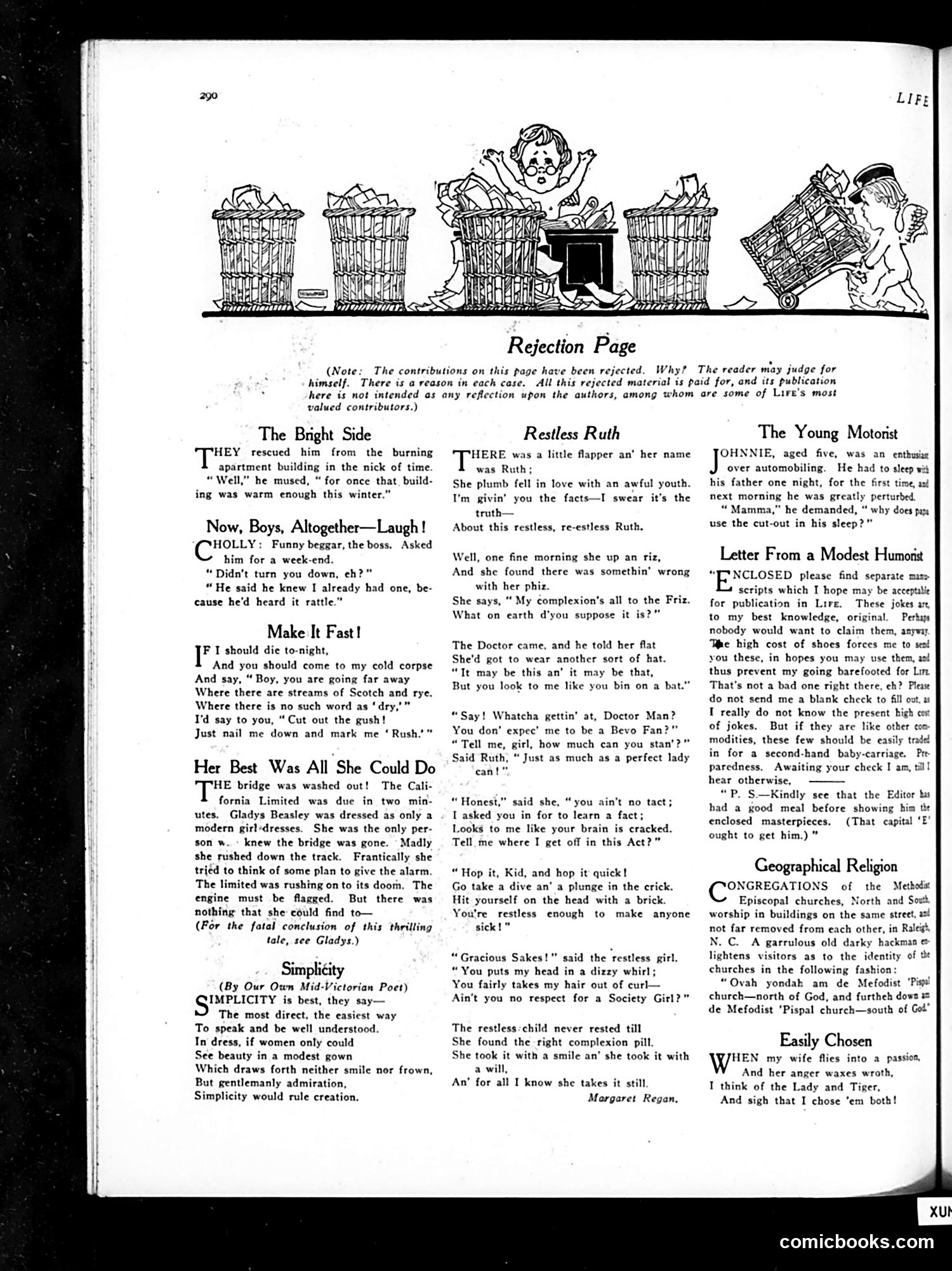
This is Life's famous "Rejection Page"—a humorous feature publishing stories and poems the magazine deliberately rejected, inviting readers to judge why. The cartoon header shows overflowing trash baskets and a cherub tossing papers, visualizing editorial waste. The rejected pieces include light comic verse and anecdotes typical of early 20th-century humor: a joke about a cold apartment, a flapper named Ruth with complexion troubles, a five-year-old obsessed with automobiles, and a poem praising Victorian simplicity in women's dress. The note explicitly states these contributions are paid for despite rejection—a tongue-in-cheek way Life acknowledged that even rejected material from valued contributors deserved publication. The satire targets the quality of submissions and contemporary cultural preoccupations (flappers, automobiles, beauty anxieties) rather than political figures. This represents Life's role as a satirical magazine of manners and social commentary.
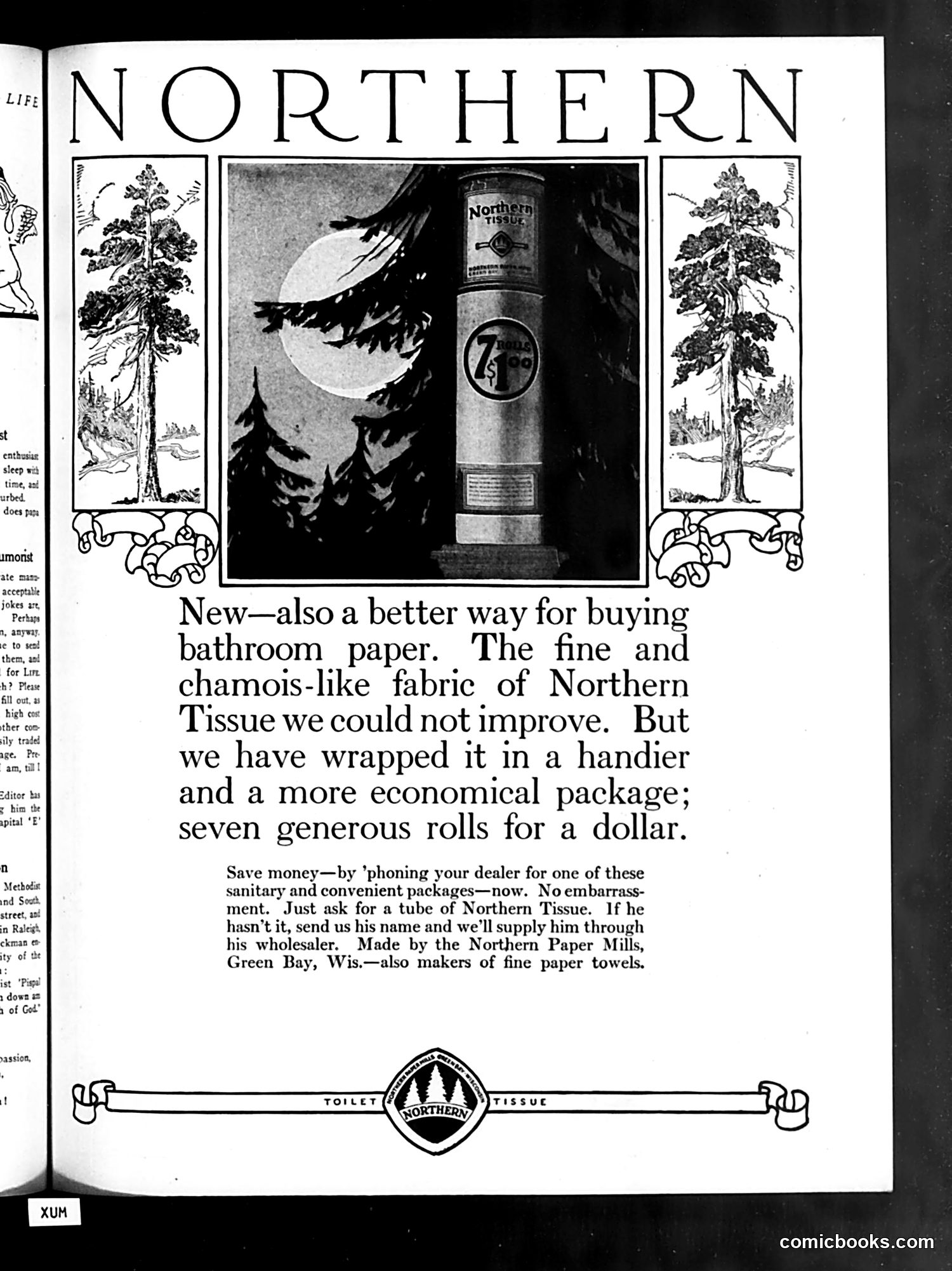
This is a **product advertisement**, not political satire. It promotes Northern Tissue bathroom paper, emphasizing a new packaging innovation: seven rolls bundled together for one dollar. The ad's visual centerpiece shows a moonlit forest scene with a product tube, flanking decorative panels of tall trees. The text emphasizes the product's quality ("fine and chamois-like fabric") while highlighting the economic appeal of bulk purchasing. Notable for modern readers: the ad stresses **discretion** ("No embarrassment") when ordering by phone—reflecting early 20th-century social attitudes about discussing bathroom products publicly. Customers could telephone dealers rather than face potential awkwardness at retail counters. Made by Northern Paper Mills in Green Bay, Wisconsin, this represents typical *Life* magazine advertising, where commercial messages occupied significant space alongside editorial content.
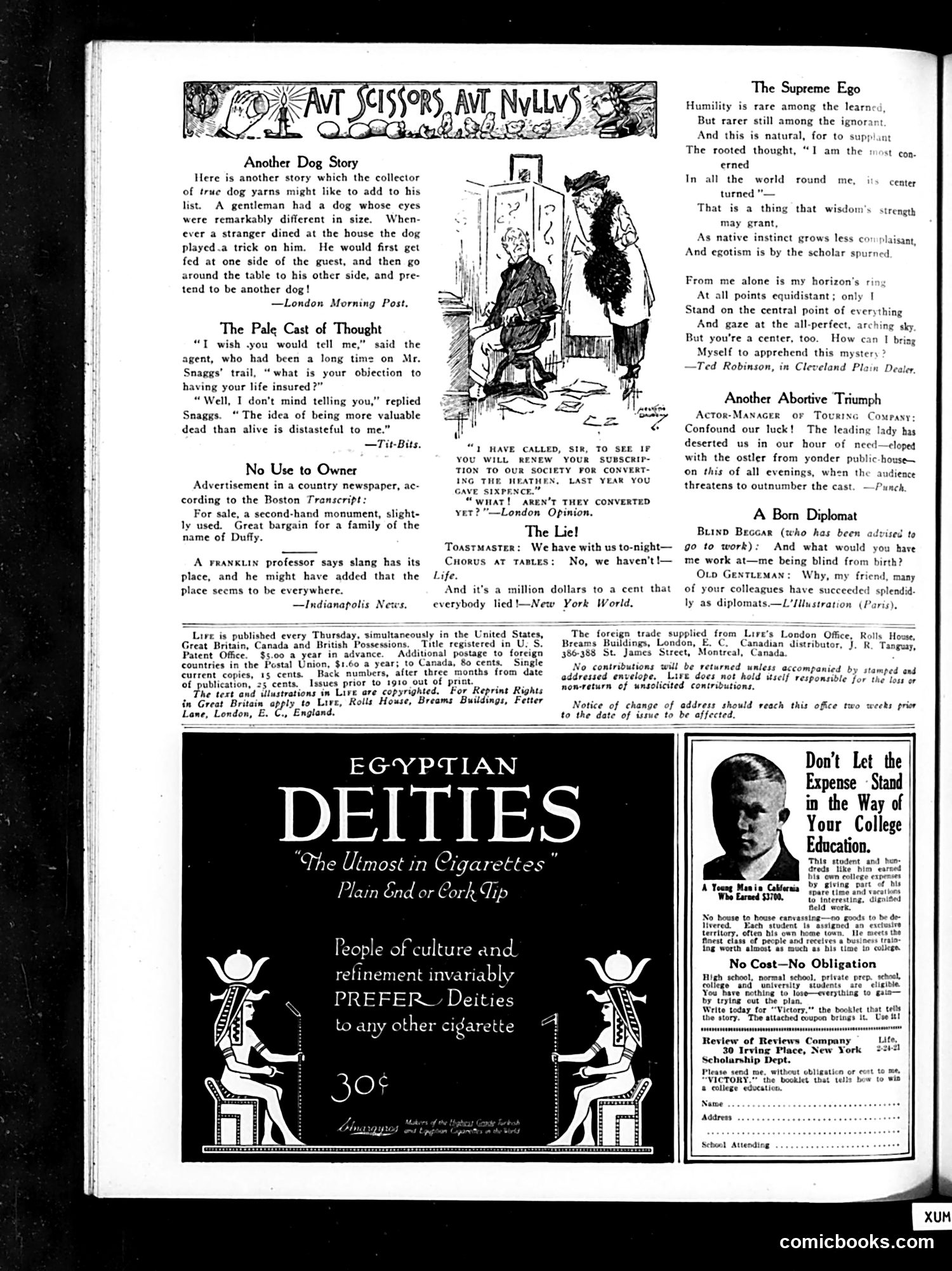
This page from *Life* magazine (a satirical American weekly) contains several brief humor pieces and advertisements: **The cartoons/jokes** are short anecdotes mocking human nature and pretension: - **"Another Dog Story"**: A trick where a dog with mismatched eyes dupes dinner guests into thinking it's two different dogs—satirizing gullibility. - **"The Pale Cast of Thought"**: A man refuses life insurance because being "more valuable dead than alive" offends him—dark satire on mortality and self-worth. - **"The Lie!"**: A toastmaster announces a guest; the audience immediately shouts "No, we haven't!"—mocking dishonesty in public speaking and social conventions. - **"Another Abortive Triumph"**: A theater manager's leading lady elopes with a stable worker on opening night—slapstick satire of theatrical chaos. - **"A Born Diplomat"**: A blind man is advised to become a diplomat since colleagues "succeeded splendidly"—dark humor suggesting diplomacy requires blindness to truth. The page also advertises Egyptian Deities cigarettes (30¢) and educational opportunities.
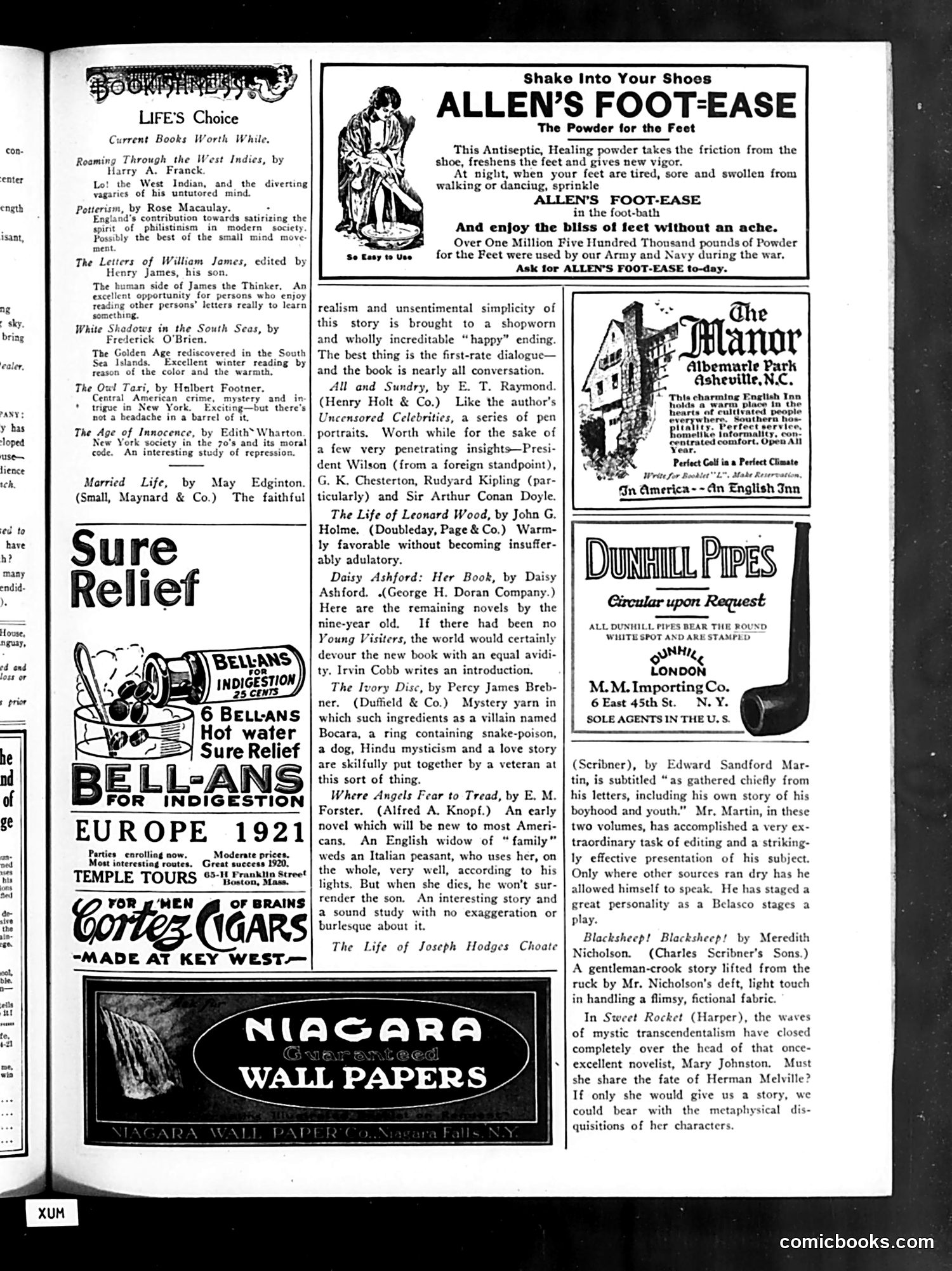
This page is primarily **book reviews and advertisements**, not political cartoons. The left column features "Life's Choice"—reviews of contemporary books including works by Edith Wharton, E.M. Forster, and others, reflecting 1921 literary trends. Notable is the review of Daisy Ashford's children's book, with Irvin Cobb providing an introduction. The advertisements dominate: **Allen's Foot-Ease powder** (marketed to post-WWI audiences, referencing Army/Navy use during the war), **Bellans indigestion remedy**, **Dunhill Pipes**, **Cortez Cigars** (made in Key West), and **Niagara Wall Papers**. The **Malamor hotel advertisement** (top right) promotes an English Inn in Asheville, North Carolina, targeting wealthy travelers. No political satire or caricature appears on this page. It's a straightforward commercial publication mixing literary criticism with period-appropriate consumer goods, reflecting post-war American prosperity and leisure culture.
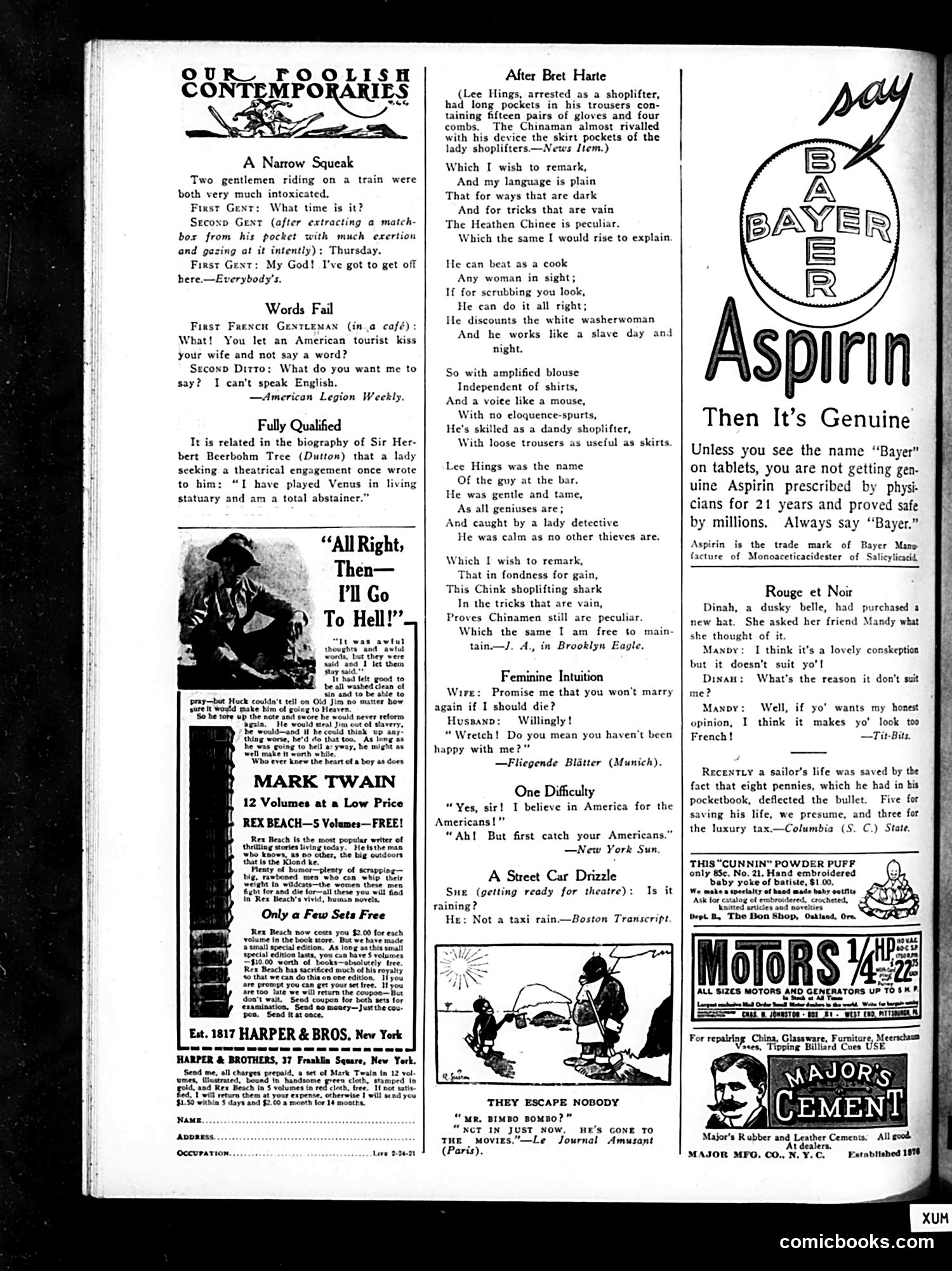
This page consists primarily of **humorous anecdotes and satirical verse** rather than political cartoons. Key pieces include: **"After Bret Harte"** — A poem mocking Chinese immigrants, specifically a shoplifter named Lee Hings. It parodies Bret Harte's famous racist poem "The Heathen Chinee," perpetuating period stereotypes about Chinese people as thieves and cheap laborers. The humor relies on anti-Chinese prejudice common in early 20th-century America. **Other jokes** satirize: - Drunk men on trains - French indifference to infidelity - American tourists abroad - Gender relations (wives, actresses) The page also includes **advertisements** for Mark Twain and Rex Beach books, Bayer Aspirin, and other products. The humor throughout reflects casual bigotry typical of 1920s American satire—ethnic stereotyping was considered entertainment for mainstream readers of *Life* magazine.