
Life, 1921-02-24 · page 14 of 32
Life — February 24, 1921 — page 14: what you’re looking at
What you’re looking at
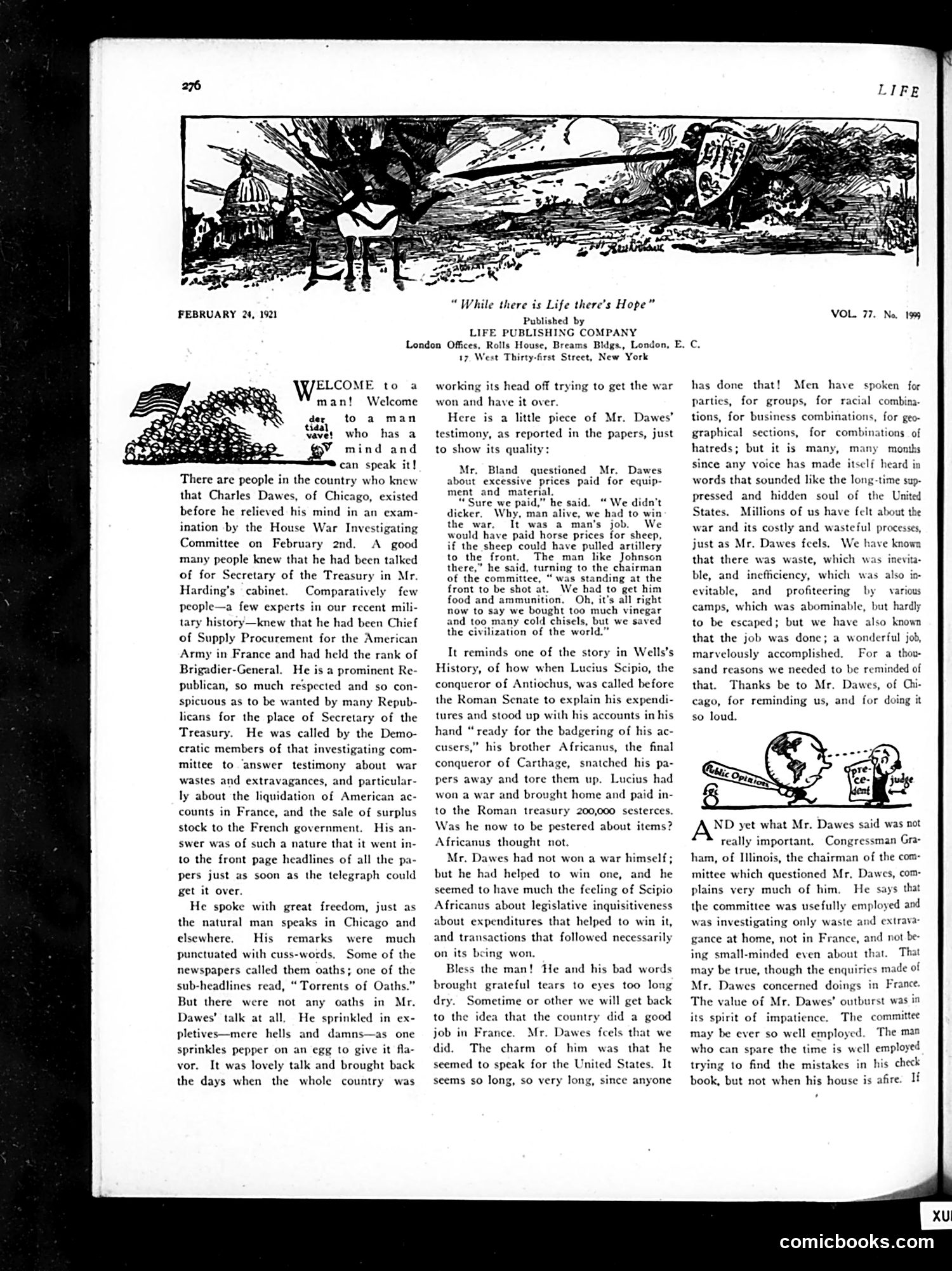
This February 24, 1921 Life Magazine page celebrates Charles Dawes, a prominent Republican who had recently served as Chief of Supply Procurement for the American Army in France and held the rank of Brigadier-General. The text praises Dawes for testifying before a Congressional committee investigating wartime expenditures and waste in France. The article portrays him as a plain-spoken "working man" who directly addressed the committee about inefficiencies and excessive prices for military supplies. The satire appears gentle—praising his candid, colorful language ("Torrents of Oaths") and his willingness to speak truth about government waste. The cartoon's exact meaning is unclear from the image alone, but the overall tone celebrates Dawes as a refreshing voice of accountability in post-war investigations.
📄 Transcribed text from this page (OCR, searchable)
Machine-transcribed from the original scan — historical spelling and the odd misread are preserved.
FEBRUARY 24, 1921 “While there is Life there's Hope” Published by LIFE PUBLISHING COMPANY London Offices, Rolls House, Breams Bldgs, London, ELCOME to a man! Welcome to a man Saves who has a ov mind and . can speak it! There are people in the country who knew that Charles Dawes, of Chicago, existed before he relieved his mind in an exam- ination by the House War Investigating Committee on February 2nd. A good many people knew that he had been talked of for Secretary of the Treasury in Mr. Harding's cabinet few people—a few experts in our recent mili- tary history—knew that he had been Chief of Supply Procurement for the American Army in France and had held the rank of Brigadier-General. He is a prominent Re- publican, so much respected and so con- Comparatively spicuous as to be wanted by many Repub- licans for the place of Secretary of the Treasury. He was called by the Demo- cratic members of that investigating com- mittee to answer testimony about war wastes and extravagances, and particular- ly about the liquidation of American ac- counts in France, and the sale of surplus stock to the French government. His an- swer was of such a nature that it went in- to the front page headlines of all the pa- pers just as soon as the telegraph could get it over. He spoke with great freedom, just as the natural man speaks in Chicago and elsewhere. His remarks punctuated with cuss-words. were much Some of the newspapers called them oaths; one of the sub-headlines read, “Torrents of Oaths.” But there any Mr. Dawes’ talk at all, He sprinkled in ex- were not oaths in pletives—mere hells and damns—as one sprinkles pepper on an egg to give it fla- It was lovely talk and brought back whole country was vor. the days when the 17 West Thirty-first Street, New York working its head off trying to get the war ¢ it over. Here is a little piece of Mr. Dawes’ won and testimony, as reported in the papers, just to show its quality: Mr. Bland questioned Mr. Dawes about excessive prices paid for equip- ment and material. “Sure we paid,” he said. “ We didn’t dicker, Why, man alive, we had to win the war. It was a man’s job. We would have paid horse prices for sheep, if the sheep could have pulled artillery to the front. The man like Johnson there,” he said, turning to the chairman of the committee, “ was standing at the front to be shot at. We had to get him food and ammunition. Oh, it’s all right now to say we bought too much vinegar and too many cold chisels, but we saved the civilization of the world.” It reminds one of the story in Wells's History, of how when Lucius Scipio, the conqueror of Antiochus, was called before the Roman Senate to explain his expendi- tures and stood up with his accounts in his hand “ready for the badgering of his ac- Africanus, the final conqueror of Carthage, snatched his pa- cusers,” his brother pers away and tore them up. Lucius had nt home and paid in- to the Roman treasury 200,000 sesterces. Was he now to be pestered about items? Africanus thought not. won a war and bro! Mr. Dawes had not won a war himself; but he had helped to win one, and he seemed to have much the feeling of Scipio Africanus about legislative inquisitiveness about expenditures that helped to win it, and transactions that followed necessarily on its being won. Bless the man! brought grateful tears to ey He and his bad words too long Sometime or other we will get back did a good dry. that the country job in France. Mr. Dawes feels that we did. The charm of him that he seemed to speak for the United States. It since anyone to the ide was seems so long, so very long VOL. 77. No. 199 has done that! Men have spoken for parties, for groups, for racial com tions, for business combinations, for geo- for combinations of graphical sections, but it is many, many since any voice has made itself heard in months words that sounded like the long-time sup- pressed and hidden soul of the United States. Millions of us have felt about the war and its costly and wasteful processes, We have known that there was waste, which was inevita- which just as Mr, Dawes feels. ble, and inefficiency, was also in- evitable, and profiteering by camps, which was abominable, but hardly to be escaped; but we have also known wonderful job, Various that the job was donc; a marvelously accomplished. For a thou- sand reasons we needed to be reminded of that. Thanks be to Mr. Dawes, of Ghi- cago, for reminding us, and for doing it so loud. ND yet what Mr. Dawes said was not really important. Congressman Gra- ham, of Illinois, the chairman of the com- mittee which questioned Mr, Dawes, com- plains very much of him. He says that the committee was usefully employed and was investigating only waste and extrava- gance at home, not in France, and not be- ing small-minded even about th Th may be true, though the enquiries made 0 Mr. Dawes concerned doings in France. The value of Mr, Dawes’ outburst was in The committee may be ever so well employed. The man who can spare the time is well employed its spirit of impatience, trying to find the mistakes in his check book, but not when his house is afire. If comicbooks.com