
Life, 1921-02-24 · page 18 of 32
Life — February 24, 1921 — page 18: what you’re looking at
What you’re looking at
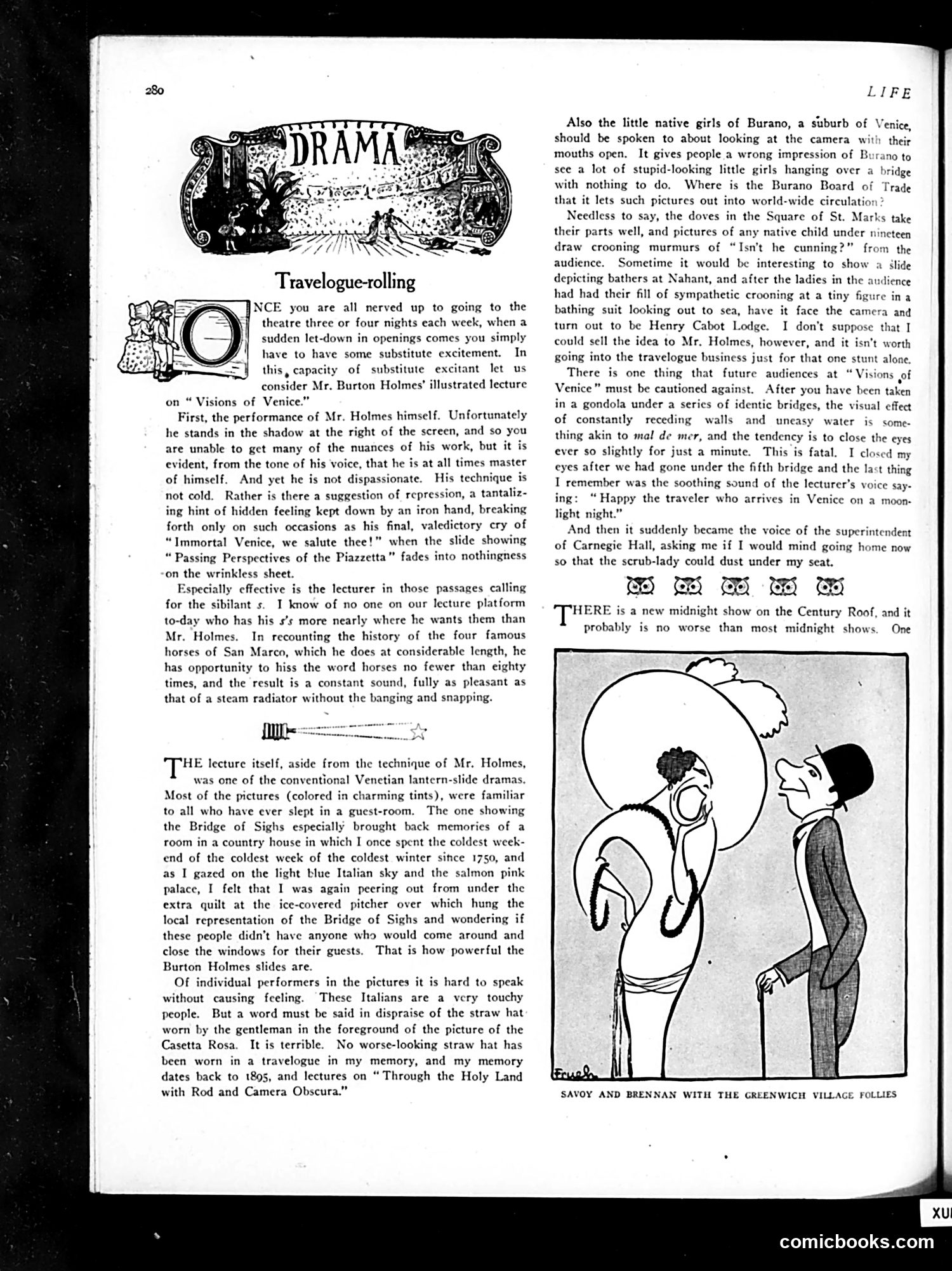
This is satirical commentary on Burton Holmes, a famous early-20th-century travel lecturer who presented illustrated lantern-slide shows about exotic locations like Venice. The article mockingly critiques both Holmes's performance style and the tedious conventions of travelogue entertainment. The cartoon at bottom—captioned "Savoy and Brennan with the Greenwich Village Follies"—depicts a man in formal dress interacting with a rotund figure, likely satirizing theatrical performers or the absurdity of vaudeville entertainment. The text ridicules Holmes's dramatic pretensions while obsessing over trivial details: his pronunciation of "s" sounds (which he allegedly perfects through excessive hissing), a poorly chosen straw hat in one Venice scene, and local girls' unflattering open-mouthed expressions. The author uses exaggerated earnestness to expose how travelogue audiences find entertainment in mundane elements rather than genuine cultural insight. The satire suggests early-cinema culture valued spectacle and emotional manipulation over substance.
📄 Transcribed text from this page (OCR, searchable)
Machine-transcribed from the original scan — historical spelling and the odd misread are preserved.
Travelogue-rolling CE you are all nerved up to going to the theatre three or four nights each week, when a sudden let-down in openings comes you simply have to have some substitute excitement, In this, capacity of substitute excitant let us consider Mr. Burton Holmes’ illustrated lecture on “ Visions of Venice.” First, the performance of Mr. Holmes himself. Unfortunately he stands in the shadow at the right of the screen, and so you are unable to get many of the nuances of his work, but it is evident, from the tone of his voice, that he is at all times master of himself. And yet he is not dispassionate. His technique is not cold. Rather is there a suggestion of repression, a tantaliz- ing hint of hidden feeling kept down by an iron hand, breaking forth only on such occasions as his final, valedictory cry of “Immortal Venice, we salute thee!” when the slide showing “Passing Perspectives of the Piazzetta” fades into nothingness ‘on the wrinkless sheet. Especially effective is the lecturer in those passages calling for the sibilant s. I know of no one on our lecture platform to-day who has his s’s more nearly where he wants them than Mr. Holmes. In recounting the history of the four famous horses of San Marco, which he does at considerable length, he has opportunity to hiss the word horses no fewer than eighty times, and the result is a constant sound, fully as pleasant as that of a steam radiator without the banging and snapping. Mt T! = lecture itself, aside from the technique of Mr. Holmes, was one of the conventional Venetian lantern-slide dramas. Most of the pictures (colored in charming tints), were familiar to all who have ever slept in a guest-room. The one showing the Bridge of Sighs especially brought back memories of a room in a country house in which I once spent the coldest week- end of the coldest week of the coldest winter sitce 1750, and as I gazed on the light blue Italian sky and the salmon pink palace, I felt that I was again peering out from under the extra quilt at the ice-covered pitcher over which hung the local representation of the Bridge of Sighs and wondering if these people didn’t have anyone who would come around and close the windows for their guests. That is how powerful the Burton Holmes slides are. Of individual performers in the pictures it is hard to speak without causing feeling. These Italians are a very touchy people. But a word must be said in dispraise of the straw hat worn by the gentleman in the foreground of the picture of the Casetta Rosa. It is terrible. No worse-looking straw hat has been worn in a travelogue in my memory, and my memory dates back to 1&5, and lectures on “ Through the Holy Land with Rod and Camera Obscura.” LIFE Also the little native girls of Burano, a suburb of Venice, should be spoken to about looking at the camera with their mouths open. It gives people a wrong impression of Burano to see a lot of stupid-looking little girls hanging over a b; idge with nothing to do, Where is the Burano Board of Trade that it lets such pictures out into world-wide circulation? Needless to say, the doves in the Square of St. Marks take their parts well, and pictures of any native child under nincteen draw crooning murmurs of “Isn't he cunning?” from the audience. Sometime it would be interesting to show i depicting bathers at Nahant, and after the ladies in the had had their fill of sympathetic crooning at a tiny figure bathing suit looking out to sea, have it face the camera and turn out to be Henry Cabot Lodge. I don't suppose that I could sell the idea to Mr. Holmes, however, and it isn’t worth going into the travelogue business just for that one stunt alone, There is one thing that future audiences at “ Visions of Venice” must be cautioned against. After you have been taken in a gondola under a serics of identic bridges, the visual effect of constantly receding thing akin to mal de mer, and the tendency is to close the eyes ever so slightly for just a minute. This is fatal. I closed my eyes after we had gone under the fifth bridge and the last thing I remember was the soothing sound of the lecturer’s voice say- walls and uneasy water is some ing: “Happy the traveler who arrives in Venice on a moon- light night.” And then it suddenly became the voice of the superintendent of Carnegie Hall, asking me if I would mind going home now so that the scrub-lady could dust under my seat. s a new midnight show on the Century Roof, and it probably is no worse than most midnight shows. One T# SAVOY AND BRENNAN WITH THE GREENWICH VILLAGE FOLLIES comicbooks.com