
Life, 1921-02-24 · page 24 of 32
Life — February 24, 1921 — page 24: what you’re looking at
What you’re looking at
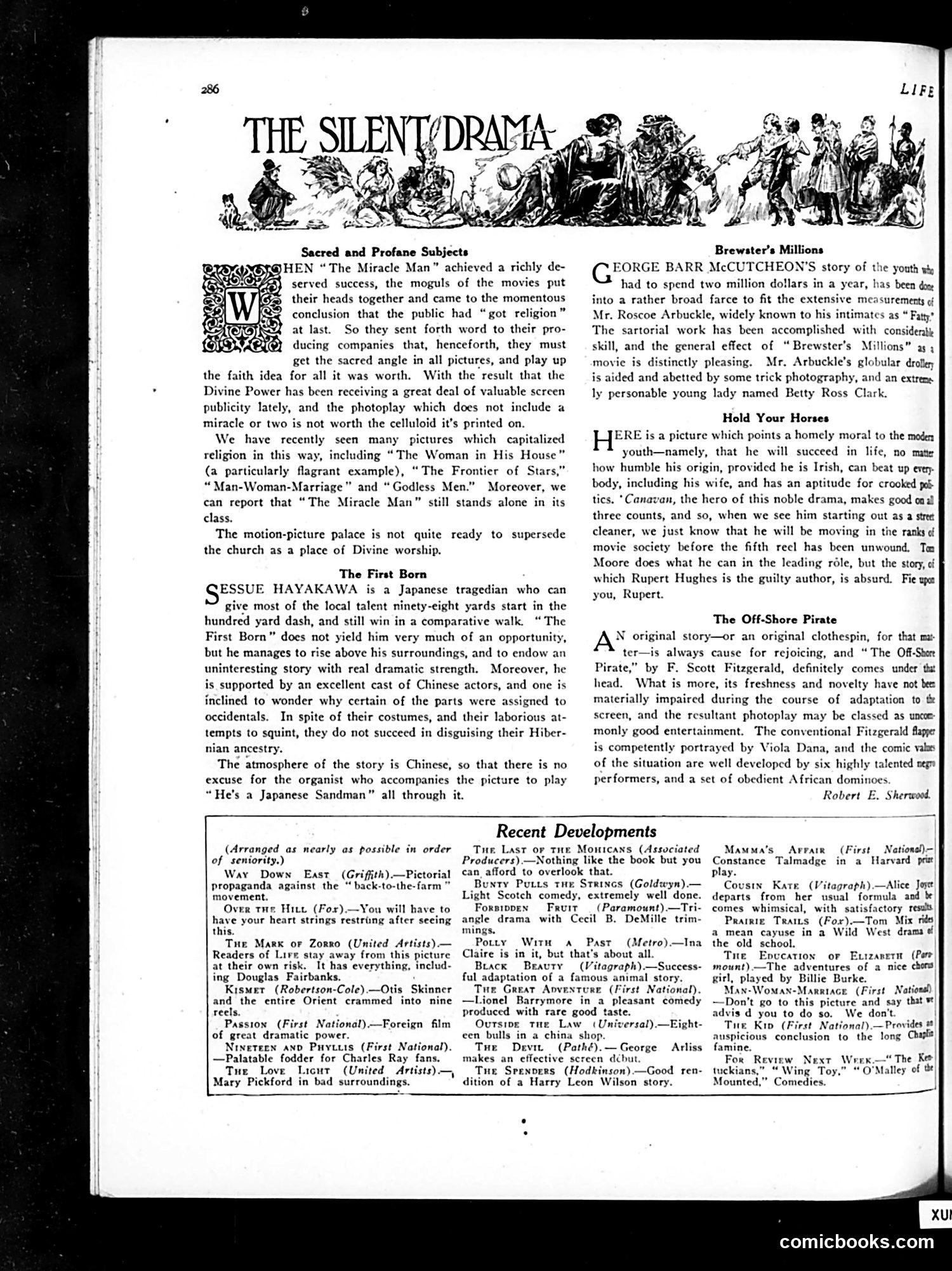
This page contains film reviews from Life's "Silent Drama" section, critiquing recent movie releases. The reviews discuss: **"Brewster's Millions"**: Adapts a novel about spending two million dollars in a year, tailored to showcase comedian Roscoe Arbuckle (nicknamed "Fatty" for his weight), whose physical comedy ("globular drollery") is enhanced by trick photography. **Religious-themed films**: The reviewer satirizes Hollywood's trend of capitalizing on the success of "The Miracle Man" by flooding the market with religion-focused pictures, noting studios now demand "sacred angles" in all productions. The satire's point: movies cannot replace actual churches as places of worship. **Other films reviewed**: "The First Born" (featuring Japanese actor Sessue Hayakawa), "Hold Your Horses" (an Irish-immigrant-success story by writer Rupert Hughes), and "The Off-Shore Pirate" (a F. Scott Fitzgerald adaptation). The reviews employ sardonic wit typical of Life's satirical style, mocking both studio greed and filmmaking trends rather than specific political figures.
📄 Transcribed text from this page (OCR, searchable)
Machine-transcribed from the original scan — historical spelling and the odd misread are preserved.
Brewster's Millions G ORGE BARR McCUTCHEON'’S story of the youth wy had to spend two million dollars in a year, has been dow into a rather broad farce to fit the extensive measurements ¢f Mr. Roscoe Arbuckle, widely known to his intimates as “ Faty’ The sartorial work has been accomplished with considerate skill, and the general effect of “Brewster's Millions” as y movie is distinctly pleasing. Mr. Arbuckle’s globular drolley is aided and abetted by some trick photography, and an extrem. ly personable young lady named Betty Ross Clark. Sacred and Profane Subjects HEN “The Miracle Man” achieved a richly de- served success, the moguls of the movies put their heads together and came to the momentous conclusion that the public had “got religion” at last. So they sent forth word to their pro- ducing companies that, henceforth, they must get the sacred angle in all pictures, and play up the faith idea for all it was worth. With the result that the Divine Power has been receiving a great deal of valuable screen publicity lately, and the photoplay which does not include a miracle or two is not worth the celluloid it’s printed on. We have recently seen many pictures which capitalized religion in this way, including “The Woman in His House” (a particularly flagrant example), “The Frontier of Stars,” “ Man-Woman-Marriage” and “Godless Men.” Moreover, we can report that “The Miracle Man” still stands alone in its class. The motion-picture palace is not quite ready to supersede the church as a place of Divine worship. The First Born ESSUE HAYAKAWA is a Japanese tragedian who can give most of the local talent ninety-eight yards start in the hundred yard dash, and still win in a comparative walk. “The First Born” does not yield him very much of an opportunity, but he manages to rise above his surroundings, and to endow an uninteresting story with real dramatic strength. Moreover, he is supported by an excellent cast of Chinese actors, and one is inclined to wonder why certain of the parts were assigned to occidentals. In spite of their costumes, and their laborious at- tempts to squint, they do not succeed in disguising their Hiber- Hold Your Horses ERE is a picture which points a homely moral to the modn youth—namely, how humble his origin, provided he is Irish, can beat up every body, including his wife, and has an aptitude for crooked poi tics. ‘Canavan, the hero of this noble drama, makes good ond three counts, and so, when we see him starting out as a street cleaner, we just know that he will be moving in the ranks of movie society before the fifth recl has been unwound, To Moore does what he can in the leading role, but the story, of which Rupert Hughes is the guilty author, is absurd. Fie upe you, Rupert. that he will succeed in life, no mate The Off-Shore Pirate N original story—or an original clothespin, for that mi- ter—is always cause for rejoicing, and “The Off-Shore Pirate,” by F. Scott Fitzgerald, definitely comes under tht head. What is more, its freshness and novelty have not bee materially impaired during the course of adaptation to tk screen, and the resultant photoplay may be classed as uncom monly good entertainment. The conventional Fitzgerald flapper is competently portrayed by Viola Dana, and the comic vale nian ancestry. The atmosphere of the story is Chinese, so that there is no excuse for the organist who accompanies the picture to play “He's a Japanese Sandman” all through it. of the situation are well developed by six highly talented negn performers, and a set of obedient African dominoes. Robert E. Sherwood. (Arranged as nearly as possible in order of seniority.) Way Down East (Griffith).—Pictorial Propaganda against the “ back-to-the-farm ” movement. Over tHe Hitt (Foxr).—You will have to have your heart strings restring after seeing this. Tue Marx or Zorro (United Artists) — Readers of Lire stay away from this picture at their own risk, It has everything, includ- ing Douglas Fairbanks. Kismet (Robertson-Cole).—Otis Skinner and the entire Orient crammed into nine reels. Passion (First National).—Foreign film of great dramatic power. Nineteen ano Puyttis (First National). —Palatable fodder for Charles Ray fans. Tue Love Licut (United Artists) —, lary Pickford in bad surroundings. Recent Developments Tur. Last or tHe Monicans (Associated Producers).—Nothing like the book but you can afford to overlook that. Bunty Putts tHe Strincs (Goldwyn).— Light Scotch comedy, extremely well done. Foxsippen Fruit _ (Paramount).—Tri- angle drama with Cecil B. DeMille trim- mings. Potty With a_ Past (Metro).—Ina Claire is in it, but that’s about all. Brack Beauty (Vitagraph).—Success- ful adaptation of a famous animal story. Tue Great Apventure (First National). —tLionel Barrymore in a pleasant comedy produced with rare good taste. Ovursioe tHe Law (Universal).—Eight- een bulls in a china shop. Tue Devit (Pathé).— George makes an effective screen dcbut Tue Srenvers (Hodkinson) —Good ren- dition of a Harry Leon Wilson story. Arliss Nationel)— Harvard prit Mama's Avrain (First Constance Talmadge in a play. Cousin. Kate (Vitagraph)—Alice Joye departs from her usual formula and be comes whimsical, with satisfactory resis Prairie Traits (For).—Tom Mix riés a mean cayuse in a Wild West dram @ the old school. Tue Epvcation or Extzanerit (Por mount).—The adventures of a nice chore girl, played by Billie Burke. Man-Woman-Marriace (First Notional —Don't go to this picture and say that ® advis d you to do so. We don't Tue Kio (First National).—Provides # auspicious conclusion to the long Chart Vrex.—" The Kee "O'Malley of te comicbooks.com