
Life, 1921-02-24 · page 15 of 32
Life — February 24, 1921 — page 15: what you’re looking at
What you’re looking at
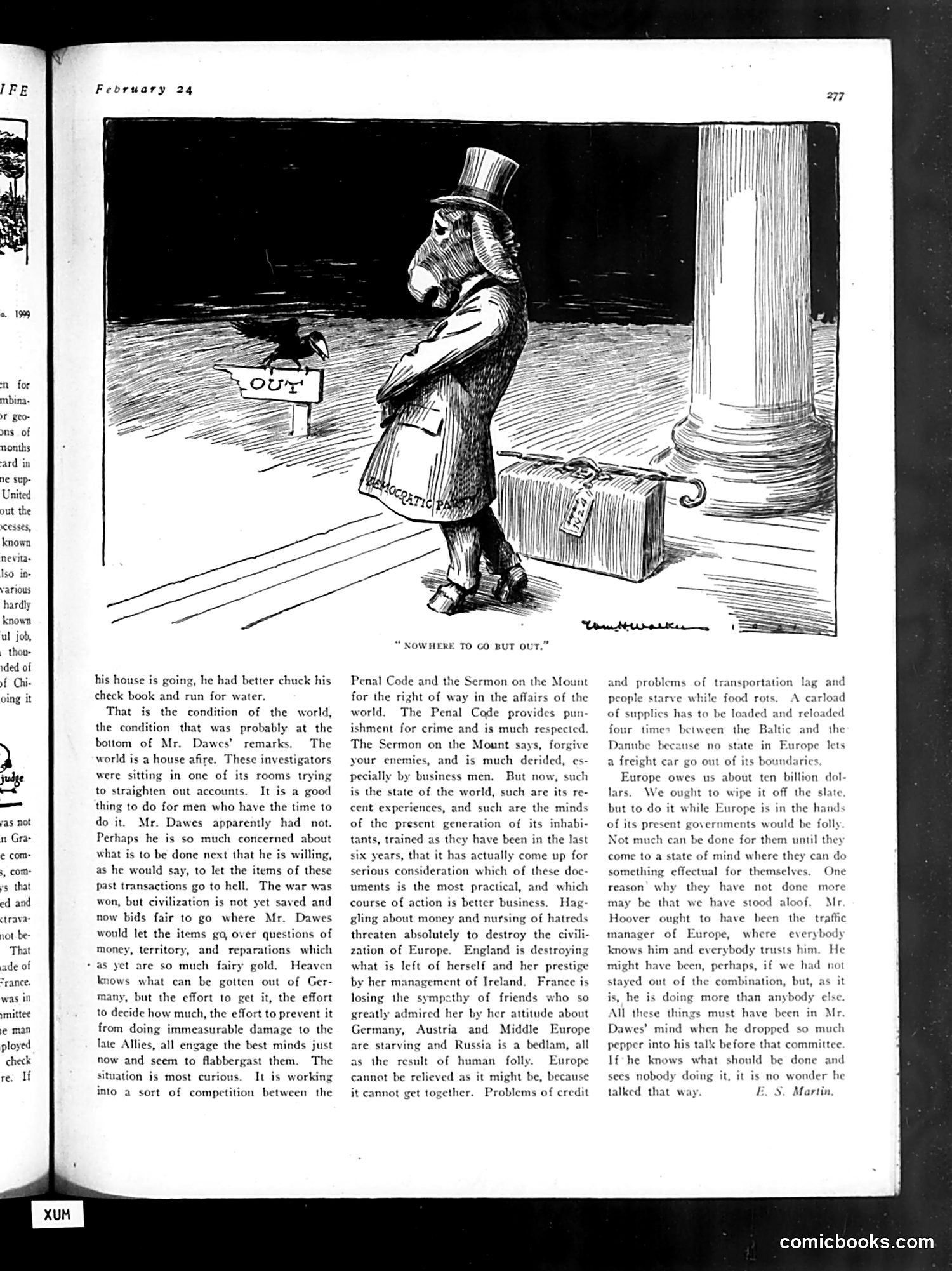
This political cartoon depicts an anthropomorphic ape or monkey in formal dress (top hat, overcoat) holding a sign reading "OUT" while standing beside a suitcase, suggesting forced evacuation or exile. The accompanying article discusses post-WWI European instability—specifically problems with Germany, Austria, and Russia. The text mentions "civilization" being threatened and references efforts to prevent "immeasurable damage" to Europe through reparations disputes. The cartoon likely satirizes a European leader or nation being expelled from international affairs, probably representing either German ambitions being thwarted or commentary on revolutionary upheaval. The "nowhere to but out" caption suggests the figure has exhausted all options and faces only removal from power or influence. The ape imagery reflects period racial/ethnic caricature common in early 20th-century satire.
📄 Transcribed text from this page (OCR, searchable)
Machine-transcribed from the original scan — historical spelling and the odd misread are preserved.
nn for mbina- oF geo ons of nonths ard ne Sup. United out the rcesses, known nevita- Iso various hardly known ul job, | thou- ded of f Chi- oing it was in ymuttee je man ployed check re. If February 24 his house is going, he had better chuck his check book and run for water. That is the condition of the world, the condition that was probably at the bottom of Mr. Dawes’ remarks, The world is a house afire. These investigators were sitting in one of its rooms trying to straighten out accounts. It is a good thing to do for men who have the time to do it. Mr. Dawes apparently had not. Perhaps he is so much concerned about what is to be done next that he is willing, as he would say, to let the items of these past transactii go to hell. The war was won, but civilization is not yet saved and now bids fair to go where Mr. Dawes would let the items go, over questions of money, territory, and reparations which * as yet are so much fairy gold. Heaven knows what can be gotten out of Ger- many, but the effort to get it, the effort to decide how much, the effort to prevent it from doing immeasurable damage to the late Allies, all engage the best minds just now and seem to flabbergast them. The situation is most curious. It is working into a sort of competition between the “NOWHERE TO GO BUT OUT.” Penal Code and the Sermon on the Mount for the right of way in the affairs of the world, The Penal Cade provides pun- ishment for crime and is much respected. The Sermon on the Mount says, forgive your enemies, and is much derided, es- pecially by business men. But now, such is the state of the world, such are its re- cent experiences, and such are the minds of the present generation of its inhabi- tants, trained as they have been in the last six years, that it has actually come up for serious consideration which of these doc- uments is the most practical, and which course of action is better business. Hag- gling about money and nursing of hatreds threaten absolutely to destroy the civili- zation of Europe. England is destroying what is left of herself and her prestige by her management of Ireland. F: losing the sympzthy of friends who so greatly admired her by her attitude about Germany, Austria and Middle Europe are starving and Russia is a bedlam, all as the result of human folly. Europe cannot be relieved as it might be, because it cannot get together. Problems of credit 277 rT nil and problems of transportation lag and people starve while food rots. A carload of supplics has to be loaded and reloaded four times between the Baltic and the Danube because no state in Europe lets a freight car go out of its boundaries Europe owes us about ten billion ¢ lars. We ought to wipe it off the slate but to do it while Europe is in the hands of its present governments would be folly Not much can be done for them until they come to a state of mind where they can do something effectual for themselves. One reason’ why they have not done more may be that we have stood aloof. Mr Hoover ought to have been the traffic manager of Europe, where everybody knows him and everybody trusts him. He might have been, perhaps, if we had not stayed out of the combination, but, as it is, he is doing more than anybody else. All these things must have been in Mr. Dawes’ mind when he dropped so muc pepper into his talk before that committee If he knows what should be done and sees nobody doing it, it is no wonder he talked that way E. S. Martin. comicbooks.com