
Life, 1921-02-24 · page 5 of 32
Life — February 24, 1921 — page 5: what you’re looking at
What you’re looking at
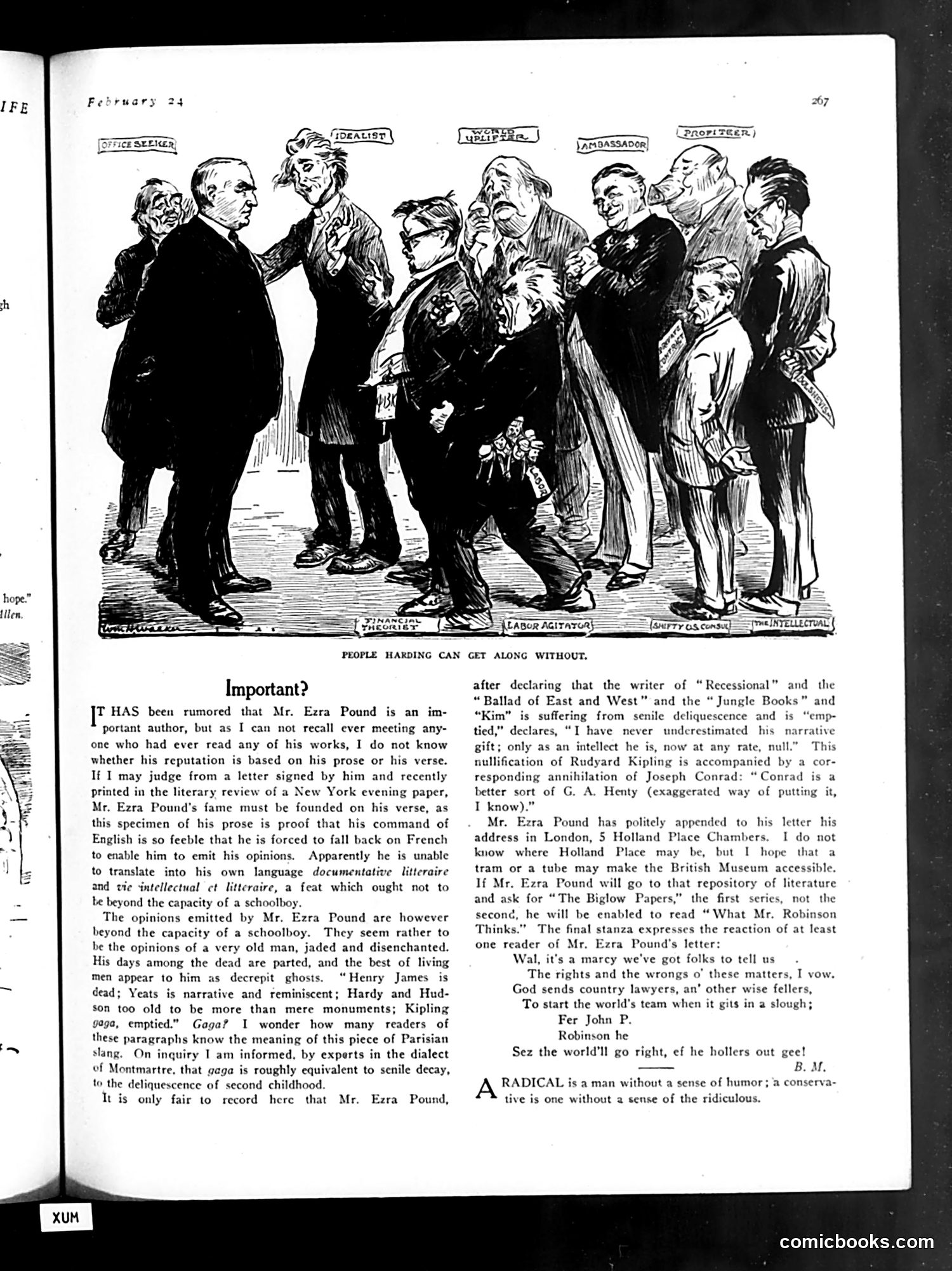
The main cartoon, titled "People Harding Can Get Along Without," depicts various political and social figures labeled with their roles: "Office Seeker," "Idealist," "Inventor," "Ambassador," "Profiteer," "Financial Speculator," "Labor Agitator," and "Intellectual." The satire targets President Harding's administration, suggesting he can function without input from diverse constituencies—idealists, workers, intellectuals, and inventors. The cartoon implies Harding's government operates independently of public interest groups and expert voices. The accompanying article criticizes Ezra Pound's literary reputation, debating whether his fame rests on prose or poetry. The text defends Pound against dismissals of his narrative gift, positioning him as more sophisticated than schoolboy-level writing. This represents early 20th-century literary criticism debates.
📄 Transcribed text from this page (OCR, searchable)
Machine-transcribed from the original scan — historical spelling and the odd misread are preserved.
(DEAUST PE (ya eR tlre= BHA FINANCIAe Yncorie ye (Prorrzerr) PEOPLE HARDING CAN GET ALONG WITHOUT. Important? IT HAS been rumored that Mr. Ezra Pound is an im- portant author, but as I can not recall ever meeting any- one who had ever read any of his works, I do not know whether his reputation is based on his prose or his verse. If I may judge from a letter signed by him and recently printed in the literary review of a New York evening paper, Mr. Ezra Pound’s fame must be founded on his verse, as this specimen of his prose is proof that his command of English is so feeble that he is forced to fall back on French to enable him to emit his opinions. Apparently he is unable to translate into his own language documentative litteraire and vie intellectual ct litteraire, a feat which ought not to be beyond the capacity of a schoolboy, The opinions emitted by Mr. Ezra Pound are however beyond the capacity of a schoolboy. They seem rather to be the opinions of a very old man, jaded and disenchanted. His days among the dead are parted, and the best of living men appear to him as decrepit ghosts. “Henry James is dead; Yeats is narrative and reminiscent; Hardy and Hud- son too old to be more than mere monuments; Kipling gaga, emptied.” Gaga? I wonder how many readers of these paragraphs know the meaning of this piece of Parisian slang. On inquiry I am informed, by experts in the dialect of Montmartre, that gega is roughly equivalent to senile decay, to the deliquescence of second childhood. lt is only fair to record here that Mr. Ezra Pound, after declaring that the writer of “Recessional” and the “Ballad of East and West" and the “Jungle Books” and im” is suffering from senile deliquescence and is “emp- tied,” declares, “I have never underestimated his narrative gift; only as an intellect he is, now at any rate, null.” This nullification of Rudyard Kipling is accompanied by a cor- responding annihilation of Joseph Conrad: “Conrad is a better sort of G. A. Henty (exaggerated way of putting it, I know).” Mr. Ezra Pound has politely appended to his letter his address in London, 5 Holland Place Chambers. I do not know where Holland Place may be, but I hope that a tram or a tube may make the British Museum accessible. If Mr. Ezra Pound will go to that repository of literature and ask for “The Biglow Papers,” the first series, not the he will be enabled to read “What Mr. Robinson The final stanza expresses the reaction of at least one reader of Mr. Ezra Pound's letter: Wal, it’s a marcy we've got folks to tell us The rights and the wrongs o' these matters, I vow. God sends country lawyers, an’ other wise fellers, To start the world’s team when it gits in a slough; Fer John P. Robinson he Sez the world'll go right, ef he hollers out gee! B. M. RADICAL is a man without a sense of humor; a conserva- tive is one without 2 sense of the ridiculous. comicbooks.com