
Life, 1921-02-24 · page 26 of 32
Life — February 24, 1921 — page 26: what you’re looking at
What you’re looking at
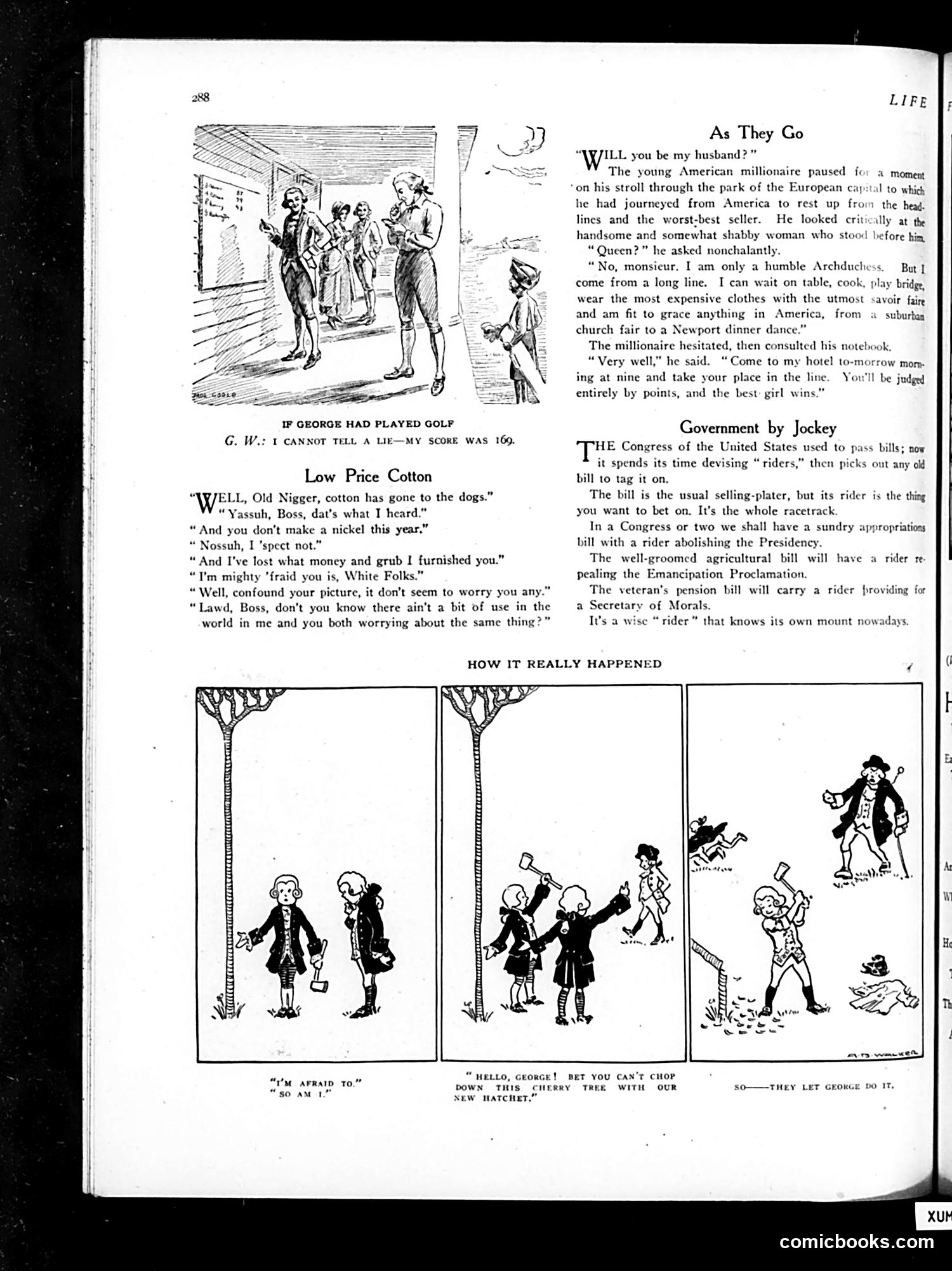
This page contains three separate satirical pieces typical of early 20th-century American humor: **"If George Had Played Golf"** mocks the famous (apocryphal) story of young George Washington confessing to chopping down his father's cherry tree. The joke: if Washington had played golf instead, he'd confess to a terrible score of 169—suggesting even historical icons can't escape modern embarrassments. **"Government by Jockey"** satirizes Congressional practice of attaching "riders" (unrelated provisions) to bills. The author warns this trend will escalate absurdly—imagining riders abolishing the Presidency or repealing the Emancipation Proclamation attached to routine appropriations bills. It critiques legislative corruption and procedural abuse. **"Low Price Cotton"** and **"As They Go"** are shorter comedic sketches about economic hardship and romantic negotiation, using period dialogue conventions. The page reflects Progressive Era concerns: political corruption, economic anxiety, and social change—all delivered through gentle, character-based humor rather than explicit political commentary.
📄 Transcribed text from this page (OCR, searchable)
Machine-transcribed from the original scan — historical spelling and the odd misread are preserved.
IF GEORGE HAD PLAYED GOLF G. W.: 1 CANNOT TELL A LIE—MY SCORE WAS 169. Low Price Cotton , Old Nigger, cotton has gone to the dogs.” “Yassuh, Boss, dat’s what I heard.” “And you don’t make a nickel this year.” “ Nossuh, I ’spect not.” “And I've lost what money and grub I furnished you.” “T'm mighty 'fraid you is, White Folks.” “Well, confound your picture, it don’t seem to worry you any.” “Lawd, Boss, don’t you know there ain’t a bit of use in the world in me and you both worrying about the same thing?” As They Go wit you be my husband?” The young American millionaire paused fo: a moment 1 to which 1 the head. lly at the fore him ‘on his stroll through the park of the European cay he had journeyed from America to rest up fro lines and the worst-best seller. He looked crit handsome and somewhat shabby woman who stc “Queen?” he asked nonchalantly. “No, monsieur, I am only a humble Archduchess. But | come from a long line. I can wait on table, cook, play bridge wear the most expensive clothes with the utmost savoir faire and am fit to grace anything in America, from a suburtag church fair to a Newport dinner dance.” The millionaire hesitated, then consulted his notebook. “Very well,” he said. “Come to my hotel to-m: ing at nine and take your place in the line. You'l entirely by points, and the best: girl wins.” Government by Jockey HE Congress of the United States used to pass bills; now it spends its time devising “ riders,” then picks out any old bill to tag it on. The bill is the usual selling-plater, but its rider is the thing you want to bet on. It’s the whole racetrack In a Congress or two we shall have a sundry appropriations bill with a rider abolishing the Presidency. The well-groomed agricultural bill will have a rider te: pealing the Emancipation Proclamation. The veteran's pension bill will carry a rider providing a Secretary of Morals. It’s a wise “rider” that knows its own mount nowa' HOW IT REALLY HAPPENED “ HELLO, GeorcE! DowN THIS NEW HATCHET.” “I’M AFRAID To.” “$0 am 1." CHERRY ans weet BET YOU CAN'T CHOP TREE WITIL OUR SO——THEY LET GEOKGE DO IT. comicbooks.com