
Life, 1921-02-24 · page 19 of 32
Life — February 24, 1921 — page 19: what you’re looking at
What you’re looking at
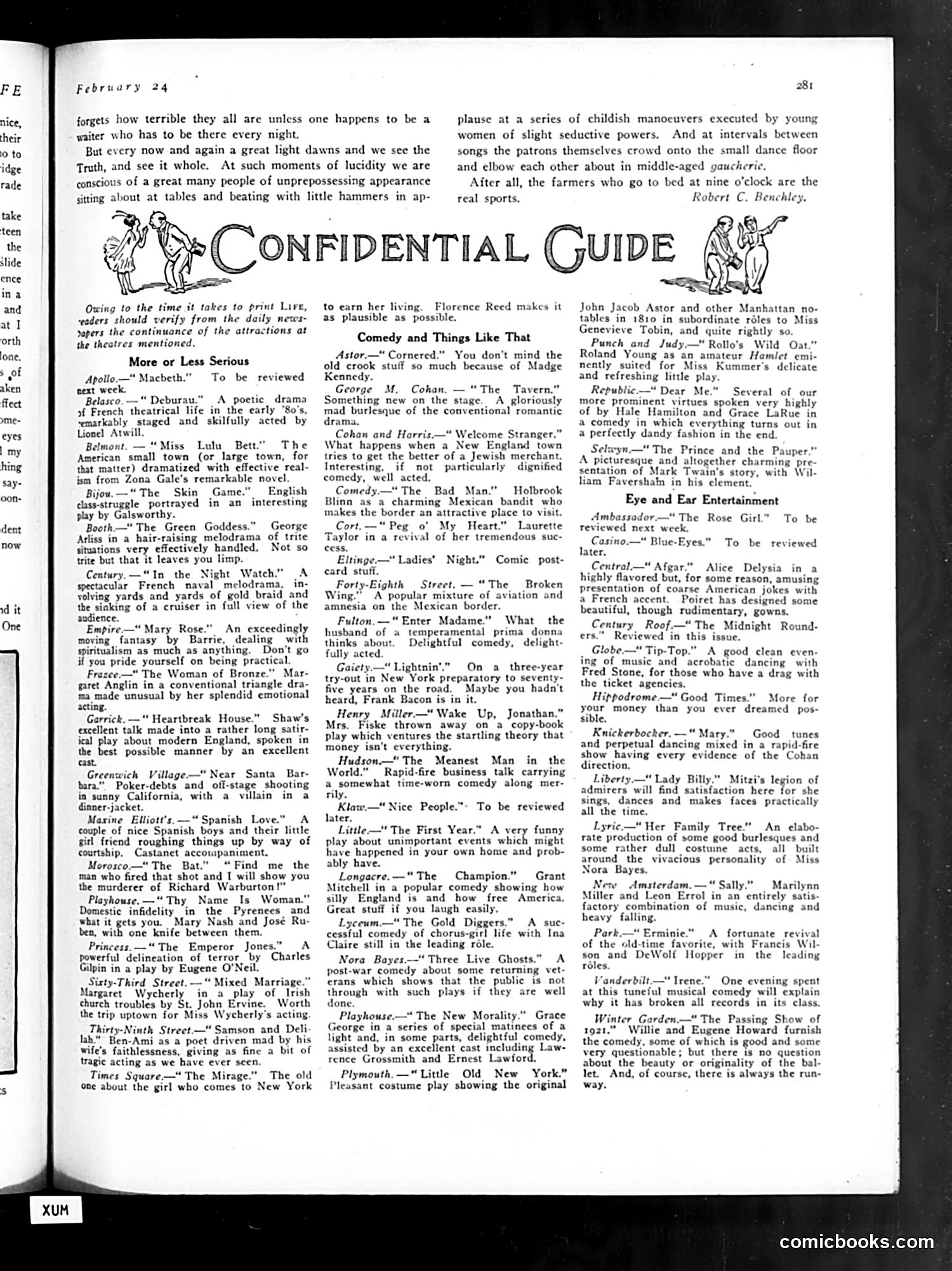
This page is primarily a theater guide—a "Confidential Guide" to Broadway shows—rather than political satire. The header quote by Robert C. Benchley (the famous humorist) opens by mocking nightclub patrons: people who sit at tables "beating with little hammers in applause" at "childish manoeuvres executed by young women," then crowd onto dance floors in "middle-aged gaucherie." Benchley contrasts these absurd urbanites with farmers who sensibly go to bed at nine o'clock. The guide itself lists current theatrical productions, divided into "More or Less Serious" and "Comedy and Things Like That" categories. It reviews plays ranging from Shakespeare's *Macbeth* to lightweight comedies, offering brief judgments on their merit and notable performers like Lionel Atwill and George Arliss. The satire here targets Jazz Age leisure culture—specifically the pretentiousness and excess of New York nightlife—rather than political figures.
📄 Transcribed text from this page (OCR, searchable)
Machine-transcribed from the original scan — historical spelling and the odd misread are preserved.
February 24 forgets how terrible they all are unless one happens to be a waiter who has to be there every night. But every now and again a great light dawns and we see the At such moments of lucidity we are conscious of a great many people of unprepossessing appearance sitting about at tables and beating with little hammers in ap- Truth, and see it whole. real sports. 281 plause at a series of childish manocuvers executed by young women of slight seductive powers, songs the patrons themselves crowd onto the small dance floor and elbow each other about in middle-aged gaucheric. After all, the farmers who go to bed at nine o'clock are the And at intervals between Robert C. Benchley. (CONFIDENTIAL GUIDE Owing to the time it takes to print Lire, seaders should verify from the daily news- sepers the continuance of the attractions at the theatres mentioned. More or Less Serious Apollo.—“ Macbeth.” To be next week. Belasco. —“ Deburau.” A poetic drama of French theatrical life in the early "80's, cemarkably staged and skilfully acted by Lionel Atwill. Belmont. — “Miss Lulu Bett.” The American small town (or large town, for that matter) dramatized with effective real- ism from Zona Gale’s remarkable novel. Bijou. —“ The Skin Game.” English chss-struggle portrayed in an_ interesting play by Galsworthy. Booth— The Green Goddess.” George Arliss in a hair-raising melodrama of trite situations very effectively handled. Not so trite but that it leaves you limp. Century. —“In the Night Watch.” A spectacular French naval melodrama, in- volving yards and yards of gold braid and the sinking of a cruiser in full view of the audience. Empire—" Mary Rose.” An exceedingly moving fantasy by Barrie, dealing with spiritualism as much as anything. Don't go if you pride yourself on being practical. Frazee.—“ The Woman of Bronze.” Mar- garet Anglin in a conventional triangle dra- ma made unusual by her splendid emotional acting. Garrick. —‘ Heartbreak House.” Shaw's excellent talk made into a rather long satir- ical play about modern England, spoken in the best possible manner by an excellent cast. Greenwich Village—" Near Santa Bar- bara.” Poker-debts and off-stage shooting in sunny California, with a villain in a dinner-jacket. Maxine Eltiott’s.—“ Spanish Love.” A couple of nice Spanish boys and their little girl friend roughing things up by way of courtship. Castanet accompaniment. Morosco—*“ The Bat.” “Find me the man who fired that shot and I will show you the murderer of Richard Warburton!” Playhouse. —“ Thy Name Is Woman.” Domestic infidelity in the Pyrenees and what it gets you. Mary Nash and José Ru- ben, with one knife between them. Princess. —“ The Emperor Jones.” A powerful delineation of terror by Charles Gilpin in a play by Eugene O'Neil. Sisty-Third Street. Mixed Marriage.” Margaret’ Wycherly in a play of Irish church troubles by St. John Ervine. Worth the trip uptown for Miss Wycherly’s acting Thirty-Ninth Strect—“ Samson and Deli lah.” Ben-Ami as a poet driven mad by his wife's faithlessness, giving as fine a bit of tragic acting as we have ever seen. Times Square—‘ The Mirage.” The old one about the girl who comes to New York reviewed to earn her living. Florence Reed makes it as plausible as possible. Comedy and Things Like That Astor.—" Cornered.” You don’t mind the old crook stuff so much because of Madge Kennedy. George M. Cohan. — “The Tavern.” Something new on the stage. A gloriously mad burlesque of the conventional romantic drama. Cohan and Harris.—* Welcome Stranger.” What happens when a New England town tries to get the better of a Jewish merchant. Interesting, if not particularly dignified comedy, well acted. Comedy.—“ The Bad Man.” Holbrook Blinn as a charming Mexican bandit who makes the border an attractive place to visit. Cort. —" Peg o' My Heart.” Laurette Taylor in a revival of her tremendous suc- Ladies’ Night.” Comic post- ighth Street. —“ The Broken A popular mixture of aviation and amnesia on the Mexican border. Fulton. —“ Enter Madame.” What the husband of « temperamental prima don! thinks about. Delightful comedy, delight- fully acted. Gaicty.—" Lightnin’.”. On a. three-year try-out in New York preparatory to seventy- five years on the road. Maybe you hadn't heard, Frank Bacon is in it. Henry Miller—“ Wake Up, Jonathan.” Mrs. Fiske thrown away on a copy-book play which ventures the startling theory that money isn't everything. Hudson" The Meanest Man in the World.” Rapid-fire business talk carrying a somewhat time-worn comedy along mer- rily. Klaw. later. Little—“ The First Year.” A very funny play about unimportant events which might have happened in your own home and prob- ably have. Longacre. —“ The Champion.” Grant Mitchell in a popular comedy showing how silly England is and how free America. Great stuff if you laugh easily. Lyceum.—" The Gold Diggers.” A suc- cessful comedy of chorus-girl life with Ina Claire still in the leading role. Nora Bayes.—“ Three Live Ghosts.” A post-war comedy about some returning vet- erans which shows that the public is not through with such plays if they are well done. Playhouse.—* The New Morality.” Grace George in a series of special matinees of a light and, in some parts, delightful comedy, assisted by an excellent cast including Law- rence Grossmith and Ernest Lawford. Plymouth, —“ Little Old New York.” Pleasant costume play showing the original “Nice People.”» To be reviewed John Jacob Astor and other Manhattan no- tables in 1810 in subordinate réles to Miss Genevieve Tobin, and quite rightly so. Punch and Judy—" Rollo's Wild Oat.” Roland Young as an amateur Hamlet emi- nently suited for Miss Kummer’s delicate and refreshing little play. Republic—* Dear Me.” of our more prominent virtues spoken very highly of by Hale Hamilton and Grace LaRue in a comedy in which everything turns out in a perfectly dandy fashion in the end. yn—The Prince and the Pauper.” A picturesque and altogether charming pre- sentation of Mark Twain's story, with Wil- liam Favershatn in his element. Eye and Ear Entertainment Rose Girl.” Several Ambassador —" The reviewed next week. Casino. Blue-Eyes.” To be later. _Central—" Afgar.” Alice Delysia in. a highly flavored but, for some reason, amusing presentation of coarse American jokes with a French accent. Poiret has designed some beautiful, though rudimentary, gowns. Century Roof-—" The Midnight Round- ers.” Reviewed in this issue. _ Globe—" Tip-Top.” A good clean even- ing of music and acrobatic dancing with Fred Stone, for those who have a drag with the ticket agencies. Hippodrome —" Good Times.” your money sible. Knickerbocker. —“ Mary.” Good tunes and perpetual dancing mixed in a rapid-fire show having every evidence of the Cohan direction, Liberty —“ Lady Billy.” Mitzi’s legion of admirers will find satisfaction here for she sings, dances and makes faces practically all the time. Lyric Her Family Tree.” An elabo- rate production of some good burlesques and some rather dull costuine acts, all built around the vivacious personality of Miss Nora Bayes. tv Amsterdam. —“ Sally.” Marilynn Miller and Leon Errol in an entirely satis- factory combination of music, dancing and heavy falling. To be reviewed More for than you ever dreamed pos- Park.—* Erminie.” of the old-time favo son and DeWolf réles. Vanderbilt —" Irene.” One evening spent at this tuneful musical comedy will explain why it has broken all records in its class. Winter Garden.—* The Passing Show of 1921.” Willie and Eugene Howard furnish the comedy, some of which is good and some very questionable; but there is no question about the beauty ‘or originality of the bal- let. And, of course, there is always the run- way. A fortunate revival e, with Francis Wil- Hopper in the leading comicbooks.com