
A complete issue · 44 pages · 1920
Life — October 14, 1920
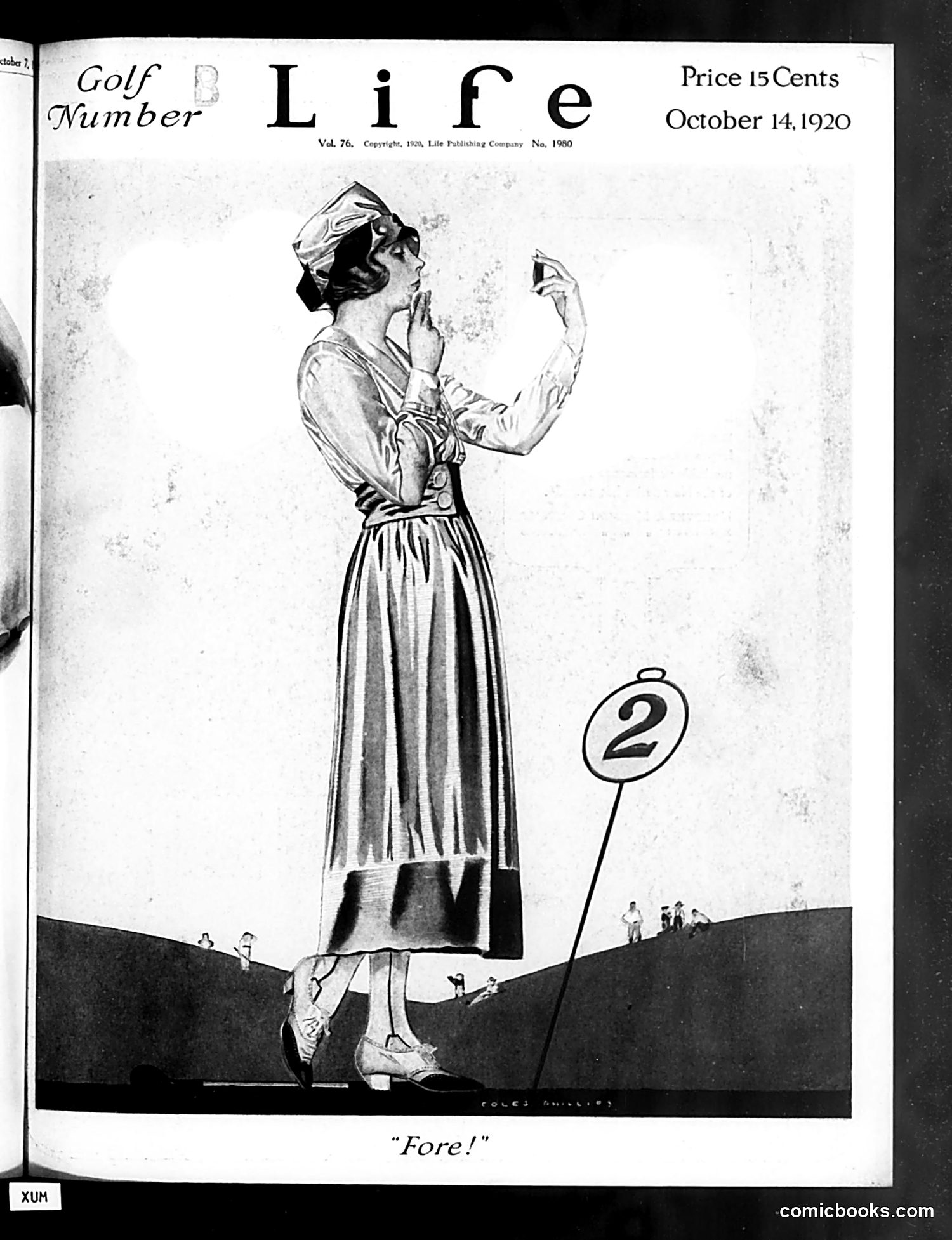
This is a golf-themed satire. The cover shows a woman on a golf course calling out "Fore!" (the traditional warning cry when a ball heads toward other golfers). She's depicted as oversized and dominating the landscape, with small golfers visible in the distance on the green. The satire likely comments on women's increasing participation in golf during the 1920s—a sport traditionally dominated by men. The exaggerated scale and her commanding position on the course suggests humor about women's growing social prominence and presence in previously male-exclusive spaces during this era of expanding women's rights (women gained voting rights in 1920, the same year this was published).
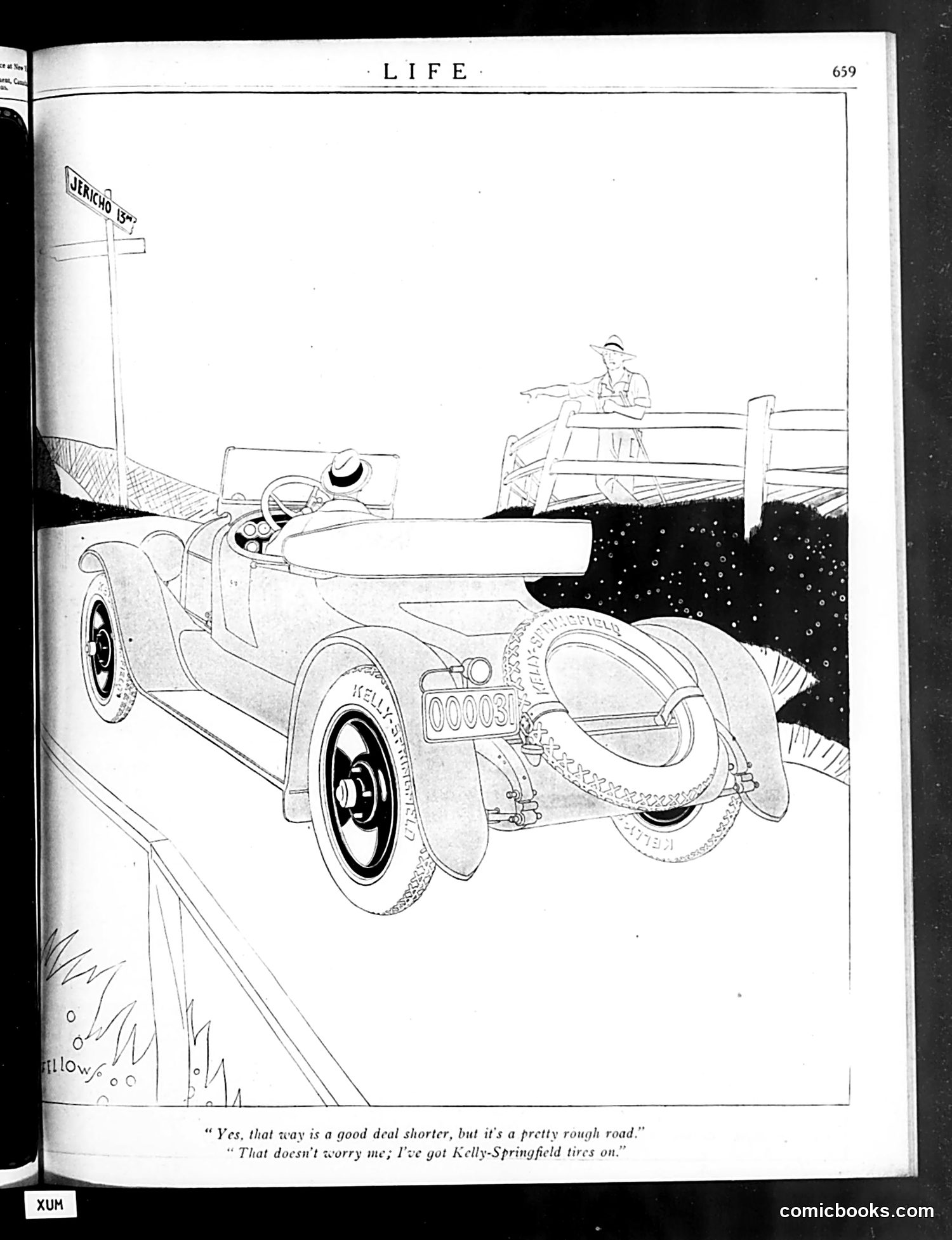
This is a vintage automobile advertisement disguised as editorial cartoon content. The image shows two men discussing a car on a rural road, with one driver operating what appears to be a 1920s-era open-air vehicle. The dialogue references "Kelly-Springfield tires"—a real tire brand from that era. The joke plays on the tension between convenience and comfort: one character notes the shortcut is "a good deal shorter, but it's a pretty rough road," while the other dismisses the concern because his vehicle has quality tires. This is essentially **product placement humor**—using a relatable scenario about road conditions to promote Kelly-Springfield tires as reliable enough to handle poor surfaces. The satirical framing as "Life" magazine content made advertising more palatable to readers of that period.
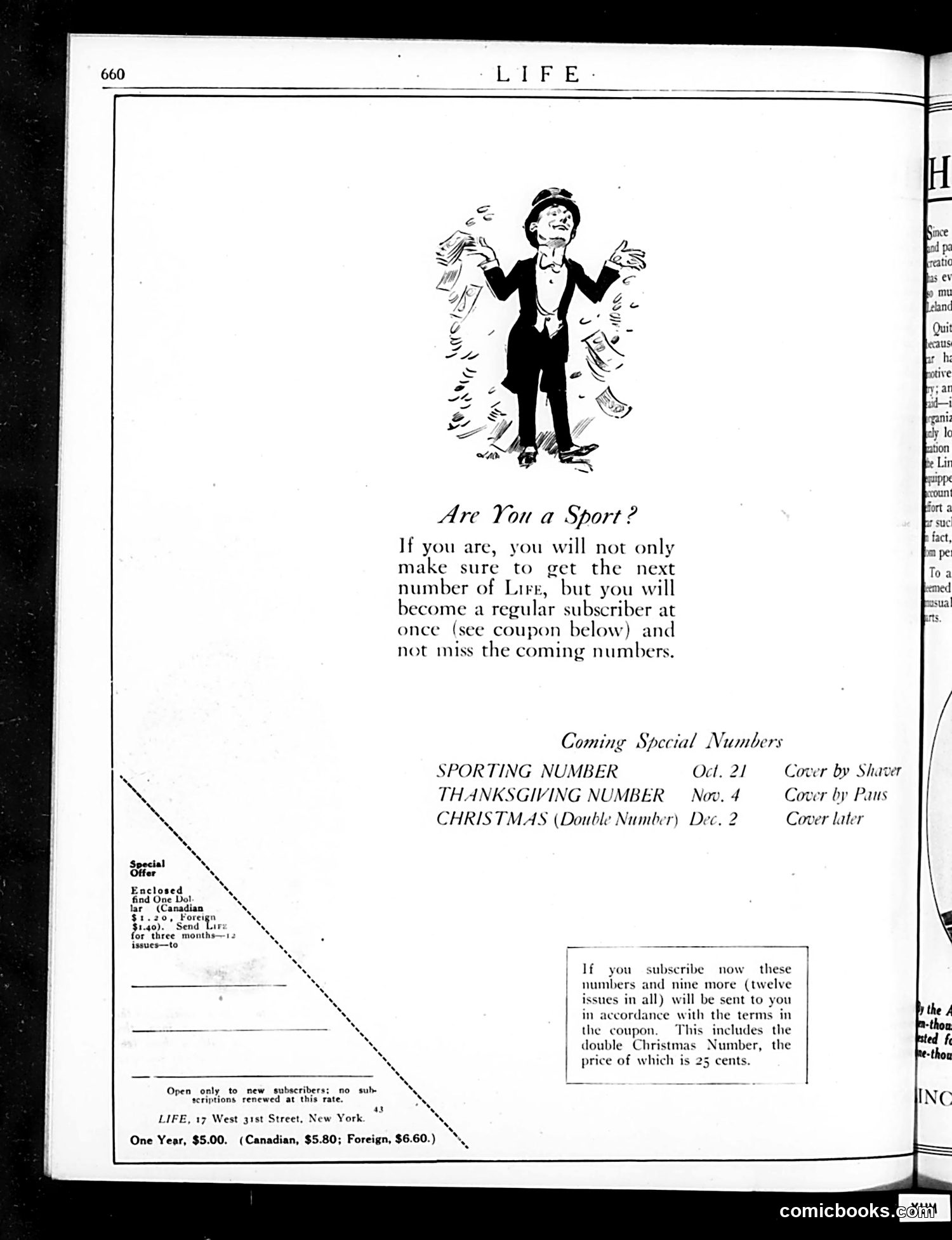
This page is primarily a **subscription advertisement** for Life magazine itself, not political satire. The central illustration shows a man in formal wear surrounded by falling money, with the heading "Are You a Sport?" The "joke" is a sales pitch: if readers are "sports" (good fellows/generous types), they should subscribe to Life to receive upcoming special issues—a Sporting Number, Thanksgiving Number, and Christmas Double Number. The money imagery humorously suggests that subscribing is a worthwhile "investment." The coupon below facilitates subscriptions at $5.00 yearly (or $5.80 Canadian; $6.60 foreign). This is straightforward magazine promotion dressed in humorous language, typical of early 20th-century advertising strategy.
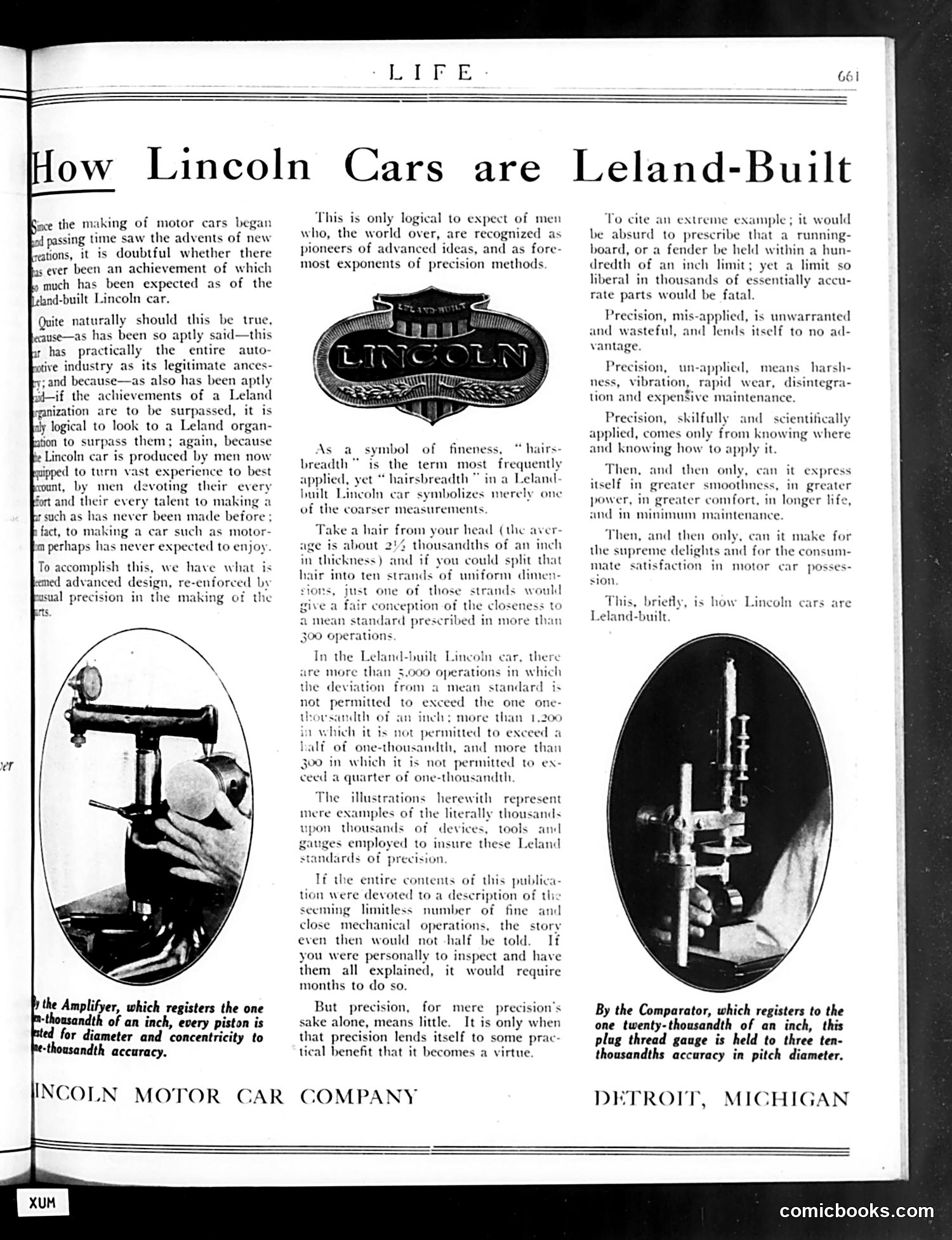
This page is primarily **advertising rather than satire or political commentary**. It's a promotional article for Lincoln Motor Car Company's manufacturing precision, published in *Life* magazine (page 661). The content explains Lincoln's manufacturing standards using a hair analogy—their tolerances are so tight that splitting a human hair into ten strands would exceed their permitted deviation in over 5,000 operations. Two photographs show precision measurement instruments used in production. The article emphasizes that Lincoln achieves superior quality through rigorous engineering standards and precision tooling. The "Amplifier" and "Comparator" devices pictured are measuring tools ensuring exact specifications. This represents early 20th-century automotive marketing highlighting technological advancement and manufacturing excellence as selling points to consumers.
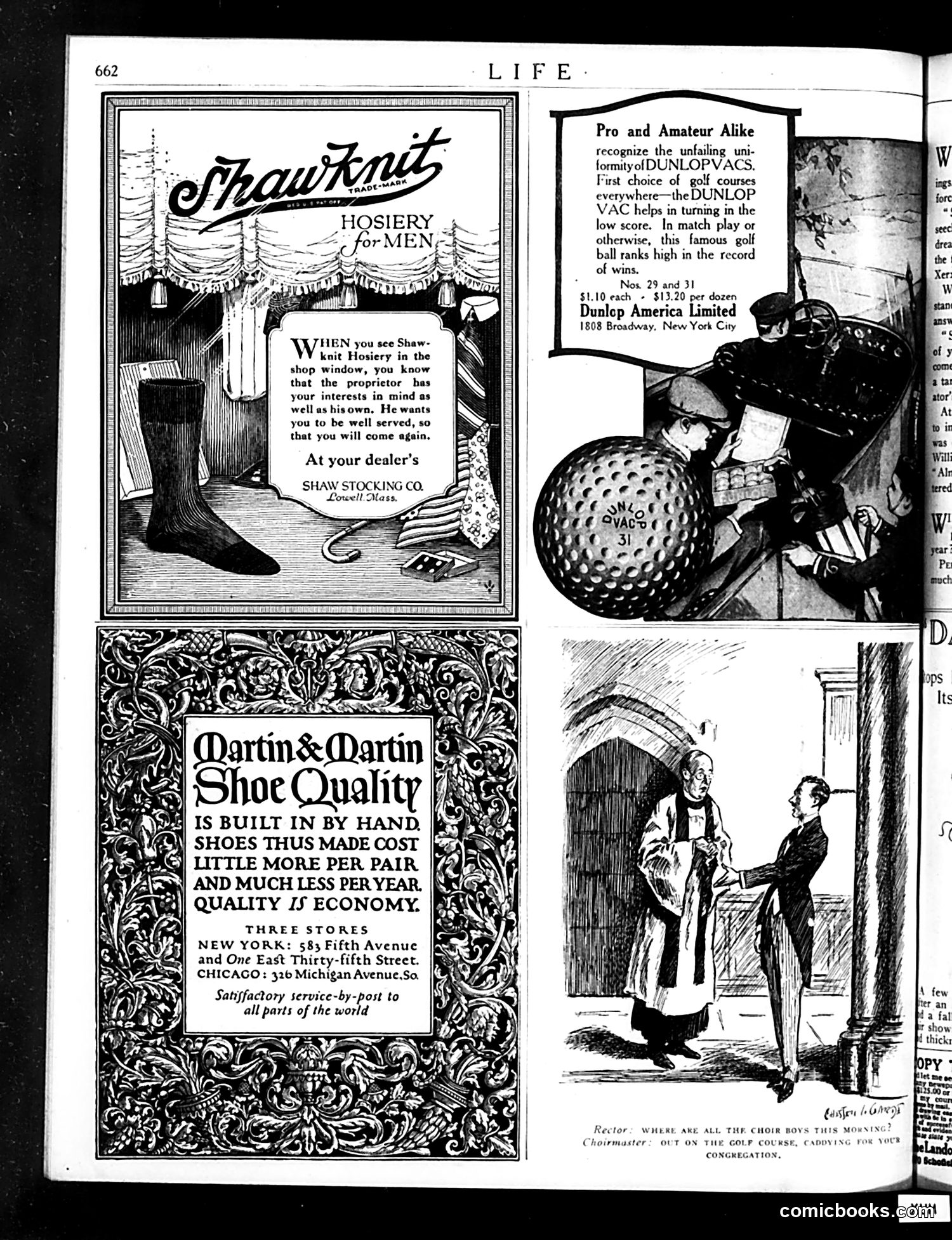
This page is primarily **advertisements** rather than political satire. The top ad promotes **Shawknit Hosiery** for men, emphasizing personal service and quality. The middle ad features **Martin & Martin Shoe Quality**, highlighting hand-made construction and durability as economical value. The right side contains a **Dunlop Vacs golf ball advertisement** and a cartoon sketch below it. The sketch depicts a **Rector** (church official) asking a Choirmaster why choir boys are missing—"out on the golf course, caddying for you congregation." This is gentle **social satire** mocking the era's enthusiasm for golf, suggesting even religious duties are abandoned for the sport. The joke reflects early 20th-century concerns about golf's popularity among the wealthy.
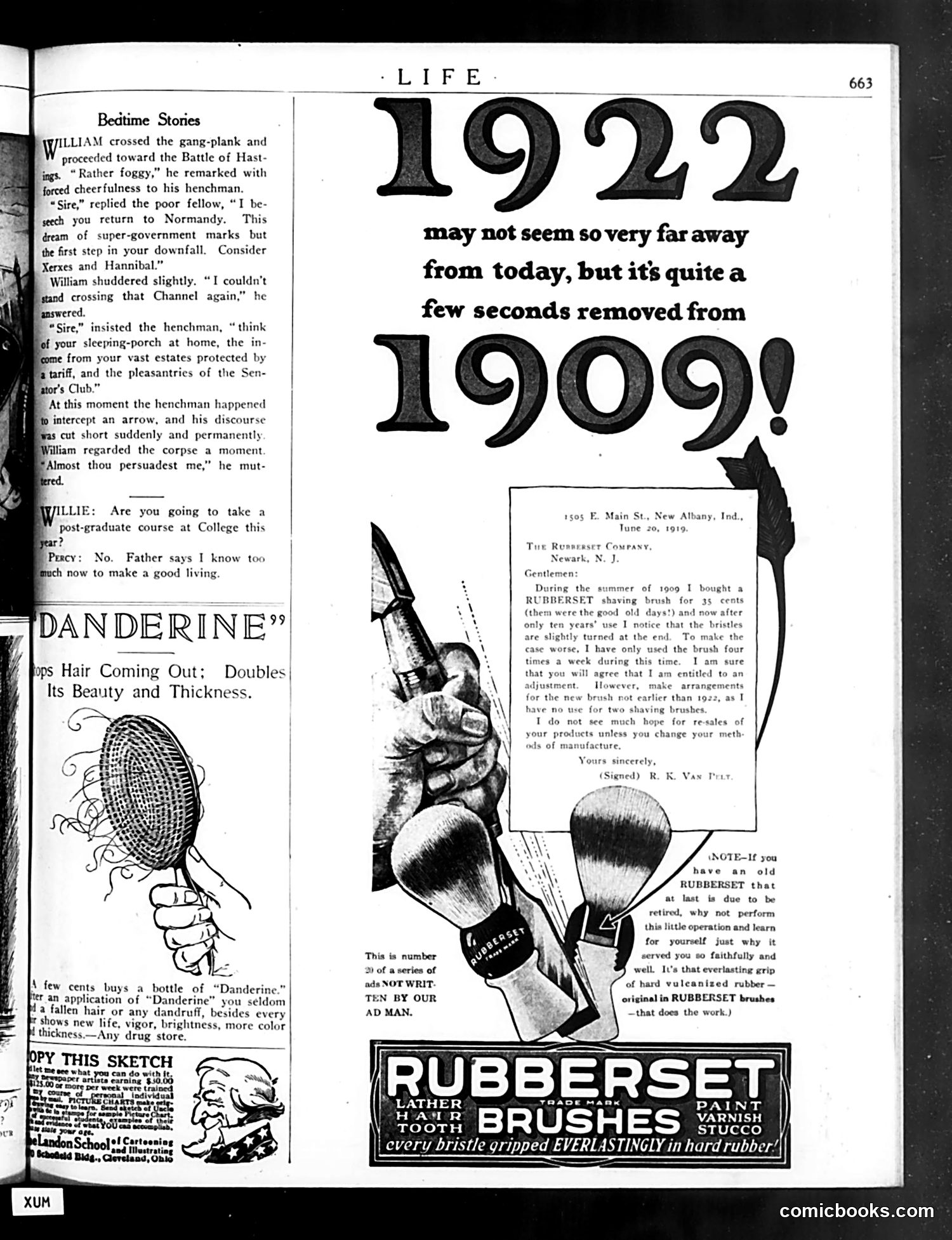
This is primarily an **advertising page** from Life magazine (June 29, 1919), dominated by a large advertisement for Rubberset brushes. The ads occupy most of the layout. The top features a customer testimonial letter dated 1909, praising a Rubberset shaving brush's durability after ten years of use. The advertiser uses this as proof of product quality. The left side contains unrelated content: a "Bedtime Stories" dialogue about William crossing a Channel and references to Hastings, plus a separate "Danderine" hair product ad and a "Copy Sketch" advertisement. The page's primary purpose is **commercial**, not satirical. There is no political cartoon. The year "1922" in large type refers to the future date when the brush will supposedly still be in use—a marketing claim about product longevity.
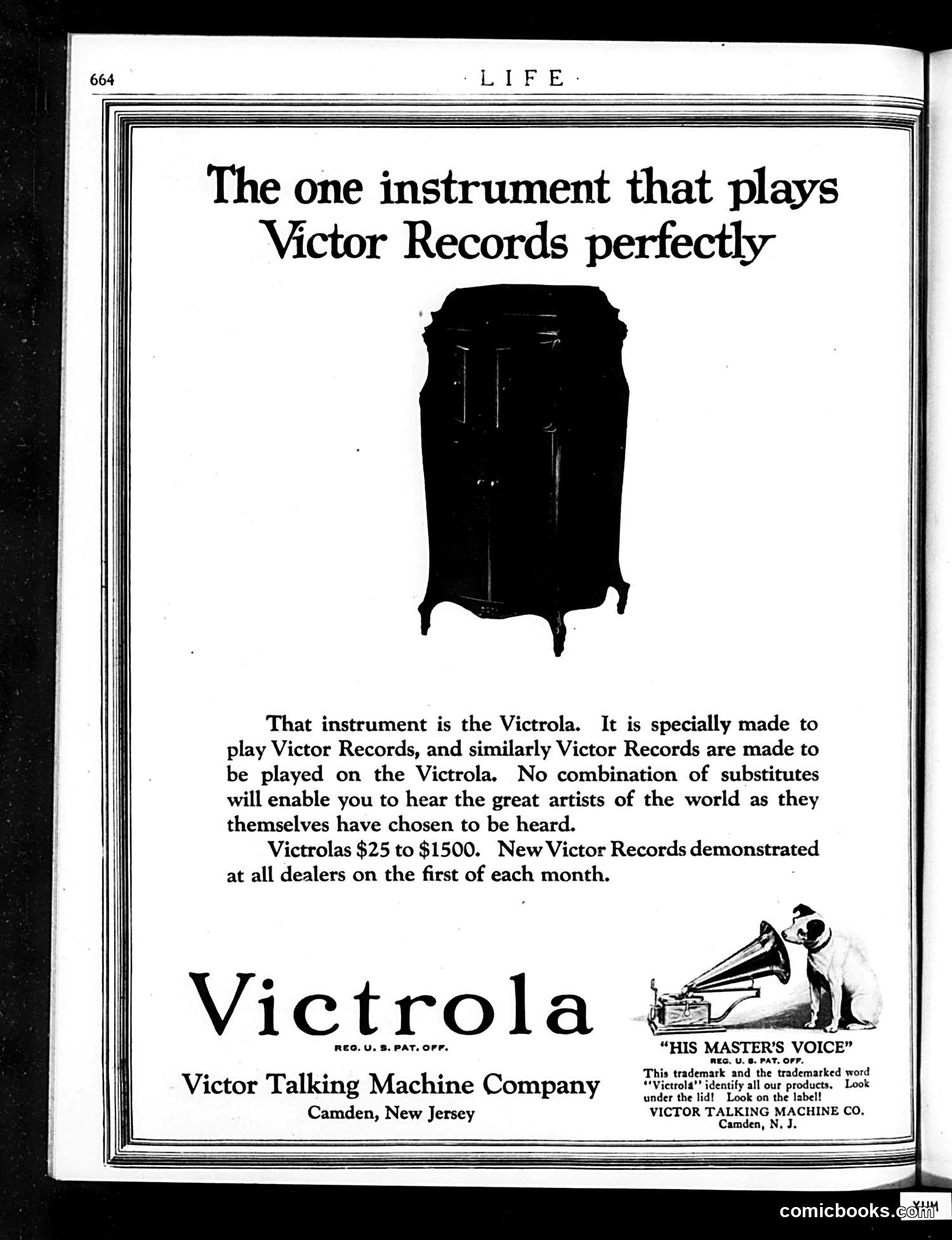
This is a **full-page advertisement**, not editorial content or satire. It promotes the Victrola, a phonograph manufactured by the Victor Talking Machine Company in Camden, New Jersey. The ad claims the Victrola is "the one instrument that plays Victor Records perfectly"—emphasizing exclusivity and superior sound quality. The central image shows the cabinet-style phonograph in silhouette. The text argues that no substitute device can properly reproduce Victor Records, and that listeners can only hear "great artists of the world as they themselves have chosen to be heard" through a Victrola specifically. The price range ($25-$1500) and mention of monthly dealer demonstrations indicate this was aspirational consumer technology of the early 20th century. The "His Master's Voice" trademark (visible lower right) was Victor's famous logo.
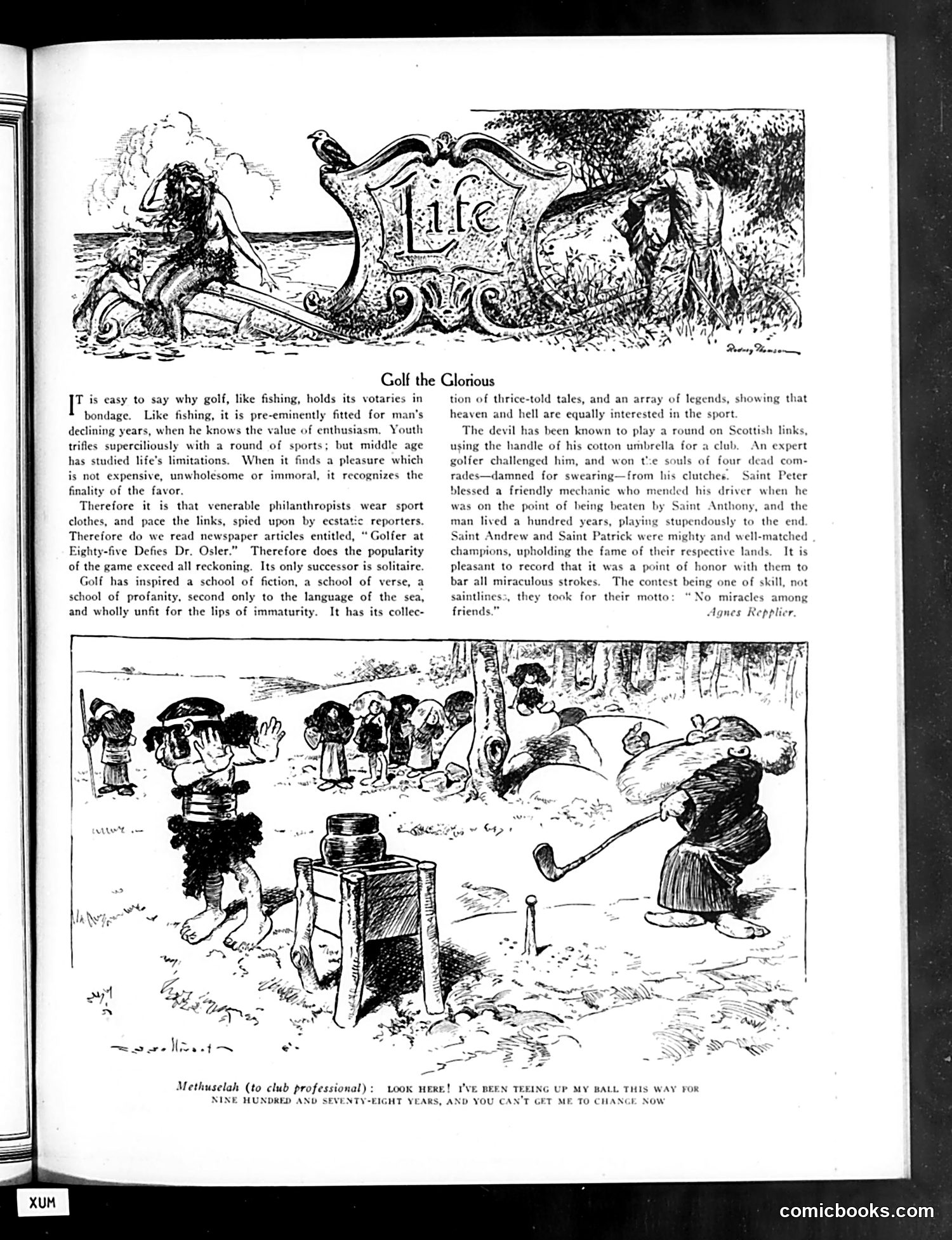
This page satirizes golf's popularity among wealthy Americans. The essay argues golf appeals to middle-aged men seeking inexpensive entertainment, contrasting it with fishing. It humorously claims golf inspired a "school of infancy, second only to the language of the sea" and references religious figures (Saint Peter, Saint Anthony, Saint Andrew, Saint Patrick) allegedly playing golf or blessed by it—obvious fabrications mocking the sport's cultural elevation. The cartoon below depicts Methuselah (the biblical figure who lived 969 years) as a professional golfer, unable to change his habits despite centuries of existence. The joke: even extreme longevity won't break golf addiction, satirizing how obsessively devoted golfers are to the sport. The satire targets golf's grip on American society and players' inability to quit.
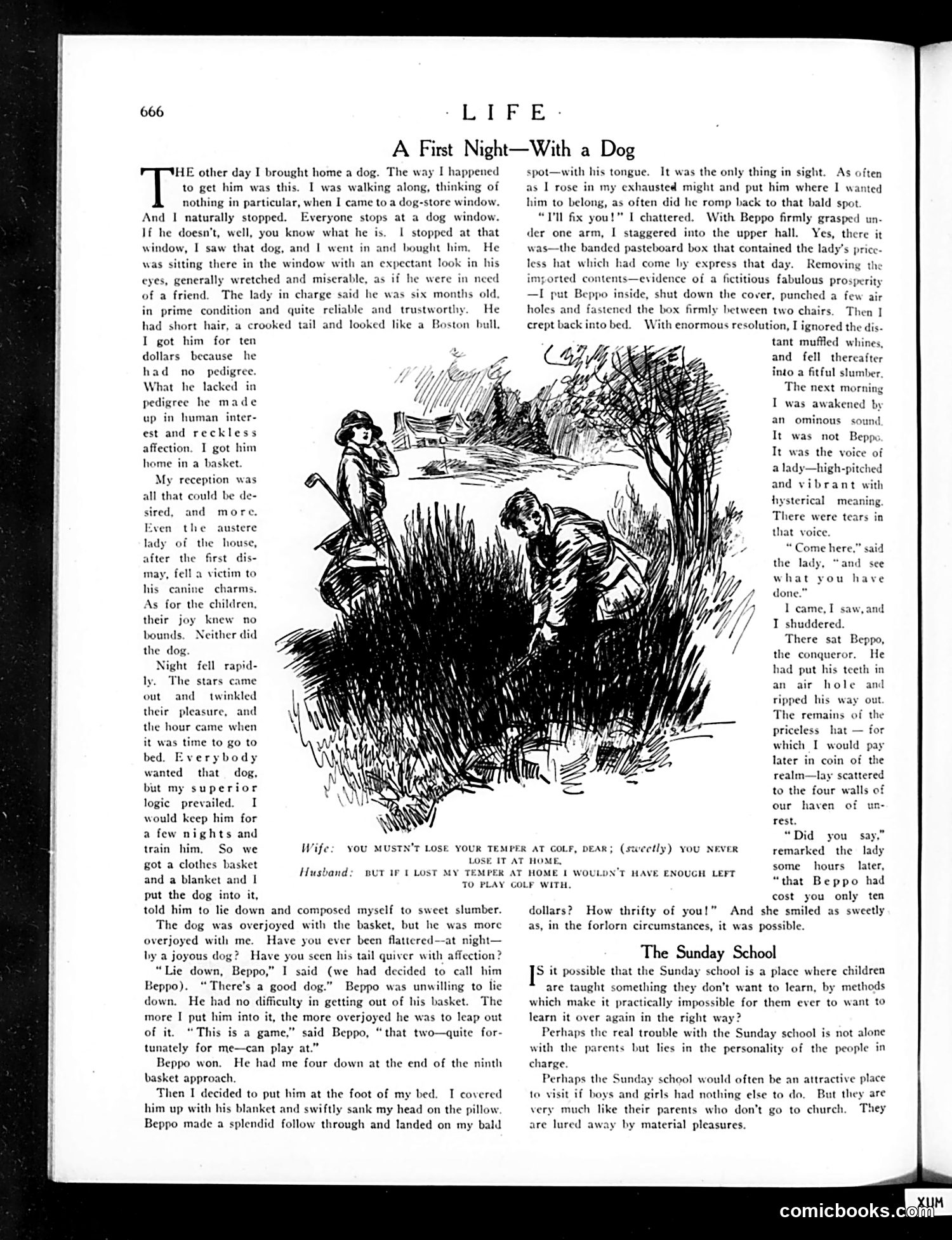
This page contains two separate pieces of humorous writing from *Life* magazine, not political cartoons. "A First Night—With a Dog" is a domestic comedy narrative about acquiring a dog from a pet store and its chaotic first night at home, culminating in the dog destroying the narrator's bed. The accompanying illustration shows figures discovering the dog's destructive handiwork in tall grass or bedding. "The Sunday School" is a brief social commentary critiquing Sunday school education. The author argues that Sunday schools use teaching methods children find unappealing, making the lessons ineffective. The piece suggests religious instruction conflicts with children's material pleasures and parental authority. Both pieces exemplify *Life*'s satirical approach to middle-class American domestic life and social institutions through humor rather than political commentary.
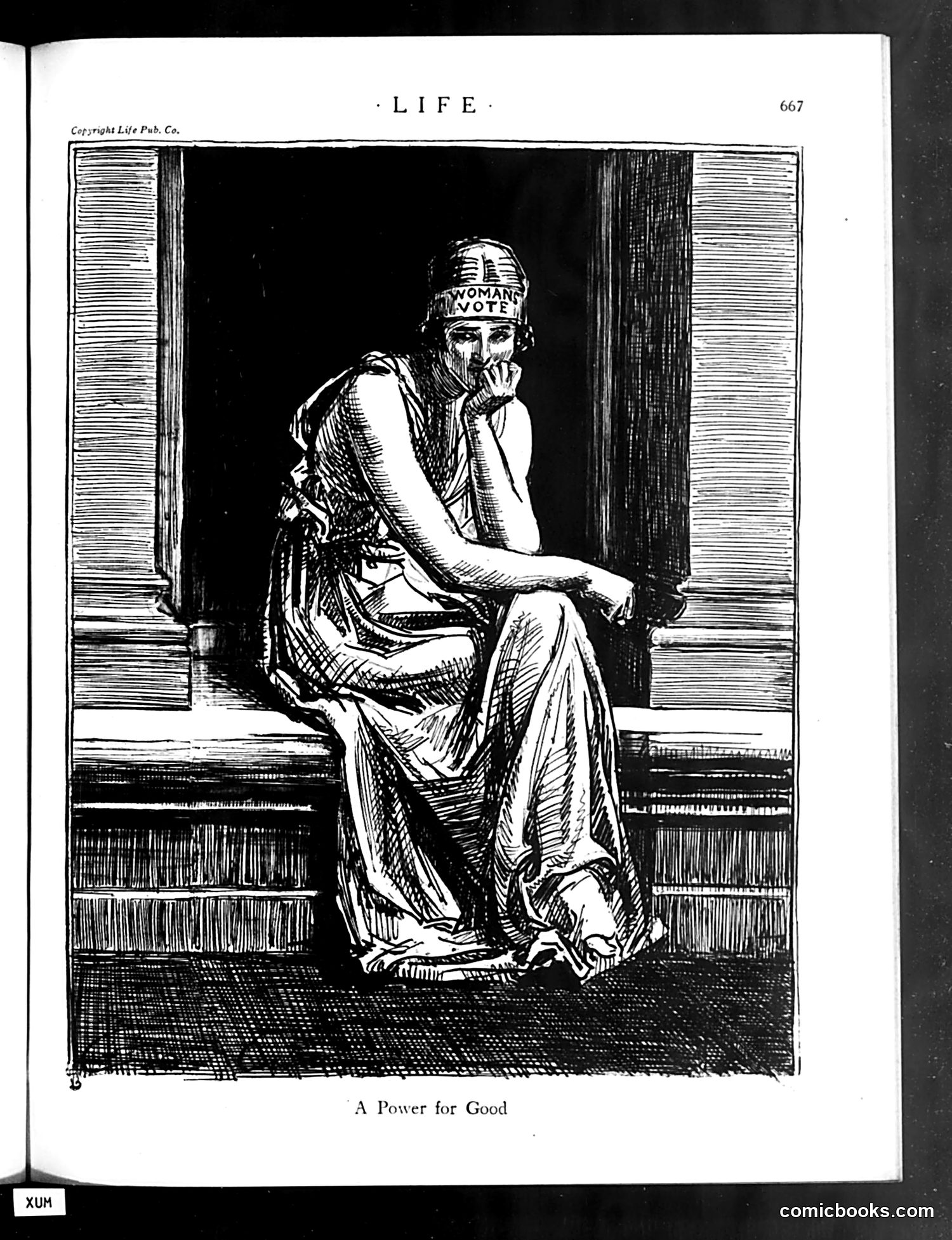
This political cartoon depicts a woman wearing a headband labeled "WOMAN VOTE," sitting in a contemplative pose with her hand to her face. She appears anxious or troubled rather than triumphant. The title "A Power for Good" is ironic—the artwork suggests skepticism about women's voting rights. The woman's worried expression and body language convey doubt or concern rather than confidence in this newfound political power. This cartoon likely dates to the early 20th century, around or shortly after women gained voting rights (1920 in the US). The satire mocks the premise that women's suffrage would automatically be beneficial, suggesting instead uncertainty about women's readiness for or commitment to exercising this power responsibly.
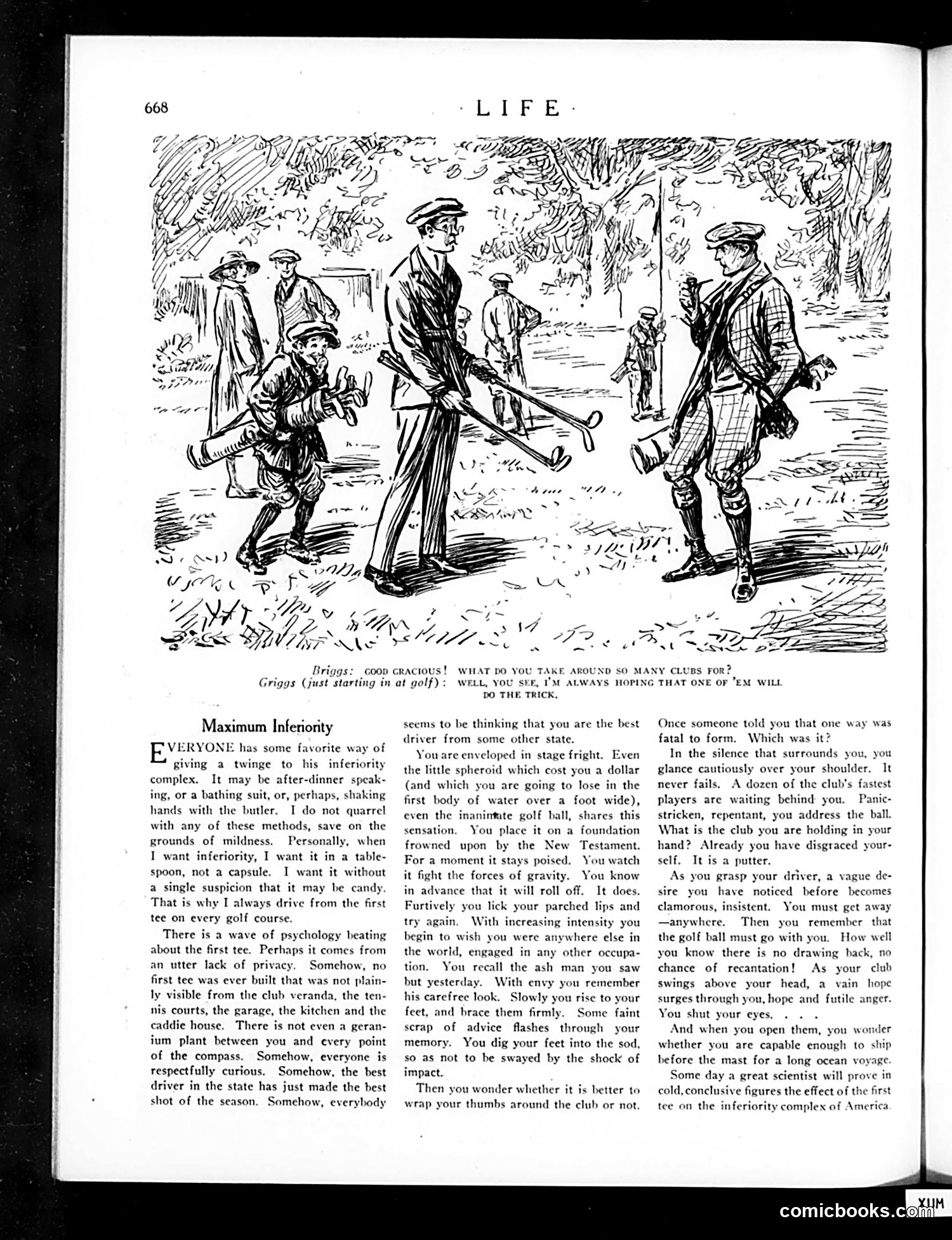
**The Cartoon:** Shows several men in early 20th-century attire on a golf course. One golfer addresses another: "GOOD GRACIOUS! WHY DO YOU GO AROUND SO MANY CLUBS FOR! WELL, YOU SEE, I'M ALWAYS HOPING THAT ONE OF 'EM WILL DO THE TRICK." **The Joke:** This satirizes golfers who carry excessive equipment, hoping that more clubs will compensate for poor skill. The humor suggests the golfer is incompetent—blaming his clubs rather than accepting his limitations. **The Article Below** ("Maximum Inferiority") discusses golf psychology, examining how players mentally struggle with the first tee, comparing themselves unfavorably to others, and how envy affects performance. It's commentary on the psychological insecurities golf exposes in players. **Context:** Early 20th-century Life magazine regularly mocked golf's growing popularity among American middle/upper classes and the neuroses it produced.
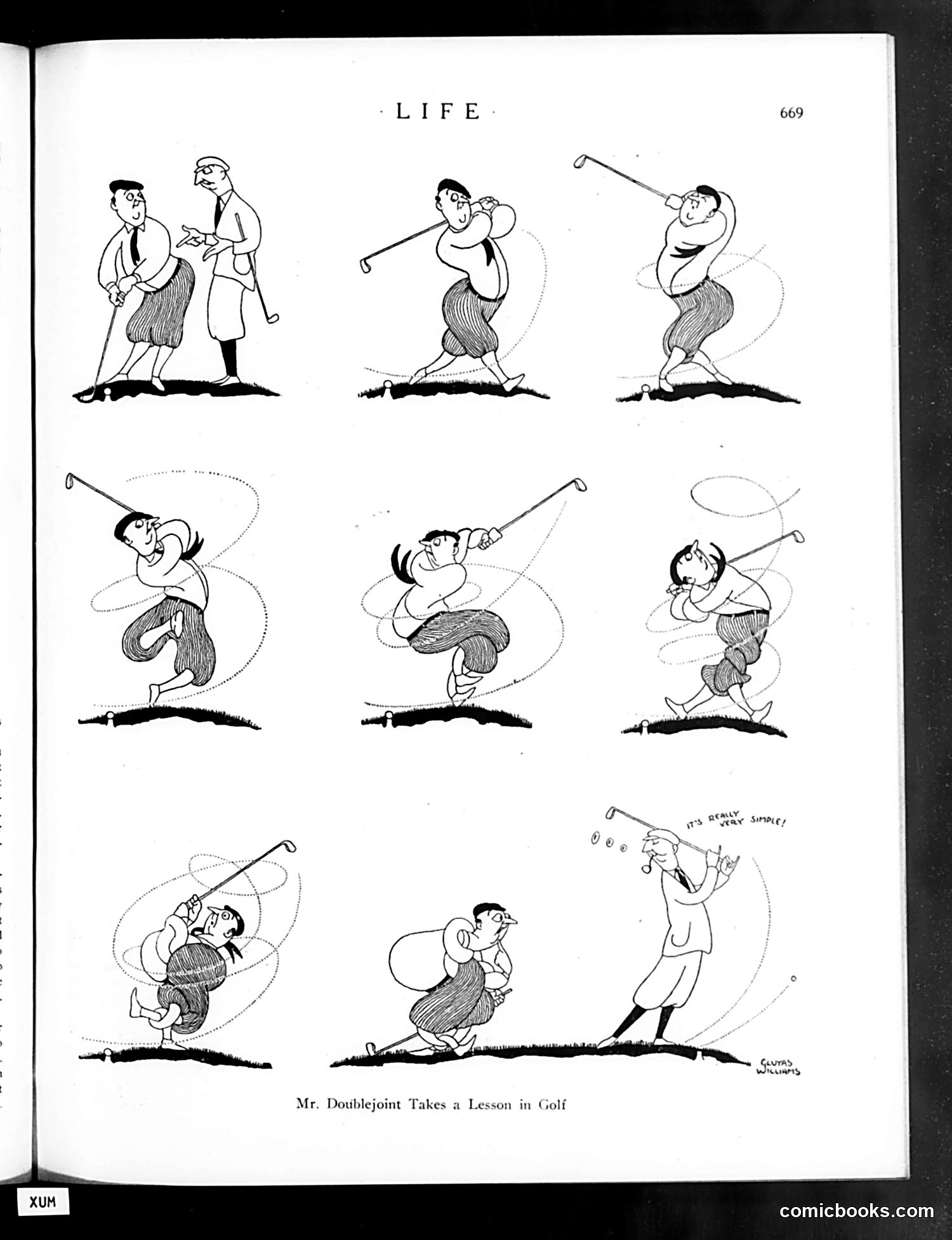
This is a humorous instructional comic strip showing a rotund, flexible character named "Mr. Doublejoint" attempting to learn golf. The sequence depicts his increasingly contorted and ridiculous body positions as he struggles through a golf swing, with dotted lines showing the erratic path of his shots. The joke relies on physical comedy: his extreme obesity and apparent lack of athletic coordination make each attempt more absurd than the last. The final panel shows him completely frustrated, exclaiming "IT'S GONE... SIMPLE NINETY!" — apparently his ball has disappeared or traveled an unexpectedly distance. This represents early 20th-century satirical humor targeting amateur golfers and their comical struggles with the sport, a popular leisure activity among the middle and upper classes of that era.
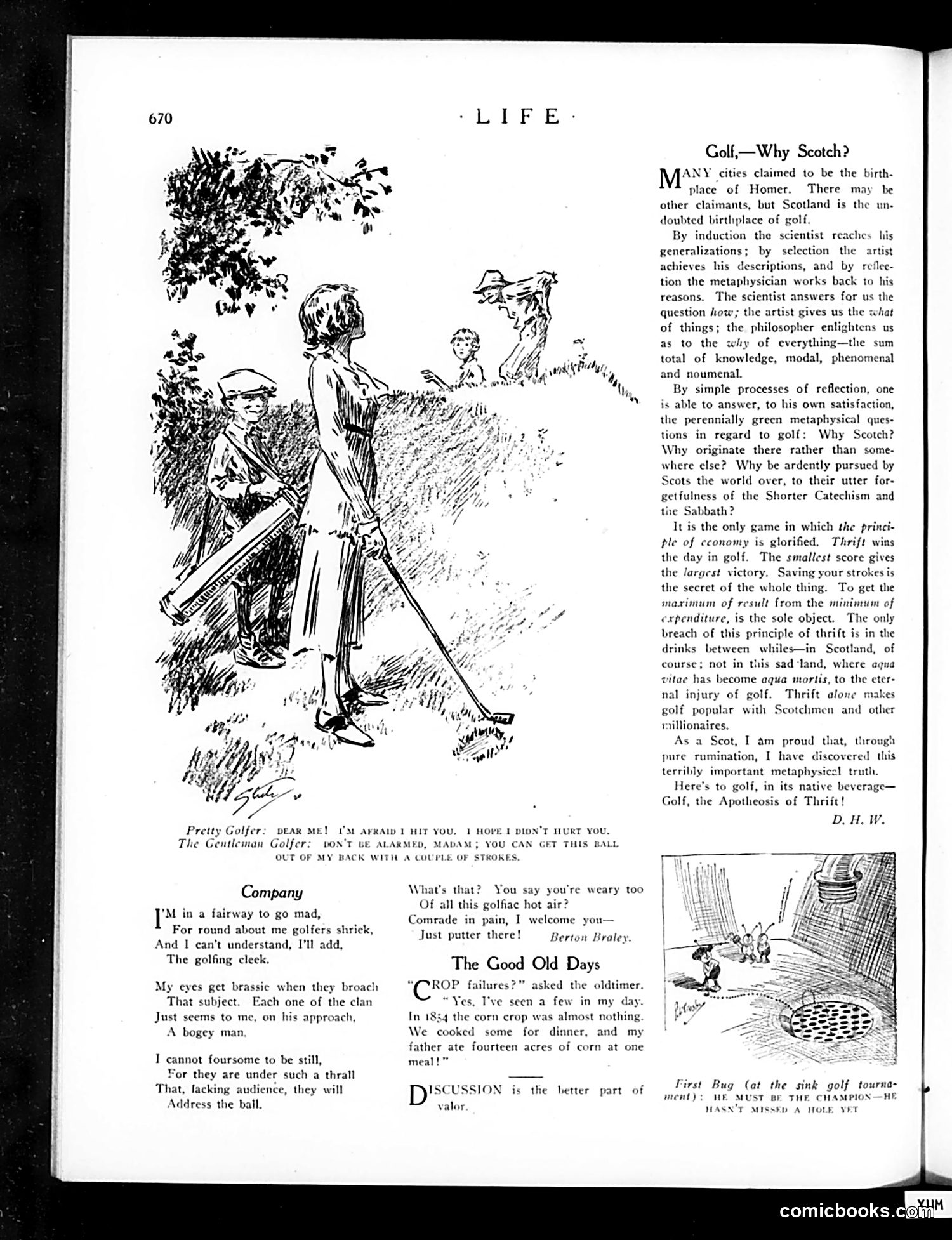
This page contains essays and verses about golf, particularly Scottish golf culture. The main illustration depicts two golfers—a "Pretty Golfer" (woman) and "The Gentleman Golfer" (man)—with dialogue about her hitting him during play. The article "Golf,—Why Scotch?" argues that Scotland is golf's birthplace and explores why Scots pursue the sport so passionately, attributing it to thrift and economy—getting "maximum result from minimum expenditure." The accompanying verses ("Company," "The Good Old Days") mock golfers' obsession with the sport and nostalgic reminiscence about past crop failures. A small cartoon at bottom shows golfers at a "sink golf tournament," with a caption joking that one player "hasn't missed a hole yet." The satire targets golf's cultural prominence and players' singular devotion to it.
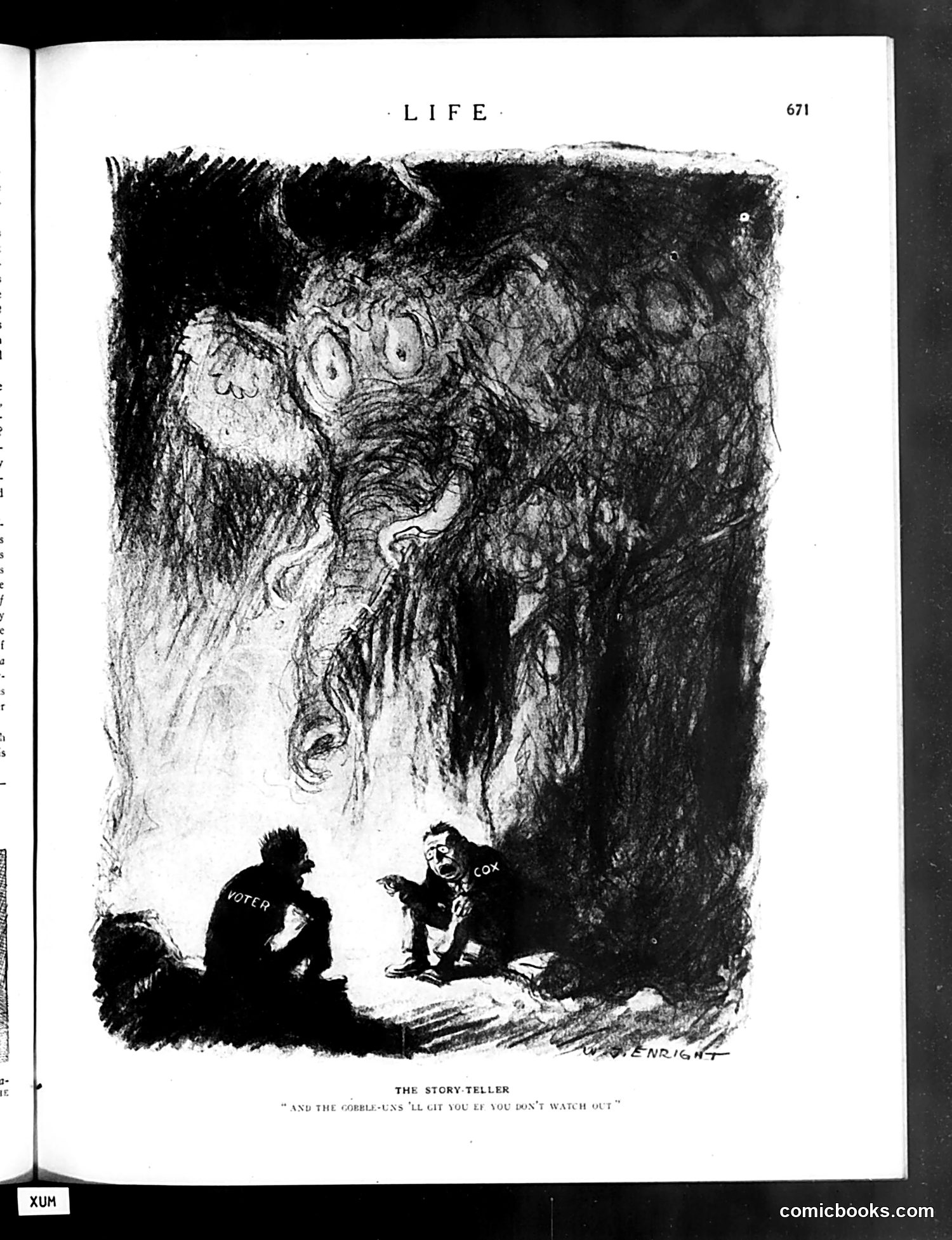
This cartoon by Enright depicts a folklore scene: a storyteller addressing an audience in what appears to be a cave or dark interior, with a grotesque goblin-like creature looming menacingly above them. The caption reads: "And the goblin-uss 'll git you if you don't watch out." The image satirizes the act of scaring listeners with tall tales and superstitious warnings—a classic storytelling trope. The contrast between the tiny, vulnerable audience members below and the exaggerated, monstrous figure above emphasizes how fear-mongering narratives can seem disproportionately powerful when told effectively. The piece likely comments on how storytellers manipulate audiences through fear, or possibly critiques superstition and folklore more broadly—a gentle mockery of both the teller's methods and listeners' credulity.
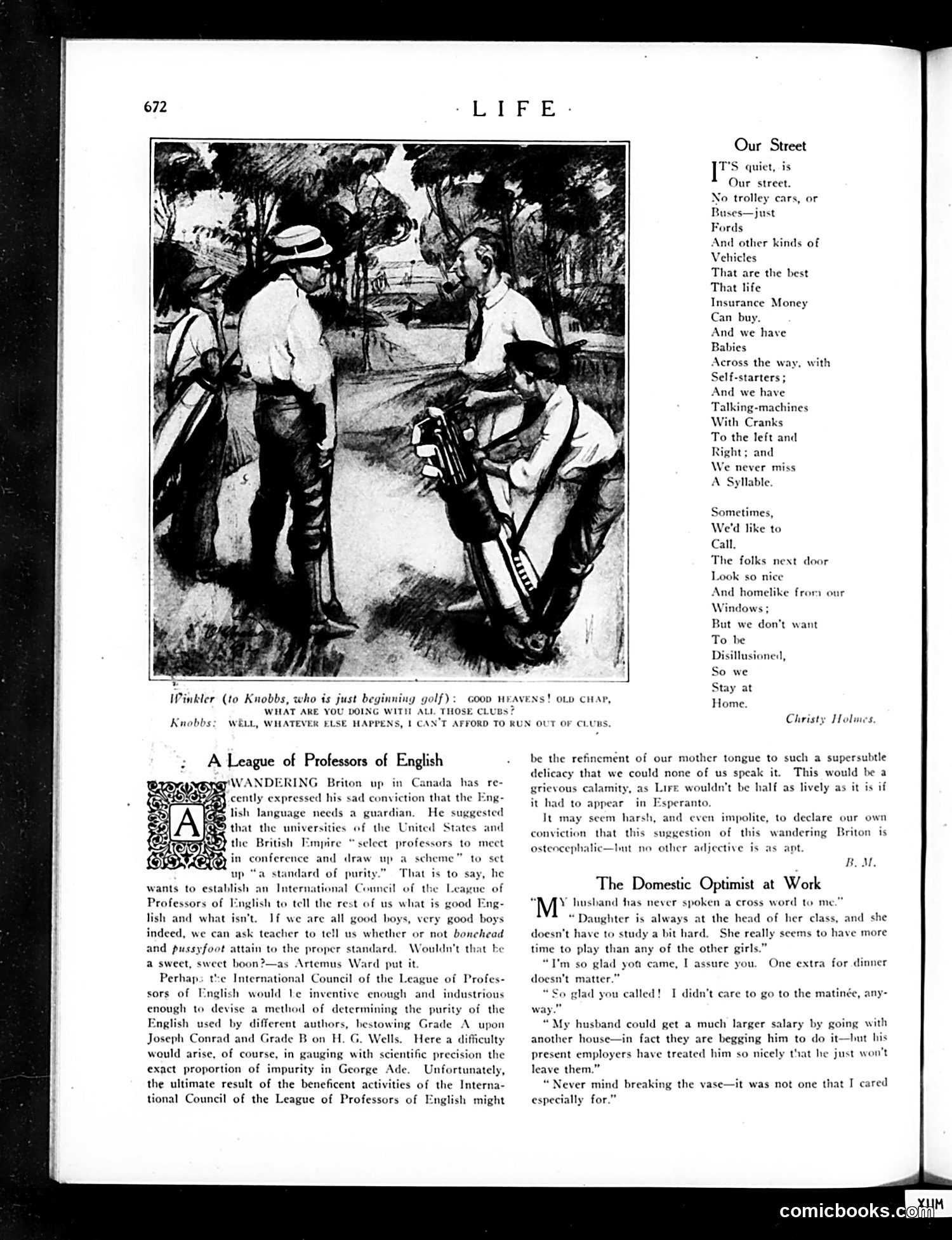
**The Cartoon:** The top illustration depicts men with golf clubs on a residential street. The caption quotes "Winkler" asking an old neighbor ("Knobbs") why he's running out of clubs, with Knobbs replying he can't afford to replace them. This satirizes **suburban recreational spending** — the joke being that even middle-class homeowners felt financial pressure to maintain leisure activities like golf, a status symbol of the era. **The Articles Below:** These address **English language purity** (a League of Professors concerned about linguistic standards) and **domestic contentment** (a wife boasting her husband won't leave despite better job offers elsewhere). The page reflects interwar American anxieties: economic precarity masked by suburban aspiration, linguistic elitism, and marital satisfaction as economic stability.
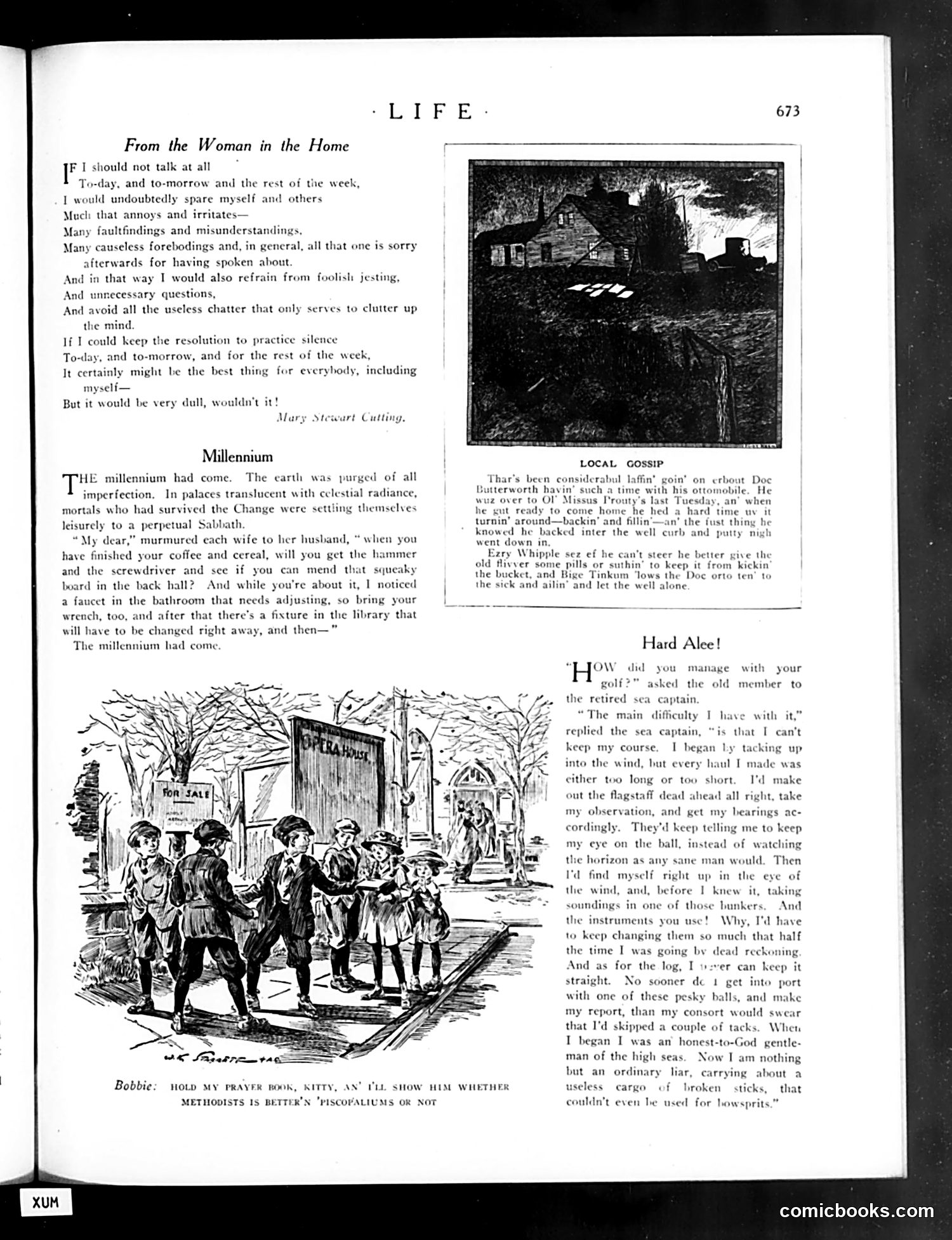
This *Life* magazine page contains three separate pieces of satirical content: 1. **"From the Woman in the Home"** (top left): A humorous essay by Mary Stewart Cutting about women's tendency to talk incessantly. It ironically notes that silence would benefit everyone—but life would be "very dull" without chatter. This gently satirizes domestic life and female stereotypes of the era. 2. **"Millennium"** (center): A short story satirizing the arrival of a perfect future where all earthly imperfections are eliminated. The joke: even in utopia, wives immediately demand husbands fix household problems (squeaky boards, leaky faucets). The satire targets both endless domestic maintenance and wives' relentless nagging. 3. **"Hard Alee!"** (bottom right): A retired sea captain attempts golf but applies nautical terminology and methods, failing miserably. He blames golf's illogical rules rather than accepting he simply doesn't understand the sport—satirizing stubborn male resistance to admitting incompetence. The cartoon (center) shows children around a "For Sale" house, likely related to the millennium theme. All content targets domestic life, gender dynamics, and human nature's resistance to change.
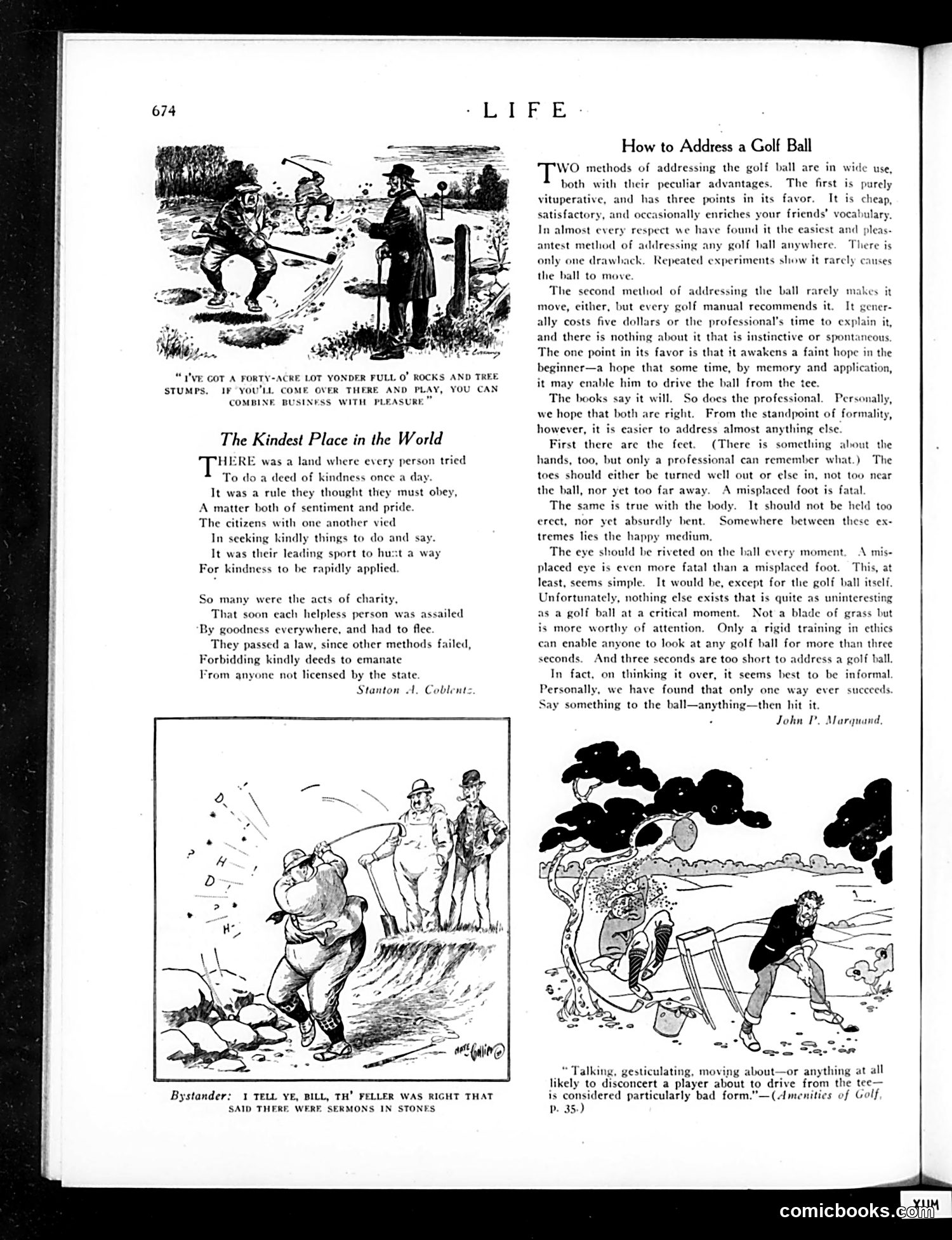
This page contains three distinct pieces of satire: **"The Kindest Place in the World"** is a poem mocking excessive do-goodism. It describes a society where mandatory kindness becomes so oppressive that people must flee and the government must *license* charity to prevent harassment. The satire targets both sentimental idealism and bureaucratic overreach—suggesting good intentions become tyrannical when enforced. **The golf cartoons** humorously illustrate the absurdity of golf instruction. The top cartoon shows someone offering land "full of rocks and stumps" as a place to play while "combining business with pleasure"—dark humor about golf's futility. The essay mocks golf manuals' overly technical advice about stance and focus, noting that neither method actually makes the ball move. John P. Marquand's conclusion—just talk to the ball and hit it—satirizes the gap between formal instruction and practical reality. **The "Bystander" caption** is a separate joke about sermons in stones (wisdom in unexpected places), accompanying an unrelated illustration. All three pieces exemplify Life's satirical approach: puncturing pretension and exposing the gap between theory and practice.
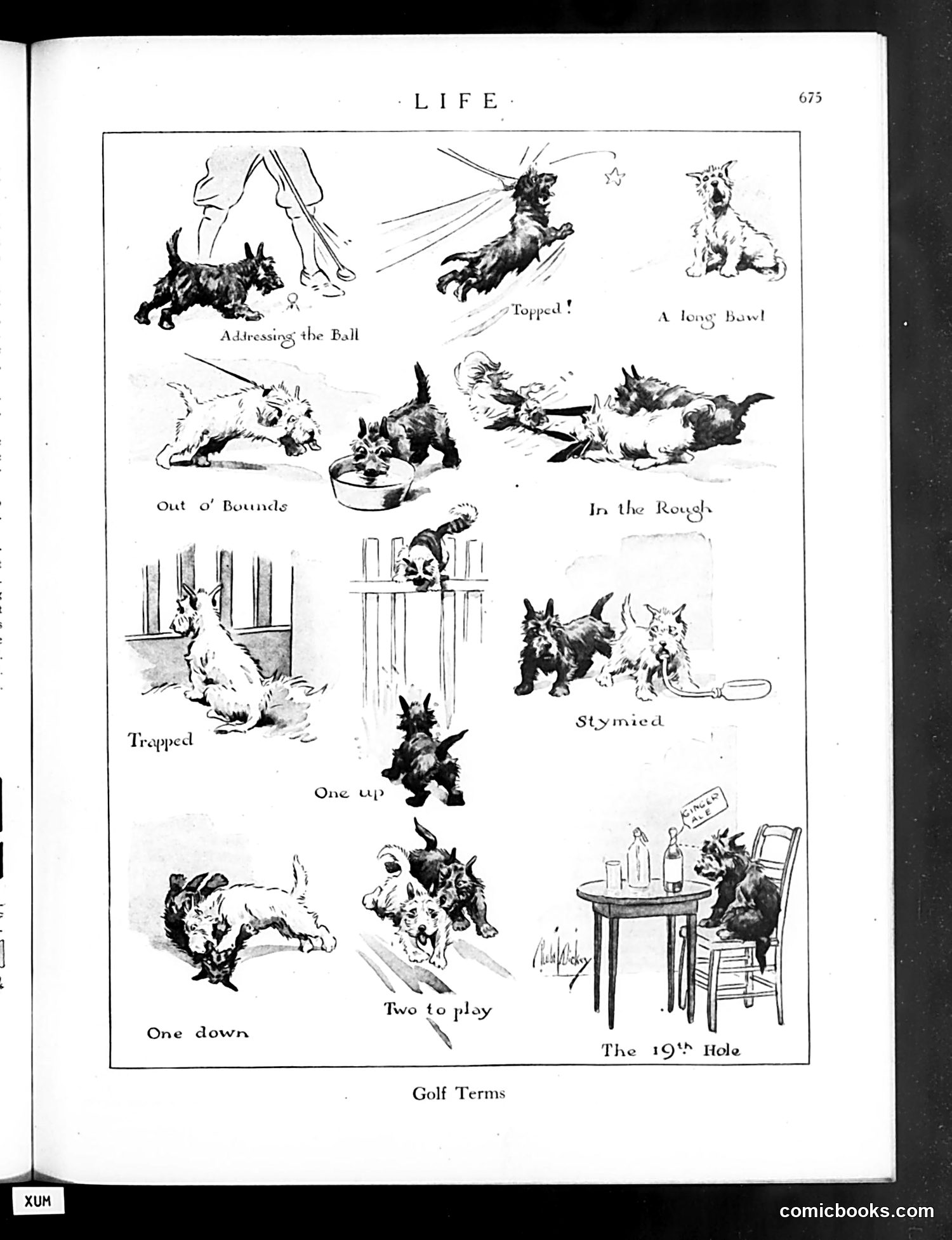
This page presents a humorous illustrated guide to golf terminology, using small dogs (likely terriers) in various scenarios to visualize common golf expressions. Each illustration pairs a golf term with a comedic visual pun: - "Addressing the Ball" shows a dog facing a ball - "Topped" depicts a dog flying over a ball - "Out o' Bounds" shows a dog outside the course - "One down" and "Two to play" illustrate match play scoring - "Trapped" shows a dog stuck by a fence - "Stymiied" shows dogs blocking each other's paths - "The 19th Hole" (the bar after golf) shows dogs at a table The satire gently mocks both golf's complex terminology and the sport's pretentious culture by reducing serious golf scenarios to silly dog antics. This reflects Life magazine's typical approach: using absurdist humor to deflate human pomposity.
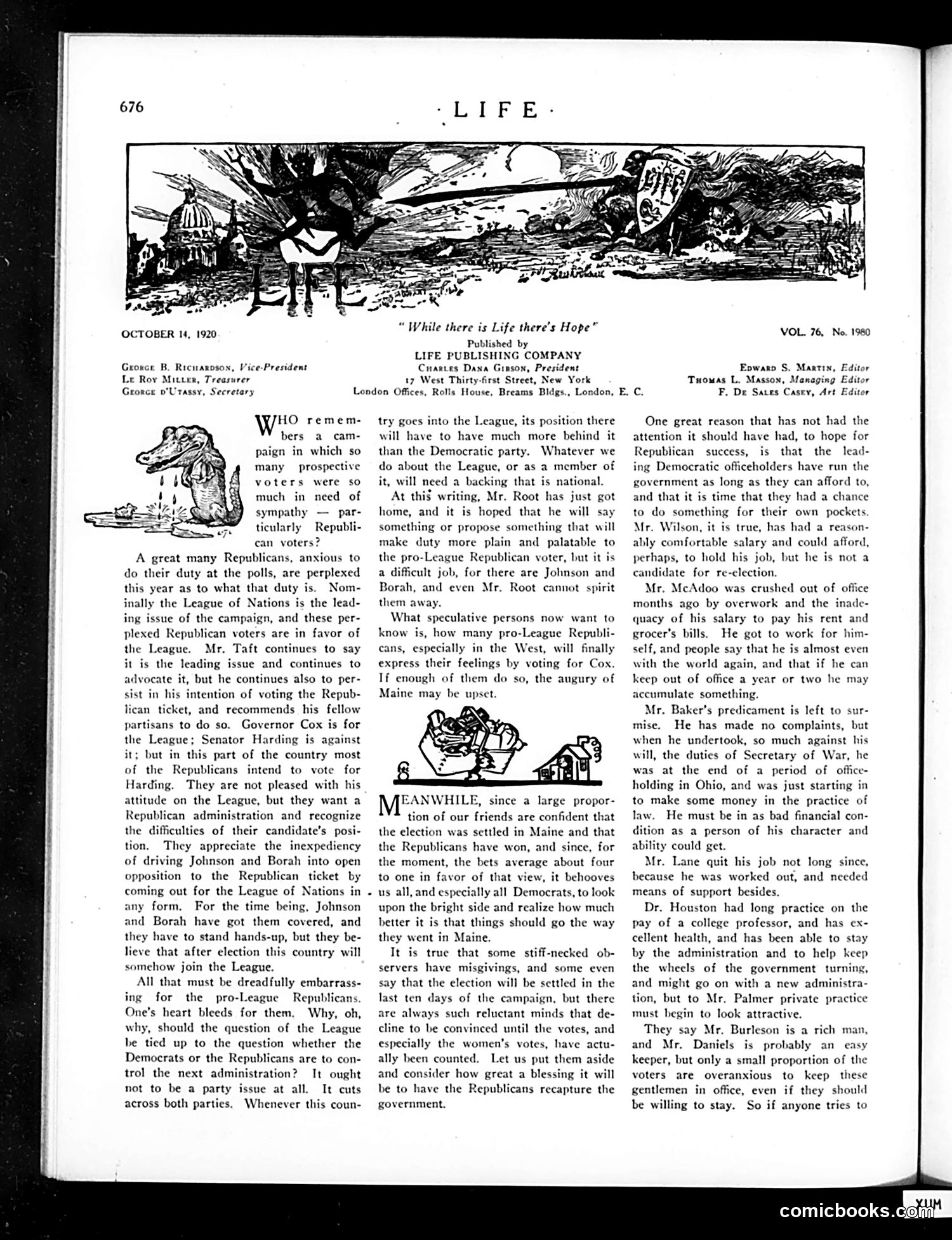
This editorial cartoon satirizes the internal contradiction facing pro-League Republicans in the 1920 presidential race. The piece mocks Republicans who support the League of Nations (President Wilson's postwar initiative) but feel obligated to vote for Republican nominee Warren Harding, who opposed League membership. The satire highlights the political awkwardness: GOP voters favor the League—an internationalist position—yet party loyalty, plus senators Johnson and Borah's anti-League stance, pressure them to support Harding anyway. The author sarcastically sympathizes with these conflicted voters while questioning whether such partisan loyalty makes sense for a supposedly bipartisan issue. The piece suggests only Elihu Root's intervention might resolve this tension. The cartoons (caricatures visible but unclear) underscore the absurdity of this position—highlighting how voters must suppress their actual beliefs for party solidarity. This reflects the actual 1920 campaign dynamic where the League became entangled with partisan politics despite being framed as a national question.
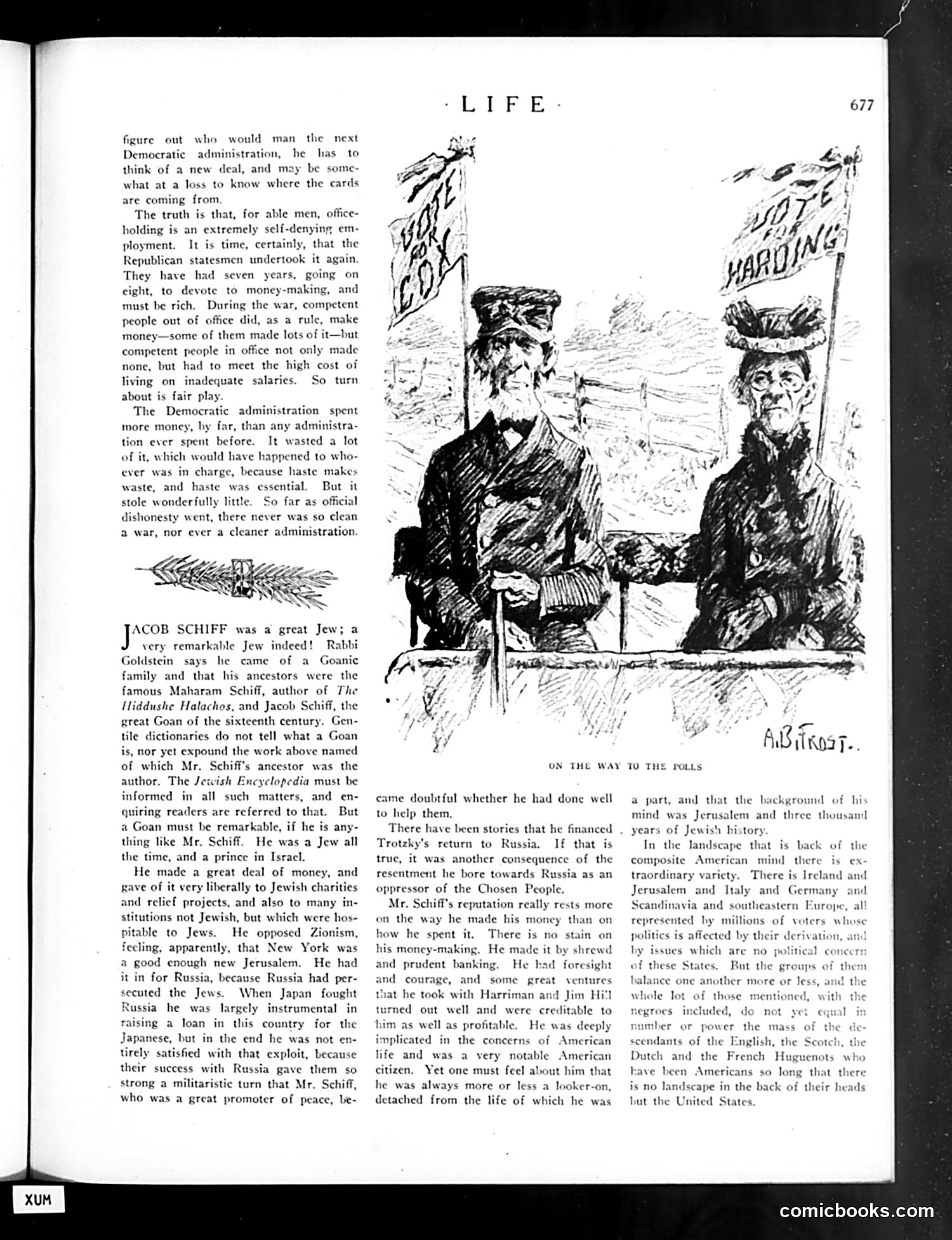
The cartoon depicts two caricatured figures climbing toward ballot boxes, labeled "CODING" and "HARDENING" (likely representing political positions hardening). The accompanying text discusses Jacob Schiff, a prominent Jewish banker and philanthropist. The satire targets the tension between Schiff's substantial financial influence and his claimed detachment from American political life. The article notes he remained psychologically tied to "Jerusalem and three thousand years of Jewish history" rather than fully invested in American concerns. The cartoon appears to mock this disconnect—showing him moving toward civic participation while remaining somewhat estranged from it. The broader context involves post-WWI politics: the text critiques both Republican and Democratic administrations' fiscal management, while Schiff's biography illustrates how wealthy, influential figures navigated American politics while maintaining divided loyalties. The "way to the polls" suggests the hypocrisy of such figures claiming detachment while wielding considerable power.
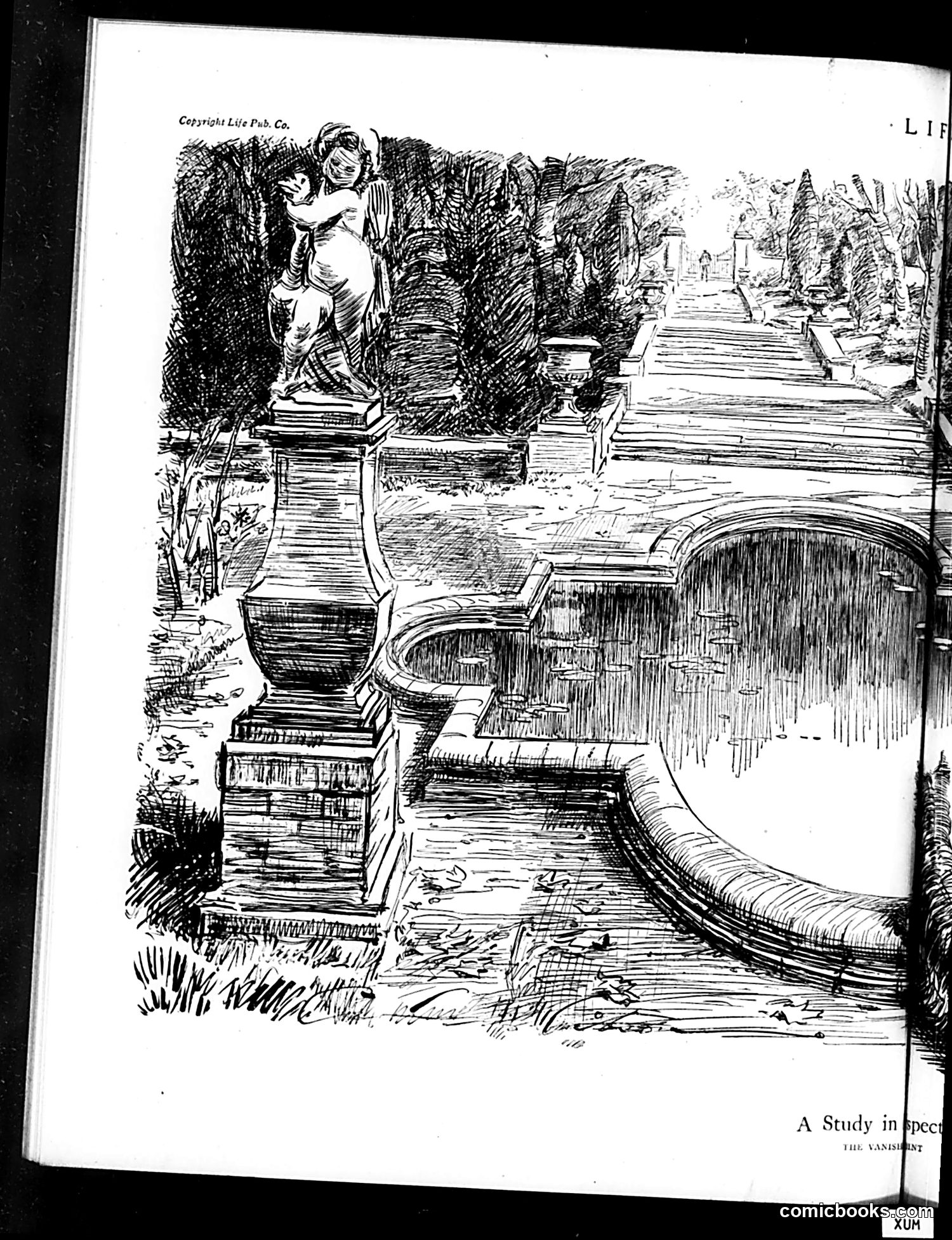
This appears to be an illustration from *Life* magazine showing a classical garden or cemetery scene with statuary, urns, and a curved pathway or hedge. The visible text fragment "A Study in" and "THE VANISH" suggests this is part of a larger article or story, though the complete title and context are cut off. The sketch depicts what seems to be classical architectural elements—pedestals, decorative urns, and sculptures—arranged along a formal garden setting. Without the full article text or title visible, I cannot definitively identify the specific satirical point or social/political commentary intended. The reference to "vanishing" in the partial title might suggest themes of loss, disappearance, or obsolescence, but this remains speculative without additional context.
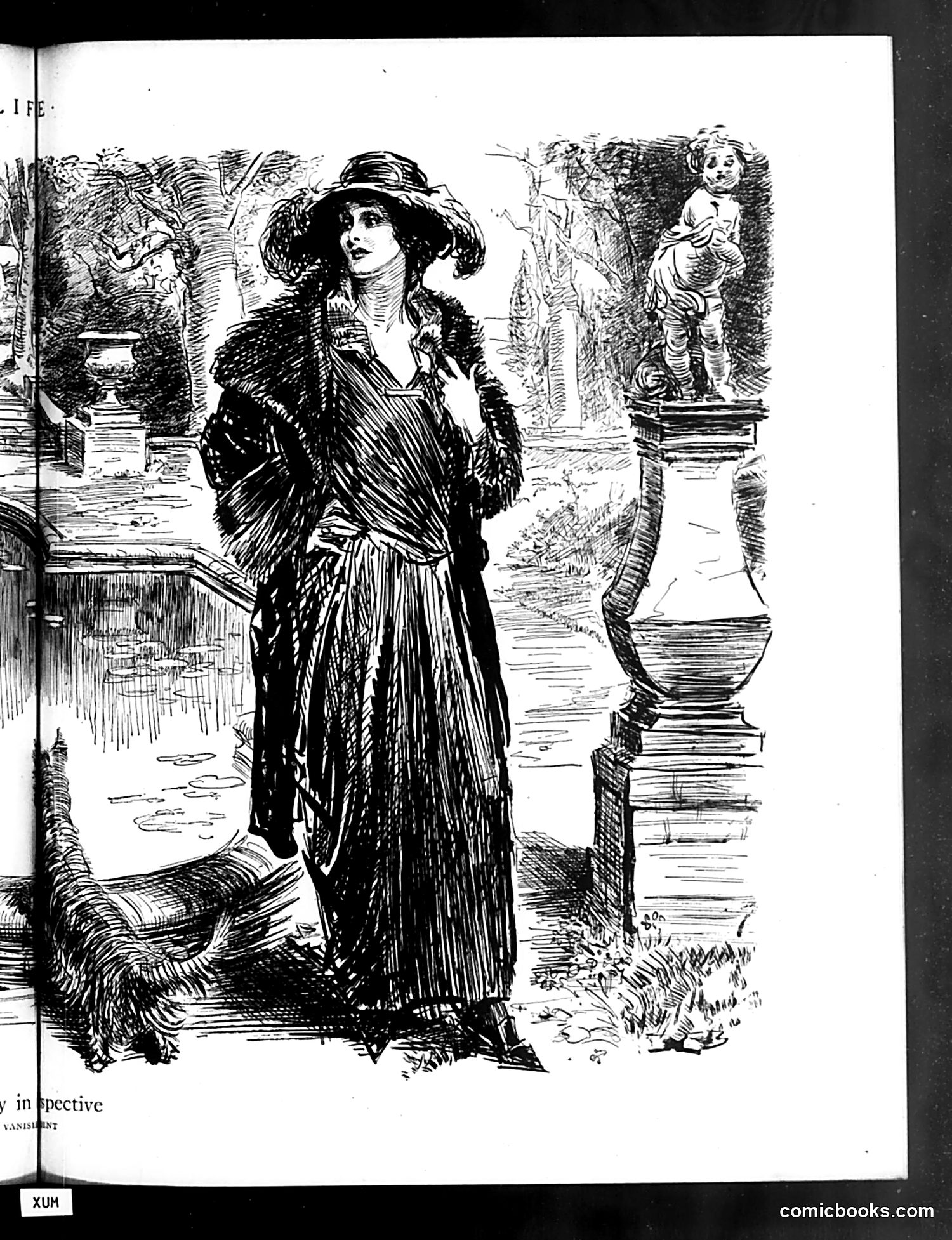
This appears to be an illustration from *Life* magazine showing a fashionably dressed woman in an elegant gown and fur stole, standing in what looks like a formal garden or estate setting. A cherub or putto statue is visible on a pedestal to her right, and other classical garden elements appear in the background. The OCR text is largely illegible, making it difficult to identify the specific satirical target or joke. The image's style and composition suggest it may be commenting on wealth, pretension, or social status—common *Life* magazine themes—but without clearer text, the precise meaning and any specific historical reference remain unclear.
This is a tongue-in-cheek endorsement piece for theatrical producer-performer George M. Cohan, written with obvious satire. The author praises Cohan's play "The Tavern," calling him "the greatest man in the world" and jokingly nominating him for President—a rhetorical device common in Life magazine's humorous criticism. The article discusses "The Tavern," which appears to be a burlesque of romantic drama that gradually devolves into absurdity (characters "throwing crockery at itself"). The author celebrates this comic deconstruction while defending cast choices (Arnold Daly, Spencer Charters) against critical complaints about age and costume inconsistencies. The satire suggests that Cohan's theatrical genius—his ability to transform earnest melodrama into hilarious farce—makes him more worthy of high office than actual politicians. This reflects the common early-20th-century practice of using "satirical candidacies" to comment on politics and culture.
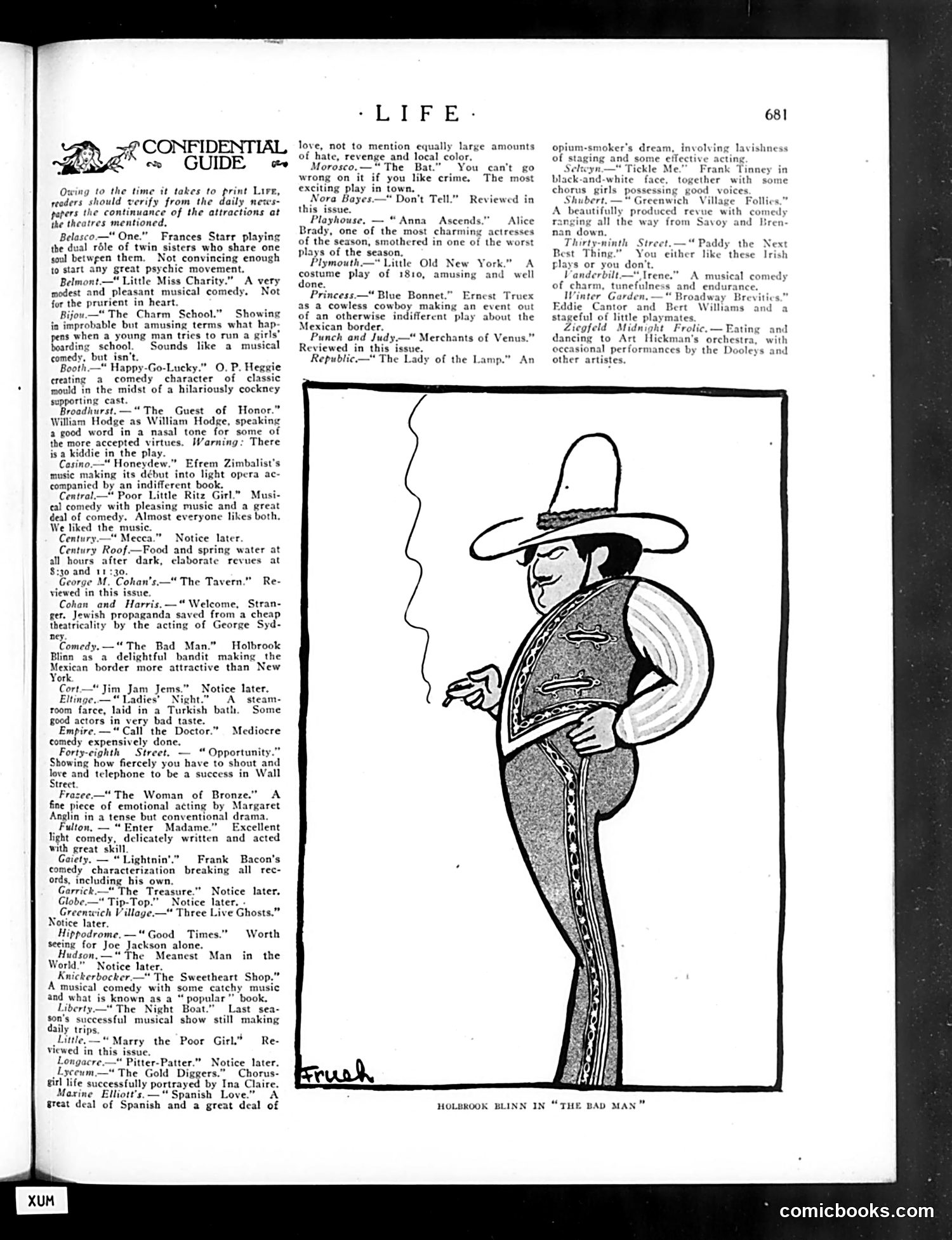
This page is primarily a **theater review guide** for New York productions, with a single illustration at bottom right. The cartoon depicts **Holbrook Blinn in "The Bad Man,"** as identified by the caption. The drawing shows a caricatured Mexican bandit character wearing an oversized sombrero and embroidered vest, depicted in exaggerated comic style typical of early 20th-century theatrical caricature. The review itself contains the satire: it praises Blinn's performance as "a delightful bandit" while sardonically noting he "mak[es] the Mexican border more attractive than New York." This is gentle social humor—the joke being that a theatrical villain is somehow more appealing than actual American urban life, and that Mexico (represented by a bandit) seems preferable to the metropolis. The broader context reflects period attitudes: Mexican characters as stock comedic/villainous types in American theater, and the casual exoticization of the Mexican border as entertainment.
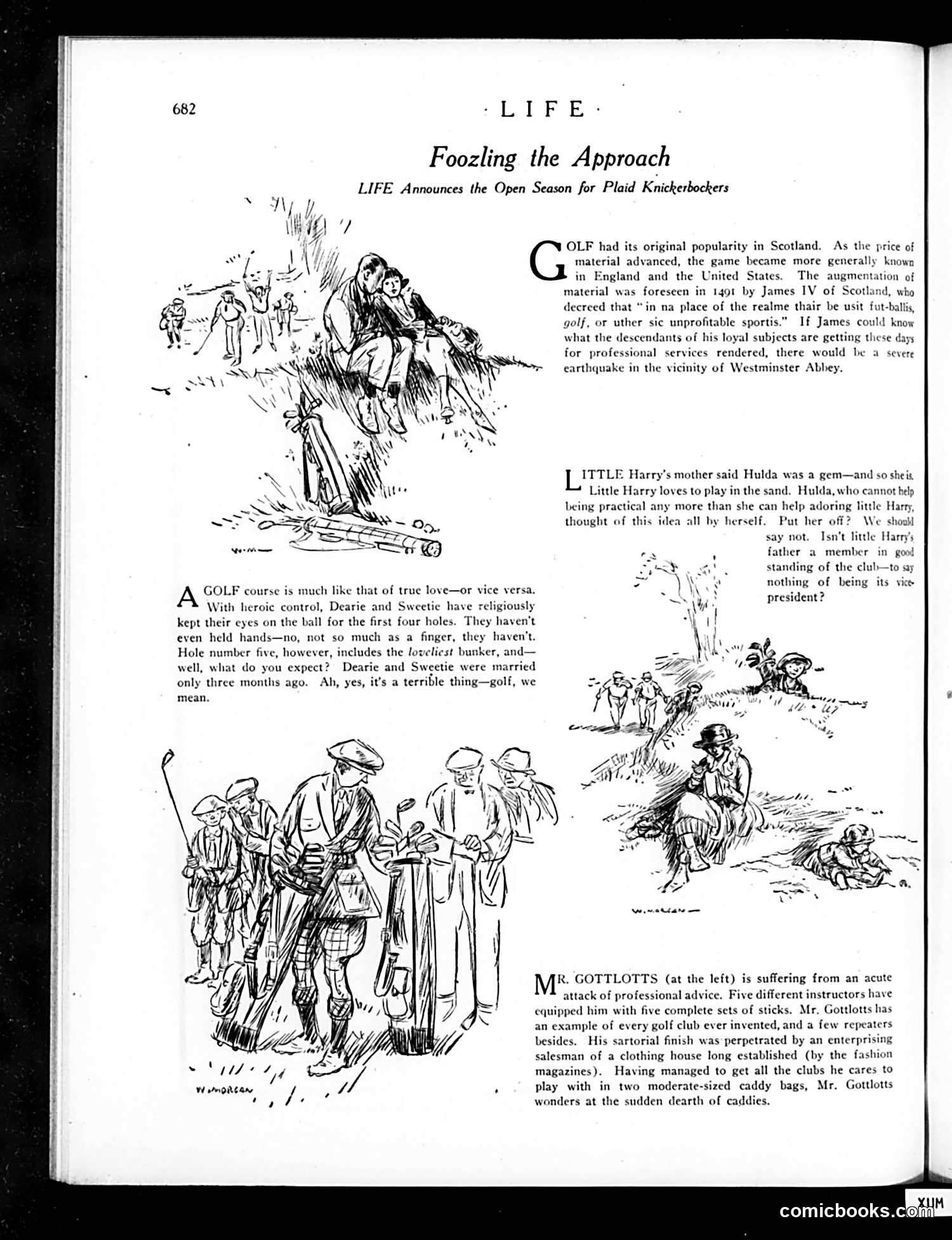
This page satirizes the early 20th-century golf craze among American and British society. The title announces "open season" for plaid knickerbockers—the distinctive golfing attire that marked one as fashionable and wealthy. The humor targets multiple aspects of golf culture: 1. **Golf as romance-killer**: The newlyweds "Dearie and Sweetie" cannot maintain proper courtship behavior on the course—they abandon restraint at the bunker, reducing romance to a golf distraction. 2. **Consumerism run amok**: Mr. Gottlotts exemplifies the absurdity of golf fashion and equipment obsession. Five instructors have sold him five complete club sets; he now owns "every golf club ever invented, and a few repeaters besides," yet ironically cannot find caddies to carry them. 3. **Class pretension**: The opening historical reference to Scottish kings mocking golf suggests the sport's transformation from leisure into status-symbol consumption. The cartoons mock golf's grip on society—as an activity that distracts from genuine human connection and enables endless commercial exploitation.
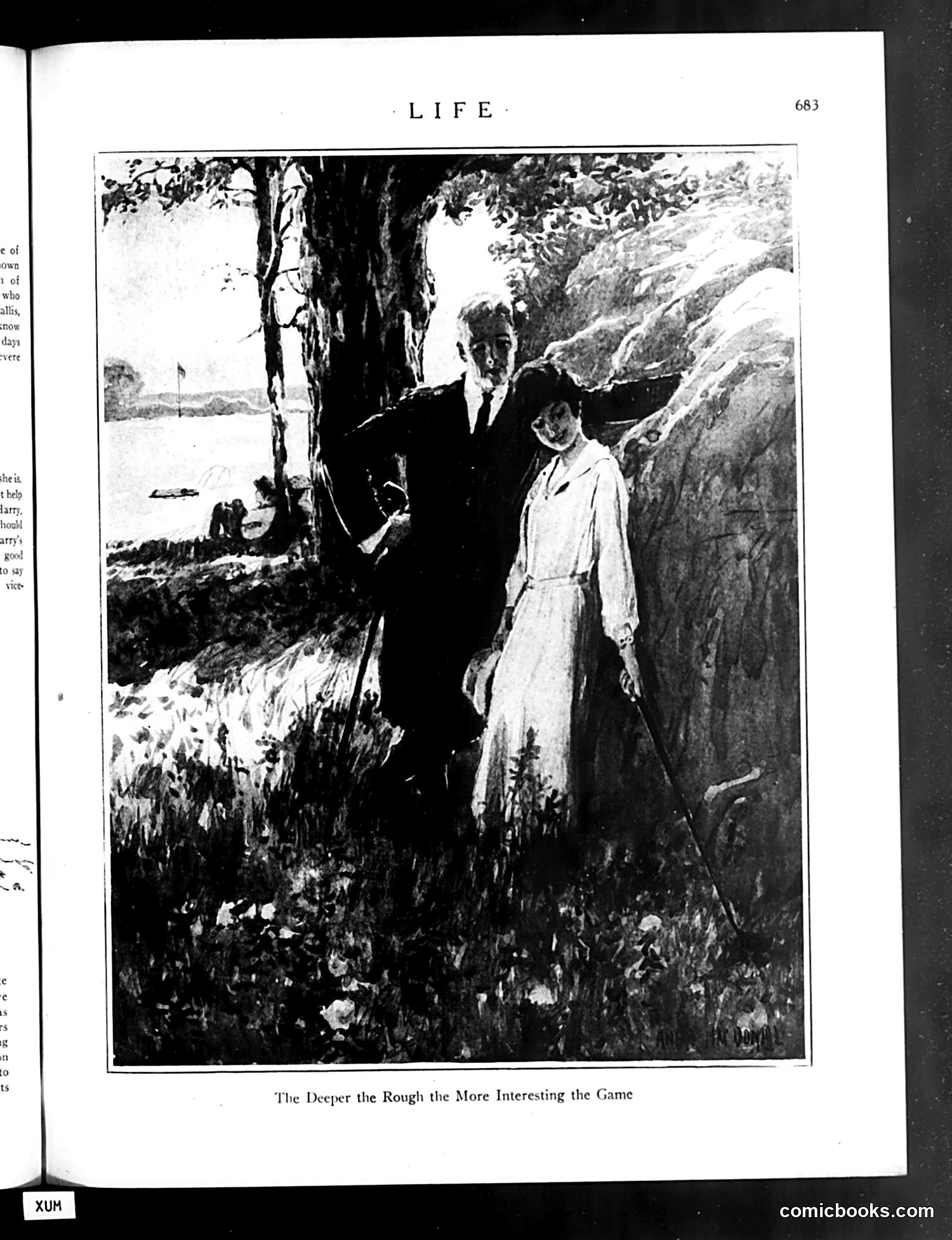
This appears to be an illustration rather than a political cartoon. The image shows two figures in early 20th-century dress examining terrain near a large tree by a waterside. The caption "The Deeper the Rough the More Interesting the Game" suggests a golfing reference—"rough" being the unmowed grass areas on a golf course that make play more challenging. The illustration likely accompanies a humorous article about golf, a popular leisure activity among the wealthy during this era. The formal dress of the figures and scenic landscape suggest this is satirizing the pretensions or earnest dedication of golf enthusiasts. Without additional context from the article text, the specific satirical point remains unclear, though it appears to mock how golfers find difficulty appealing rather than frustrating.
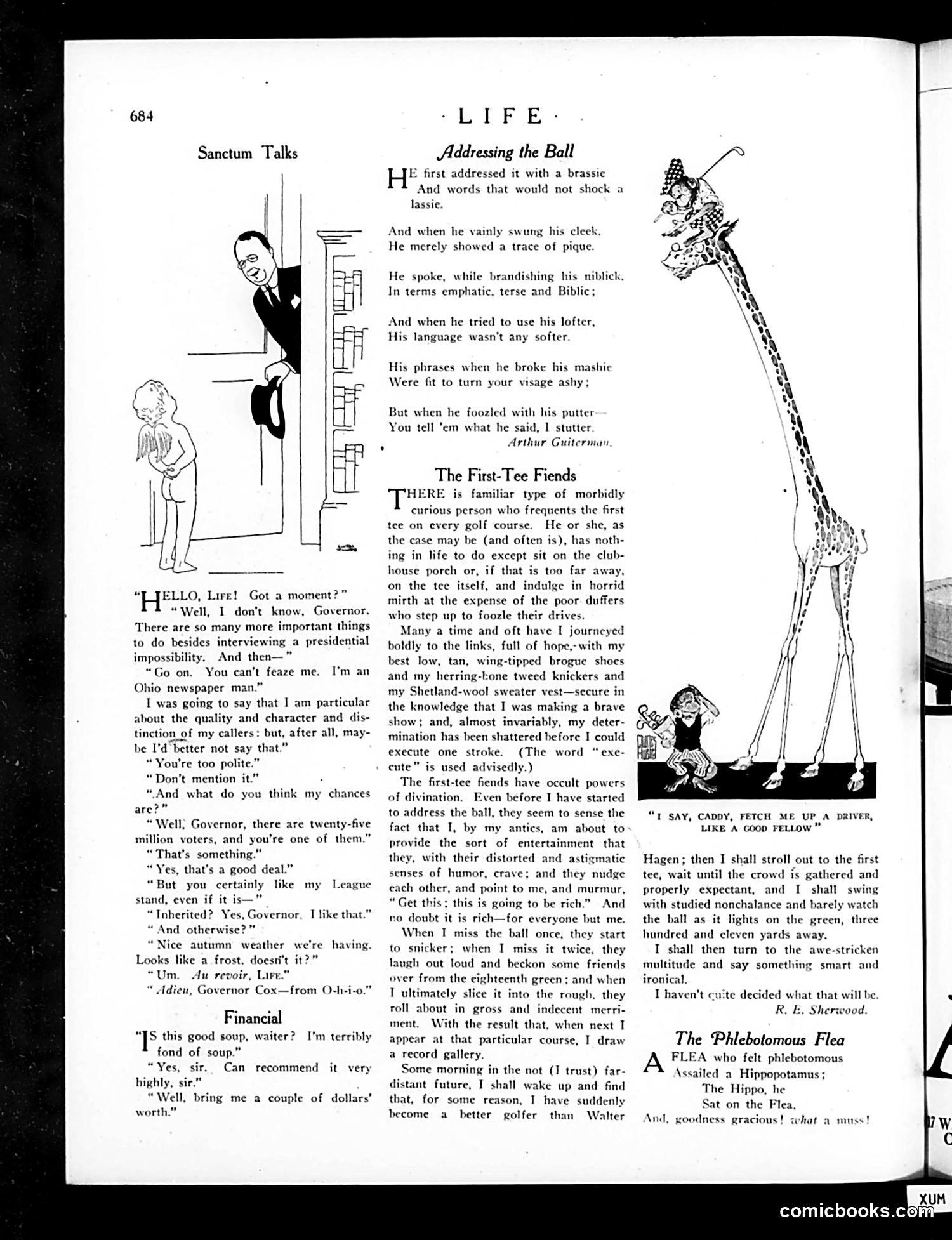
This page features a satirical interview between *Life* magazine's editor and an unnamed Ohio politician seeking the presidency. The "Governor" is identified only as an "Ohio newspaper man" and an "impossibility"—likely a contemporary political figure, though the OCR text doesn't reveal his name clearly. The satire mocks his political ambitions through deflating humor: when he asks about his chances among "twenty-five million voters," the interviewer responds he's "one of them"—implying his individual significance is negligible. The interviewer's evasions ("Inherited? Yes, Governor") suggest the politician represents hollow, inherited political standing rather than earned merit. The accompanying golf and humor pieces parody amateur golfers' social pretensions—a common *Life* theme reflecting 1920s anxieties about middle-class performance and public embarrassment.
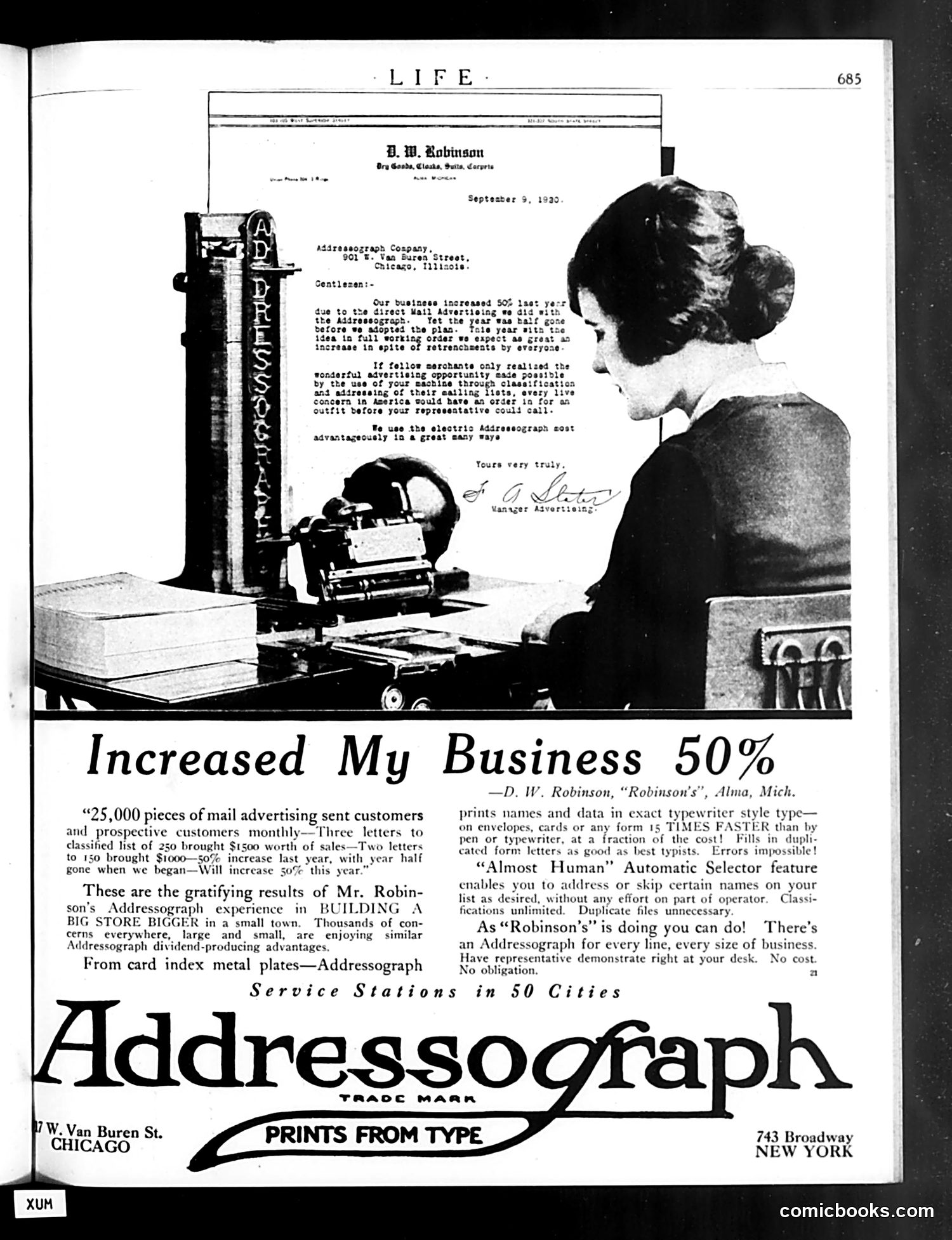
This is primarily a **product advertisement**, not a political cartoon. It promotes the Addressograph—a mechanical device for printing names and addresses on mail in typewriter style. The "satire" is implicit advertising copy: D.W. Robinson, a store owner from Alma, Michigan, testifies that direct mail advertising using the Addressograph increased his business 50% in one year. The device's key selling points are efficiency (prints faster and cheaper than manual typing) and the "Almost Human" automatic selector feature (allowing operators to address or skip specific names without manual effort). The image shows a woman operating the machine while reviewing Robinson's testimonial letter. For modern readers, this represents early **mass marketing technology**—the predecessor to contemporary bulk mail and digital mailing lists. The 1920 date places this at the dawn of sophisticated direct-mail advertising as a business practice. The "joke" is that a small-town merchant could compete with larger businesses through smarter advertising technology—a genuine business advantage of the era.
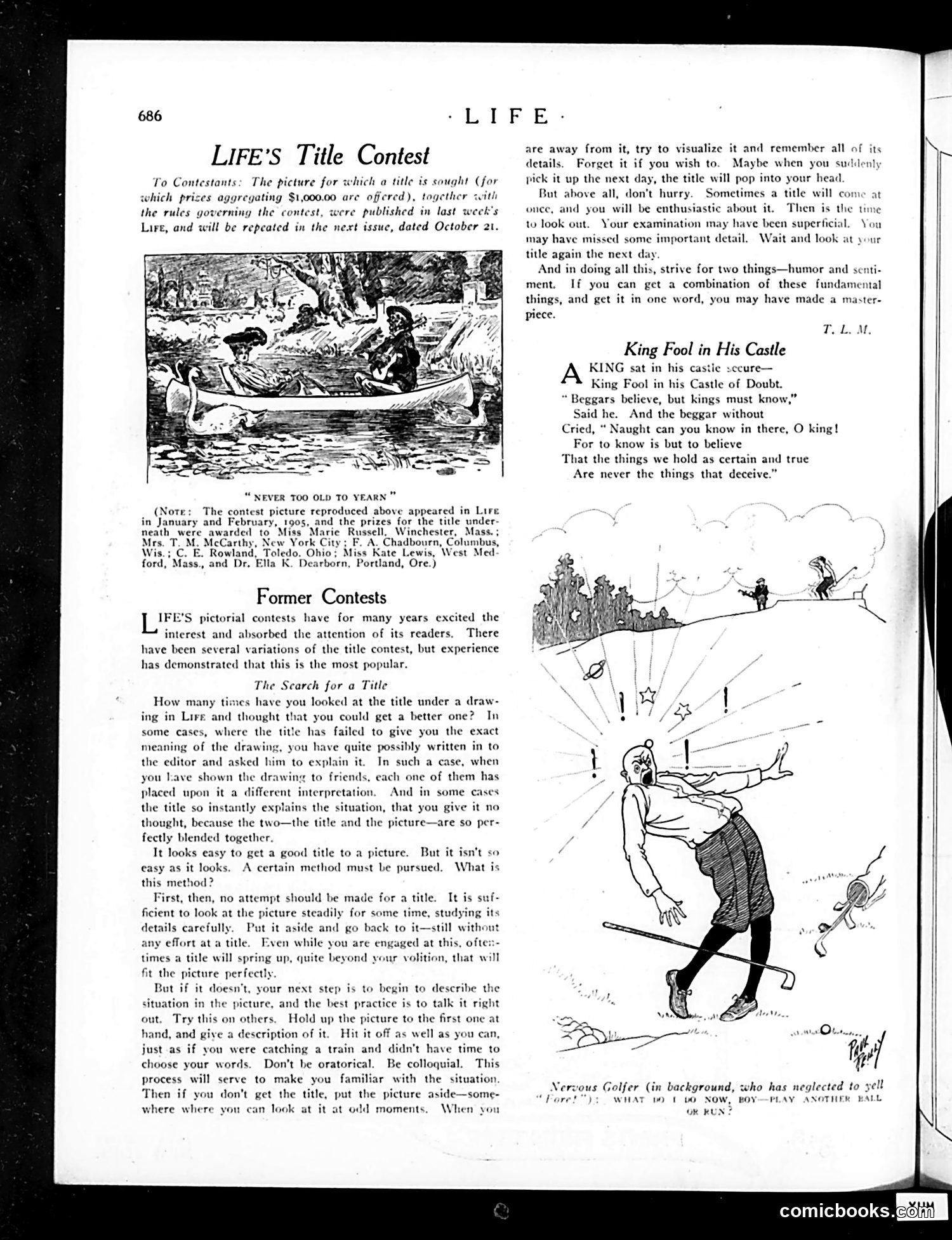
This page showcases Life magazine's long-running "Title Contest," inviting readers to submit witty captions for published illustrations, with prizes totaling $1,000. The main cartoon depicts a nervous golfer who has apparently hit a ball wildly off-course into a wooded area, while another golfer in the background (who neglected to yell "Fore!" as safety protocol requires) faces potential danger. The humor lies in the collision between proper golf etiquette and the actual chaos unfolding. The poem "King Fool in His Castle" presents a philosophical dialogue between a king isolated in his "Castle of Doubt" and a beggar outside, debating whether certainty and knowledge are truly knowable—a commentary on the limits of authority and wisdom. The page also provides detailed guidance to contest participants on how to develop strong titles through careful observation, discussion, and combining humor with sentiment.
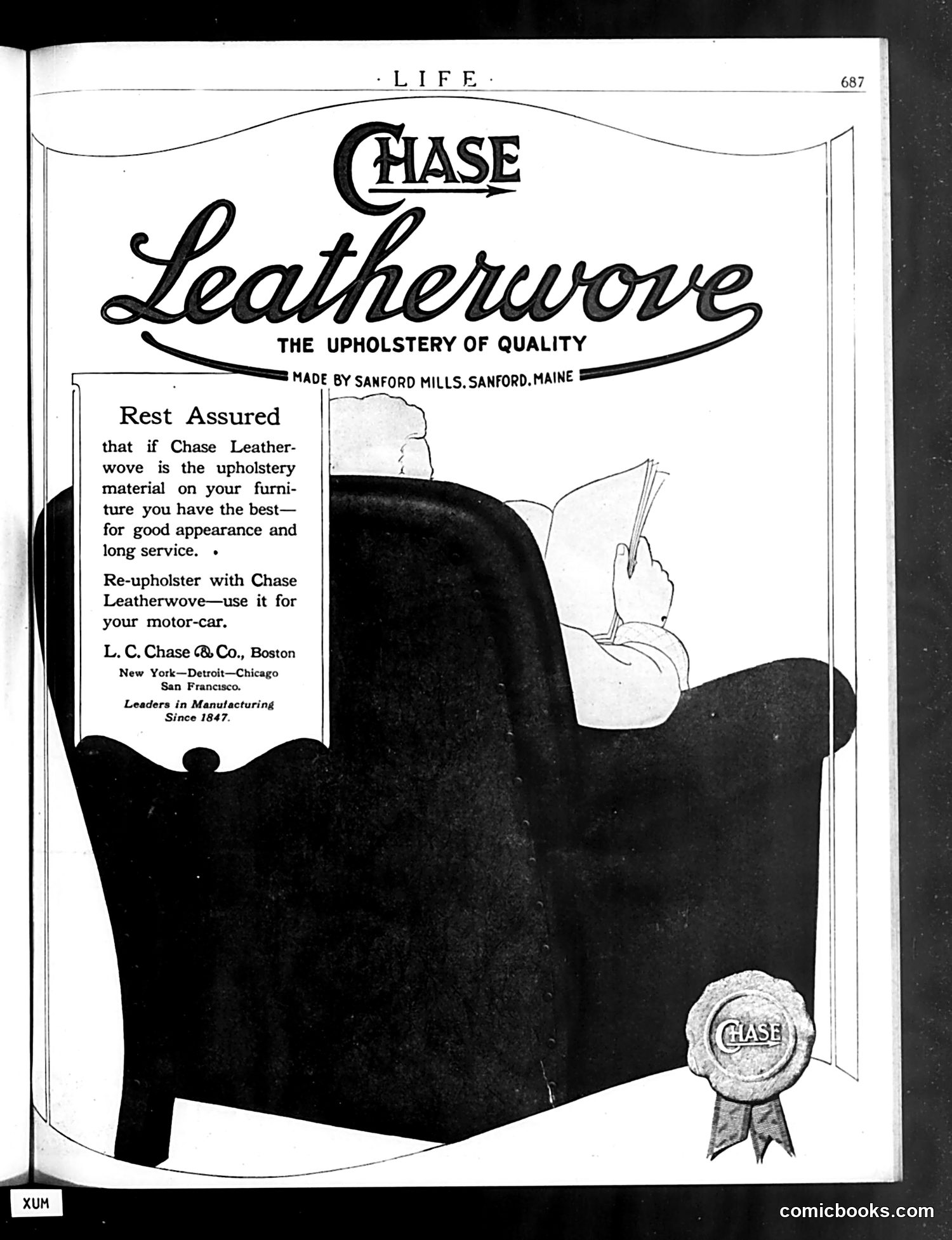
This is a **full-page advertisement**, not satire or political commentary. It promotes Chase Leatherwove, an upholstery material manufactured by L.C. Chase & Co. (established 1847), with locations in major American cities. The ad features an illustration of a person reclining in a black upholstered chair, emphasizing the product's comfort and quality. The messaging targets furniture owners and early automobile buyers, promoting Leatherwove for both home furnishings and motor-car upholstery—reflecting the era's emerging car culture. The decorative ribbon seal at bottom reinforces brand prestige. This represents typical early-20th-century *Life* magazine advertising that blended commerce with lifestyle aspirations.
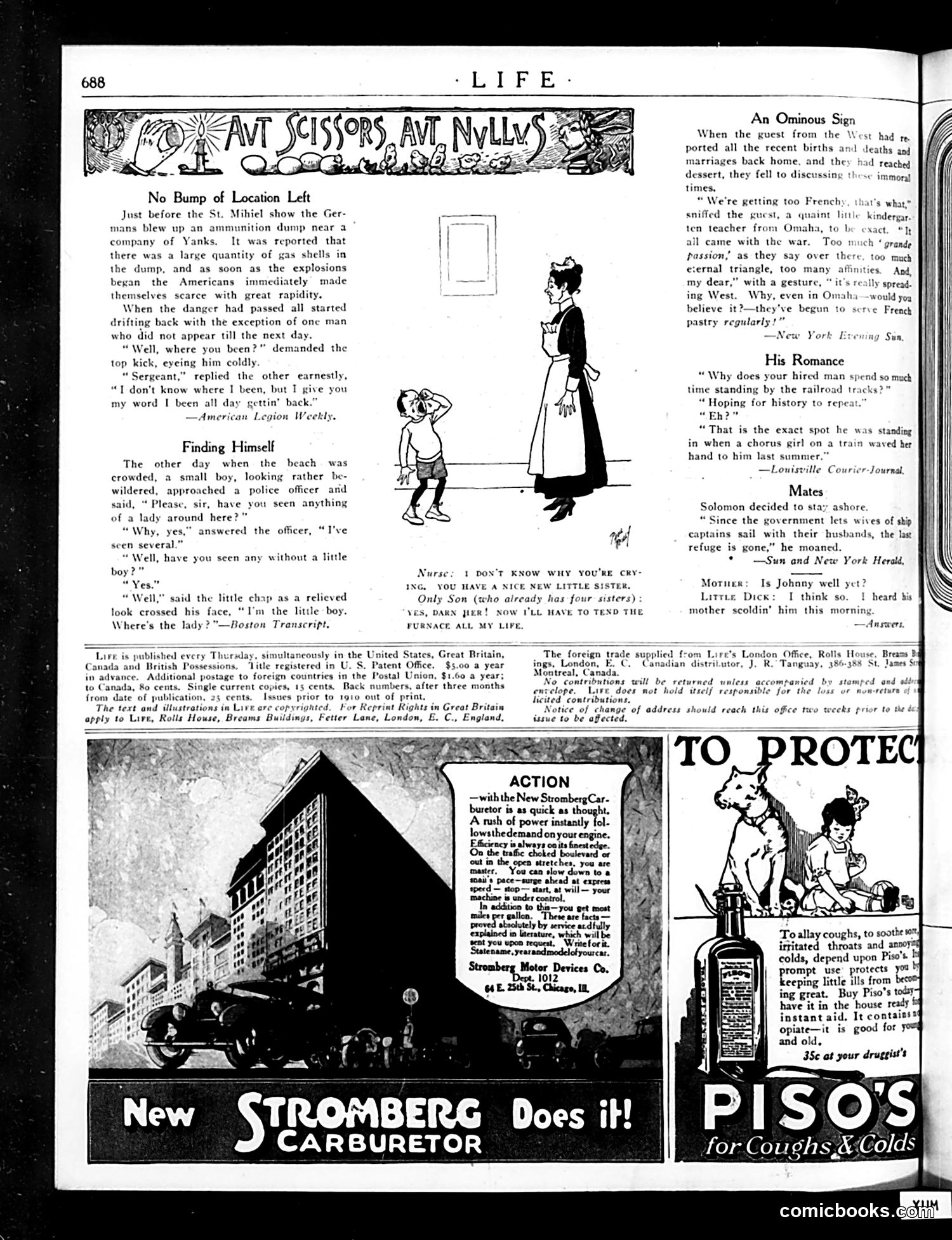
This page from *Life* magazine contains several short humorous anecdotes and two advertisements. **The humor pieces** are brief jokes typical of early-20th-century American magazines: - A WWI anecdote about a soldier who took an entire day to retreat from a German ammunition dump - A child's logic joke about finding his lost mother - A complaint from an only son upset about gaining four sisters (now responsible for household chores) - Social commentary on post-WWI "French" influences (jazz, loose morality, French pastries) entering small-town America - A hired man's romantic nostalgia for a chorus girl he once saw from a train **The advertisements** promote: - The Stromberg carburetor for automobiles - Piso's cough medicine for children The page reflects post-WWI American attitudes: innocent nostalgia, small-town social conservatism, and wartime references. The humor is gentle, domestic, and family-oriented—typical of *Life*'s satirical but genteel approach.
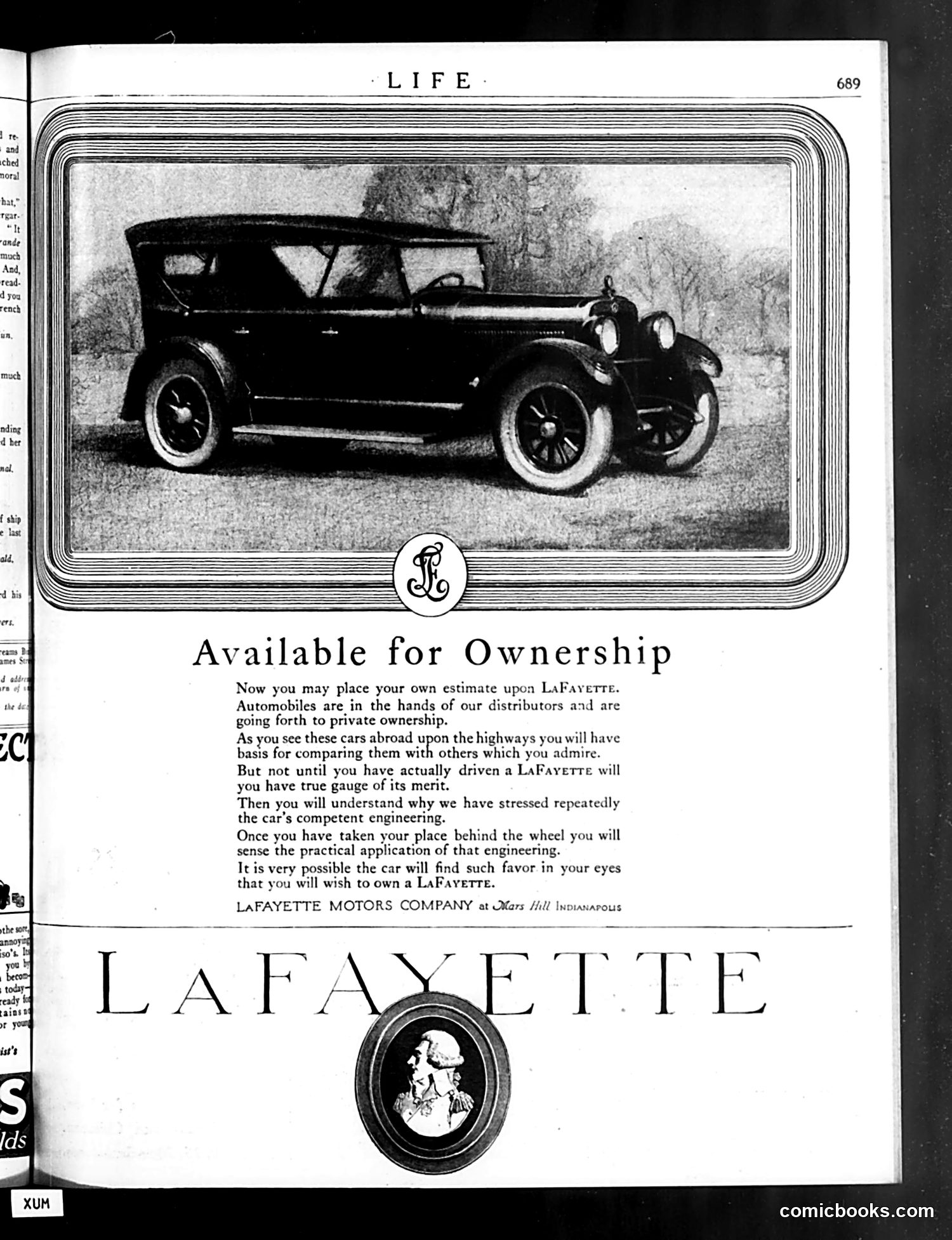
This is **not satire or a cartoon**—it's a straightforward advertisement for Lafayette automobiles from the 1920s era. The page features: - A photograph of a Lafayette motor car (an open-air touring vehicle typical of the period) - Marketing copy encouraging potential buyers to test-drive and evaluate the car themselves - A company logo and the Lafayette Motors Company name, located in Mars Hill, Indianapolis The advertisement appeals to consumer confidence by inviting direct comparison with competitor vehicles and emphasizing the car's "competent engineering." The portrait at the bottom appears to be Lafayette's namesake, the Marquis de Lafayette, lending historical prestige to the brand name. This represents standard automotive advertising from the early automobile industry, before Lafayette Motors ceased operations in the 1930s.
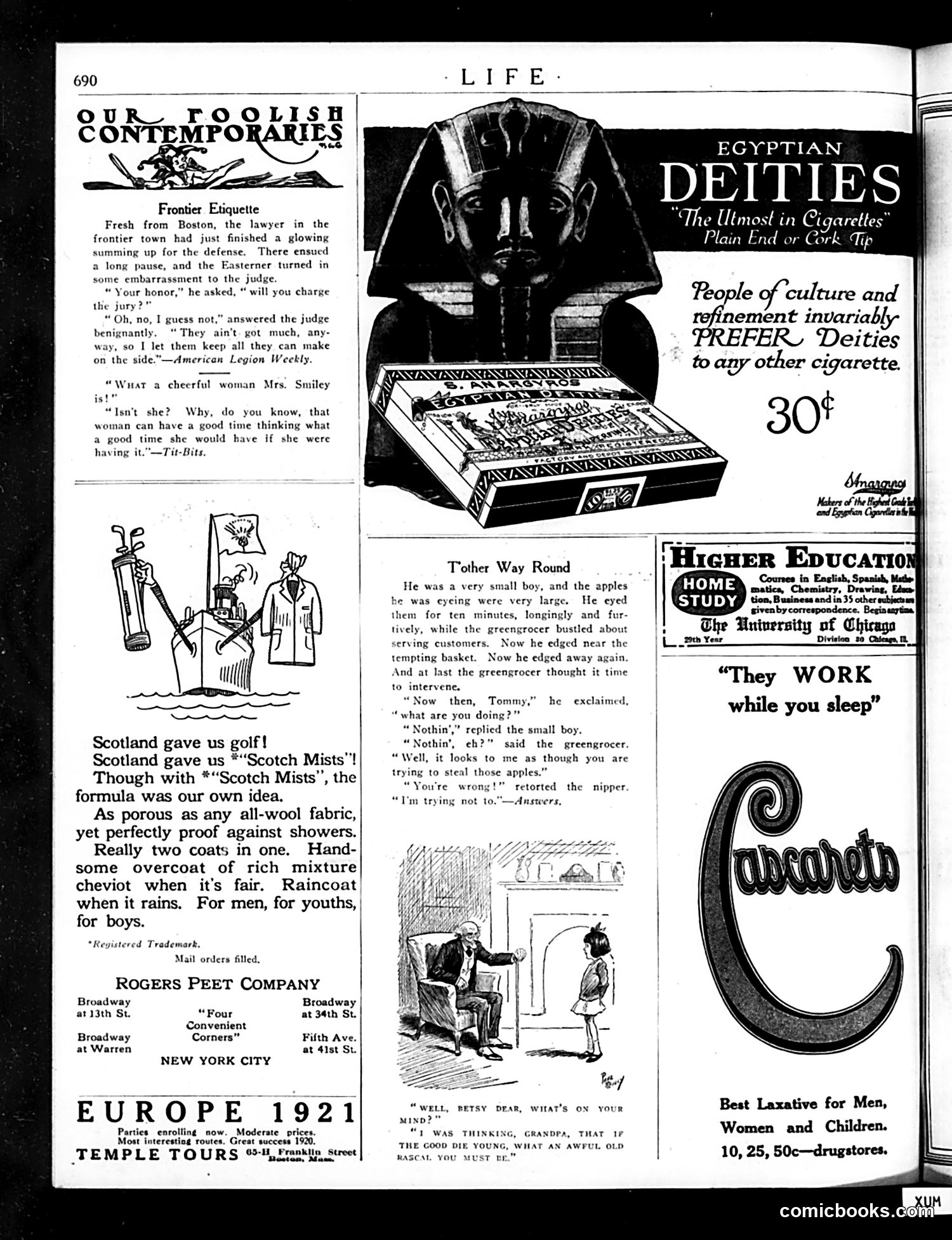
This page from *Life* magazine contains several satirical humor pieces typical of the publication: **"Frontier Etiquette"** mocks the contrast between Eastern legal formality and Western frontier lawlessness—a Boston lawyer's shock at a judge who allows jurors to keep bribes ("make on the side") rather than charge them. **"Tother Way Round"** presents a child's logic: a grocer accuses a boy of stealing apples, but the boy clarifies he's "trying not to" steal them—reversing the grocer's assumption through innocent wordplay. The page also includes advertisements (Egyptian Deities cigarettes, University of Chicago correspondence courses, Caborath laxative) and promotional copy for Rogers Peet clothing and Temple Tours travel service. The humor relies on period-specific expectations about law, propriety, and childhood innocence—concepts modern readers would need historical context to fully appreciate.
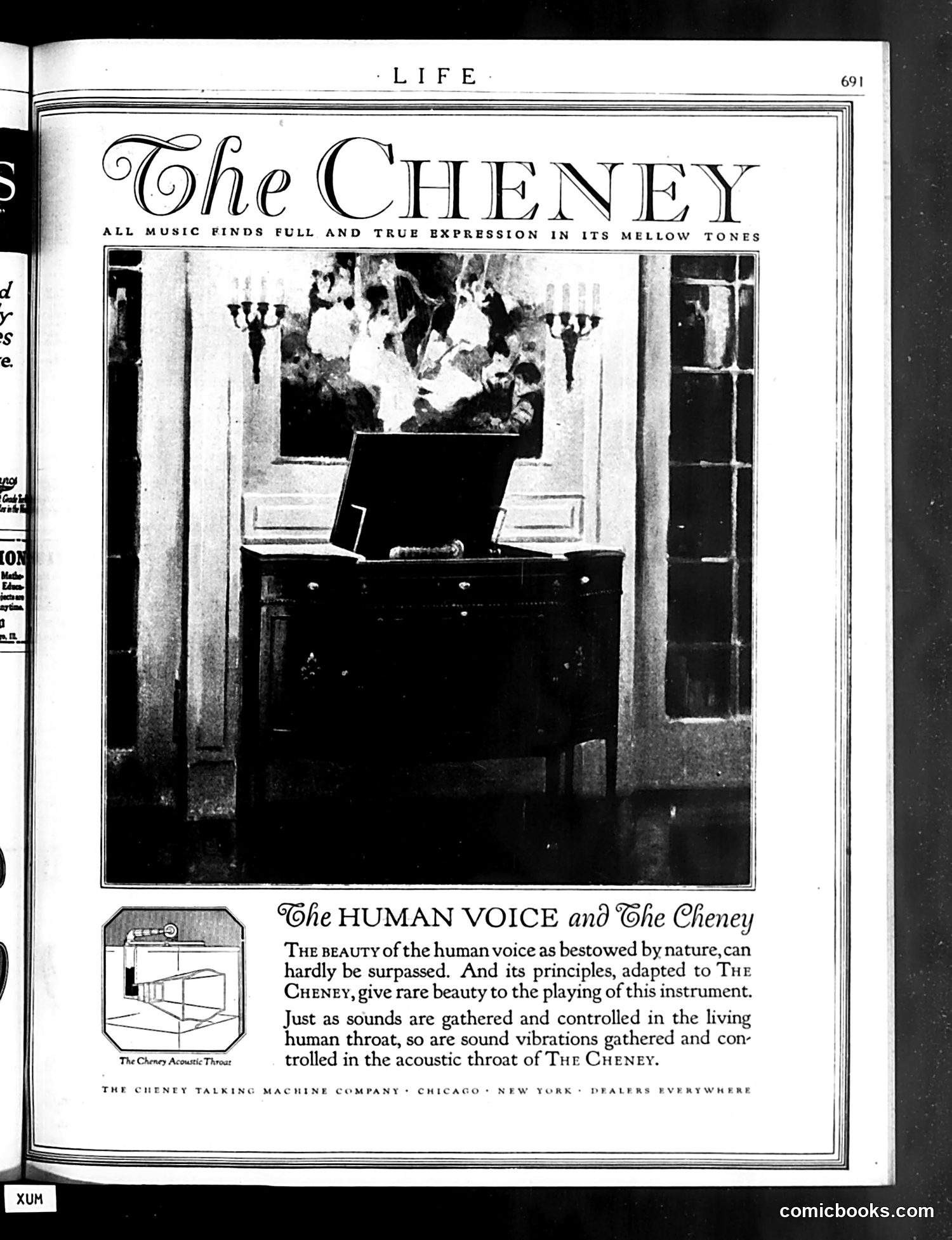
This is a **product advertisement**, not satire or political content. It promotes "The Cheney," an early talking machine (phonograph), manufactured by the Cheney Talking Machine Company based in Chicago and New York. The ad uses an analogy comparing the instrument's sound quality to the human voice. The image shows an elegant phonograph in a formal parlor setting with a portrait visible above it. The text claims that just as the human throat naturally produces beautiful sound, The Cheney's "acoustic throat" similarly gathers and controls vibrations to reproduce music with comparable warmth and authenticity. This reflects early 20th-century marketing strategy: positioning mechanical sound reproduction as rivaling live human performance—a key selling point when phonographs competed against live entertainment and other brands.
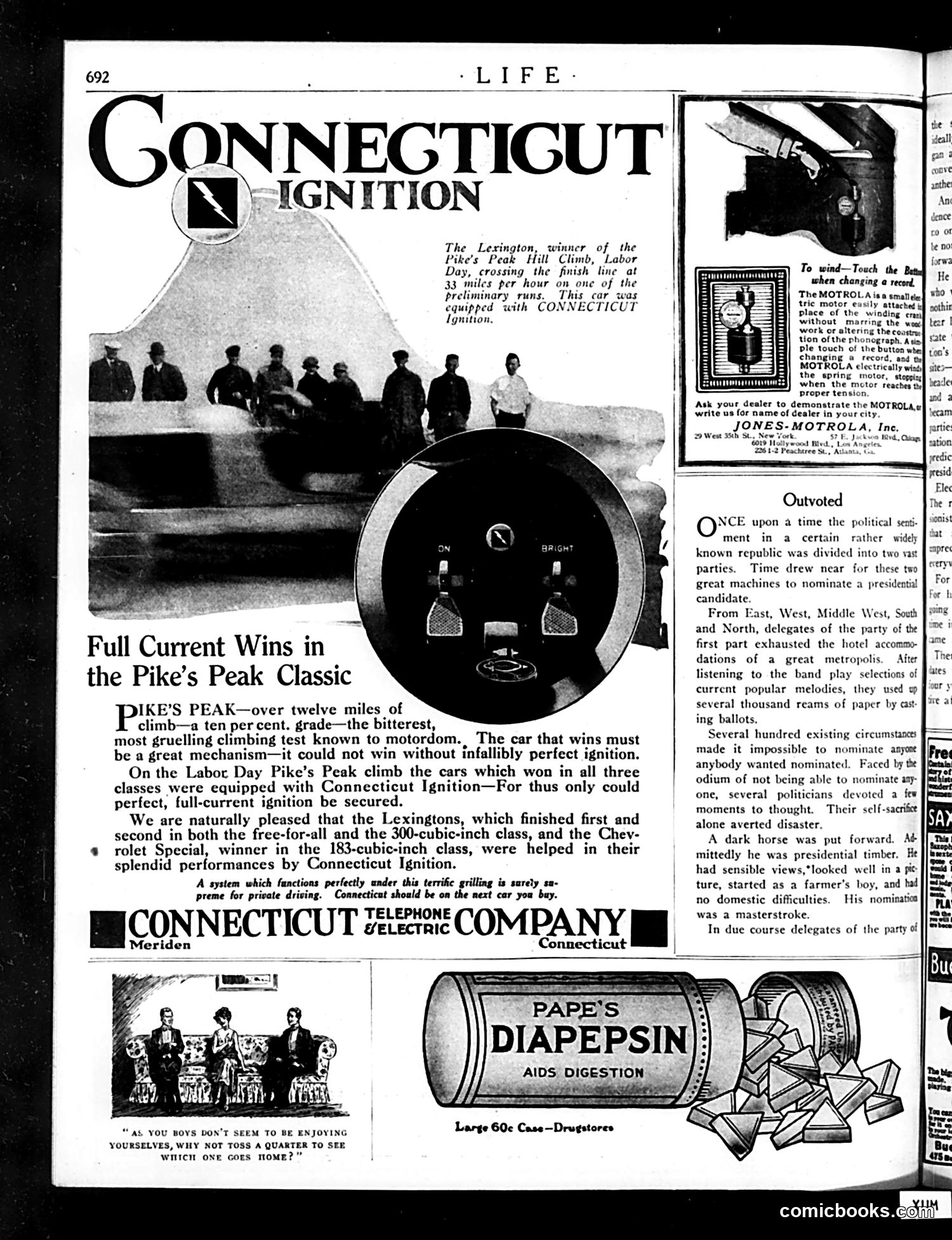
This page consists primarily of **automobile and product advertisements**, not political satire. The main feature is a Connecticut Ignition Company ad celebrating the Lexington car's victory in the Pike's Peak Hill Climb race, emphasizing that perfect ignition systems were essential for winning such grueling competitions. The brief text segment labeled "Outvoted" appears to be satirical **political commentary** about a presidential nominating convention. It describes how delegates from different regions gathered to nominate a candidate, but "several hundred existing circumstances" made nomination impossible. The narrative then introduces a "dark horse" candidate—a former farmer with "sensible views" and "no domestic difficulties"—as a humorous solution. However, **the specific politicians or election being referenced are unclear** from this excerpt alone and would require additional historical context to identify. The remaining content includes product advertisements for Motola phonographs and Pape's Diapepsin digestive aid, typical of 1920s-era Life magazine pages mixing editorial content with commercial promotions.
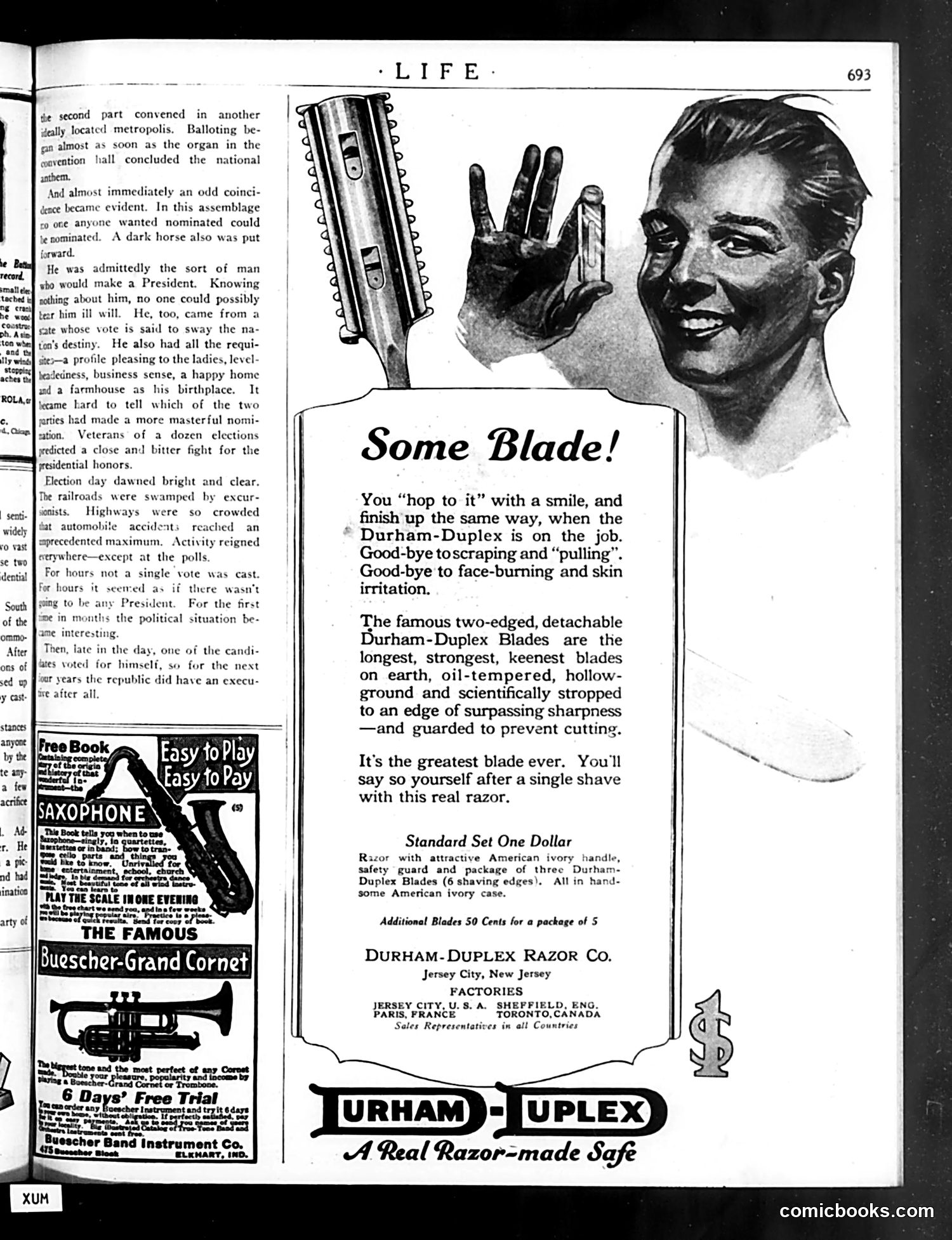
This page contains a political cartoon satirizing the 1920 presidential election process. The narrative describes two major-party conventions nominating candidates—both equally unqualified "dark horses" chosen solely for their appealing appearance, business sense, and farmhouse backgrounds, with no actual distinguishing qualities. The satire's punchline: on Election Day, voter turnout is so abysmal that for hours *no one votes at all*. Only when one candidate votes for himself does the nation finally have a president-elect. **The joke:** The cartoon mocks American electoral apathy and the superficiality of candidate selection—suggesting voters are so disengaged and the candidates so indistinguishable that democracy nearly grinds to a halt. The remainder of the page is dominated by a Durham-Duplex Razor advertisement featuring a smiling man holding the product, unrelated to the political content.
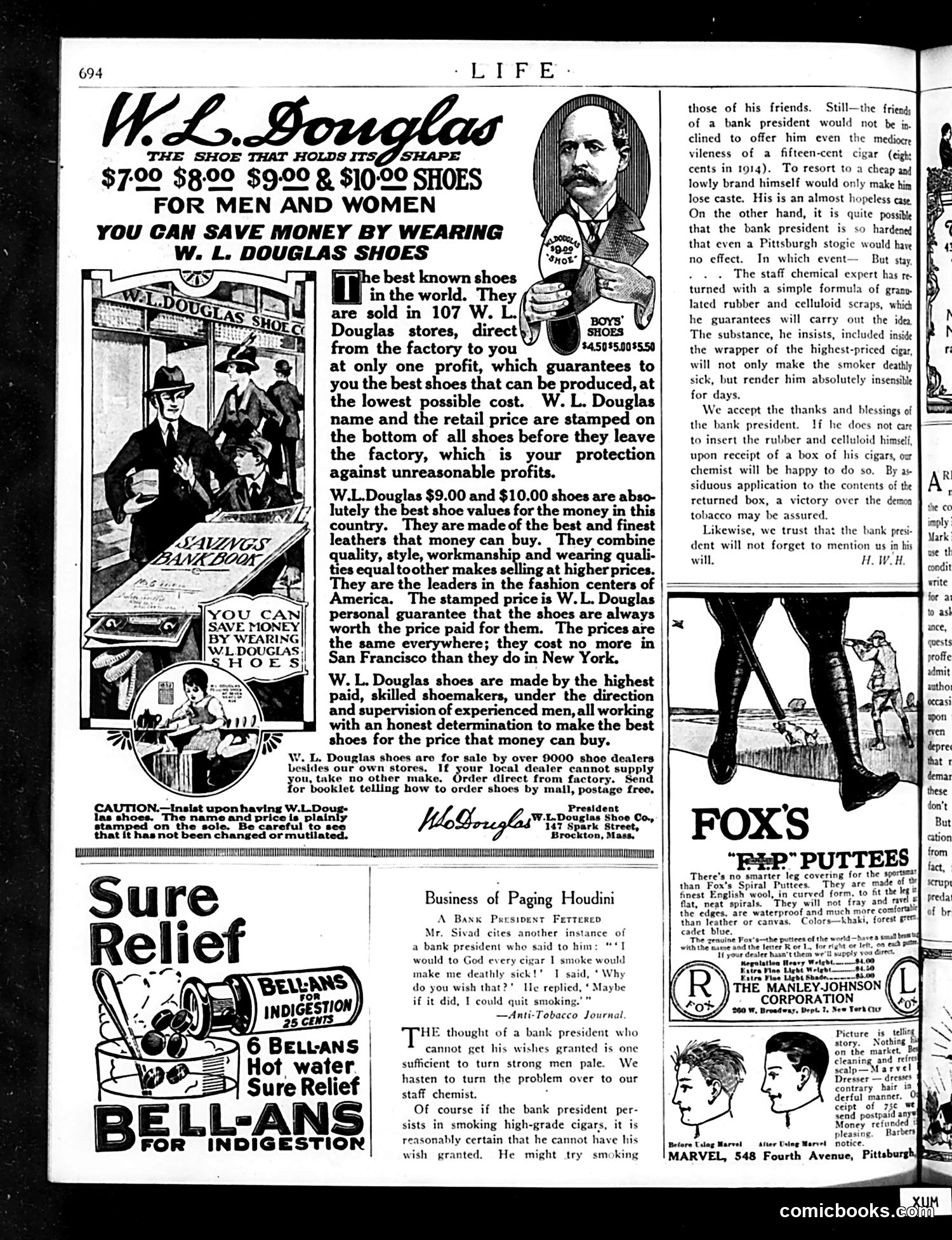
This page is primarily **advertising** (W.L. Douglas shoes, Bell-Ans antacid, Fox's puttees, and hair products), but includes one satirical piece: "Business of Paging Houdini." The **cartoon joke** concerns a bank president who complains that cigars make him sick, wishing they were deadly so he'd quit smoking. A chemist offers to insert rubber and celluloid into his cigars to make him "absolutely insensible for days"—a darkly comic "solution" to his problem. The satire targets: - **Smoking culture**: Anti-tobacco sentiment was growing in 1914 - **Social hypocrisy**: The president won't quit despite suffering, and friends won't offer him cheaper cigars because it would damage his social status - **Class anxiety**: Smoking expensive cigars is a marker of respectability he can't abandon without "losing caste" The reference to **Houdini** (famous escape artist) in the title suggests the bank president is trapped—unable to escape his own habits or social expectations.
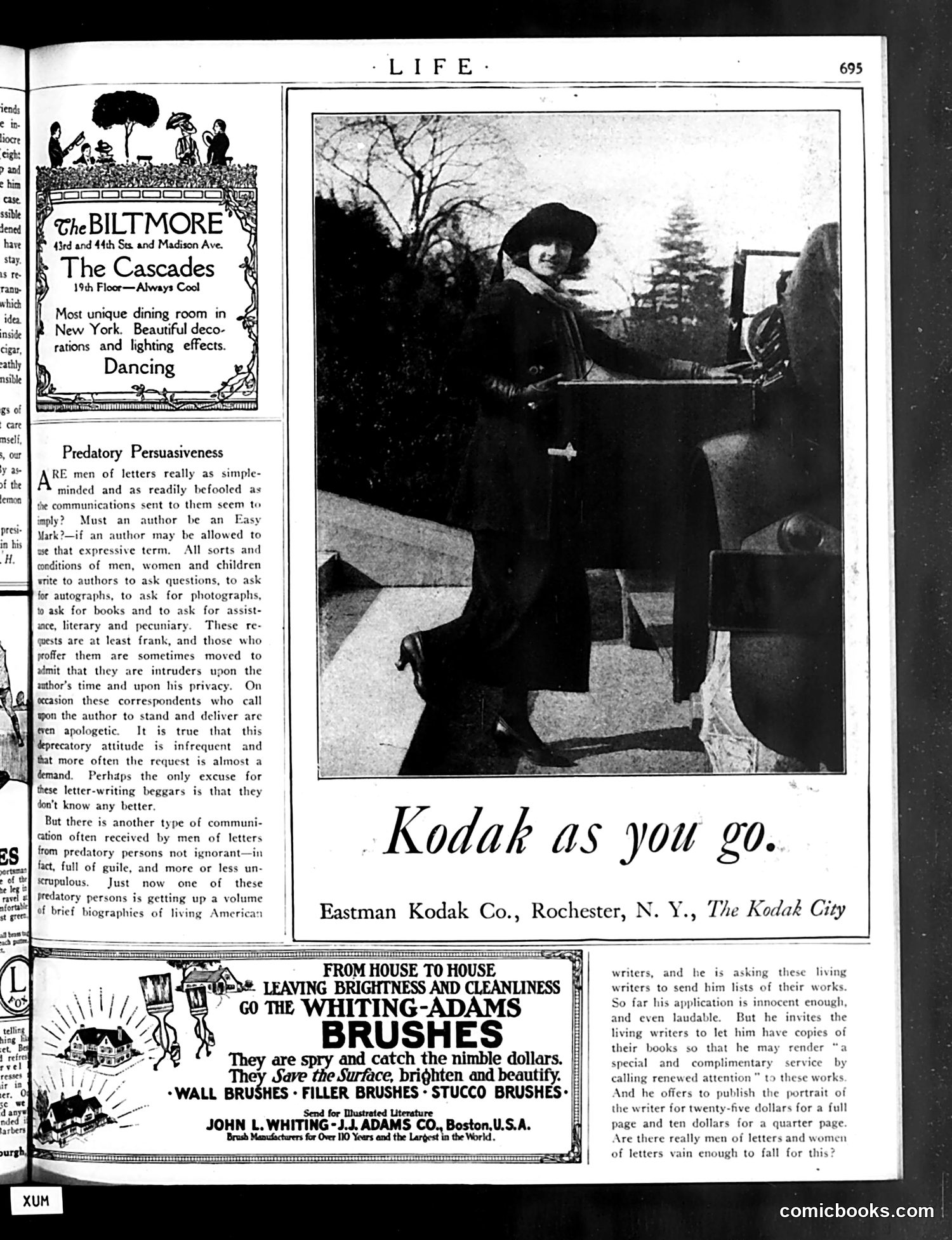
This page is primarily **advertising and editorial content** rather than political satire. The main advertisement features **Kodak cameras** with the slogan "Kodak as you go"—promoting portable photography for everyday leisure activities. The photograph shows a woman using a camera outdoors, reflecting early 20th-century marketing of cameras as consumer goods for the general public. Below is an advertisement for **Whiting-Adams brushes**, emphasizing their quality and durability for household cleaning tasks. The left column contains an editorial piece titled "Predatory Persuasiveness," which critiques authors who make excessive demands on their correspondents—asking for autographs, photographs, and assistance—treating letter-writers as intruders on their privacy. This reflects period concerns about fan mail culture and author accessibility.
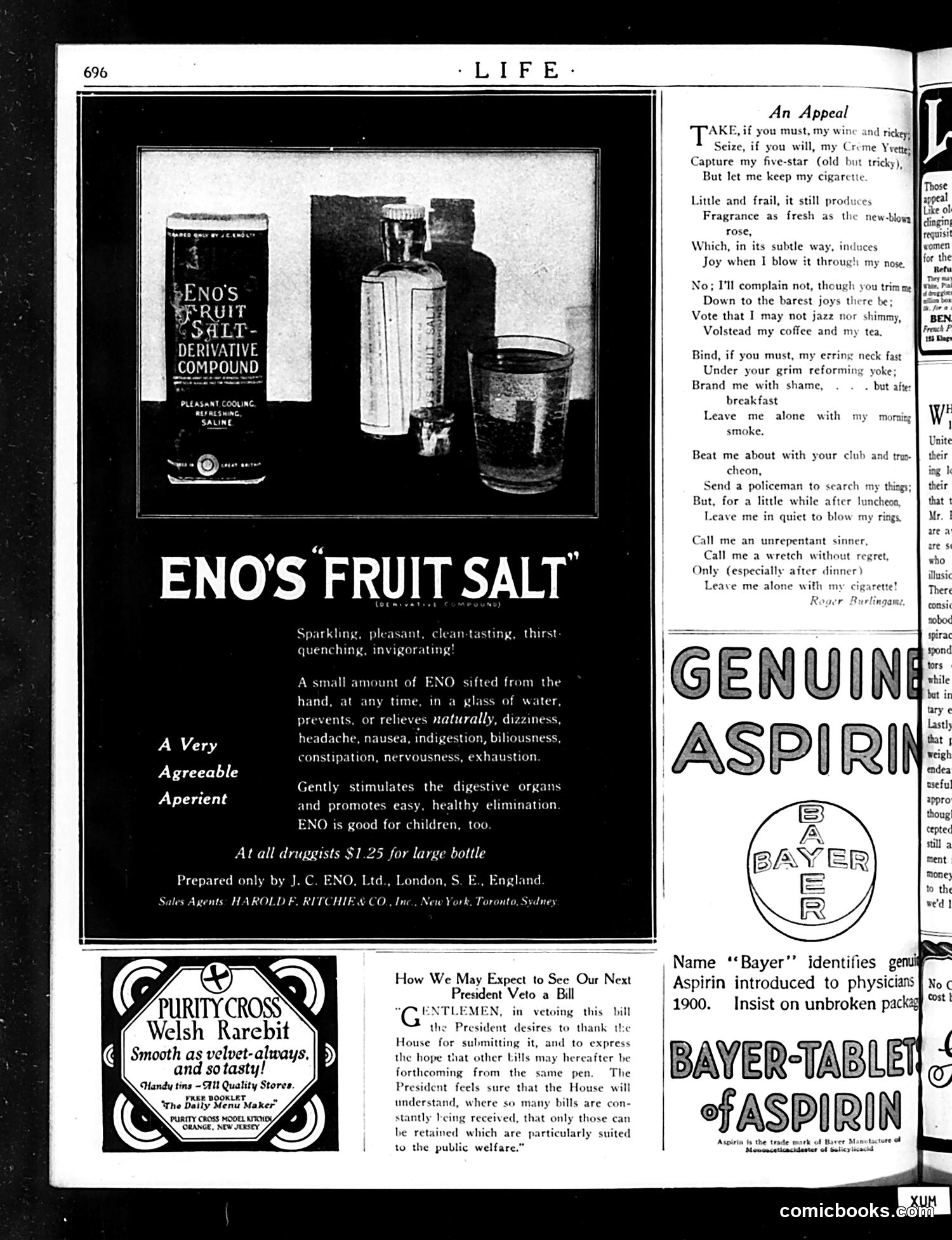
This page is primarily **advertising**, not editorial content or political cartoon. The dominant advertisement is **Eno's Fruit Salt**, a British digestive remedy sold as a cure-all for indigestion, headache, and constipation. The accompanying poem "An Appeal" is tongue-in-cheek copy positioning the product as the one indulgence a person should keep amid various restrictions—likely referencing **Prohibition** (the ban on alcohol, mentioned explicitly) and other social reforms of the early 1920s. The poem's speaker surrenders wine, expensive art, and personal freedom but pleads to keep cigarettes and morning coffee, framing Eno's as the digestive solution for such temptations. Secondary advertisements include **Purity Cross Welsh Rarebit** (a packaged food) and **Bayer Aspirin**, noting the trademark was "introduced to physicians in 1900." The small editorial item about a presidential veto is incidental filler, not satire. **This is a commercial page with no significant political cartoon content.**
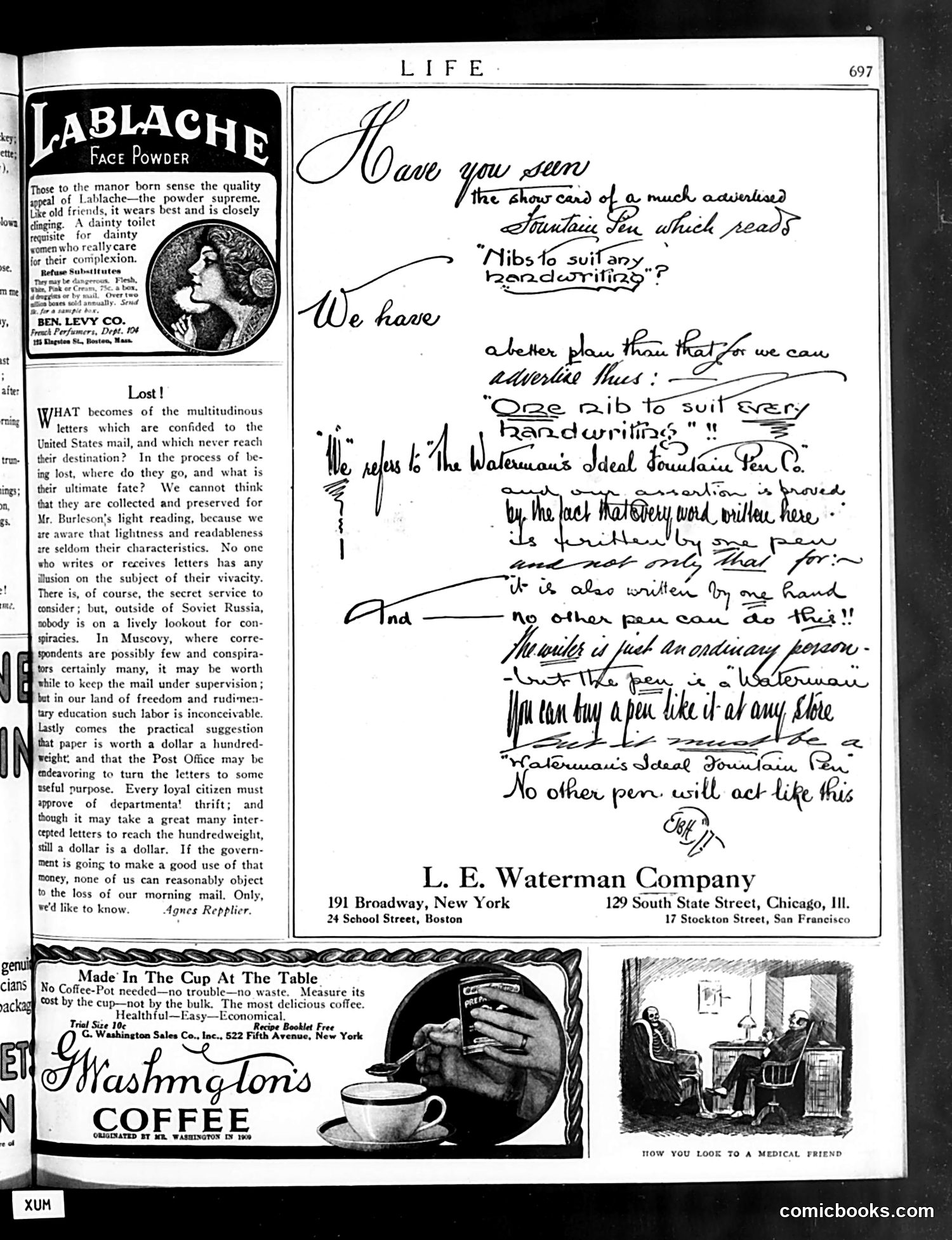
This page contains advertisements and a satirical essay by Agnes Repplier about missing mail during the Wilson administration. **The Main Content:** Repplier humorously speculates where lost letters go. She suggests three possibilities: the Secret Service (implying government surveillance), Soviet-style mail inspection conspiracies, or—most likely—that the Post Office is collecting paper scraps for their weight value (worth "$1 a hundredweight") to fund departmental operations. **The Political Context:** The essay references **Postmaster General Albert Burleson**, Wilson's appointee known for censoring mail during WWI. Repplier's gentle satire mocks government inefficiency and hints at mail surveillance under the guise of patriotism, a real concern during wartime censorship. **The Advertisements:** Include Lablache face powder, L.E. Waterman fountain pens (with promotional handwriting), Washington's Coffee, and a small cartoon about visiting doctors—typical period advertisements with no particular satirical content. The page reflects early-20th-century anxieties about government overreach during wartime.
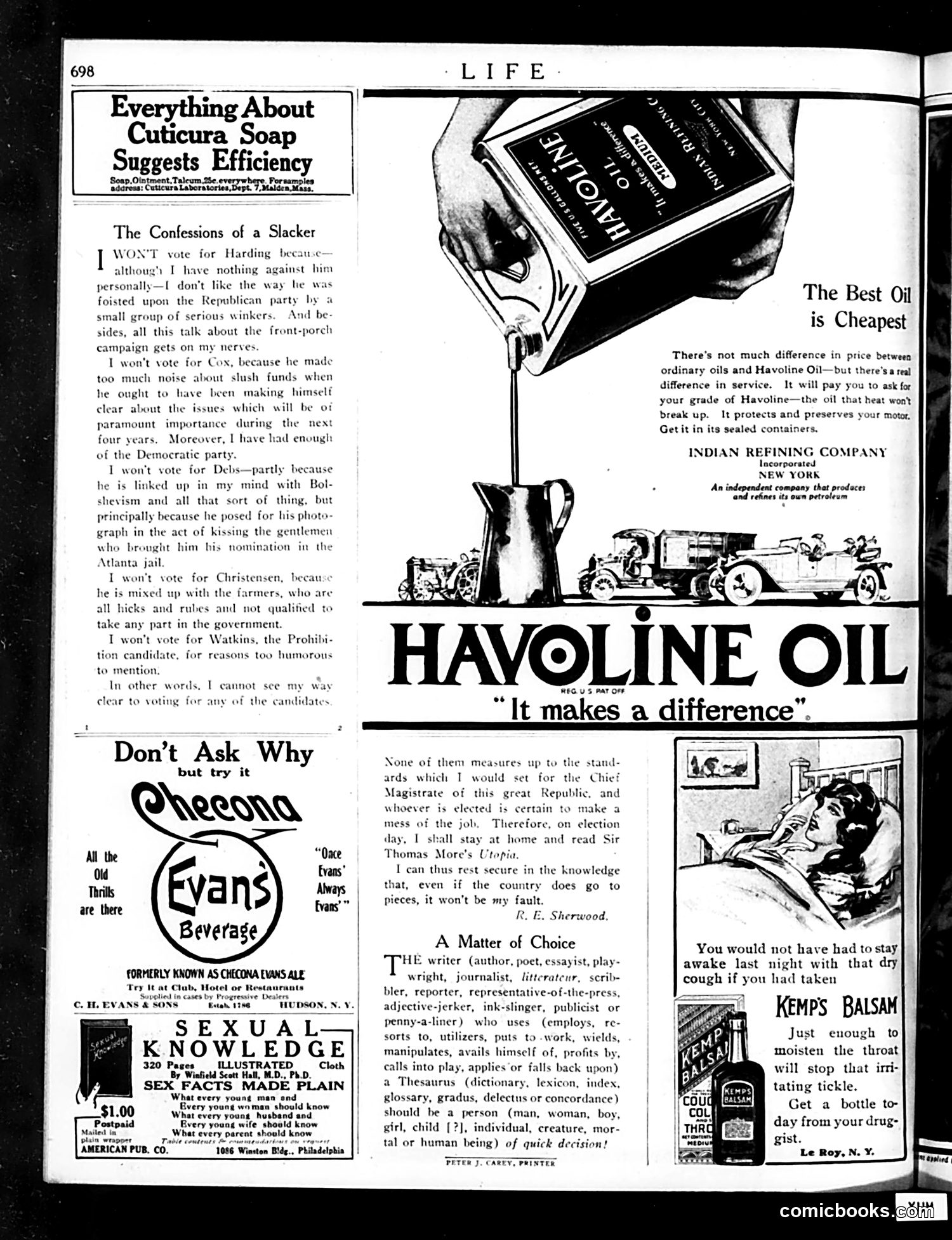
This 1920 page satirizes the 1920 U.S. presidential election through "The Confessions of a Slacker," where a voter dismisses all four major candidates: - **Harding** (Republican front-runner): rejected for being "foisted upon" the party by backroom dealers - **Cox** (Democrat): dismissed for discussing slush funds rather than substantive issues - **Debs** (Socialist): rejected for association with Bolshevism and a jail-cell photograph - **Christensen** (Farmer-Labor): scorned for representing farmers deemed unqualified for government The slacker's conclusion—that no candidate meets his standards, so he'll stay home reading Thomas More's *Utopia*—is the satire's point: perfectionist idealism used as justification for political disengagement. The author (R.E. Sherwood) mocks this attitude by showing how such reasoning produces voter apathy regardless of consequence. The remaining content is advertisements (Cuticura Soap, Havoline Oil, Kemp's Balsam, Chicora Evans Beverage, and a sexual knowledge book).
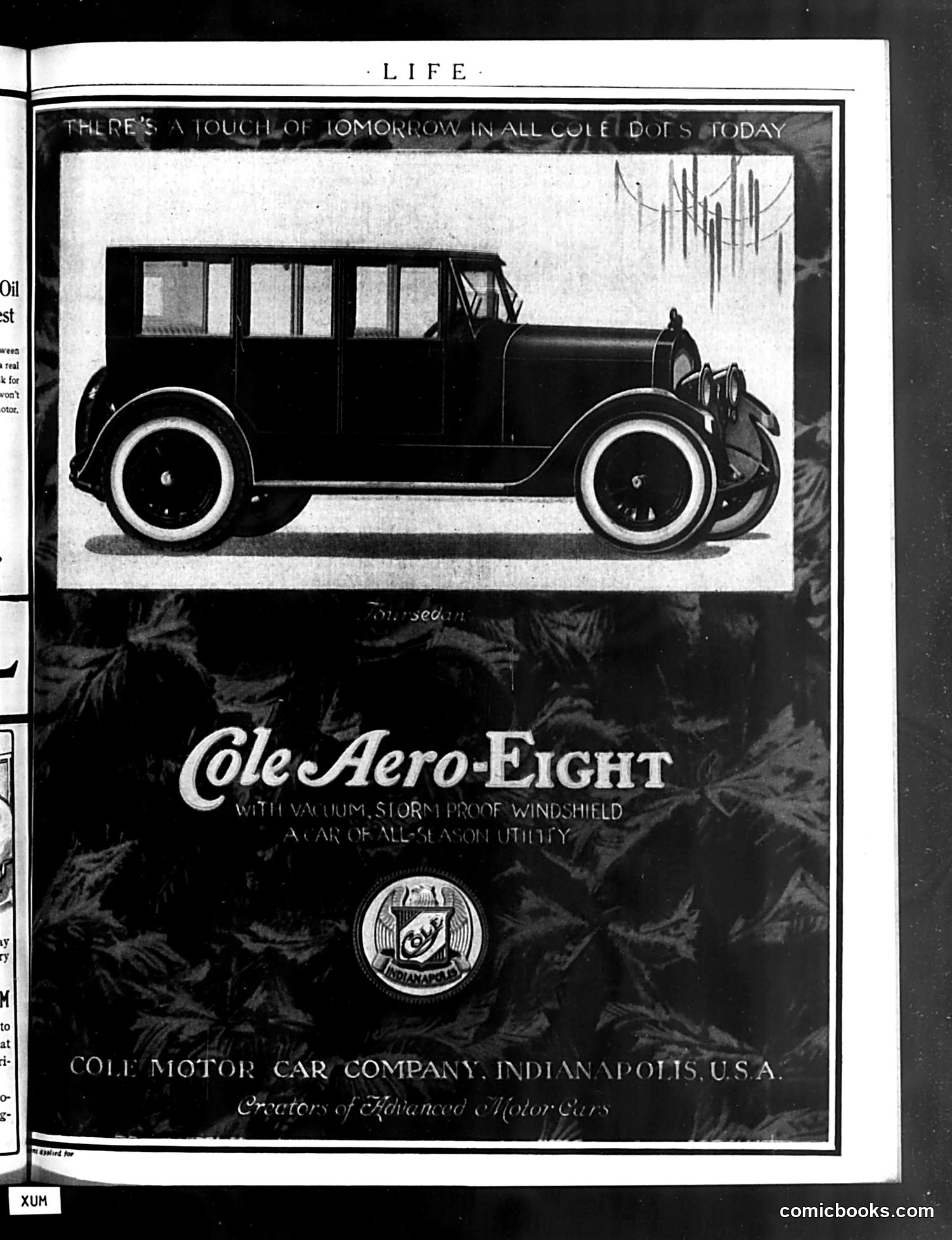
This is primarily an advertisement rather than political satire. It promotes the Cole Aero-Eight automobile, manufactured by Cole Motor Car Company in Indianapolis. The ad emphasizes modern features: "a touch of tomorrow in all Cole's today," highlighting the car's vacuum stormproof windshield and "all-season utility." The sleek side-view illustration showcases the vehicle's contemporary design. The tagline "Creators of Balanced Motor Cars" suggests Cole positioned itself as a quality manufacturer. This represents early automotive advertising in *Life* magazine, targeting affluent readers interested in cutting-edge technology and luxury vehicles—typical of 1920s American consumer culture promoting automobiles as progressive, desirable products.
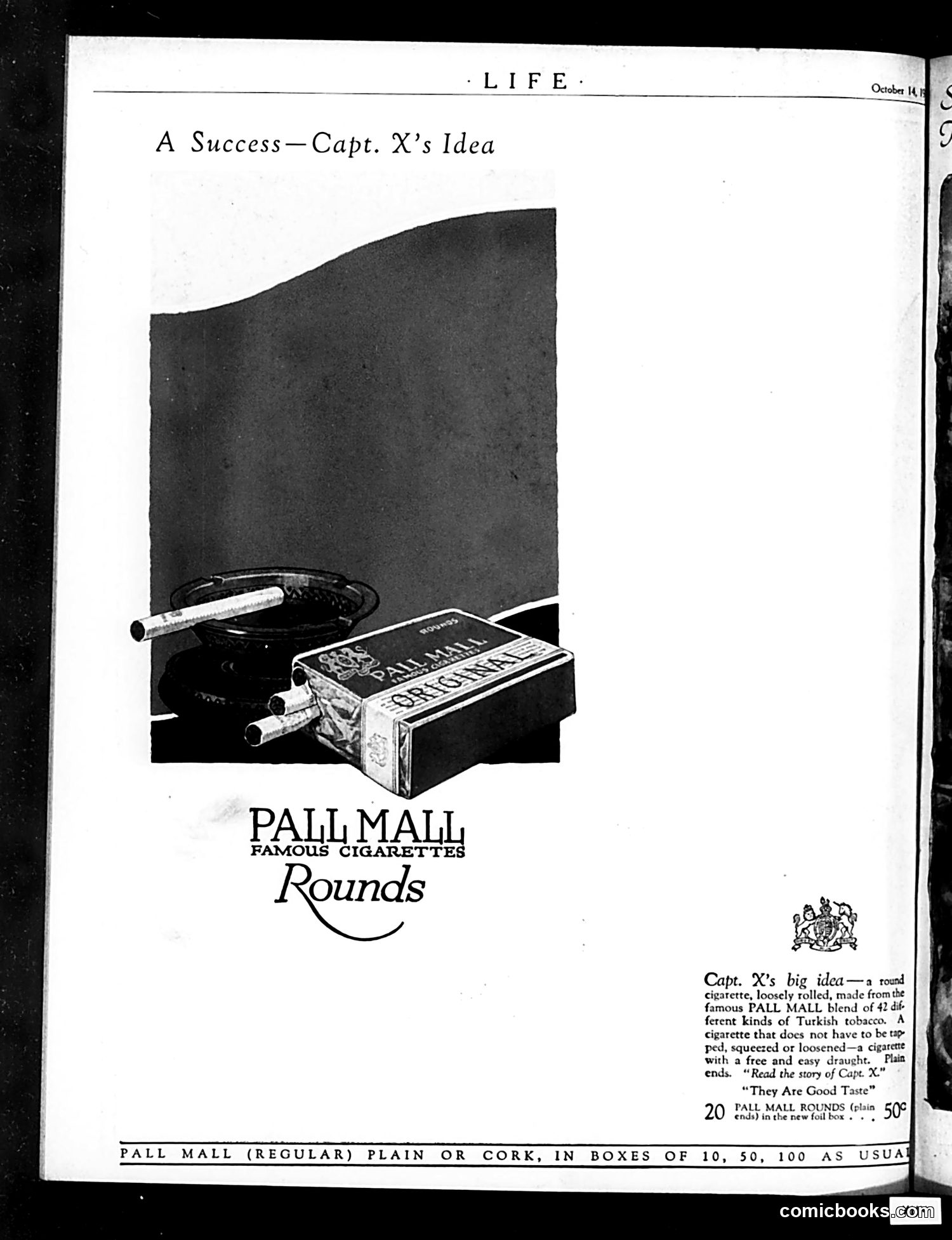
This is primarily a **cigarette advertisement**, not a political cartoon. It appears in *Life* magazine (October 14, date unclear) and promotes Pall Mall's "Rounds" cigarettes. The ad features a fictional "Capt. X" who supposedly invented a round, loosely-rolled cigarette made from Turkish tobacco blends. The marketing angle emphasizes convenience—it doesn't require tapping, squeezing, or loosening like traditional cigarettes, offering instead an easy draw. The imagery shows the product alongside an ashtray and matches. The tagline "They Are Good Taste" appeals to sophistication. There is **no satirical political content** here—this is straightforward commercial advertising using a fictional inventor narrative to market a product innovation. The "success" referenced is commercial success for the cigarette brand.