
Life, 1920-10-14 · page 5 of 44
Life — October 14, 1920 — page 5: what you’re looking at
What you’re looking at
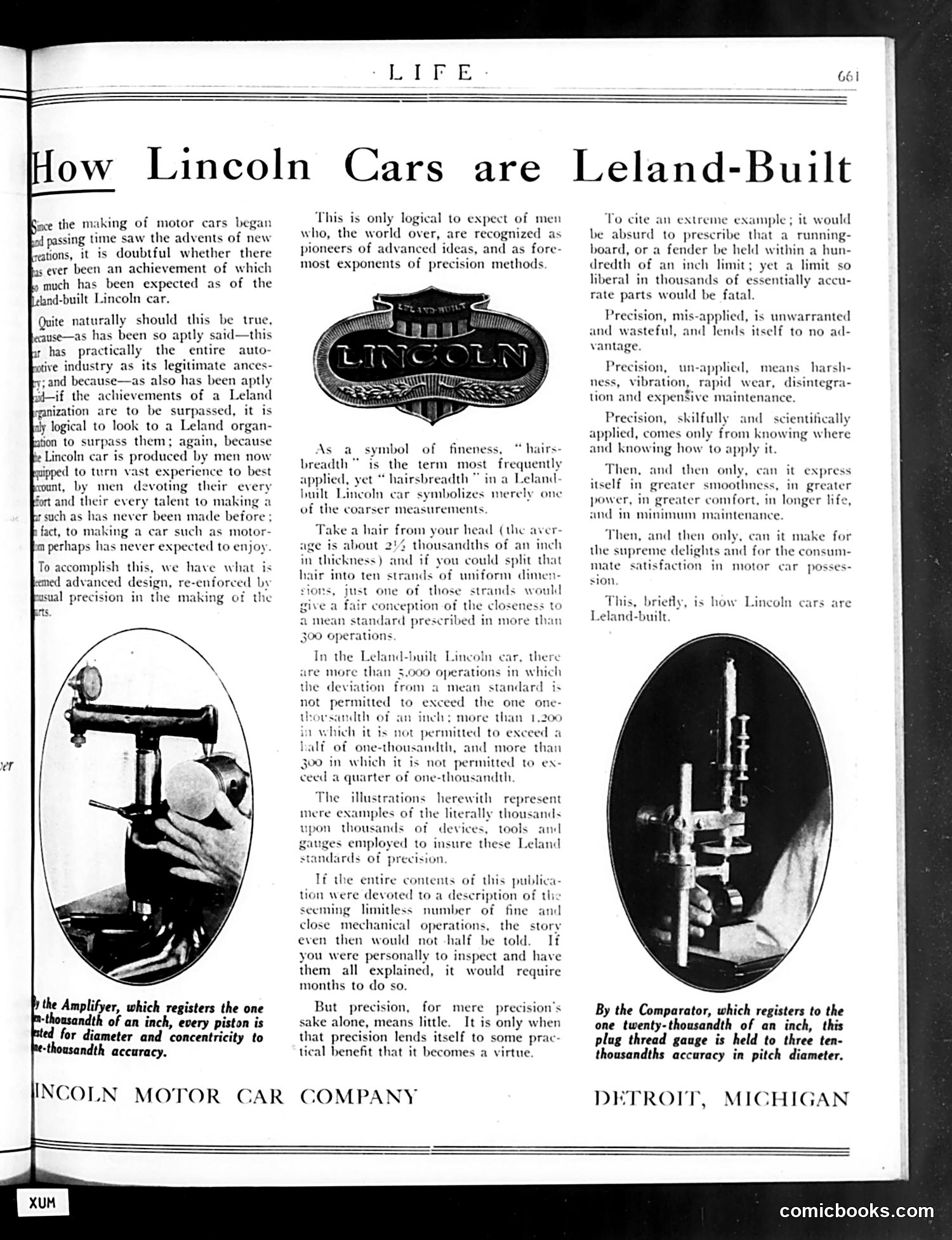
This page is primarily **advertising rather than satire or political commentary**. It's a promotional article for Lincoln Motor Car Company's manufacturing precision, published in *Life* magazine (page 661). The content explains Lincoln's manufacturing standards using a hair analogy—their tolerances are so tight that splitting a human hair into ten strands would exceed their permitted deviation in over 5,000 operations. Two photographs show precision measurement instruments used in production. The article emphasizes that Lincoln achieves superior quality through rigorous engineering standards and precision tooling. The "Amplifier" and "Comparator" devices pictured are measuring tools ensuring exact specifications. This represents early 20th-century automotive marketing highlighting technological advancement and manufacturing excellence as selling points to consumers.
📄 Transcribed text from this page (OCR, searchable)
Machine-transcribed from the original scan — historical spelling and the odd misread are preserved.
¢ the making of motor cars began od passing time saw the advents of new rations, it is doubtful whether there 2s ever been an achievement of which » much has been expected as of the Deland-built Lincoln car. Quite naturally should this be true, cause—as has been so aptly said—this ¢ has practically the entire auto- stive industry as its legitimate ances- ;and because—as also has been aptly nid-if the achievements of a Leland sanization are to be surpassed, it is aly logical to look to a Leland organ- jon to surpass them; again, because Lincoln car is produced by men now muipped to turn vast experience to best mount, by men devoting their every fort and their eve alent to making such as has never been made before ; fact, to making a car such as motor- im perhaps has never expected to enjoy. To accomplish this, we have what is yemed advanced design, re-enforced by usual precision in the making of the ns, H the Amplifyer, which registers the one m-thousandth of an inch, every piston is led for diameter and concentricity to -thousandth accuracy. INCOLN MOTOR CAR gical to expect of men who, the world over, are recognized as pioneers of advanced ideas, and as fore- most exponents of precision methods. As a symbol of fineness, “ hairs- breadth the term most frequently applied, yet “ hairsbreadth ” in a Leland built Lincoln car symbolizes merely one of the coarser measurements. Take a hair from your head (the aver- age is about thousandths of an inch in thickness) and if you could split that hair into ten strands of uniform dimen- just one of those strands would give a fair conception of the closer ¢ a mean standard preseribed in more than 300 operations In the Leland-built Lincoln ear, there are more than 3,000 operations in which the deviation from a mean standard is not permitted to exceed the one one- thovsandth of an inch; more than 1,200 in which it is not permitted to exceed ¢ half of one-thousandth, and more thar 300 in which it is not permitted to ex- ceed a quarter of one-thousandth. he illustrations herewith represent mere examples of the literally thousands upon thousands of devices, tools and gauges employed to insure these Leland standards of precision If the entire contents of this publica- tion were devoted to a description of th seeming limitless number of fine and close mechanical operations, the story even then would not -half be told. If you were personally to inspect and have them all explained, it would require months to do so. But precision, for mere precision’s sake alone, means little. It is only when that precision lends itself to some prac- tical benefit that it becomes a virtue. COMPANY To cite an extreme example ; it would be absurd to prescribe that a_running- board, or a fender be held within a hun- dredth of an inch limit; yet a limit so liberal in thousands of essentially accu- rate parts would be fatal. Precision, mis-applied, is unwarranted asteful, and lends itself to no ad- Precision, un-applied, means harsh- ness, vibration, rapid wear, disintegra- tion and expen$ive maintenance. Precision, skilfully and scientifically applied, comes only from knowing where and knowing how to apply it. Then, and then only, can it expre itself in greater smoothness, in greater power, in greater comfort, in longer life, and in minimum maintenance. Then, and then only, can it make for the supreme delights and for the consum- mate satisfaction in motor car posses- sion This, briefly, is how Lincoln cars are Leland-built By the Comparator, which registers to the one twenty-thousandth of an inch, this plug thread gauge is held to three ten- thousandths accuracy in pitch diameter. DETROIT, MICHIGA comicbooks.com