
Life, 1920-10-14 · page 24 of 44
Life — October 14, 1920 — page 24: what you’re looking at
What you’re looking at
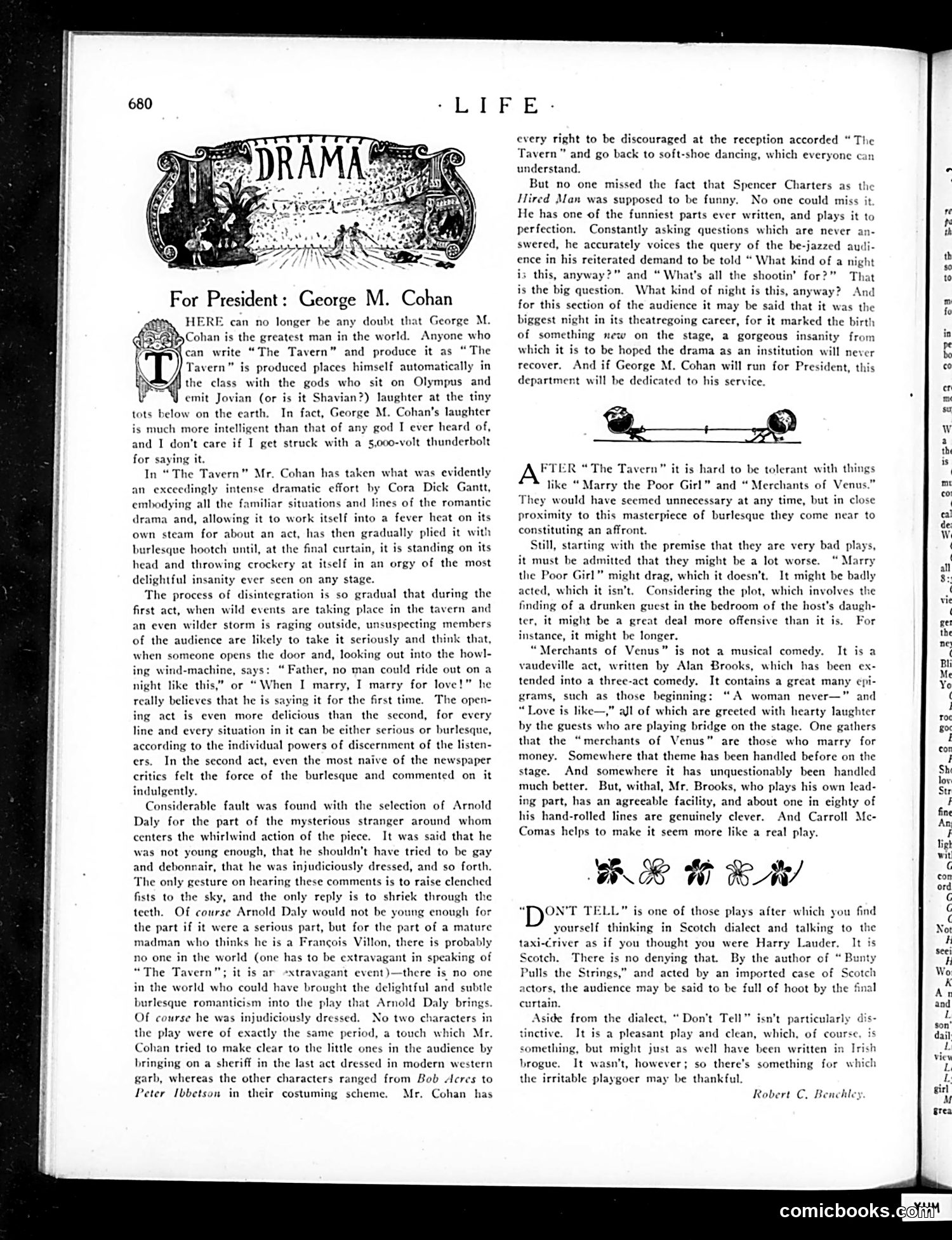
This is a tongue-in-cheek endorsement piece for theatrical producer-performer George M. Cohan, written with obvious satire. The author praises Cohan's play "The Tavern," calling him "the greatest man in the world" and jokingly nominating him for President—a rhetorical device common in Life magazine's humorous criticism. The article discusses "The Tavern," which appears to be a burlesque of romantic drama that gradually devolves into absurdity (characters "throwing crockery at itself"). The author celebrates this comic deconstruction while defending cast choices (Arnold Daly, Spencer Charters) against critical complaints about age and costume inconsistencies. The satire suggests that Cohan's theatrical genius—his ability to transform earnest melodrama into hilarious farce—makes him more worthy of high office than actual politicians. This reflects the common early-20th-century practice of using "satirical candidacies" to comment on politics and culture.
📄 Transcribed text from this page (OCR, searchable)
Machine-transcribed from the original scan — historical spelling and the odd misread are preserved.
*LIFE: For President: George M. Cohan can no longer be any doubt that George M. Cohan is the greatest man in the world. Anyone who can write “The Tavern” and produce it as “The Tavern” is produced places himself automatically in Ajthe class with the gods who sit on Olympus and emit Jovian (or is it Shavian?) laughter at the tiny below on the earth. In fact, George M. Cohan’s laughter is much more intelligent than that of any god I ever heard of, and I don’t care if I get struck with a §,000-volt thunderbolt for saying it. In “The Tavern” Mr. Cohan has taken what was evidently an exceedingly intense dramatic effort by Cora Dick Gantt, embodying all the familiar situations and lines of the romantic drama and, allowing it to work itself into a fever heat on its own steam for about an act, has then gradually plied it with burlesque hootch until, at the final curtain, it is standing on its head and throwing crockery at itself in an orgy of the most delightful insanity ever seen on any stage. The process of disintegration is so gradual that during the first act, when wild events a an even wilder storm is raging outside, unsuspecting members of the audience are likely to take it seriously and think that, when someone opens the door and, looking out into the howl- ing wind-machine, says: “Father, no man could ride out on a night like this,” or “When I marry, I marry for love!" he really believes that he is saying it for the first time. The open- ing act is even more delicious than the second, for every line and every situation in it can be either serious or burlesque, according to the individual powers of discernment of the listen- ers. In the second act, even the most naive of the newspaper critics felt the force of the burlesque and commented on it indulgently. Considerable fault was found with the selection of Arnold Daly for the part of the mysterious stranger around whom centers the whirlwind action of the piece. It was said that he was not young enough, that he shouldn't have tried to be gay and debonnair, that he was injudiciously dressed, and so forth. The only gesture on hearing these comments is to raise clenched fists to the sky, and the only reply is to shriek through the tecth. Of course Arnold Daly would not be young enough for the part if it were a serious part, but for the part of a mature madman who thinks he is a Francois Villon, there is probably no one in the world (one has to be extravagant in speaking of “The Tavern”; it is ar «xtravagant event)—there is no one in the world who could have brought the delightful and subtle burlesque romanticism into the play that Arnold Daly. bri Of course he was injudiciously dressed. e taking place in the tavern and No two characters in the play were of exactly the same period, a touch which Mr. Cohan tried to make clear to the little ones in the audience by bringing on a sheriff in the last act dressed in modern western garb, whereas the other characters ranged from Bob Acres to Peter Ibbetson in their costuming scheme. Mr. Cohan has every right to be discouraged at the reception accorded “The Tavern” and go back to soft-shoe dancing, which everyone can understand. But no one missed the fact that Spencer Charters as ti Hired Man was supposed to be funny. No one could miss it He has one of the funniest parts ever written, and plays it to perfection. Constantly asking questions which are never an- swered, he accurately voices the query of the be-jazzed audi- ence in his reiterated demand to be told “ What kind of a night ix this, anywa: and “What's all the shootin’ for?” That is the big question. What kind of night is this, anyway? And for this section of the audience it may be said that it was the biggest night in its theatregoing career, for it marked the birth of something new on the stage, a gorgeous insanity from which it is to be hoped the drama as an institution will never recover. And if George M. Cohan will run for President, this department will be dedicated to his service. © FTER “The Tavern” it is hard to be tolerant with things like “ Marry the Poor Girl” and “ Merchants of Venus.” They would have seemed unnecessary at any time, but in close proximity to this masterpiece of burlesque they come near to constituting an affront. Still, starting with the premise that they are very bad plays, it must be admitted that they might be a lot worse. “ Marry the Poor Girl” might drag, which it doesn’t. It might be badl acted, which it isn’t. Considering the plot, which involves the finding of a drunken guest in the bedroom of the host's daugh- ter, it might be a great deal more offensive than it is. For instance, it might be longer. “Merchants of Venus” is not a musical comedy. It is a vaudeville act, written by Alan Brooks, which has been ex- tended into a three-act comedy. It contains a great many epi- zrams, such as those beginning: “A woman never—” and Love is like—,” aJl of which are greeted with hearty laughter by the guests who are playing bridge on the stage. One gathers that the “merchants of Venus" are those who marry for money. Somewhere that theme has been handled before on the stage. And somewhere it has unquestionably been handled much better. But, withal, Mr. Brooks, who plays his own lead- ing part, has an agreeable facility, and about one in eighty of his hand-rolled lines are genuinely clever. And Carroll Mc- Comas helps to make it seem more like a real play. TE EM “DON'T TELL” is one of those plays after which you find yourself thinking in Scotch dialect and talking to the ta: ver as if you thought you were Harry Lauder. It is Scotch. There is no denying that. By the author of “ Bur Pulls the Strings,” and acted by an imported case of Scotch actors, the audience may be said to be full of hoot by the final curtain. Aside from the dialect, “ Don't Tell” isn’t particularly dis tinctive. It is a pleasant play and clean, which, of course something, but might just as well have been written in Ir brogu It wasn't, however; so there’s something for which the irritable playgoer may be thankful. Robert C. Benehley comicbooks.