
Life, 1920-10-14 · page 18 of 44
Life — October 14, 1920 — page 18: what you’re looking at
What you’re looking at
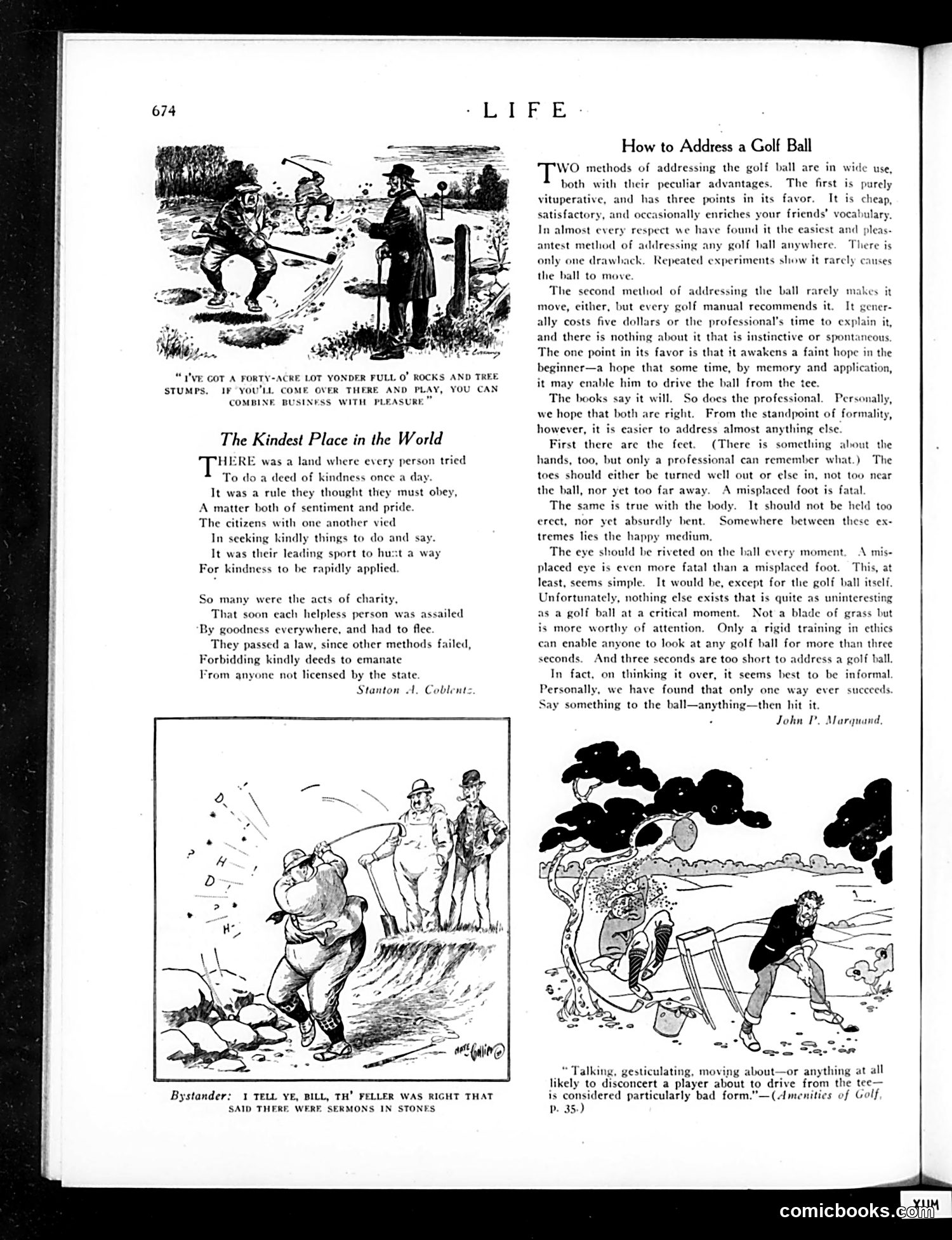
This page contains three distinct pieces of satire: **"The Kindest Place in the World"** is a poem mocking excessive do-goodism. It describes a society where mandatory kindness becomes so oppressive that people must flee and the government must *license* charity to prevent harassment. The satire targets both sentimental idealism and bureaucratic overreach—suggesting good intentions become tyrannical when enforced. **The golf cartoons** humorously illustrate the absurdity of golf instruction. The top cartoon shows someone offering land "full of rocks and stumps" as a place to play while "combining business with pleasure"—dark humor about golf's futility. The essay mocks golf manuals' overly technical advice about stance and focus, noting that neither method actually makes the ball move. John P. Marquand's conclusion—just talk to the ball and hit it—satirizes the gap between formal instruction and practical reality. **The "Bystander" caption** is a separate joke about sermons in stones (wisdom in unexpected places), accompanying an unrelated illustration. All three pieces exemplify Life's satirical approach: puncturing pretension and exposing the gap between theory and practice.
📄 Transcribed text from this page (OCR, searchable)
Machine-transcribed from the original scan — historical spelling and the odd misread are preserved.
“I'VE GOT A FORTY-ACRE LOT YONDER FULL 0” ROCKS AND TR STUMPS, IF YOU'LL COME OVER THERE AND PLAY, YOU CAN COMBINE BUSINESS WITH PLEASURE” The Kindest Place in the World HERE was a land where every person tried To do a deed of kindness once a day. It was a rule they thought they must obey, A matter both of sentiment and pride. The citizens with one another vied In seeking kindly things to do and say. It was their leading sport to hunt a way For kindness to be rapidly applied. So many were the acts of charity, That soon each helpless person was assailed By goodness everywhere, and had to flee. They passed a law, since other methods failed, Forbidding kindly deeds to emanate From anyone not licensed by the state. Stanton A. Coblente Bystander: 1 TELL YE, BILL, TH’ FELLER WAS RIGHT THAT SAID THERE WERE SERMONS IN STONES How to Address a Golf Ball WO methods of addressing the golf ball are in wide use, both with their peculiar advantages. The first is purely vituperative, and has three points in its favor. It is cheap, satisfactory, and occasionally enriches your friends’ vocabulary, In almost every respect we have found it the easiest and pleas- antest method of addressing any golf hall anywhere. There is only one drawback. Repeated experiments show it rarely causes the ball to move. The second method of addressing the ball rarely m move, either, but every golf manual recommends it. It gener- ally costs five dollars or the professional's time to explain it, and there is nothing about it that is instinctive or spontancous. The one point in its favor is that it awakens a faint hope in the beginner—a hope that some time, by memory and application, it may enable him to drive the ball from the tee. The books say it will. So does the professional. Personal! we hope that both are right. From the standpoint of formality, however, it is easier to address almost anything else. First there are the feet. (There is something about the 1 kes it hands, too, but only a professional can remember what.) The toes should either be turned well out or else in, not too near the ball, nor yet too far away. A misplaced foot is fatal. The same is true with the body. It should not be held too erect, nor yet absurdly bent. Somewhere between these ex- tremes lies the happy medium. The eye should he riveted on the hall every moment. A mis- placed eye is even more fatal than a misplaced foot. This, at least, seems simple. It would be, except for the golf hall itself. Unfortunately, nothing else exists that is quite as uninteresting as a golf ball at a critical moment. Not a blade of grass but is more worthy of attention. Only a rigid training in ethics can enable anyone to look at any golf ball for more than three seconds. And three seconds are too short to address a golf ball. In fact, on thinking it over, it seems best to be informal Personally, we have found that only one way ever succeeds. Say something to the ball—anything—then hit it. John P. Marquand, _* Talking, gesticulating, moving about—or anything at all likely to disconcert a player about to drive from the t is considered particularly bad form."—(dmenities of Golf Pp. 35-) comicbooks.