
Life, 1920-10-14 · page 10 of 44
Life — October 14, 1920 — page 10: what you’re looking at
What you’re looking at
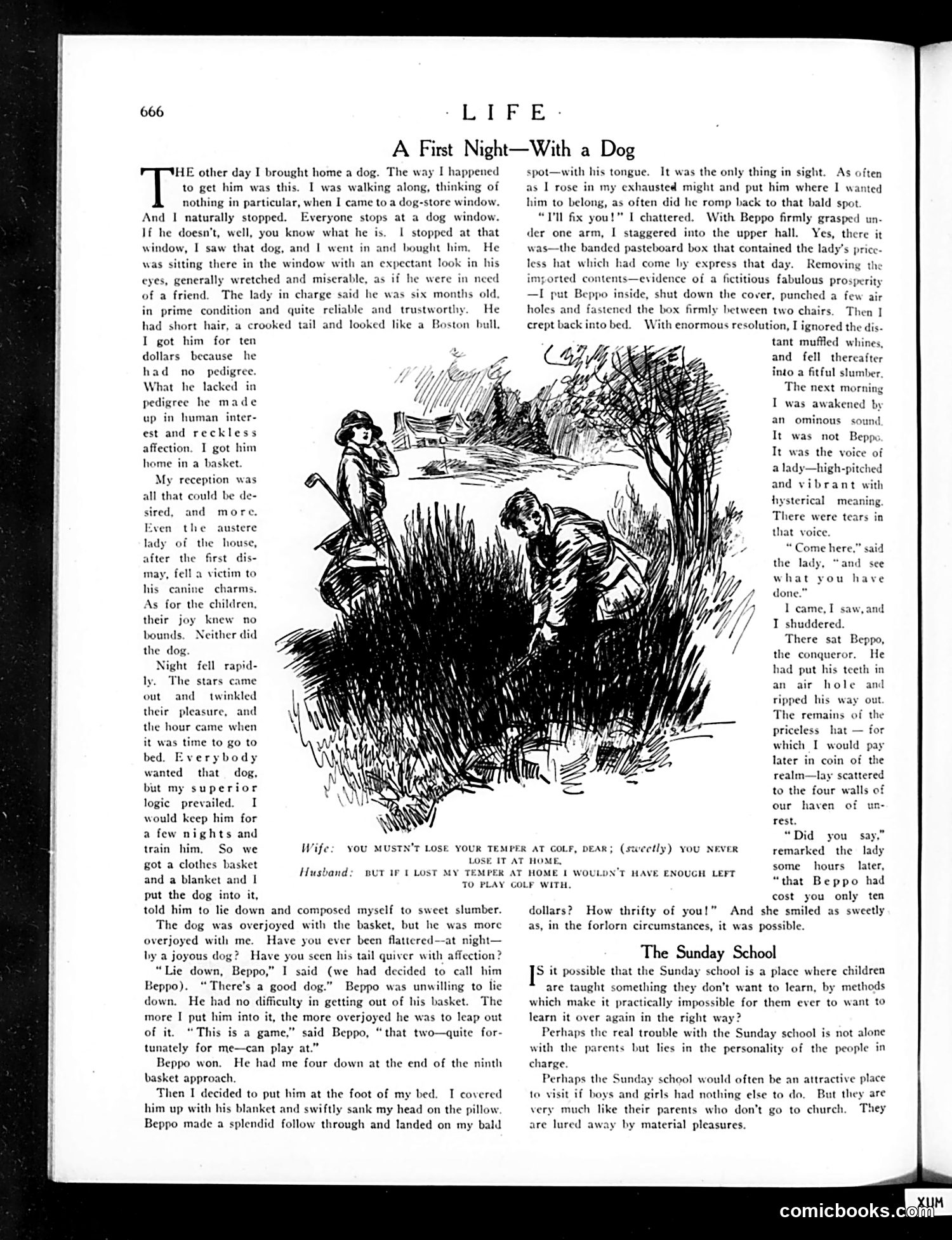
This page contains two separate pieces of humorous writing from *Life* magazine, not political cartoons. "A First Night—With a Dog" is a domestic comedy narrative about acquiring a dog from a pet store and its chaotic first night at home, culminating in the dog destroying the narrator's bed. The accompanying illustration shows figures discovering the dog's destructive handiwork in tall grass or bedding. "The Sunday School" is a brief social commentary critiquing Sunday school education. The author argues that Sunday schools use teaching methods children find unappealing, making the lessons ineffective. The piece suggests religious instruction conflicts with children's material pleasures and parental authority. Both pieces exemplify *Life*'s satirical approach to middle-class American domestic life and social institutions through humor rather than political commentary.
📄 Transcribed text from this page (OCR, searchable)
Machine-transcribed from the original scan — historical spelling and the odd misread are preserved.
LIFE. A First Night—With a Dog IHE other day I brought home a dog. The way I happened to get him was this. I was walking along, thinking of nothing in particular, when I came to a dog-store window. And I naturally stopped. Everyone stops at a dog window. If he doesn’t, well, you know what he is. I stopped at that window, I saw that dog, and I went in and bought him. He was sitting there in the window with an expectant look in his eyes, generally wretched and miserable, as if he were in need of a friend. The lady in charge said he was six months old, in prime condition and quite reliable and trustworthy. He had short hair, a crooked tail and looked like a Boston bull. I got him for ten dollars because he had no_ pedigree. What he lacked in pedigree he made up in human inter- est and reckless affection. I got him home in a basket. My reception was all that could be de- sired, and more. Even the austere dy of the house, ter the first dis- may, fell a victim to his canine charms. As for the children, their joy knew no bounds, Neither did the dog. Night fell rapid- ly, The stars came out and twinkled their pleasure, and the hour came when it was time to go to bed. Everybody wanted that dog, but my superior logic prevailed. I would keep him for a few nights and train him. So we got a clothes basket and a blanket and I put the dog into it, told him to lie down and composed myself to sweet slumber. The dog was overjoyed with the basket, but he was more overjoyed with me. Have you ever been flattered—at night— by a joyous dog? Have you scen his tail quiver with affection? “Lie down, Beppo,” I said (we had decided to call him Beppo). “There's a good dog.” Beppo was unwilling to lie down. He had no difficulty in getting out of his basket. The more I put him into it, the more overjoyed he was to leap out of it. “This is a game,” said Beppo, “that two—quite for- tunately for me—can play at.” Beppo won. He had me four down at the end of the ninth basket approach. Then I decided to put him at the foot of my bed. I covered him up with his blanket and swiftly sank my head on the pillow Beppo made a splendid follow through and landed on my bald Wife: Husband YOU MUSTN'T LOSE YOUR TEMPER AT GOLF, DEAR; (sweetly) YOU NEVER LOSE IT AT HOME, BUT IF | LOST MY TEMPER AT HOME I WOULDN'T HAVE ENOUGH LEFT TO PLAY GOLF WITH. spot—with his tongue. It was the only thing in sight. As often as I rose in my exhausted might and put him where I wanted him to belong, as often did he romp back to that bald spot. “Tl fix you!" I chattered. With Beppo firmly grasped un- der one arm, I staggered into the upper hall. Yes, there it was—the banded pasteboard box that contained the lady’s price- less hat which had come by express that day. Removing the imported contents—evidence of a fictitious fabulous prosperity —I put Beppo inside, shut down the cover, punched a few air holes and fastened the box firmly between two chairs. Then I crept back into bed. With enormous resolution, I ignored the dis- tant muffled whi and fell thereafter into a fitful slumber, The next morning I was awakened by an ominous sound Tt was not Beppx Tt was the voice of a lady—high-pitched and vibrant with hysterical meaning. There were tears in that voice. “Come here,” said the lady, “and see what you have done. 1 came, I saw, and I shuddered. There sat Beppo, the conqueror. He had put his teeth in an air hole and ripped his way out The remains of the priceless hat — for which I would pay later in coin of the realm—lay scattered to the four walls of our haven of un- rest, “Did you say,” remarked the lady some hours later, “that Beppo had cost you only ten How thrifty of you!” And she smiled as sweetly as, in the forlorn circumstances, it was possible. The Sunday School S it possible that the Sunday school is a place where children are taught something they don’t want to learn, by methods which make it practically impossible for them ever to want to learn it over again in the right way? Perhaps the real trouble with the Sunday school is not alone with the parents but lies in the personality of the people in charge. Perhaps the Sunday school would often be an attractive place to visit if boys and girls had nothing else to do. But they are very much like their parents who don't go to church, They are lured away by material pleasures. dollars? comicbooks.