
A complete issue · 40 pages · 1920
Life — September 23, 1920
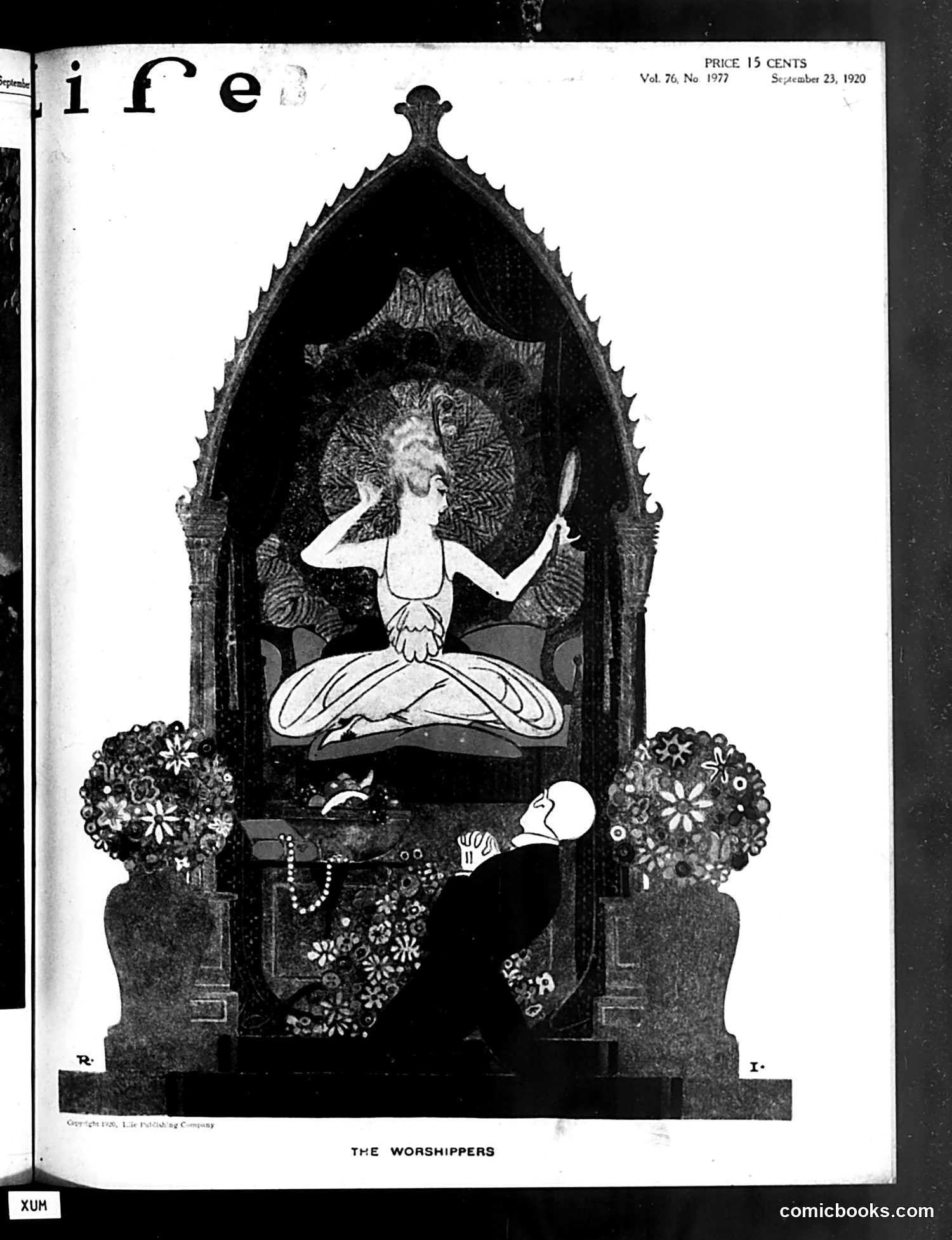
This Art Deco illustration satirizes celebrity worship and fan devotion. A glamorous performer—likely a popular stage or film actress of the 1920s—is elevated on a pedestal in an ornate shrine-like setting, striking a theatrical pose. Below, a solitary figure in dark clothing gazes upward in reverent adoration, hands clasped in prayer-like devotion. The satire targets the emerging cult of celebrity in the Jazz Age: the elevation of entertainers to near-religious status by admirers. The shrine imagery mocks how fans treated actresses as objects of worship rather than ordinary people. The composition emphasizes the absurdity of this parasocial relationship—one person's intense, one-directional veneration of an unattainable idol.
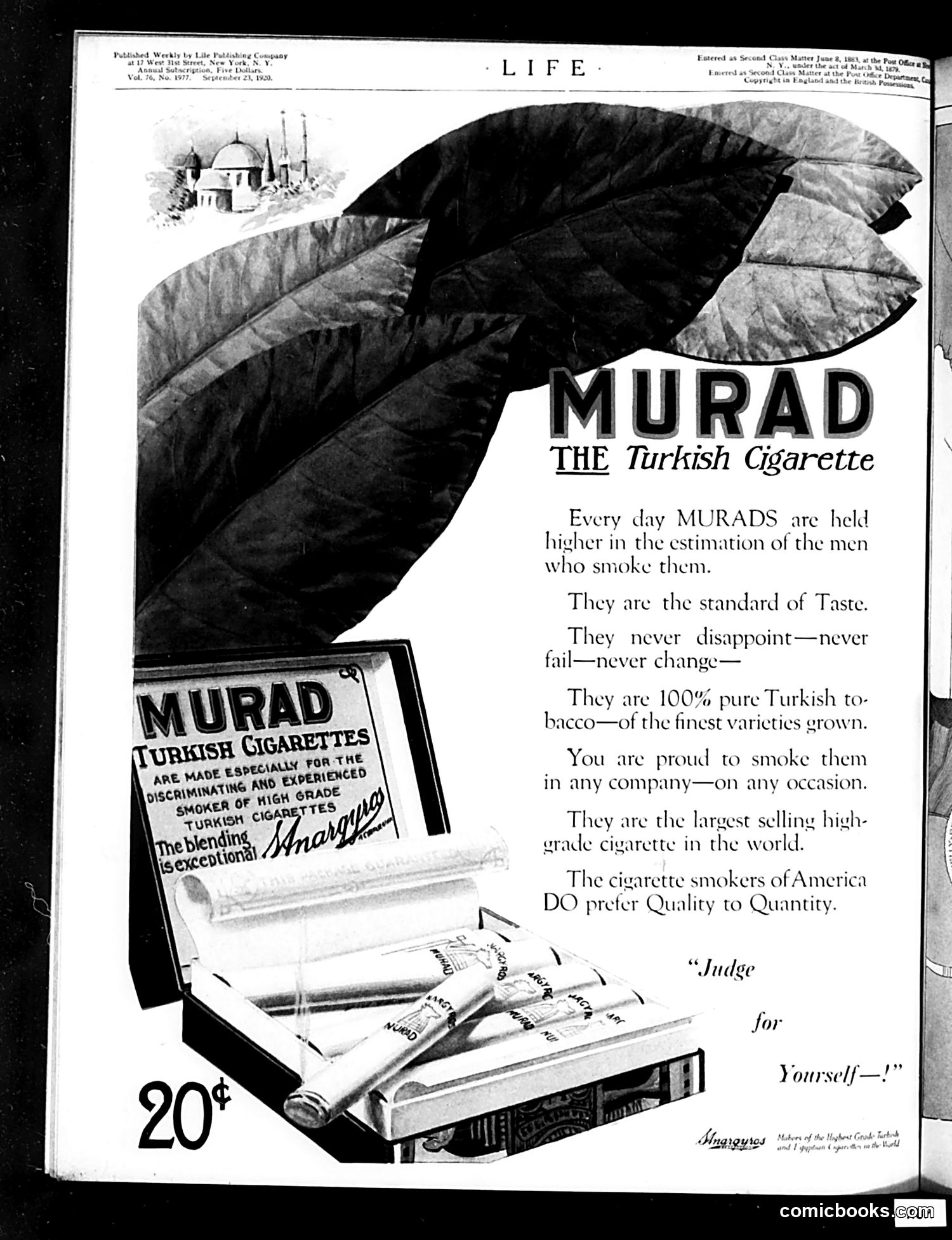
This is a straightforward **cigarette advertisement**, not satire or political commentary. It promotes Murad brand Turkish cigarettes at 20 cents per pack. The ad uses orientalist imagery—a stylized Turkish mosque and architectural elements—to market "100% pure Turkish tobacco" as a luxury product. The copy emphasizes quality over quantity, claiming Murads are "the largest selling high-grade cigarette in the world" and appeals to American smokers' preference for quality. The elegant hand holding cigarettes is a common advertising device of the era, suggesting sophistication and refined taste. There's no cartoon or satirical intent here—it's period marketing that exploits exotic Turkish imagery to sell cigarettes as a status symbol to discriminating American consumers.
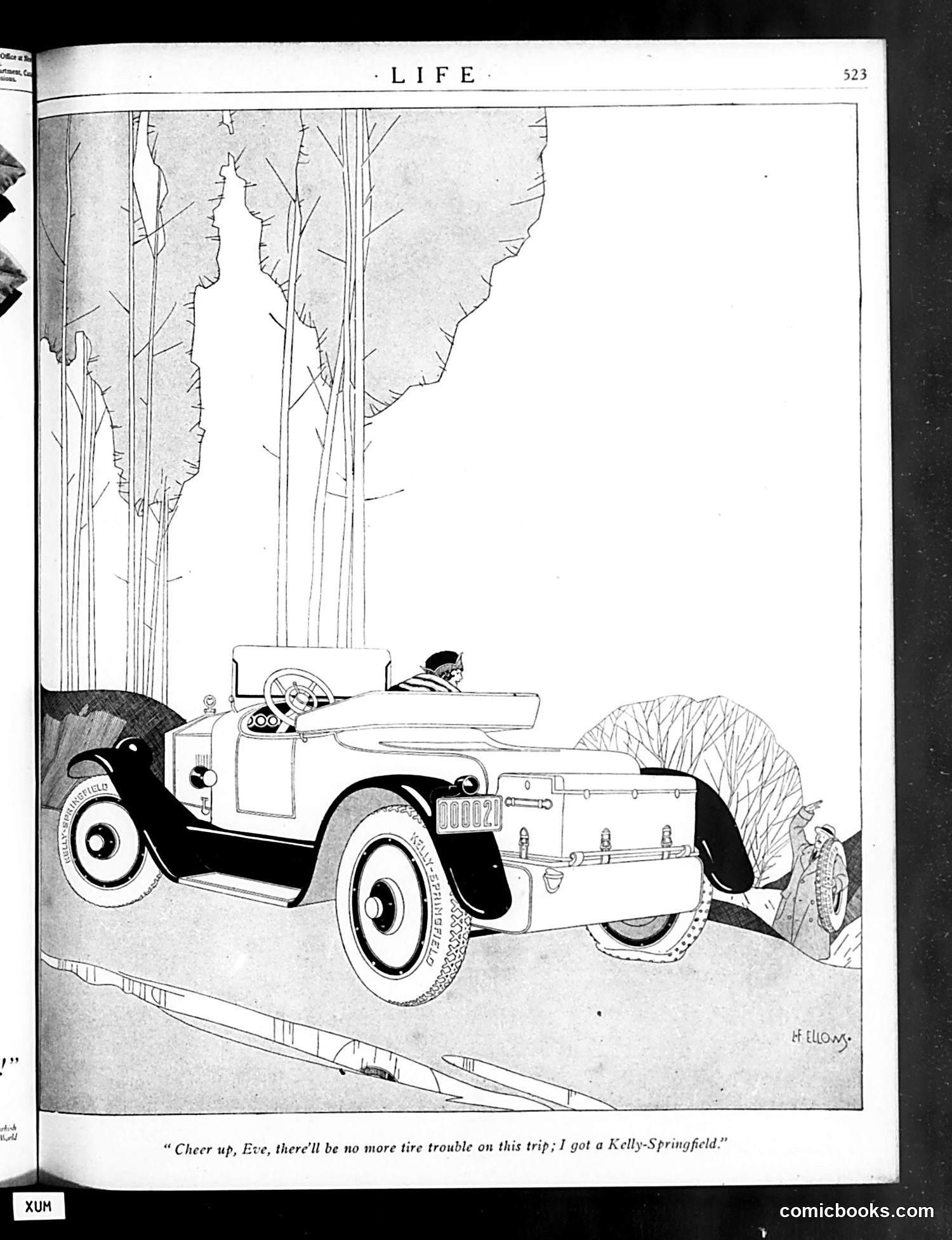
This cartoon from *Life* magazine (page 523) depicts a man driving a car on a woodland road, with a woman passenger beside him. The caption reads: "Cheer up, Eve, there'll be no more tire trouble on this trip; I got a Kelly-Springfield." The humor relies on a **product advertisement disguised as comedy**. The joke is straightforward: the driver has purchased Kelly-Springfield brand tires, so they won't experience flat tires during their journey. The name "Eve" suggests a romantic outing. This represents early 20th-century advertising strategy—embedding brand names into humorous scenarios to promote products. The artwork style and automobile design suggest this dates to the 1920s. The satire is minimal; it's primarily a **branded advertisement** presented as editorial cartoon content, a common practice in *Life* magazine.
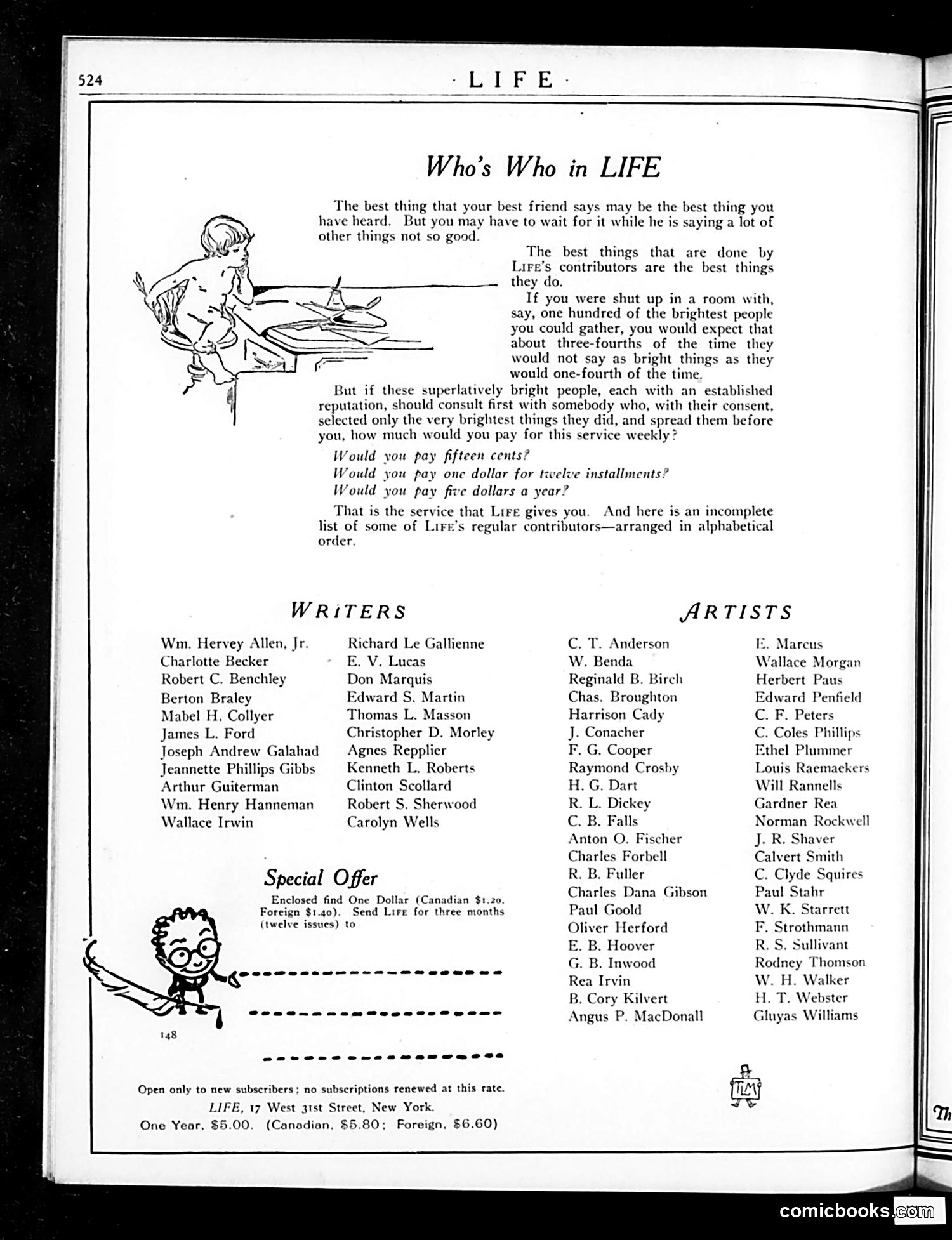
This is primarily a **subscription advertisement and contributor showcase** rather than satirical content. The page explains LIFE magazine's value proposition through a hypothetical scenario: if readers locked 100 brilliant people in a room, only about 75% of their conversation would be "bright." LIFE claims to curate only the brightest ideas from its contributors and present them to readers. The cartoon illustration simply depicts a cheerful figure at a desk, humorously representing the editorial process. Below this concept, LIFE lists its regular **writers and artists** alphabetically—essentially a masthead promoting the magazine's creative talent to potential subscribers. The "Special Offer" invites new subscriptions at $1.00 for three months. This is promotional content, not political satire.
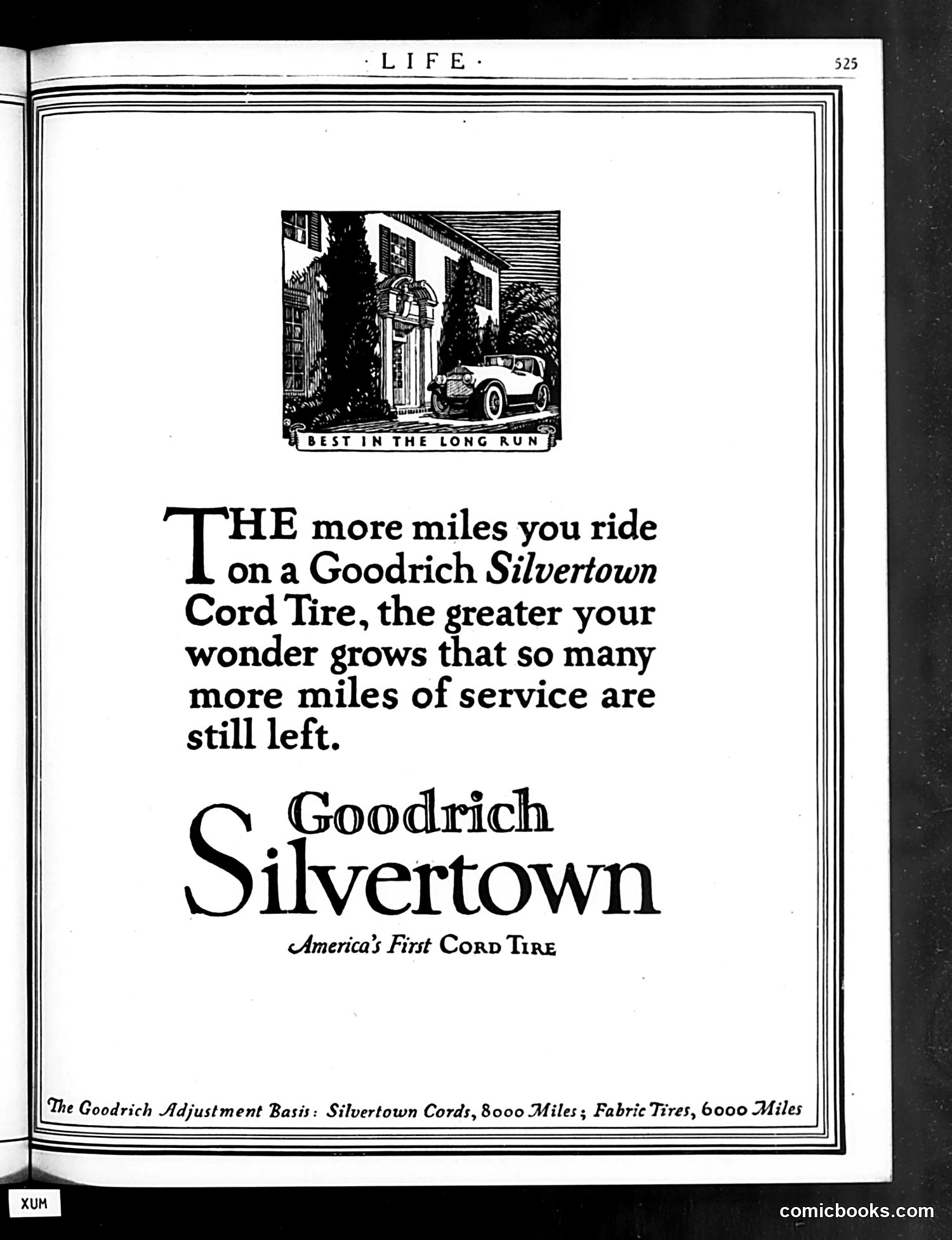
This is **not a cartoon or satire**, but rather a straightforward **automobile tire advertisement** from Life magazine (page 525). The ad promotes Goodrich Silvertown Cord Tires, emphasizing durability through the tagline "Best in the Long Run." The illustrated vignette shows a car parked at a residential home, suggesting reliability for everyday family use. The copy's central claim—that drivers wonder how many more miles remain even after extensive use—positions the product as exceptionally long-lasting. The fine print cites "The Goodrich Adjustment Basis": Silvertown Cords lasted 8,000 miles; competing fabric tires, 6,000 miles. This represents typical early-20th-century tire marketing, where mileage durability was a major selling point before modern tire technology became standard.
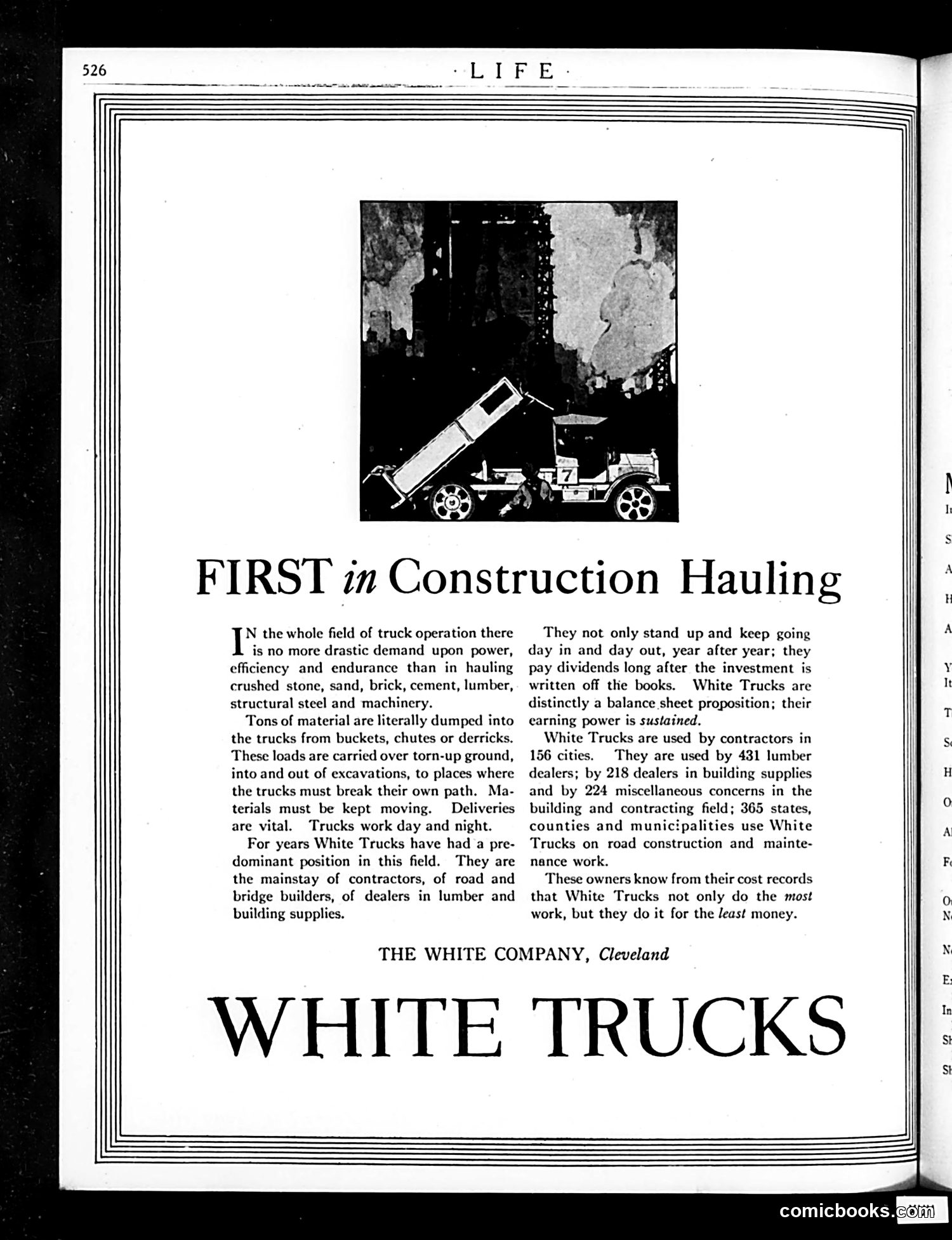
This is **not satire or a political cartoon**—it's a straightforward commercial advertisement for White Trucks, manufactured by The White Company in Cleveland. The image shows trucks actively dumping construction materials (sand, brick, lumber, etc.), illustrating their practical utility. The text emphasizes White Trucks' dominance in construction hauling, citing their use by contractors, lumber dealers, and road builders across 156 cities and multiple states. The advertisement's appeal is economic efficiency: White Trucks supposedly deliver "the most work" for "the least money," backed by contractors' cost records. This represents early-20th-century industrial marketing—promoting trucks as essential business equipment by highlighting reliability, widespread adoption, and proven financial returns rather than through humor or satire.
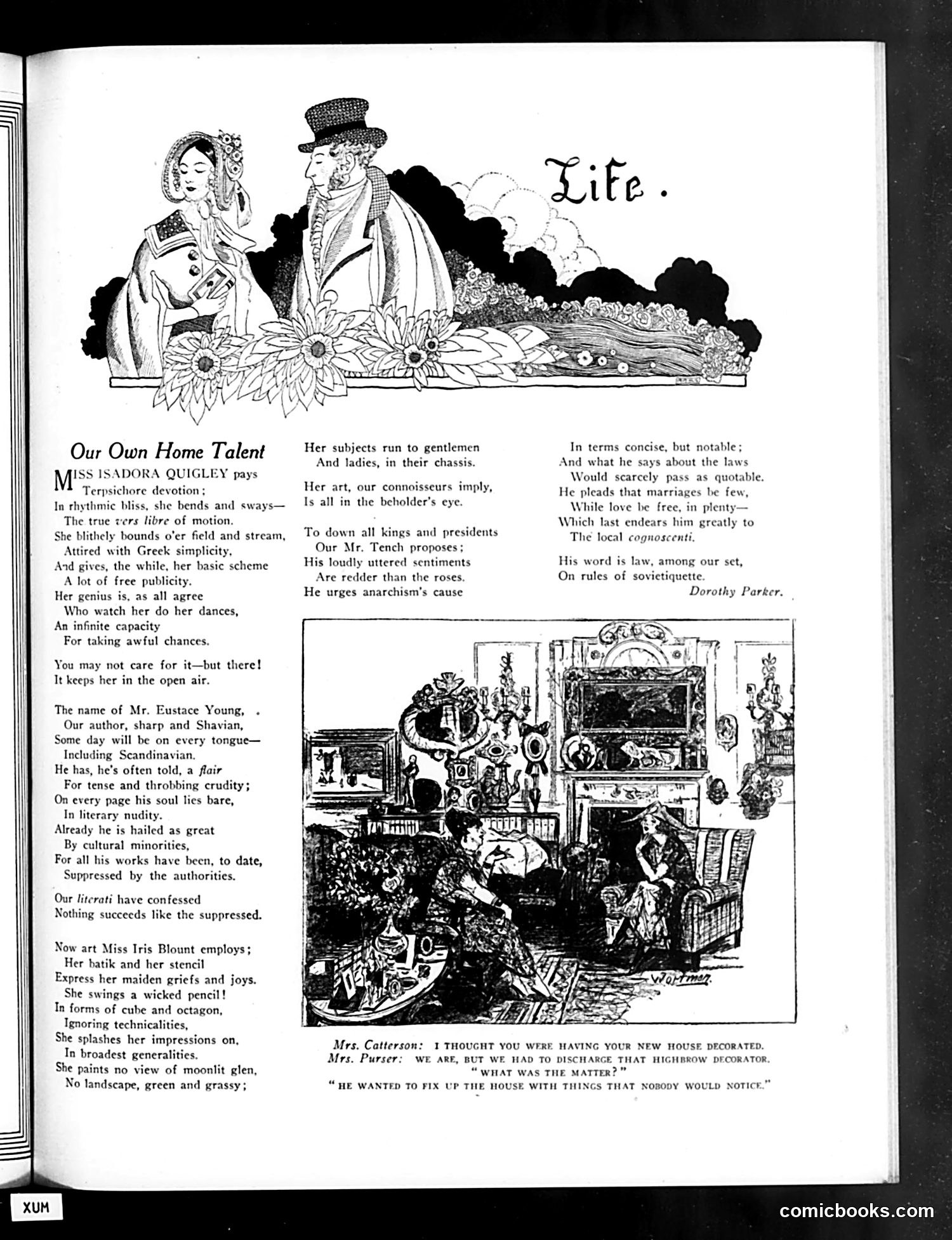
This page satirizes early 20th-century artistic and literary circles. The upper section praises "Miss Isadora Quigley," a fictional dancer-artist embodying the era's bohemian ideal—someone who defies social convention through "rhythmic" movement and avant-garde work. The cartoon below mocks pretentious interior decoration. Mrs. Catterton mentions "highbrow disposition," while Mrs. Parker's response—"He wanted to fix up the house with things that nobody would notice"—jokes about wealthy patrons who spend lavishly on fashionable but invisible or incomprehensible art and decor. The satire targets both bohemian artists claiming radical freedom and affluent society figures attempting to appear cultured by acquiring incomprehensible modern art—a commentary on the gap between artistic pretension and actual taste.
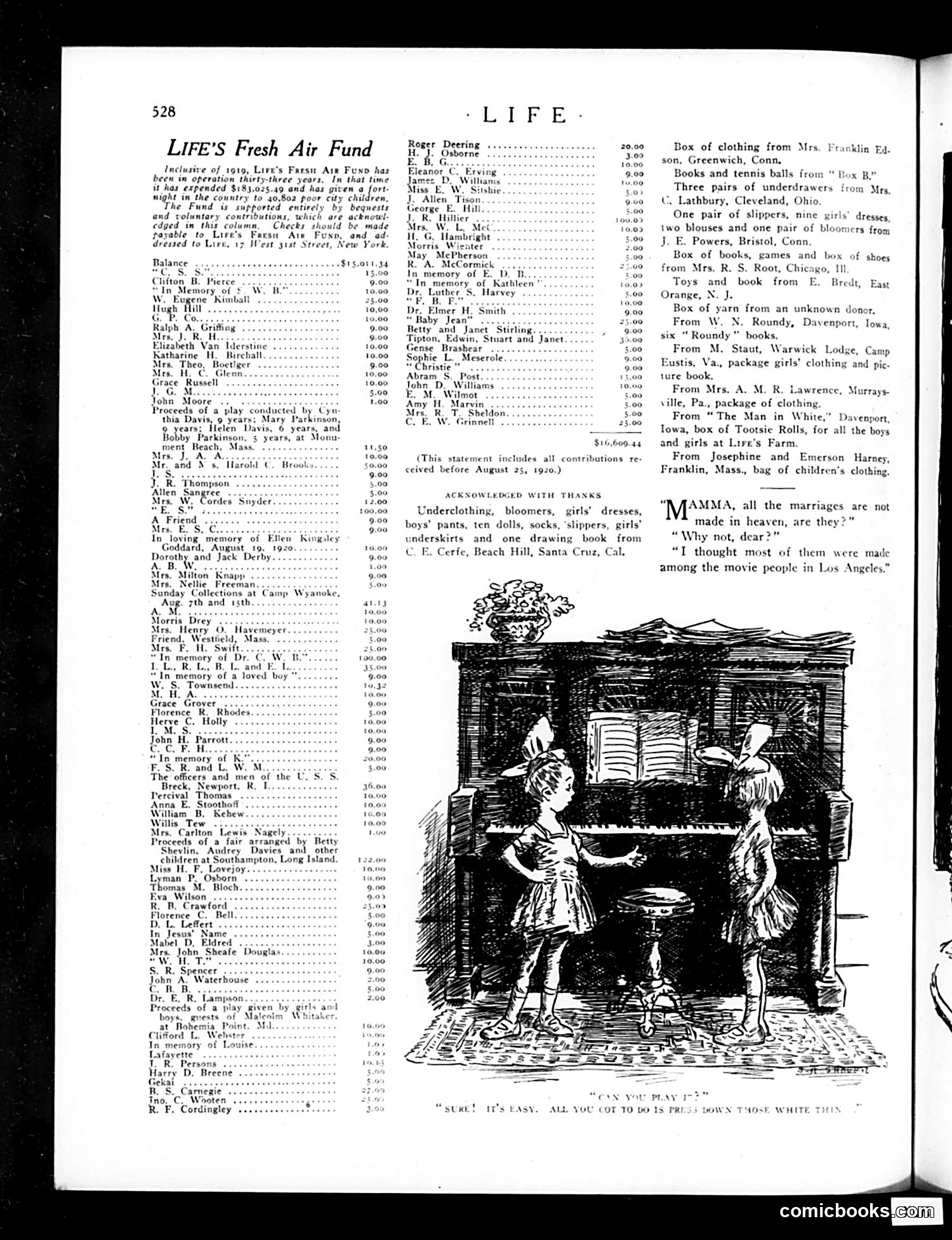
This page contains **Life's Fresh Air Fund** — a charitable fundraising list documenting donations for sending poor children to the countryside for health and recreation. The left column lists numerous donors and contribution amounts (ranging from $1 to $100+), totaling $10,690.44. The cartoon below depicts two young girls playing a game at a fireplace, with one saying "Can you play?" The other responds: "Sure! It's easy. All you got to do is pretend those white things are snow!" **The satire**: The joke reflects urban poverty and pollution — city children are so unfamiliar with snow that they must imagine white objects as snow. It satirizes poor living conditions where children lack basic exposure to nature, justifying the Fresh Air Fund's mission to provide rural experiences for disadvantaged youth.
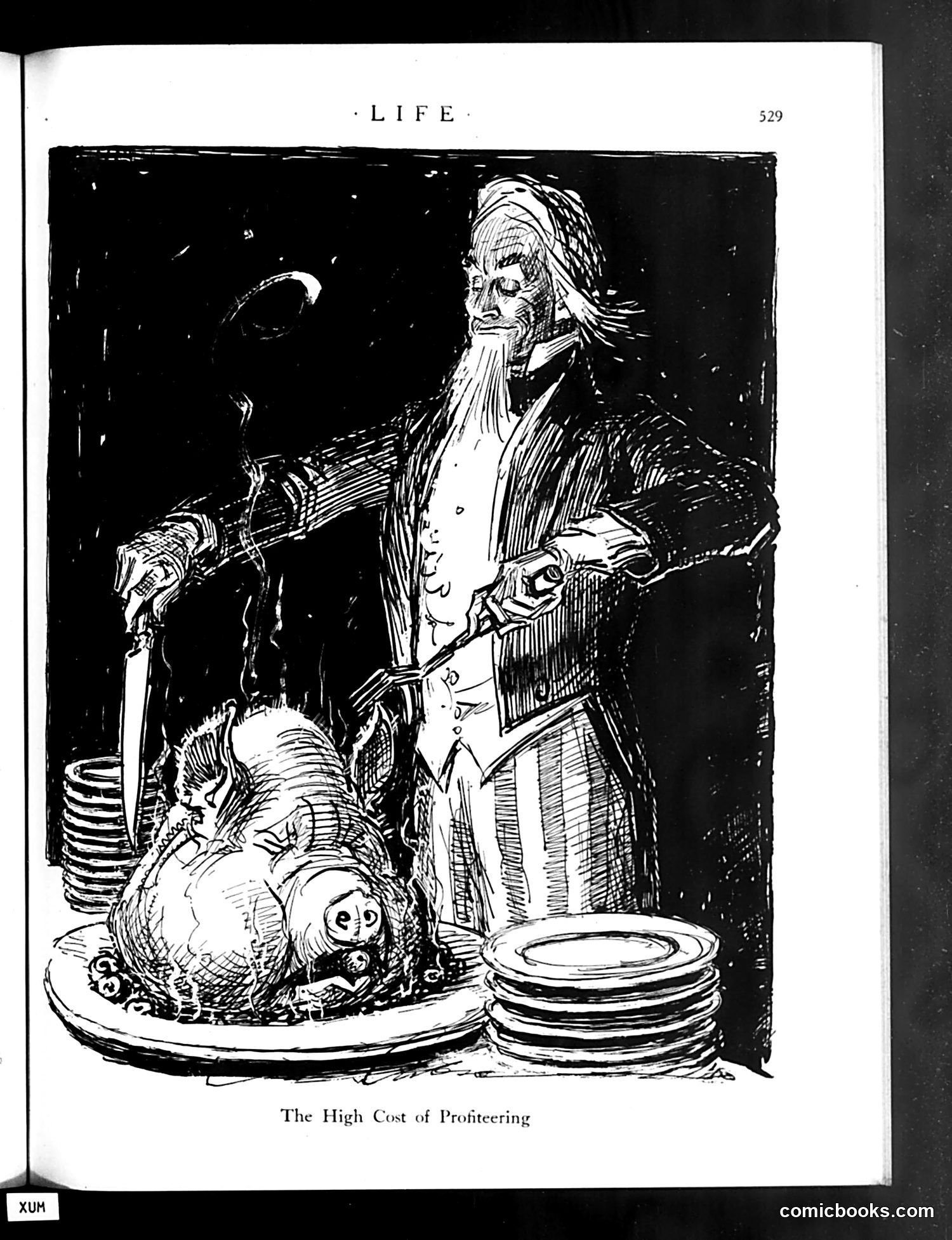
This cartoon satirizes war profiteering during what appears to be World War I era. An elderly businessman with a long beard—likely representing a military contractor or war profiteer—stands prominently displaying a roasted pig or similar meat on a platter. The abundant stacked plates beside him suggest enormous wealth and excess consumption. The title's bitter irony is key: the "high cost" refers not to the profiteer's expense, but to the human cost paid by soldiers. The well-fed businessman contrasts sharply with the implication that soldiers suffered shortages while contractors grew wealthy from war contracts. The cartoon critiques how some capitalists exploited wartime scarcity and government contracts for personal gain while the nation's fighting men sacrificed.
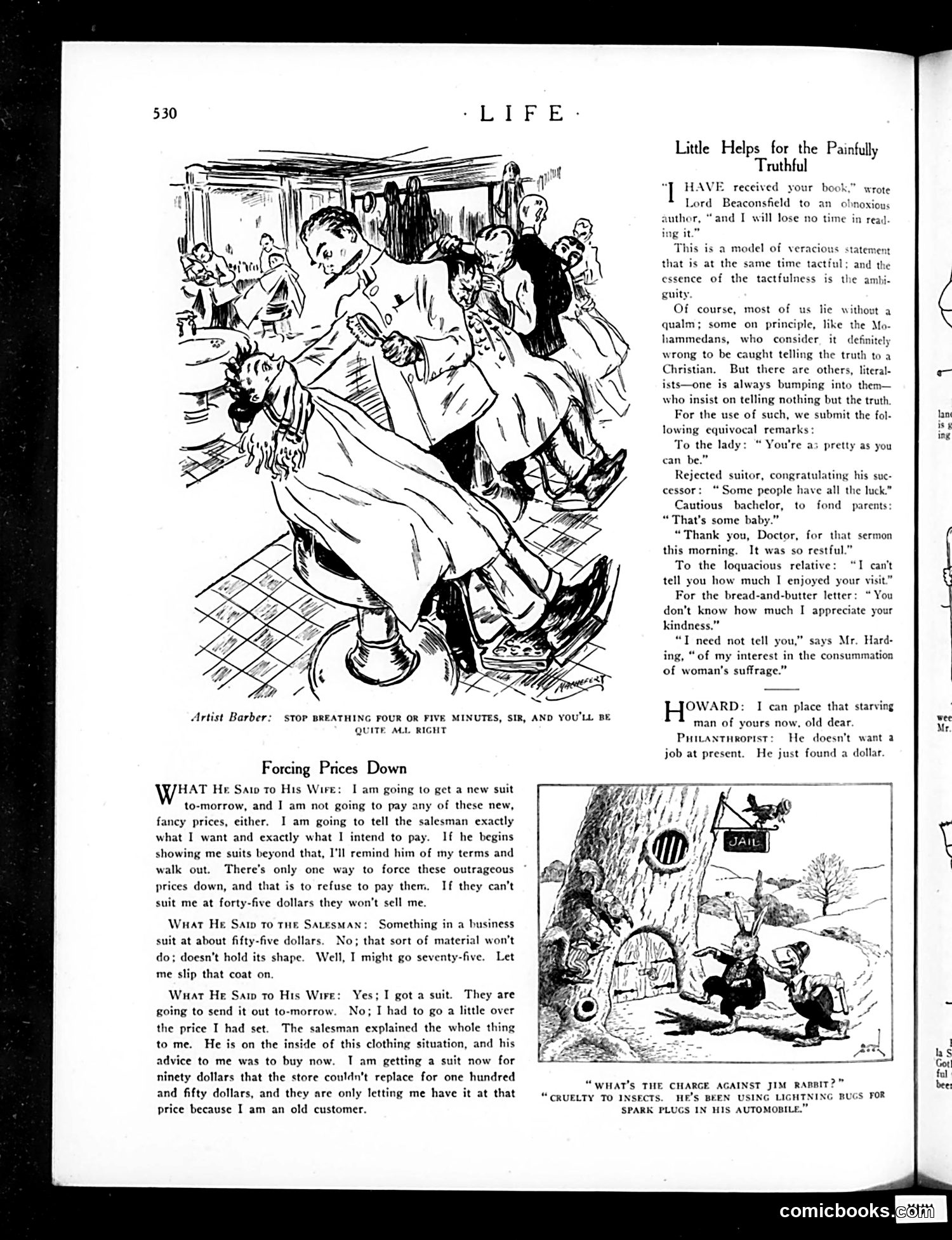
**Top Cartoon: "Artist Barber"** A satirical sketch showing a barber performing an overly elaborate haircut on a patient, with onlookers watching. The caption reads: "STOP BREATHING FOUR OR FIVE MINUTES, SIR, AND YOU'LL BE QUITE ALL RIGHT." The joke mocks barbers who treat simple haircuts as complex artistic procedures, wasting customers' time with unnecessary fussiness. **Bottom Section: "Forcing Prices Down"** A humorous dialogue between a husband and wife about negotiating suit prices. The husband describes pressuring a salesman by threatening to leave, ultimately securing a suit priced at $90-95 instead of $150—demonstrating consumer tactics for combating inflated post-war clothing costs. **Right Panel: Jim Rabbit Cartoon** A small cartoon showing Jim Rabbit being arrested. The charge: "CRUELTY TO INSECTS. HE'S BEEN USING LIGHTNING BUGS FOR SPARK PLUGS IN HIS AUTOMOBILE." This is absurdist humor about animal welfare.
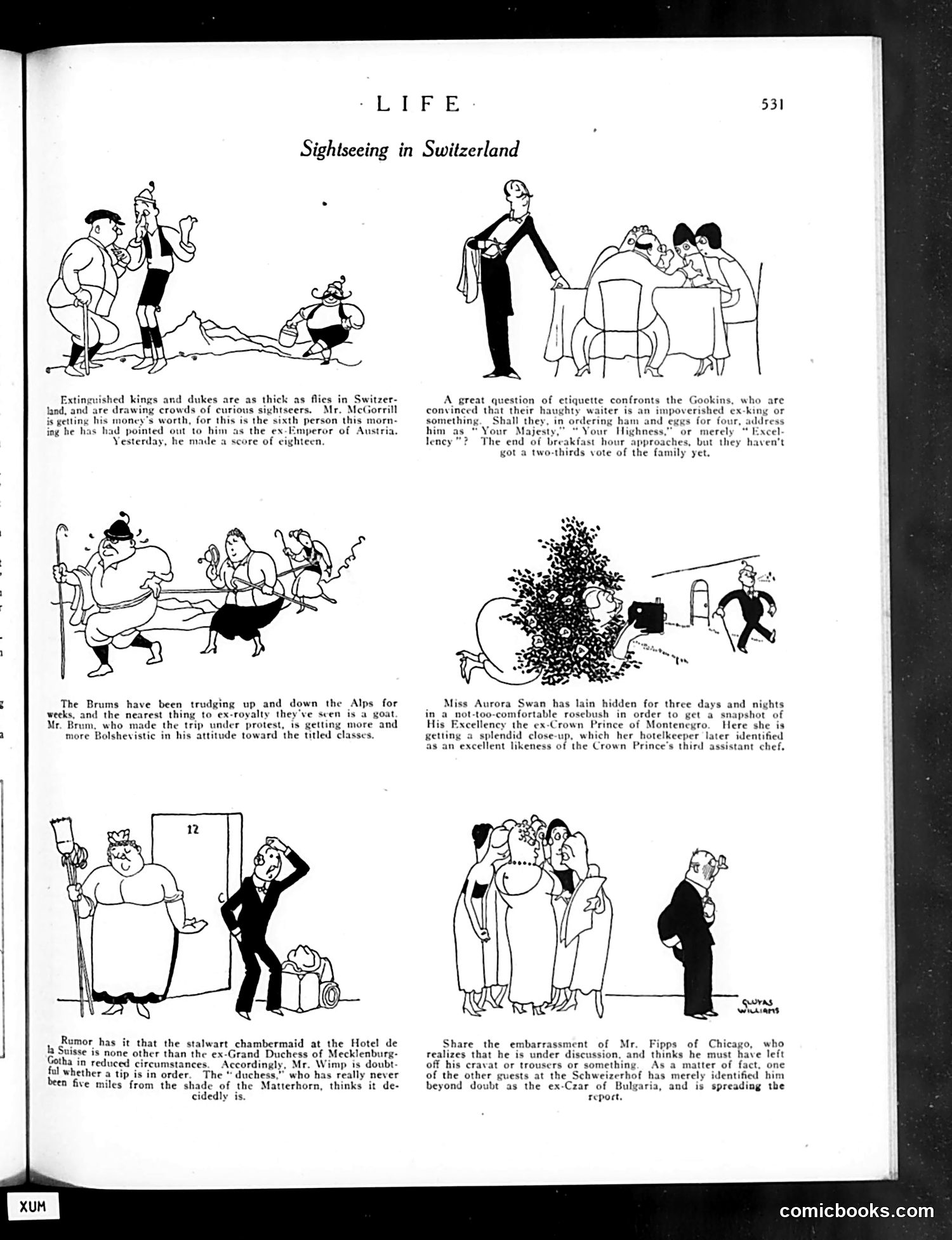
This page presents humorous vignettes mocking wealthy American and European tourists in Switzerland. The cartoons depict: **Social satire targets:** - Aristocratic pretension: "Distinguished kings and dukes are as thick as flies in Switzerland," drawing crowds of curious sightseers - Class anxiety: A waiter confronts the "Gookins" about etiquette violations at breakfast - Tourist desperation: Miss Aurora Swan hiding for three days to photograph herself as "Crown Prince's third assistant chef" - Social climbing gone wrong: Mr. Fipps of Chicago embarrassed after being mistaken for someone important at the Hotel de Suisse The humor lies in exposing the absurdity of wealthy tourists seeking status through European travel while committing embarrassing social blunders and fabricating credentials. It satirizes the era's obsession with Old World aristocratic prestige and nouveau-riche American aspirations.
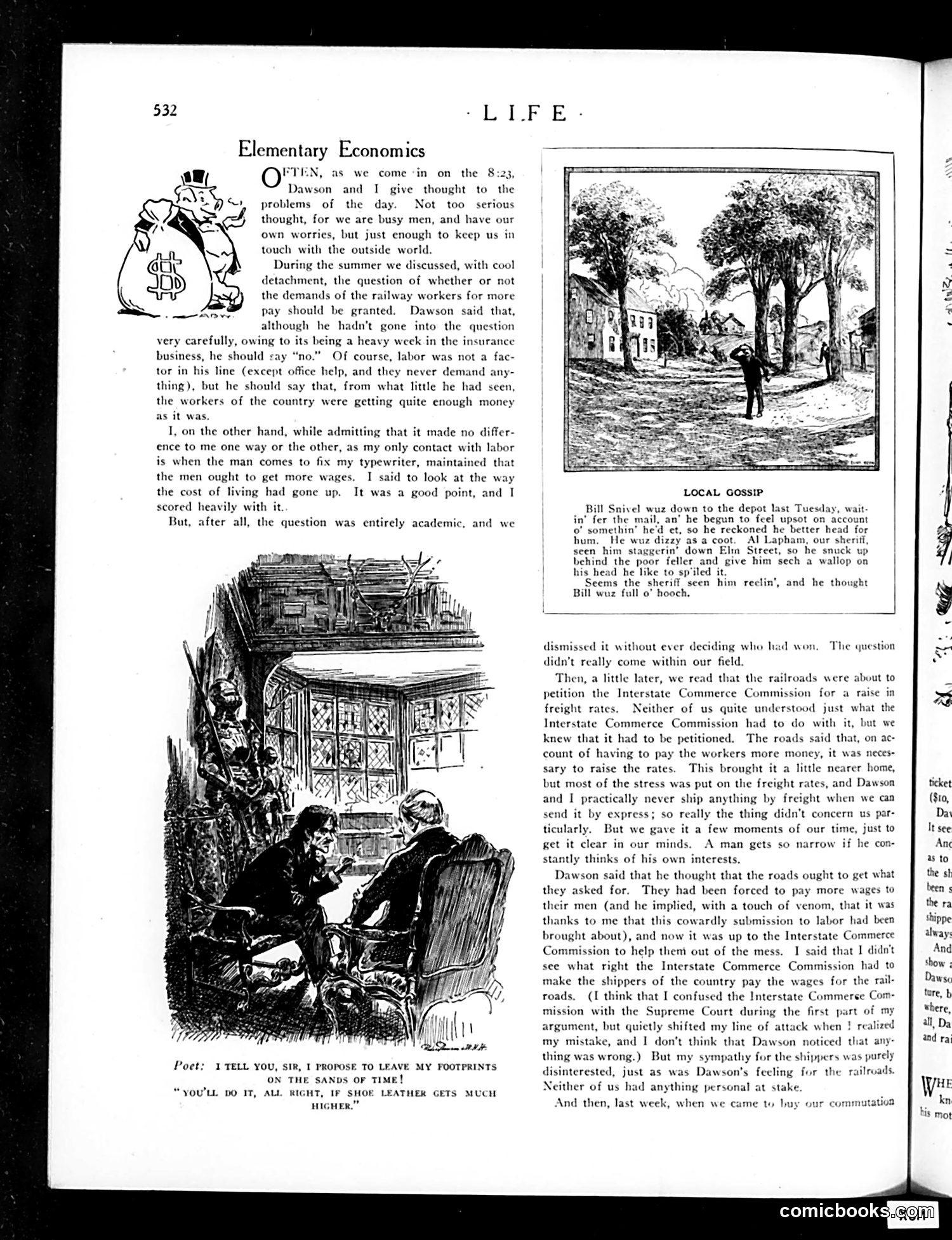
This page from *Life* magazine satirizes labor disputes and railroad economics through a conversation between two businessmen. The main cartoon depicts two figures discussing wage demands—one represents labor interests, the other appears to be management or an employer. The text discusses whether railroad workers deserve higher pay. The author argues against simply raising wages without considering operational costs, while acknowledging workers need fair compensation. The piece references Interstate Commerce Commission hearings about freight rate increases. The satire targets the complexity of labor negotiations: both sides claim hardship, neither wants to compromise, and the public gets caught between them. The accompanying illustration of two men in discussion emphasizes how abstract economic debates ignore workers' actual needs and suffering.
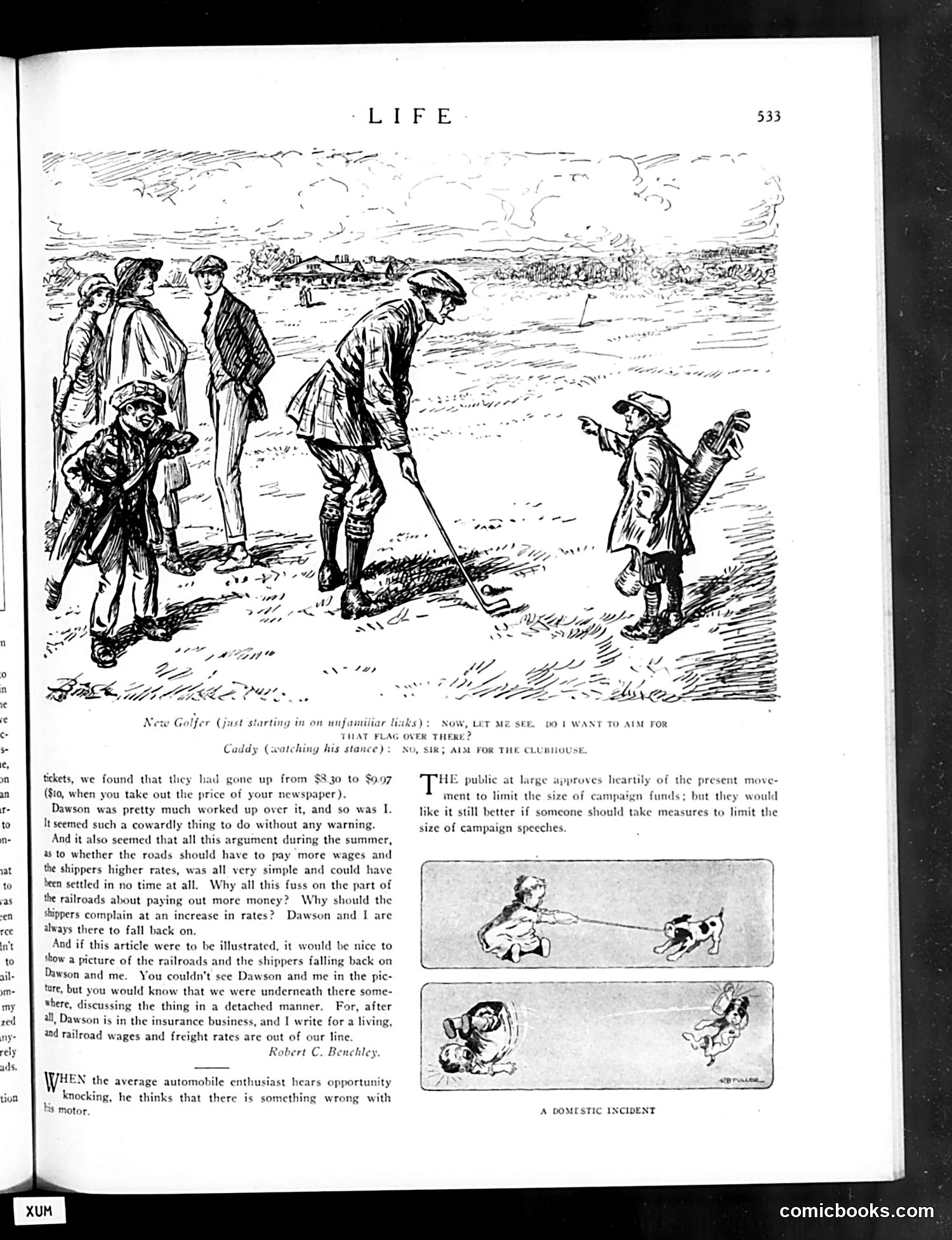
The top cartoon depicts a golf scene with well-dressed men and a caddy. The caption reads: "NEW GOLFER (just starting in on unfamiliar links): NOW, LET ME SEE. DO I WANT TO AIM FOR THAT FLAG OVER THERE? / CADDY (catching his stance): NO, SIR; AIM FOR THE CLUBHOUSE." This is a joke about a novice golfer's poor aim—the caddy sarcastically suggests aiming for the clubhouse instead of the flag, implying the beginner is so inept he'd likely send the ball flying in a completely wrong direction anyway. Below, there's a section titled "A DOMESTIC INCIDENT" showing cartoon vignettes, though details are unclear from the image quality. The page also contains text about campaign finance and railroad wages by Robert C. Benchley.
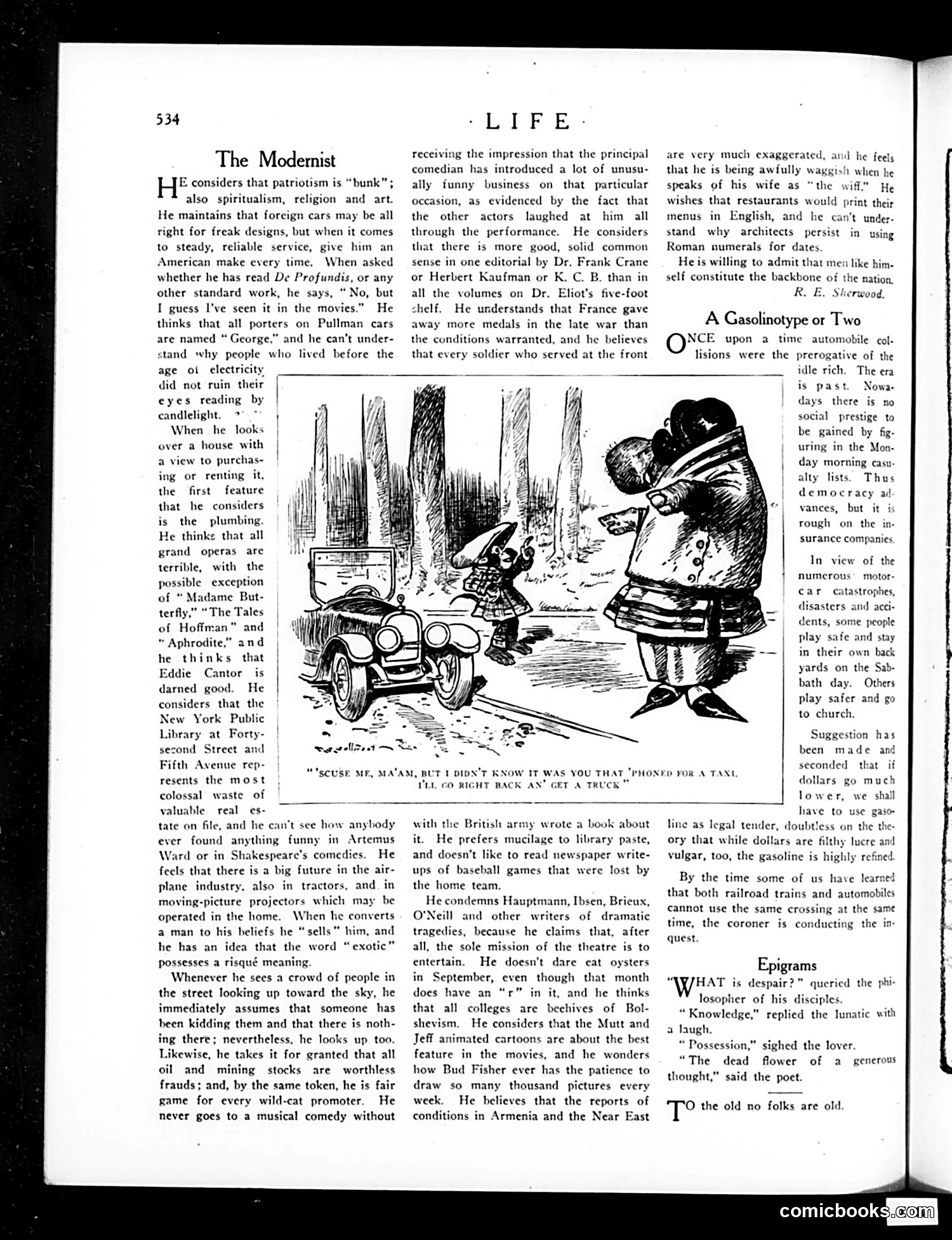
The main cartoon depicts a wealthy woman in an elaborate hat stopping a small child in a toy car, with the caption: "Scuse me, ma'am, but I didn't know it was you that phoned for a taxi. I'll go right back an' get a truck." **The Joke:** This is satire about class and automobile culture. A woman—likely upper-class, given her ornate dress and commanding presence—has mistaken a child's toy vehicle for a taxi. The child's response mockingly suggests she's so large or demands so much space that she actually needs a "truck" rather than a regular taxi. It's a visual gag about wealthy women's perceived size, pretension, or excessive needs during the early automobile era. The humor relies on the absurdity of the situation and social commentary about the wealthy's disconnection from ordinary reality.
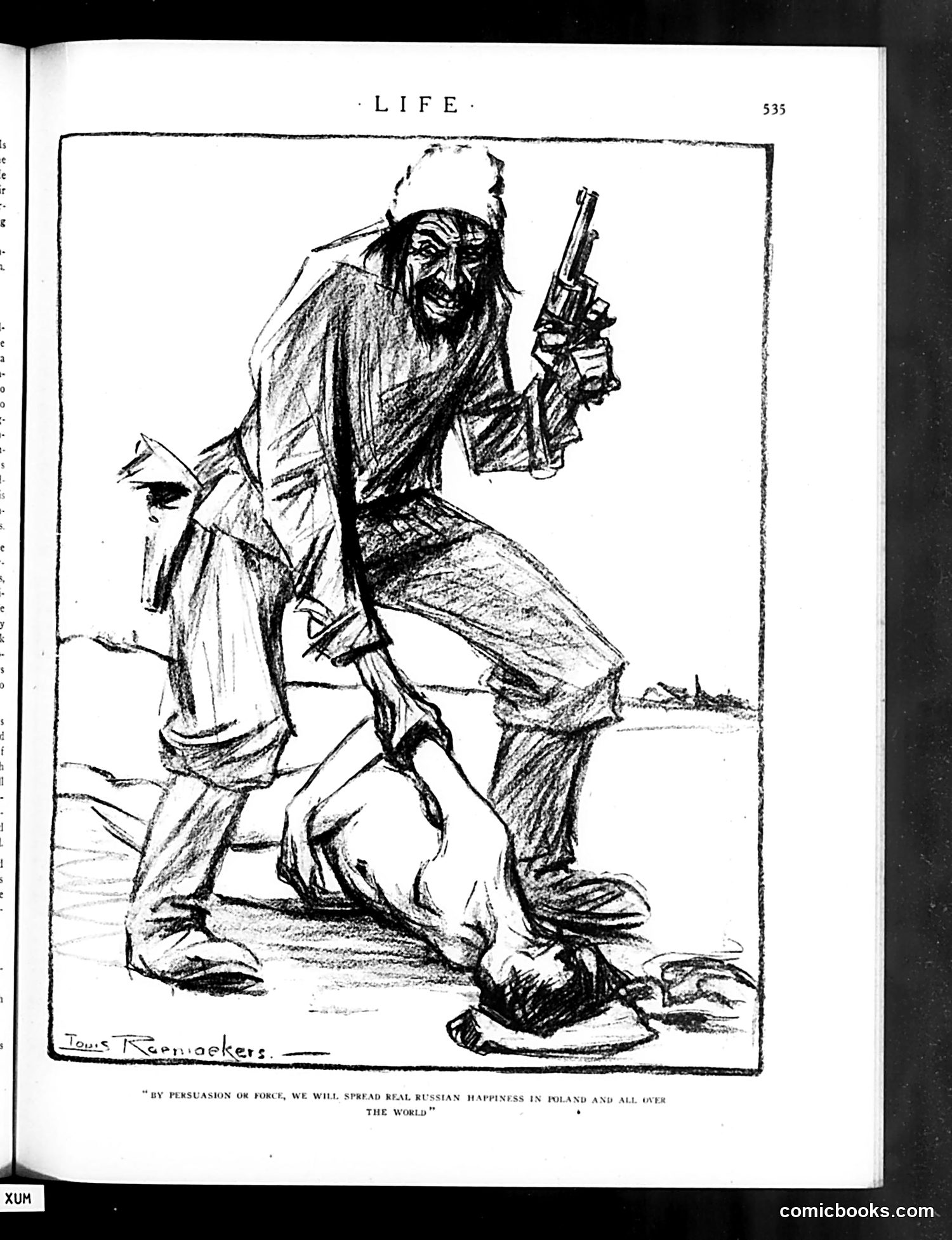
This is a satirical cartoon by Rollin Kirby titled "Tonis Roguiackers" (or similar - OCR unclear). It depicts a menacing, caricatured figure holding a revolver, representing Russian Bolshevism or communist aggression. The quote below reads: "By persuasion or force, we will spread real Russian happiness in Poland and all over the world." The cartoon sarcastically critiques Soviet threats to expand communist ideology across Europe, particularly into Poland, which had recently gained independence after WWI. The grotesque portrayal of the Russian figure and the emphasis on "force" and "happiness" (ironically presented) conveys Life magazine's anti-Bolshevik stance during the early Cold War tensions of the 1920s-1930s. The weapon emphasizes the threat posed by Soviet expansionism.
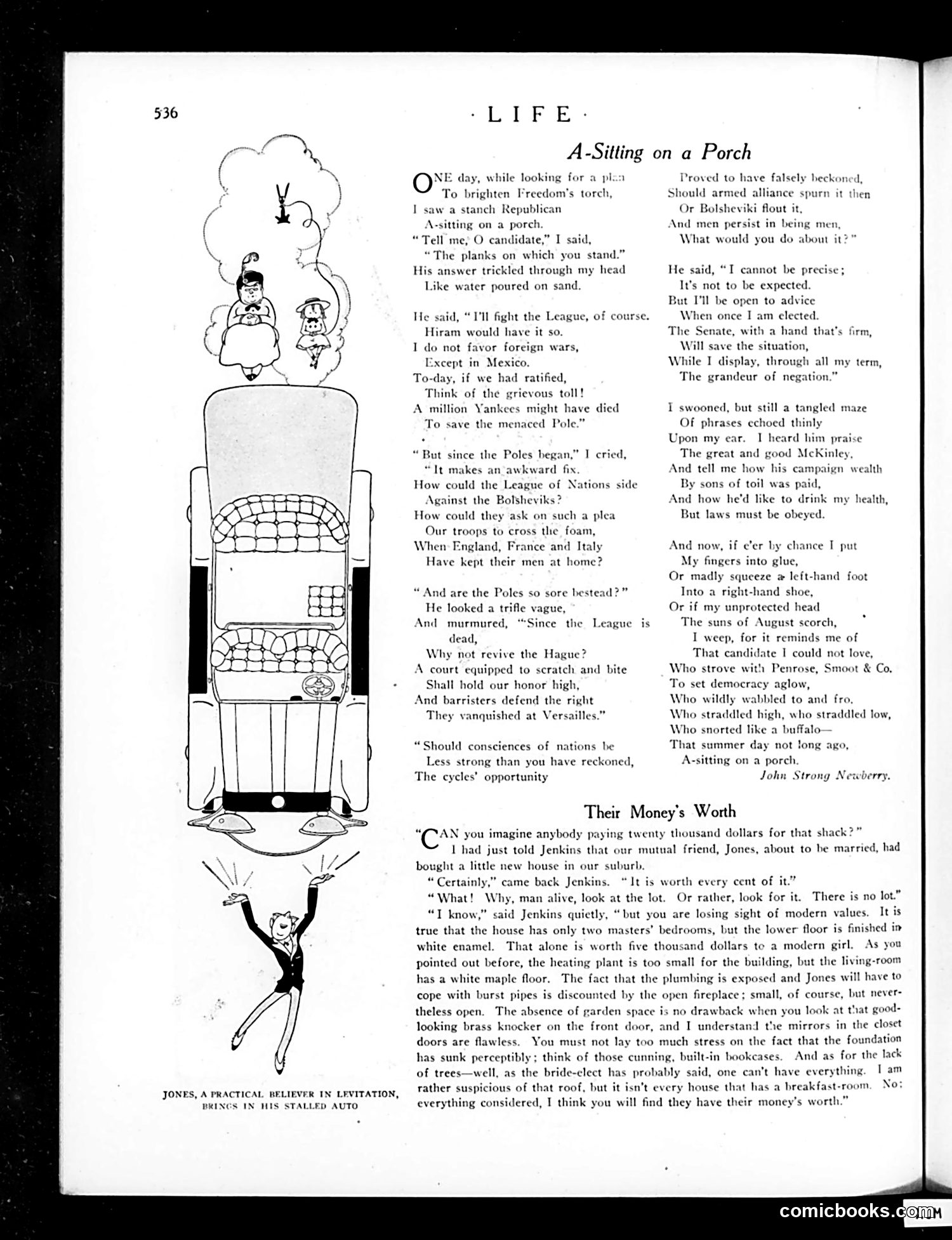
This poem by John Strong Newberry satirizes an unnamed Republican candidate discussing his political platform while sitting on a porch. The candidate claims he "cannot precise" his positions until elected, promising vague action through "negation" rather than concrete policy. The cartoon (left) shows two figures sitting atop a tall structure—likely representing the candidate elevated by his supporters. Below, a figure appears to be doing a handstand, possibly satirizing the awkwardness or instability of the candidate's position. The satire targets political evasion: a candidate refusing to articulate clear positions before election, instead offering platitudes about saving democracy and obeying laws while dodging specifics. This was apparently a common frustration with early 20th-century political campaigns.
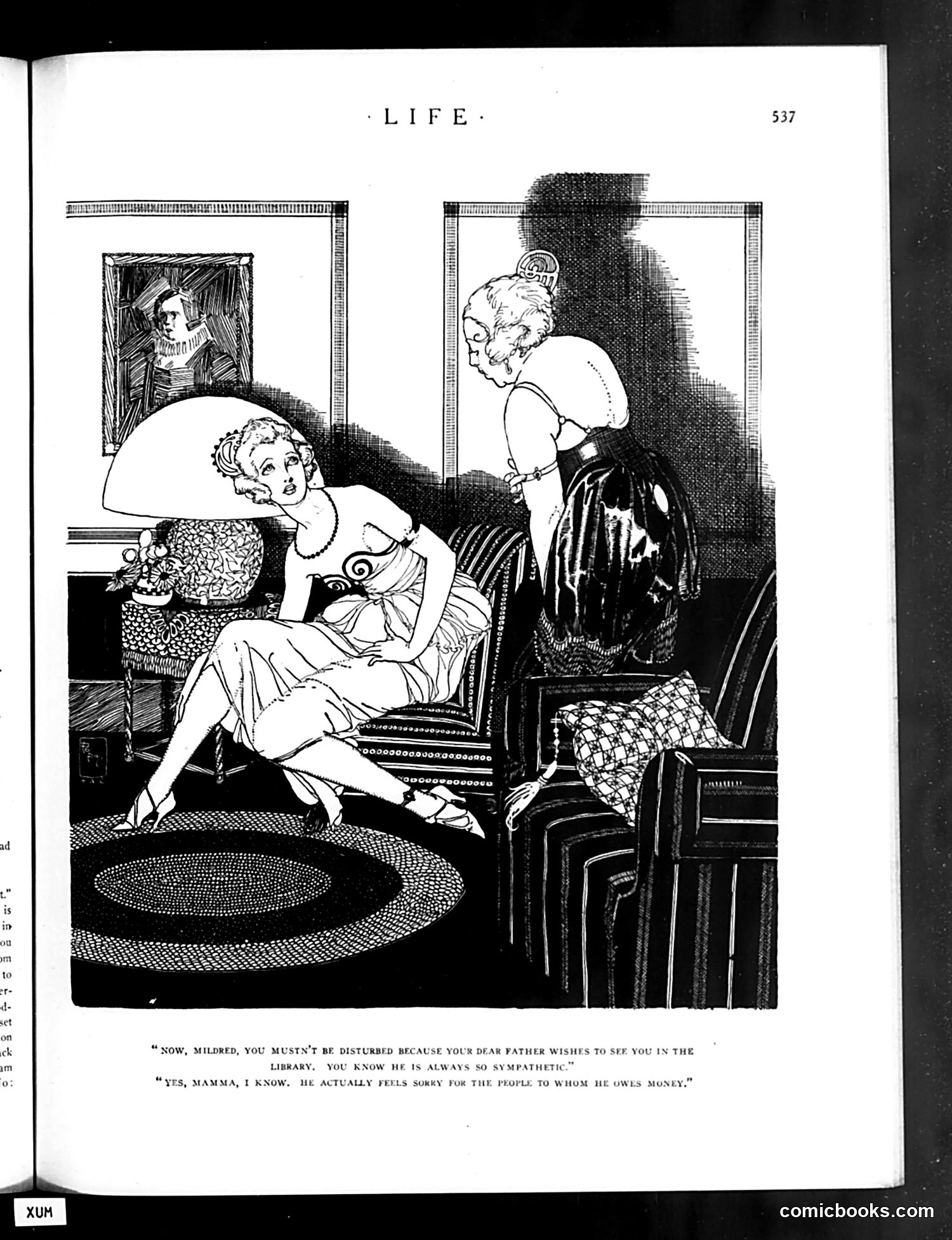
This satirical illustration depicts a domestic scene mocking hypocrisy about sympathy and morality. A mother consoles her daughter "Mildred" before meeting their father in the library, assuring her of his sympathetic nature. The daughter's response reveals the satire: she sarcastically notes the father feels "sorry for the people to whom he owes money"—implying he's a debtor who claims emotional sensitivity while avoiding financial obligations. The cartoon critiques wealthy individuals who present themselves as compassionate and understanding while neglecting their debts. The Art Deco styling and fashionable clothing suggest upper-class subjects, making the social commentary sharper: even the privileged pretend virtue while shirking responsibility. The joke targets the disconnect between professed morality and actual conduct.
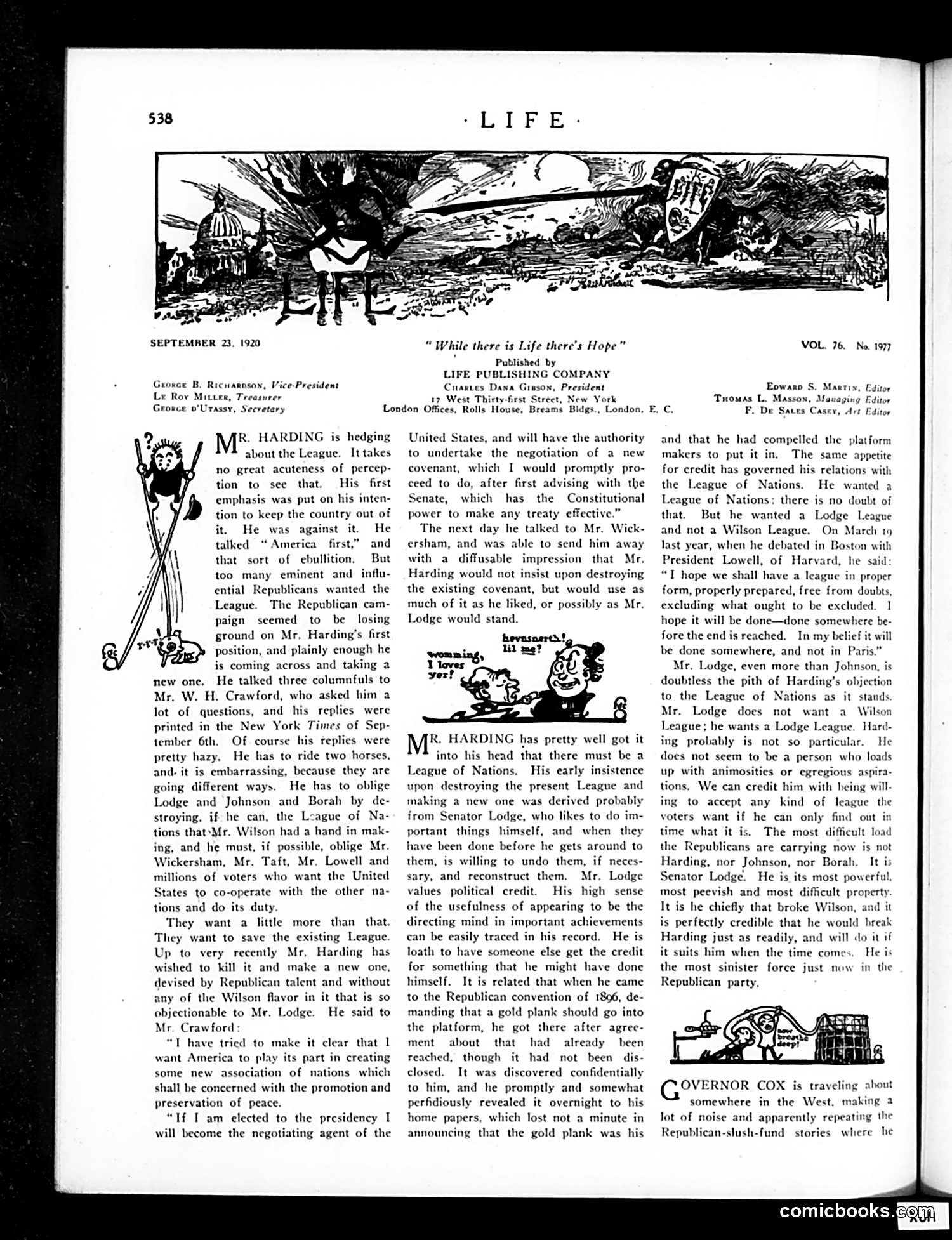
This 1920 *Life* magazine editorial cartoon critiques Republican presidential candidate Warren G. Harding's flip-flopping stance on the League of Nations. The text reveals Harding initially opposed the League (advocating "America first"), but as Republican support for it grew, he shifted position to avoid losing votes. The satire highlights Harding's political duplicity: he told different audiences contradictory things—telling one interviewer he'd create a "new covenant" while implying to another he'd preserve Wilson's existing League. The piece mocks his attempts to "ride two horses going different ways," pleasing both anti-League Republicans (like Senator Lodge) and pro-League voters. The cartoons appear to show Harding caught between conflicting positions. The underlying critique is that Harding prioritizes political expediency over principle, making vague promises to win the election.
This page discusses contemporary political debates, particularly regarding Britain's labor movement and governance. The text references the "hunger-striking mayor of Cork"—likely **Terence MacSwiney**, an Irish republican imprisoned by Britain, whose 1920 death by starvation became a major political event. The cartoons appear to satirize politicians and labor disputes, though specific figures are difficult to identify clearly in reproduction. The main points concern: 1. **British Labor Party power**: Whether laborites or Parliament will control British governance, with miners demanding ownership of coal mines 2. **Irish independence**: The unresolved question of Irish self-rule versus British dominion control 3. **American labor implications**: Suggesting British labor unrest could inspire similar American worker demands The text expresses concern that MacSwiney needs better nutrition to survive his imprisonment, noting absurdly that some believed magical "currents" could sustain him—mocking both his treatment and contemporary pseudoscience claims about sustenance without food.
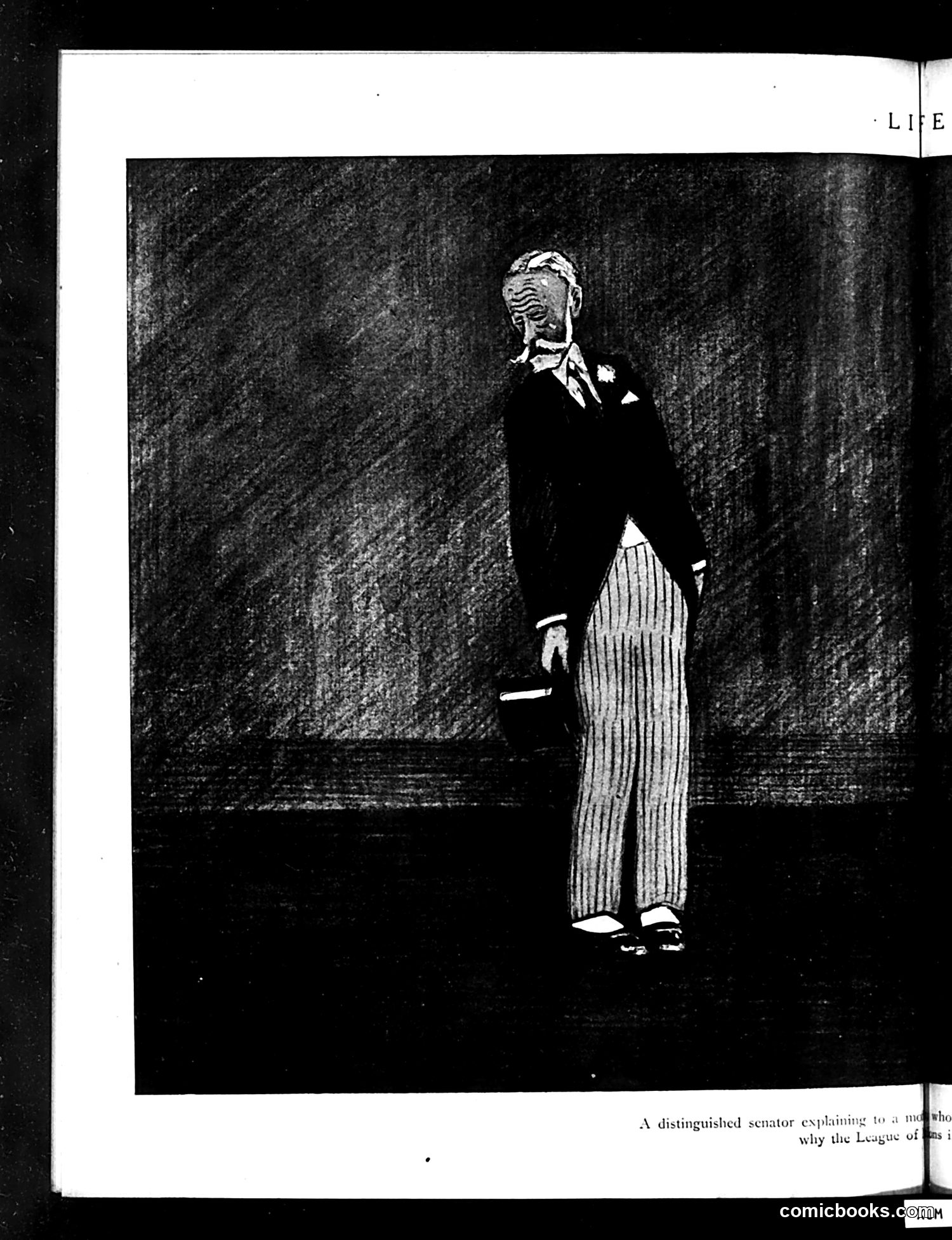
This page from *Life* magazine shows a well-dressed senator in formal attire (tuxedo and striped trousers) gesturing while speaking. The caption indicates he is "explaining to a [audience member, text cut off] why the League of [Nations, text cut off]." This satirizes early 20th-century debates over U.S. involvement in the League of Nations. The cartoon likely mocks senators who opposed or had to justify their position on League membership—a deeply divisive political issue of the era. The senator's formal dress and gesture suggest pompous political rhetoric, implying the explanation involves self-serving justifications rather than substantive reasoning. The incomplete caption prevents identifying the specific senator or fully understanding the joke's target, but the overall theme criticizes political spin around this major foreign policy question.
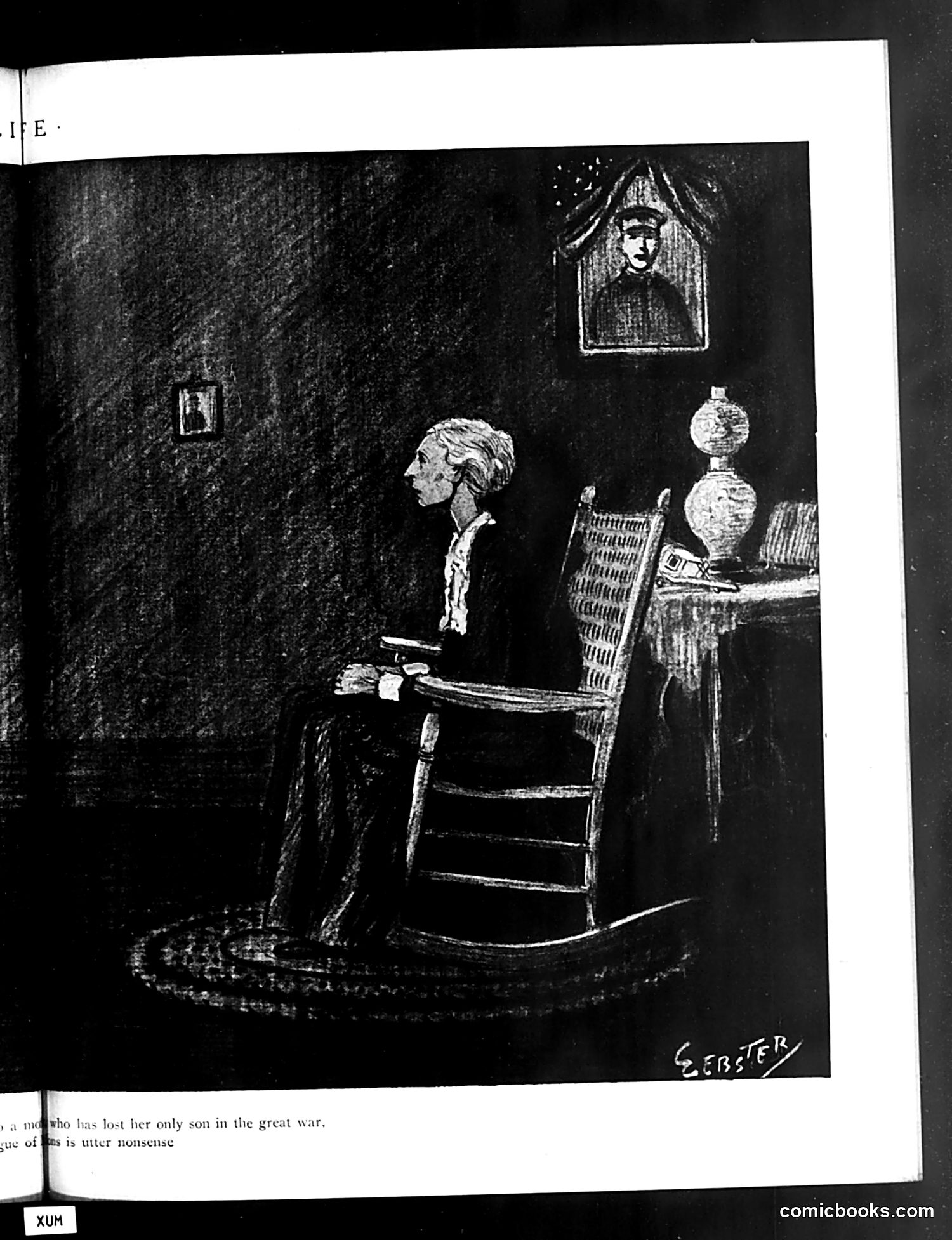
This cartoon depicts an elderly woman in dark clothing sitting in a rocking chair, gazing at a portrait of a young man on the wall above her. The incomplete OCR text references "a mother who has lost her only son in the great war" and describes something as "utter nonsense." The cartoon appears to be a poignant commentary on maternal grief during World War I. The woman's solemn pose and the prominent portrait suggest themes of loss and remembrance. The accompanying text fragment seems critical—likely mocking insensitive or dismissive attitudes toward a grieving mother's suffering. Without the complete caption, the specific target of the satire remains unclear, but this appears to critique either callous public indifference to war casualties or perhaps propaganda minimizing mothers' losses.
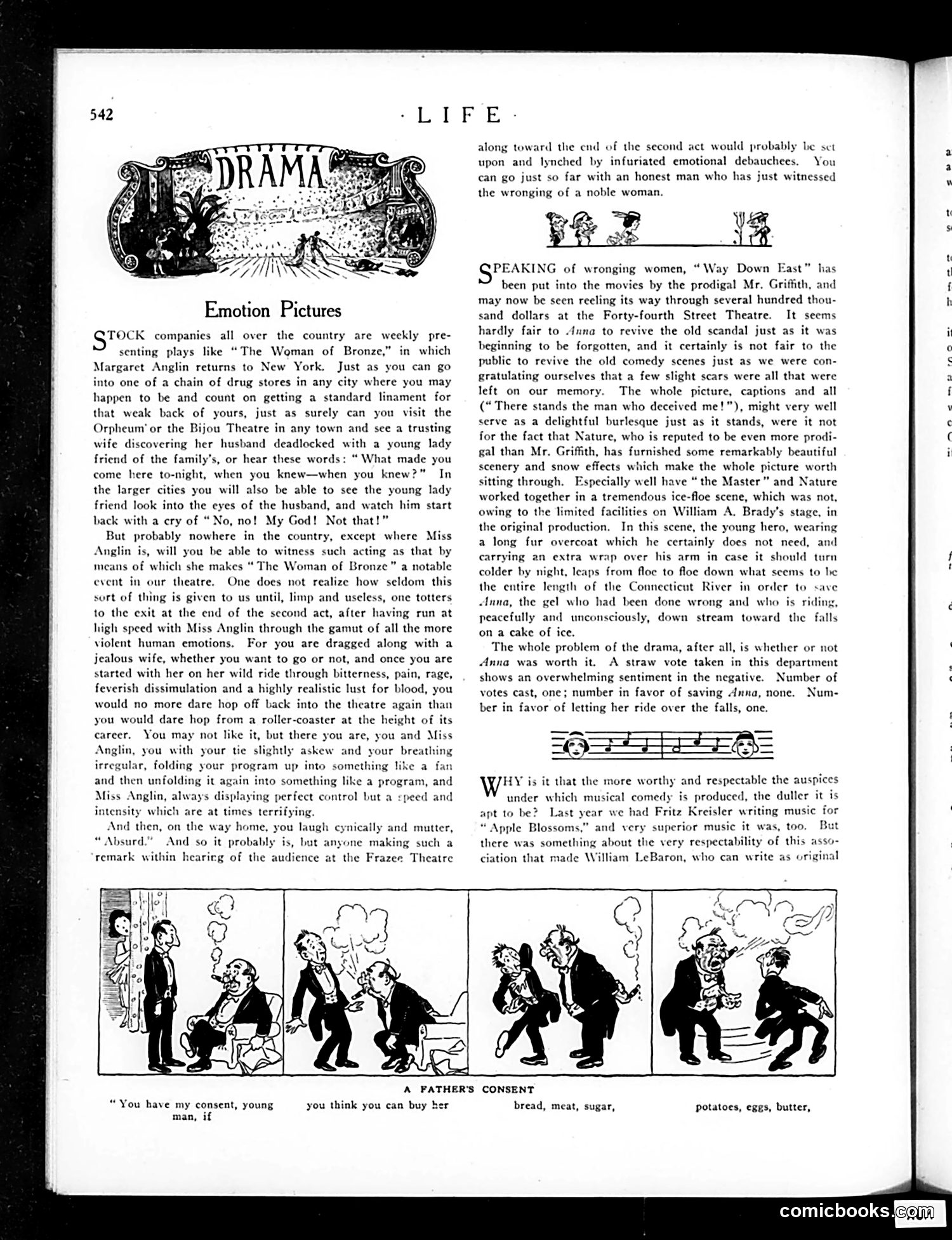
This page satirizes mass-produced theatrical melodrama. The article critiques how standardized "emotion pictures" are churned out like chain-store products across America—predictable plots featuring wronged wives discovering husbands with mistresses, all designed to manipulate audiences through exaggerated emotional manipulation. The text praises Margaret Anglin's performance in "The Woman of Bronze" as exceptional, contrasting her genuine artistry against the formula-driven mediocrity elsewhere. It also discusses D.W. Griffith's film adaptation of "Way Down East," noting the irony of reviving an old scandal while praising the natural scenery that saves the otherwise ridiculous plot. The bottom cartoon ("A Father's Consent") shows a comedic negotiation sequence—likely satirizing economic desperation or matrimonial transactions, though the specific reference is unclear without additional context. The satire's point: American entertainment factories prioritize profit over artistry, manufacturing predictable emotional responses rather than genuine theatrical experience.
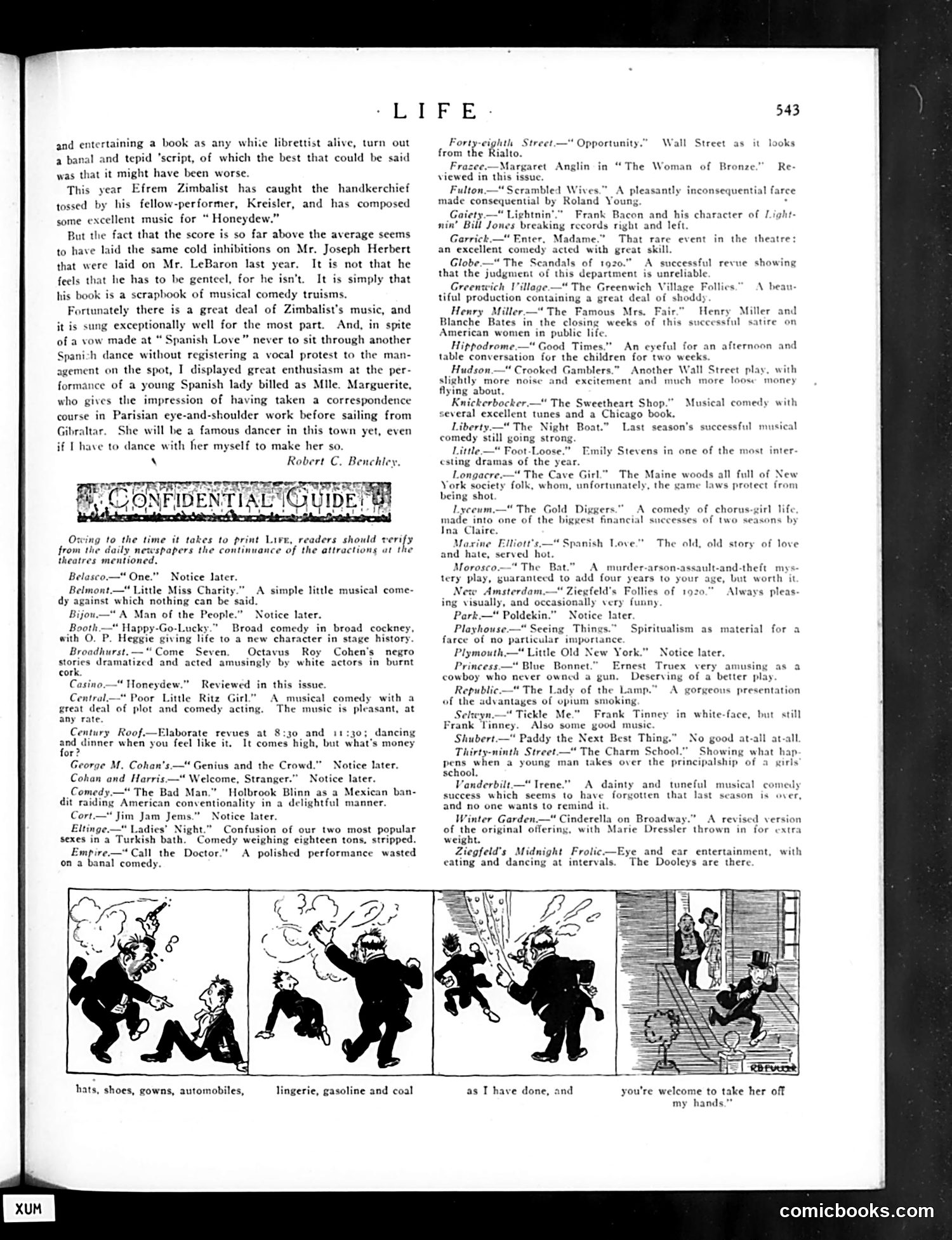
This is a theater review page from Life magazine's entertainment section. The cartoons at the bottom illustrate a humorous domestic scenario: a man juggling various household items (hats, shoes, gowns, automobiles, lingerie, gasoline, and coal) while a woman watches from a doorway. The final panel shows her saying "you're welcome to take her off my hands"—suggesting she's offering to let him manage some female figure's demands. The joke reflects 1920s gender anxieties: the man is overwhelmed by the material demands and chaos of modern domestic/consumer life, while the woman appears indifferent or relieved to pass responsibility to him. It's likely satirizing either marital dynamics or the contemporary "new woman" stereotype of the Jazz Age. The page itself is primarily theater listings and reviews by Robert C. Benchley, covering Broadway productions from that season.
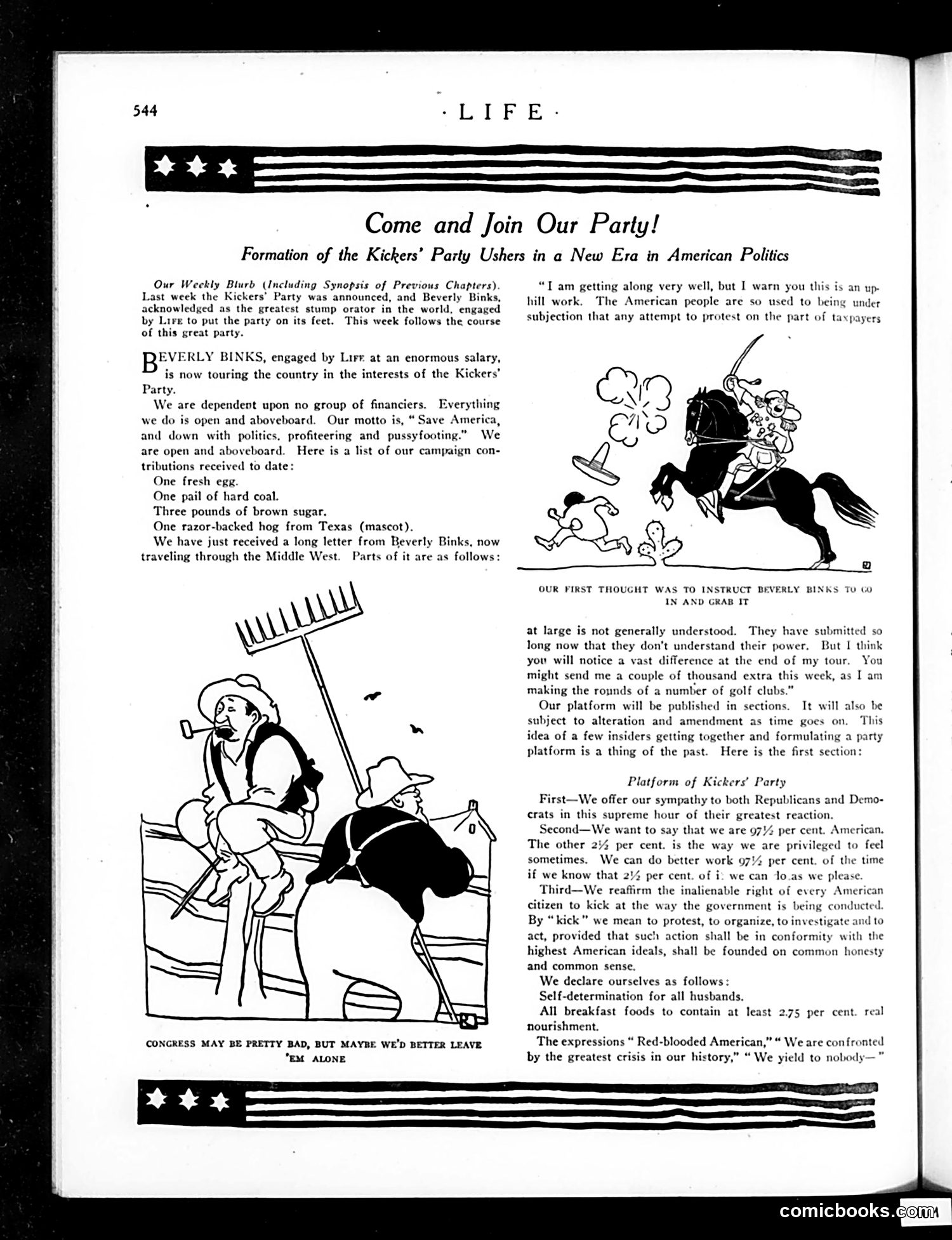
This Life magazine article satirizes a newly-formed "Kickers' Party"—a protest political movement claiming to oppose established politics and corruption. The satire works on multiple levels: **The Setup:** Beverly Binks, hired as the party's orator, tours the country promoting an "anti-politics" platform while requesting campaign funds for "golf clubs." This contradicts their stated independence from financiers. **The Joke:** Their campaign contributions consist of trivial items (an egg, coal, a hog)—mocking how poorly-organized grassroots movements actually are despite grand rhetoric. **The Political Point:** The cartoons and platform mock how protest movements adopt inflated language ("97% American," "Red-blooded American," "greatest crisis") while pursuing absurd goals (mandatory breakfast nutrition, "self-determination for husbands"). The satire suggests that anti-establishment movements, despite claiming moral superiority, often repeat empty political clichés and lack genuine substance or funding—making them ineffectual as real change agents.
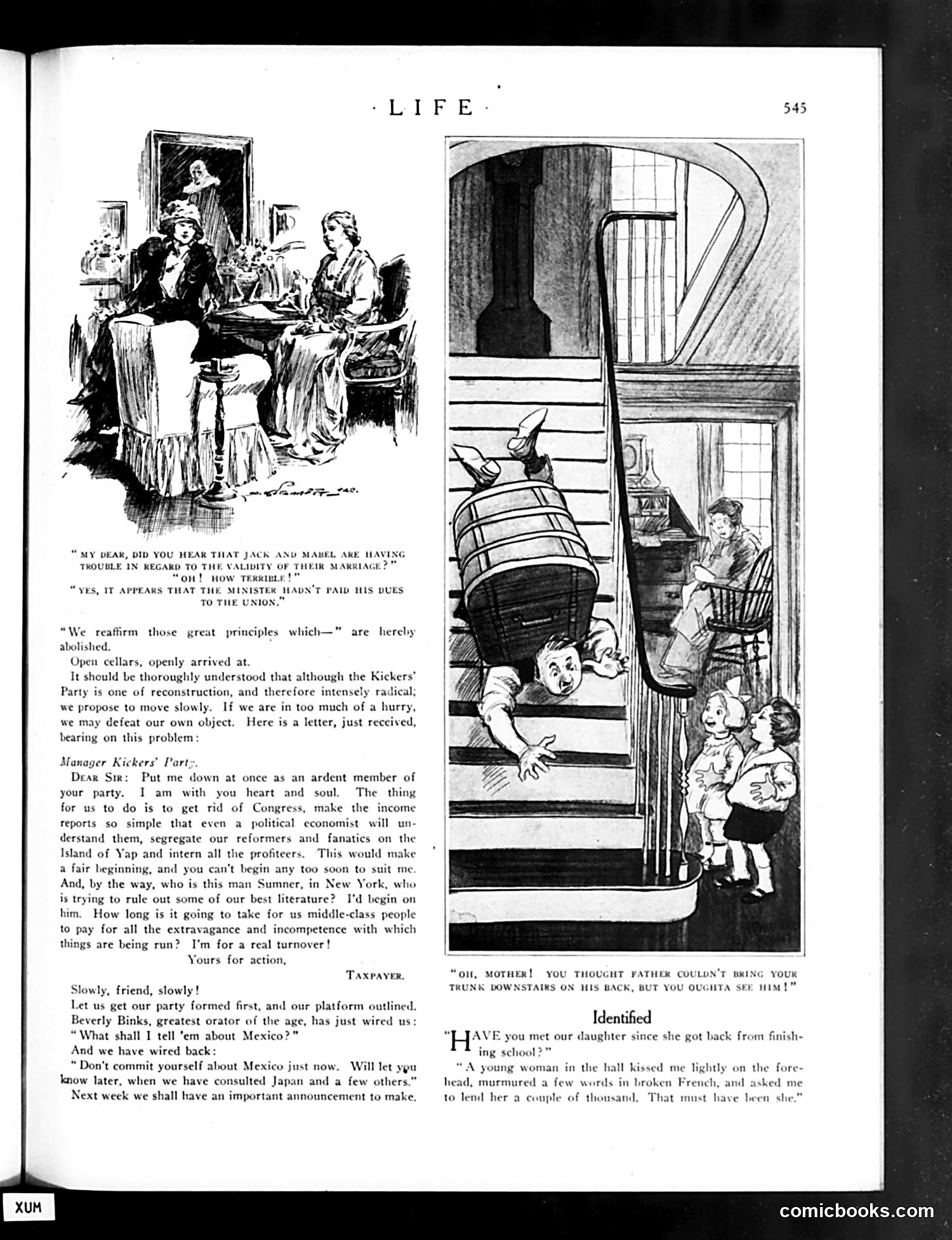
This page contains three satirical pieces mocking early 20th-century American politics and social pretension: **Top left cartoon**: Gossip about a couple's marriage validity being questioned because their minister hadn't paid union dues—satirizing bureaucratic absurdity overriding actual legitimacy. **Center section**: A mock "Kickers' Party" platform letter. The satire targets radical reformers who demand sweeping change (abolishing Congress, exiling reformers to Yap island, censoring literature) while their leadership equivocates on actual policy (Mexico). The joke: revolutionary parties full of grand rhetoric but no concrete answers. **Right cartoon**: A man struggling to carry a trunk downstairs, with caption suggesting he's improbably strong—likely satirizing either marital dynamics or working-class aspiration. **Bottom section**: A brief joke about a finished schoolgirl's only distinguishing trait being that she kisses men and borrows money—mocking vapid upper-class daughters. Overall, the page ridicules political radicalism, bourgeois pretension, and social hypocrisy through humor.
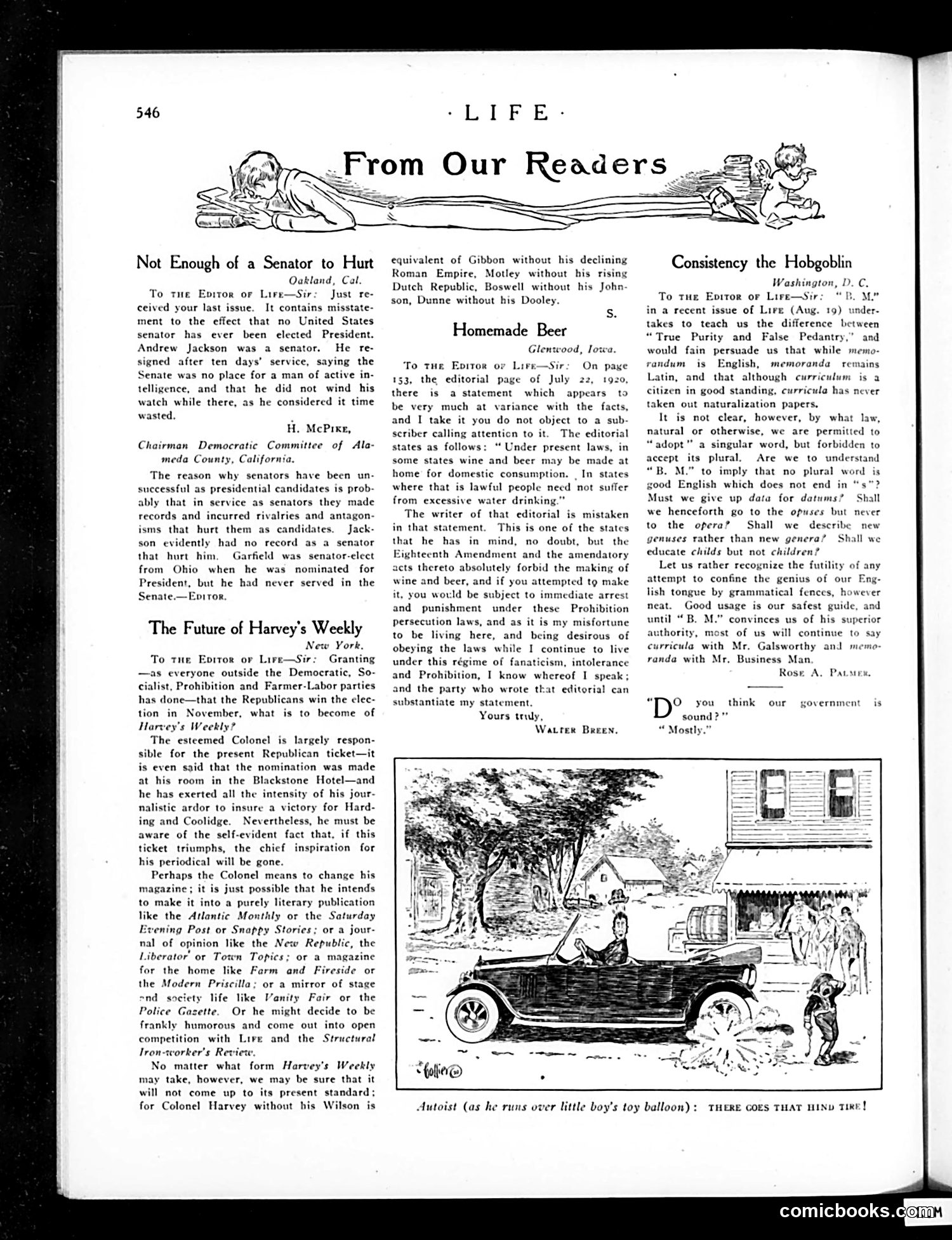
This "From Our Readers" page contains reader letters addressing political and social issues circa 1920. **Main content:** 1. **Andrew Jackson/Senators as President** - A reader corrects Life's claim that no senator became president, citing Jackson's brief senatorial service before resigning. 2. **Harvey's Weekly's Future** - A letter speculates that Colonel Harvey's political magazine (which allegedly influenced the Republican nomination of Harding-Coolidge) will lose its purpose if Republicans win the election, becoming irrelevant without a Democratic target. 3. **Prohibition Enforcement** - A reader from Iowa disputes Life's editorial suggesting homemade beer was legal in some states. The writer insists the Eighteenth Amendment (Prohibition) forbids all home beer-making and threatens arrest for violations. **The cartoon** shows a car running over a child's toy balloon with caption "THERE GOES THAT HIND TIRE!" - likely satirizing careless danger or waste. These letters reflect early 1920s political divisions, Prohibition debates, and media influence concerns.
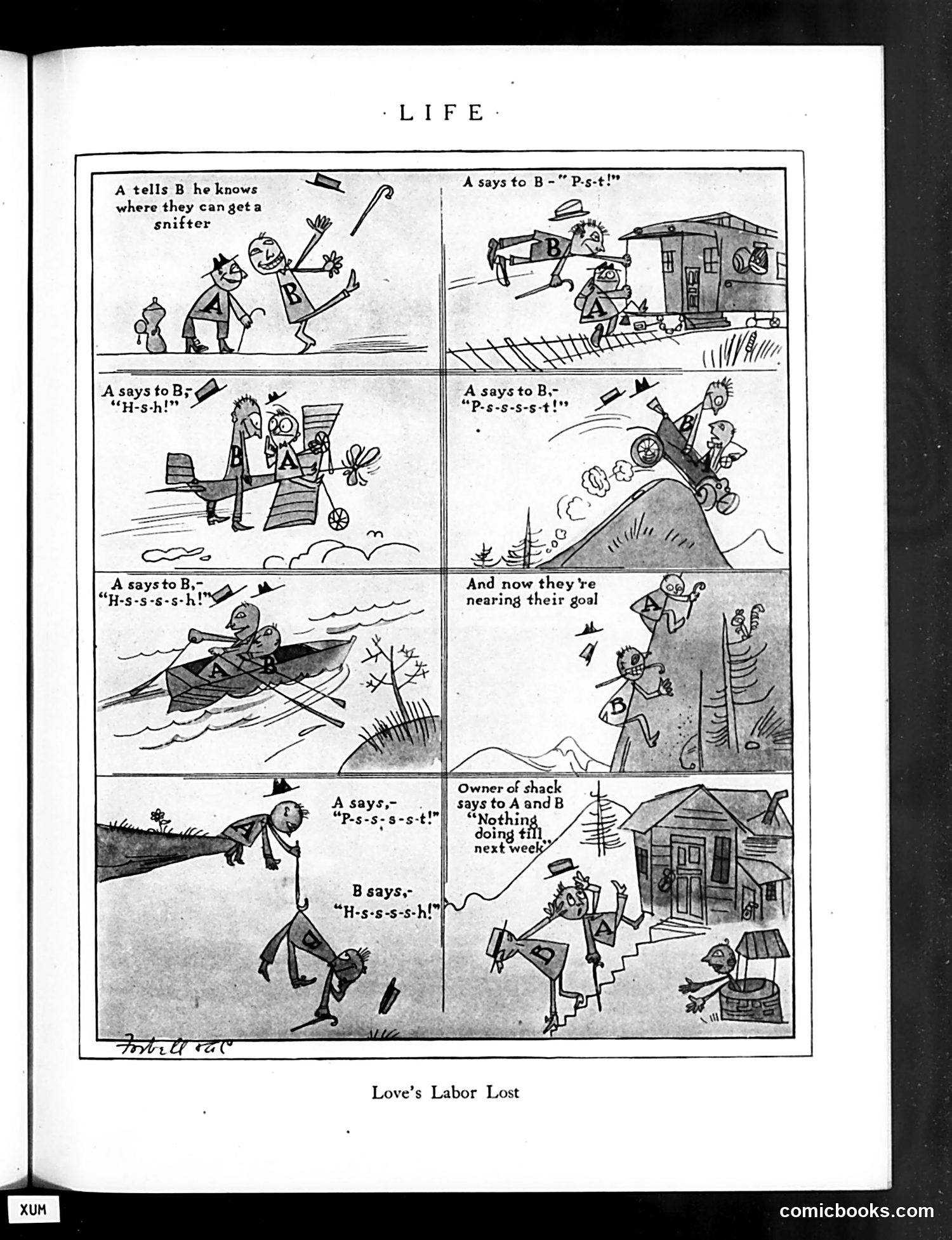
This satirical comic strip mocks Prohibition-era bootlegging. Two men (A and B) communicate in hushed whispers and sibilant sounds ("psst," "shh") as they navigate a comical quest to find illegal alcohol—a "snifter" (drink). The humor traces their increasingly elaborate journey: they whisper directions, travel by car and boat, climb a hill, and finally reach a ramshackle shack. The owner's punchline—"Nothing doing till next week"—deflates their entire effort. The title "Love's Labor Lost" (Shakespeare reference) emphasizes the wasted energy spent circumventing Prohibition laws. The comic satirizes how widespread and absurd bootlegging had become, with ordinary citizens engaging in elaborate, secretive schemes simply to obtain alcohol. The exaggerated whispering and tiptoeing mock both the conspiratorial atmosphere Prohibition created and the futility of the endeavor.
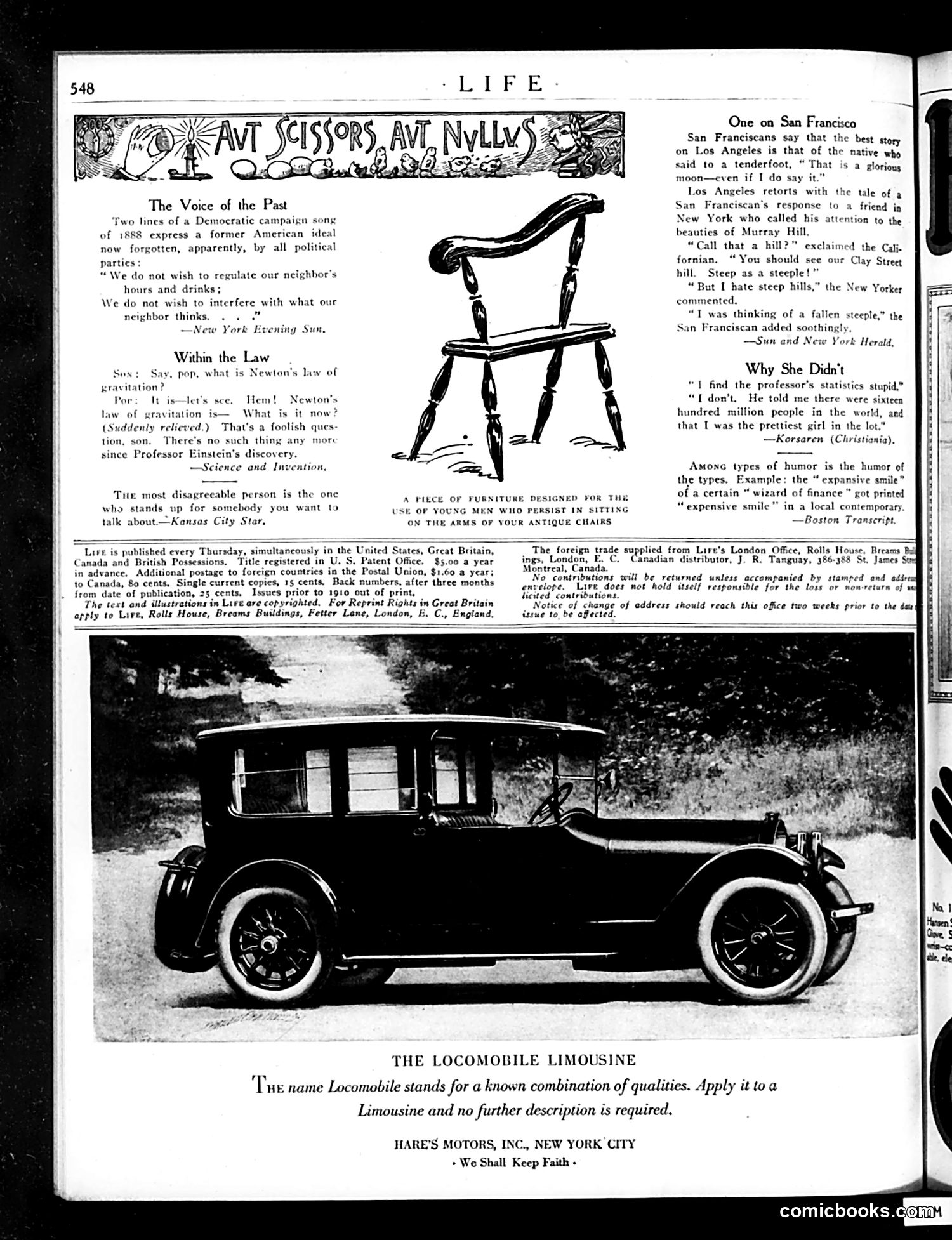
This page from *Life* magazine contains several short satirical pieces typical of the publication's humor: **"The Voice of the Past"** critiques modern political parties for abandoning 19th-century Democratic ideals about personal liberty and non-interference in private matters. **"Within the Law"** is a joke about Einstein's theory of relativity making Newton's laws of gravitation "obsolete"—poking fun at how quickly scientific authority was being overturned in the modern era. **"One on San Francisco"** presents a regional humor exchange between San Francisco and Los Angeles, with exaggerated claims about steep hills. **"Why She Didn't"** is a joke about a woman rejecting a professor's statistics lecture, but finding his claim that she's "the prettiest girl" more persuasive than his data. The page also includes a furniture advertisement (a chair designed to prevent men from sitting on antique armrests) and an ad for a Locomobile limousine. These reflect early 20th-century domestic concerns and automotive marketing.
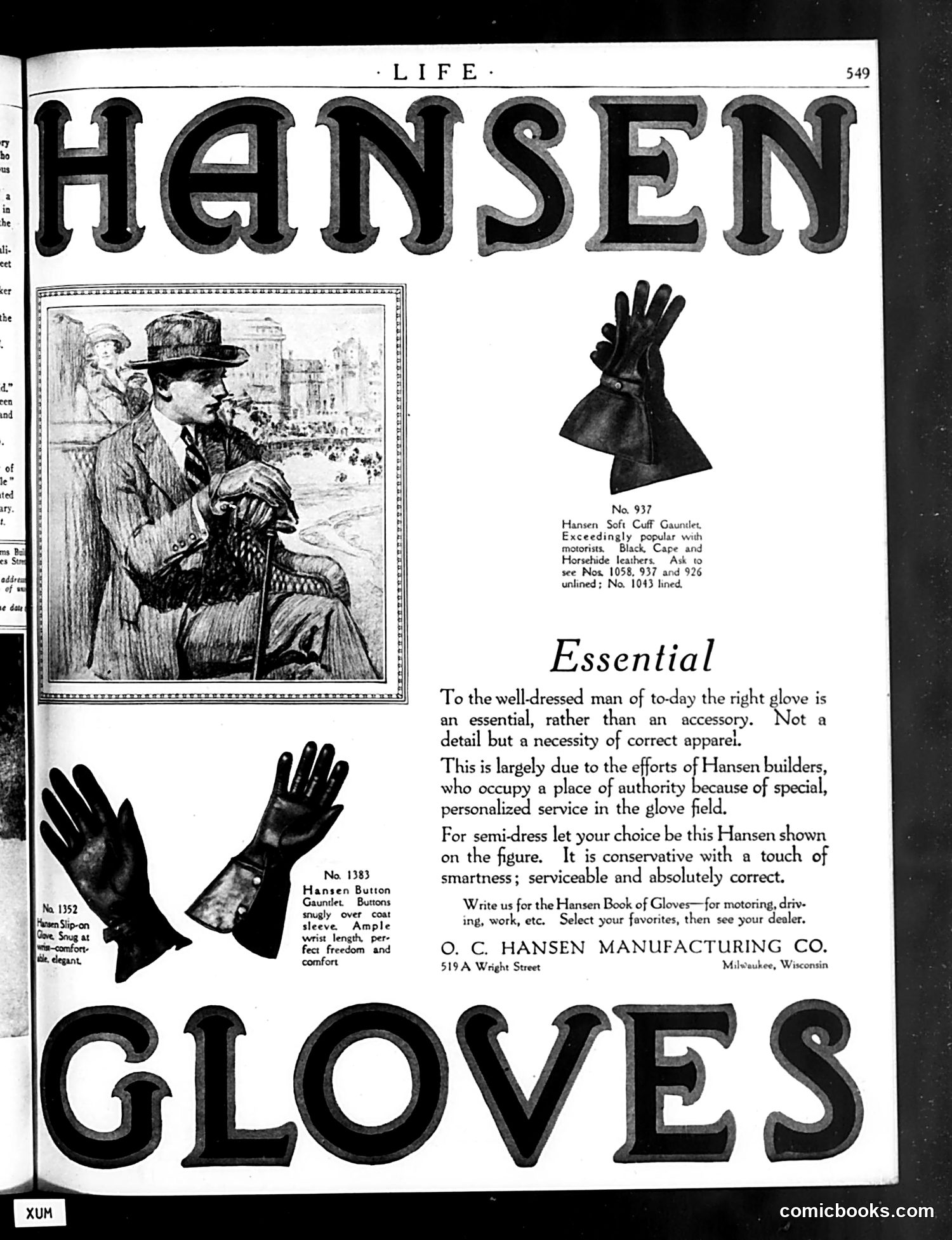
This page is primarily a **product advertisement**, not political satire. It promotes O.C. Hansen Manufacturing Company's gloves from Milwaukee, Wisconsin. The illustration at top left depicts two well-dressed men in early 20th-century attire (suits, hats) examining gloves, establishing the product's association with gentlemanly sophistication. The ad emphasizes that quality gloves are "essential" to proper dress for "the well-dressed man of to-day"—positioning them as a necessity rather than luxury. The page displays specific glove styles: No. 937 (soft cuff gauntlet for motorists), No. 1383 (button gauntlet), and No. 1352 (slip-on). The marketing strategy targets different activities (motoring, driving, work), suggesting Hansen's competitive advantage through "special, personalized service in the glove field." This reflects early 1900s consumer culture emphasizing correct social presentation through quality accessories.
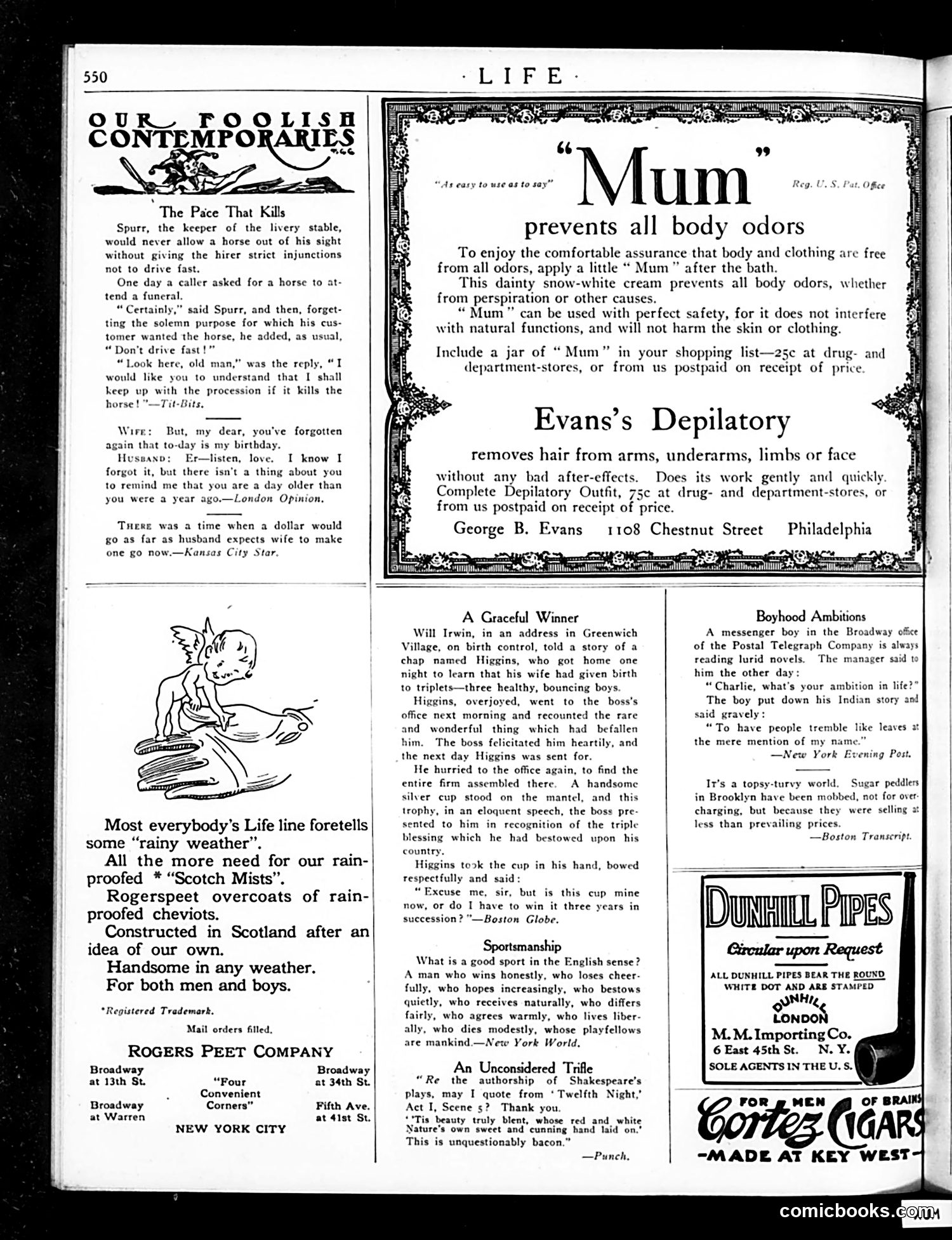
This page features several short humorous anecdotes typical of *Life* magazine's satirical content. **"The Pace That Kills"** mocks a overly cautious livery-stable keeper (Spurr) who obsessively warns renters against fast driving—even when the renter needs to attend a funeral procession, where staying with the group matters more than safety. The other brief jokes target domestic life: a husband forgetting his wife's birthday and claiming nothing about her has changed in a year (she's not visibly aged); and commentary on inflation—husbands expect wives to stretch dollars further than economically possible. **The advertisements** reflect early 20th-century feminine concerns: "Mum" deodorant (body odors being a social embarrassment), Evans's hair-removal cream (depilation), and Rogerspeet raincoats. These ads reveal anxieties about appearance and hygiene marketed to women. The anecdotes about Higgins' triplets and sportsmanship are generic wit without specific historical reference.
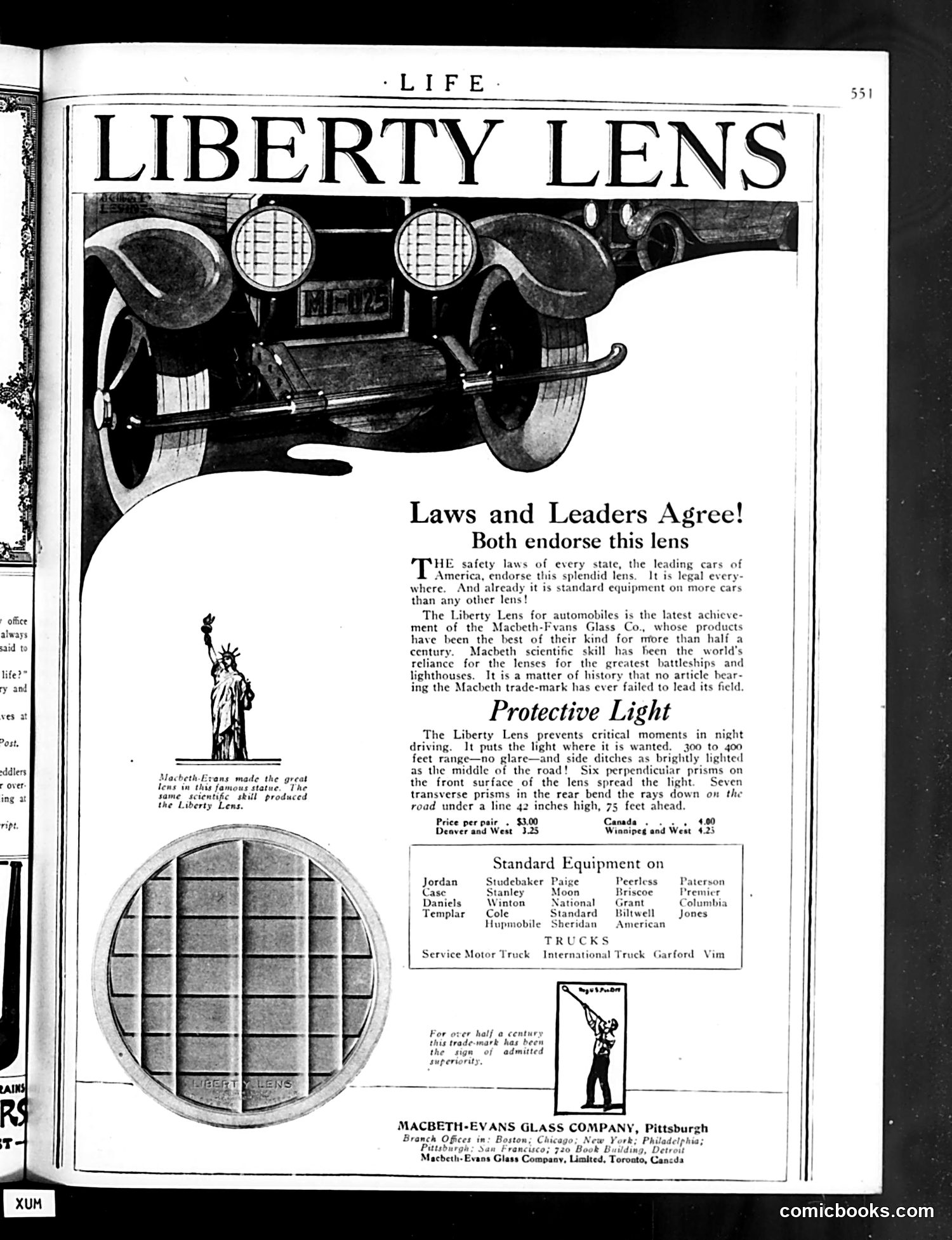
This is primarily a **product advertisement**, not political satire. The Macbeth-Evans Glass Company promotes their "Liberty Lens" automobile headlight using patriotic imagery and claims of widespread endorsement. The **Statue of Liberty reference** appears decorative rather than satirical—the company claims the same craftsmen who made the famous statue's lens now produce their automotive product, implying superior quality and American excellence. The "Laws and Leaders Agree" headline suggests regulatory and industry endorsement, listing numerous car manufacturers as standard equipment users. This was common advertising strategy for automotive products in this era. The **technical specifications** describe the lens's safety features—reduced glare, improved visibility range, and light distribution—addressing genuine driving concerns of the early automobile age. No identifiable political figures or satirical commentary appears present. This is straightforward commercial advertising leveraging American patriotism and appeals to authority to market automotive safety equipment.
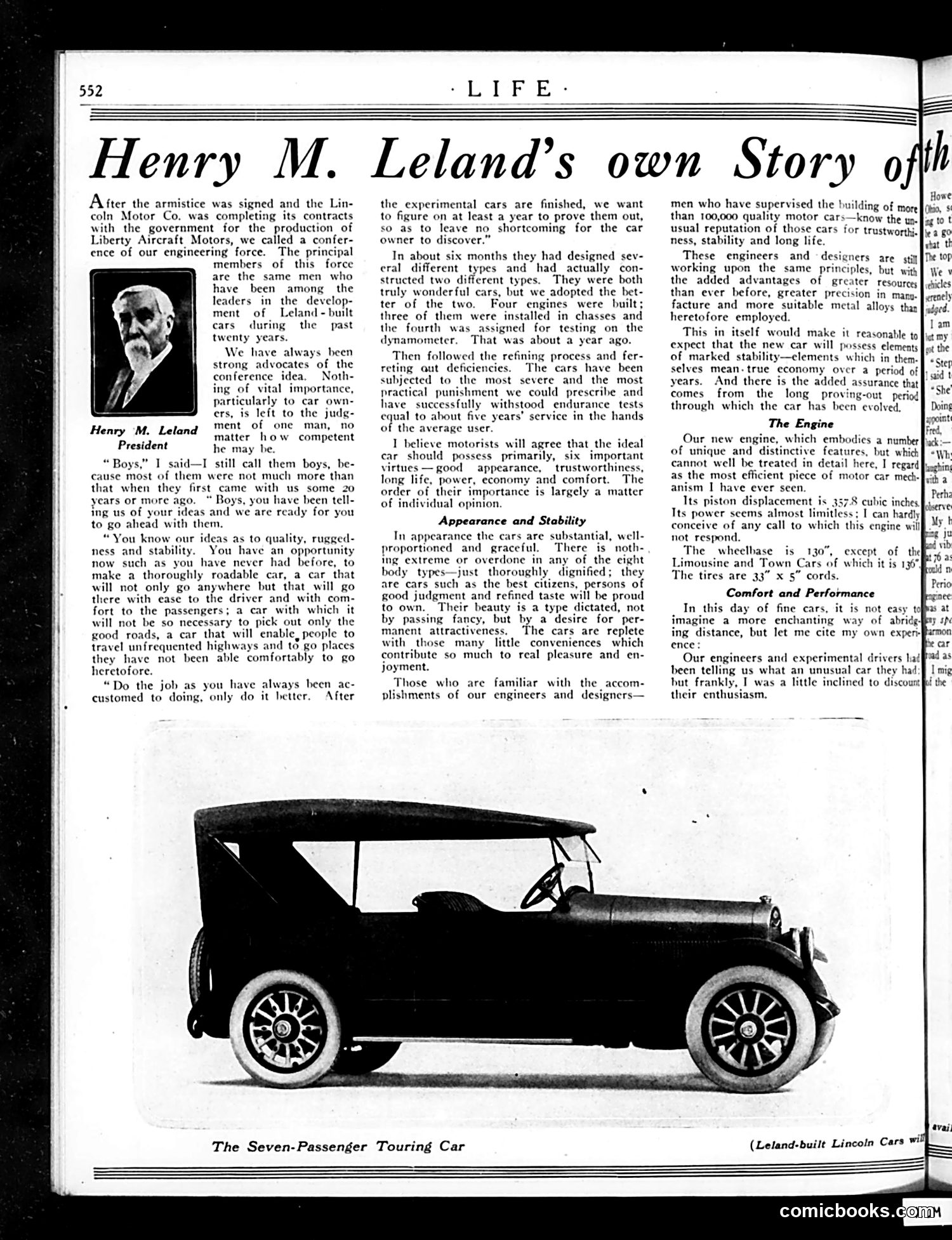
This is **not a cartoon or satire**, but rather a corporate advertisement/article from Life magazine featuring Henry M. Leland, president of the Lincoln Motor Company. The page presents Leland's account of post-WWI automobile development. After completing military aircraft engines during the war, Lincoln's engineering team designed new car models. Leland describes his management philosophy—collaborative conferences with engineers rather than individual decision-making—and outlines the six virtues he believes cars should possess: appearance, trustworthiness, longevity, power, economy, and comfort. The image shows a technical drawing of the "Seven-Passenger Touring Car," a luxury automobile meant to demonstrate Lincoln's manufacturing quality and innovation. This represents **corporate self-promotion disguised as editorial content**, a common advertising practice of the era where companies purchased space to tell their story directly to readers.
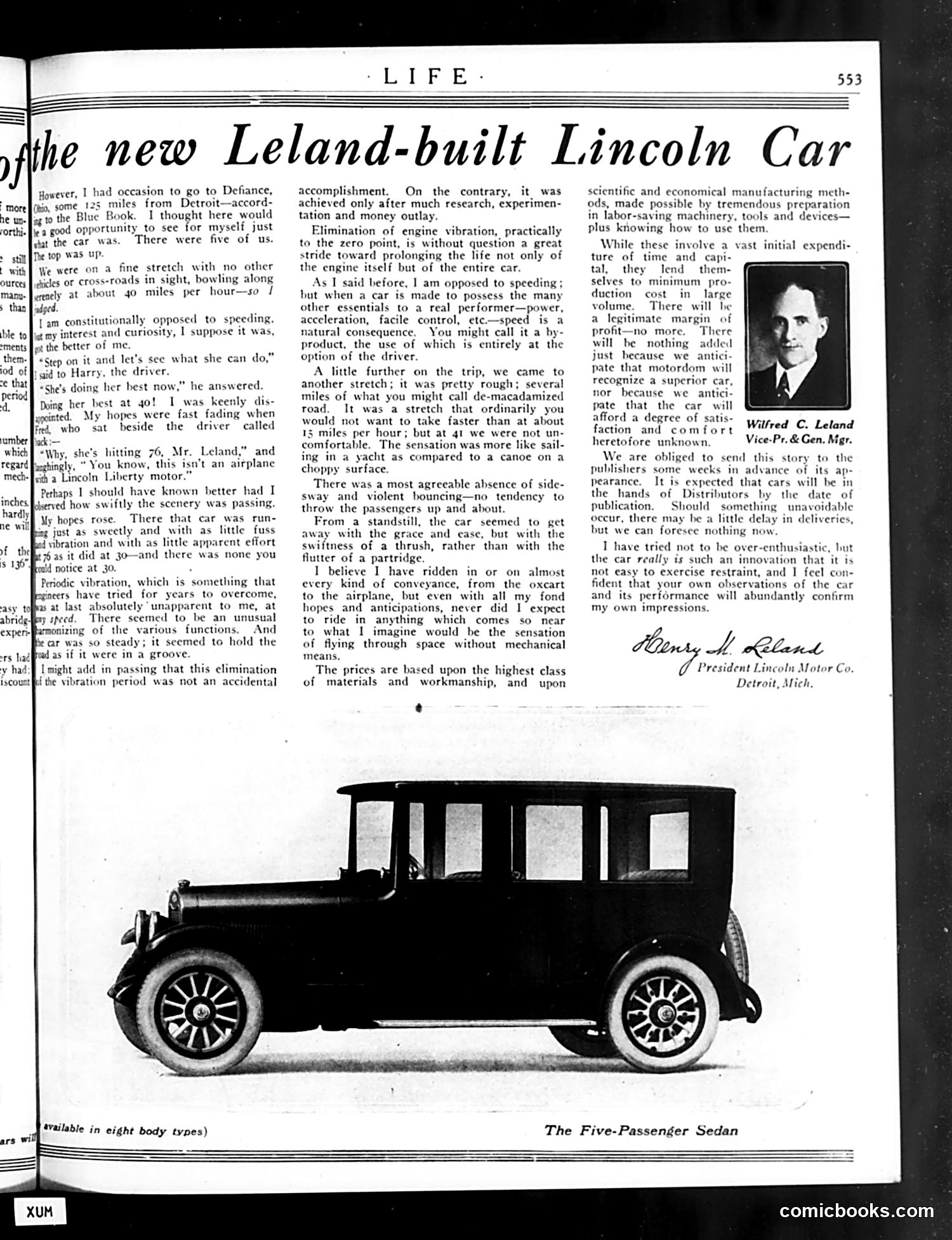
This is primarily **advertising content**, not satire or political commentary. The page features an article by Henry M. Leland, president of Lincoln Motor Co., describing his personal test drive of the new Leland-built Lincoln automobile. The text praises the car's engineering achievements—particularly the elimination of engine vibration, smooth acceleration, and stable handling at various speeds. Leland compares the driving experience to "flying through space without mechanical means" and riding in a yacht rather than a canoe. The accompanying image shows "The Five-Passenger Sedan," a formal side-profile photograph of the vehicle. **Context for modern readers:** This represents early automotive advertising that emphasizes technical innovation and luxury performance rather than style or status symbols. The detailed, first-person testimonial format was common for high-end car marketing of this era, lending credibility through the manufacturer's own endorsement.
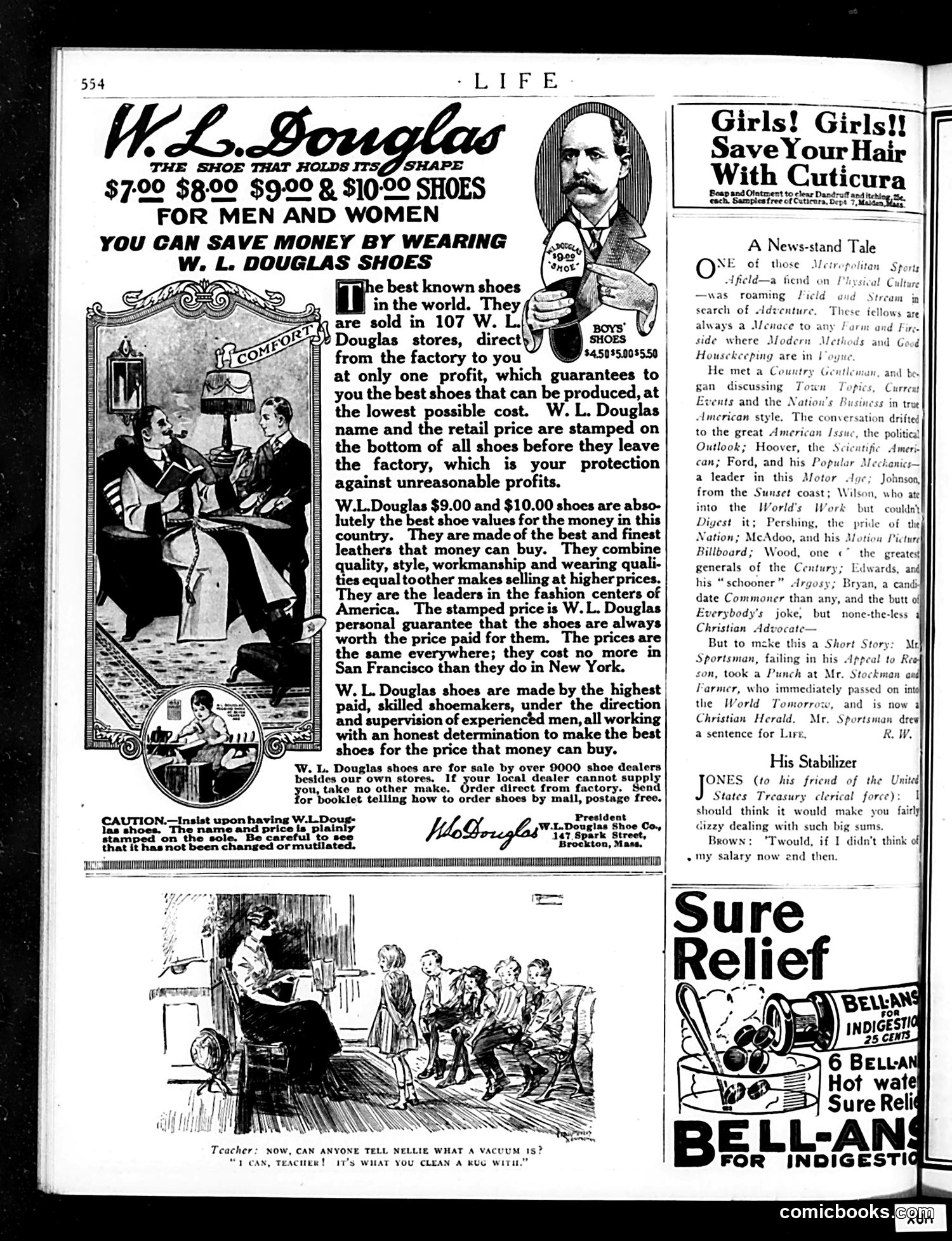
This page is primarily **advertising**, dominated by a large W.L. Douglas shoe company advertisement. The ad emphasizes direct factory-to-consumer sales at fixed prices as protection against "unreasonable profits"—a message resonating with Progressive Era concerns about fair pricing and corporate transparency. Below the shoe ad is a small **cartoon joke**: A teacher asks students what a vacuum is; a child answers "it's what you clean a rug with." The humor is simple wordplay—the child defines the object by its use rather than understanding the concept. At page bottom is a **brief comedic dialogue** between Treasury Department workers about salary ("dizzy dealing with such big sums"). The joke plays on "dizzy"—both the disorientation from handling large figures and the speaker's dismissal of concern since his own salary remains small. The remaining space contains small product advertisements (Cuticura hair product, Bell-Ans indigestion remedy) and a "news-stand tale" about a Sportsman and Farmer—content too fragmented to fully parse from the OCR. **Context:** This reflects early 20th-century magazine format mixing editorial content with dense advertising.
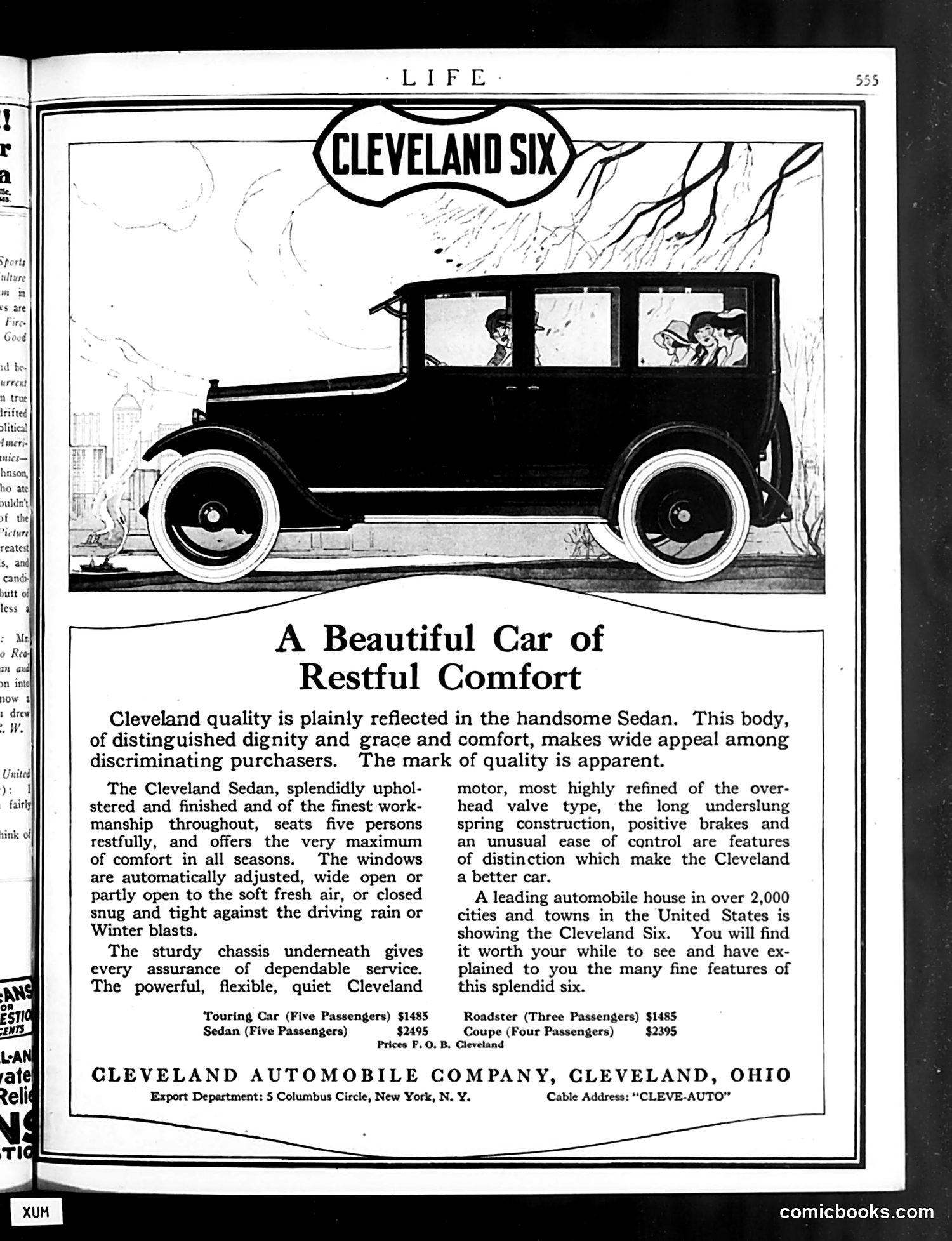
This is **not a cartoon or satire**—it's a straightforward automobile advertisement from *Life* magazine's advertising section. The page promotes the Cleveland Six, a luxury sedan manufactured by the Cleveland Automobile Company in Cleveland, Ohio. The image shows a side-profile illustration of an elegant early-1920s automobile with five passengers visible through windows. The accompanying text emphasizes quality features: comfortable seating for five, adjustable windows, sturdy chassis, refined motor, and reliable brakes. Prices range from $1,485 (touring car) to $2,495 (sedan), presented as F.O.B. Cleveland. The company notes its widespread dealer network across 2,000+ American cities. This represents typical early-automotive-era marketing emphasizing craftsmanship and comfort to "discriminating purchasers"—the affluent audience *Life* magazine targeted. There is no political or satirical content on this page.
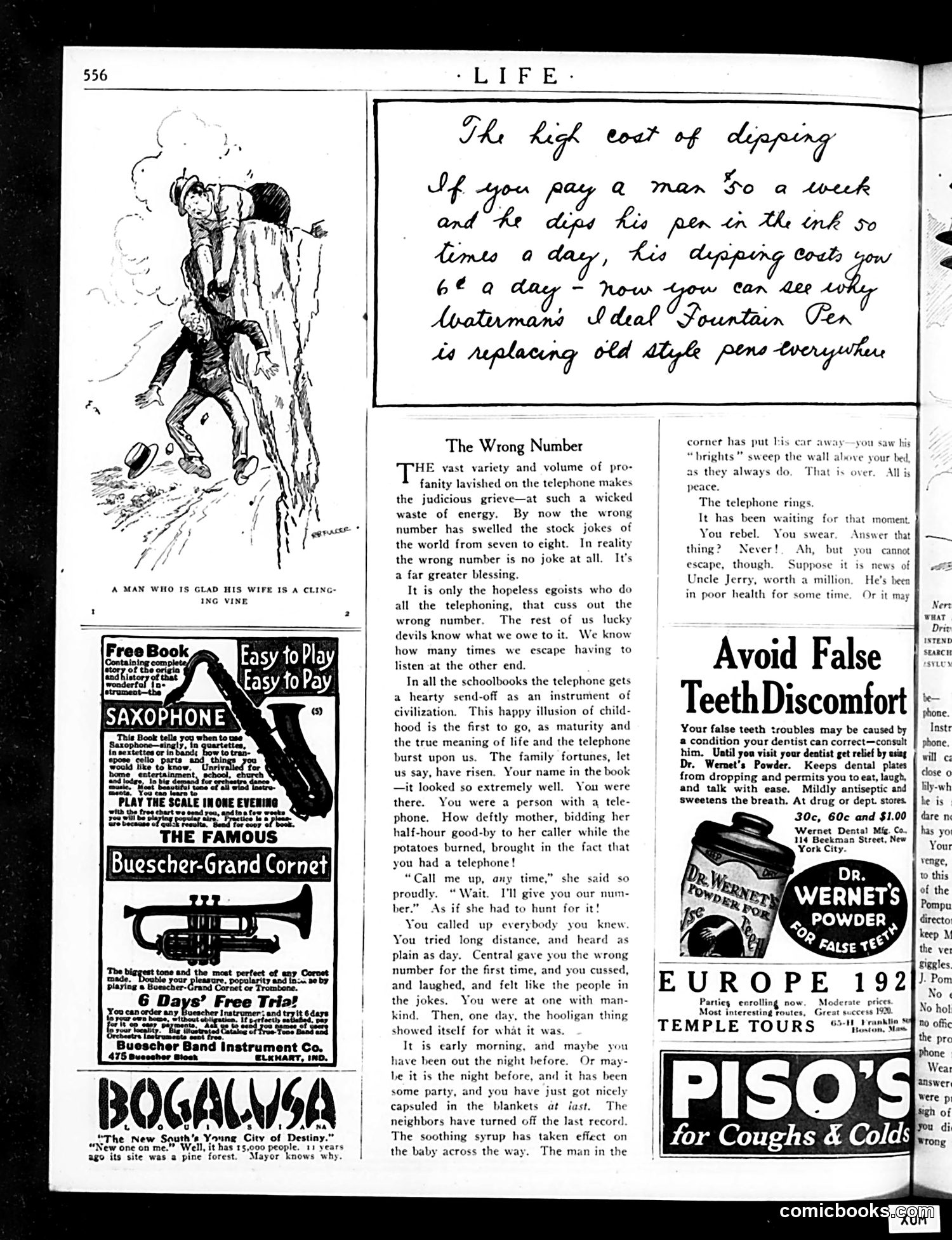
This satirical essay celebrates the unexpected blessing of receiving wrong-number telephone calls—a social commentary on early 20th-century telephone culture. **The Point**: While most people curse wrong numbers, the author argues they're actually fortunate escapes. Unwanted callers reach you constantly now that your name appears in the phone directory. A wrong number provides blessed relief from social obligations—you can ignore it guilt-free, unlike legitimate calls demanding your attention. **The Social Context**: The piece reflects anxiety about the telephone as a new technology that invaded domestic privacy. By having a listed phone number, you became obligated to answer calls from family, friends, and acquaintances. The essay's tongue-in-cheek tone mocks how people view the telephone as a mark of social status, while revealing its exhausting social demands. The cartoon (left) shows a man clinging to a woman, captioned "A Man Who Is Glad His Wife Is a Clinging Vine"—likely satirizing dependent relationships, though the exact connection to the text remains unclear.
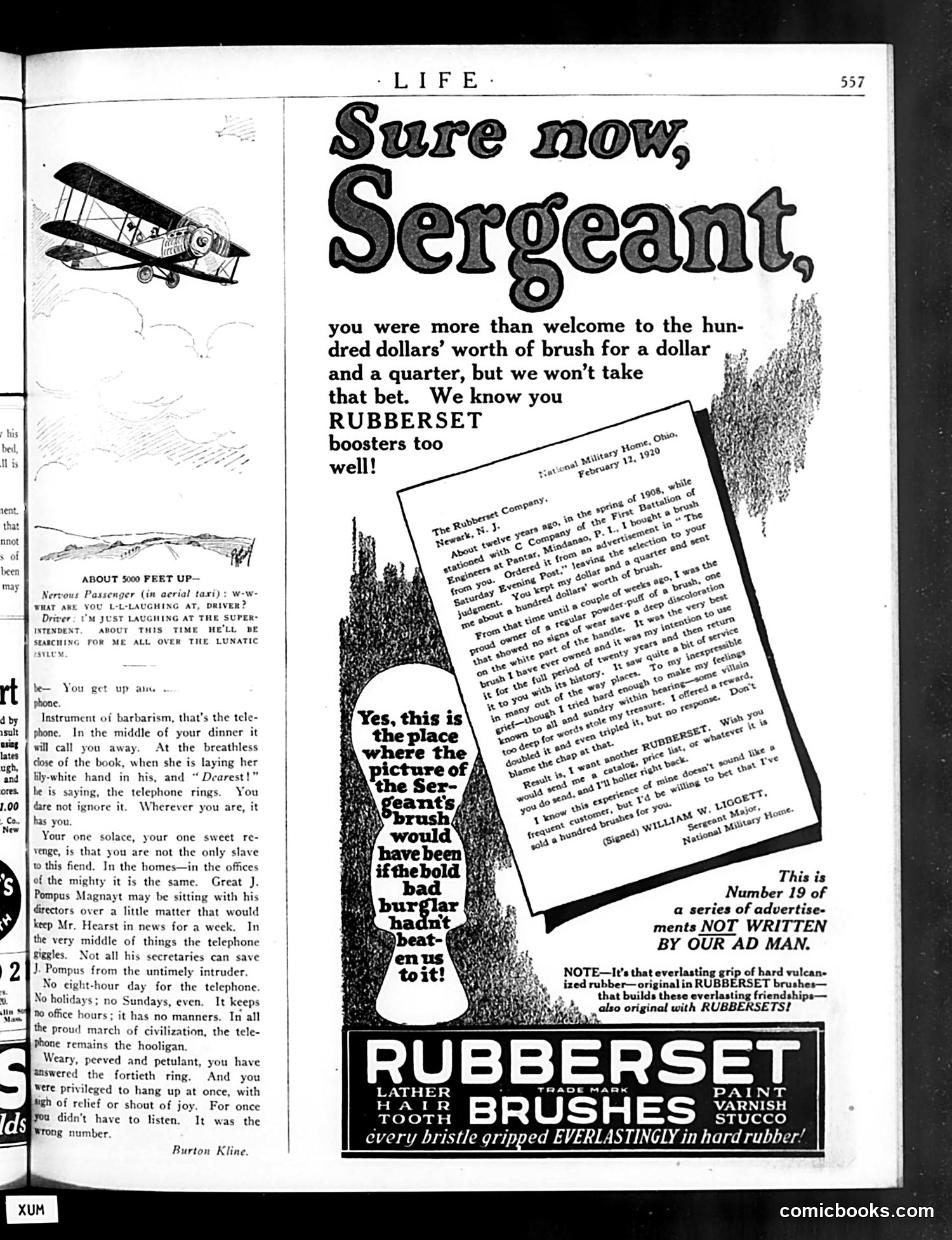
This page contains two distinct pieces: **Top cartoon** by Burton Kline satirizes telephone intrusion. A nervous airplane passenger asks why the driver is laughing; the driver replies he's amused the superintendent will be searching for him in "the lunatic asylum"—suggesting the superintendent will go mad looking for the missing driver. The accompanying text mocks the telephone as an inescapable "hooligan" that interrupts even important business meetings and dinner, ruling people's lives without mercy or respect for hierarchy. Even powerful figures like "J. Pompus Magnayt" cannot escape its tyranny. The joke's point: the telephone is a democratizing nuisance that enslaves everyone equally. **Bottom section** is primarily a Rubberset Brushes advertisement disguised as editorial content. It includes a testimonial letter from a National Military Home (dated February 13, 1920) praising the durability of Rubberset brushes, framed as an unsolicited endorsement. The ad emphasizes the brushes' "everlasting" hard rubber grip—a sales pitch presented as authentic customer praise rather than obvious advertising.
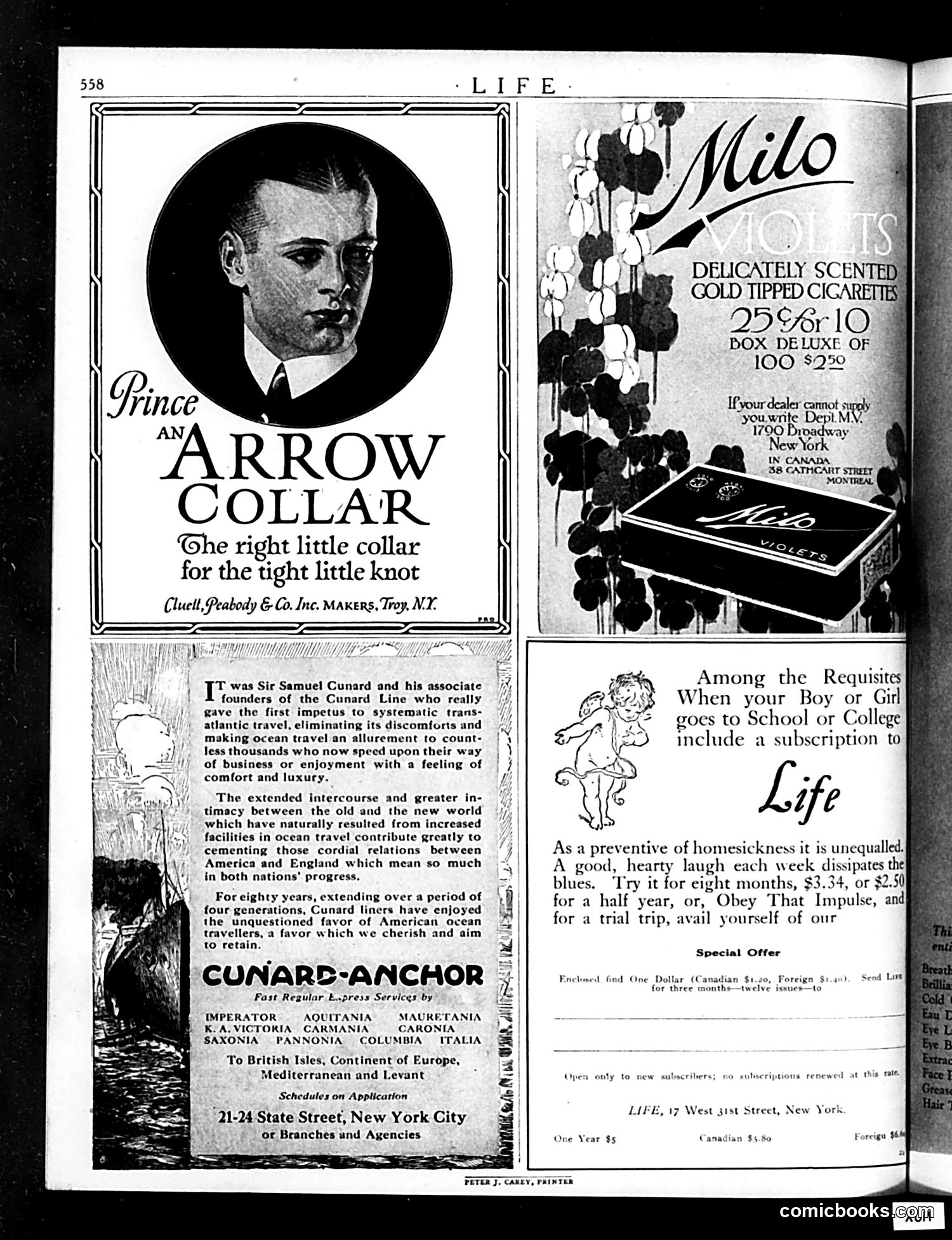
This page contains three distinct advertisements, not political cartoons. **Left side:** An Arrow Collar advertisement featuring a sharp-dressed man in profile with the tagline "the right little collar for the tight little knot." This targets men's fashion sensibilities of the era, emphasizing refined masculinity. **Center:** A Cunard-Anchor steamship advertisement celebrating Sir Samuel Cunard's role in establishing transatlantic travel. The ad emphasizes luxury ocean travel's role in strengthening Anglo-American relations—a patriotic appeal reflecting early 20th-century commercial nationalism. **Right side:** Two product ads: Milo Violets delicately-scented cigarettes (gold-tipped, 25¢ for 10), and a Life magazine subscription pitch positioned as a back-to-school requisite, marketed as preventing homesickness through humor. The page reflects period advertising conventions: gentlemen's grooming products, luxury travel, tobacco, and magazine subscriptions as status markers of refinement and cosmopolitan taste.
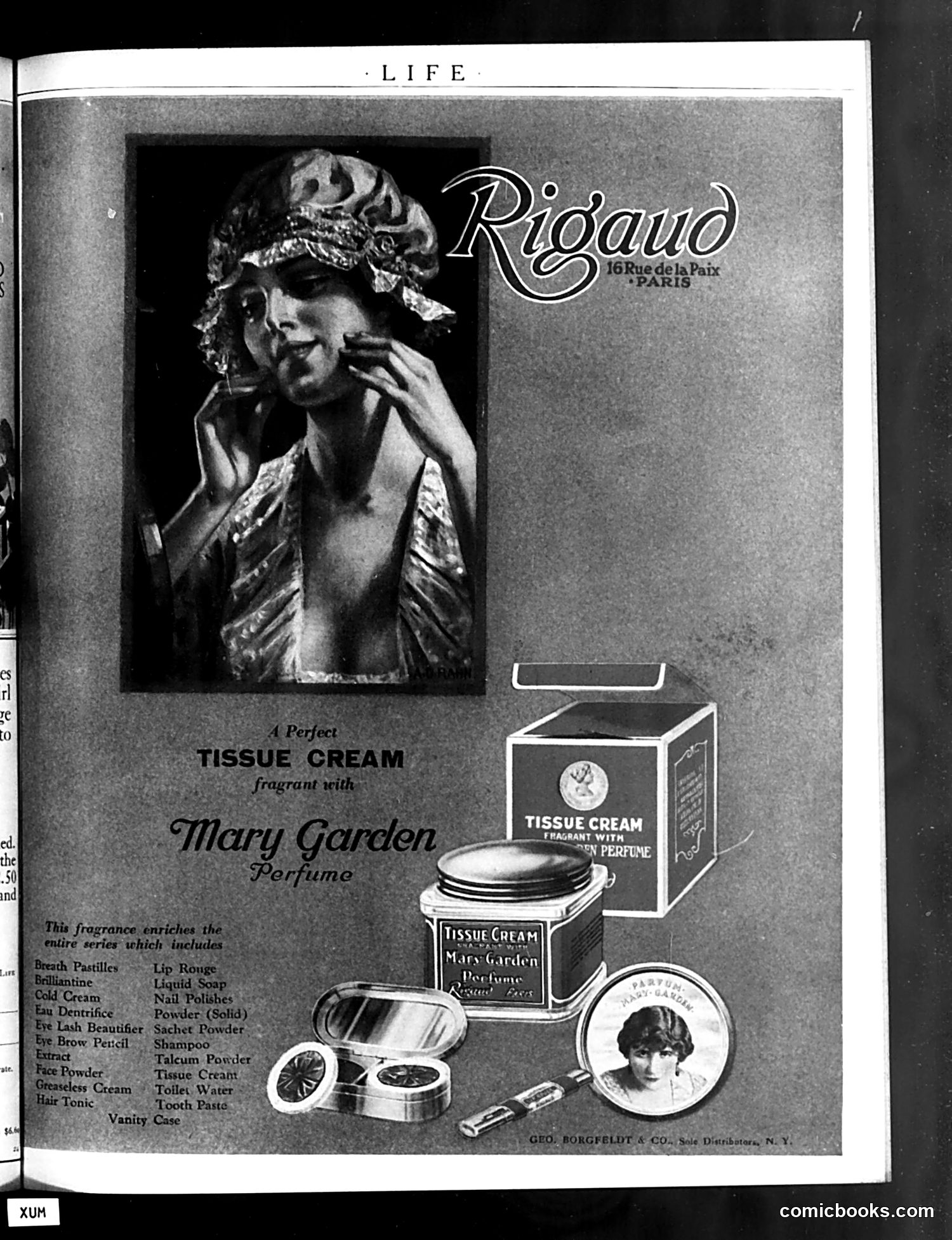
This is a **beauty product advertisement**, not political satire. It promotes Rigaud's "Tissue Cream" fragrance infused with "Mary Garden Perfume," a product line from the Paris-based cosmetics company (located at 16 Rue de la Paix). The page features a glamorous photograph of a woman in exotic costume and makeup, positioned to suggest luxury and sophistication. Below are product images showing the cream's packaging and various related cosmetic items in the Rigaud line. The advertisement lists the complete product range, including powder, rouge, perfume, and other beauty items. This represents typical early-to-mid-20th-century luxury cosmetics marketing aimed at affluent women, emphasizing French elegance and exotic appeal.
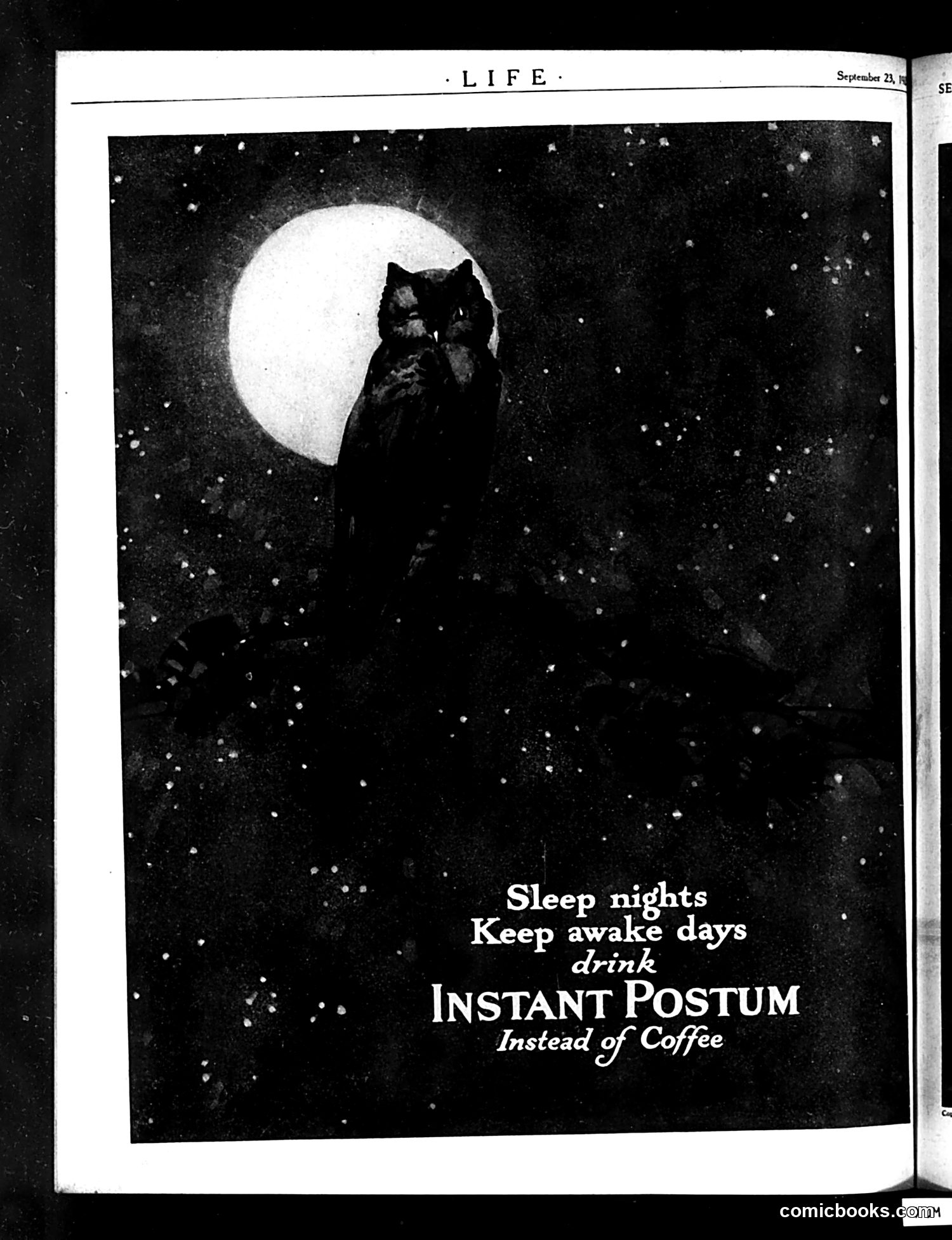
This is a commercial advertisement rather than political satire. It depicts an owl silhouetted against a full moon in a starry night sky, using dark, atmospheric imagery. The ad promotes Instant Postum, a caffeine-free coffee substitute, with the tagline: "Sleep nights / Keep awake days / drink INSTANT POSTUM / Instead of Coffee." The owl—a creature associated with nighttime activity—appears deliberately ironic. The advertisement's pitch is that by switching from coffee to Postum (which lacks caffeine), consumers can sleep better at night while remaining alert during the day. The nocturnal owl symbolizes the problem coffee causes: keeping people awake when they should be resting. This reflects early-20th-century marketing that positioned Postum as a health-conscious alternative to stimulating beverages.