
Life, 1920-09-23 · page 19 of 40
Life — September 23, 1920 — page 19: what you’re looking at
What you’re looking at
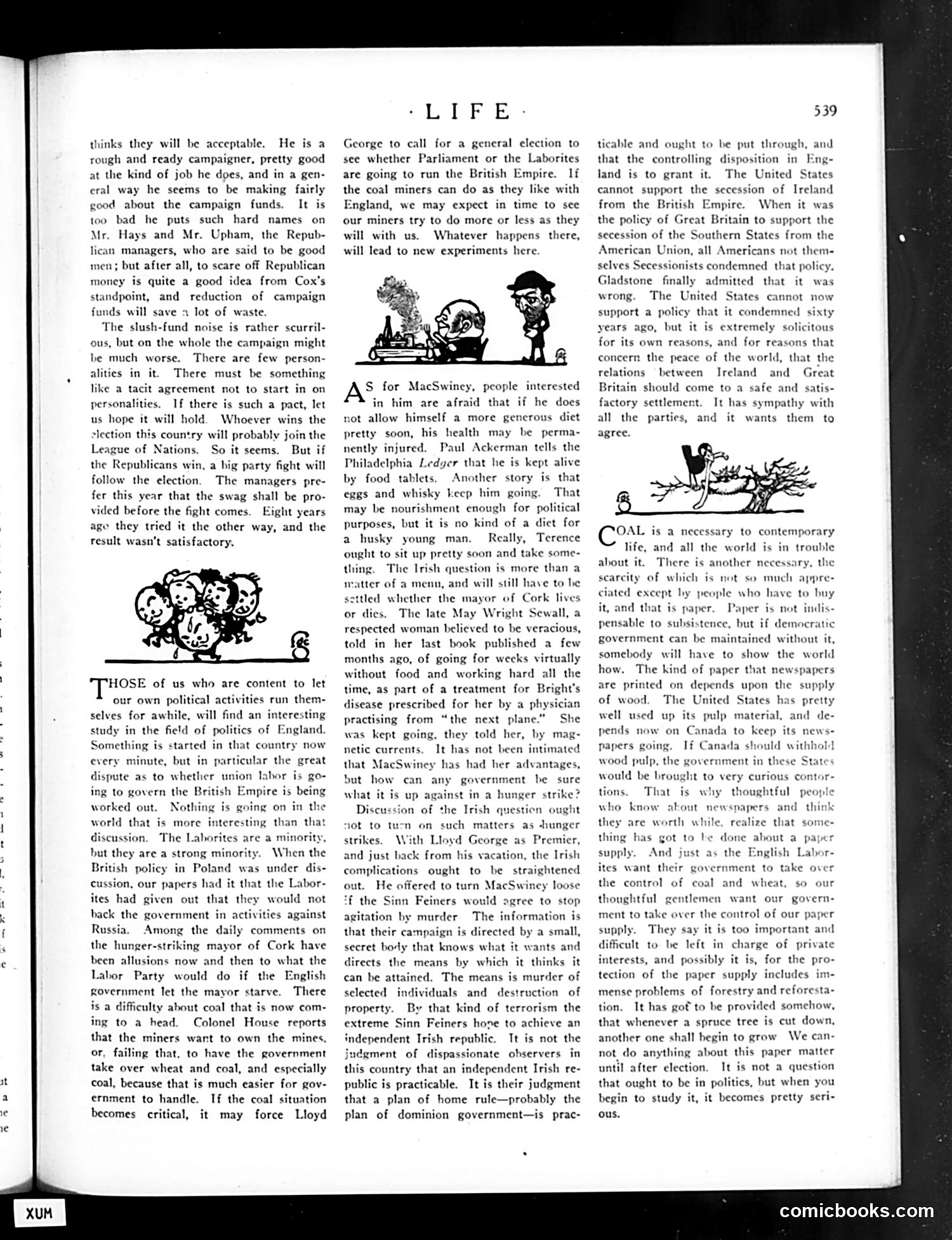
This page discusses contemporary political debates, particularly regarding Britain's labor movement and governance. The text references the "hunger-striking mayor of Cork"—likely **Terence MacSwiney**, an Irish republican imprisoned by Britain, whose 1920 death by starvation became a major political event. The cartoons appear to satirize politicians and labor disputes, though specific figures are difficult to identify clearly in reproduction. The main points concern: 1. **British Labor Party power**: Whether laborites or Parliament will control British governance, with miners demanding ownership of coal mines 2. **Irish independence**: The unresolved question of Irish self-rule versus British dominion control 3. **American labor implications**: Suggesting British labor unrest could inspire similar American worker demands The text expresses concern that MacSwiney needs better nutrition to survive his imprisonment, noting absurdly that some believed magical "currents" could sustain him—mocking both his treatment and contemporary pseudoscience claims about sustenance without food.
📄 Transcribed text from this page (OCR, searchable)
Machine-transcribed from the original scan — historical spelling and the odd misread are preserved.
thinks they will be acceptable. He is a rough and ready campaigner, pretty good at the kind of job he does, and in a gen- cral way he seems to be making fairly good about the campaign funds. It is too bad he puts such hard names on Mr. Hays and Mr. Upham, the Repub- lican managers, who are said to be good men; but after all, to scare off Republican money is quite a good idea from Cox's standpoint, and reduction of campaign funds will save 2 lot of waste. The slush-fund noise is rather scurril- ous, but on the whole the campaign might le much worse. There are few person- alities in it. There must be something like a tacit agreement not to start in on personalities. If there is such a pact, let us hope it will hold) Whoever wins the election this country will probably join the League of Nations. So it seems. But if the Republicans win, a big party fight will follow the election. The managers pre- fer this year that the swag shall be pro- vided before the fight comes. Eight years age they tried it the other way, and the result wasn’t satisfactory. HOSE of us who are content to let our own political activities run them- selves for awhile, will find an interesting study in the field of politics of F Something is started in that country now every minute, but in particular the great dispute as to whether union ing to govern the British Empire is being worked out. hor is go- Nothing is going on in the world that is more interesting than that discussion. The Laborites are a minority, but they are a strong minority. When the British policy in Poland was under dis- cussion, our papers had it that the Labor- ites had given out that they would not hack the government in activities against Russia. Among the daily comments on the hunger-striking mayor of Cork have been allusions now and then to what the Labor Party would do if the English government let the mayor starve. There is a difficulty about coal that is now com- ing to a head. Colonel House reports that the miners want to own the mines, or, failing that. to have the government take over wheat and coal, and especially coal, because that is much easier for gov- ernment to handle. If the coal situation becomes critical, it may force Lloyd -LIFE-: George to call for a general election to see whether Parliament or the Laborites are going to run the British Empire. If the coal miners can do as they like with England, we may expect in time to see our miners try to do more or less as they will with us. Whatever happens there, will lead to new experiments here. people interested in him are afraid that if he does not allow himself a more gencrous diet pretty soon, his health nently injured. Paul Ackerman tells the Philadelphia Ledger that he is kept alive by food tablets. Another story is that eggs and whisky keep him going. That may be nourishment enough for political purposes, but it is no kind of a diet for a husky young man. Really, Terence ought to sit up pretty soon and take some- thing. The Irish question is more than a matter of a menu, and will still have to he ttled whether the mayor of Cork lives The late May Wright Sewall, a respected woman believed to be veracious, told in her last book published a few months ago, of going for weeks virtually without food and working hard all the time, as part of a treatment for Bright's disease prescribed for her by a physician practising from “the next plane.” She was kept going, they told her, by mag- netic currents, It has not been intimated that MacSwiney has had her advantages, but how can government be sure what it is up against in a hunger strike? Discussion of the Irish questicn ought may be perma- or dics. any not to tucn on such matters as -hunger strikes. With Lloyd George as Premier, and just back from his vacation, the Irish complications ought to be straightened out. He offered to turn MacSwincy loose if the Sinn Feiners would agree to stop The information is nis directed by a small, agitation by murder that their campa secret body that knows what it wants and directs the means by which it thinks it can be attained. The means is murder of selected individuals and destruction of property. By that kind of terrorism the extreme Sinn Feiners hope to achieve an independent Irish republic, It is not the judgment of dispassionate observers in this country that an independent Irish re- public is practicable. It is their judgment that a plan of home rule—probably the plan of dominion government—is prac- 539 ticable and ought to be put through, and that the controlling disposition in Eng- land is to grant it. The United States cannot support the secession of Ireland from the British Empire. When it was the policy of Great Britain to support the secession of the Southern States from the American Union, all Americans not them- selves Secessionists condemned that policy. Gladstone finally admitted that it wrong. The United cannot support a policy that it condemned sixty years ago, but it is extremely solicitous was tates now for its own reasons, and for reasons that concern the peace of the world, that th relations Ireland and Great Britain should come to a safe and satis- factory settlement. It has sympathy with all the parties, and it wants them to agree. between BR OAL is a necessary to contemporary life, and all the world is in trouble about it. There is another necessary, the scarcity of which is not so much appre- ciated except hy people who have to buy it, and that is paper. Paper is not indis- pensable to subsistence, but if democratic government can be maintained without it, somebody will have to show the world how. The kind of paper that newspapers are printed on depends upon the supply of wood. The United States has pretty well used up its pulp material, and de- pends now on Canada to keep its news- papers going. If Canada should with wood pulp, the government in these State would be brought to very curious contor tions. thoughtful That is why peop who know about newspapers and think realize that thing has got to he done about a paper supply. they are worth while. some- And just as the English Labor- ites want their government to take over the control of coal and wheat, so our thoughtful gentlemen want our govern- ment to take over the control of our paper supply. difficult to be left in charge of private interests, and possibly it is, for the pro- tection of the paper supply includes They say it is too important and mense problems of forestry and reforesta- tion. It has gof to be provided somehow, that whenever a spruce tree is cut down, another one shall begin to grow We can- not do anything about this paper matter until after election. It is not a question that ought to be in politics, but when you begin to study it, it becomes pretty seri- ous. comicbooks.com