
Life, 1920-09-23 · page 32 of 40
Life — September 23, 1920 — page 32: what you’re looking at
What you’re looking at
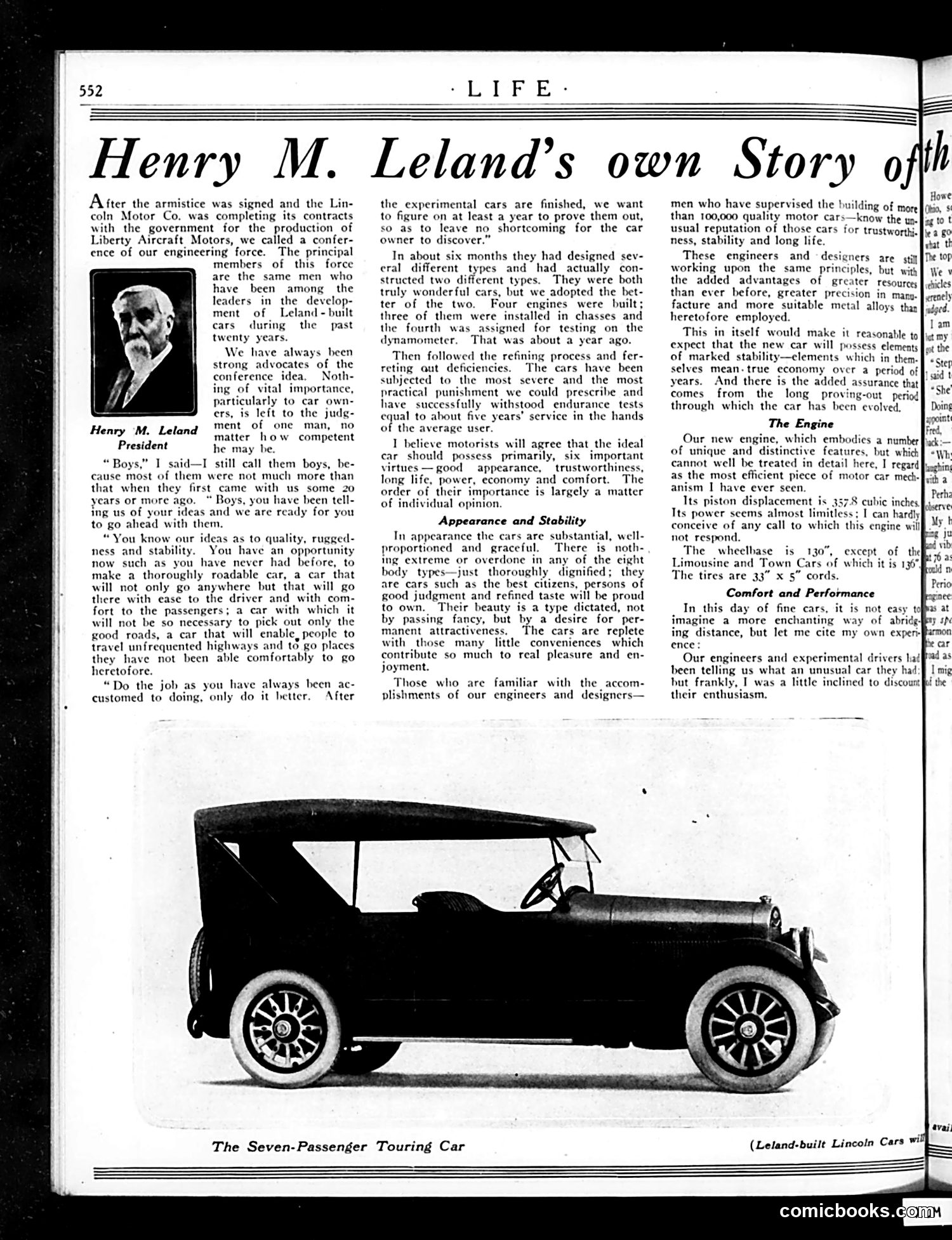
This is **not a cartoon or satire**, but rather a corporate advertisement/article from Life magazine featuring Henry M. Leland, president of the Lincoln Motor Company. The page presents Leland's account of post-WWI automobile development. After completing military aircraft engines during the war, Lincoln's engineering team designed new car models. Leland describes his management philosophy—collaborative conferences with engineers rather than individual decision-making—and outlines the six virtues he believes cars should possess: appearance, trustworthiness, longevity, power, economy, and comfort. The image shows a technical drawing of the "Seven-Passenger Touring Car," a luxury automobile meant to demonstrate Lincoln's manufacturing quality and innovation. This represents **corporate self-promotion disguised as editorial content**, a common advertising practice of the era where companies purchased space to tell their story directly to readers.
📄 Transcribed text from this page (OCR, searchable)
Machine-transcribed from the original scan — historical spelling and the odd misread are preserved.
Henry M. Leland’s own Story o After the armistice was signed and the Lin- coln Motor Co. was completing its contracts with the government for the production of Liberty Aircraft Motors, we called a confer- ence of our engineering force. The principal members of this force are the same men who have been among the leaders in the develop- ment of Leland - built cars during the past twenty years. We have always been strong advocates of the conference idea. Noth- ing of vital importance, particularly to car own- ers, is left to the judg- ment of one man, no matter how competent he may be. “Boys,” I said—I still call them boys, be- cause most of them were not much more than that when they first came with us some 20 years or more ago. “ Boys, you have been tell- ing us of your ideas and we are ready for you to go ahead with them. “You know our ideas as to quality, rugged- ness and stability. You have an opportunity now such as you have never had before, to make a thoroughly roadable car, a car that will not only go anywhere but that_ will go there with ease to the driver and with com- fort to the passengers; a car with which it will not be so necessary to pick out only the good roads, a car that will enable, people to travel unfrequented highways and to go places they have not been able comfortably to go heretofore. “Do the job as you have always been ac- customed to doing, only do it better. After President the experimental cars are finished, we want to figure on at least a year to prove them out, so as to leave no shortcoming for the car owner to discover.” In about six months they had designed sev- eral different typ and had_ actually con- structed two different types. They were both truly wonderful cars, but we adopted the bet- ter of the two. Four engines were built; three of them were installed in chasses and the fourth was assigned for testing on the dynamometer, That was about a year ago. Then followed the refining process and fer- reting aut deficiencies. The cars have been subjected to the most severe and the most practical punishment we could prescribe and have successfully withstood endurance tests equal to about five years’ service in the hands of the average user. I believe motorists will agree that the idea car should possess primarily, six important virtues — good appearance, trustworthiness, long life, power, economy and comfort. The order of their importance is largely a matter of individual opinion. Appearance and Stability In appearance the cars are substantial, well- proportioned and graceful. There is noth- ing extreme or overdone in any of the eight body types—just thoroughly. dignified; they are cars such as the best citizens, persons of good judgment and refined taste will be proud to own. Their beauty is a type dictated, not by passing fancy, but by a desire for ‘per- manent attractiveness. The cars are replete with those many little conveniences which contribute so much to real pleasure and en- joyment. Those who are familiar with the accom- plishments of our engineers and designers— The Seven-Passenger Touring Car men who have supervised the building of more than 100,000 quality motor cars—know the tn. usual reputation of those cars for trustworthi. ness, stability and long life. F’ These engineers and designers are. stit working upon the same principles, but with the added advantages of greater resources than ever before, greater precision in many. facture and more suitable metal alloys than heretofore employed. . This in itself would make it reasonable to expect that the new car will possess elements of marked stability—clements which in them. selves mean. true economy over a period of years. And there is the added assurance that comes from the long proving-out period through which the car has been evolved, The Engine Our new engine, which embodies a number of unique and distinctive features, but which cannot well be treated in detail here, I regard as the most efficient piece of motor car mech- anism I have ever seen. Its piston displacement is 357.8 cubic inches Its power scems almost limitless: I can hardly conceive of any call to which this engine will not respond. The wheelbase is 130", except of Limousine and Town Cars of which it is 136° The tires are 33” x 5” cords. Comfort and Performance In this day of fine cars, it is not easy to imagine a more enchanting way of abridg} ing distance, but let me cite my own exper ence: Our engineers and experimental drivers had] been telling us what an unusual car they had but frankly, IT was a little inclined to discount their enthusiasm,