
Life, 1920-09-23 · page 14 of 40
Life — September 23, 1920 — page 14: what you’re looking at
What you’re looking at
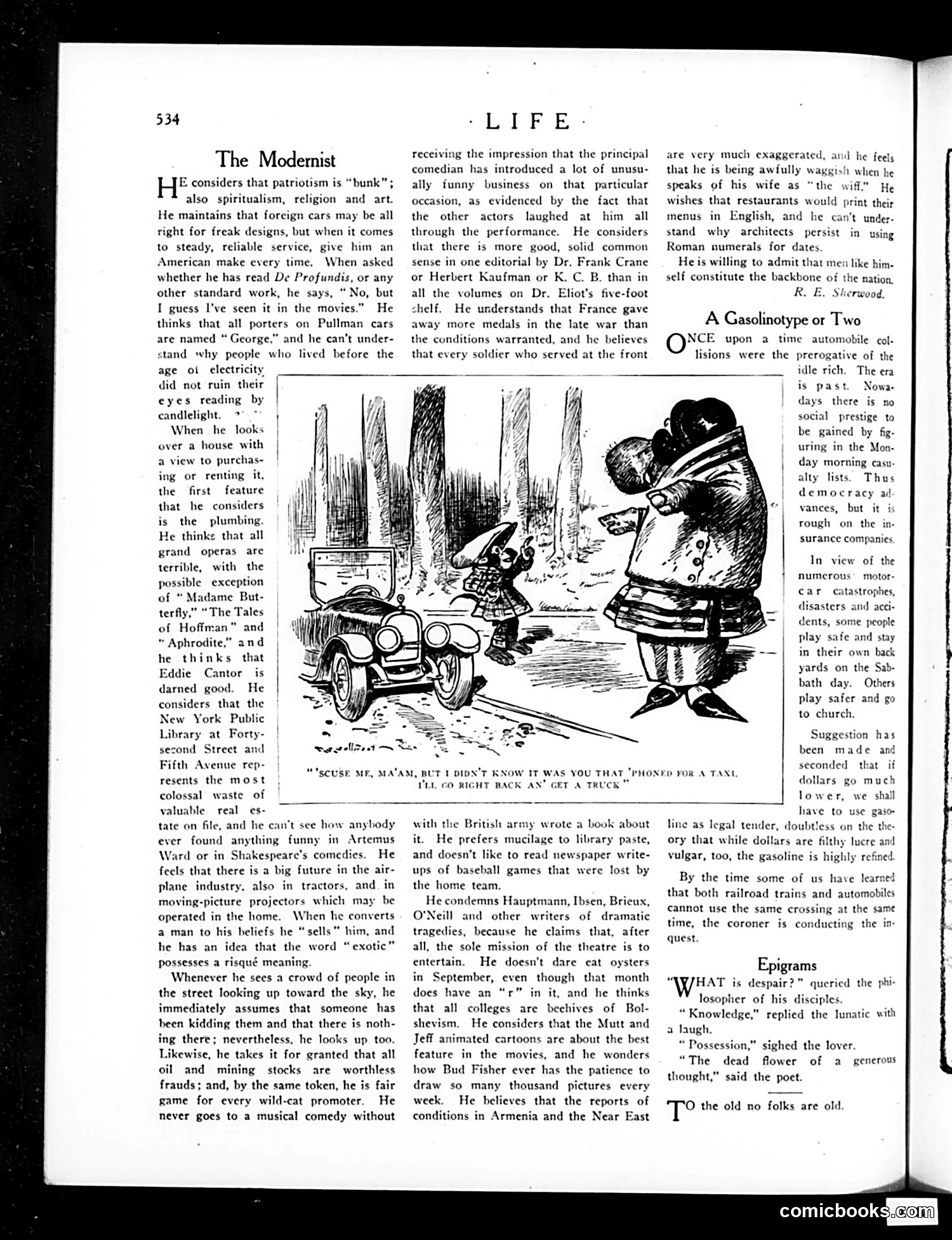
The main cartoon depicts a wealthy woman in an elaborate hat stopping a small child in a toy car, with the caption: "Scuse me, ma'am, but I didn't know it was you that phoned for a taxi. I'll go right back an' get a truck." **The Joke:** This is satire about class and automobile culture. A woman—likely upper-class, given her ornate dress and commanding presence—has mistaken a child's toy vehicle for a taxi. The child's response mockingly suggests she's so large or demands so much space that she actually needs a "truck" rather than a regular taxi. It's a visual gag about wealthy women's perceived size, pretension, or excessive needs during the early automobile era. The humor relies on the absurdity of the situation and social commentary about the wealthy's disconnection from ordinary reality.
📄 Transcribed text from this page (OCR, searchable)
Machine-transcribed from the original scan — historical spelling and the odd misread are preserved.
The Modernist considers that patriotism is “bunk”; also spiritualism, religion and art. He maintains that foreign cars may be all right for freak designs, but when it comes to steady, reliable service, give him an American make every time, When asked whether he has read De Profundis, or any other standard work, he says, “ No, but I guess I’ve seen it in the movies.” He thinks that all porters on Pullman cars are named “ George,” and he can’t under- stand why people who lived before the age oi electricity -LIFE. receiving the impression that the principal comedian has introduced a lot of unusu- ally funny business on that particular occasion, as evidenced by the fact that the other laughed at him all through the performance. He considers that there is more good, solid common sense in one editorial by Dr, Frank Crane or Herbert Kaufman or K. C. B. than in all the volumes on Dr. Eliot's five-foot shelf. He understands that France gave away more medals in the late war than the conditions warranted, and he believes that every soldier who served at the front actors are very much exaggerated, and he feels that he is being awfully waggish when he speaks of his wife as “the wi He wishes that restaurants would print their menus in English, and he can't under- stand why architects persist in using Roman numerals for dates. He is willing to admit that men like him- self constitute the backbone of the nation. R. E, Sherwood, A Gasolinotype or Two CE upon a time automobile col- lisions were the prerogative of the idle rich. The era did not ruin their eyes reading by candlelight. 7 When he looks over a house with a view to purchas- ing or renting it, the first feature that he considers is the plumbing. He thinks that all grand operas are terrible, with the possible exception of “ Madame But- terfly,” “The Tales of Hoffman" and “ Aphrodite,” and he thinks that Eddie Cantor is darned good. He considers that the New York Public Library at Forty- second Street and Fifth Avenue rep- resents the most colossal waste of SCUSE MF, MA'AM, BUT I DIDN'T KNOW IT W You THAT" I'L, CO RIGHT BACK AN’ GET A TRUCK” HONED FOR A TANI is past. Nowa- days there is no social prestige to be gained by fig- uring in the Mon- day morning casu- alty lists. Thus democracy ad vances, but it is rough on the in- surance companies In view of the numerous car motor- catastrophes, disasters and acci- dents, some people play in their own back yards on the Sab- bath day. Others play safer and go to church. afe and stay Suggestion has been made and seconded that if dollars go much lower, we shall valuable real es- tate on file, and he can't see how anybody ever found anything funny in Artemus Ward or in Shakespeare's comedies. He feels that there is a big future in the air- plane industry, also in tractors, and. in moving-picture projectors which may be operated in the home. When he converts a man to his heliefs he “sells” him, and he has an idea that the word “exotic” possesses a risqué meaning. Whenever he sees a crowd of people in the street looking up toward the sky, he immediately assumes that someone has been kidding them and that there is noth- ing there; nevertheless, he looks up too. Likewise, he takes it for granted that all oil and mining stocks are worthless frauds; and, by the same token, he is fair game for every wild-cat promoter. He never goes to a musical comedy without with the British army wrote it. He prefers mucilage to library paste, and doesn't like to read newspaper write- ups of baseball games that were lost by the home team. He condemns Hauptmann, Ibsen, Brieux, O'Neill and other of dramatic tragedies, because he claims that, after all, the sole mission of the theatre is to entertain. He doesn't dare cat oysters in September, even though that month does have an “r” writers r” in it, and he thinks that all colleges are beehives of Bol- shevism. He considers that the Mutt and Jeff animated cartoons are about the best feature in the movies, and he wonders how Bud Fisher ever has the patience to draw so many thousand pictures every week. He believes that the reports of conditions in Armenia and the Near East have to use gaso- line as legal tender, doubtless on the ¢ ory that while dollars are filthy lucre vulgar, too, the gasoline is highly refined. By the time some of us have learned that both railroad trains and automobiles cannot use the same crossing at the same time, the coroner is conducting the in- quest. Epigrams "NY/HAT is despair?” queried the phi- losopher of his disciples. “Knowledge,” replied the lunatic with a laugh, “ Possession,” sighed the lover. “The dead flower of a thought,” said the poet. generous T°? the old no folks are old.