
Life, 1920-09-23 · page 33 of 40
Life — September 23, 1920 — page 33: what you’re looking at
What you’re looking at
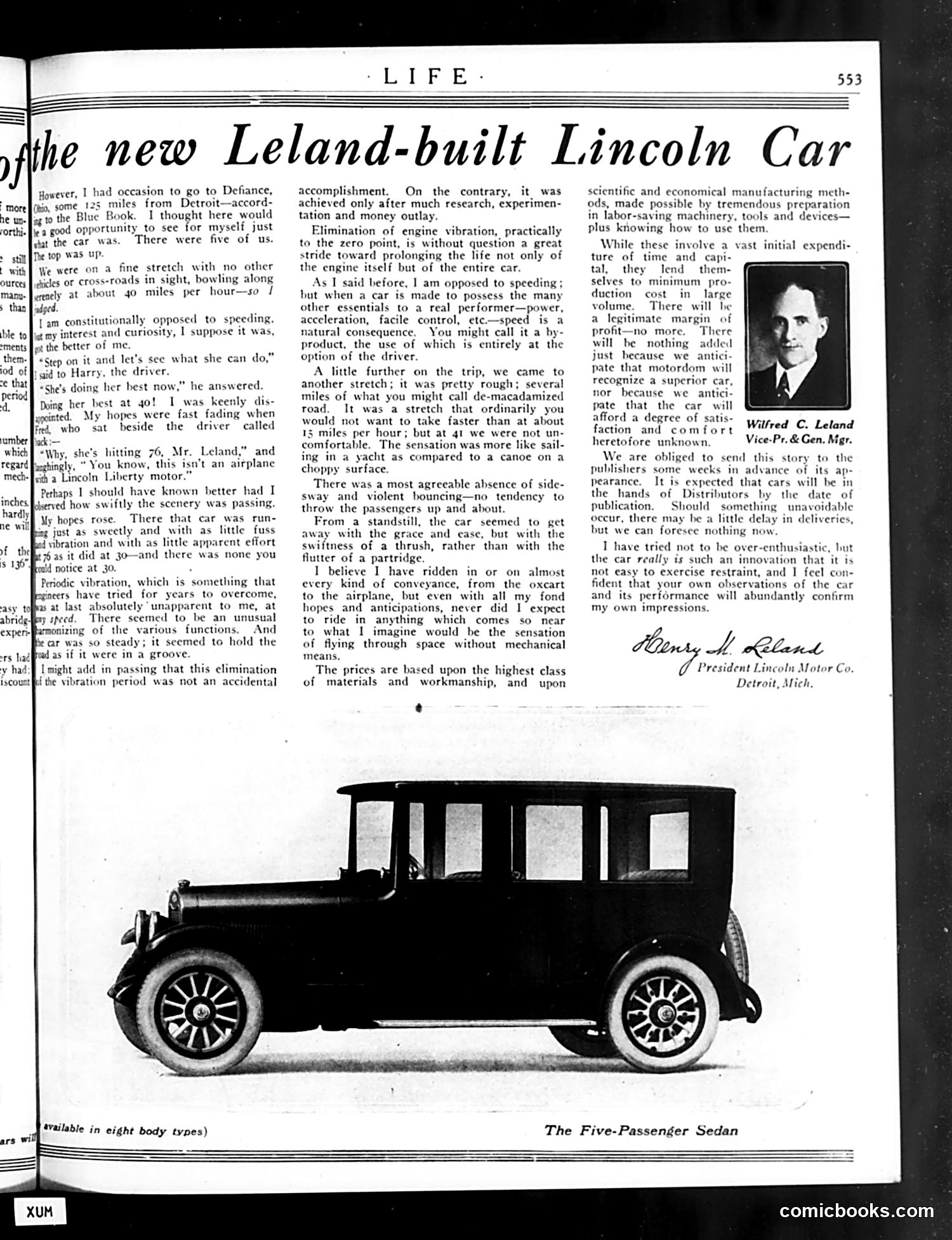
This is primarily **advertising content**, not satire or political commentary. The page features an article by Henry M. Leland, president of Lincoln Motor Co., describing his personal test drive of the new Leland-built Lincoln automobile. The text praises the car's engineering achievements—particularly the elimination of engine vibration, smooth acceleration, and stable handling at various speeds. Leland compares the driving experience to "flying through space without mechanical means" and riding in a yacht rather than a canoe. The accompanying image shows "The Five-Passenger Sedan," a formal side-profile photograph of the vehicle. **Context for modern readers:** This represents early automotive advertising that emphasizes technical innovation and luxury performance rather than style or status symbols. The detailed, first-person testimonial format was common for high-end car marketing of this era, lending credibility through the manufacturer's own endorsement.
📄 Transcribed text from this page (OCR, searchable)
Machine-transcribed from the original scan — historical spelling and the odd misread are preserved.
still t with ourees man + thas e new Leland-built Lincoln Car ever, I had occasion to go to Defiance, fain, some 125 miles from Detroit—accord- io the Blue Book. I thought here would lea good opportunity to see for myself just vat the car was. There were five of us. The top was up. We were on a fine stretch with no other dicks or cross-roads in sight, bowling along ‘eaely at about 4o miles per hour—so / adged. . [am constitutionally opposed to speeding, it my interest and curiosity, 1 suppose it was, jt the better of me. “Step on it and let's see what she can do,” i}; gid to Harry, the driver: *She’s doing her best now,” he answered. Doing her best at go! I was keenly dis- My hopes were fast fading when sat beside the driver called hitting 76, Mr. Leland,” and echingly, “You know, this isn't an airplane sith a Lincoln Liberty motor.” Perhaps 1 should have known better had I jerved how swiftly the scenery was passing. My hopes rose. There that car was run- bing just as sweetly and with as little fuss sd vibration and with as little apparent effort as it did at 3o—and there was none you ald notice at 30. . Periodic vibration, which is something that egneers have tried for years to overcome, 2s at last absolutely ‘unapparent to me, at sapeed. There seemed to be an unusual amonizing of the various functions. And he ar was so steady; it seemed to hold the ad as if it were in a groove. I might add in passing that this elimination {the vibration period was not an accidental accomplishment. On the contrary, it) was achieved only after much research, experimen- tation and money outlay. Elimination of engine vibration, practically to the zero point, is without question a gre: stride toward prolonging the life not only of the engine itself but of the entire car. As I said before, 1 am opposed to speedin| but when a car is made to possess the many other essentials to a real performer—power, acceleration, facile control, etc.—speed is a natural consequence. You might call it a by- product, the use of which is entirely at the option of the driver. A little further on the trip, we came to another stretch; it was pretty rough; several miles of what you might call de-macadamized road. It was a stretch that ordinarily you would not want to take faster than at about 15 miles per hour; but at 41 we were not un- comfortable. The sensation was more like sail- ing in a yacht as compared to a canoe on a choppy surface. There was a most agreeable absence of side- sway and violent bouncing—no tendency to throw the passengers up and about. From a standstill, the car seemed to get away with the grace and ease, but with the swiftness of a thrush, rather than with the flutter of a partridge. I believe I have ridden in or on almost every kind of conveyance, from the oxcart to the airplane, but even with all my fond hopes and anticipations, never did 1 expect to ride in anything which comes so near to what I imagine would be the sensation of flying through space without mechanical means. The prices are based upon the highest class of materials and workmanship, and upon e scientific and economical manufacturing meth ods, made possible by tremendous preparation in labor-saving machinery, tools and devices— plus knowing how to use them While these involve a vast initial expendi- ture of time and capi- tal, they lend them- selves to minimum pro duction cost in large volume. There will he a legitimate margin of profit—no more. There will be nothing added just because we antici- pate that motordom will recognize a superior car, nor because we antici- pate that the car will afford a degree of satis- faction and comfort heretofore unknown. Wilfred C. Leland Vice-Pr. & Gen. Mgr. We are obliged to send this story to the publishers some weeks in advance of its ap- pearance. It is expected that cars will be in the hands of Distributors by the date of publication. Should something unavoidable occur, there may be a little delay in deliveries, but we can foresee nothing now. I have tried not to be over-enthusiastic, hut the car really is such an innovation that it is not easy to exercise restraint, and I feel con- fident that your own observations of the car and its performance will abundantly confirm my own impressions. President Lincoln Motor Co. Detroit, Mich, The Five-Passenger Sedan comicbooks.com