
Life, 1920-09-23 · page 18 of 40
Life — September 23, 1920 — page 18: what you’re looking at
What you’re looking at
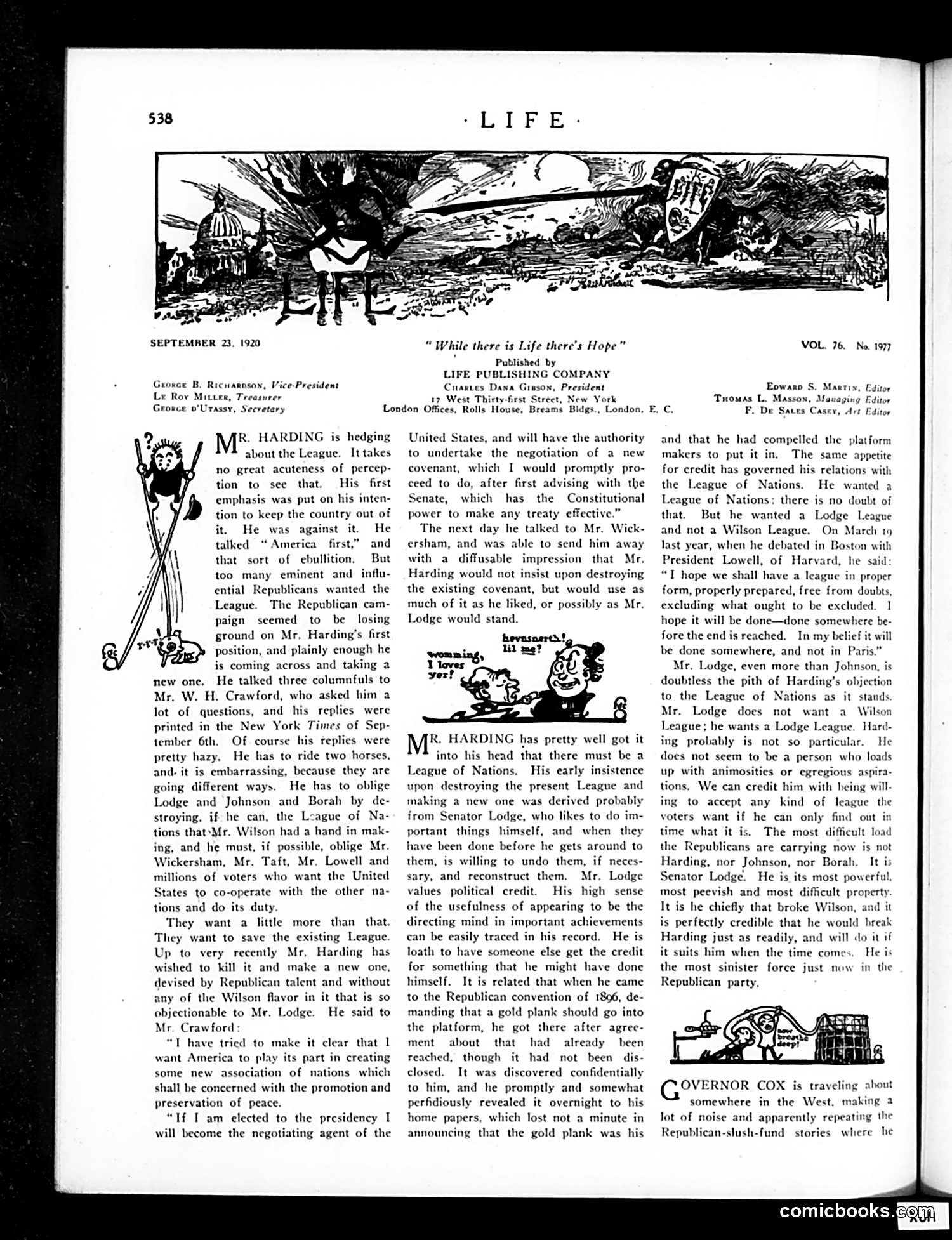
This 1920 *Life* magazine editorial cartoon critiques Republican presidential candidate Warren G. Harding's flip-flopping stance on the League of Nations. The text reveals Harding initially opposed the League (advocating "America first"), but as Republican support for it grew, he shifted position to avoid losing votes. The satire highlights Harding's political duplicity: he told different audiences contradictory things—telling one interviewer he'd create a "new covenant" while implying to another he'd preserve Wilson's existing League. The piece mocks his attempts to "ride two horses going different ways," pleasing both anti-League Republicans (like Senator Lodge) and pro-League voters. The cartoons appear to show Harding caught between conflicting positions. The underlying critique is that Harding prioritizes political expediency over principle, making vague promises to win the election.
📄 Transcribed text from this page (OCR, searchable)
Machine-transcribed from the original scan — historical spelling and the odd misread are preserved.
SEPTEMBER 23, 1920 Georce B. Ricuarnson, Vice-President Le Rov Mittee, Treasurer Groxce v'Urassy, Secretary R. HARDING is hedging about the League. It takes no great acuteness of percep- tion to see that. His first emphasis was put on his inten- tion to keep the country out of it. He was against it. He talked “America first,” and that sort of ebullition. But too many eminent and influ- ential Republicans wanted the League. The Republican cam- paign scemed to be losing ground on Mr. Harding's first position, and plainly enough he is coming across and taking a new one. He talked three columnfuls to Mr. W. H. Crawford, who asked him a lot of questions, and his replies were printed in the New York Times of Sep- tember 6th. Of course his teplies were pretty hazy. He has to ride two horses, and. it is embarrassing, because they are going different ways. He has to oblige Lodge and Johnson and Borah by de- stroying, if he can, the League of Na- tions that‘Mr. Wilson had a hand in mak- ing, and he must, if possible, oblige Mr. Wickersham, Mr. Taft, Mr. Lowell and millions of voters who want the United States to co-operate with the other na- tions and do its duty. They want a little more than that. They want to save the existing League. Up to very recently Mr, Hard has wished to kill it and make a new one, devised by Republican talent and without any of the Wilson flavor in it that is so objectionable to Mr. Lodge. He said to Mr. Crawford: “LT have tried to make it clear that 1 want America to play its part in creating some new association of nations which shall be concerned with the promotion and preservation of peace. “If I am elected to the presidency I will become the negotiating agent of the London Offices, Rolls House, Breams Bldgs. “While there is Life there's Hope” Published by LIFE PUBLISHING COMPANY Cartes Dawa Grnsox, President 17 West Thirty-first Street, New York United States, and will have the authority to undertake the negotiation of a new covenant, which I would promptly pro- ceed to do, after first advising with the Senate, which has the Constitutional power to make any treaty effective.” The next day he talked to Mr. Wick- ersham, and was able to send him away with a diffusable impression that Mr. Harding would not insist upon destroying the existing covenant, but would use as much of it as he liked, or possibly as Mr. Lodge would stand. hevnsnerth!, Lil me? . HARDING has pretty well got it into his head that there must be a League of Nations. His early insistence upon destroying the present League and making a new one was derived probably from Senator Lodge, who likes to do im- portant things himself, and when they have been done before he gets around to them, is willing to undo them, if neces- sary, and reconstruct them. Mr. Lodge values political credit. His high sense of the usefulness of appearing to be the directing mind in important achievements can be easily traced in his record. He is loath to have someone else get the credit for something that he might have done himself. It is related that when he came to the Republican convention of 1896, de- manding that a gold plank should go into the platform, he got there after agree- ment about that had already been reached, though it had not been dis- closed. It was discovered confidentially to him, and he promptly and somewhat perfidiously revealed it overnight to his home papers, which lost not a minute in announcing that the gold plank was his London, E. C. VOL. 76. No. 1977 Eowano S. Mantis, Editor Tuomas L. Masson, Managing Editor F, De Sates Casey, Art Editor and that he had compelled the platform makers to put it in. The same appetite for credit has governed his relations with the League of Nations. He wanted a League of Nations: there is no doubt of that. But he wanted a Lodge League and not a Wilson League. On March 19 last year, when he debated in Boston with President Lowell, of Harvard, he said: “T hope we shall have a league in proper form, properly prepared, free from doubts, excluding what ought to be excluded. I hope it will be done—done somewhere be- fore the end is reached. In my belief it will be done somewhere, and not in Paris.” Mr. Lodge, even more than Johnson, is doubtless the pith of Harding’s objection to the League of Nations as it stands. Mr. Lodge does not want a Wilson League; he wants a Lodge League. Hard- ing probably is not so particular. He does not seem to be a person who loads up with animosities or egregious aspira- tions. We can credit him with being will- ing to accept any kind of league the voters want if he can only find out in time what it is. The most difficult load the Republicans are carrying now is not Harding, nor Johnson, nor Borah. It is Senator Lodge. He is its most powerful, most peevish and most difficult property It is he chiefly that broke Wilson, and it is perfectly credible that he would break Harding just as readily, and will do it if it suits him when the time comes. He is the most sinister force just now in the Republican party. OVERNOR COX is traveling about somewhere in the West, making 2 lot of noise and apparently repeating the Republican-slush-fund stories where he comicbooks