
Life, 1920-09-23 · page 12 of 40
Life — September 23, 1920 — page 12: what you’re looking at
What you’re looking at
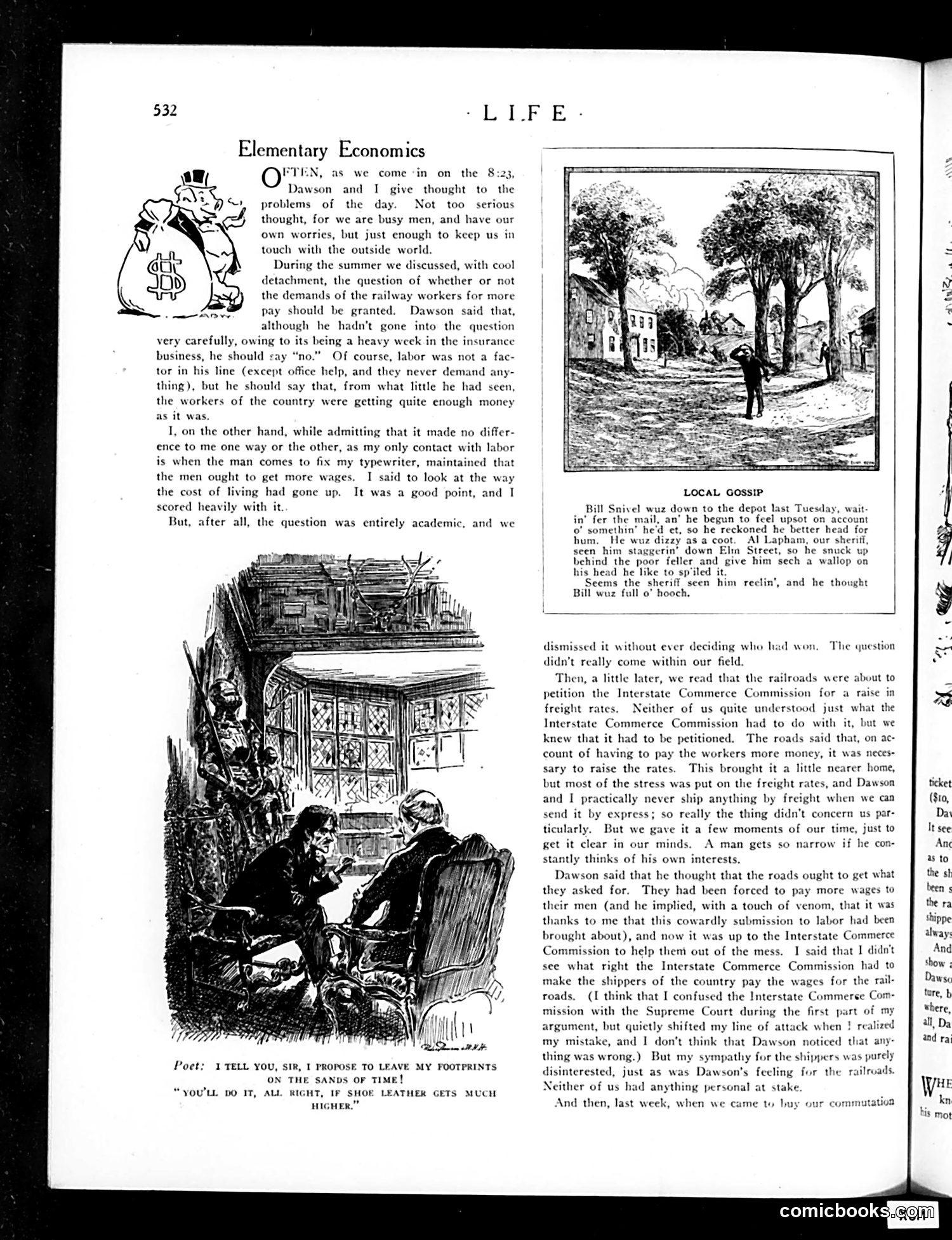
This page from *Life* magazine satirizes labor disputes and railroad economics through a conversation between two businessmen. The main cartoon depicts two figures discussing wage demands—one represents labor interests, the other appears to be management or an employer. The text discusses whether railroad workers deserve higher pay. The author argues against simply raising wages without considering operational costs, while acknowledging workers need fair compensation. The piece references Interstate Commerce Commission hearings about freight rate increases. The satire targets the complexity of labor negotiations: both sides claim hardship, neither wants to compromise, and the public gets caught between them. The accompanying illustration of two men in discussion emphasizes how abstract economic debates ignore workers' actual needs and suffering.
📄 Transcribed text from this page (OCR, searchable)
Machine-transcribed from the original scan — historical spelling and the odd misread are preserved.
Elementary Economics FTIEN, as we come -in on the x Dawson and I give thought to the problems of the day. Not too serious thought, for we are busy men, and have our own worries, but just enough to keep us in touch with the outside world. During the summer we discussed, with cool detachment, the question of whether or not the demands of the railway workers for more pay should be granted. Dawson said that, although he hadn't gone into the question very carefully, owing to its being a heavy week in the insurance business, he should say “no.” Of course, labor was not a fac- tor in his line (except office help, and they never demand any- thing), but he should say that, from what little he had seen, the workers of the country were getting quite enough money as it was, I, on the other hand, while admitting that it made no differ- ence to me one way or the other, as my only contact with labor is when the man comes to fix my typewriter, maintained that the men ought to get more wages. I said to look at the way the cost of living had gone up. It was a good point, and I scored heavily with it. But, after all, the question was entirely academic, and we 1 | | \\ RQ rd Poet; 1 TELL YOU, SIR, I PROPOSE TO LEAVE MY FOOTPRINTS ON THE SANDS OF TIME! N “yoU'LL DO IT, ALI RIGHT, IF SHOE HIGHER.” THER GETS MUCH LOCAL GossiP Bill Snivel wuz down to the depot last Tuesday, in’ fer the mail, an’ he begun to feel upsot on account 0’ somethin’ he'd et, so he reckoned he better head for hum. He wuz dizzy asa coot. Al Lapham, our sheriff seen him staggerin’ down Elia Street, so he snuck up behind the poor feller and give him sech a wallop on his head he like to sp'iled it. Seems the sheriff seen him reclin’, and he thought Bill wuz full 0’ hooch. dismissed it without ever deciding who had won, The question didn’t really come within our field. Then, a little later, we read that the railroads were about to petition the Interstate Commerce Commission for a raise in freight rates. Neither of us quite understood just what the Interstate Commerce Commission had to do with it, but we knew that it had to be petitioned. The roads said that, on ac- count of having to pay the workers more money, it was neces- sary to raise the rates. This brought it a little nearer home, but most of the stress was put on the freight rates, and Dawson and I practically never ship anything by freight when we can send it by express; so really the thing didn’t concern us par- ticularly. But we gave it a few moments of our time, just to get it clear in our minds, A man gets so narrow if he con- stantly thinks of his own interests, Dawson said that he thought that the roads ought to get what they asked for. They had been forced to y more wages to their men (and he implied, with a touch of venom, that it was thanks to me that this cowardly submission to labor had been brought about), and now it was up to the Interstate Commerce Commission to help them out of the mess. I said that 1 didn’t see what right the Interstate Commerce Commission had to make the shippers of the country pay the wages for the rail- roads. (I think that I confused the Interstate Commersée Com- mission with the Supreme Court during the first part of my argument, but quictly shifted my line of attack when ! realized my mistake, and I don’t think that Dawson noticed that any- thing was wrong.) But my sympathy for the shippers was purely disinterested, just as was Dawson's feeling for the railroads. Neither of us had anything personal at stake And then, last week, when we came to buy our commutation ticket (Sto, Dai It see Ang as to the sh been s the ra shippe alway: