
Life, 1920-09-23 · page 22 of 40
Life — September 23, 1920 — page 22: what you’re looking at
What you’re looking at
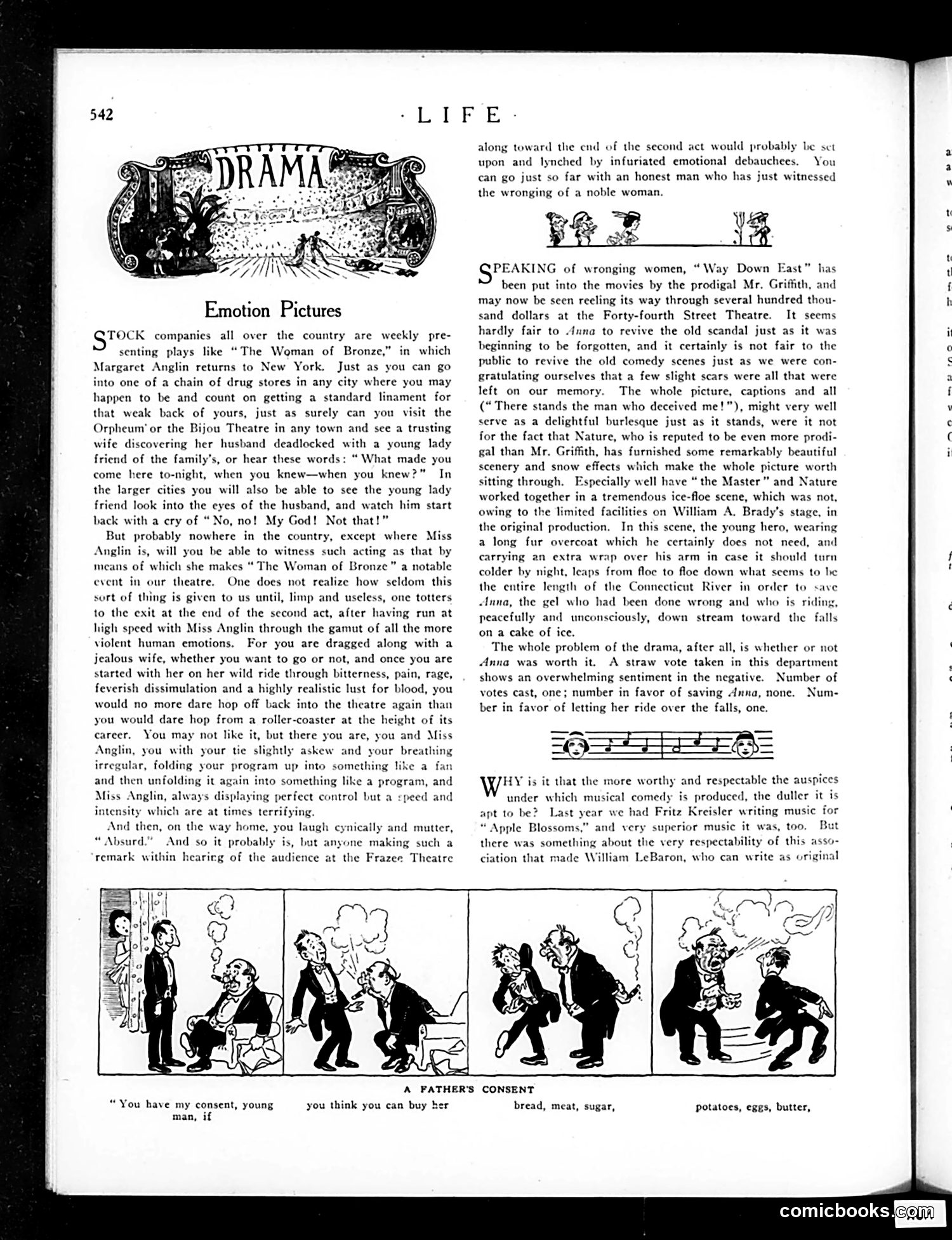
This page satirizes mass-produced theatrical melodrama. The article critiques how standardized "emotion pictures" are churned out like chain-store products across America—predictable plots featuring wronged wives discovering husbands with mistresses, all designed to manipulate audiences through exaggerated emotional manipulation. The text praises Margaret Anglin's performance in "The Woman of Bronze" as exceptional, contrasting her genuine artistry against the formula-driven mediocrity elsewhere. It also discusses D.W. Griffith's film adaptation of "Way Down East," noting the irony of reviving an old scandal while praising the natural scenery that saves the otherwise ridiculous plot. The bottom cartoon ("A Father's Consent") shows a comedic negotiation sequence—likely satirizing economic desperation or matrimonial transactions, though the specific reference is unclear without additional context. The satire's point: American entertainment factories prioritize profit over artistry, manufacturing predictable emotional responses rather than genuine theatrical experience.
📄 Transcribed text from this page (OCR, searchable)
Machine-transcribed from the original scan — historical spelling and the odd misread are preserved.
Emotion Pictures TOCK companies all over the country are weekly pre- senting plays like “The Woman of Bronze,” in which argaret Anglin returns to New York. Just as you can go into one of a chain of drug stores in any city where you may happen to be and count on getting a standard linament for that weak back of yours, just as surely can you visit the Orpheum’ or the Bijou Theatre in any town and see a trusting wife discovering her husband deadlocked with a young lady friend of the family’s, or hear these words: “ What made you come here to-night, when you knew—when you knew?” In the larger cities you will also be able to see the young lady friend look into the eyes of the husband, and watch him start back with a cry of “No, no! My God! Not that!” But probably nowhere in the country, except where Miss Anglin is, will you be able to witness such acting as that by means of which she makes “ The Woman of Bronze” a notable event in our theatre. One does not realize how seldom this surt of thing is given to us until, limp and useless, one totters to the exit at the end of the second act, after having run at high speed with Miss Anglin through the gamut of all the more violent human emotions. For you are dragged along with a jealous wife, whether you want to go or not, and once you are started with her on her wild ride through bitterness, pain, rage, feverish dissimulation and a highly realistic lust for blood, you would no more dare hop off back into the theatre again than you would dare hop from a roller-coaster at the height of its career, You may not like it, but there you are, you and Miss Anglin, you with your tie slightly askew and your breathing irregular, folding your program up into something like a fan and then unfolding it again into something like a program, and Miss Anglin, always displaying perfect control but a speed and intensity which are at times terrifying. And then, on the way home, you laugh cynically and mutter, “Absurd.” And so it probably is, but anyone making such a remark within hearirg of the audience at the Frazee Theatre along toward the end of the second act would probably be set upon and lynched by infuriated emotional debauchees. You can go just so far with an honest man who has just witnessed the wronging of a noble woman. PEAKING of wronging women, “Way Down East” has been put into the movies by the prodigal Mr. Griffith, and may now be seen reeling its way through several hundred thou- sand dollars at the Forty-fourth Street Theatre. It seems hardly fair to Anna to revive the old scandal just as it was beginning to be forgotten, and it certainly is not fair to the public to revive the old comedy scenes just as we were con- gratulating ourselves that a few slight scars were all that were left on our memory. The whole picture, captions and all (“ There stands the man who deceived me!"), might very well serve as a delightful burlesque just as it stands, were it not for the fact that Nature, who is reputed to be even more prodi- gal than Mr. Griffith, has furnished some remarkably beautiful scenery and snow effects which make the whole picture worth sitting through. Especially well have “the Master” and Nature worked together in a tremendous ice-floe scene, which was not, owing to the limited facilities on William A. Brady’s stage, in the original production. In this scene, the young hero, wearing a long fur overcoat which he certainly does not need, and carrying an extra wrap over his arm in case it should turn colder by night, leaps from floc to floe down what scems to he the entire length of the Connecticut River in order to save «Inna, the gel who had been done wrong and who is riding, peacefully and unconsciously, down stream toward the falls on a cake of ice. The whole problem of the drama, after all, is whether or not Anna was worth it. A straw vote taken in this department shows an overwhelming sentiment in the negative. Number of votes cast, one; number in favor of saving Anna, none. Num- ber in favor of letting her ride over the falls, one. HY is it that the more worthy and respectable the auspices under which musical comedy is produced, the duller it is apt to be? Last year we had Fritz Kreisler writing music for “Apple Blossoms,” and very superior music it was, too. But there was something about the very respectability of this asso- ciation that made William LeBaron, who can write as original A FATHER'S CONSENT “You have my consent, young you think you can buy her man, if bread, meat, sugar, Potatoes, eggs, butter, comicbooks