
Life, 1920-09-23 · page 23 of 40
Life — September 23, 1920 — page 23: what you’re looking at
What you’re looking at
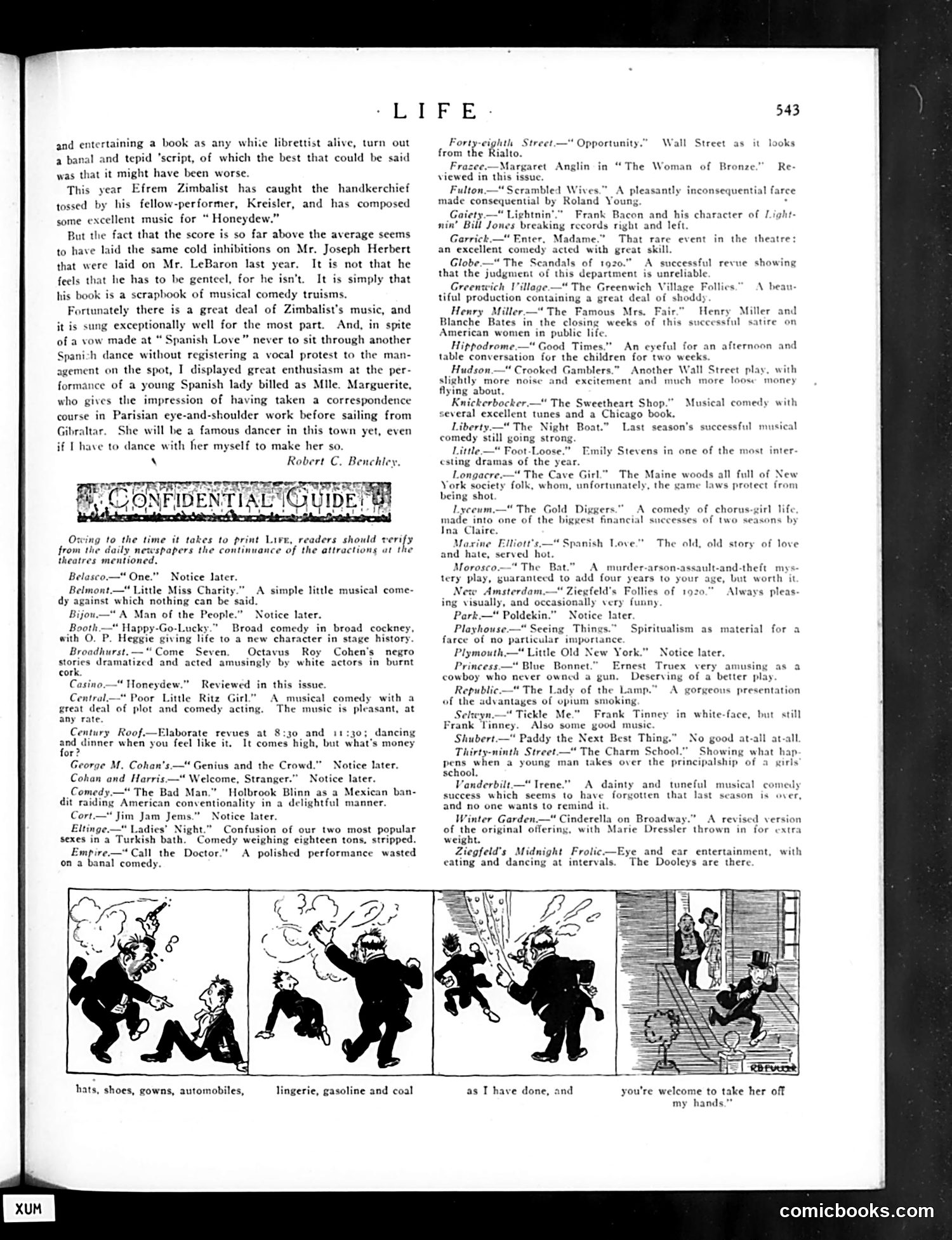
This is a theater review page from Life magazine's entertainment section. The cartoons at the bottom illustrate a humorous domestic scenario: a man juggling various household items (hats, shoes, gowns, automobiles, lingerie, gasoline, and coal) while a woman watches from a doorway. The final panel shows her saying "you're welcome to take her off my hands"—suggesting she's offering to let him manage some female figure's demands. The joke reflects 1920s gender anxieties: the man is overwhelmed by the material demands and chaos of modern domestic/consumer life, while the woman appears indifferent or relieved to pass responsibility to him. It's likely satirizing either marital dynamics or the contemporary "new woman" stereotype of the Jazz Age. The page itself is primarily theater listings and reviews by Robert C. Benchley, covering Broadway productions from that season.
📄 Transcribed text from this page (OCR, searchable)
Machine-transcribed from the original scan — historical spelling and the odd misread are preserved.
~LIFE 543 and entertaining a book as any white librettist alive, turn out ‘a banal and tepid ‘script, of which the best that could be said was that it might have been worse. This year Efrem Zimbalist has caught the handkerchief his fellow-performer, Kreisler, and has composed “ Honeydew.” But the fact that the score is so far above the average seems to have laid the same cold inhibitions on Mr. Joseph Herbert that were laid on Mr. LeBaron last yea It is not that he feels that he has to be genteel, for he isn’t. It is simply that his book is a scraphook of musical comedy truisms. Fortunately there is a great deal of Zimbalist’s music, and it is sung exceptionally well for the most part. And, in spite of a vow made at “ Spanish Love” never to sit through another Spanish dance without registering a vocal protest to the man- agement on the spot, I displayed great enthusiasm at the per- formance of a young Spanish lady billed as Mile. Marguerite, who gives the impression of having taken a correspondence course in Parisian eye-and-shoulder work before sailing from Gibraltar. She will be a famous dancer in this town yet, even tossed b some excellent music for if I have to dance with her myself to make her sc Robert C. Benchley. ng to the time it takes to print Lire, readers should verify from tie daily newspapers the continuance of the attractions ut the theatres mentioned, Belasco— One.” Notice later. ‘elmont.—" Little Miss Charity.” dy against which nothing can be said. Bijou.—" A Man of the People.” Booth.—" Happy-Go-Lucky.” Broad comedy in broad cockney, with O. P. Heggie giving life to a new character in stage history. Broadhurst.—“ Come Seven. Octavus Roy Cohen's negro stories dramatized and acted amusingly by white actors in burnt cork Casino.— Honeydew.” Reviewed in this issue. Central—" Poor Little Ritz Girl.” A_ musical comedy with a great deal of plot and comedy acting, The music is pleasant, at any rate A simple little musical come- Notice later. Century Roof—Elaborate revues at 8:30 and 11:30; dancing gad dinner when you feel like it. It comes high, but what's money lor? George M. Cohan’s.—" Genius and the Crowd.” Notice later. Cohan and Harris—*“ Welcome, Stranger.” Notice later. Comedy.—* The Bad Man.” Holbrook Blinn as a Mexican ban- dit raiding American conventionality in a delightful manner. Cort—* Jim Jam Jems.” Notice later Eltinge.—" Ladies’ Night.” Confusion of our two most popular sexes in a Turkish bath. Comedy weighing eighteen tons, stripped. Empire.—* Call the Doctor.” A polished performance wasted on a banal comedy. Forty-eighth Street — Opportunity.” Wall Street as it looks from the Rialto. Frazee.—Margaret Anglin in “The Woman of Bronze.” Re- viewed in this issue. Fulton —" Scrambled Wives.” A pleasantly inconsequential farce made consequential by Roland Young : Gaiety.—" Lightnin’.”| Frank Bacon and his character of Lig nin’ Bill Jones breaking records right and left. Garrick —" Enter, Madame.” That rare event in the theatre: an excellent comedy acted with great skill. Globe—" The Scandals of 1920.” A successful revue showing that the judgment of this department is unreliable _ Greenwich Millage —“ The Greenwich Village Follies tifal production containing a great deal of shoddy Henry Miller—“ The Famous Mrs. Fair.” Henry Miller and Blanche Bates in the closing weeks of this successful satire on American women in public life Hippodrome.—" Good Times.” An cyeful for an afternoon and table conversation for the children for two weeks Hudson.—" Crooked Gamblers.” Another Wall Street play, with slightly more noise and excitement and much more loose money flying about. Knickerbocker —" The Sweetheart Shop.” several excellent tunes and a Chicago book. iberty.—" The Night Boat.” comedy still going strong Little —" Foot-Loose esting dramas of the year. Longacre.— The Cave Girl.” The Maine woods all full of New York society folk, whom, unfortunately, the game laws pre t from being shot Lyceum.—" The Gold Diggers.” A comedy of chorus made into one of the biggest financial successes of two sea Ina Claire. Maxine Elliott’s,—" Spa and hate, served hot. Morosco—" The Bat.” A_murder-arson-assault-and-theft_ mys- tery play, guaranteed to add four years to your age, but worth it New Amsterdam.— Ziegfeld’s Follies of 1920." Always pleas- ing visually, and occasionally very funny Park.—" Poldekin.” Notice later Playhouse-—" Seeing Things.” Spiritualism as material for a farce of no particular importance Plymouth.— Little Old New York.” Notice later. Princess—" Blue Bonnet.” Ernest Truex very amusing as a cowboy who never owned a gun, Deserving of a better play Republic—" The Lady of the Lamp. of the advantages of opium smoking Selteyn.—" Tickle Me.” Frank Tinney in white-face, but still Frank Tinney. Also some good music Shubert—" Paddy the Next Best Thing.” No good at-all at-all Thirty-ninth Street—" The Charm School.” Showing what hap pens when a young man takes over the principalship of a gir school. Vanderbilt—" Irene." A dainty and tuneful musical comedy success which seems to have forgotten that last season is over, and no one wants to remind it Winter Garden.—" Cinderella on Broadway.” A revised version of the original offering, with Marie Dressler thrown in for extra weight. Ziegfeld’s Midnight Frolic-—Eye and ear entertainment, with cating and dancing at intervals. The Dooleys are there \ beau. Musical comedy with Last season's successful musical Emily Stevens in one of the most inter h Love." The old, old story of love A gorgeous presentation hats, shoes, gowns, automobiles, lingerie, gasoline and coal as T have done, and you're welcome to ta my hand comicbooks.com