
A complete issue · 36 pages · 1920
Life — August 26, 1920
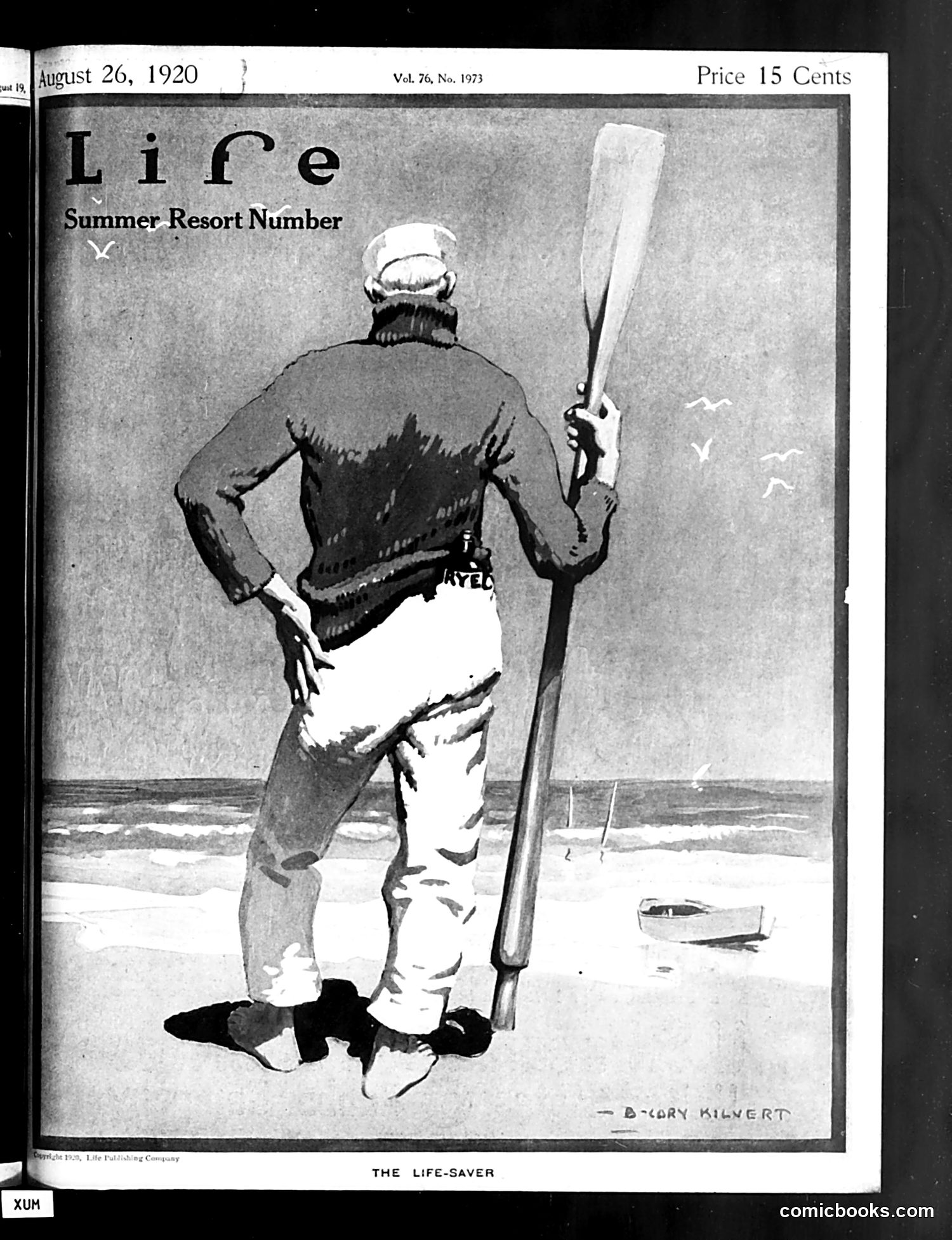
This cover illustration by Boardman Kilvert depicts a figure viewed from behind, standing on a beach holding an oar. The person wears a bathing costume of the 1920s era—a dark jacket over white pants with black shoes—and a white swimming cap. The title "The Life-Saver" appears ironic: the figure strikes a heroic pose with the oar, but stands alone on an empty beach with only a small boat visible in the distance and birds in the sky. The satire likely mocks either ineffectual rescue efforts, overstated heroics, or perhaps references a specific 1920 news event involving a lifeguard or coastal rescue. The "Summer Resort Number" designation suggests this appeared in a seasonal entertainment issue.
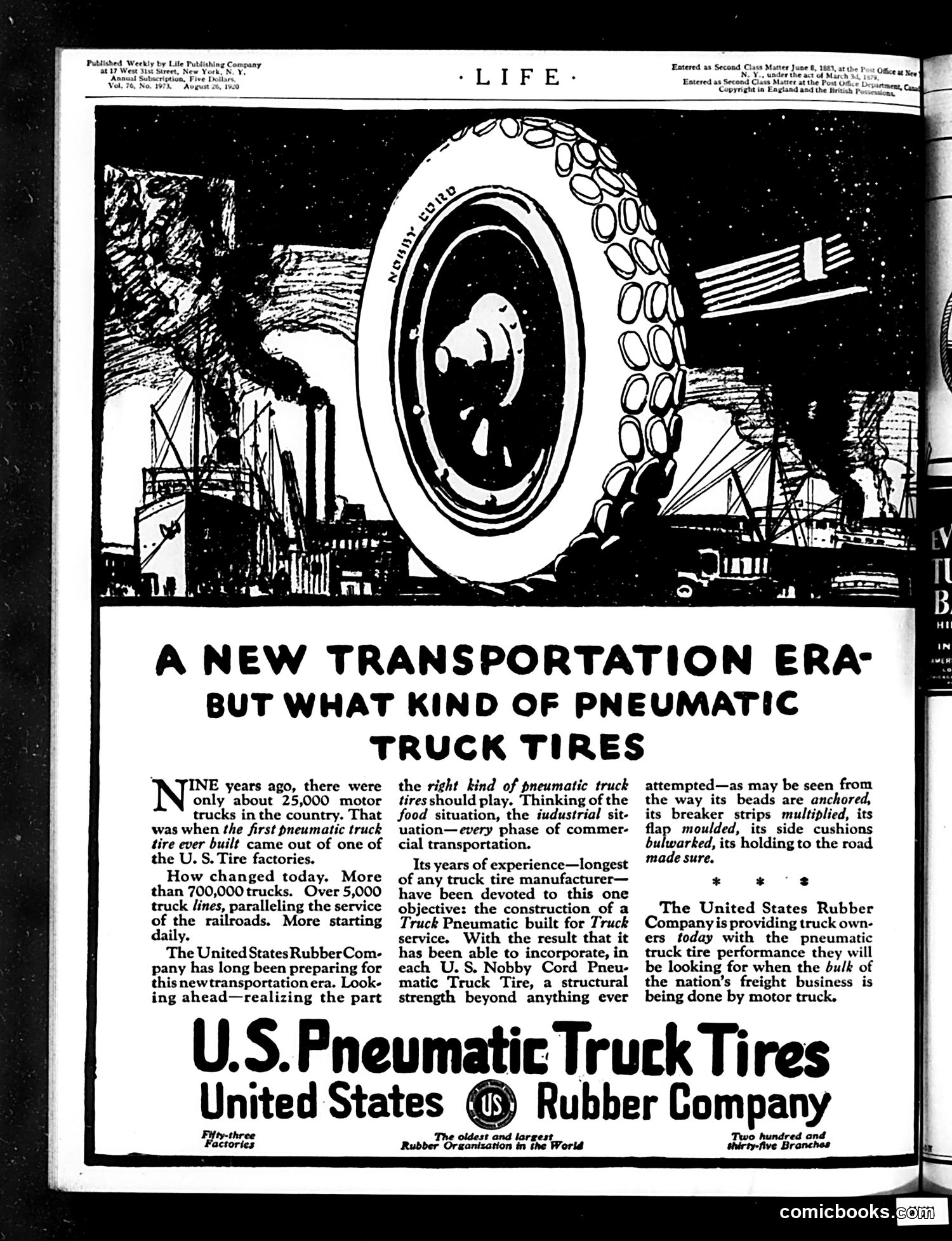
This page is **primarily advertising**, not satirical content. It's a full-page ad for U.S. Pneumatic Truck Tires by the United States Rubber Company, published in Life magazine (August 28, 1920, based on the header). The ad uses dramatic illustration of an enormous truck tire to promote a "new transportation era." The text emphasizes that nine years prior, only 25,000 motor trucks existed; now there are over 50,000, creating demand for specialized pneumatic truck tires. The ad claims U.S. Rubber has developed superior "Tract Pneumatic" tires specifically engineered for truck service, highlighting their structural strength. There is **no political satire or caricature** here—it's straightforward industrial marketing capitalizing on the truck transportation boom of the early 1920s.
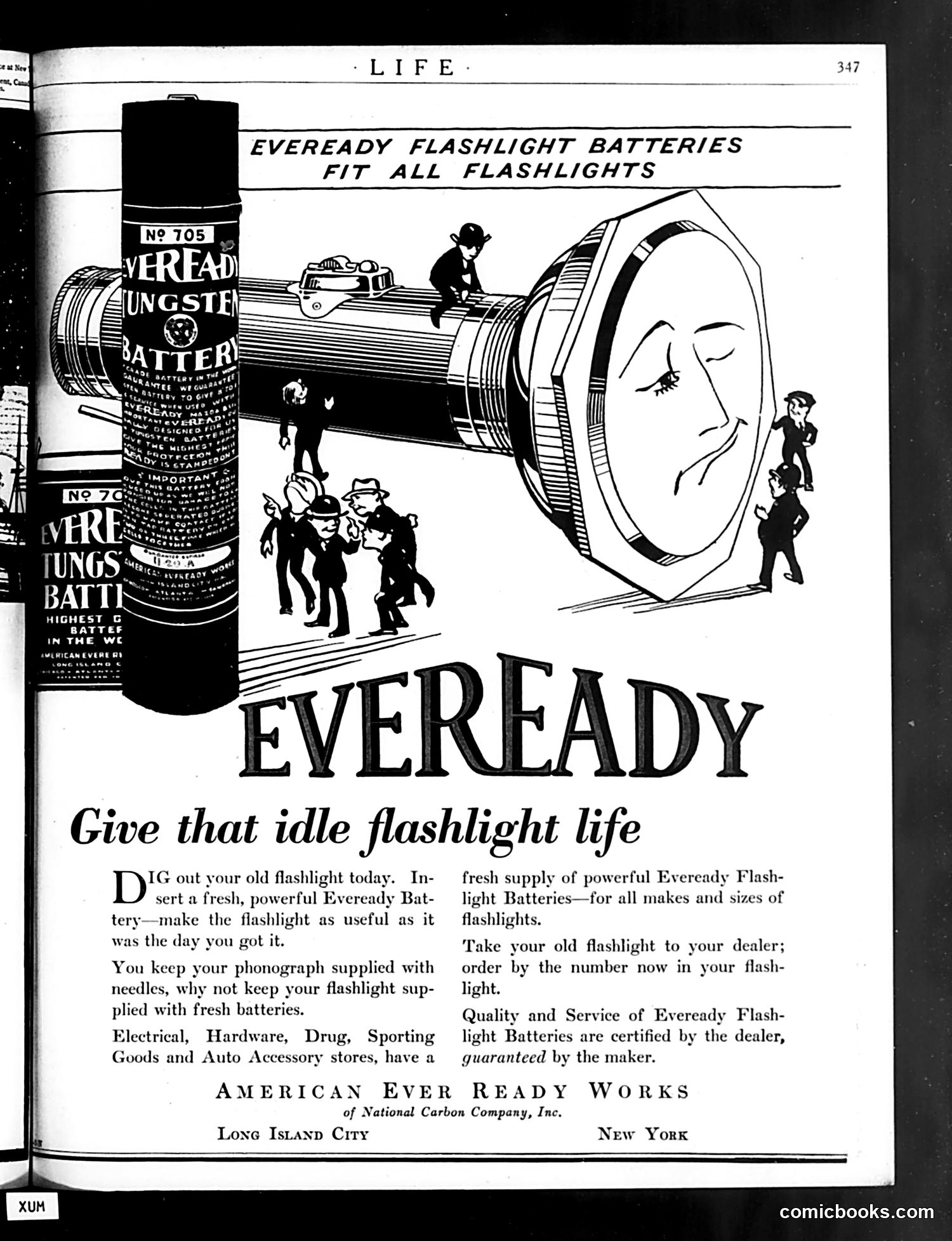
This is primarily a **commercial advertisement**, not editorial satire. It promotes Eveready flashlight batteries, appearing in *Life* magazine (page 347). The ad uses visual humor rather than political commentary. It depicts a comically oversized flashlight with people appearing tiny by comparison—a surreal scale exaggeration meant to emphasize the product's power and reliability. The headline "Give that idle flashlight life" plays on the double meaning of "life" (both the magazine's title and literal vitality). The advertisement encourages readers to replace old flashlight batteries with fresh Eveready batteries, positioning them as universally compatible ("fit all flashlights"). It notes availability at electrical, hardware, drug, and sporting goods stores. There is **no political or social satire** present—this is straightforward consumer advertising using visual whimsy to promote battery sales.
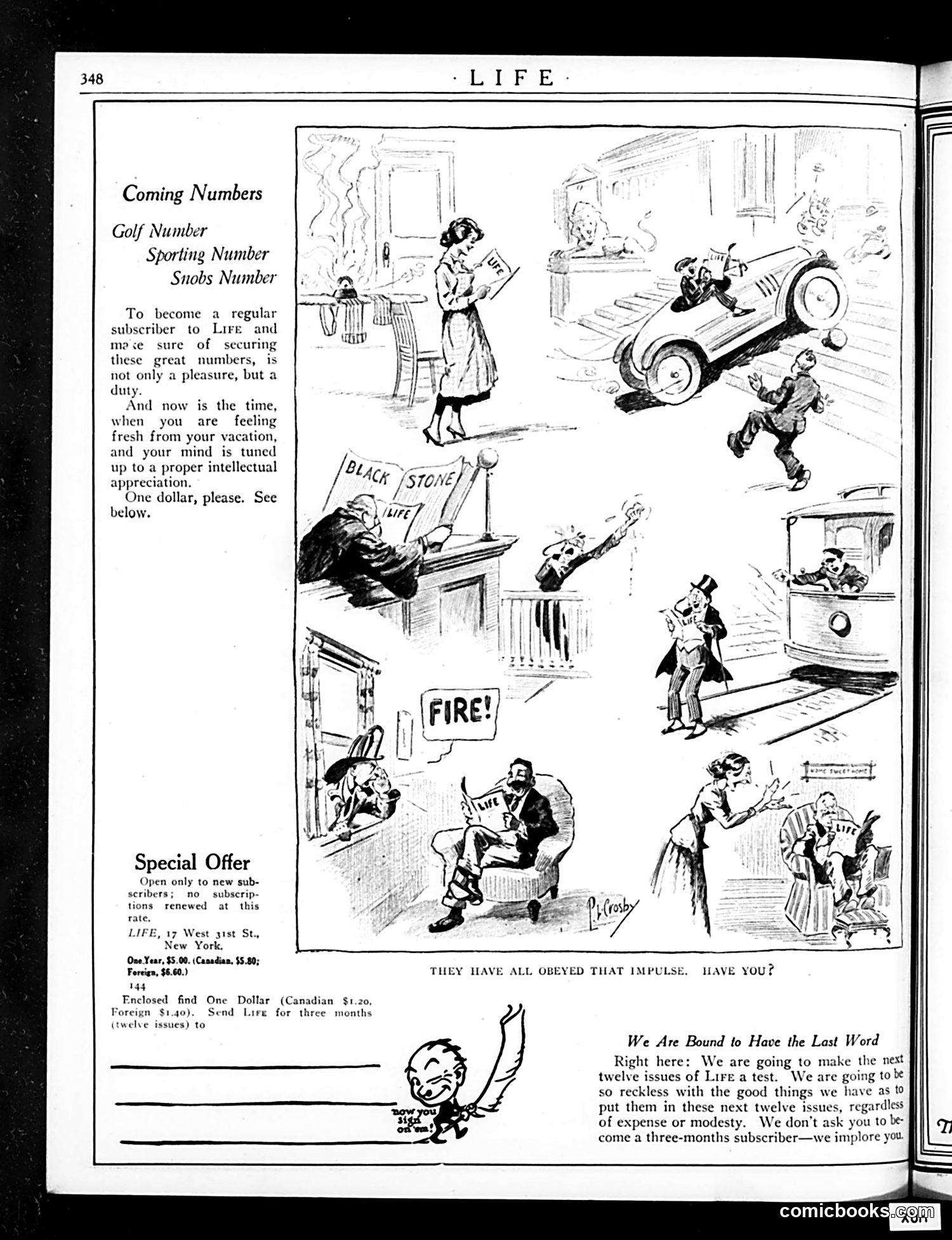
This page contains **subscription promotional material** rather than political cartoons. The left side advertises Life magazine's "Coming Numbers" (upcoming issues) featuring Golf, Sporting, and Snobs content, with subscription pricing. The central illustration is titled **"They Have All Obeyed That Impulse, Have You?"** It depicts various comedic scenarios—a woman reading Life, someone in a speeding car, people responding to emergencies (marked "FIRE!")—suggesting Life magazine inspires readers to take action or embrace impulses. The cartoons appear to be promoting subscription conversions rather than satirizing specific political figures or events. The bottom section pledges Life will "have the last word" in upcoming issues, making bold editorial promises to attract readers. This is primarily **advertising content** masquerading as entertainment.
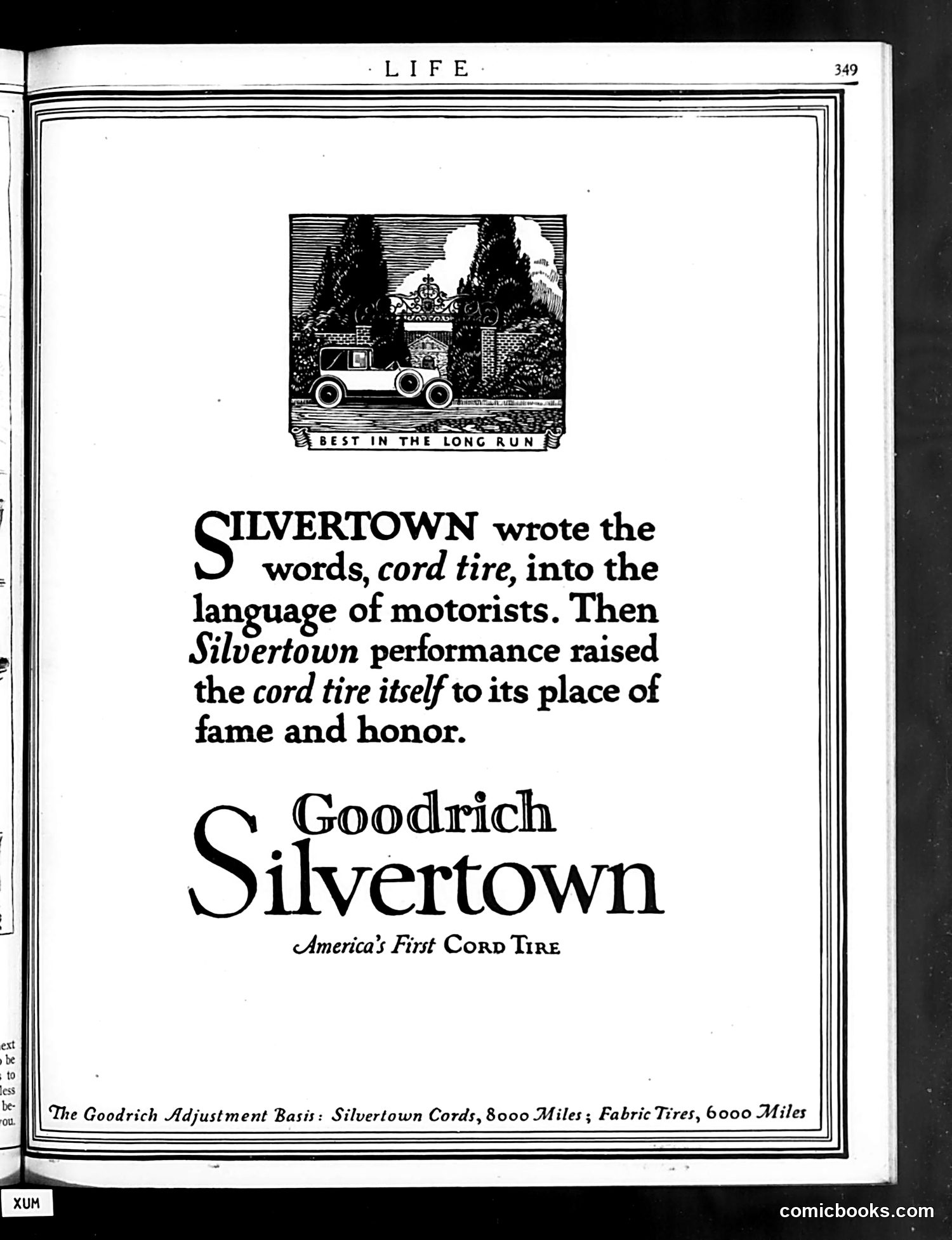
This page is primarily a **Goodrich Silvertown tire advertisement**, not satirical content. The ad claims that Silvertown introduced the term "cord tire" into motorists' vocabulary, then backed it with superior performance to earn its reputation. The small illustration shows a vintage automobile passing between tall cypress trees near what appears to be a Mediterranean villa, with the tagline "BEST IN THE LONG RUN." The bottom specification line notes different tire types: Silvertown Cords (8,000 miles) versus Fabric Tires (6,000 miles), emphasizing durability advantages. This represents early automotive-era marketing positioning Silvertown as America's first cord tire manufacturer, appealing to motorists concerned with tire longevity and reliability—key selling points in the pre-1920s automobile market.
This is not a cartoon or satirical content—it's a **straightforward advertisement** for White Trucks, manufactured by The White Company in Cleveland. The ad promotes White Trucks as economical workhorses, claiming they deliver "the most work for the least money." It emphasizes the company's design philosophy: every detail was chosen to improve efficiency and reduce costs. The ad cites evidence of value: owners with 100,000-300,000 miles on their trucks supposedly attest to White's durability and economy. This appears in *Life* magazine's advertising section (page 350), representing typical early-20th-century industrial advertising that appeals to business owners through claims of reliability and cost-effectiveness rather than humor or satire.
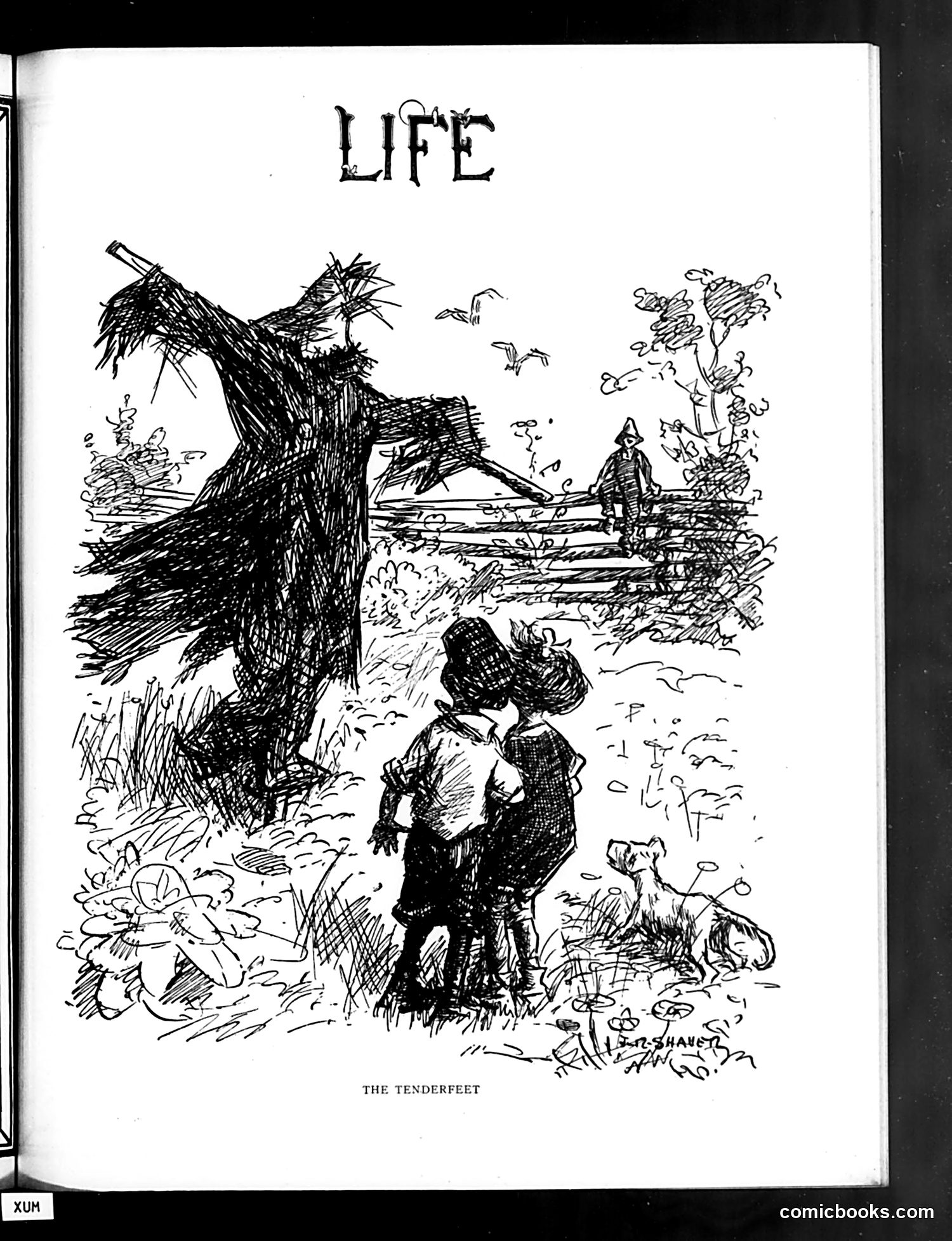
This page is titled "LIFE" at the top and labeled "THE TENDERFOOT" at the bottom, with what appears to be a signature (possibly "E.W. Kemble" or similar). The illustration depicts a young, inexperienced person (the "tenderfoot"—period slang for a newcomer or greenhorn) in a rural or frontier setting. The figure stands among rustic elements: a gnarled tree, wooden fence, wildflowers, and what appears to be a dog. Other figures are visible in the background near a fence. The satire likely mocks urban newcomers to rural/frontier life—their naïveté and unfamiliarity with country ways. The delicate, somewhat prissy appearance of the central figure contrasts with the rough frontier landscape, suggesting the humor derives from this clash between civilized inexperience and rugged reality.
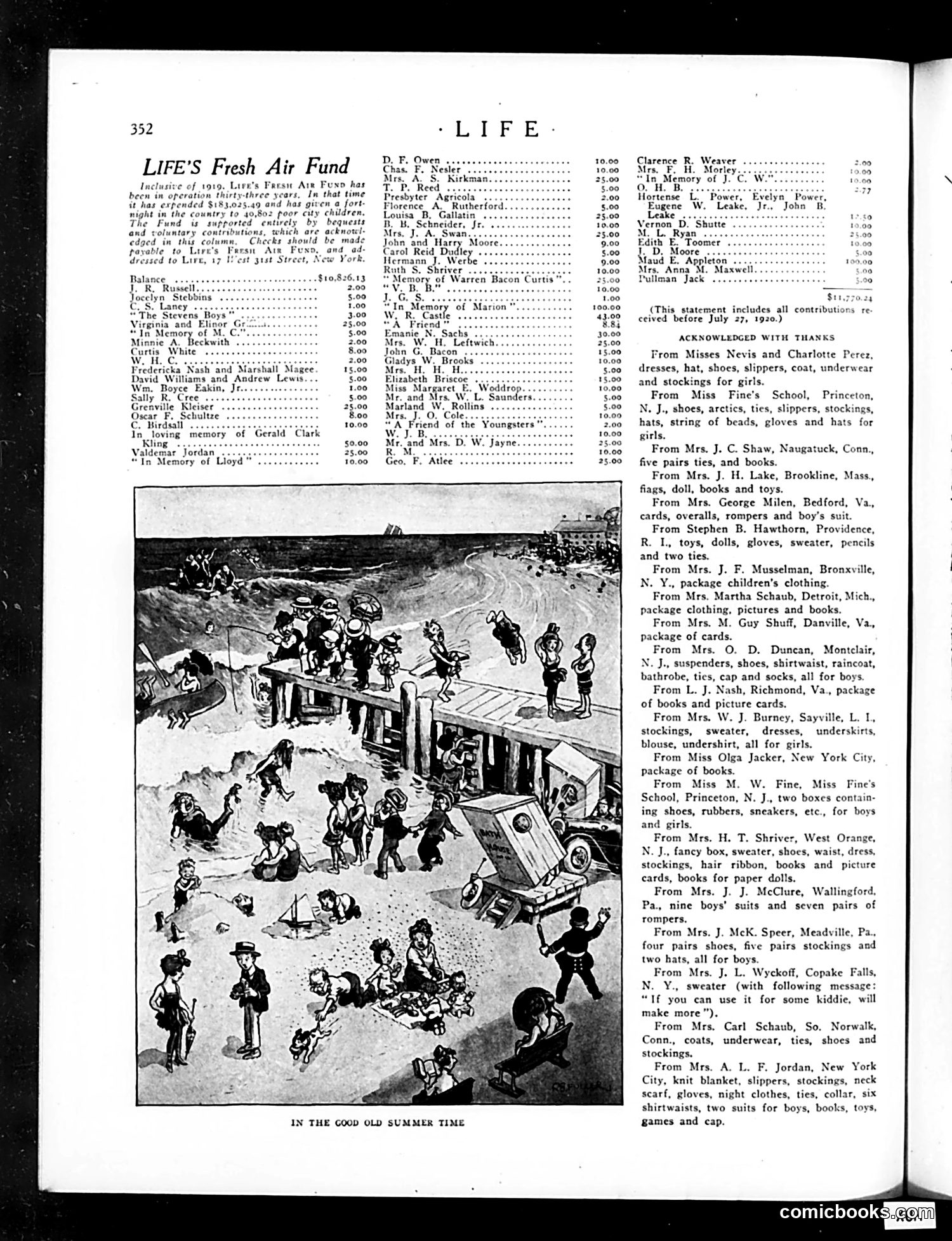
This illustration depicts a nostalgic beach or seaside scene from the early 20th century. It shows children and families enjoying summer leisure activities—swimming, playing games, relaxing on the sand, and socializing on a boardwalk or pier. The page itself is not political satire but rather a charitable appeal: "LIFE's Fresh Air Fund," which solicited donations to send poor urban children to the countryside for summer. The list names contributors and amounts given. The accompanying text explains the fund's purpose and acknowledges donations received, including gifts of children's clothing and supplies from various donors. The nostalgic illustration romanticizes wholesome summer recreation, reinforcing the fund's mission to provide healthy outdoor experiences to children who might otherwise lack such opportunities.
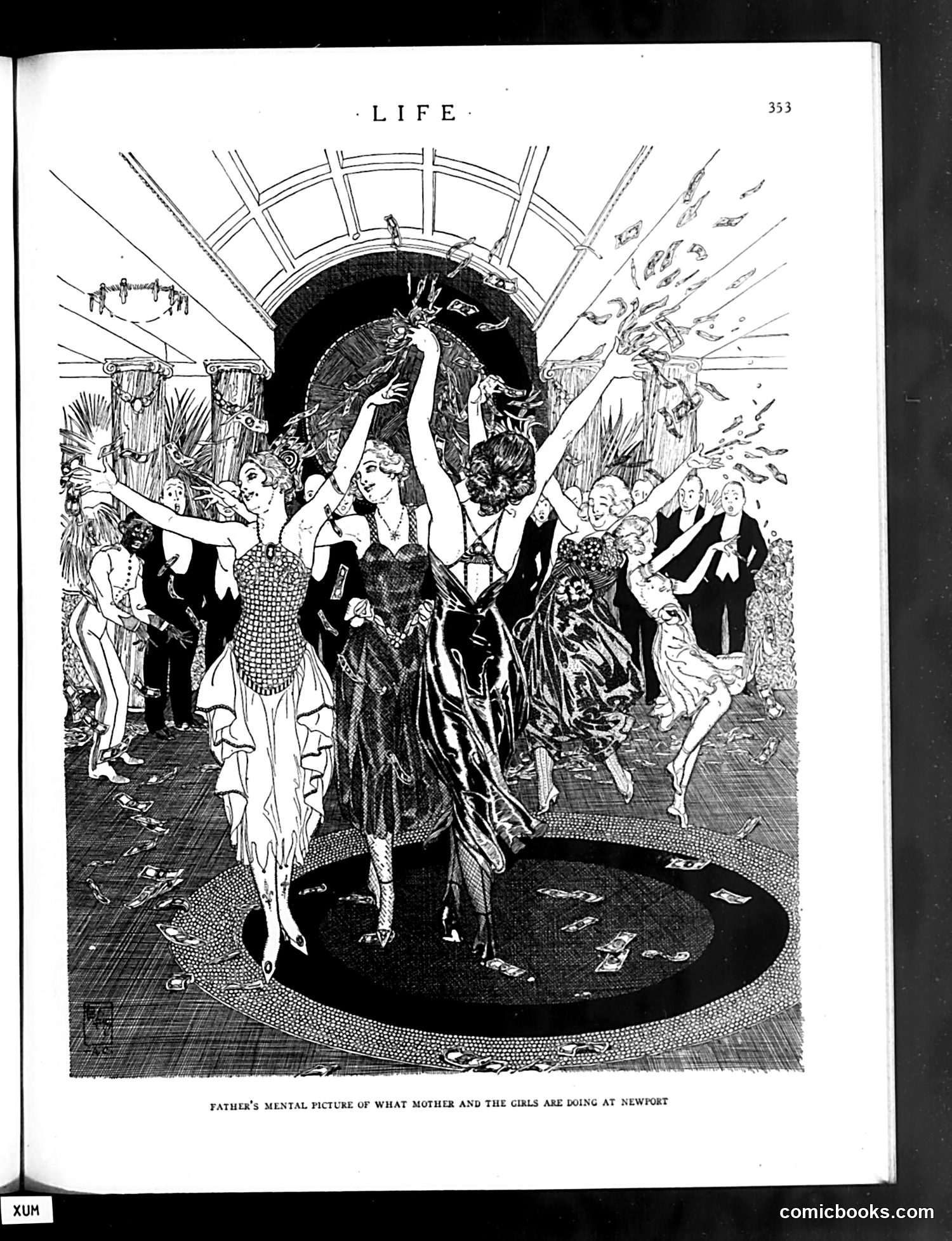
This is a satirical illustration from *Life* magazine depicting "Father's Mental Picture of What Mother and the Girls Are Doing at Newport." The cartoon shows an extravagant, fantastical scene: elegantly dressed women in a grand ballroom with classical architecture, dancing and socializing beneath an ornate dome with radiating light. Money appears to scatter across the floor. The satire targets the stereotype of wealthy families vacationing at Newport, Rhode Island—a famous resort destination for the American elite. The joke presents the husband's imagined (and exaggerated) vision of his wife and daughters' lavish spending and frivolous activities while he remains elsewhere, presumably working to fund their expensive leisure. The cartoon mocks both the conspicuous consumption of the wealthy and the gender dynamics of the era, where husbands bankrolled wives' social activities.
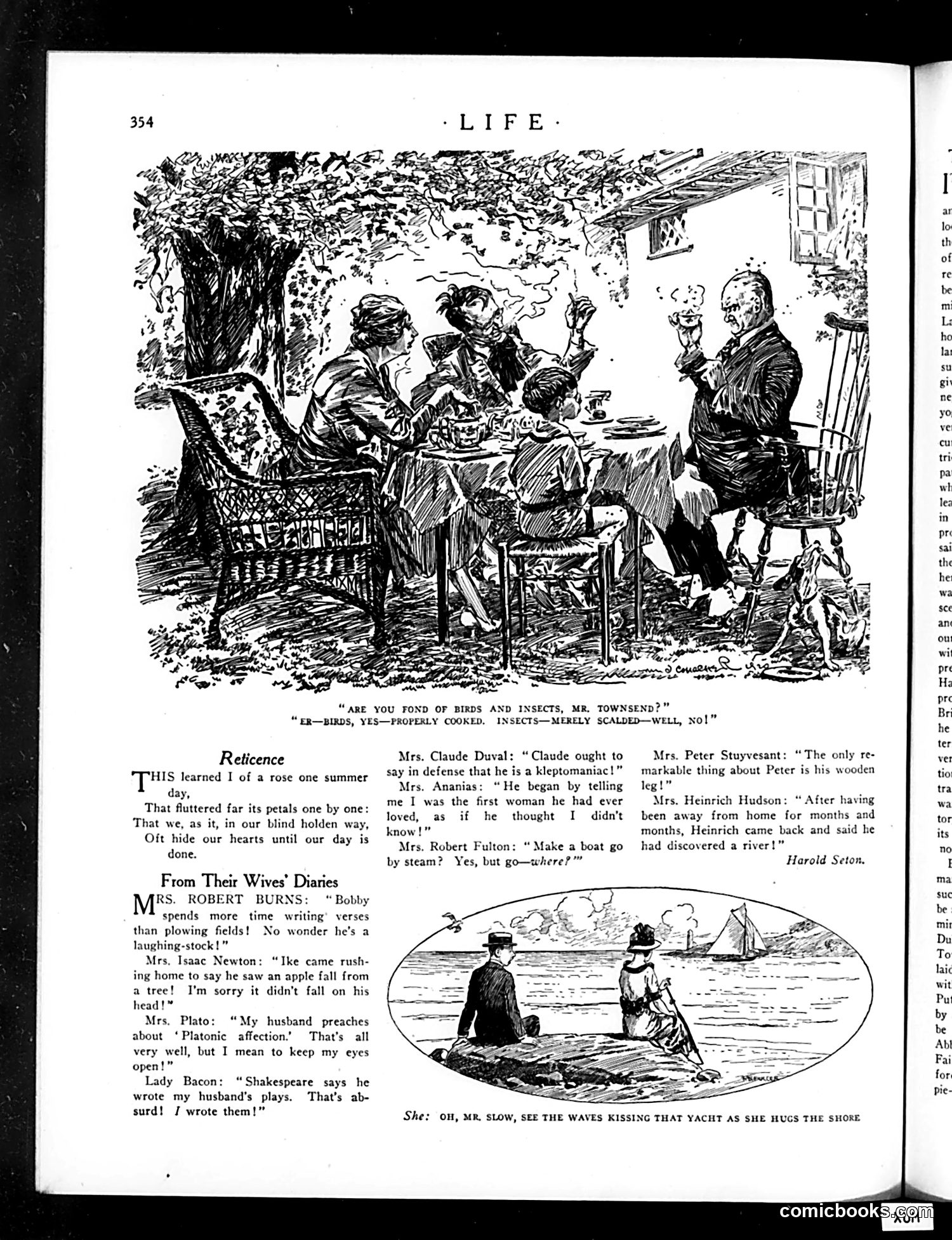
The main illustration depicts a social gathering where Mr. Townsend is asked if he's "fond of birds and insects." The humor turns on his answer: he likes birds (properly cooked) but finds insects merely "scalded"—a crude joke treating insects as food. Below, "From Their Wives' Diaries" contains brief, domestic anecdotes mocking husbands. These include Mrs. Burns joking about her husband spending more time writing verses than working, Mrs. Newton describing her husband falling from a tree, and Lady Bacon claiming she actually wrote her husband's Shakespeare plays—absurdist humor deflating male pretension through female perspective. The second illustration shows a couple by the shore with romantic implications, captioned about a yacht and waves. The content reflects early 20th-century satirical humor targeting domestic life and gender dynamics.
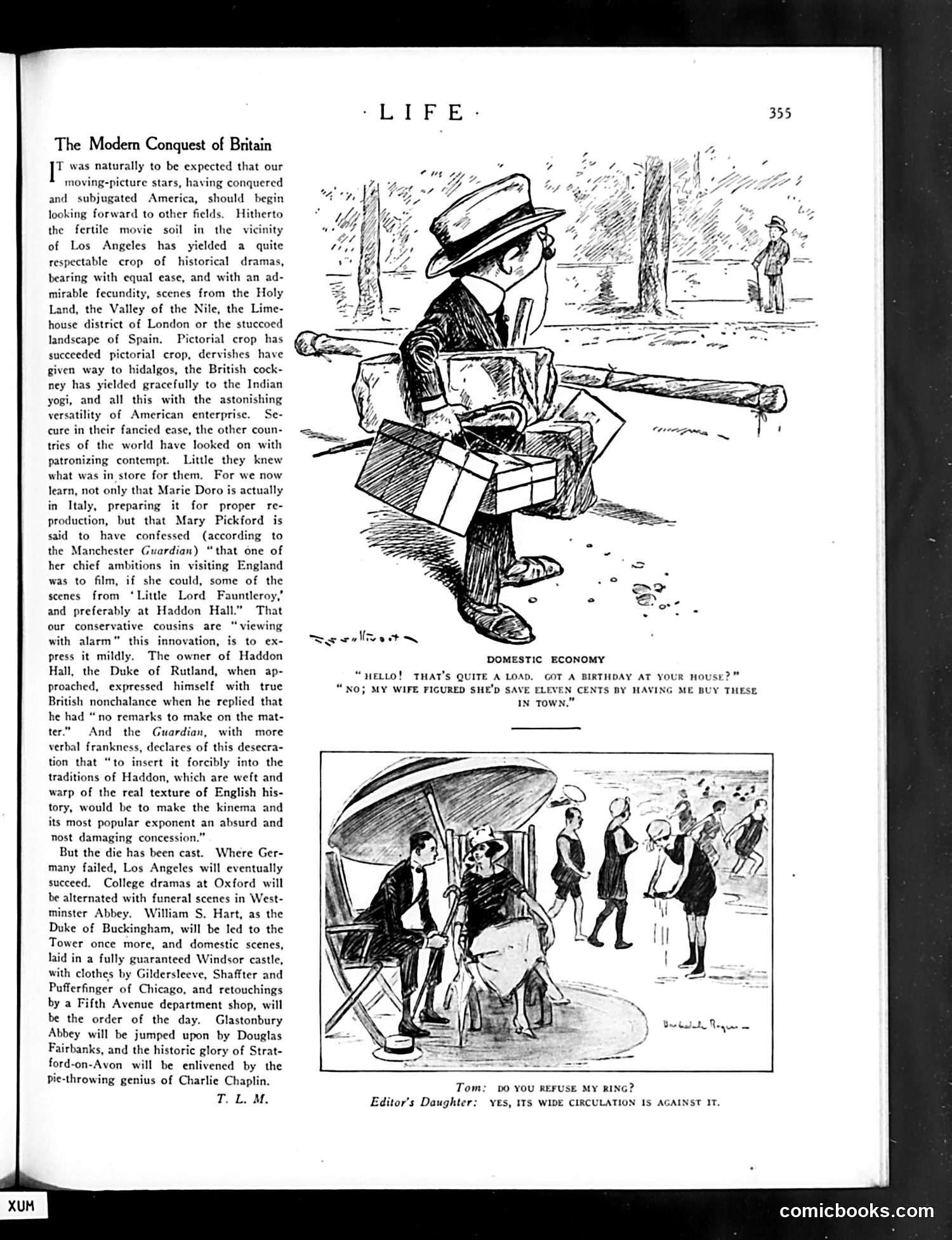
This page satirizes the contrast between high-minded cultural aspirations and modest household budgets. The top cartoon shows a man burdened with heavy parcels labeled with expensive items—apparently purchased to maintain social status or keep up with cultural trends. The caption mocks his wife's "economy": she saves pennies by having him buy expensive goods in town rather than locally. The lower cartoon depicts a beach scene where a man in formal dress (possibly Tom, mentioned in the caption) refuses to wear a ring, claiming "wide circulation" is against it—likely satirizing class pretensions or social rules about jewelry among the wealthy versus working classes. The overall theme: the absurd financial gymnastics middle-class families perform to maintain respectability.
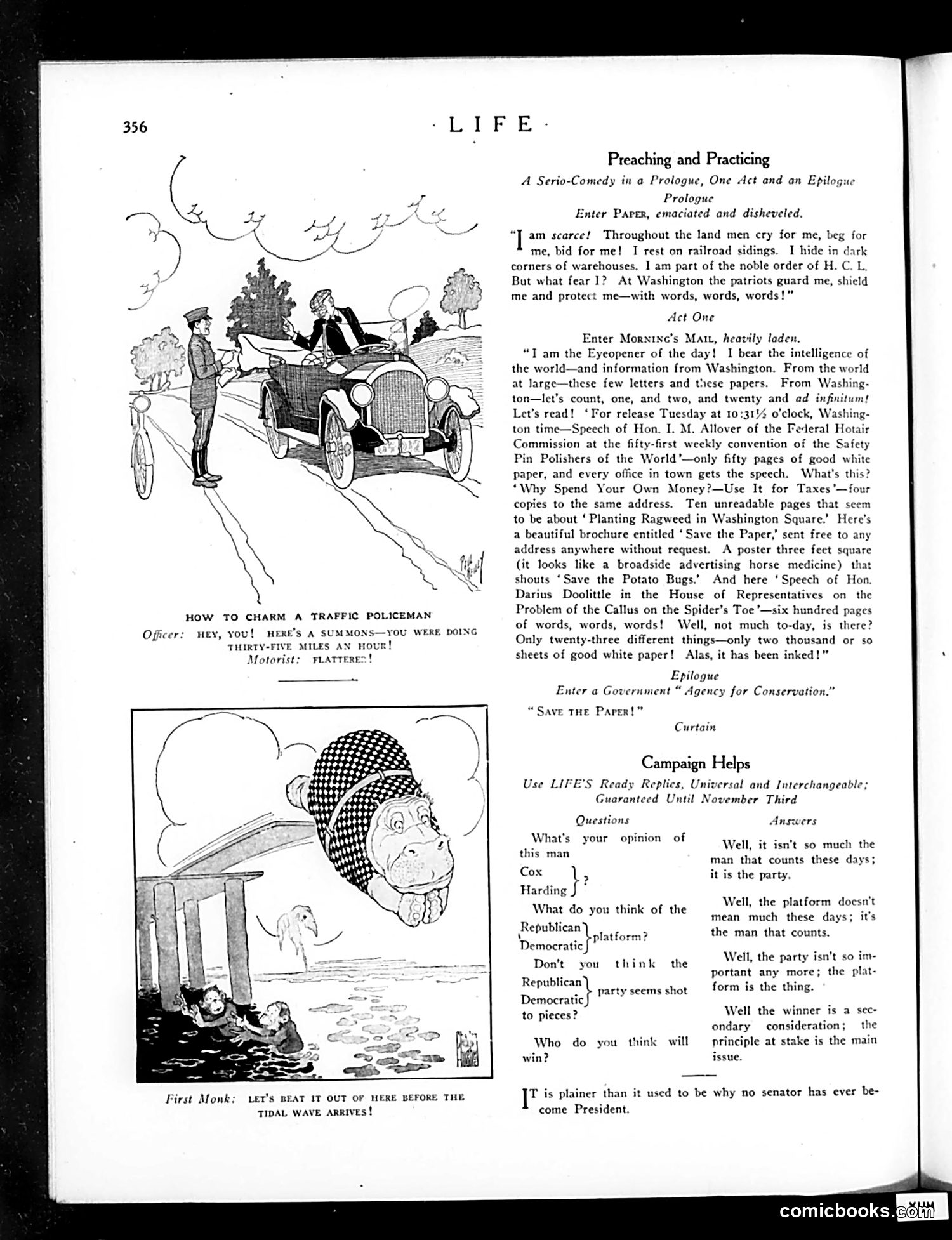
This page presents a satirical play mocking Republican hypocrisy during a political campaign. The title "Preaching and Practicing" sets up the central joke: politicians advocate for government conservation measures while personally wasting resources. The main cartoon "How to Charm a Traffic Policeman" depicts someone (likely a politician) speeding in an automobile—a luxury suggesting wealth and privilege—while appearing to charm their way out of consequences. The "Campaign Helps" section features Q&A responses emphasizing that party affiliation matters more than actual policy substance or character. One response explicitly states "it is the party" that counts, not the individual. The monks cartoon satirizes political chaos, suggesting politicians' infighting destroys the party itself ("beat it out of here before the tidal wave arrives"). Overall, the page critiques campaign-era hypocrisy and superficial party politics.
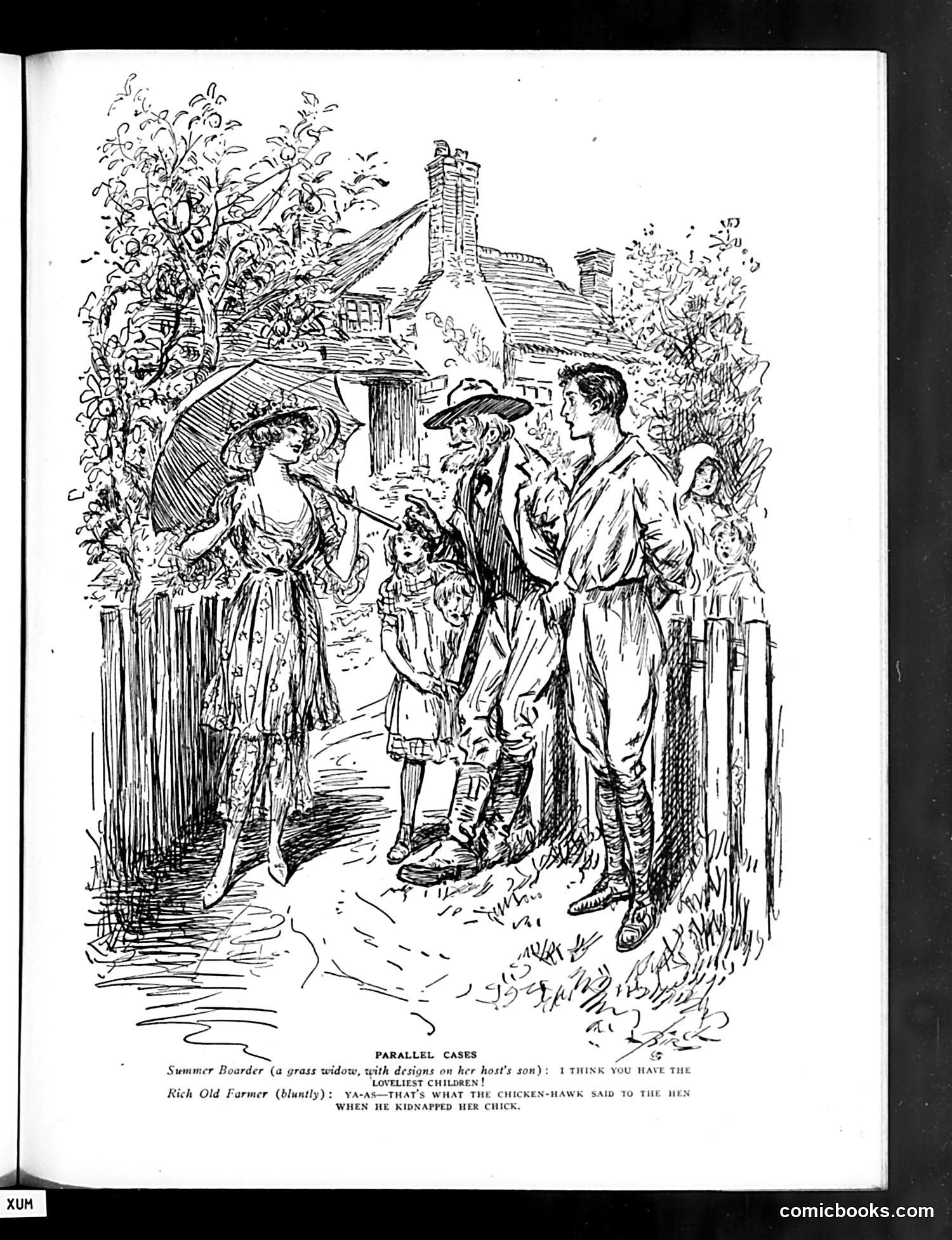
This cartoon presents two scenarios side-by-side with a humorous parallel. A well-dressed Summer Boarder (a wealthy visitor from the city staying in the countryside) praises a Rich Old Farmer's children as "the loveliest children," while the farmer dismissively compares them to a chicken-hawk stealing chicks—implying the boarder's children are predatory or unwanted. The satire mocks the class dynamics between rural farmers and urban summer tourists. The boarder's flattery appears disingenuous or condescending, while the farmer's crude response deflates any pretense of civility. The joke exposes the tension and mutual suspicion between rural and urban social classes in early 20th-century America, with each viewing the other with thinly-veiled contempt.
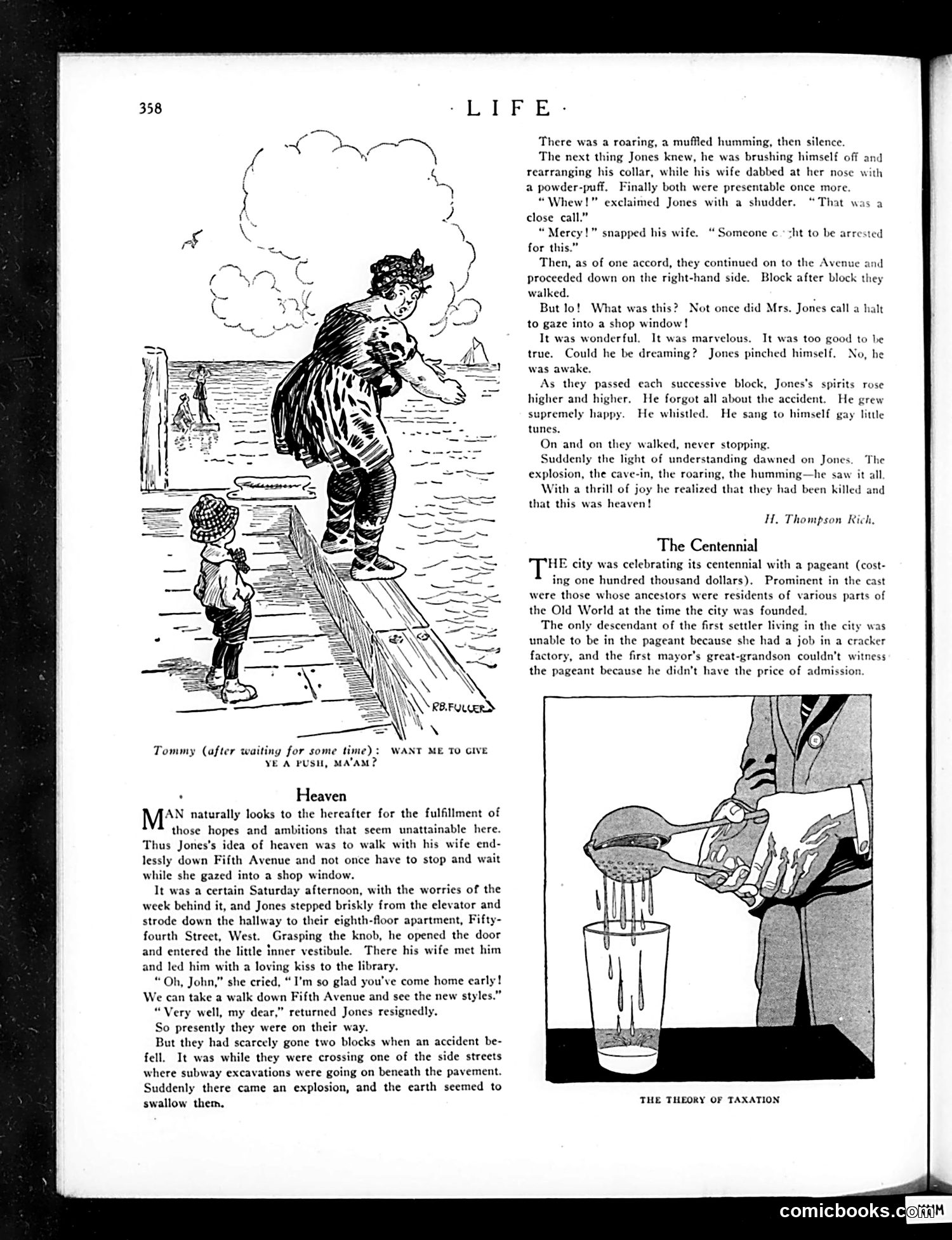
This page contains two distinct pieces of satirical content: **"Heaven"** (top): A narrative story about Jones and his wife experiencing a near-death experience during a subway excavation accident in their city. The story celebrates their realization that being alive together—even amid urban chaos and danger—constitutes their version of heaven. This satirizes materialistic pursuits and urban life's hazards while affirming simple domestic happiness. **"The Centennial"** (bottom right): Text mocking a city's hundred-year celebration pageant. It criticizes that descendants of the city's founders cannot participate because they lack wealth or social standing—they've lost their prominence. This satirizes how American cities celebrated their histories while ignoring how founding families had often declined into poverty. The illustration labeled "The Theory of Taxation" (lower right) appears to show wealth redistribution visually.
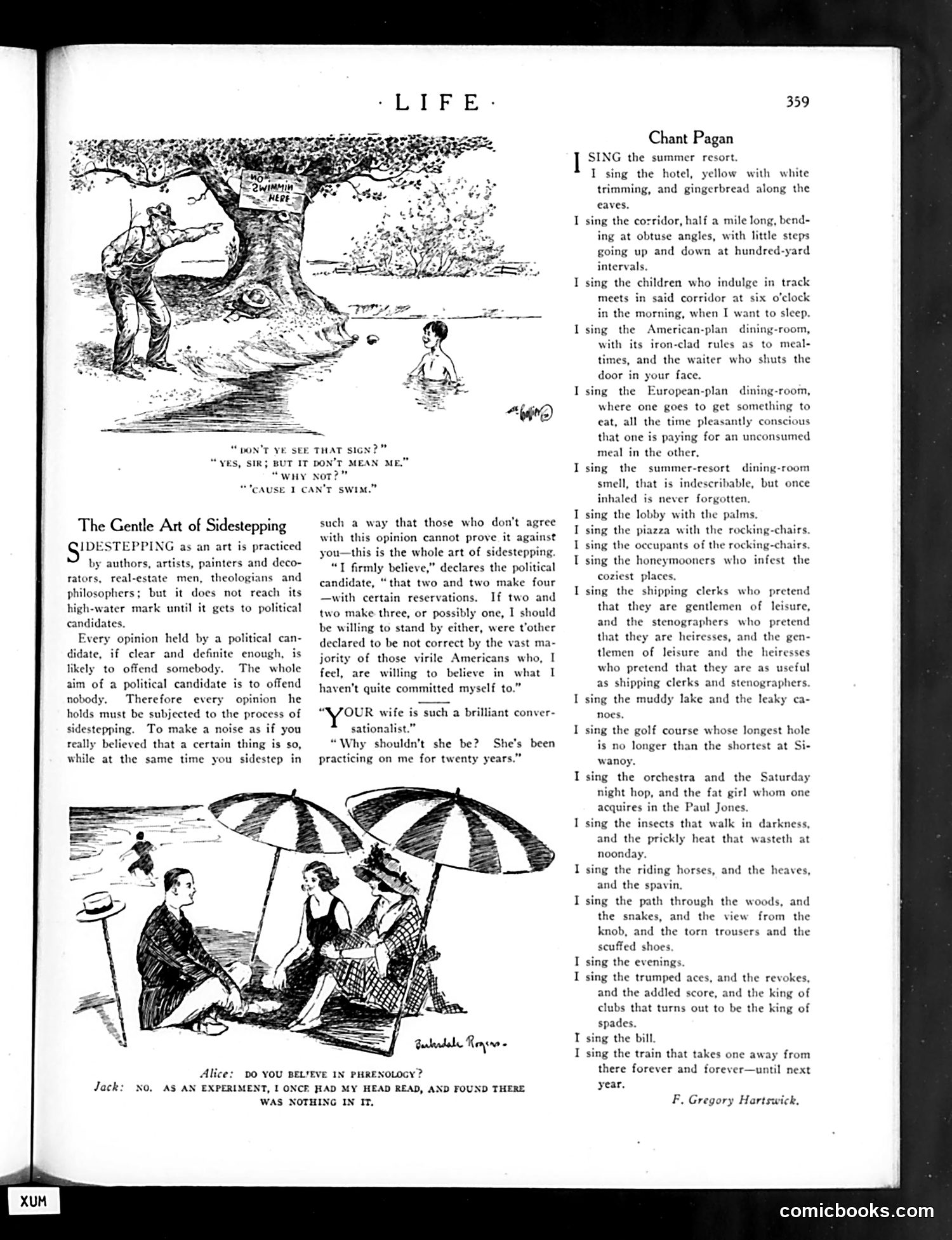
This satirical piece critiques political candidates' evasiveness. The text explains that politicians avoid taking clear stances on contentious issues, instead making vague statements that allow disagreement without contradiction—hence "sidestepping." The cartoon below illustrates this through a beach scene where a man asks a woman about "phrenology" (a pseudoscience claiming skull shape indicates intelligence). She responds by praising him as a "brilliant conversationalist" for twenty years—avoiding any actual answer about whether she believes in the theory. The joke: just as the woman deflects without committing, politicians similarly dodge real positions by appearing agreeable while remaining noncommittal. This allows them to appeal to multiple constituencies without alienating anyone through actual opinions.
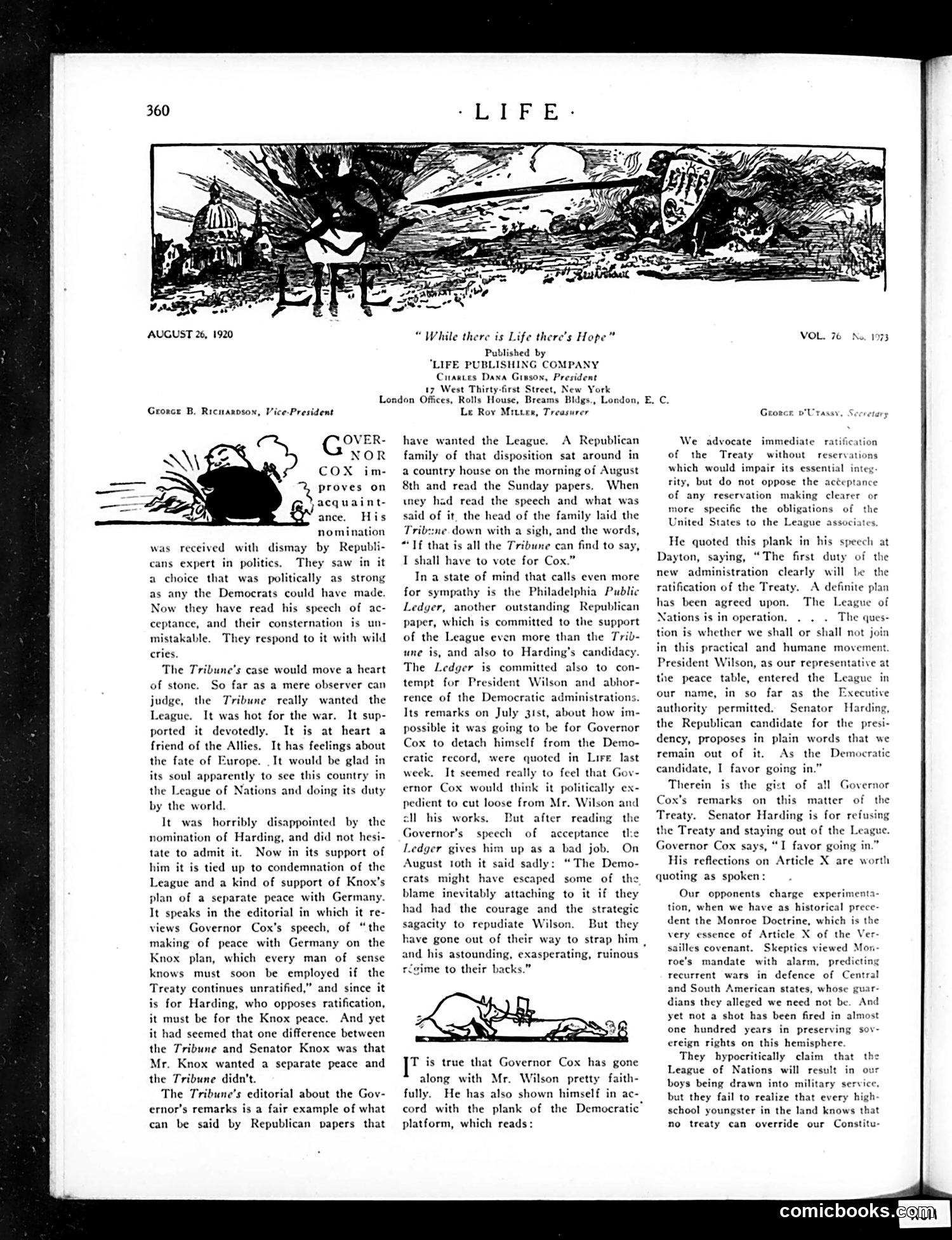
This page discusses the 1920 presidential election and the League of Nations treaty. The text criticizes Republican nominee James Cox's position on the League, comparing it unfavorably to Senator Harding's stance of opposing League membership without reservations. The cartoons (two small illustrations visible) appear to be satirical commentary on these political positions, though specific details are difficult to discern from the image quality. The editorial argues that Republicans and Democrats differ on whether America should join Wilson's League of Nations. It suggests Governor Cox has tried to straddle both positions, while Harding takes a clearer stand against League involvement. The piece reflects the heated 1920 debate over American isolationism versus international engagement—a central issue of that election.
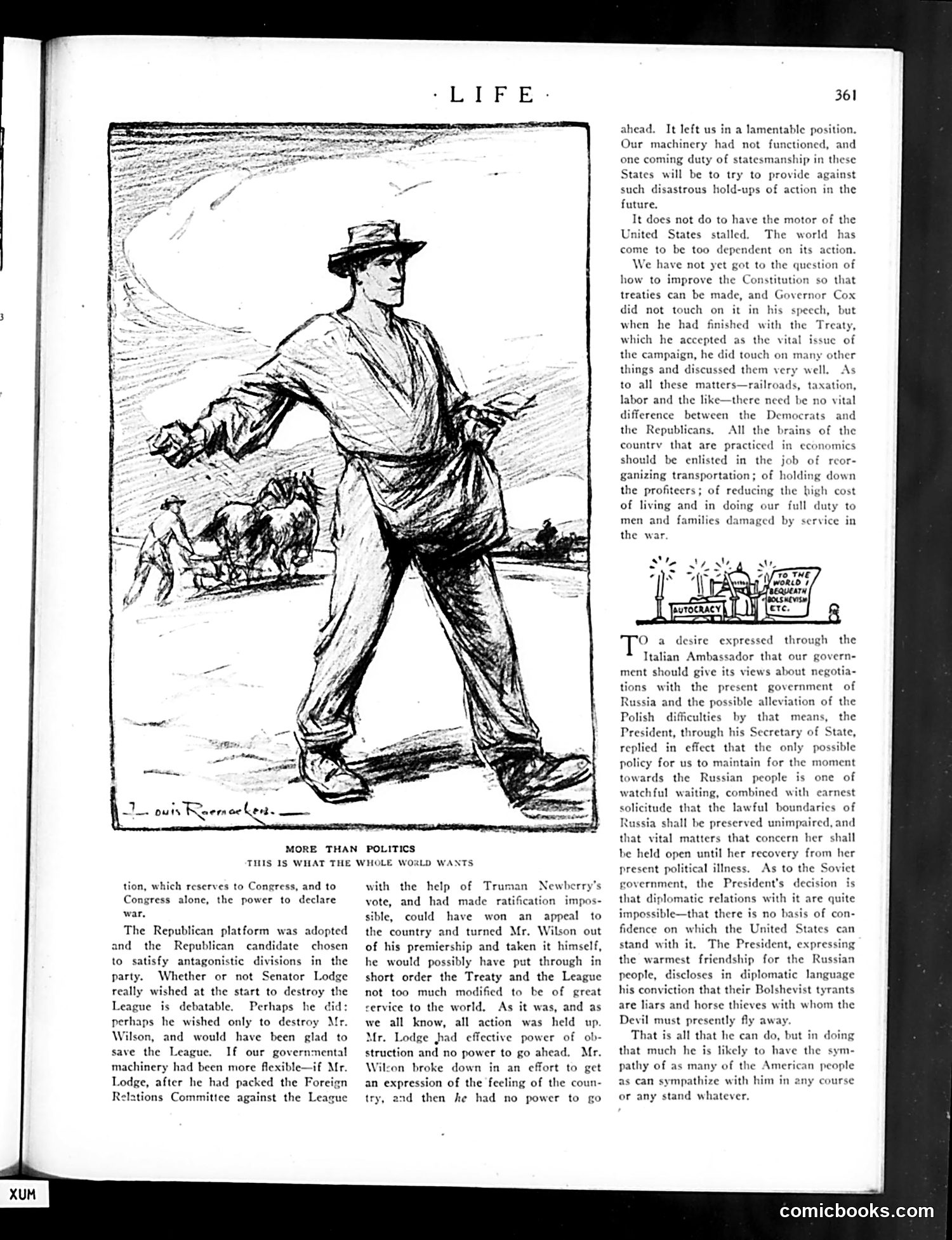
This page critiques post-WWI American political dysfunction, specifically the failure to ratify the League of Nations treaty. The illustration shows a large figure (representing American government/leadership) struggling to direct smaller figures below—a visual metaphor for the nation's inability to act decisively. The text analyzes how Senator Henry Cabot Lodge's obstruction of the League and President Wilson's inflexibility created a governmental stalemate where neither side could advance their agenda. The author argues this paralysis damaged America's global standing at a critical moment when the world depended on U.S. leadership. The piece also addresses Wilson's anti-Soviet position (conveyed through the Italian Ambassador), presenting the administration's "watchful waiting" policy toward Bolshevik Russia—maintaining aloofness while regarding Soviet leaders with deep distrust as fundamentally untrustworthy. The cartoonist (signed but unclear) emphasizes that the real issue transcends partisan politics: America's broken constitutional machinery endangered both domestic and international recovery.
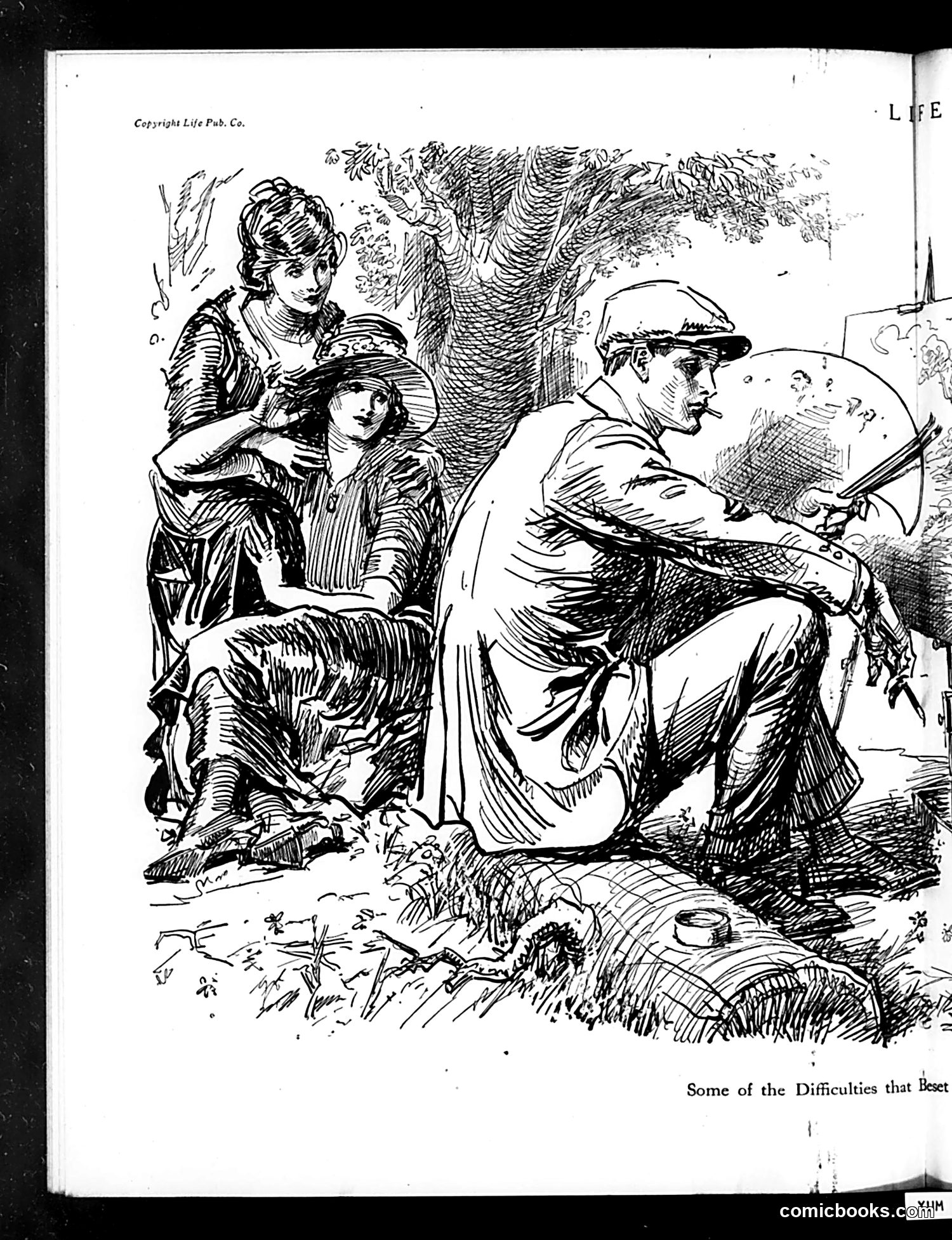
This is a pen-and-ink illustration from *Life* magazine showing what appears to be a camping or outdoor scene. The caption reads "Some of the Difficulties that Beset" (text cut off). The image depicts two women and a man outdoors near a tree. The man, wearing a cap and work clothes, appears to be fishing or engaged in some outdoor activity. The women are dressed in early 20th-century attire and seem to be observing or assisting him. The incomplete caption suggests this is satirizing the practical difficulties women faced when attempting outdoor activities or camping—likely mocking either their unfamiliarity with such pursuits or the social complications of mixed-gender outdoor recreation during this era. However, without the complete caption, the specific target of the satire remains unclear.
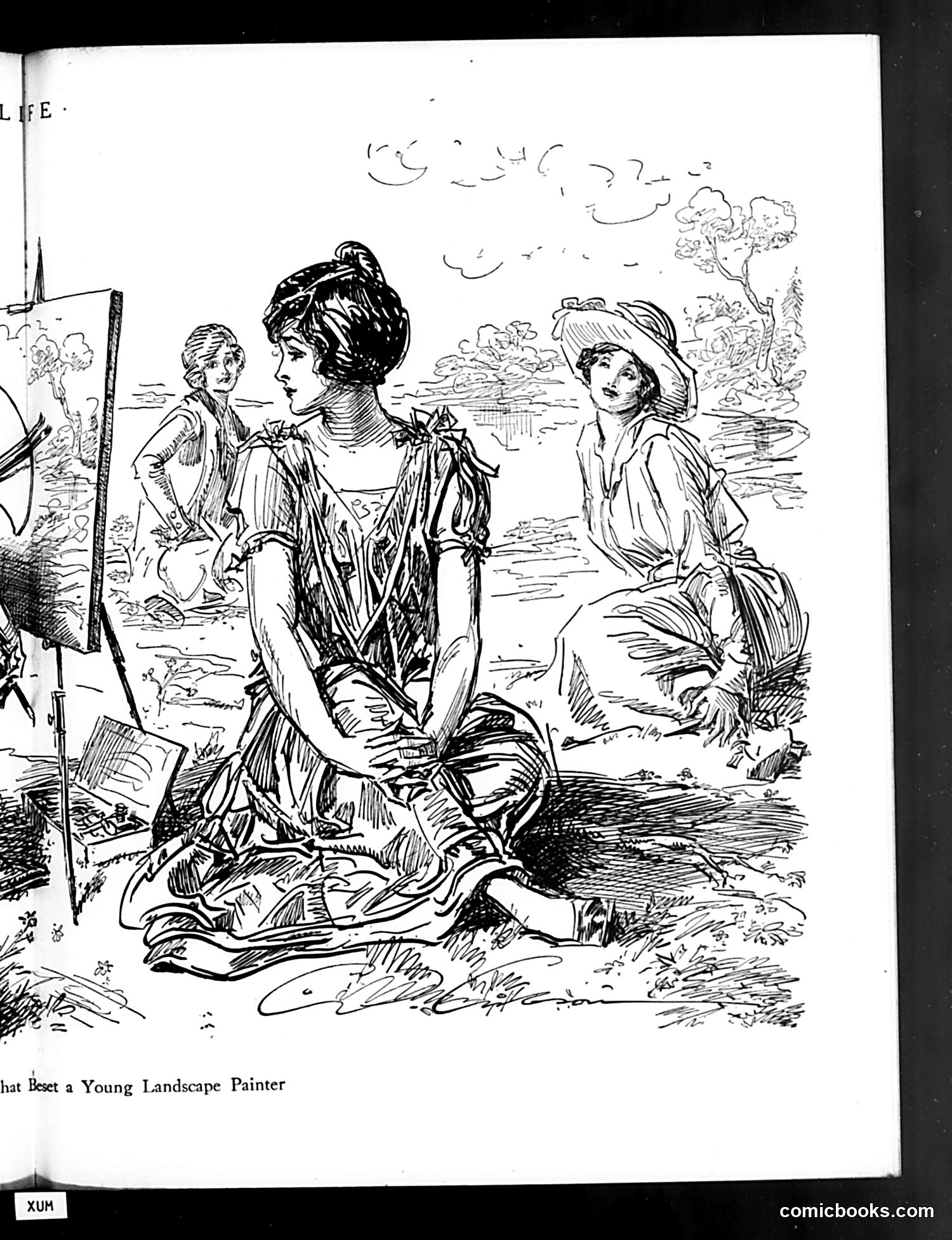
This appears to be an illustration titled "hat Beset a Young Landscape Painter" (the word "What" is likely cut off at the left margin). The image shows three figures in an outdoor setting with art supplies. The central figure is a young woman seated with painting materials, flanked by two other figures. The illustration style and clothing suggest early 20th-century publication. The title suggests the cartoon concerns challenges or "hats" (problems/issues) facing aspiring landscape painters. The satire likely mocks either pretentious artistic aspirations, the impracticality of outdoor painting, or social obstacles women faced entering the art profession. Without additional context or visible publication date, the precise satirical target remains unclear, though the gendered composition suggests commentary on women in professional artistic pursuits.
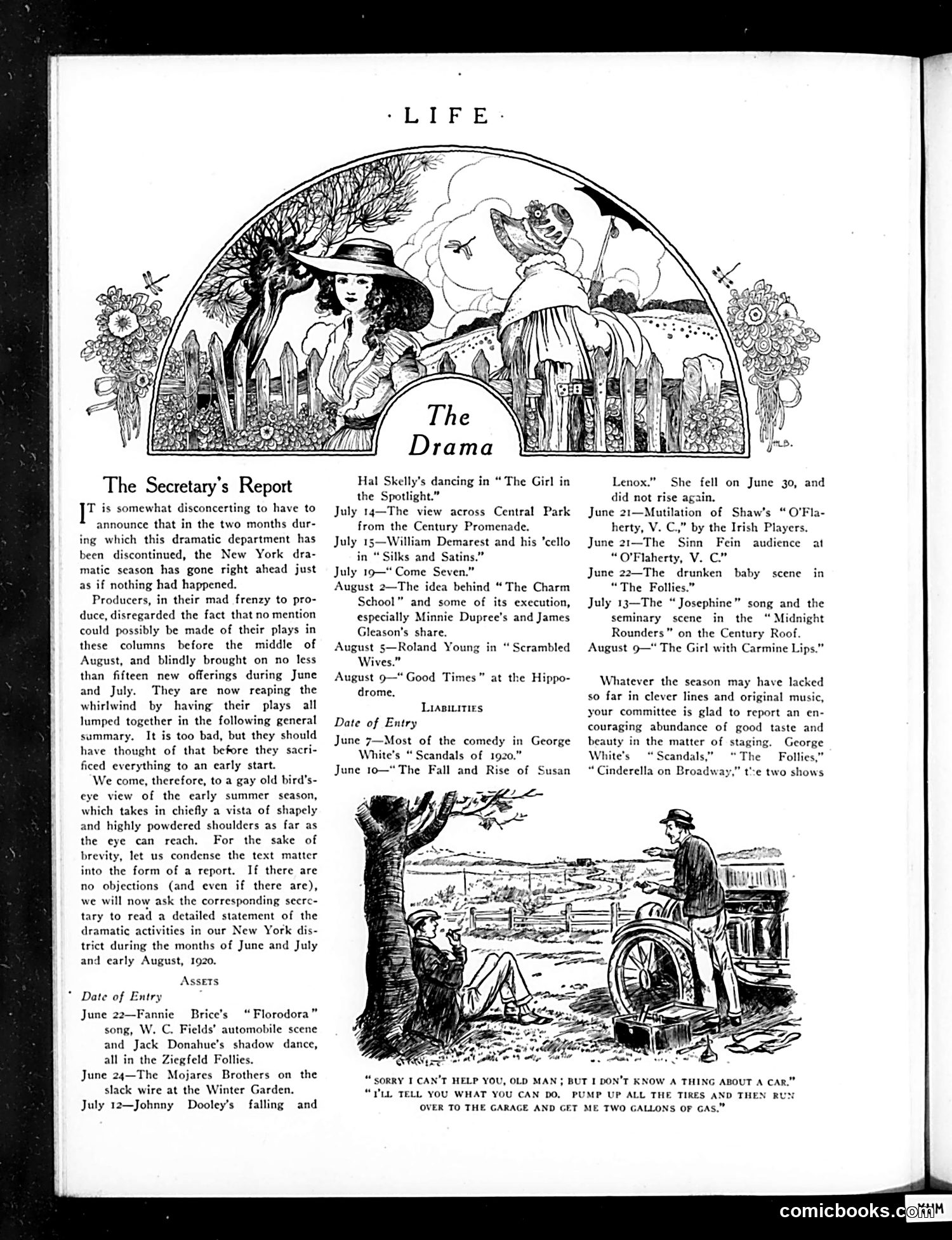
This is a humorous theater-season review from *Life* magazine's drama section. The "Secretary's Report" satirizes Broadway's commercial excess by presenting the summer 1920 theater season as a business ledger, dividing shows into "Assets" (worthwhile performances) and "Liabilities" (disappointing ones). The joke targets producers who ignored the magazine's publication schedule and flooded the market with fifteen shows in June-July, forcing *Life* to lump them together rather than give individual coverage. Notable assets include W.C. Fields' comedy and the Ziegfeld Follies; liabilities include George White's "Scandals" and a George Bernard Shaw adaptation butchered by the Irish Players. The bottom illustration depicts a rural car-repair scene—likely satirizing technology's growing role in American life. The satire mocks both theatrical oversupply and modern automotive culture.
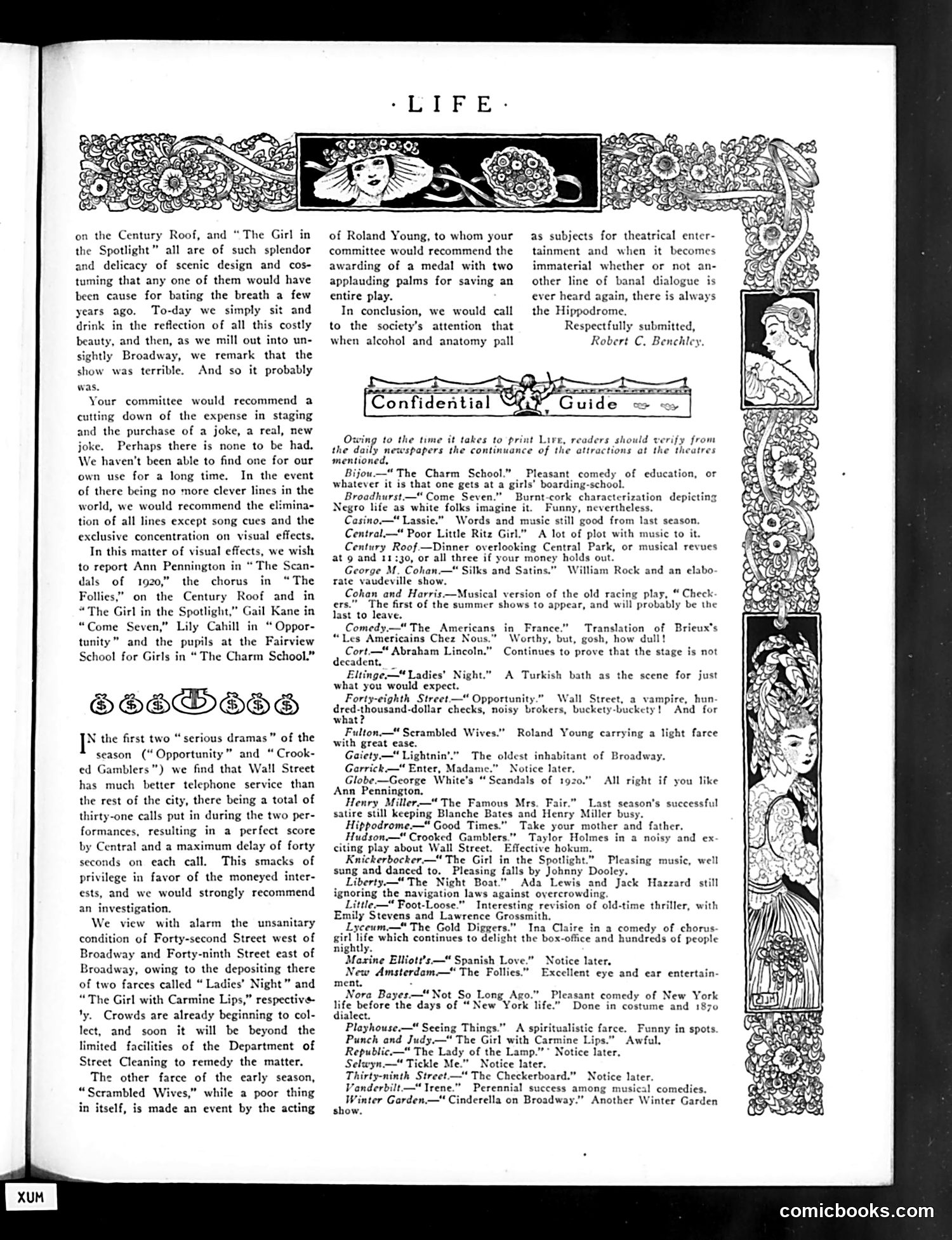
This page is a **satirical theater review** by Robert C. Benchley, a famous humorist, critiquing Broadway's 1920 season. The satire works on multiple levels: **Main Points:** - Benchley mocks expensive theatrical productions that look beautiful but lack substance—audiences leave saying "the show was terrible" despite lavish staging - He recommends eliminating dialogue entirely and focusing only on visual spectacle and attractive performers (Ann Pennington, Gail Kane) - He satirizes **"Scrambled Wives"** and similar lightweight comedies, praising only Roland Young's acting for "saving" a bad play - A humorous aside mocks "Wall Street privilege"—during serious dramas, wealthy theatergoers made 31 phone calls uninterrupted, while regular citizens would face delays **The core joke:** Broadway is producing expensive fluff with no genuine wit. The solution? Abandon pretense entirely—just hire pretty dancers and remove all dialogue. The "Confidential Guide" section provides brief theater listings for current shows, mostly comedies and musicals with lightweight plots.
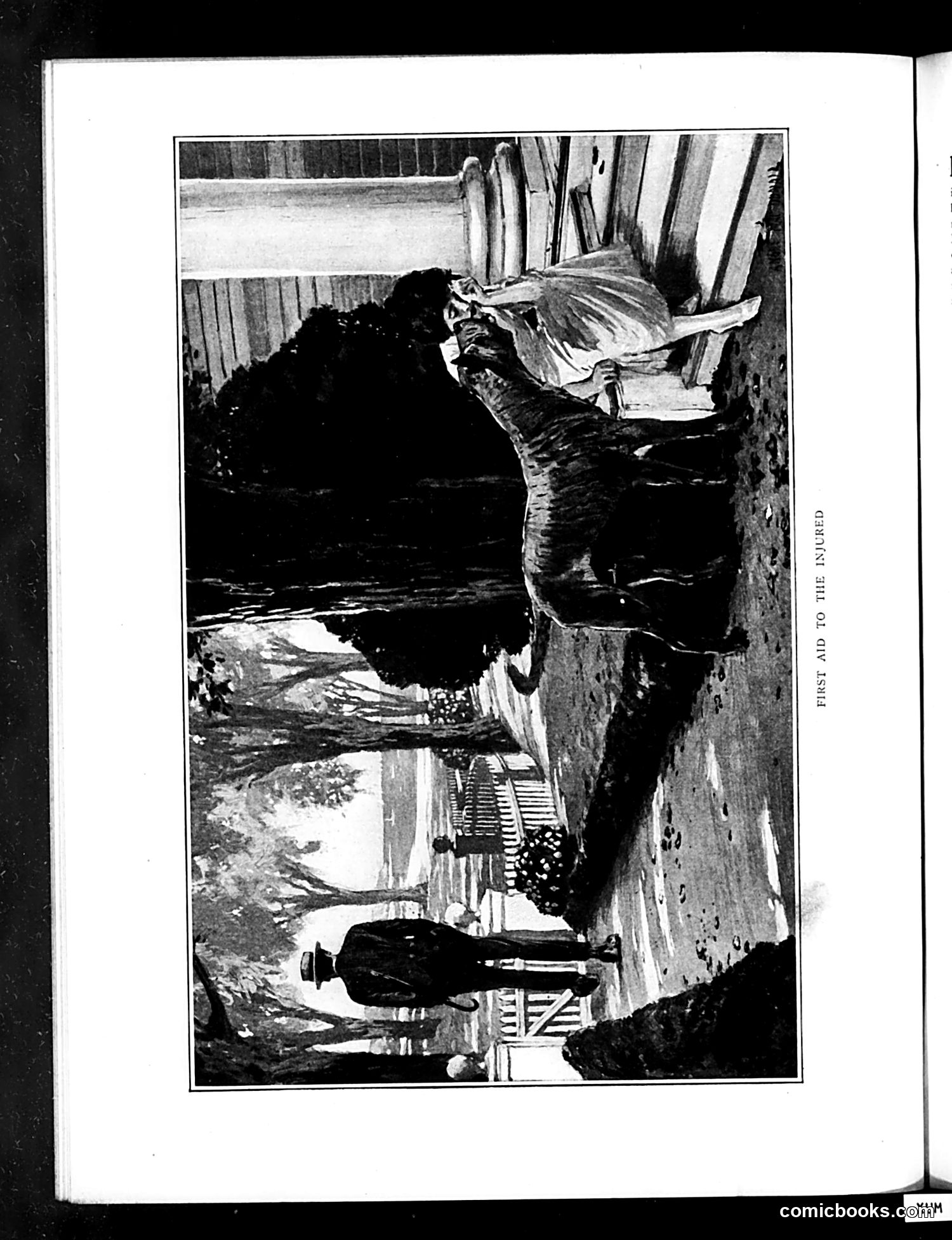
This page contains a single black-and-white photograph oriented sideways, showing what appears to be a domestic or interior scene. The caption reads "FIRST AID TO THE INJURED." The OCR text is largely corrupted and unhelpful. Without clearer text or additional context, I cannot confidently identify: - Which specific political or social issue is being satirized - Who the figures represent - What historical event prompted this commentary The phrase "First Aid to the Injured" suggests the image comments on some form of relief or assistance, possibly political, but the photograph's details are too unclear in this reproduction to determine the specific satire or its targets. Additional context about the magazine issue's date would be necessary for accurate interpretation.
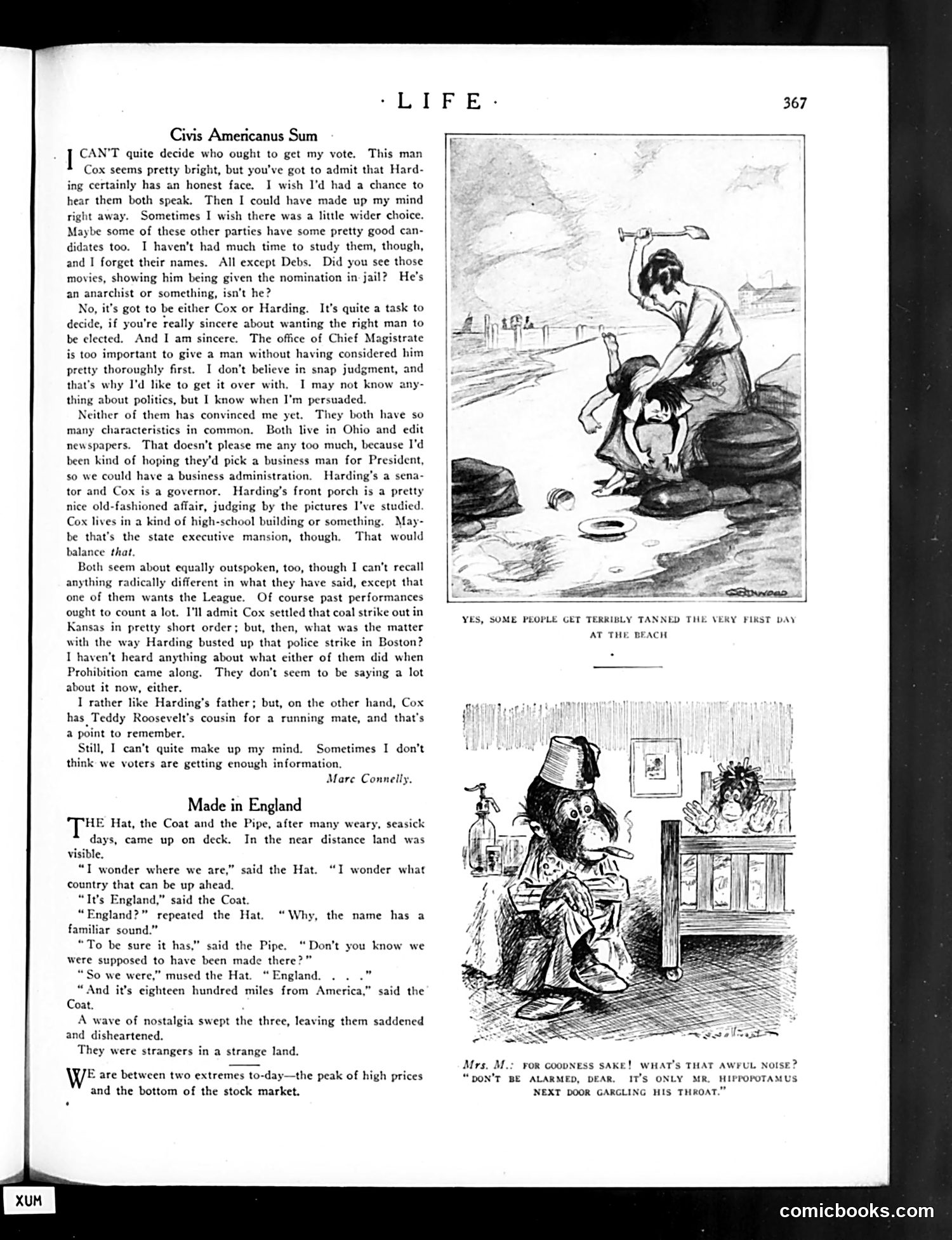
**Main Article - "Civis Americanus Sum":** This satirizes an indecisive 1920 voter choosing between presidential candidates Cox and Harding. The narrator claims to want the "right man" but admits knowing almost nothing about politics. He notes both candidates are Ohio newspaper editors with similar positions, and confuses policy details (mentioning Eugene Debs, the Socialist candidate, as an "anarchist"). The satire targets voter apathy and superficial decision-making based on appearance ("honest face") and personal details (Harding's "front porch") rather than actual platform differences. **Secondary Sketches:** Two brief humorous cartoons: one about sunburned beachgoers, another depicting anthropomorphized Hat, Coat, and Pipe objects returning "home" to England but feeling like foreigners—likely commenting on post-WWI disorientation or nostalgia. The page exemplifies Life's satirical approach to contemporary politics and social behavior.
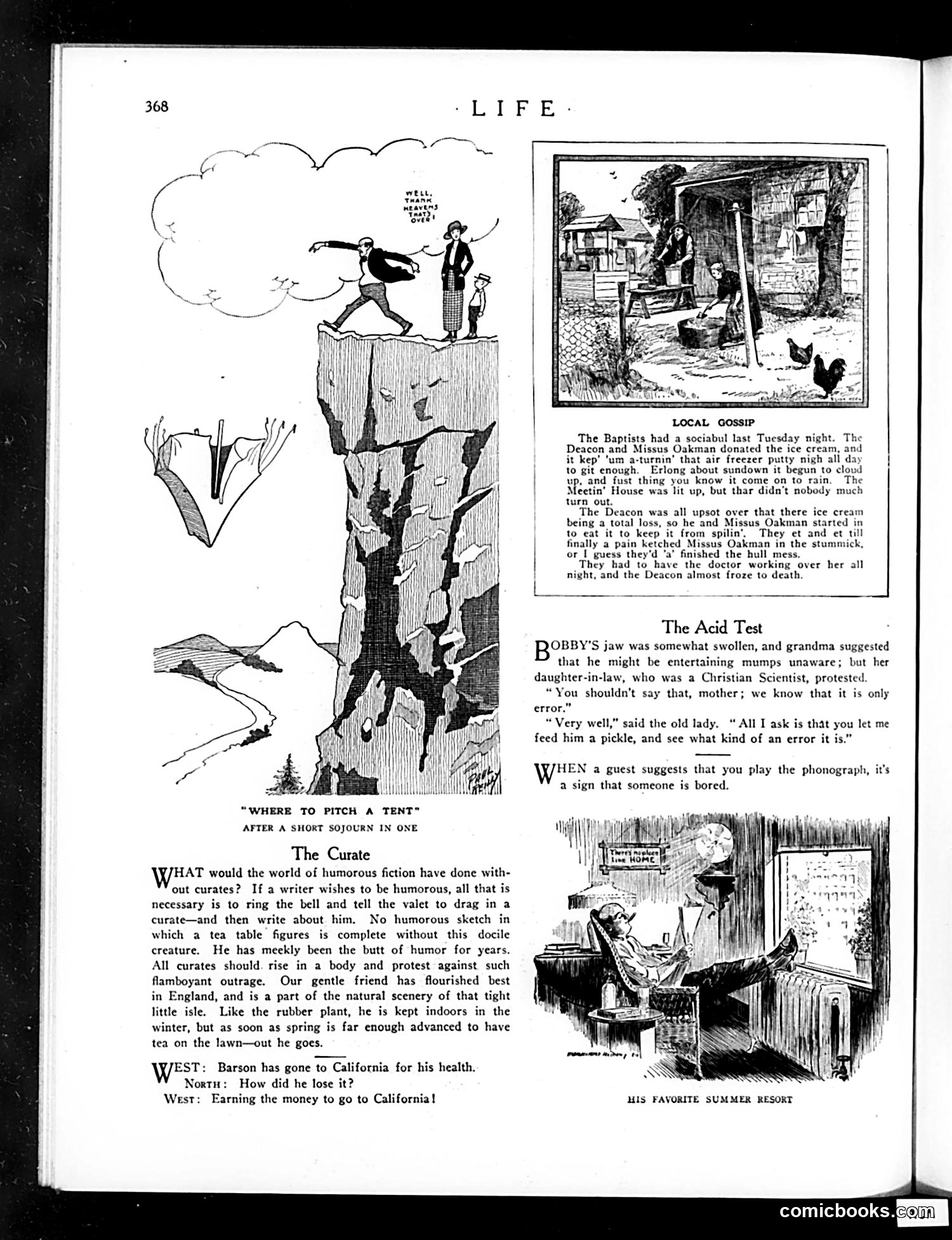
This page contains several humorous sketches typical of early 20th-century American satire: **"Local Gossip"** depicts rural characters—the Deacon and Missus Oakman—who laboriously churn ice cream for a Baptist social, only to have rain prevent attendance. They then eat the entire batch to prevent waste, causing the wife stomach distress and the Deacon to nearly freeze. The humor targets small-town life's petty disasters and working-class earnestness. **"The Acid Test"** mocks Christian Science's denial of material reality. A grandmother's commonsense suggestion (feed the sick boy a pickle) contrasts with the daughter-in-law's spiritual explanation that illness is merely "error," satirizing the sect's rejection of medical evidence. **"The Curate"** critiques British literary convention—the hapless Anglican curate as a stock comedic figure in humorous fiction, perpetually subject to ridicule. The final joke about a Californian "losing his health while earning money to regain it" satirizes get-rich-quick schemes and health-tourism fads.
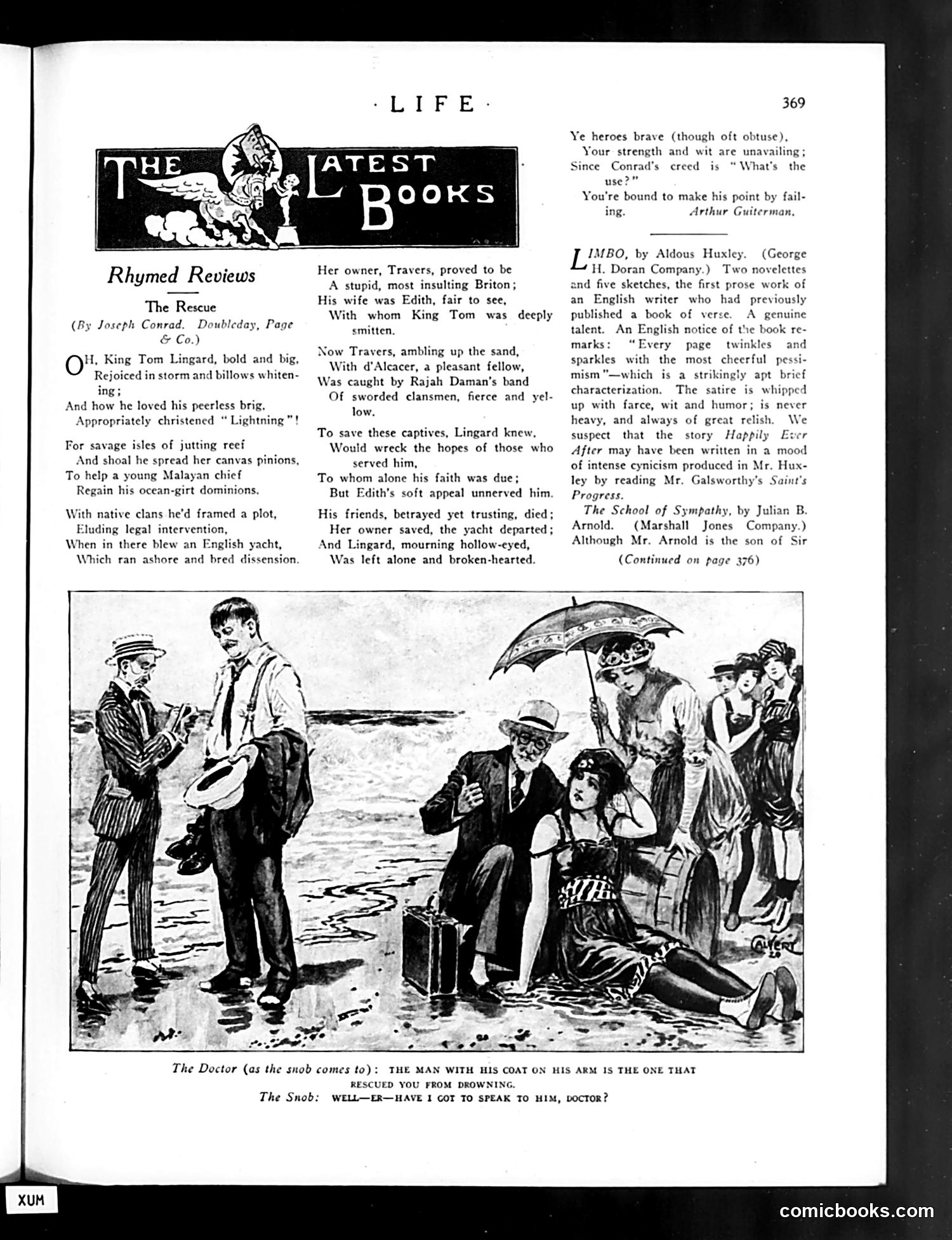
This page reviews Joseph Conrad's novel *The Rescue* in verse form, summarizing its plot: noble sea captain King Tom Lingard must choose between loyalty to his native allies and saving an English woman (Edith) he loves. Conrad's theme—that heroic action ultimately fails—prompts the reviewer's commentary that heroes are "bound to make his point by failing." The cartoon below satirizes British class consciousness. A snobbish man, rescued from drowning by a working-class doctor, asks his physician whether he must acknowledge or socialize with his rescuer. The joke mocks the snob's priorities: rather than gratitude for life-saving, he's concerned about social status and whether he's obligated to interact with someone of lower class. This reflects Edwardian anxieties about maintaining class boundaries even in situations that render such distinctions absurd.
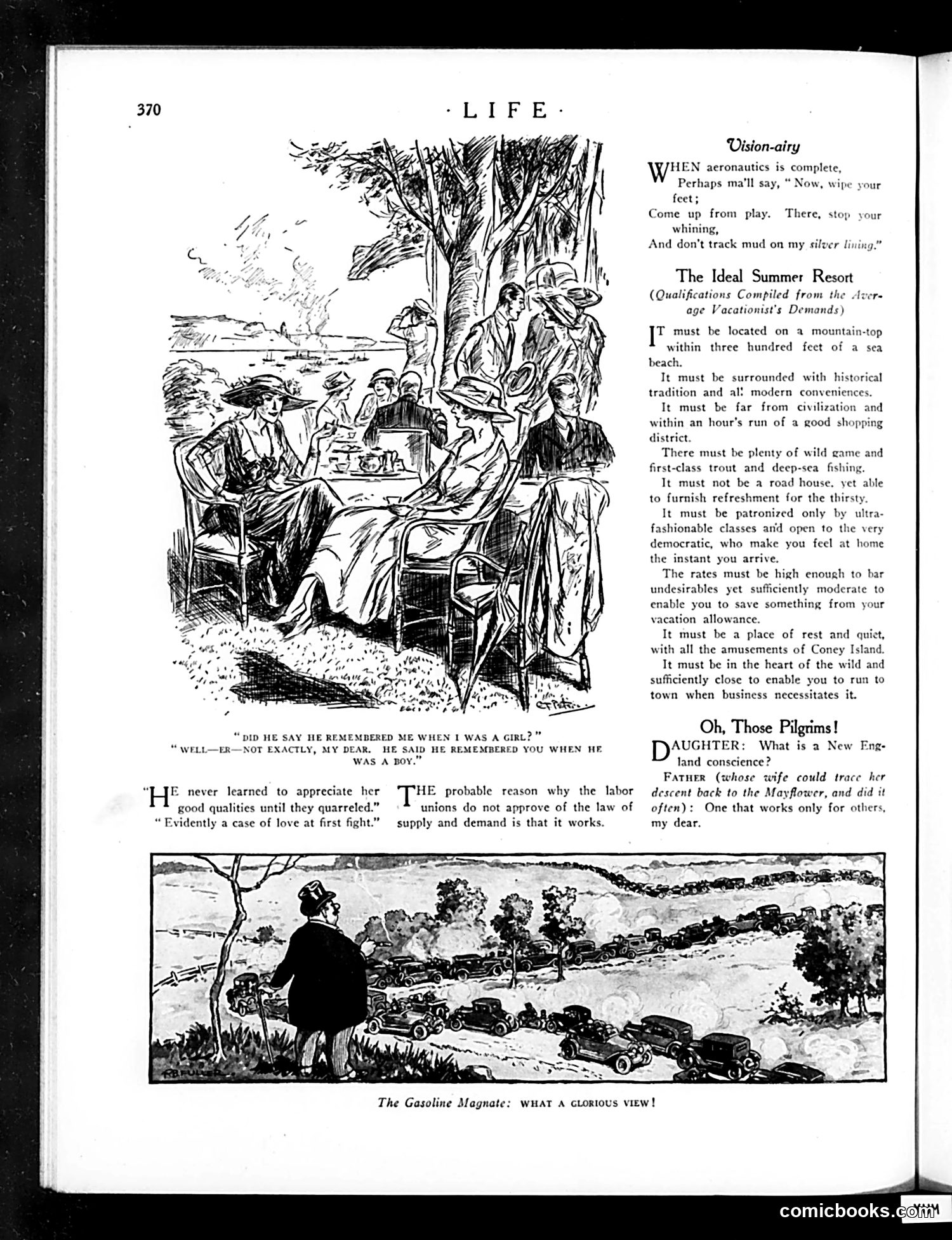
This page contains three distinct satirical pieces: **"Vision-airy"** opens with a humorous poem about aeronautics, imagining a future where children arrive home muddy via aircraft—a joke about emerging aviation technology. **"The Ideal Summer Resort"** satirizes vacationist contradictions by listing mutually incompatible demands: a location must be isolated yet near shopping, expensive yet affordable, quiet yet entertaining like Coney Island, wild yet civilized. The satire mocks how tourists want everything simultaneously—the impossible wish-list of the average vacationer. **"Oh, Those Pilgrims!"** jokes about New England ancestry. A daughter asks about "New England conscience"; the father—whose wife traces descent to the Mayflower and constantly reminds him—replies it's a conscience that "works only for others." This satirizes sanctimonious New England Puritanism and people who boast of Mayflower ancestry while being hypocritical. **"The Gasoline Magnate"** (bottom illustration) appears to mock wealthy automobile owners admiring a massive traffic jam, suggesting ironic satisfaction in the congestion their vehicles create. The overall theme: satirizing modern American desires, pretensions, and contradictions.
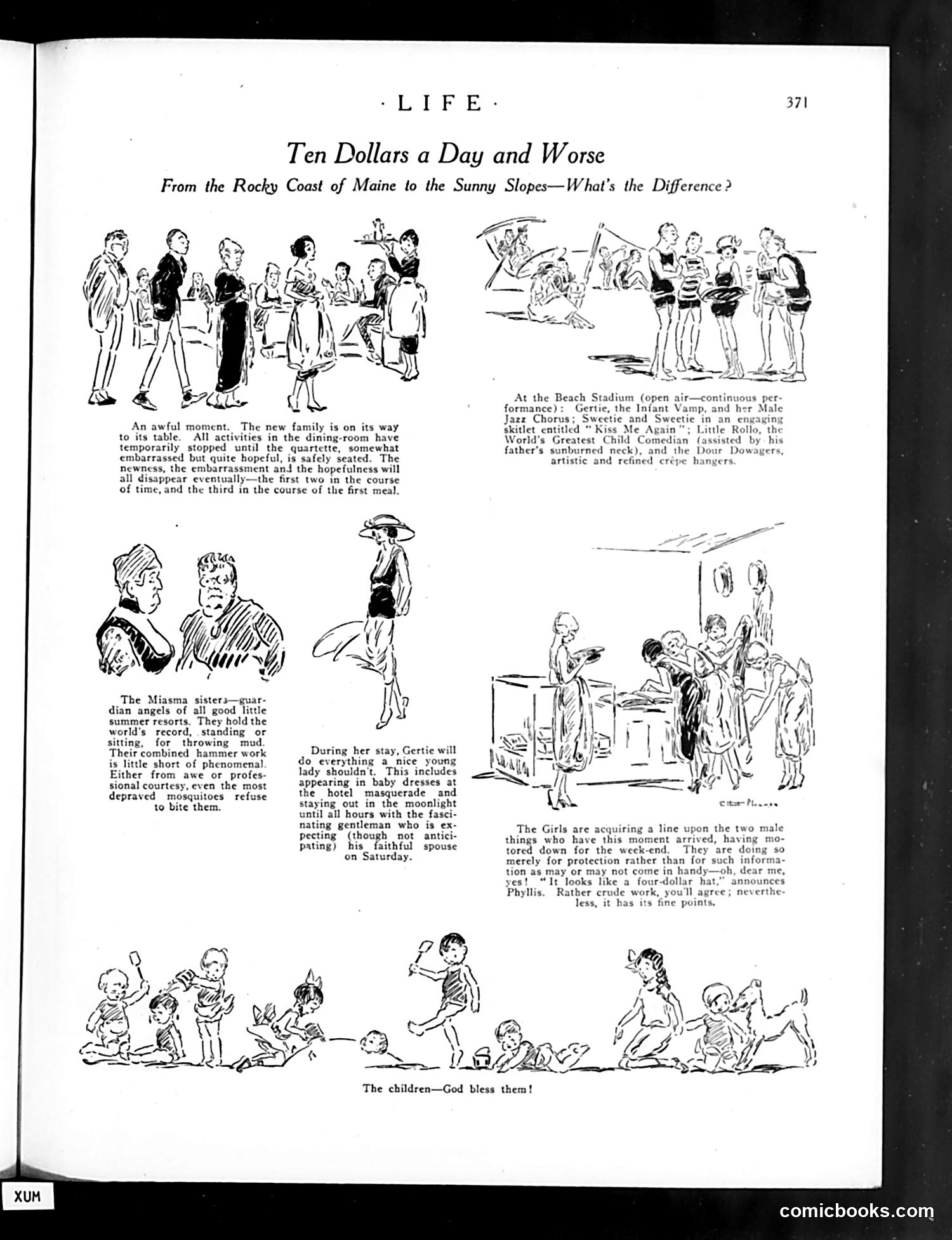
This Life magazine article satirizes the chaos of American summer vacation culture, comparing modest Maine coastal resorts to fancy southern destinations. The page mocks the pretensions and mishaps of vacationing families through several vignettes: **The central joke**: Despite spending ten dollars daily (substantial money in this era), vacationers experience identical social embarrassments and disappointments whether on rocky Maine shores or sunny southern slopes—the location doesn't matter. **Key satirical targets**: - Newly arrived families awkwardly entering dining rooms, hoping their outsider status disappears - "The Miasma Sisters"—gossipy resort women who spread mud and negativity - A young woman named Gertie misbehaving scandalously (appearing in baby dresses, staying out late with men) - Young women acquiring male "escorts" for protection, examining jewelry with crude commentary The illustrations show families, children playing, and social interactions capturing the forced gaiety and underlying anxiety of resort life. The final caption—"The children—God bless them!"—suggests resigned acceptance of vacation chaos.
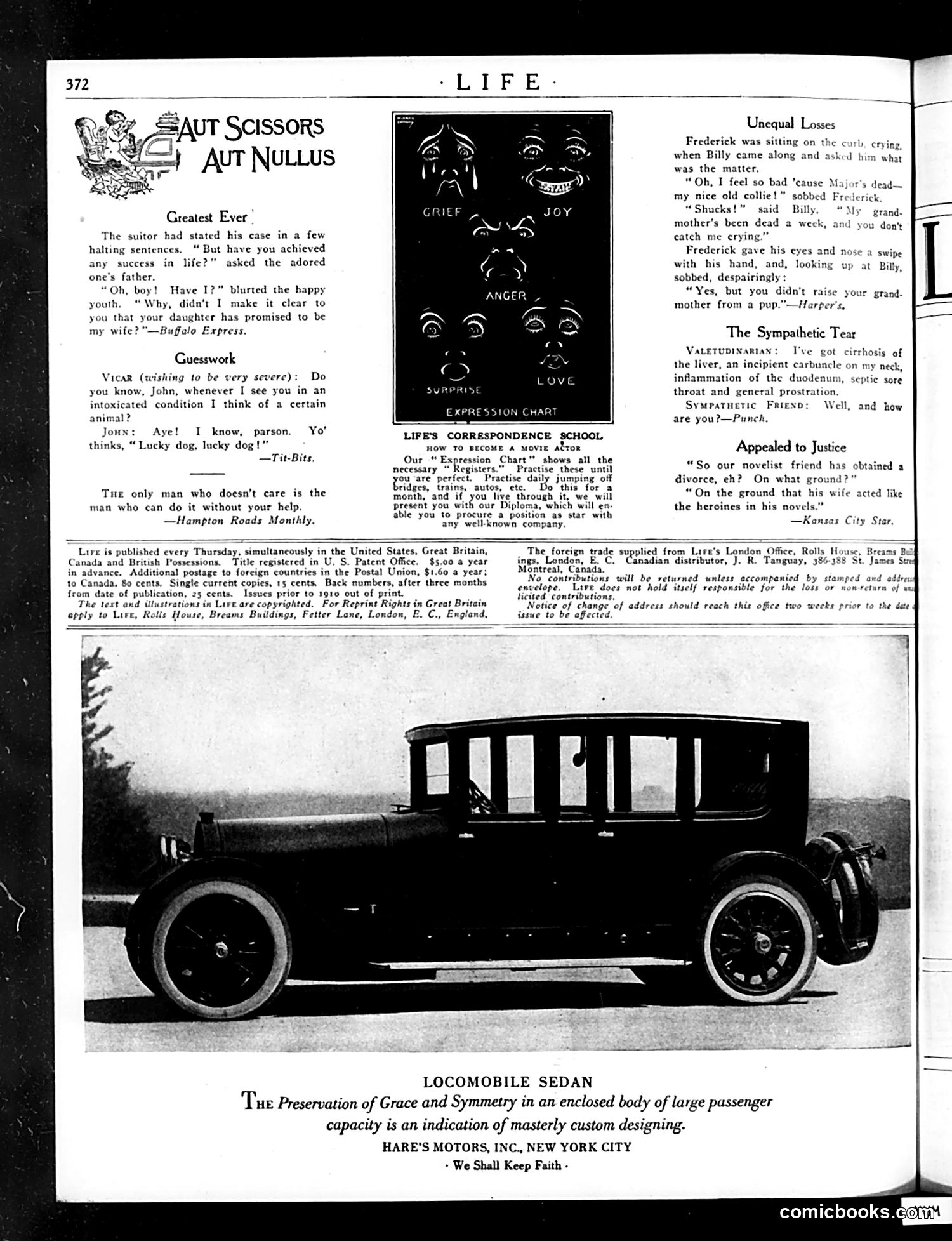
This page contains **humor shorts and advertising** rather than political cartoons. The jokes mock social pretense and hypocrisy: - **"Greatest Ever"**: A suitor boasts of "success in life" by announcing his engagement—satirizing shallow definitions of achievement - **"Guesswork"**: A drunk parishioner assumes the vicar compares him to a dog; he cheerfully agrees it means "lucky dog"—mocking both clerical judgment and the man's obliviousness - **"Unequal Losses"**: A boy cries over his dead dog; when a friend dismisses it (his mother died too), the boy retorts he "raised" the dog but didn't raise his mother—dark humor about emotional attachment priorities - **"Appealed to Justice"**: A novelist's wife divorces him because she behaves like characters in his novels—satirizing how fiction reflects reality The **"Expression Chart"** advertises a correspondence school teaching emotional registers through dangerous stunts ("jumping off ridges, trains, autos"). A **Locomobile sedan advertisement** appears below, promoting automotive design. These are lighthearted social satires typical of early 20th-century humor magazines.
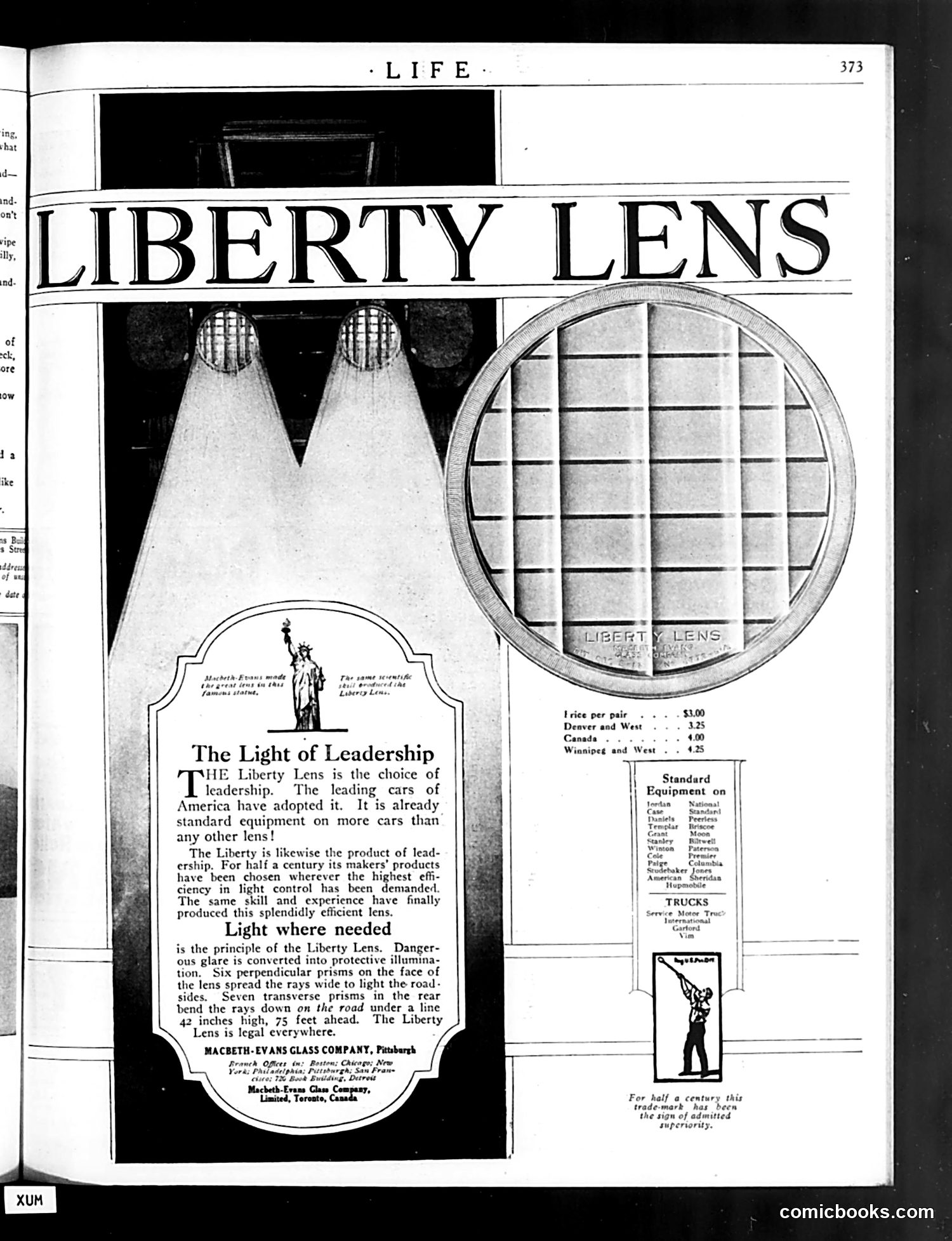
This is primarily a **product advertisement**, not political satire. The page promotes the Liberty Lens, an automobile headlight lens manufactured by Macbeth-Evans Glass Company. The ad uses patriotic imagery—the Statue of Liberty appears prominently—to associate the product with American leadership and superiority. The text claims the Liberty Lens is "the choice of leadership" and is "standard equipment on more cars than any other lens," establishing market dominance through appeals to quality and authority rather than humor. The technical description explains the lens's practical function: converting dangerous glare into safe illumination through a system of prisms that spread light to roadsides while keeping rays low on the road ahead (42 inches high, 75 feet ahead). Pricing varies by region, suggesting this is a national campaign. The small illustration at bottom right depicts a figure, likely representing the brand's longevity ("half a century"), emphasizing reliability and tradition. This represents early 20th-century automotive advertising strategy: combining patriotic symbolism with technical credibility claims.
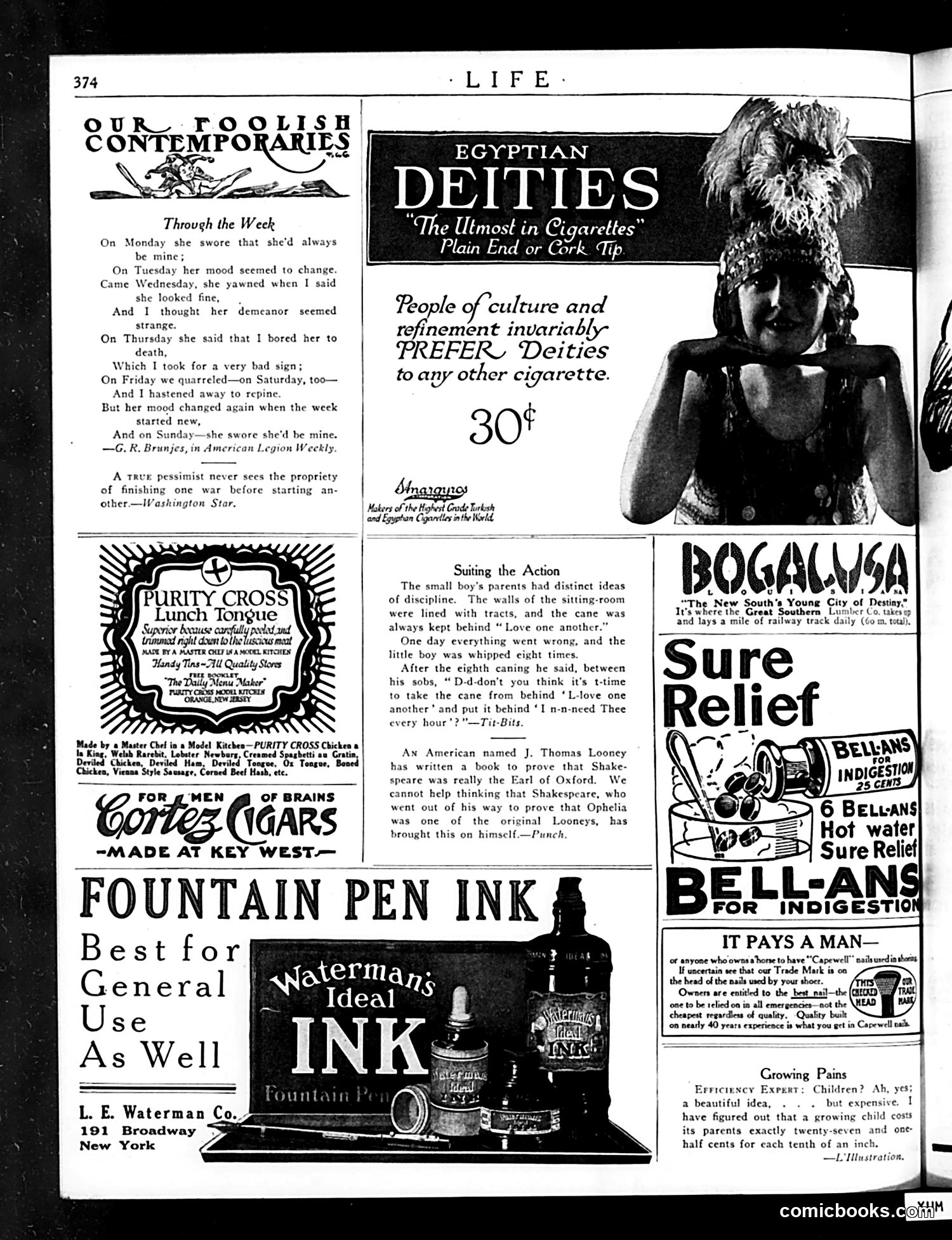
This is primarily an **advertising page** from Life magazine with minimal satirical content. The notable editorial item is a brief **joke about Shakespeare authorship**: An American named J. Thomas Looney published a book arguing that the Earl of Oxford—not Shakespeare—wrote Shakespeare's plays. The joke's point: Shakespeare himself proved his connection to the Looney family by writing about a character named Ophelia who "went out of his way to prove that Ophelia was one of the original Looneys"—a pun playing on the character's madness and the surname "Looney." The satire mocks both the far-fetched authorship theory and Looney's surname as inherently ridiculous. The page otherwise contains **period advertisements** for cigarettes, cigars, lunch tongue, fountain pen ink, digestive remedies, and railroad services—typical of 1920s Life magazine content. These ads contain no significant satirical intent, merely period marketing language emphasizing quality and cultural refinement.
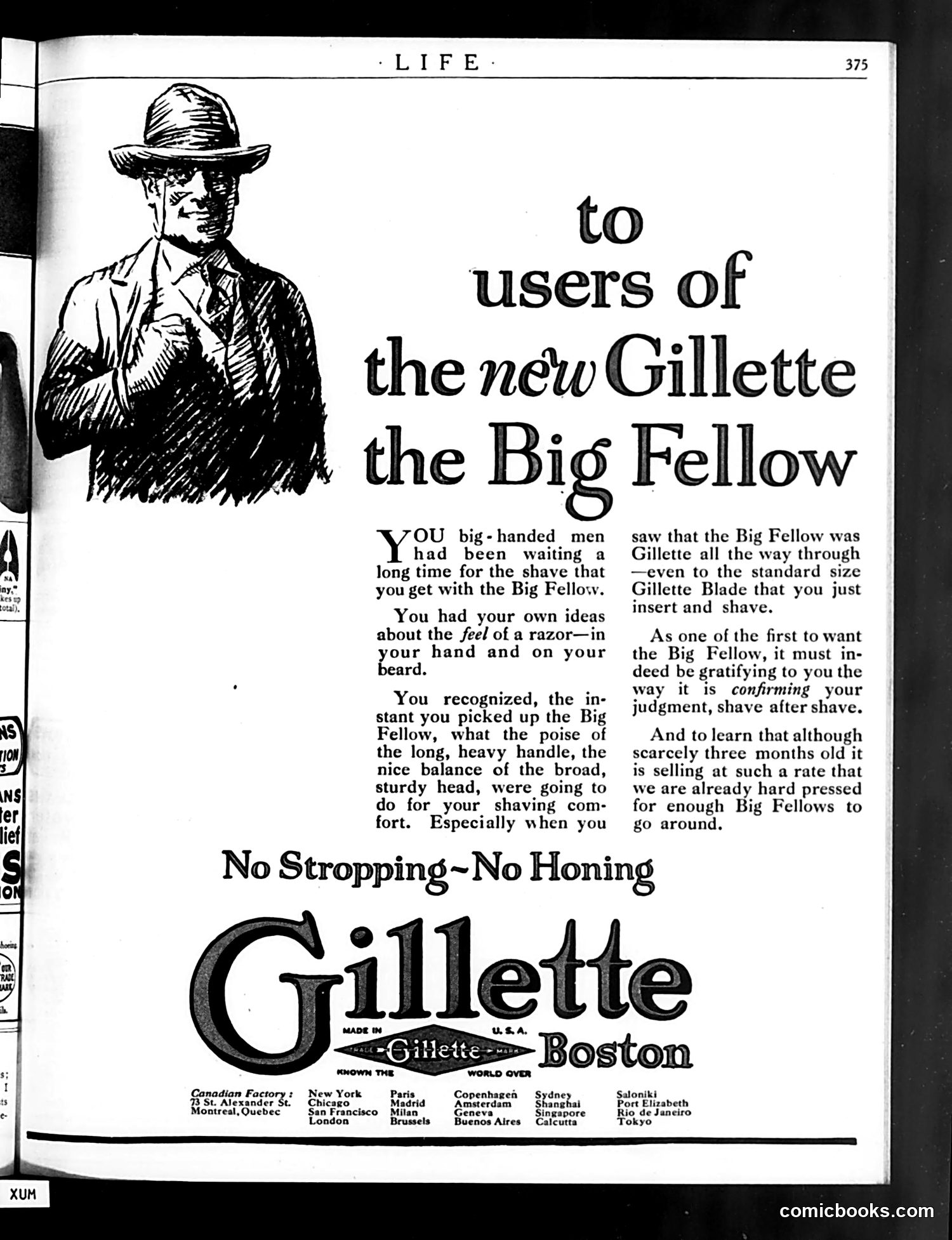
This is a **product advertisement**, not political satire. It promotes Gillette's new "Big Fellow" safety razor to male consumers. The illustration shows a rugged, masculine man in work clothes and a wide-brimmed hat—representing the target demographic of large-handed laborers who needed a sturdy razor. The ad addresses these men directly, validating their preferences for a heavy-handled, well-balanced tool suited to their hands and beards. The marketing emphasizes practical benefits: no stropping or honing required, standard Gillette blades, and strong initial sales (described as "hard pressed for enough Big Fellows"). The global factory locations listed underscore Gillette's international reach and product reliability. The "Big Fellow" nickname appeals to masculine pride, positioning the razor as equipment for substantial, capable men rather than delicate consumers. This reflects early 20th-century marketing that aligned consumer goods with gender identity and working-class aspiration.
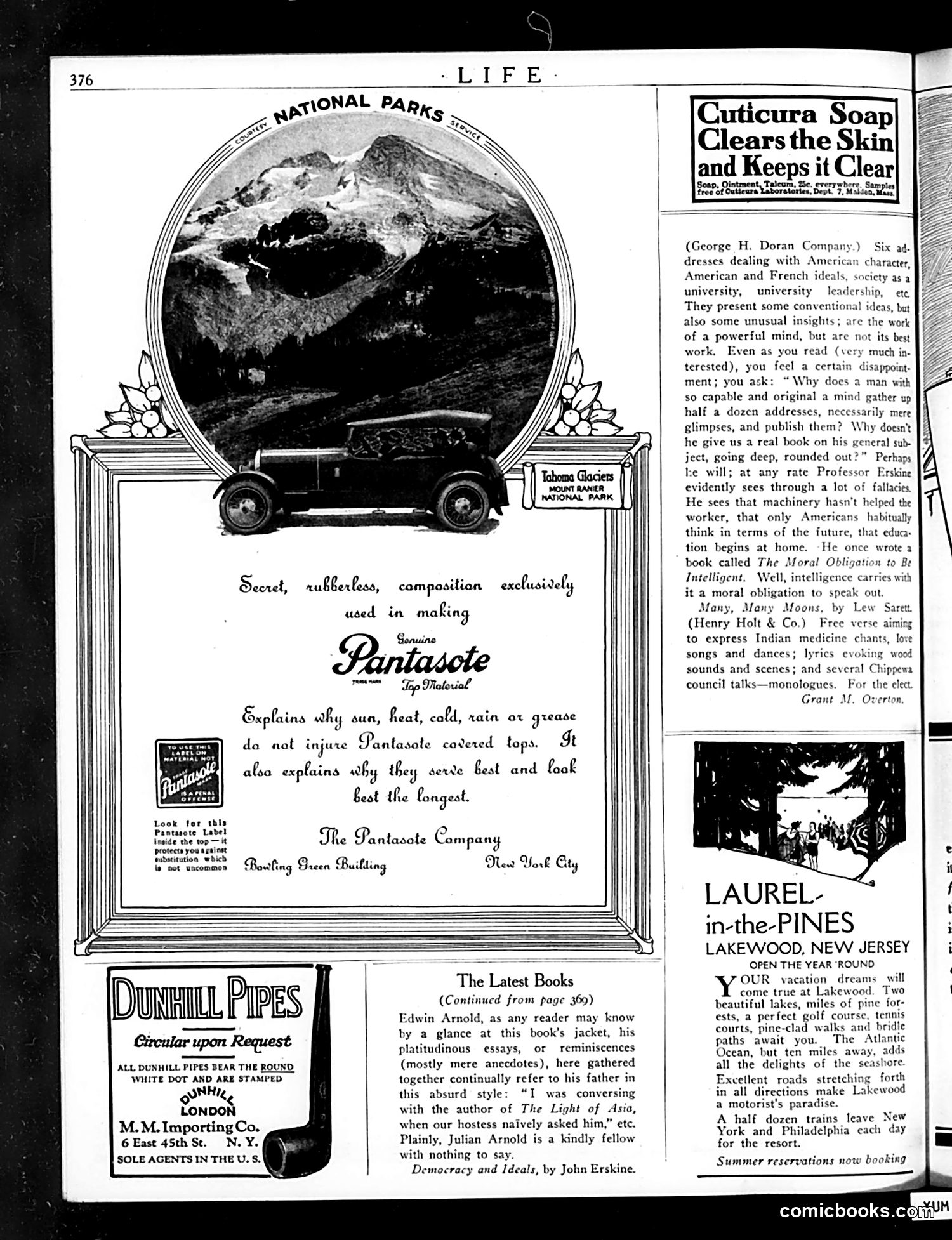
This page is primarily **advertising**, not political satire. It contains four product advertisements: 1. **Pantasote** (car tops) — emphasizes durability against weather 2. **Cuticura Soap** — skin care product 3. **Dunhill Pipes** — tobacco pipes from London 4. **Laurel-in-the-Pines** — New Jersey resort destination The page also includes a **book review section** ("The Latest Books"), discussing works by Edwin Arnold and John Erskine on American character and democracy. The reviewer mildly critiques Arnold's writing as platitudinous but praises Erskine's thinking, particularly his book *The Moral Obligation to Be Intelligent*. There is **no political cartoon or satire** visible here. The page represents typical 1920s magazine content: advertisements mixed with literary criticism, targeting educated, middle-class readers interested in consumer goods and intellectual discussion.
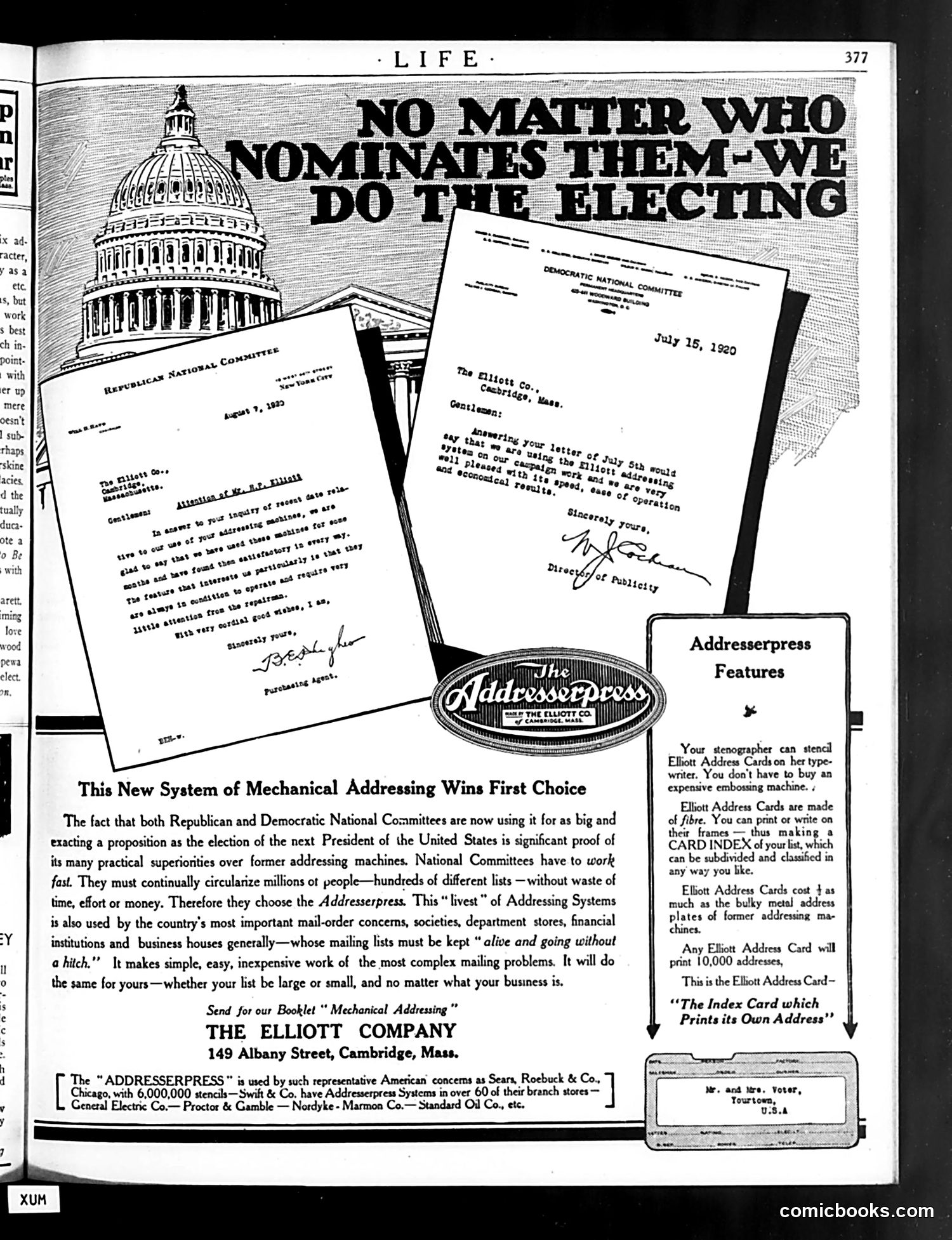
This page is primarily **advertising**, not political satire. The headline's reference to "no matter who nominates them—we do the electing" is part of a commercial pitch, not commentary on elections. The ad promotes the "Addresserpress," a mechanical mailing-list system. Both the Republican and Democratic National Committees supposedly used it for campaign mailings during the 1920 presidential election—mentioned as proof of the machine's reliability. The satirical element is minimal: the ad *uses* the appearance of political importance (showing letters from both major party committees) to sell addressing equipment to businesses. It's clever marketing rather than political cartooning—implying that if national party committees trusted this system for critical mass-mailing needs, any business should too. The secondary ad promotes Elliott Address Cards, a simpler alternative system. This reflects how early-20th-century companies leveraged political credibility to market business technology.
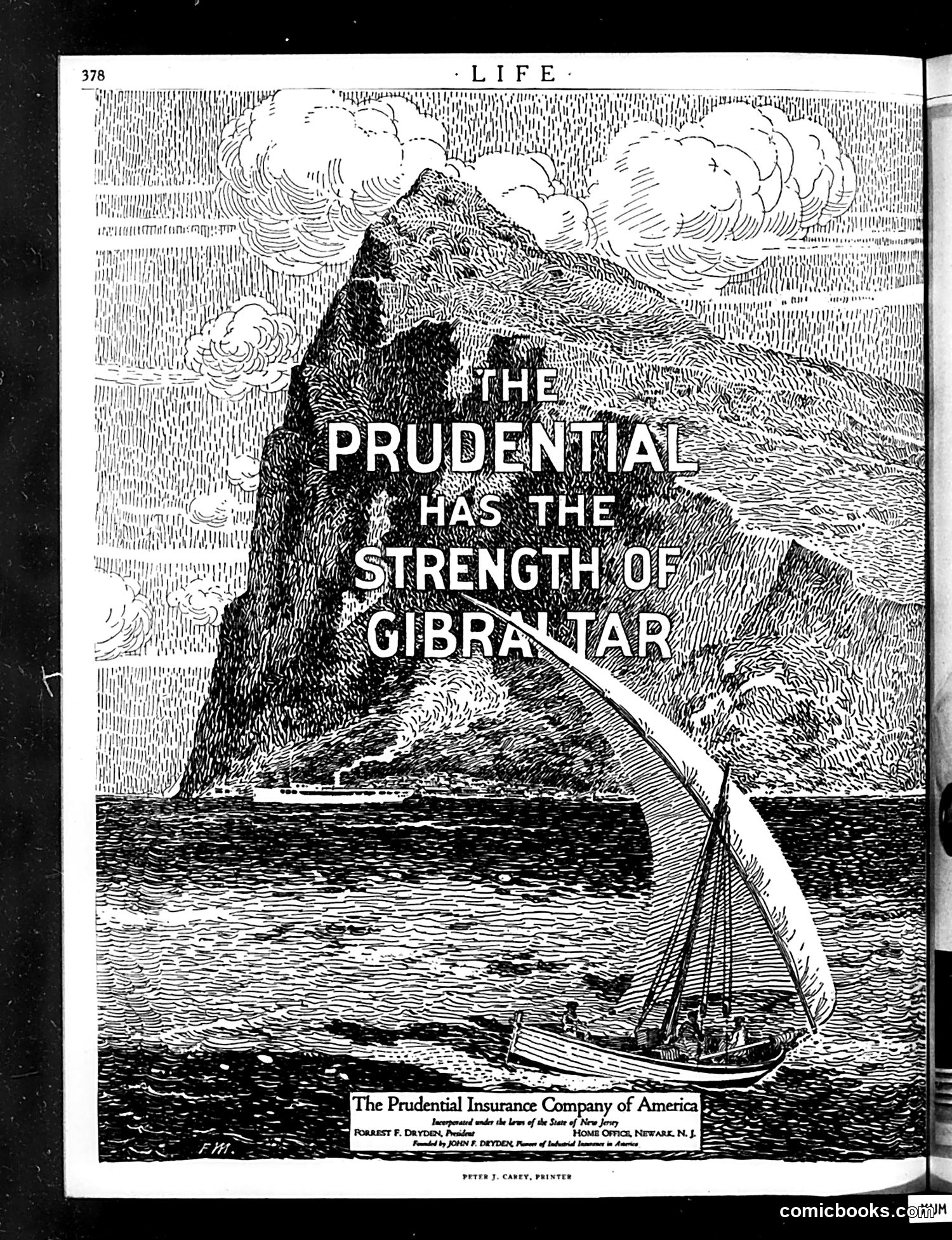
This is a **full-page advertisement** for The Prudential Insurance Company of America, not political satire. The image depicts the Rock of Gibraltar—a famous, imposing natural fortress—alongside a sailing ship in rough seas. The ad's text claims "THE PRUDENTIAL HAS THE STRENGTH OF GIBRALTAR," using the rock as a metaphor for stability and reliability. Gibraltar was historically significant as a strategic British stronghold, making it synonymous with permanence and unshakeable security. This was a common advertising strategy in early 20th-century American magazines: associating insurance companies with immovable, trustworthy natural landmarks to reassure customers their premiums would be safe and their claims honored. The Prudential used this exact "Strength of Gibraltar" slogan extensively during this era. This is **advertising content**, not editorial commentary or political cartooning.
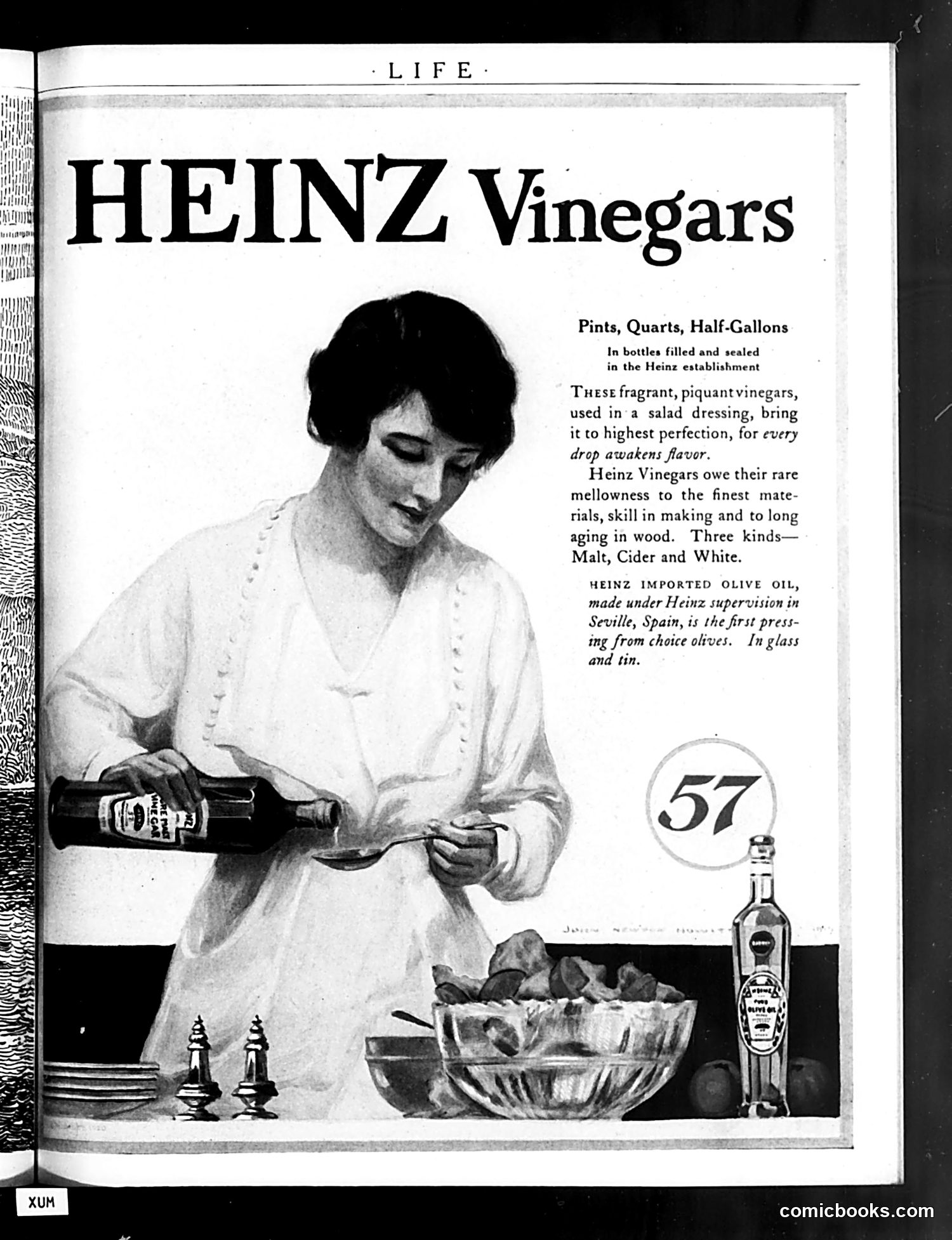
This is a **product advertisement**, not political satire. The page promotes Heinz Vinegars from *Life* magazine (a publication known for humor and satire, though this particular page contains no satirical content). The ad features a woman in early 20th-century dress preparing a salad, pouring Heinz vinegar. The copy emphasizes quality—aged in wood, available in three varieties (Malt, Cider, White), and sold in multiple sizes. A secondary pitch promotes Heinz olive oil from Seville, Spain, described as "first pressing from choice olives." The numbered circle (57) likely indicates this is part of a numbered advertisement series in the magazine. There is no cartoon or satire present—this is straightforward commercial advertising targeting home cooks, using a domestic scene to associate the brand with culinary sophistication and care.
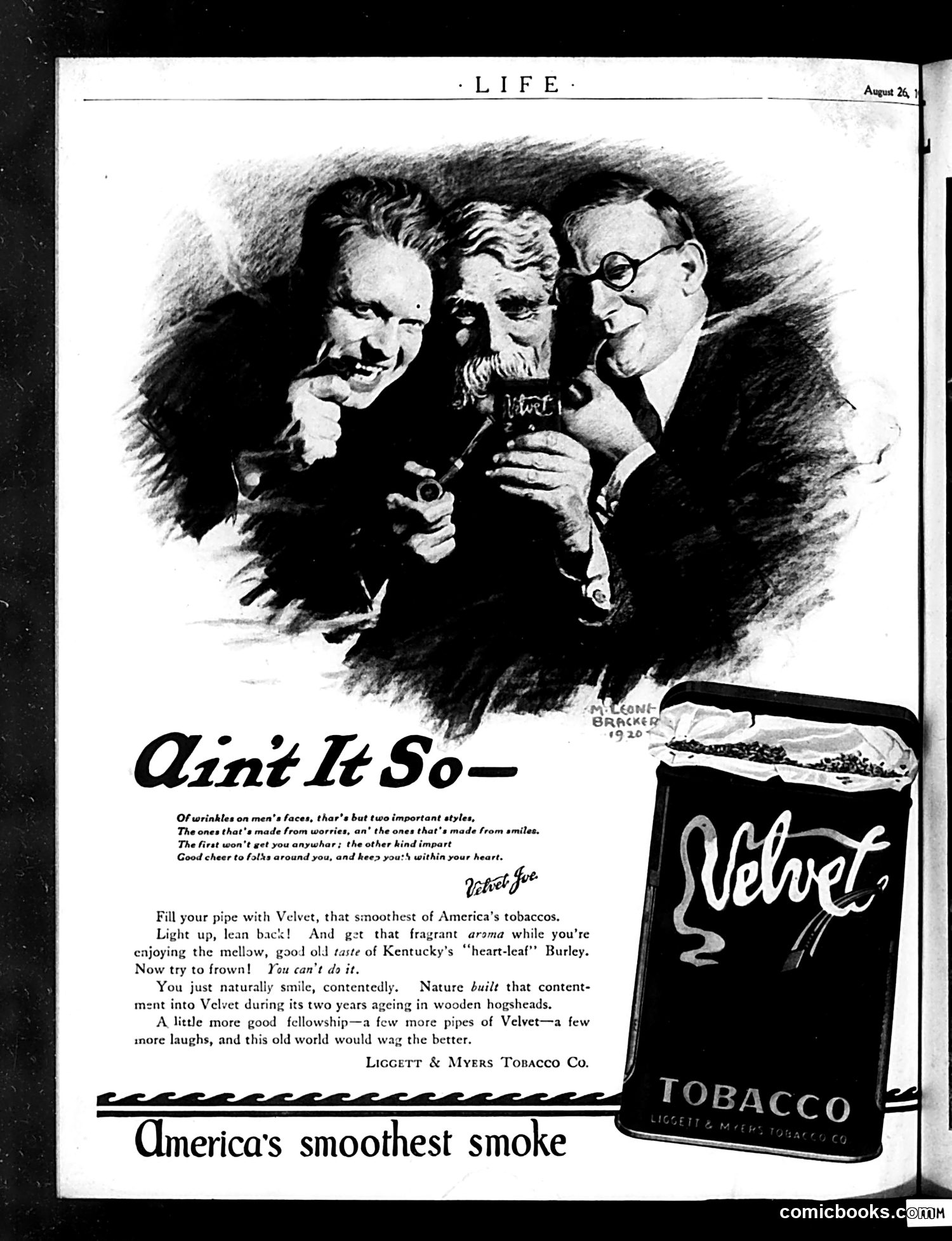
This is a **tobacco advertisement**, not political satire. The illustration shows three men examining or discussing a pipe, drawn in a sketch style signed "Al Leone Barchet 1920." The ad's message uses folk-style verse to argue that wrinkles from smiling (caused by happiness) are preferable to worry lines. It then promotes Velvet pipe tobacco as naturally inducing contentment and good cheer. The copywriting emphasizes the product's smooth taste from Kentucky barley aged in wooden casks for two years. The appeal is to masculine fellowship and good humor—smoking Velvet will make you smile naturally, improve your mood, and spread goodwill. The final line suggests that more pipes and laughter would improve society generally. This reflects early 20th-century advertising that openly promoted tobacco's mood-enhancing and social benefits, before health warnings existed.