
Life, 1920-08-26 · page 15 of 36
Life — August 26, 1920 — page 15: what you’re looking at
What you’re looking at
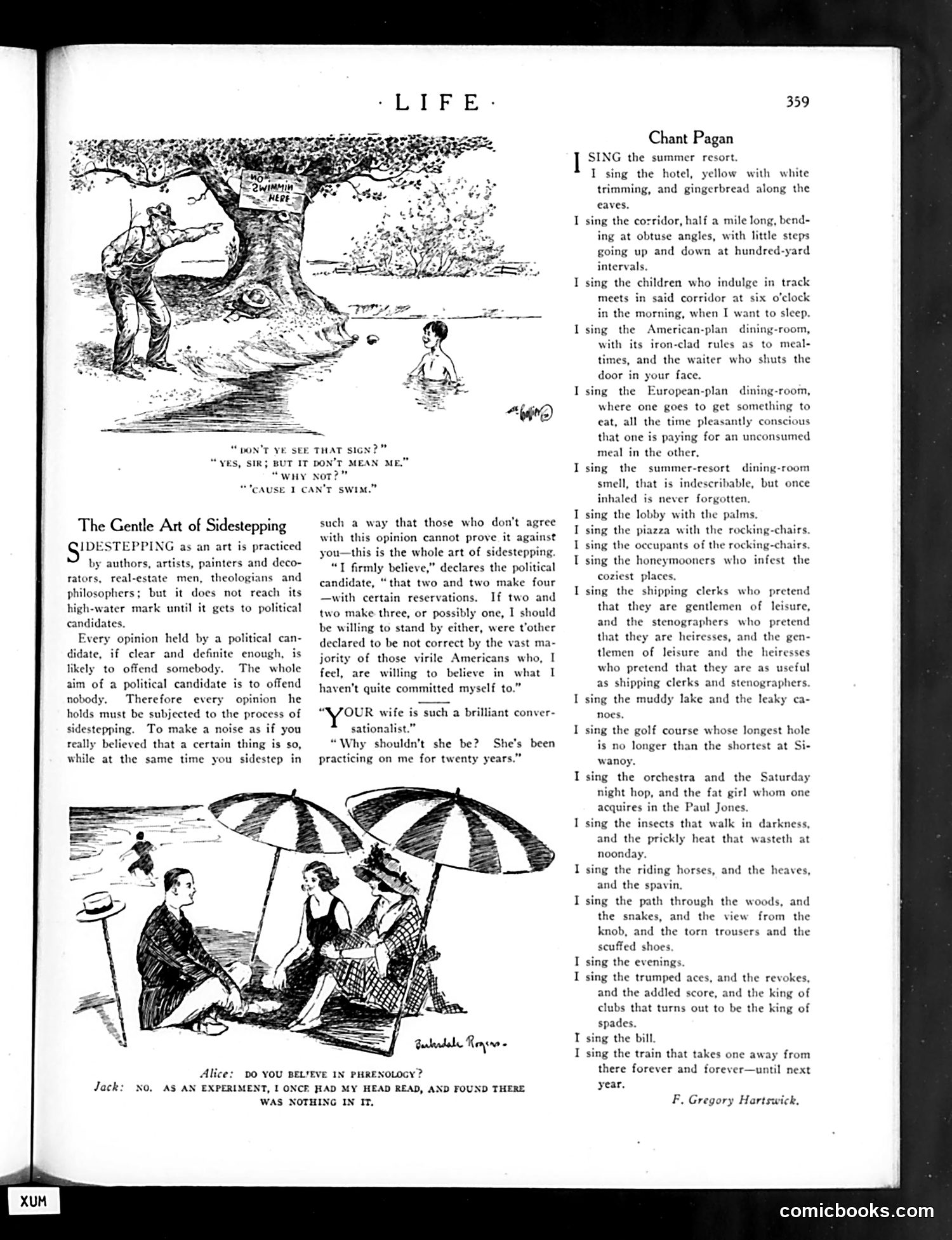
This satirical piece critiques political candidates' evasiveness. The text explains that politicians avoid taking clear stances on contentious issues, instead making vague statements that allow disagreement without contradiction—hence "sidestepping." The cartoon below illustrates this through a beach scene where a man asks a woman about "phrenology" (a pseudoscience claiming skull shape indicates intelligence). She responds by praising him as a "brilliant conversationalist" for twenty years—avoiding any actual answer about whether she believes in the theory. The joke: just as the woman deflects without committing, politicians similarly dodge real positions by appearing agreeable while remaining noncommittal. This allows them to appeal to multiple constituencies without alienating anyone through actual opinions.
📄 Transcribed text from this page (OCR, searchable)
Machine-transcribed from the original scan — historical spelling and the odd misread are preserved.
, SIR; BUT IT DON’T MEAN ME.” “wy Not? “CAUSE 1 CAN'T swiat.” The Gentle Art of Sidestepping IDESTEPPING as an art is practiced by authors, artists, painters and deco- rators, real-estate men, theologians and philosophers; but it does not reach its high-water mark until it gets to political candidate: Every opinion held by a political can- didate, if clear and definite enough, is likely to offend somebody. The whole aim of a political candidate is to offend nobody. Therefore eve: opinion he holds must be subjected to the process of sidestepping. To make a noise as if you really believed that a certain thing is so, while at the same time you sidestep in Alice: Jack: such a way that those who don't agree with this opinion cannot prove it against you—this is the whole art of sidestepping. “TI firmly believe,” declares the political candidate, “that two and two make four —with certain reservations. If two and two make three, or possibly one, I should be willing to stand by either, were tother declared to be not correct by the vast ma- jority of those virile Americans who, | feel, are willing to believe in what 1 haven't quite committed myself to.” “SVOUR wife is such a brilliant conver- sationalist.” “Why shouldn't she be? She's been practicing on me for twenty years.” DO YOU BEL'EVE IN PHRENOLOGY? NO, AS AN EXPERIMENT, I ONCE HAD MY HEAD READ, AND FOUND THERE WAS NOTHING IN IT, Chant Pagan SING the summer resort. I sing the hotel, yellow with white trimming, and gingerbread along the eaves. sing the corridor, half a mile long, bend- ing at obtuse angles, with little steps going up and down at hundred-yard intervals, sing the children who indulge in track meets in said corridor at six o'clock in the morning, when I want to sleep. sing the American-plan dining-room, with its iron-clad rules as to meal- times, and the waiter who shuts the door in your face. sing the European-plan where one goes to get something to eat, all the time pleasantly conscious that one is paying for an unconsumed dining-room, meal in the other, sing the dining-room smell, that is indescribable, but once summer-resort inhaled is never forgotten. sing the lobby with the palms. sing the piazza with the rocking-chairs. sing the occupants of the rocking-chairs, sing the honeymooners who infest the coziest place: sing the shipping clerks who pretend that they are gentlemen of leisure, and the stenographers who pretend that they are heiresses, and the gen- tlemen of leisure and the heiresses who pretend that they are as useful as shipping clerks and stenographers. sing the muddy lake and the leaky ca- noes. sing the golf course whose longest hole is no longer than the shortest at Si wanoy. sing the orchestra and the Saturday night hop, acquires in the Paul Jones. and the fat girl whom one sing the insects that walk in darkness, and the prickly heat that wasteth at noonday sing the riding horses, and the heaves, and the spavin. sing the path through the woods, and the snakes, and the view from the knob, and the torn trousers and the scuffed shoes. I sing the evenings. I sing the trumped aces, and the revokes, and the addled score, and the king of clubs that turns out to be the king of spades. I sing the bill. sing the train that takes one away from there forever and forever—until next year, F, Gregory Hartswick. comicbooks.com