
Life, 1920-08-26 · page 21 of 36
Life — August 26, 1920 — page 21: what you’re looking at
What you’re looking at
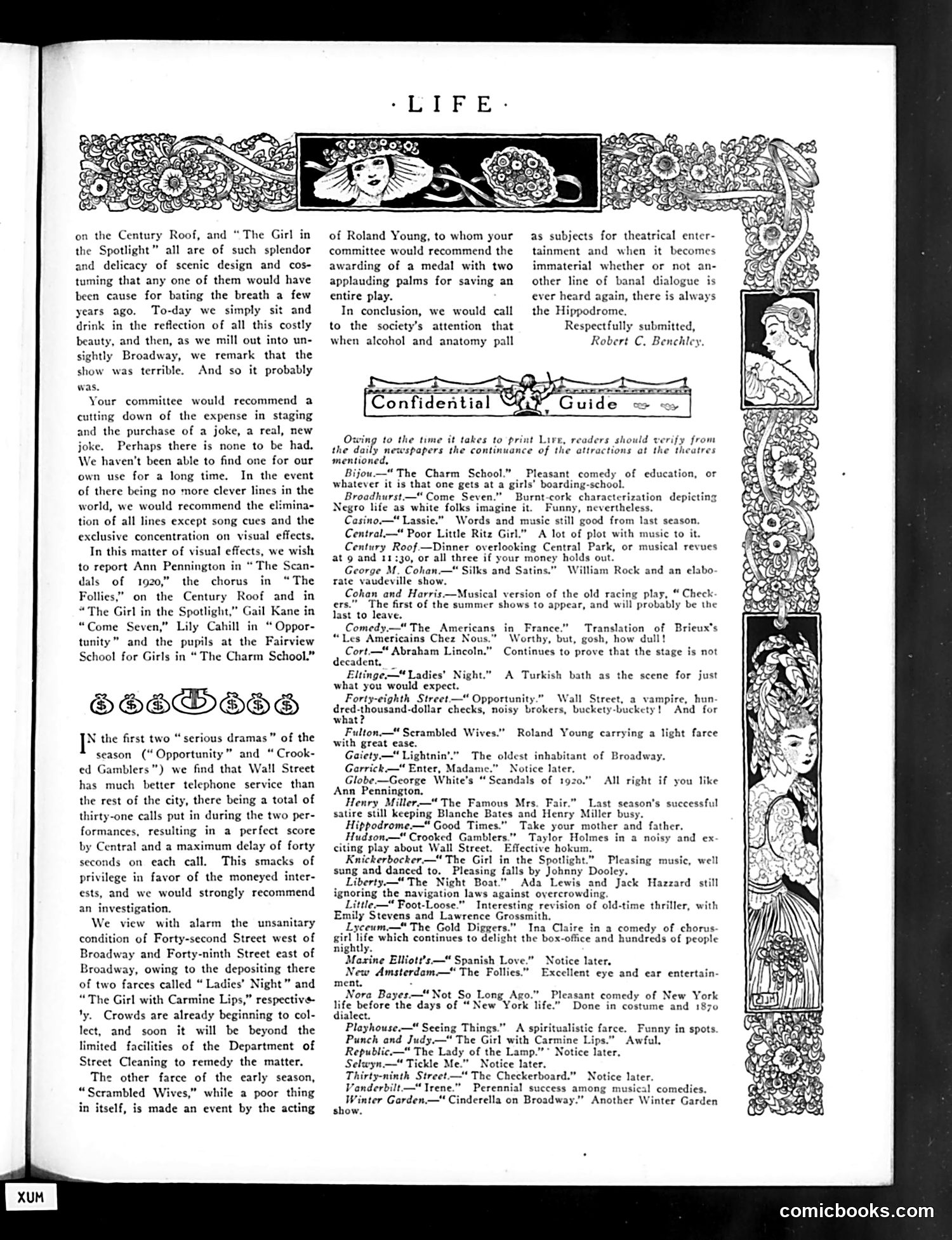
This page is a **satirical theater review** by Robert C. Benchley, a famous humorist, critiquing Broadway's 1920 season. The satire works on multiple levels: **Main Points:** - Benchley mocks expensive theatrical productions that look beautiful but lack substance—audiences leave saying "the show was terrible" despite lavish staging - He recommends eliminating dialogue entirely and focusing only on visual spectacle and attractive performers (Ann Pennington, Gail Kane) - He satirizes **"Scrambled Wives"** and similar lightweight comedies, praising only Roland Young's acting for "saving" a bad play - A humorous aside mocks "Wall Street privilege"—during serious dramas, wealthy theatergoers made 31 phone calls uninterrupted, while regular citizens would face delays **The core joke:** Broadway is producing expensive fluff with no genuine wit. The solution? Abandon pretense entirely—just hire pretty dancers and remove all dialogue. The "Confidential Guide" section provides brief theater listings for current shows, mostly comedies and musicals with lightweight plots.
📄 Transcribed text from this page (OCR, searchable)
Machine-transcribed from the original scan — historical spelling and the odd misread are preserved.
on the Century Roof, and “ The Girl in the Spotlight” all are of such splendor and delicacy of scenic design and cos- tuming that any one of them would have been cause for bating the breath a few years ago. To-day we simply sit and drink in the reflection of all this costly beauty, and then, as we mill out into un- sightly Broadway, we remark that the show was terrible. And so it probably was. Your committee would recommend a cutting down of the expense in staging and the purchase of a joke, a real, new joke. Perhaps there is none to be had. We haven't been able to find one for our own use for a long time. In the event of there being no more clever lines in the world, we would recommend the elimina- tion of all lines except song cues and the exclusive concentration on visual effects. In this matter of visual effects, we wish to report Ann Pennington in “ The Scan- dals of 1920," the chorus in “The Follies,” on the Century Roof and in “The Girl in the Spotlight,” Gail Kane in “Come Seven,” Lily Cahill in “ Oppor- tunity” and the pupils at the Fairvie School for Girls in “The Charm School.” ©S@O4Hh wy the first two “serious dramas” of the season (“ Opportunity” and “ Crook- ed Gamblers”) we find that Wall Street has much better telephone service than the rest of the city, there being a total of thirty-one calls put in during the two per- formances, resulting in a perfect score by Central and a maximum delay of forty seconds on each call. This smacks of privilege in favor of the moneyed inter- ests, and we would strongly recommend an investigation. We view with alarm the unsanitary condition of Forty-second Street west of Broadway and Forty-ninth Street east of Broadway, owing to the depositing there of two farces called “ Ladies’ Night” and “The Girl with Carmine Lips,” respective 'y. Crowds are already beginning to col- lect, and soon it will be beyond the limited facilities of the Department of Street Cleaning to remedy the matter. The other farce of the early season, “Scrambled Wives,” while a poor thing in itself, is made an event by the acting of Roland Young, to whom your as subjects for theatrical enter- committee would recommend the — tainment and when it becomes awarding of a medal with two immaterial whether or not an- applauding palms for saving an other line of banal dialogue is entire play. ever heard again, there is always In conclusion, we would call the Hippodrome, to the society’s attention that Respectfully submitted, when alcohol and anatomy pall Robert C. Benchley. ‘3 eS Confidential ng to the time it takes to print Lire, readers should verify from the daily newspapers the continuance of the attractions at the theatres mentioned, Bijou.—“ The Charm School.” Pleasant comedy of education, or whatever it is that one gets at a girls’ boarding-school. Broadhurst—* Come Seven.” Burnt-cork characterization depicting Negro life as white folk: agine it. Funny, nevertheless, Casino— Lassie.” Words and music still good from last season, Central— Poor Little Ritz Girl.” A lot of plot with music to it. Century Roof—Dinner overlooking Central Park, or musical revues at 9 and 11:30, or all three if your money holds out. George M. Cohan.— Silks and Satins.” William Rock and an elabo rate vaudeville sho Cohan and Harris —Musical version of the old racing play, “ Check ers.” The first of the summer shows to appear, and will probably be the last to leave. Comedy.—" The Americans in France.” Translation of Brieux's “Les Americains Chez No Worthy, but, gosh, how dull! Cort.—“ Abraham Lincoln.” Continues to prove that the stage is not decadent, _ Eltinge—* Ladies’ Night.” A Turkish bath as the scene for just what you would expect. Forty-eighth Street—* Opportunity.” Wall Street, a vampire, hun- dred thoussed-dollar, checks, noisy brokers, buckety-buckety! And for what Fulton—* Scrambled Wives.” Roland Young carrying a light farce with great ease. Gaiety—" Lightnin’.” The oldest inhabitant of Broadway. Garrick. Enter, Madame.” Notice later. Globe—George White's “ Scandals of 1920.” Ann Pennington. Henry Miller—* The Famous Mrs. Fair.” Last season’s successful satire still keeping Blanche Bates and Henry Miller busy. Hippodrome.—" Good Times.” Take your mother and father, Hudson—" Crooked Gamblers.” Taylor Holmes in a noisy and ex citing play about Wall Street. Effective hokum. Knickerbocker —" The Girl in the Spotlight.” Pleasing music, well sung and danced to. Pleasing falls by Johnny Dooley. Liberty—* The Night Boat.” Ada Lewis and Jack Hazzard still ignoring the navigation laws against overcrowding. Little. Foot-Loose.” Interesting revision of old-time thriller, with Emily Stevens and Lawrence Grossmith. Lyceum—*" The Gold Diggers.” Ina Claire in a comedy of chorus. girl life which continues to delight the box-office and hundreds of people nightly. Maxine Elliott’s—" Spanish Love.” Notice later. New Amsterdam—* The Follies.” Excellent eye and ear entertain- ment. : Nora Bayes—“ Not So Long Ago.” Pleasant comedy of New York life before the days of “New York life.” Done in costume and 1870 dialect. Playhouse.— Seeing Things.” A spiritualistic farce. Funny in spots. Punch and Judy,—“ The Girl with Carmine Lips.” Awful, Republic.—* The Lady of the Lamp.” Notice later, Selwyn.—" Tickle Me.” Notice later. Thirty-ninth Street— The Checkerboard.” Notice later. Vanderbilt— Irene.” Perennial success among musical comedies. Winter Garden.—" Cinderella on Broadway.” Another Winter Garden show. All right if you like comicbooks.com