
Life, 1920-08-26 · page 25 of 36
Life — August 26, 1920 — page 25: what you’re looking at
What you’re looking at
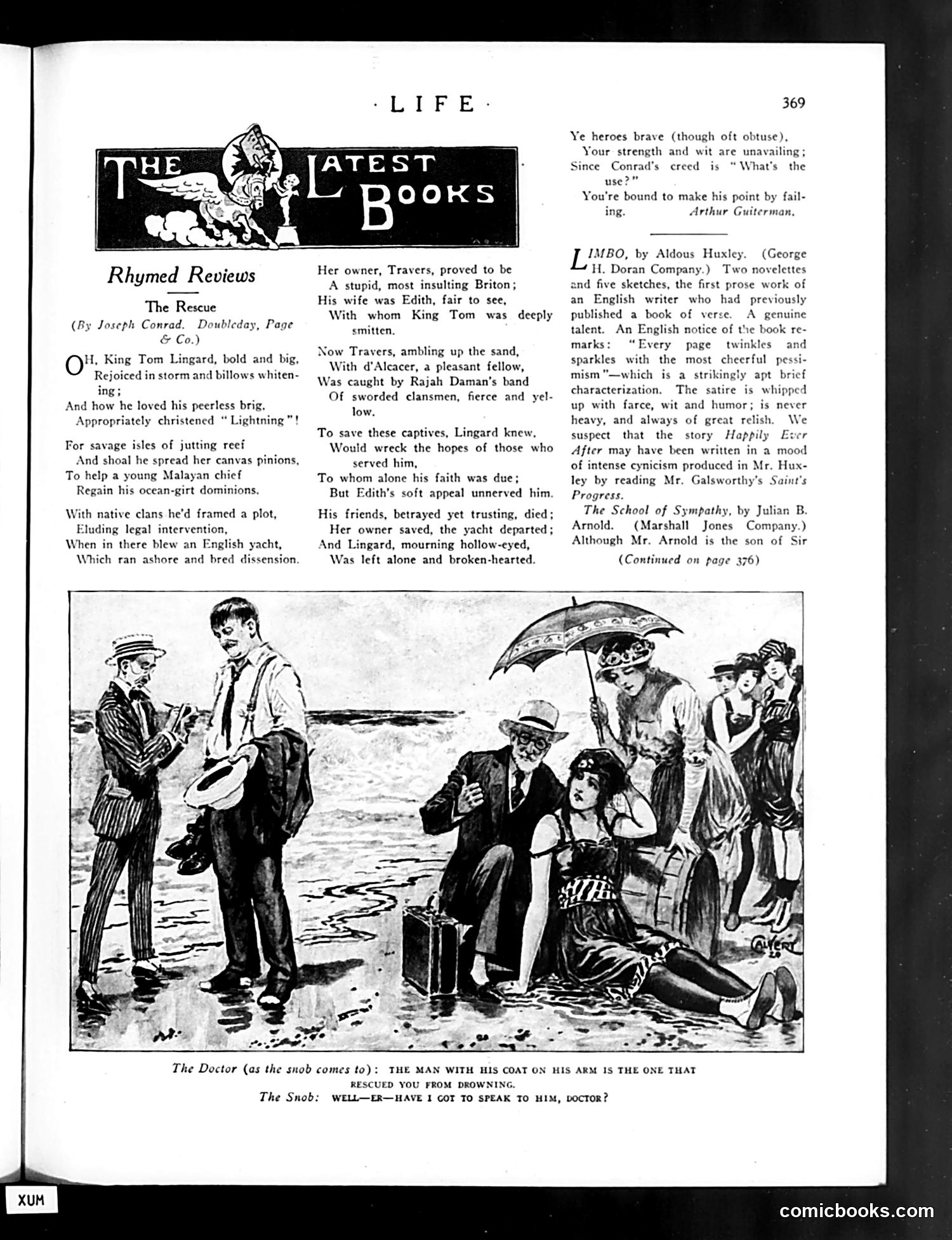
This page reviews Joseph Conrad's novel *The Rescue* in verse form, summarizing its plot: noble sea captain King Tom Lingard must choose between loyalty to his native allies and saving an English woman (Edith) he loves. Conrad's theme—that heroic action ultimately fails—prompts the reviewer's commentary that heroes are "bound to make his point by failing." The cartoon below satirizes British class consciousness. A snobbish man, rescued from drowning by a working-class doctor, asks his physician whether he must acknowledge or socialize with his rescuer. The joke mocks the snob's priorities: rather than gratitude for life-saving, he's concerned about social status and whether he's obligated to interact with someone of lower class. This reflects Edwardian anxieties about maintaining class boundaries even in situations that render such distinctions absurd.
📄 Transcribed text from this page (OCR, searchable)
Machine-transcribed from the original scan — historical spelling and the odd misread are preserved.
Rhymed Reviews The Rescue (By Joseph Conrad. Doubleday, Page & Co.) H, King Tom Lingard, bold and big, Rejoiced in storm and billows whiten- ing; And how he loved his peerless brig, Appropriately christened “ Lightning"! For savage isles of jutting reef And shoal he spread her canvas pinions, To help a young Malayan chief Regain his ocean-girt dominions, With native clans he'd framed a plot, Eluding legal intervention, When in there blew an English yacht, Which ran ashore and bred dissension Her owner, Travers, proved to be A stupid, most insulting Briton; His wife was Edith, fair to see, With whom King Tom was deeply smitten. Now Travers, ambling up the sand, With d’Alcacer, a pleasant fellow, Was caught by Rajah Daman’s band Of sworded clansmen, fierce and yel- low. To save these captives, Lingard knew, Would wreck the hopes of those who served him, To whom alone his faith was due; But Edith’s soft appeal unnerved him. His friends, betrayed yet trusting, died; Her owner saved, the yacht departed; And Lingard, mourning hollow-eyed, Was left alone and broken-hearted. 369 Ye heroes brave (though oft obtuse), Your strength and wit are unavailing; Since Conrad's “What's the use?” You're bound to make his point by fail- ing. creed is Arthur Guiterman, IMBO, by Aldous Huxley. (George H. Doran Company.) Two novelettes and five sketches, the first prose work of an English writer who had previously published a book of verse. A genuine talent. An English notice of the book re- marks: “Every page twinkles 4 sparkles with the most cheerful pess mism"—which is a strikingly apt brief characterization. The satire is whipped up with farce, wit and humor; is never heavy, and always of great relish. We suspect that the story Happily Ever After may have been written in a mood of intense cynicism produced in Mr. Hux- ley by reading Mr. Galsworthy’s Saint's Progress. The School of Sympathy, by Julian B Arnold. (Marshall Jones Company.) Although Mr. Arnold is the son of Sir (Continued on page 376) The Doctor (as the snob comes to): RESCUED YOU FROM DROWNING. THE MAN WITH HIS COAT ON HIS ARM IS THE ONE THAT The Snob: WELL—ER—HAVE 1 GOT TO SPEAK TO HIM, DOCTOR? comicbooks.com