
Life, 1920-08-26 · page 11 of 36
Life — August 26, 1920 — page 11: what you’re looking at
What you’re looking at
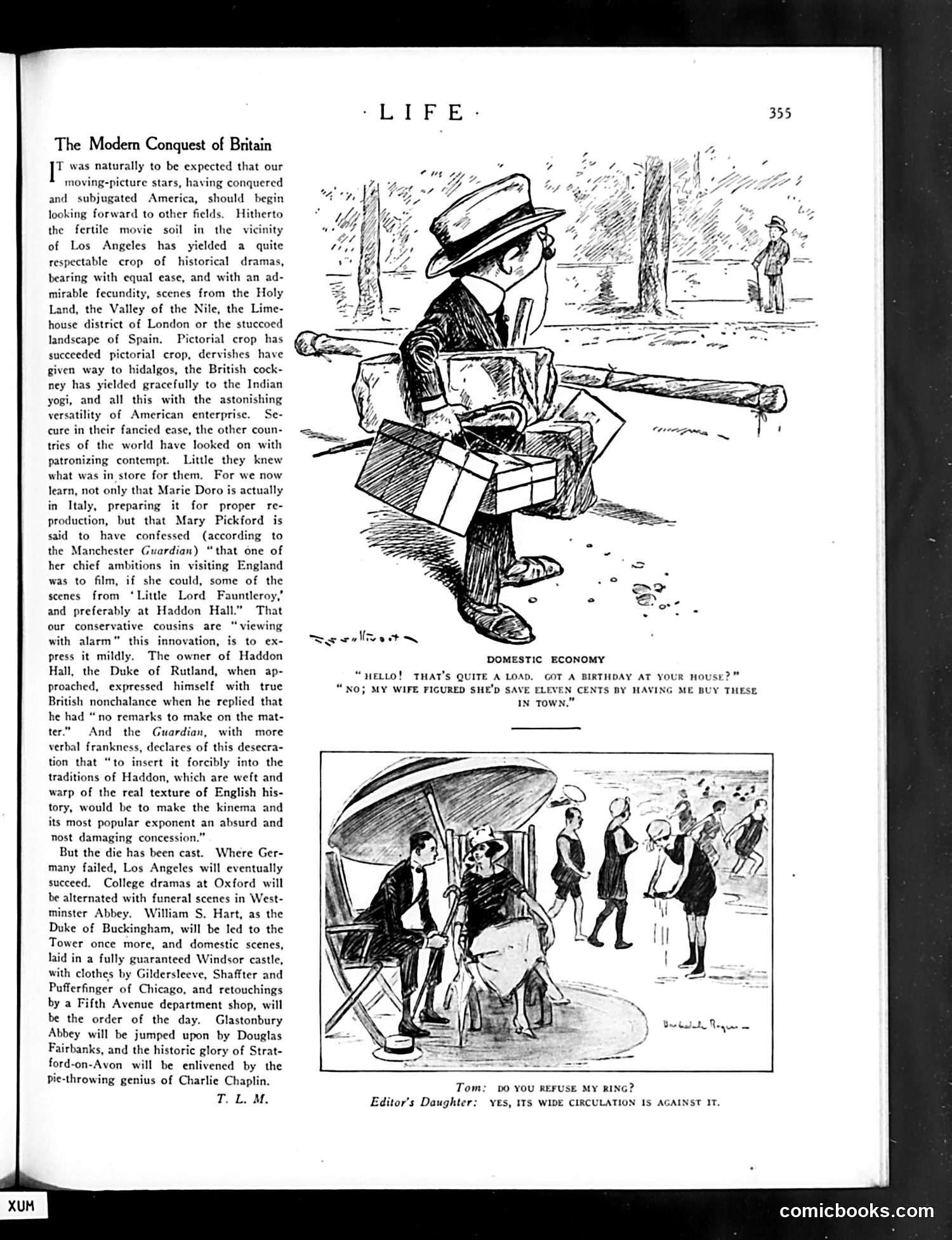
This page satirizes the contrast between high-minded cultural aspirations and modest household budgets. The top cartoon shows a man burdened with heavy parcels labeled with expensive items—apparently purchased to maintain social status or keep up with cultural trends. The caption mocks his wife's "economy": she saves pennies by having him buy expensive goods in town rather than locally. The lower cartoon depicts a beach scene where a man in formal dress (possibly Tom, mentioned in the caption) refuses to wear a ring, claiming "wide circulation" is against it—likely satirizing class pretensions or social rules about jewelry among the wealthy versus working classes. The overall theme: the absurd financial gymnastics middle-class families perform to maintain respectability.
📄 Transcribed text from this page (OCR, searchable)
Machine-transcribed from the original scan — historical spelling and the odd misread are preserved.
The Modern Conquest of Britain T was naturally to be expected that our moving-picture stars, having conquered and subjugated America, should begin looking forward to other fields. Hitherto the fertile movie soil in the vicinity of Los Angeles has yielded a quite respectable crop of historical dramas, bearing with equal ease, and with an ad- mirable fecundity, scenes from the Holy Land, the Valley of the Nile, the Lime- house district of London or the stuccoed landscape of Spain. Pictorial crop has succeeded pictorial crop, dervishes have given way to hidalgos, the British cock- ney has yielded gracefully to the Indian yogi, and all this with the astonishing versatility of American enterprise. Se- cure in their fancied ease, the other coun- tries of the world have looked on with patronizing contempt. Little they knew what was in store for them. For we now learn, not only that Marie Doro is actually in Italy, preparing it for proper re- production, but that Mary Pickford is said to have confessed (according to the Manchester Guardian) “that one of her chief ambitions in visiting England was to film, if she could, some of the scenes from ‘Little Lord Fauntleroy,’ and preferably at Haddon Hall.” That our conservative cousins are “viewing with alarm” this innovation, is to ex- press it mildly. The owner of Haddon Hall, the Duke of Rutland, when ap- proached, expressed himself with true British nonchalance when he replied that he had “no remarks to make on the mat- ter.” And the Guardian, with more verbal frankness, declares of this desecra- tion that “to insert it forcibly into the traditions of Haddon, which are weft and warp of the real texture of English his- tory, would be to make the kinema and its most popular exponent an absurd and nost damaging concession.” But the die has been cast. Where Ger- many failed, Los Angeles will eventually succeed. College dramas at Oxford will be alternated with funeral scenes in West- minster Abbey. William S. Hart, as the Duke of Buckingham, will be led to the Tower once more, and domestic scenes, laid in a fully guaranteed Windsor castle, with clothes by Gildersleeve, Shaffter and Pufferfinger of Chicago, and retouchings by a Fifth Avenue department shop, will be the order of the day. Glastonbury Abbey will be jumped upon by Douglas Fairbanks, and the historic glory of Strat- ford-on-Avon will be enlivened by the Pie-throwing genius of Charlie Chaplin. T. L. M. Se elle “HELLO! THAT'S QUITE A LOAD. “NO; MY WIFE FIGURED SHE'D SAVE ELEVEN CENTS BY HAVING ME BUY THESE. DOMESTIC ECONOMY GOT A BIRTHDAY AT YOUR HOUSE?” IN TO! Tom: Editor's Daughter: DO YOU REFUSE MY RING? YES, ITS WIDE CIRCULATION 1S AGAINST IT. comicbooks.com