
Life, 1920-08-26 · page 17 of 36
Life — August 26, 1920 — page 17: what you’re looking at
What you’re looking at
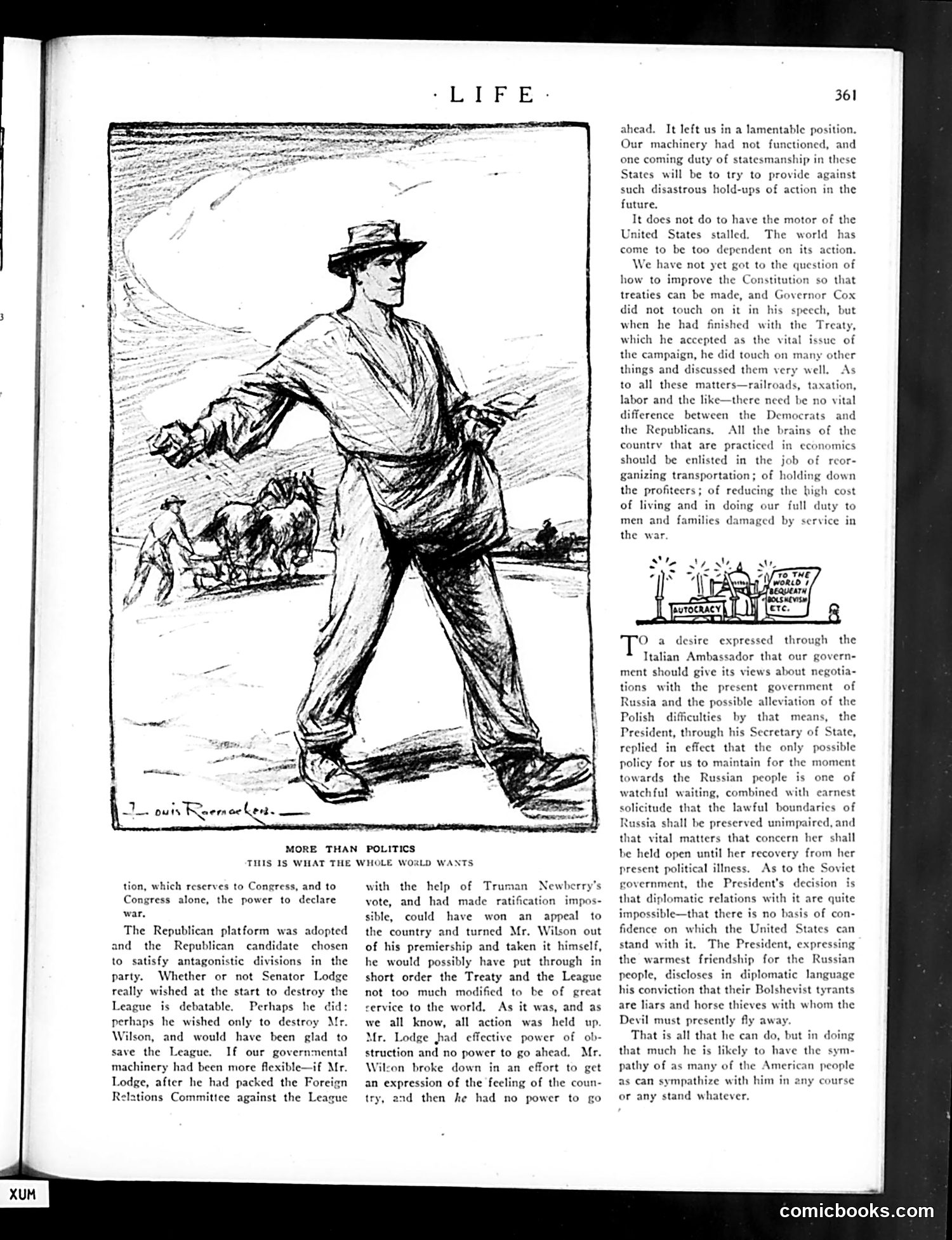
This page critiques post-WWI American political dysfunction, specifically the failure to ratify the League of Nations treaty. The illustration shows a large figure (representing American government/leadership) struggling to direct smaller figures below—a visual metaphor for the nation's inability to act decisively. The text analyzes how Senator Henry Cabot Lodge's obstruction of the League and President Wilson's inflexibility created a governmental stalemate where neither side could advance their agenda. The author argues this paralysis damaged America's global standing at a critical moment when the world depended on U.S. leadership. The piece also addresses Wilson's anti-Soviet position (conveyed through the Italian Ambassador), presenting the administration's "watchful waiting" policy toward Bolshevik Russia—maintaining aloofness while regarding Soviet leaders with deep distrust as fundamentally untrustworthy. The cartoonist (signed but unclear) emphasizes that the real issue transcends partisan politics: America's broken constitutional machinery endangered both domestic and international recovery.
📄 Transcribed text from this page (OCR, searchable)
Machine-transcribed from the original scan — historical spelling and the odd misread are preserved.
Roan IPN eg no ae Pa Se rs MORE THAN POLITICS THIS 1S WHAT THE WHOLE WORLD WANTS tion, which reserves to Congress, and to Congress alone, the power to declare war, The Republican platform was adopted and the Republican candidate chosen to satisfy antagonistic divisions in the part Whether or not Senator Lodge really wished at the start to destroy the League is debatable. Perhaps he d perhaps he wished only to destroy M Wilson, and would have been glad to save the League. If our governmental machinery had been more flexible—if Mr. Lodge, after he had packed the Foreign Relations Commitice against the League Newberry’s ion impos- with the help of Truman vote, and had made ratifi sible, could have won an appeal to the country and turned Mr, Wilson out of his premiership and taken it himself, he would possibly have put through in short order the Treaty and the League not too much modified to be of great service to the world, As it was, and as we all know, all action was held up. Mr. Lodge jhad effective power of ob- struction and no power to go ahead. Mr. Wilson broke down in an effort to get an expression of the feeling of the coun- try, and then he had no power to go 361 ahead. It left us in a lamentable position. Our machinery had not functioned, and one coming duty of statesmanship in these States will be to try to provide against such disastrous hold-ups of action in the future. It does not do to have the motor of the United States stalled. The world has come to be too dependent on its action. We have not yet got to the question of how to improve the Constitution so that treaties can be made, and Governor Cox did not touch on it in his speech, but when he had finished with the Treaty, which he accepted as the vital issue of the campaign, he did touch on many other things and discussed them very well. As to all these matters—railroads, taxation, labor and the like—there need be no vital difference between the Democrats and the Republicans, All the brains of the country that are practiced should be enlisted in the job of reor- ganizing transportation; of holding down the profiteers; of reducing the high cost of living and in doing our full duty to men and families damaged by service in the war. 1 economics Oa desire expressed through the Italian Ambassador that our govern- ment should give its views about negotia- tions with Russia and the possible alleviation of the Polish difficulties by that means, the President, through his Secretary State, replied in effect that the only possible policy for us to maintain for the moment towards the Russian watchful waiting, combined with earnest solicitude that the lawful b Russia shall be preserved unimpaired, and that vital matters that concern her shall be held open until her recovery from her present political illness. As to the Soviet government, the President's that diplomatic relations with it are quite impossible—that there is no basis of con- fidence on which the United States can stand with it, The President, expressing the warmest friendship for the Russia people, discloses in diplomatic langua) his conviction that their Bolshevist tyrants are liars and horse thieves with whom the Devil must presently fly away. That is all that he can do, but in doing that much he is likely to have the sym- pathy of as many of the American people the present government of people is one of ndaries of decision is as can sympathize with him in any course or any stand whatever, comicbooks.com