
Life, 1920-08-26 · page 16 of 36
Life — August 26, 1920 — page 16: what you’re looking at
What you’re looking at
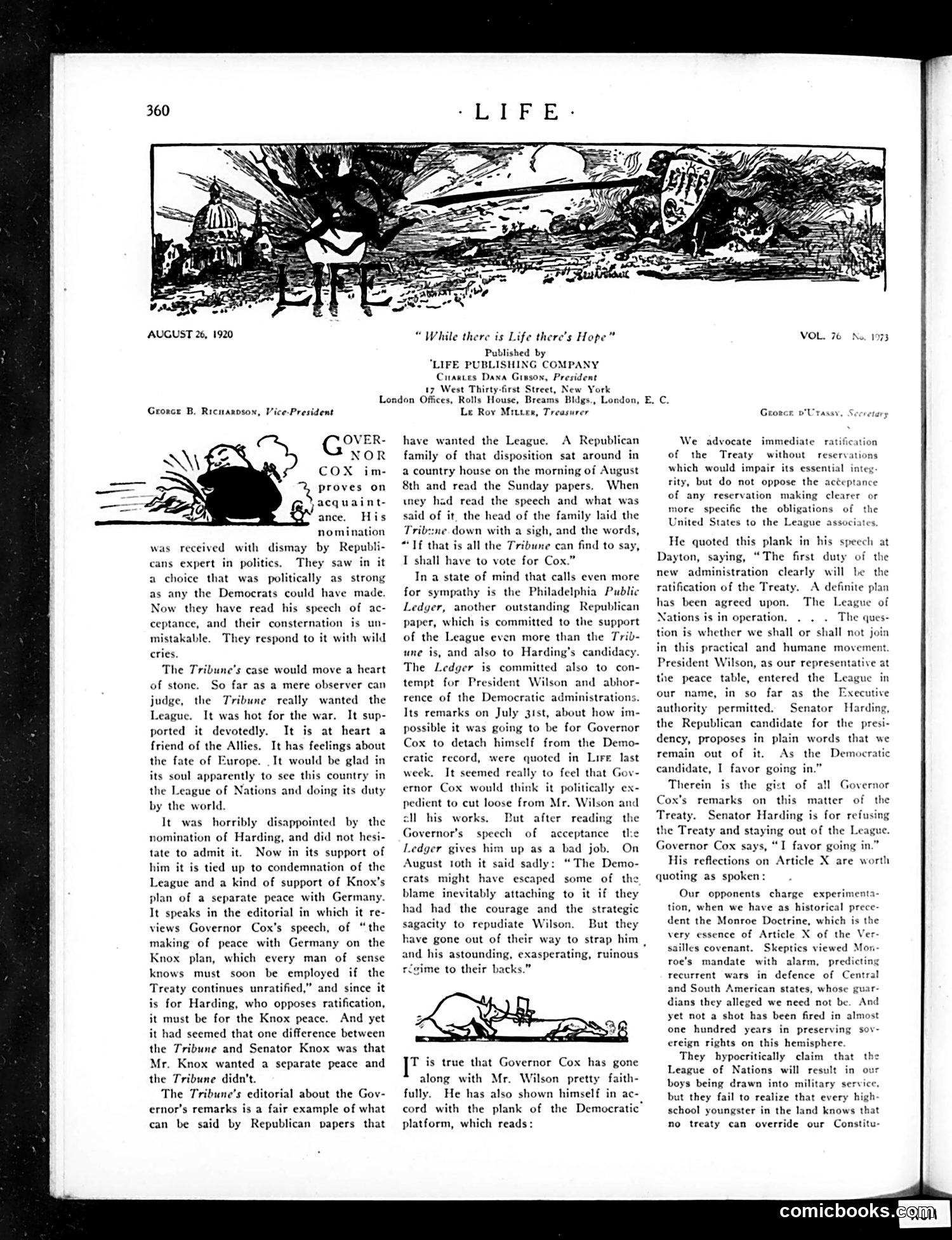
This page discusses the 1920 presidential election and the League of Nations treaty. The text criticizes Republican nominee James Cox's position on the League, comparing it unfavorably to Senator Harding's stance of opposing League membership without reservations. The cartoons (two small illustrations visible) appear to be satirical commentary on these political positions, though specific details are difficult to discern from the image quality. The editorial argues that Republicans and Democrats differ on whether America should join Wilson's League of Nations. It suggests Governor Cox has tried to straddle both positions, while Harding takes a clearer stand against League involvement. The piece reflects the heated 1920 debate over American isolationism versus international engagement—a central issue of that election.
📄 Transcribed text from this page (OCR, searchable)
Machine-transcribed from the original scan — historical spelling and the odd misread are preserved.
Wl r \\ X Ba NY AUGUST 26, 1920 “While there is Life there’s Hope” Published by ‘LIFE PUBLISHING COMPANY Cartes Dana Ginsox, President 17 West Thirty-first Street, New York VOL. 76 No. 1973 London Offices, Rolls House, Breams Bldgs., London, E. C. Groacr B. Ricwarosox, Vice-President OVER- NOR cox i % proves on yacquaint- His nomination was received with dismay by Republi- cans expert in politics, They saw in it a choice that was politically as strong as any the Democrats could have made. Now they have read his speech of ac- ceptance, and their consternation is un- mistakable. They respond to it with wild cries. The Tribune's case would move a heart So far as a mere observer can the Tribune really wanted the League. It was hot for the war. It sup- ported it devotedly. It is at heart a friend of the Allies, It has feelings about the fate of Europe. It would be glad in its soul apparently to see this country in the League of Nations and doing its duty by the world. It was horribly disappointed by the nomination of Harding, and did not hesi- tate to admit it. Now in its support of him it is tied up to condemnation of the League and a kind of support of Knox's plan of a separate peace with Germany. It speaks in the editorial in which it re- views Governor Cox's speech, of “the making of peace with Germany on the Knox plan, which every man of sense knows must soon be employed if the Treaty continues unratified,” and since it is for Harding, who opposes ratification, it must be for the Knox peace. And yet it had seemed that one difference between the Tribune and Senator Knox was that Mr. Knox wanted a separate peace and the Tribune didn't. The Tribune's editorial about the Gov- ernor’s remarks is a fair example of what can be said by Republican papers that ance. of stone, judge, Le Roy Mruter, Treasurer have wanted the League. A Republican family of that disposition sat around in a country house on the morning of August 8th and read the Sunday papers, When uney had read the speech and what was said of it, the head of the family laid the Tribz:ne down with a sigh, and the words, “Tf that is all the Tribune can find to say, I shall have to vote for Cox.” In a state of mind that calls even more for sympathy is the Philadelphia Public Ledger, another outstanding Republican paper, which is committed to the support of the League even more than the Trib- une is, and also to Harding's candidacy. The Ledger is committed also to con- tempt for President Wilson and abhor- rence of the Democratic administrations. Its remarks on July 31st, about how im- possible it was going to be for Governor Cox to detach himself from the Demo- cratic record, were quoted in Lire last week. It seemed really to feel that Gov- ernor Cox would think it politically ex- pedient to cut loose from Mr. Wilson and cll his works. But after reading Governor's speech of acceptance the Ledger gives him up as a bad job. On August toth it said sadly: “The Demo- crats might have escaped some of the blame inevitably attaching to it if they had had the courage and the strategic sagacity to repudiate Wilson. But they have gone out of their w and his astounding, exasperating, ruinous zime to their backs.” the T is true that Governor Cox has gone along with Mr. Wilson pretty f. fully. He has also shown himself in ac- cord with the plank of the Democratic’ platform, which reads: y to strap him | Grorcr v'Ura: We advocate immediate ra of the Treaty without which would impair its essential integ- rity, but do not oppose the acteptance of any reservation making clearer or more specific the obligations of the United States to the L ation reservations ue associates. He quoted this plank in his speech at Dayton, saying, “The first duty of t! new administration clearly will be th ratification of the Treaty. has been agreed upon. The League of Nations is in operation. . . The ques- tion is whether we shall or shall not join in this practical and humane movemer President Wilson, as our representative at the peace table, entered the League in our name, in so far as the Executive authority permitted. Senator Hardin, the Republican candidate for the presi dency, proposes in plain words that we remain out of it. As the Democratic candidate, I favor going in.” A definite Therein is the gist of all Governor Cox's remarks on this matter of the Treaty. Senator Harding is for refusing the Treaty and staying out of the League. Governor Cox says, “I favor going in.” His reflections on Article X are worth quoting as spoken: Our opponents charge experi' a- tion, when we have as historical prec dent the Monroe Doctrine, which is the very essence of Article of the V sailles covenant. Skeptics viewed Mor roe’s mandate with alarm, recurrent wars in defence of Central and South American states, whose guar- dians they alleged we need not be. And yet not a shot has been fired in almost one hundred years in preserving sov- ereign rights on this hemisphere. They hypocritically claim that the League of Nations will result in o boys being drawn into military servic but they fail to realize that every high- school youngster in the land knows that no treaty can override our Constitu- predicting comicbooks Sam |