
Life, 1920-08-26 · page 14 of 36
Life — August 26, 1920 — page 14: what you’re looking at
What you’re looking at
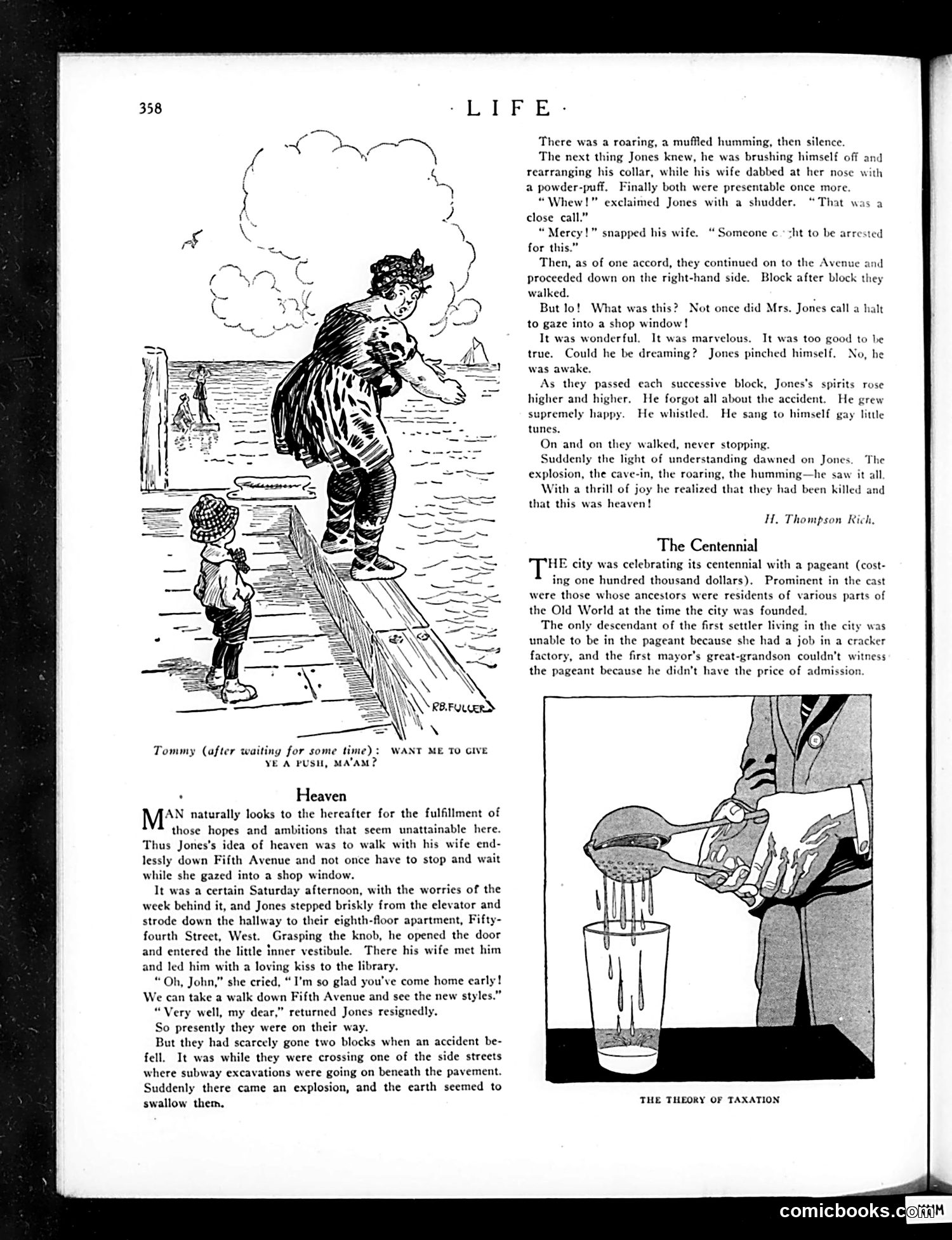
This page contains two distinct pieces of satirical content: **"Heaven"** (top): A narrative story about Jones and his wife experiencing a near-death experience during a subway excavation accident in their city. The story celebrates their realization that being alive together—even amid urban chaos and danger—constitutes their version of heaven. This satirizes materialistic pursuits and urban life's hazards while affirming simple domestic happiness. **"The Centennial"** (bottom right): Text mocking a city's hundred-year celebration pageant. It criticizes that descendants of the city's founders cannot participate because they lack wealth or social standing—they've lost their prominence. This satirizes how American cities celebrated their histories while ignoring how founding families had often declined into poverty. The illustration labeled "The Theory of Taxation" (lower right) appears to show wealth redistribution visually.
📄 Transcribed text from this page (OCR, searchable)
Machine-transcribed from the original scan — historical spelling and the odd misread are preserved.
“LIFE. Tommy (after waiting for some time): WANT ME TO GIVE YE A PUSH, MA'AM? . Heaven N naturally looks to the hereafter for the fulfillment of those hopes and ambitions that seem unattainable here. Thus Jones’s idea of heaven was to walk with his wife end- lessly down Fifth Avenue and not once have to stop and wait while she gazed into a shop window. It was a certain Saturday afternoon, with the worries of the week behind it, and Jones stepped briskly from the elevator and strode down the hallway to their eighth-floor apartment, Fifty- fourth Street, West. Grasping the knob, he opened the door and entered the little inner vestibule. There his wife met him and led him with a loving kiss to the library. “Oh, John,” she cried, “I’m so glad you've come home early! We can take a walk down Fifth Avenue and see the new styles.” “Very well, my dear,” returned Jones resignedly, So presently they were on their way. But they had scarcely gone two blocks when an accident be- fell. It was while they were crossing one of the side streets where subway excavations were going on beneath the pavement. Suddenly there came an explosion, and the earth seemed to swallow them. There was a roaring, a muffled humming, then silence. The next thing Jones knew, he was brushing himself off and rearranging his collar, while his wife dabbed at her nose with a powder-puff. Finally both were presentable once more. “Whew!” exclaimed Jones with a shudder, “That was a close call.’ “Mercy!” snapped his wife. for this.” Then, as of one accord, they continued on to the Avenue and proceeded down on the right-hand side. Block after block they walked. . But lo! What was this? Not once did Mrs. Jones call a halt to gaze into a shop window! It was wonderful. It was marvelous. It was too good to be true. Could he be dreaming? Jones pinched himself. No, he was awake. As they passed each successive block, Jones's spirits rose higher and higher. He forgot all about the accident. He grew supremely happy. He whistled. He sang to himself gay little tunes. “Someone c° sht to be arrested On and on they walked, never stopping. Suddenly the light of understanding dawned on Jones, The explosion, the cave-in, the roaring, the humming—he saw it all With a thrill of joy he realized that they had been killed and that this was heaven! H. Thompson Rich, The Centennial HE city was celebrating its centennial with a pageant (cost- ing one hundred thousand dollars), Prominent in the cast were those whose ancestors were residents of various parts of the Old World at the time the city was founded. The only descendant of the first settler living in the city was unable to be in the pageant because she had a job in a cracker factory, and the first mayor's great-grandson couldn't witness the pageant because he didn’t have the price of admission. THE THEORY OF TAXATION comicbooks.