
A complete issue · 41 pages · 1920
Life — June 24, 1920
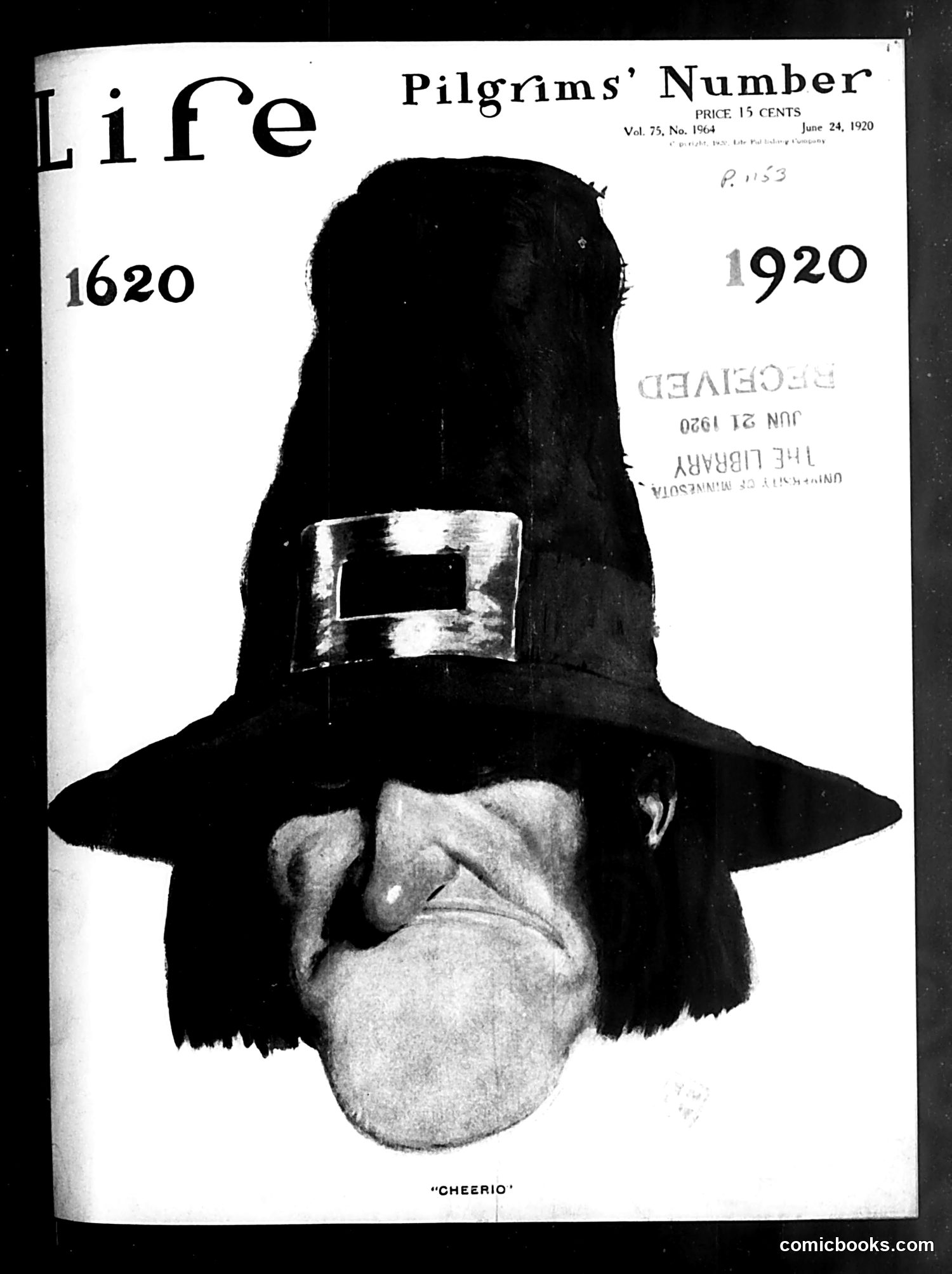
This is the cover of Life magazine's "Pilgrims' Number" from June 24, 1920, commemorating the 300th anniversary of the Pilgrims' 1620 landing at Plymouth Rock. The image shows a figure in Pilgrim attire (tall hat, collar) whose face is obscured by a large glass or transparent barrier labeled "CHEERIO." The design cleverly juxtaposes 1620 and 1920, suggesting a comparison between the historical Pilgrims and modern America. The barrier obscuring the Pilgrim's face likely satirizes how Americans in 1920 viewed their Pilgrim heritage—as something distant, unclear, or obscured by time and intervening centuries. The "cheerio" caption (British slang for goodbye/cheers) may suggest ironic distance from the serious historical legacy these founders represented.
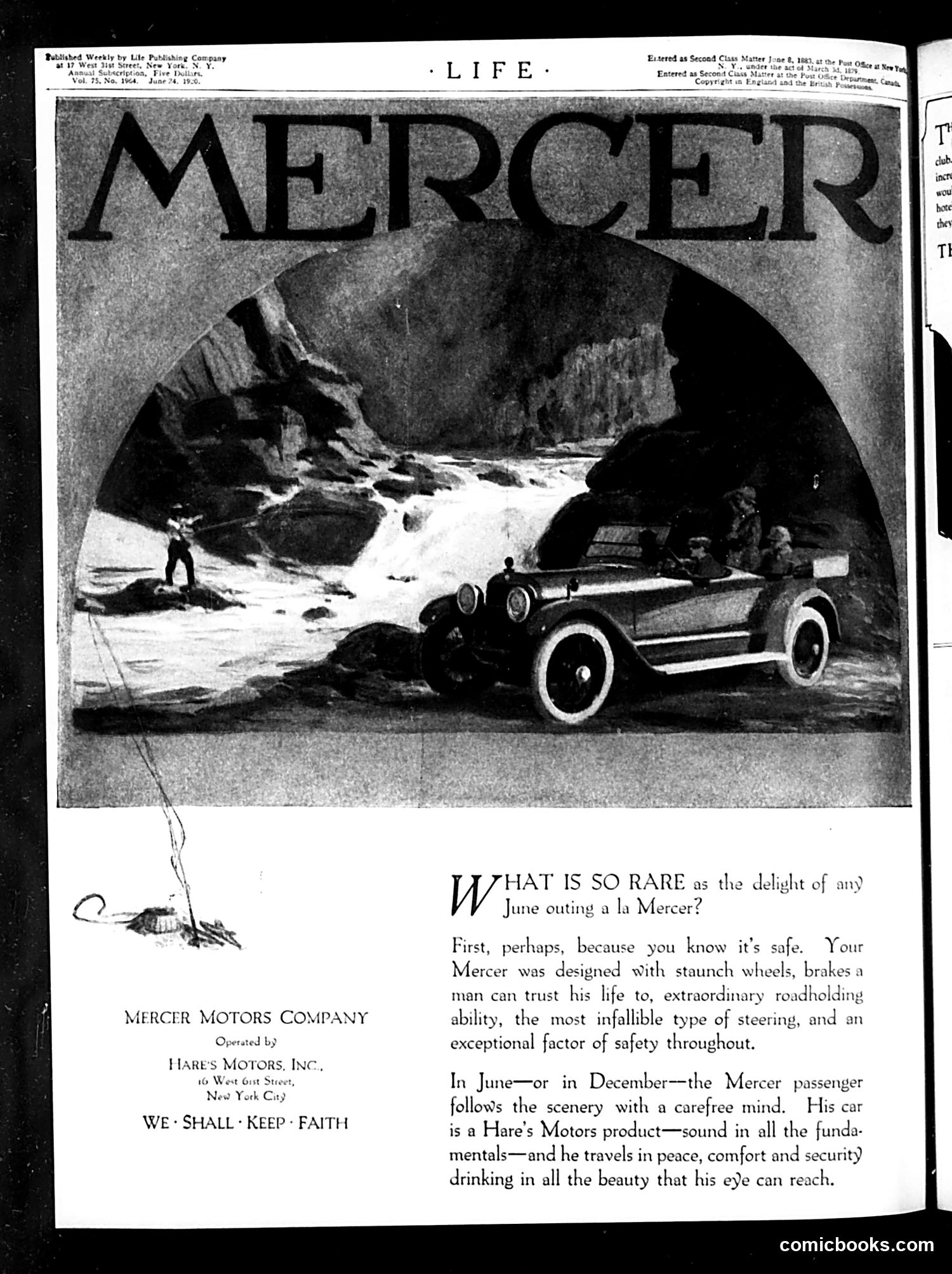
This is primarily a **commercial advertisement**, not political satire. It promotes the Mercer automobile, manufactured by Mercer Motors (operated by Hares Motors, Inc. in New York City) with the tagline "WE SHALL KEEP FAITH." The ad depicts a luxury touring car parked beneath a dramatic natural rock arch, with figures enjoying a scenic riverside outing. The sales pitch emphasizes safety features—staunch wheels, reliable brakes, superior steering—and positions the Mercer as enabling carefree leisure travel ("drinks in all the beauty that his eye can reach"). This reflects early 20th-century automobile marketing targeting affluent consumers who could afford recreational motoring excursions. The romantic landscape imagery appeals to aspirational lifestyles rather than containing political commentary.
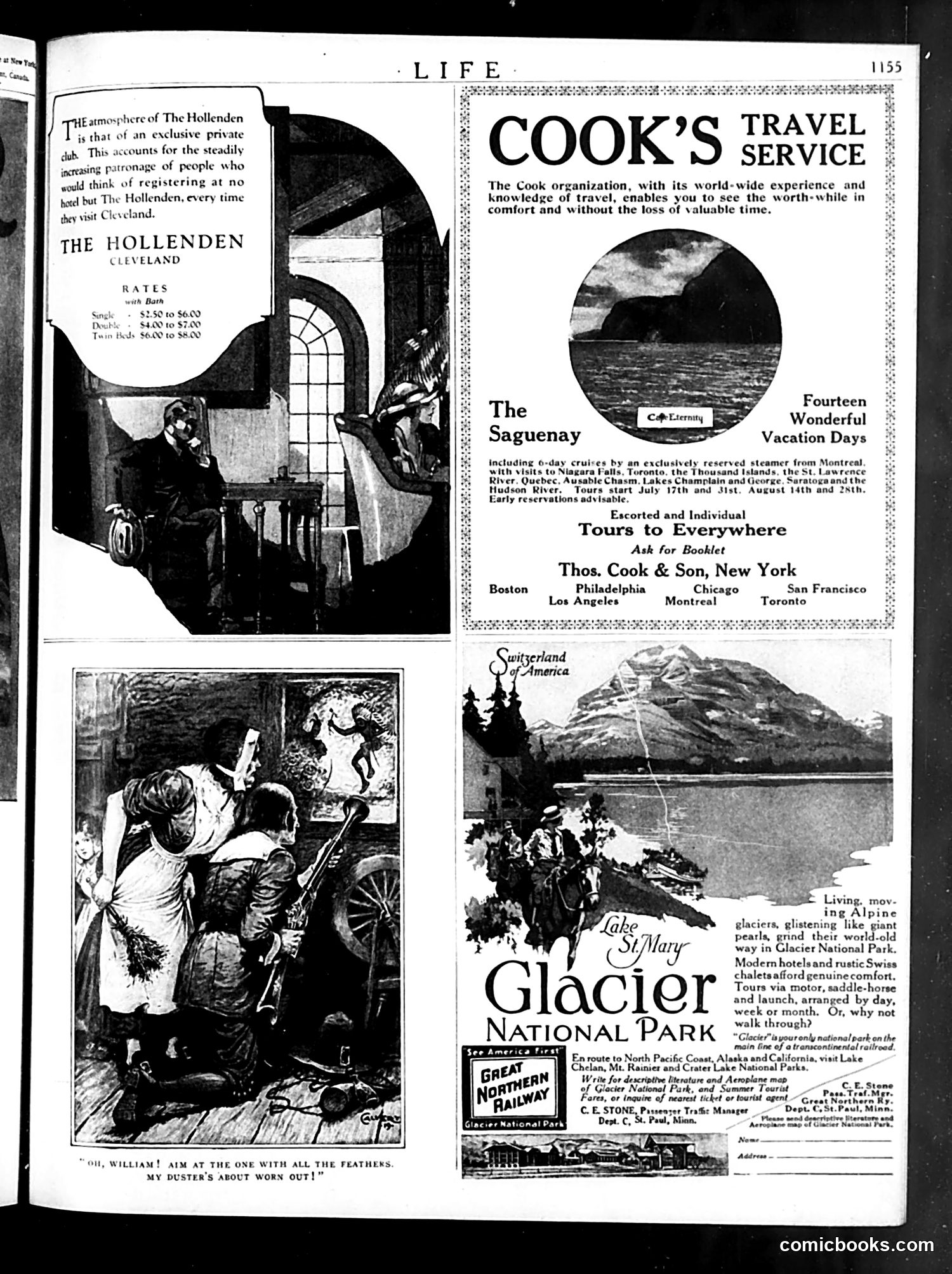
This page is primarily **advertising** rather than editorial content. The left side features an ad for The Hollenden hotel in Cleveland with period interior imagery. The right side contains travel advertisements: Cook's Travel Service promoting "The Saguenay" cruise and "Fourteen Wonderful Vacation Days," and a Glacier National Park ad via the Great Northern Railway. The only cartoon appears at the bottom left, captioned "OH, WILLIAM! AIM AT THE ONE WITH ALL THE FEATHERS. MY DUSTER'S ABOUT WORN OUT!" The sketch depicts what appears to be a domestic scene with a woman directing a man, likely satirizing household chores or marital dynamics in early 20th-century America—a common Life magazine humor subject.
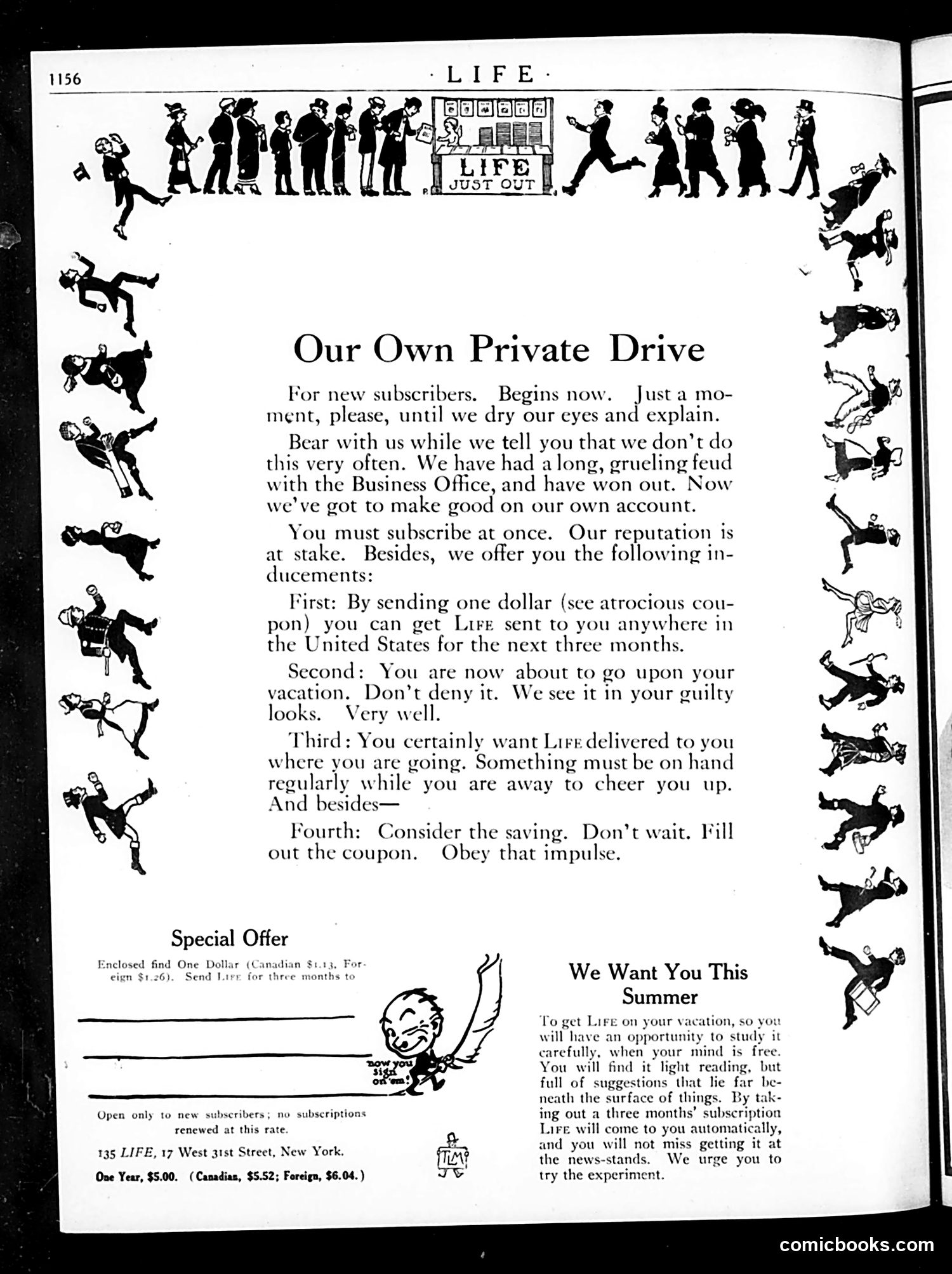
This is primarily a **subscription drive advertisement** for *Life* magazine, disguised as satirical content. The page uses humorous silhouettes of people in various acrobatic poses around the borders—falling, jumping, tumbling—to visually convey chaos and comedic desperation. The text announces that *Life* has "won out" against the Business Office in some internal dispute and now needs subscriptions. The four inducements offered are lighthearted: cheap rates ($1 for three months), vacation reading, delivery while away, and overall savings. The cartoon figures aren't identified political caricatures but rather generic comedic illustrations emphasizing the magazine's humorous tone. The entire piece is a self-promotional joke about the publication's own financial needs, written in *Life*'s characteristic witty, self-aware voice.
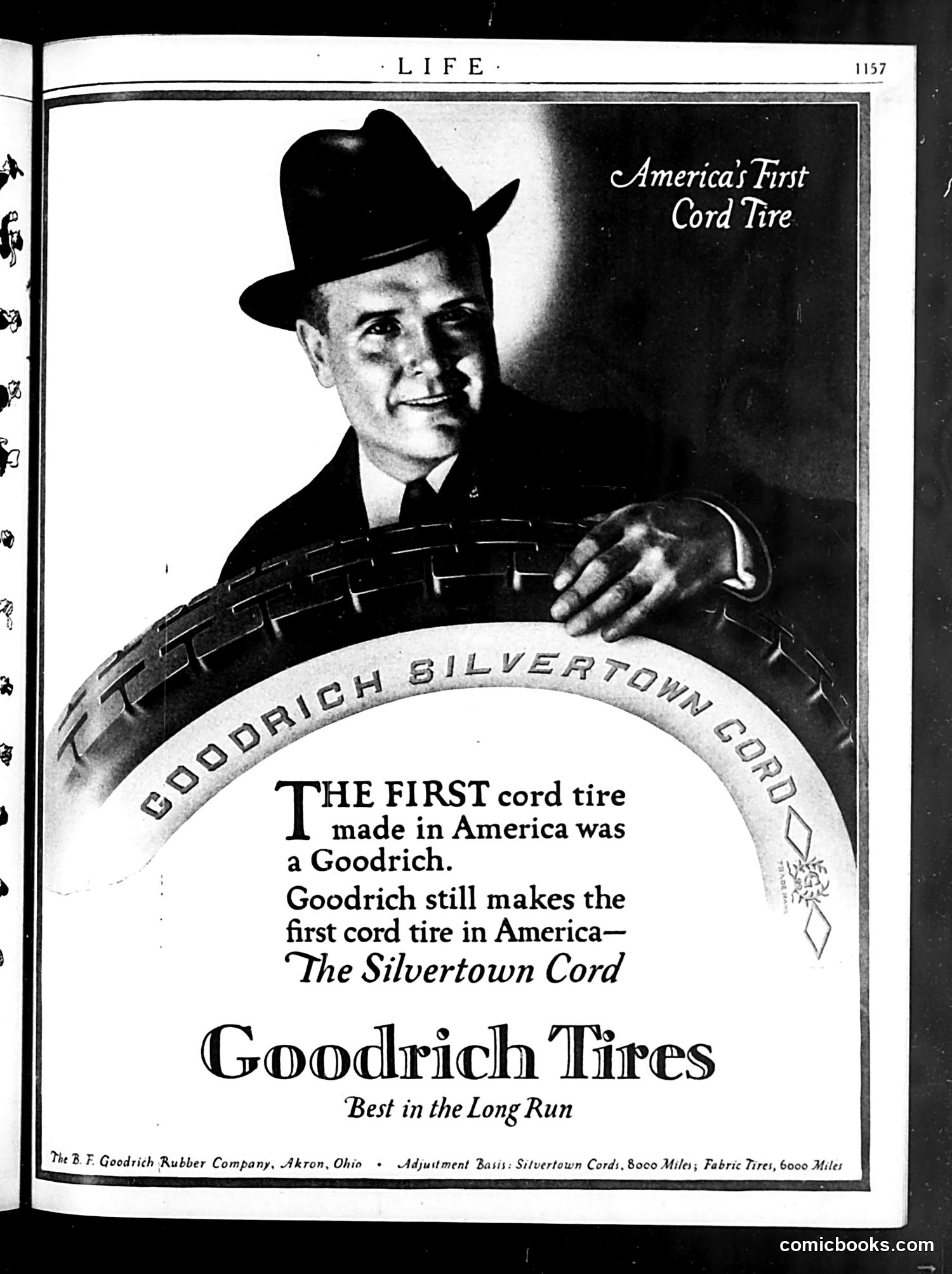
This is **not a political cartoon or satire** — it's a straightforward **advertisement for Goodrich Tires**, published in *Life* magazine (page 1157). The ad features a man in a cowboy hat posing with a large tire branded "Goodrich Silvertown Cord." The ad's text claims Goodrich made America's first cord tire and continues to make the first cord tire (the Silvertown model). The "America's First" messaging is the ad's primary pitch: establishing Goodrich as an industry pioneer and market leader. The cowboy imagery conveys durability and American authenticity. The tagline "Best in the Long Run" emphasizes tire longevity and reliability. This reflects early automotive-era advertising strategy: linking products to American achievement and innovation.
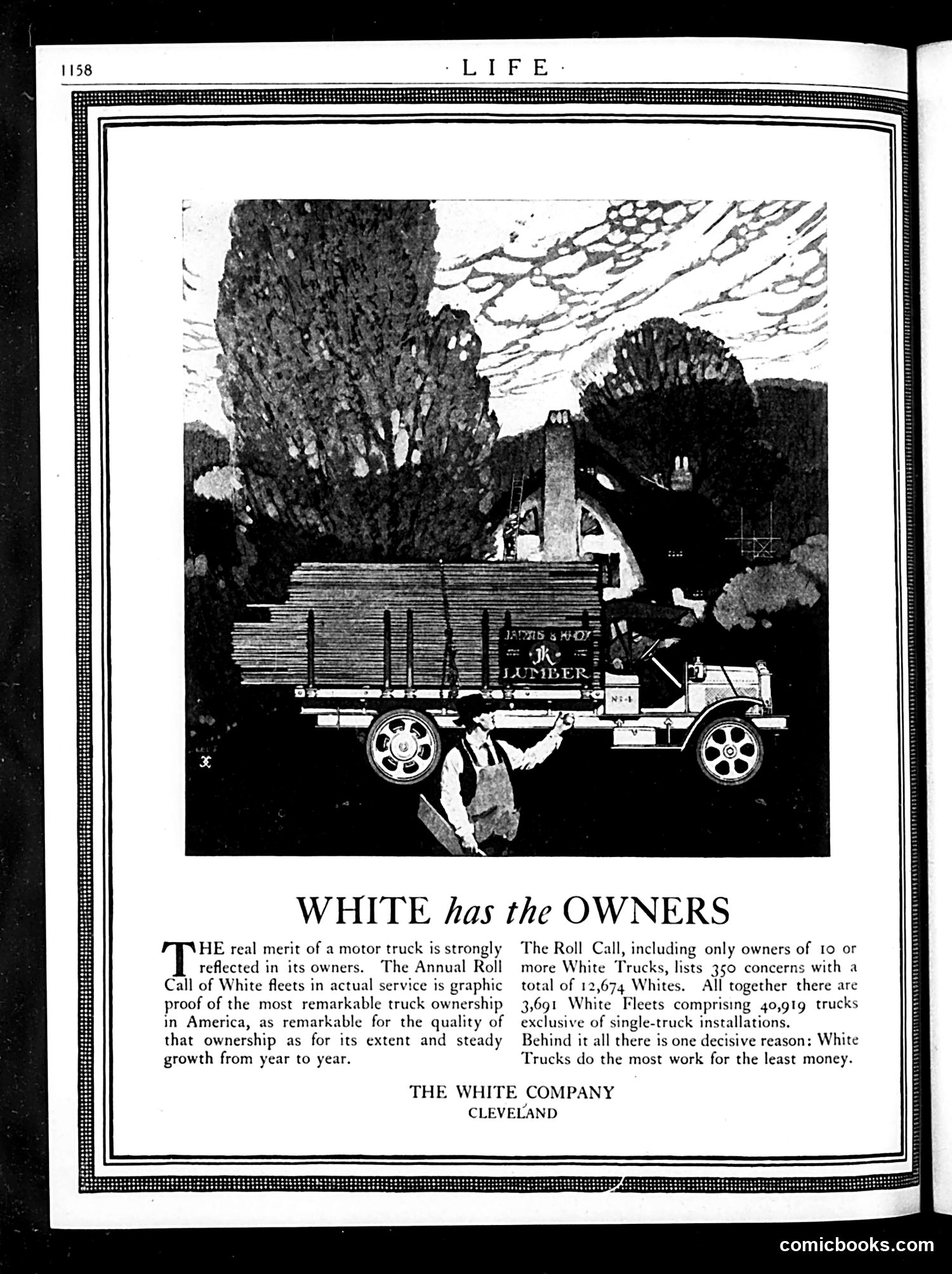
This is primarily a **product advertisement**, not political satire. The White Company, a Cleveland-based truck manufacturer, is marketing their vehicles to fleet owners. The image shows a stylized truck loaded with lumber, positioned before an industrial or quarry setting with dramatic rock formations. A worker gestures toward the vehicle. The advertisement's argument is straightforward: White trucks dominate American fleet ownership. The text cites "The Roll Call" of White truck owners—12,674 vehicles across 3,691 fleets—claiming this ownership concentration proves White trucks deliver superior value: "White Trucks do the most work for the least money." This is a data-driven marketing appeal to business owners, using ownership statistics as evidence of product quality and cost-effectiveness. There is no political or social satire present.
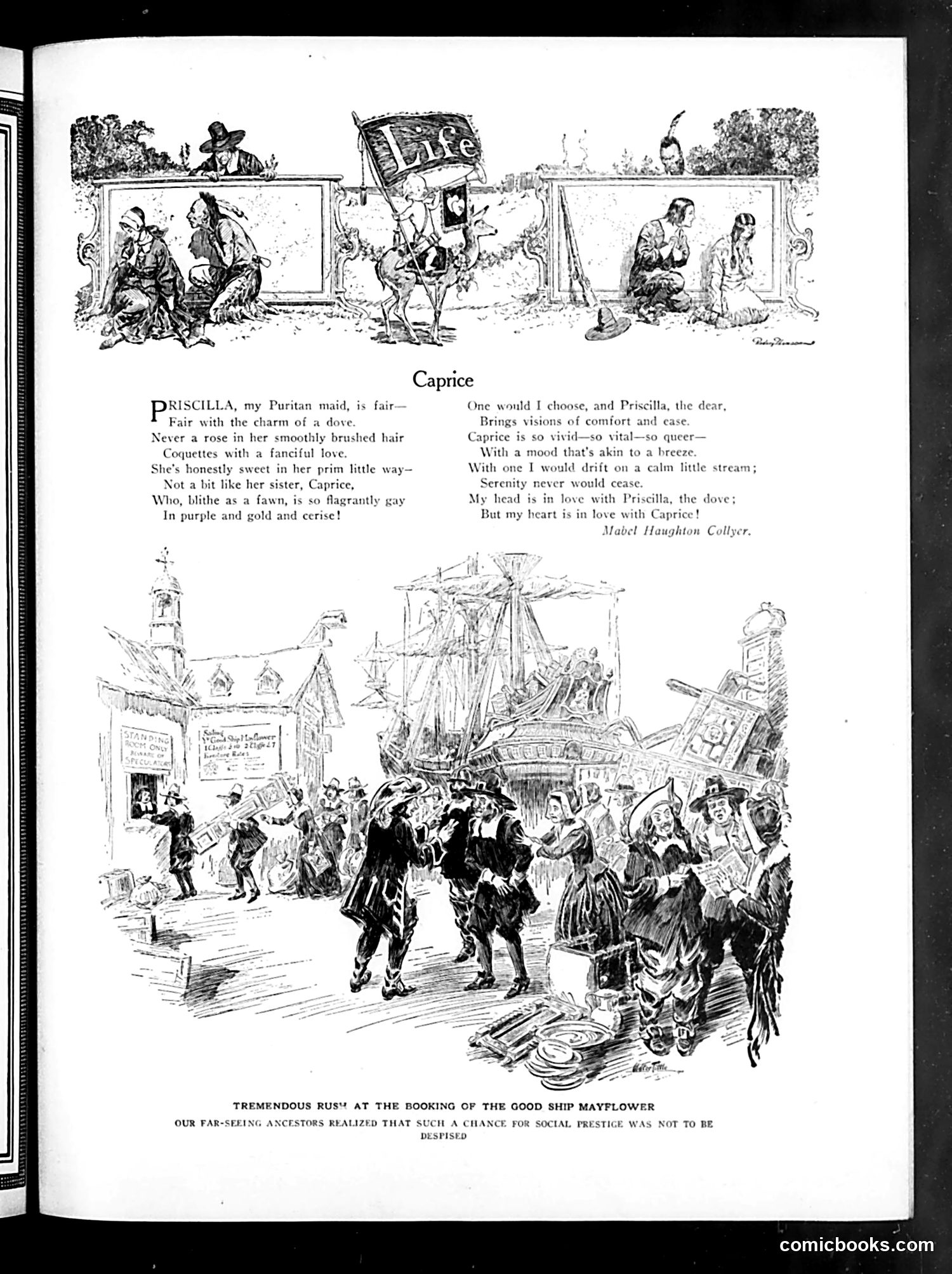
This page contains a poem titled "Caprice" by Mabel Haughton Collyer about romantic indecision. The speaker describes Priscilla, a "Puritan maid," as fair but ultimately chooses the more vivacious Caprice over her, declaring "my heart is in love with Caprice!" The lower illustration depicts a chaotic harbor scene labeled "Tremendous Rush at the Booking of the Good Ship Mayflower." It satirizes Americans' enthusiasm for booking Mayflower passage, suggesting our ancestors' journey was driven by social prestige rather than genuine religious conviction. The crowded, frenzied scene mocks the notion that people want to associate with Puritan heritage for fashionable reasons rather than historical accuracy.
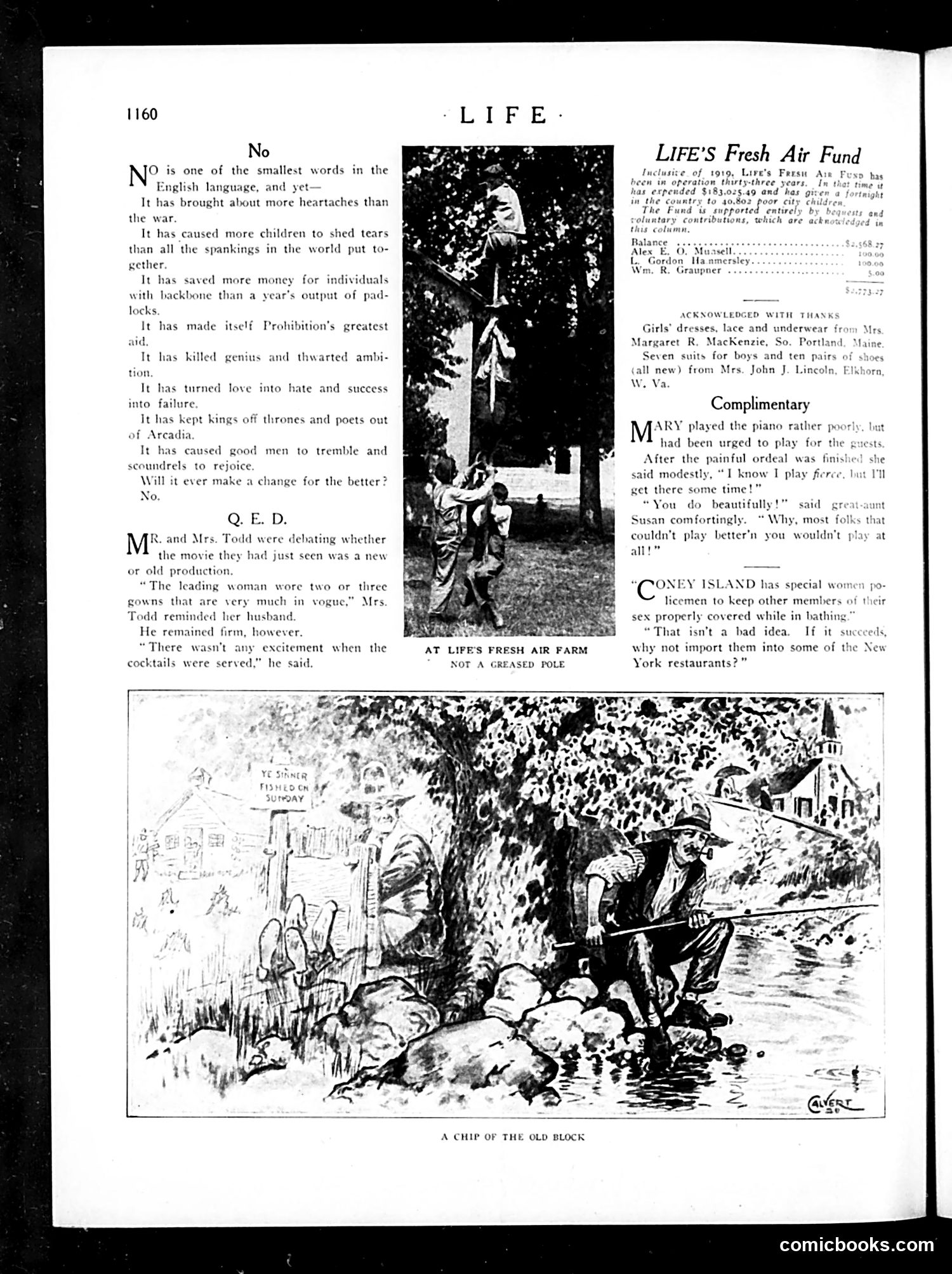
This page contains three distinct pieces: 1. **"No" essay by Q.E.D.**: A satirical poem attacking Prohibition, listing its negative social consequences (headaches, tears, money wasted on locks, genius killed, love turned to hate, etc.). The closing question "Will it ever make a change for the better? No." suggests the author views Prohibition as fundamentally harmful and unlikely to improve. 2. **"Complimentary" anecdote**: A brief humorous story about a woman playing piano poorly, with a guest's backhanded compliment about her playing. 3. **"A Chip of the Old Block" cartoon**: A fishing scene showing what appears to be men catching fish, with rural/rustic humor intended, though the specific joke is unclear from the image alone. The dominant theme is **anti-Prohibition sentiment**, a major satirical target for Life magazine during the 1920s.
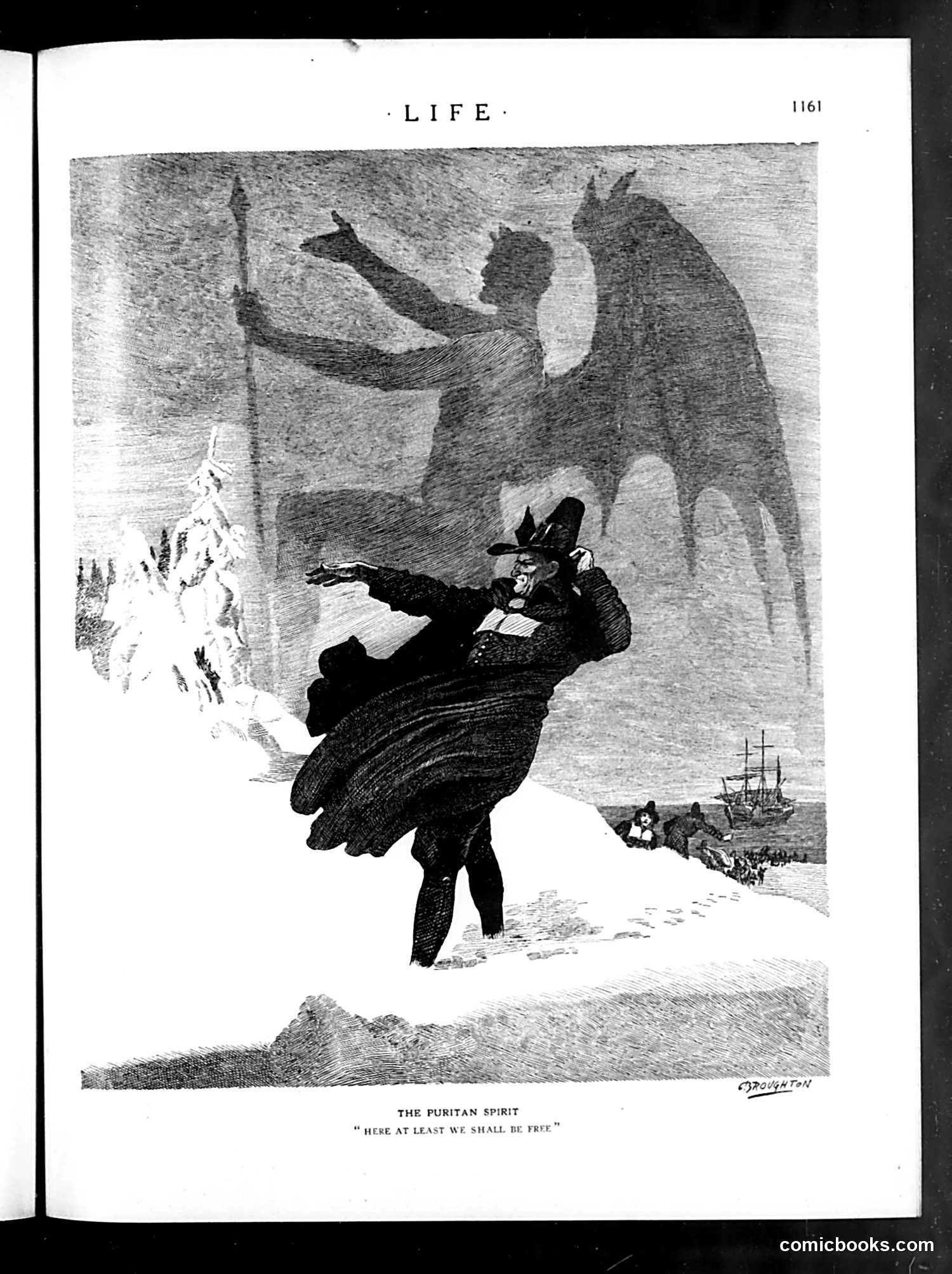
This cartoon depicts a figure in colonial-era dress (hat, coat) fleeing across snowy terrain, with a large demonic shadow looming behind him. A ship is visible in the distance, suggesting escape by sea. The caption reads: "HERE AT LEAST WE SHALL BE FREE" The satire appears to comment on the contradiction between the Puritans' stated ideals of religious freedom and their actual practices. The demonic shadow suggests that the "Puritan spirit" itself—their repressive moral authority and intolerance—pursues them even as they escape persecution. The cartoon implies that Puritans brought their own oppressive nature to the New World, undermining their claimed quest for liberty. The artist is credited as "Cesare" or similar.
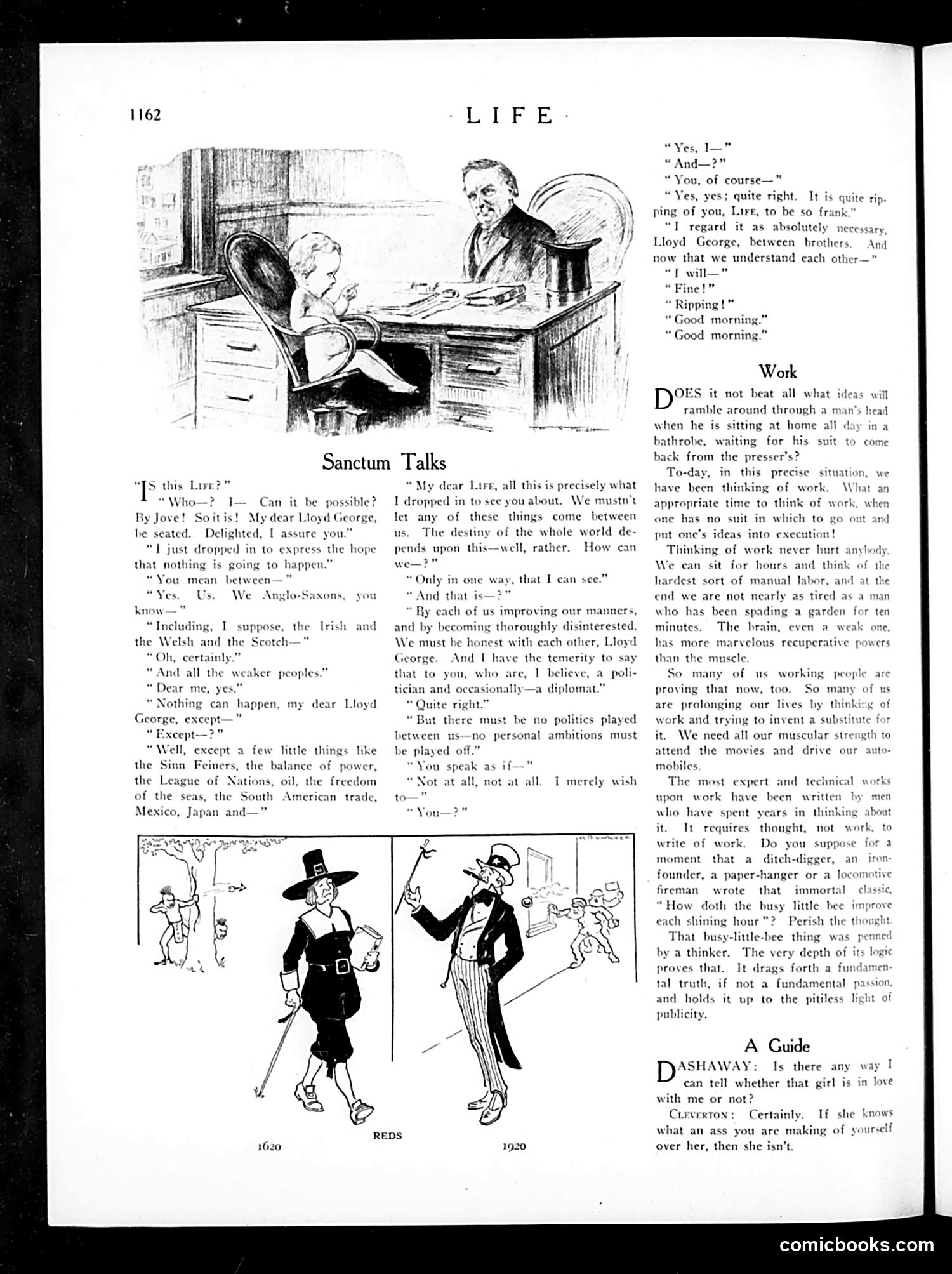
This page contains two distinct sections: **"Sanctum Talks"** presents a dialogue between two men at a desk about international affairs. One figure (labeled "Lloyd George") discusses politics with another, mentioning the Sinn Féiners, League of Nations, oil, freedom of seas, and American trade with Mexico and Japan. The conversation satirizes post-WWI diplomatic concerns. **"Work"** is an essay praising mental labor and creative thinking, arguing that sitting idle produces the best ideas—a paradoxical celebration of contemplation disguised as work. Below is a cartoon labeled "REDS" (1920) showing two figures in exaggerated poses, likely satirizing radical political movements during the post-war Red Scare period. The page reflects 1920s concerns: international diplomacy, labor philosophy, and anxieties about communist/radical movements.
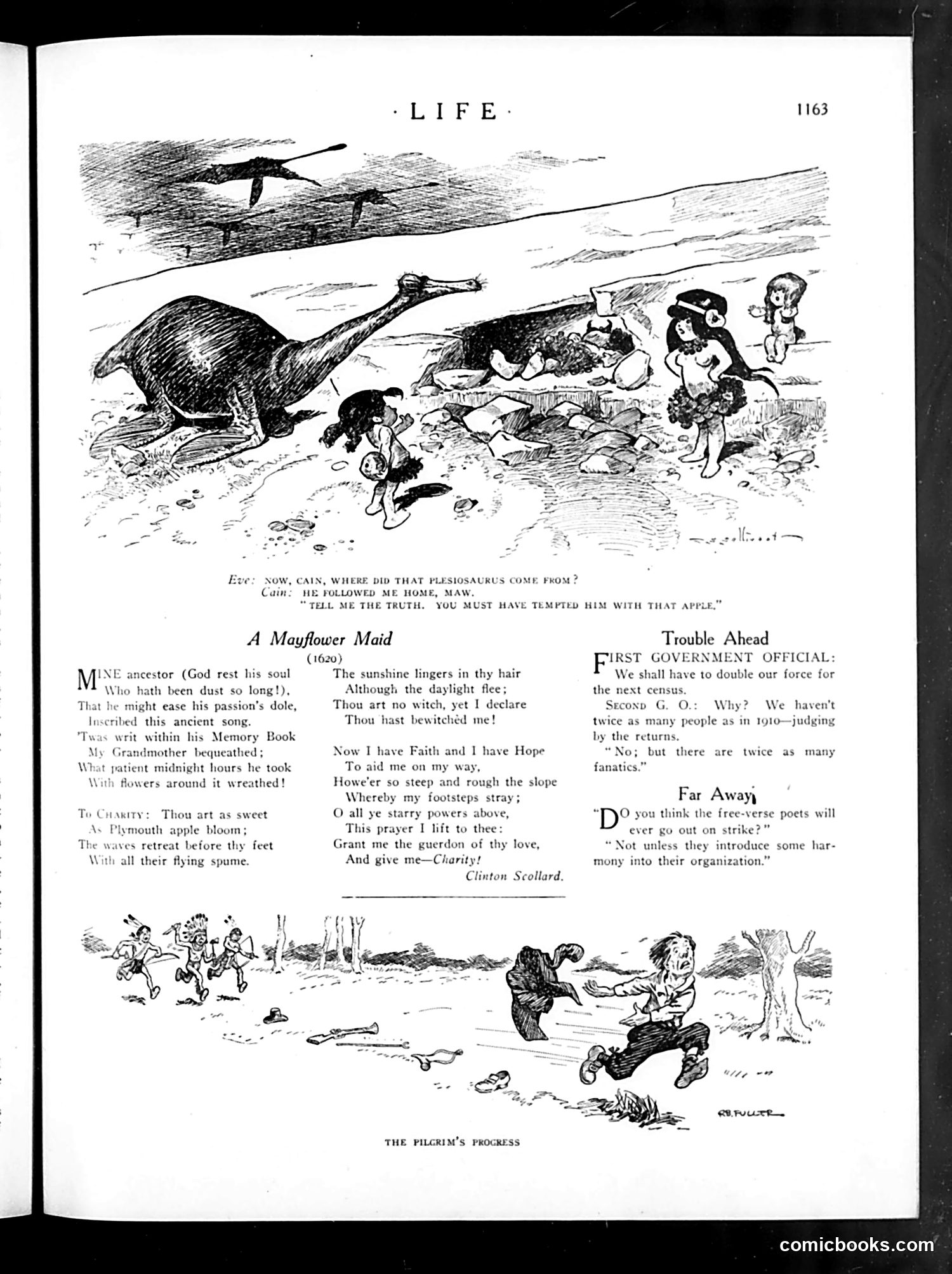
**Top Cartoon:** A humorous domestic scene where children have brought home a dead plesiosaur. The dialogue reveals the children followed it home and mother blames them for tempting it with an apple—a playful inversion of the Adam and Eve story. This is pure fantasy humor with no political content. **"A Mayflower Maid" and "Trouble Ahead":** These are short poems/verses. The first romanticizes a Mayflower ancestor; the second satirizes government bureaucracy through two officials discussing troop increases, with one dismissing concerns about "fanatics." **"Far Away":** A brief quip about free-verse poets and organizational harmony—likely mocking modernist poetry trends. **Bottom Cartoon "The Pilgrim's Progress":** Depicts figures traveling or struggling through landscape, likely referencing Bunyan's allegory, though the specific satirical point remains unclear from this image alone.
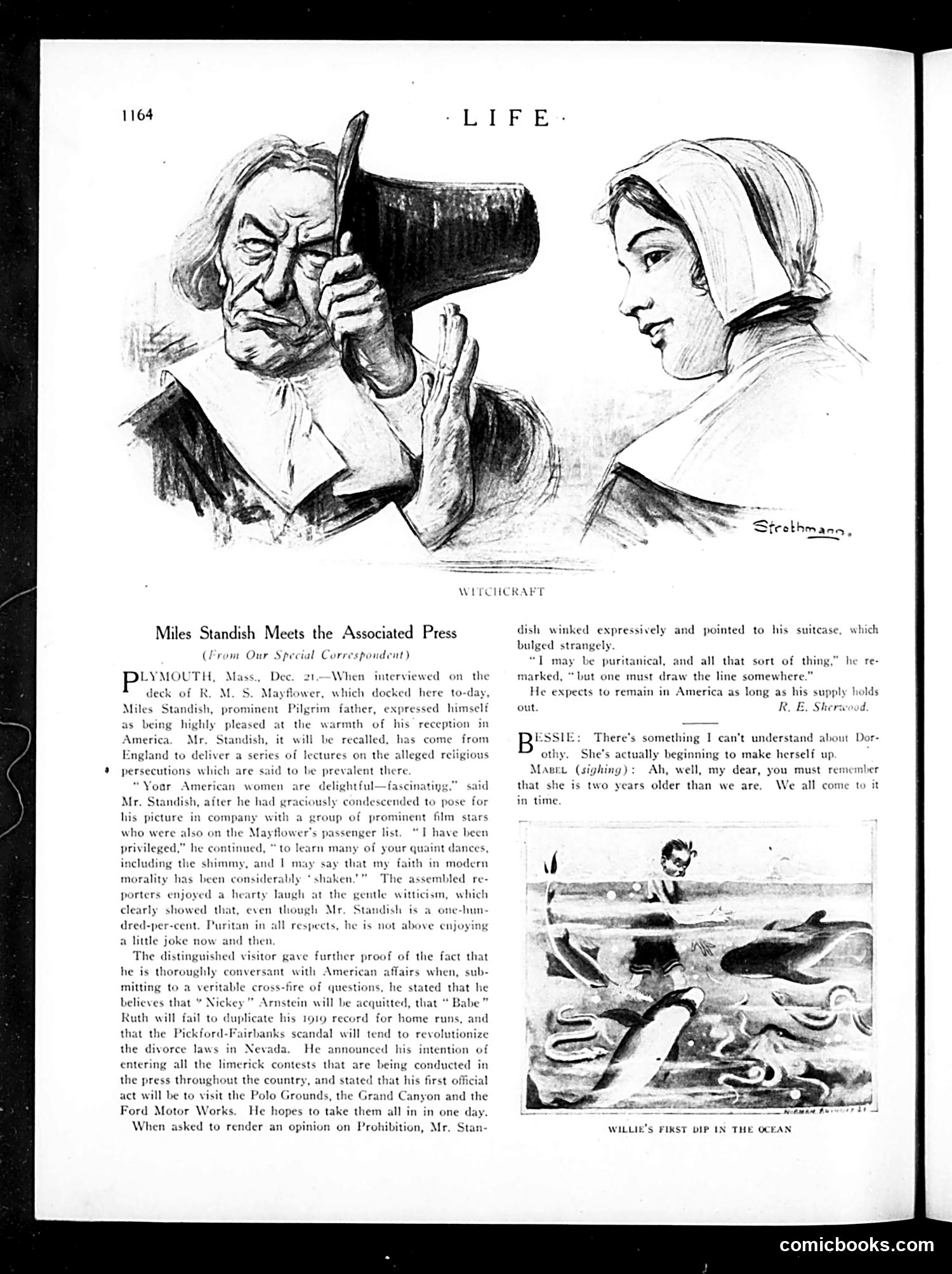
**"Witchcraft"** (top illustration) depicts an old man with a telescope confronting a young woman in a bonnet. The cartoon satirizes Miles Standish, the Pilgrim leader mentioned in the article below, who is "interviewed on the deck of R.M.S. Mayflower" by the Associated Press in Plymouth, Massachusetts on December 21st. The "witchcraft" title suggests Standish represents old-fashioned Puritan attitudes. The telescope implies he's examining or scrutinizing the modern woman—likely referencing his criticism of contemporary American women's morality, which he claims has been "shaken" by modern dances and attitudes. The satire mocks his stern, puritanical judgmentalism against progressive American society.
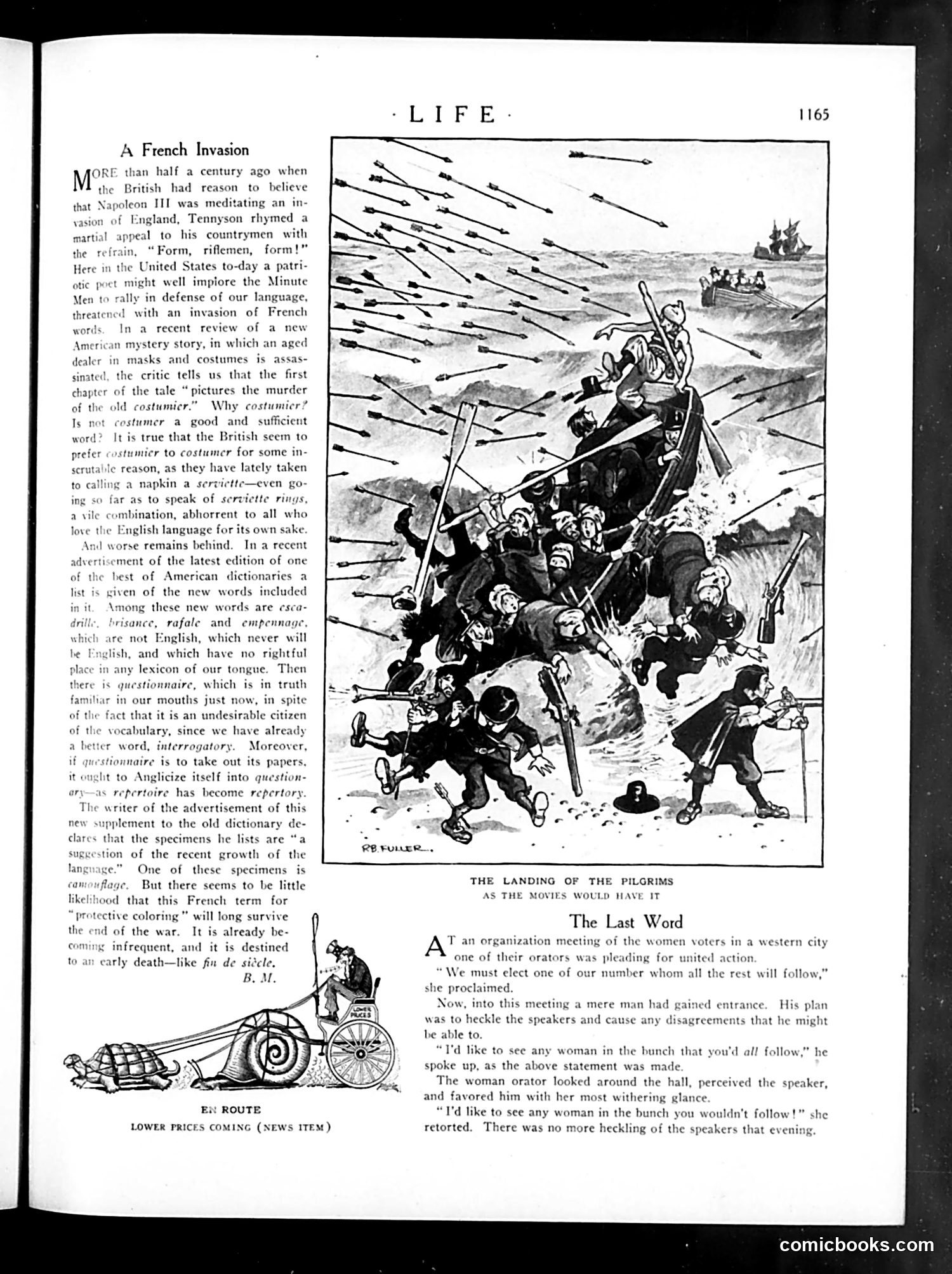
**Main Content:** The page contains two articles. "A French Invasion" discusses new French words entering English (questionnaire, reportage, etc.), lamenting their adoption. **The Cartoons:** The large illustration depicts "The Landing of the Pilgrims as the Movies Would Have It"—a comedic reimagining showing the Pilgrim landing as chaotic slapstick, with figures tumbling and children running amok, contrasting sharply with the historical dignified narrative. Below is a small illustration labeled "En Route: Lower Prices Coming (News Item)" showing a tortoise with a spiral shell, apparently satirizing slow economic improvement. **The Satire:** The main joke mocks both Hollywood's sensationalized historical dramatizations and early cinema's lowbrow entertainment values, suggesting filmmakers would trivialize the Pilgrims' serious arrival into comedy.
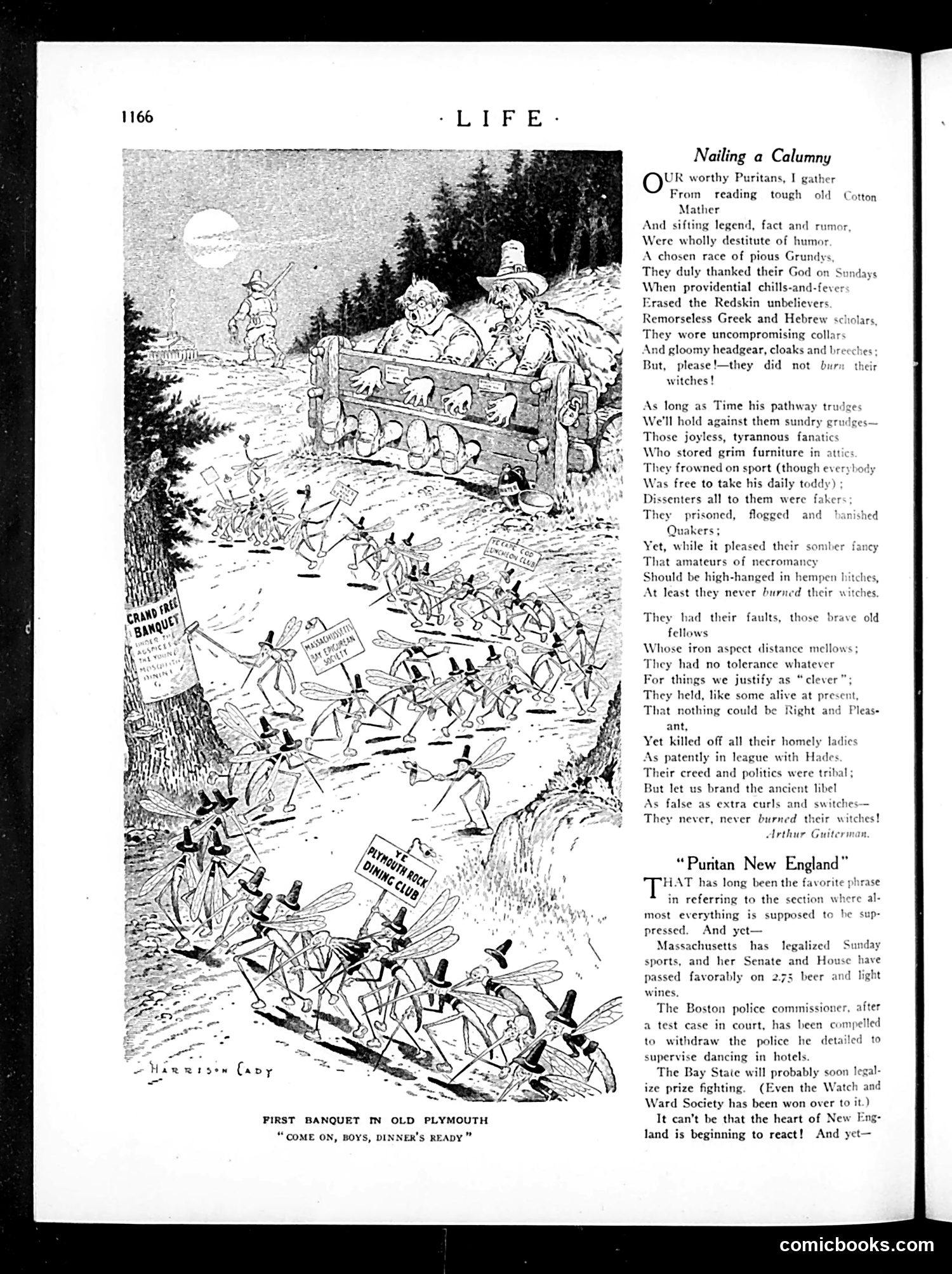
This page contains a satirical poem titled "Nailing a Calumny" and a cartoon titled "First Banquet in Old Plymouth." The poem defends Puritan settlers against accusations of burning witches, arguing they were actually austere but not literally witch-burners. It criticizes them for other faults—intolerance, hypocrisy, and killing Native Americans—while insisting "they never burned their witches." The cartoon depicts the "First Banquet in Old Plymouth" with the caption "Come on, boys, dinner's ready." It shows Pilgrims and Native Americans in a chaotic scene that appears to satirize the mythologized "first Thanksgiving," suggesting the relationship was far more complicated and violent than popular history suggests. The accompanying text "Puritan New England" continues this theme, noting that Massachusetts has recently legalized Sunday sports and beer—progress that contrasts sharply with strict Puritan values.
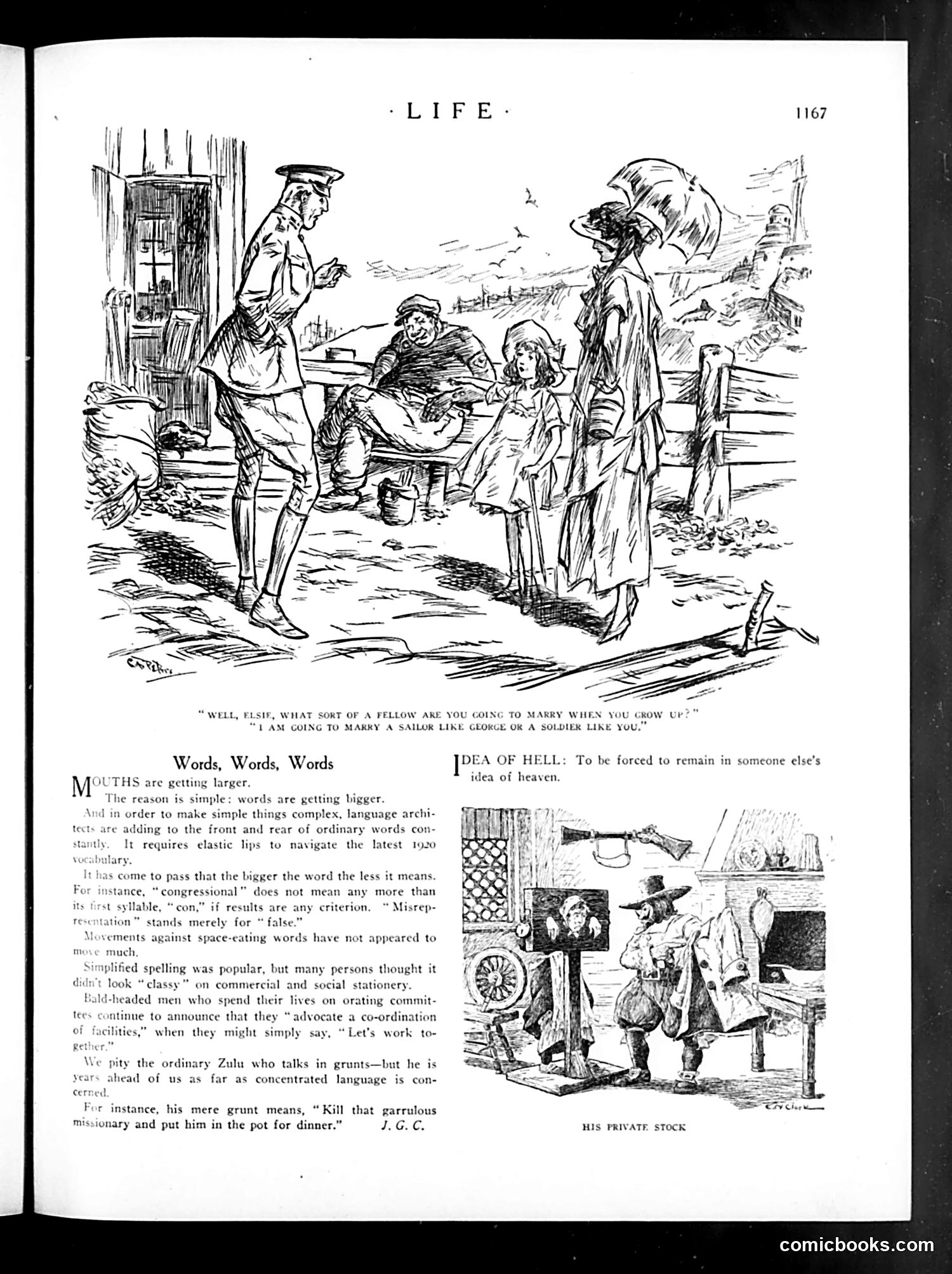
**Top Cartoon:** A military officer questions a young child about future marriage prospects. The child responds, "I am going to marry a sailor like George or a soldier like you." This satirizes early 20th-century militarism and gender expectations—children are already socialized to admire military figures and assume gendered romantic futures. **Article "Words, Words, Words":** Criticizes language inflation and verbosity in modern usage. The author argues that unnecessarily complex words obscure simple meanings, citing examples like "advocate a co-ordination of facilities" instead of "let's work together." The piece mocks pretentious speech among educated and commercial classes. **Bottom Illustration "His Private Stock":** Appears to depict a merchant or trader with goods, though its specific satirical point is unclear from the visible context.
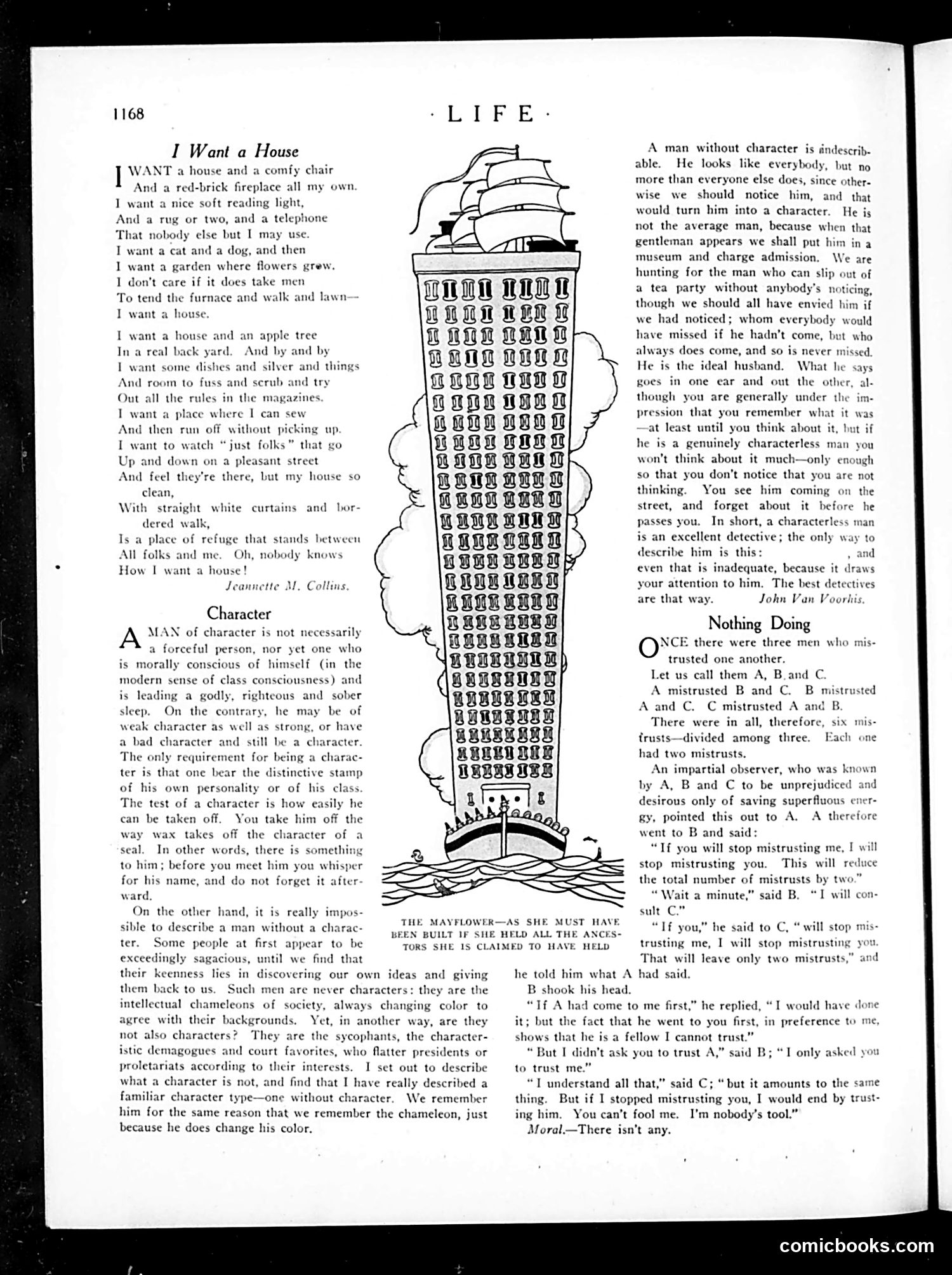
This page contains three literary pieces rather than political cartoons: 1. **"I Want a House"** by Jeannette M. Collins—a nostalgic poem listing domestic desires (furniture, pets, garden). 2. **"Character"** by John Van Voorhis—an essay defining what makes someone memorable, arguing that truly distinctive individuals are rare and valuable. 3. **"Nothing Doing"**—a humorous anecdote about three men (A, B, C) playing word games with trust and mistrust, ultimately revealing the logical paradox that stopping mutual distrust requires trust itself. The illustration shows a tall ship-topped building, likely representing ambition or achievement. The content emphasizes personal values—domesticity, character, and logical reasoning—typical of Life's satirical, middle-class readership interests.
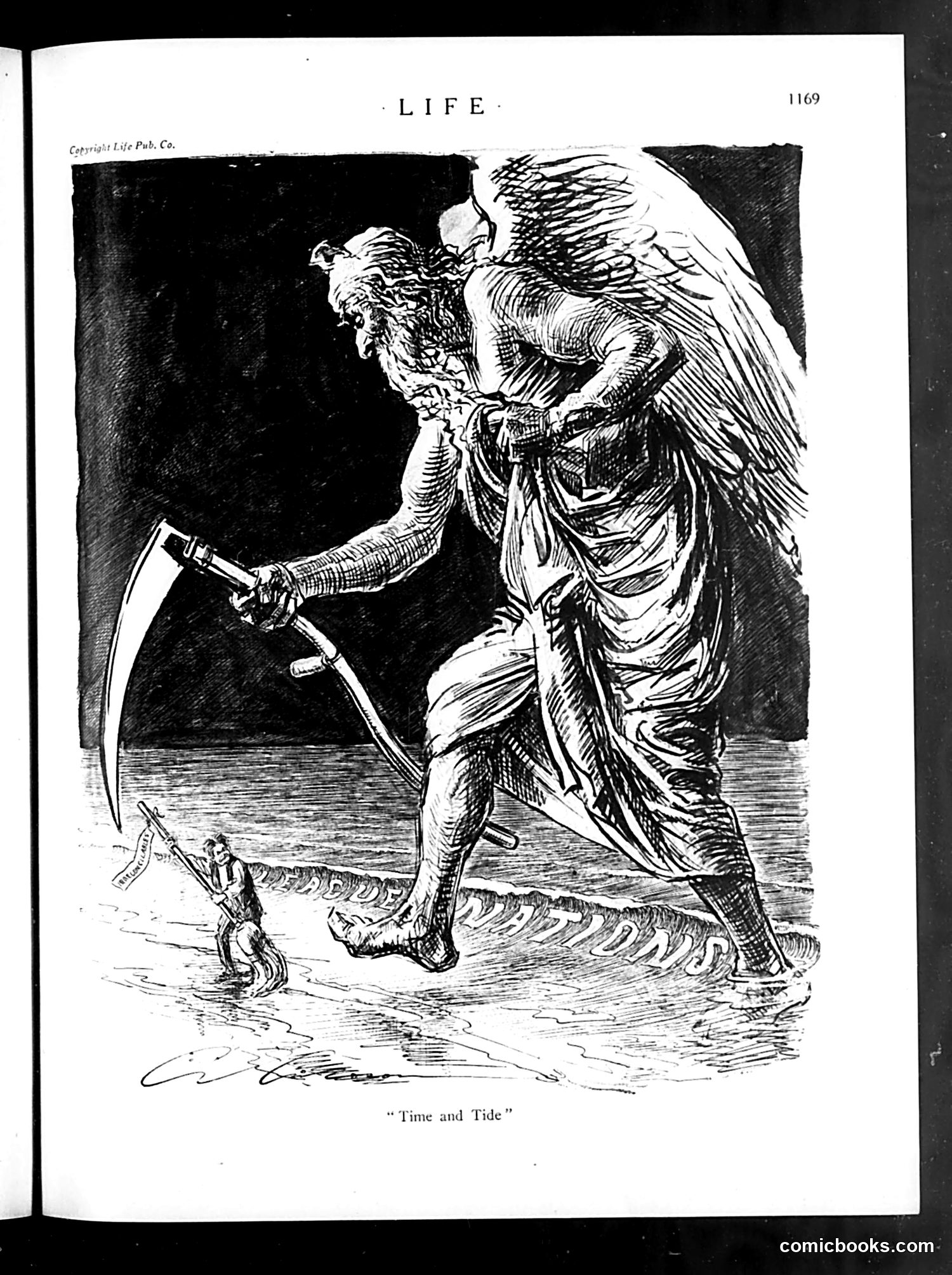
This editorial cartoon depicts Death (a skeletal figure with wings, holding a scythe) as an enormous, towering force looming over a tiny human figure on a beach. The human appears to be a common person, dwarfed by Death's overwhelming presence as waves crash nearby. The title "Time and Tide" plays on the proverb "time and tide wait for no man," suggesting the inevitability of mortality and the relentless passage of time. The cartoon uses the dramatic size contrast to emphasize how powerless individual humans are against death and the forces of nature. This appears to be a memento mori—a reminder of human mortality—functioning as social or philosophical commentary rather than political satire. The stark black-and-white engraving style enhances the ominous mood.
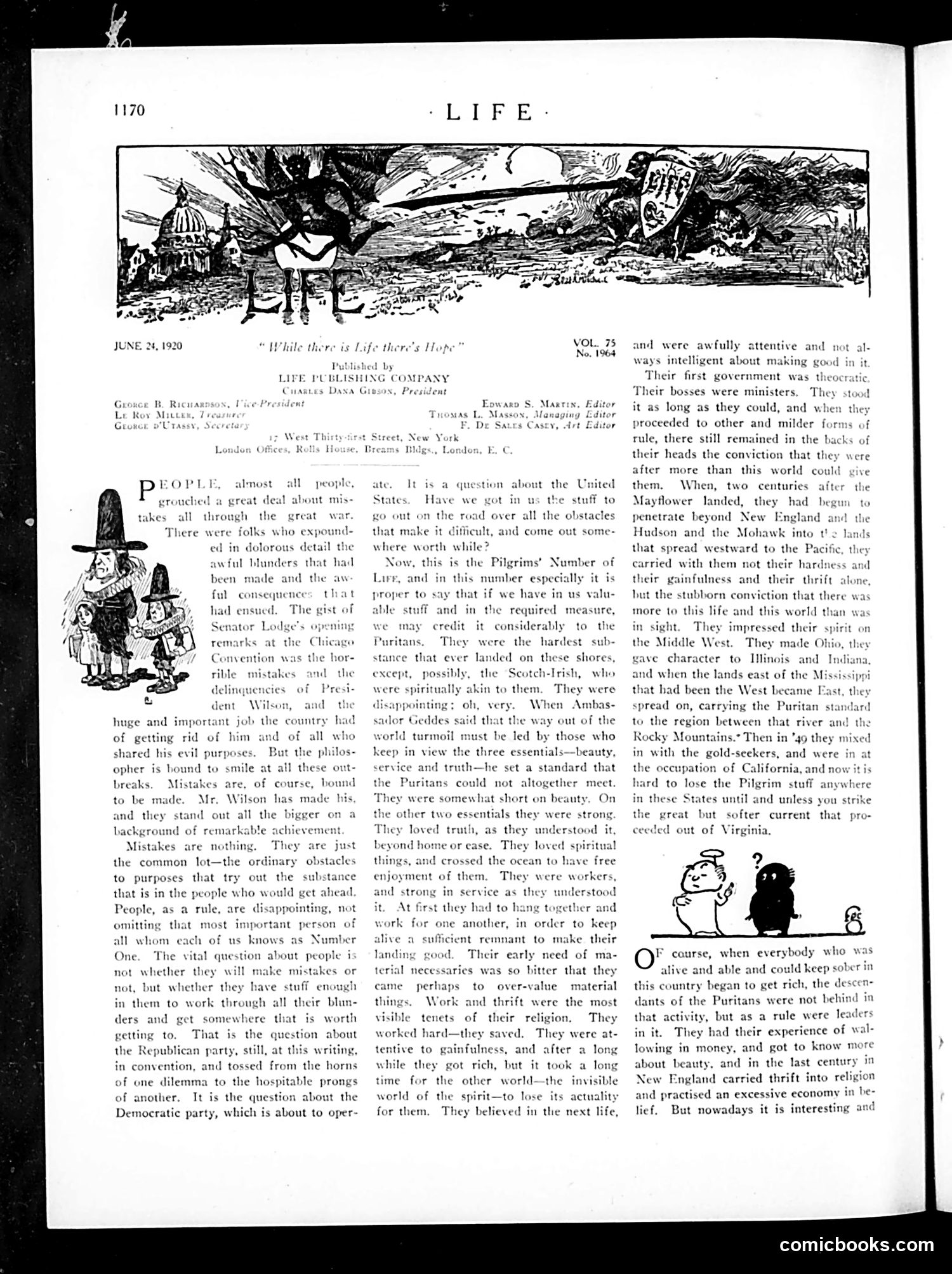
This is primarily editorial commentary rather than a traditional political cartoon. The page celebrates the Pilgrims as the subject of Life's "Pilgrims' Number," using them to comment on contemporary American character and governance. The text argues that the Pilgrims possessed essential virtues—hard work, thrift, spiritual conviction, and truth—that enabled them to overcome obstacles. The author draws parallels to current debates about whether Americans retain this "stuff" to navigate post-WWI challenges facing both the Republican and Democratic parties. The small cartoon vignette (lower right) appears unrelated—a simple comedic illustration about economic hardship ("Of course, when everybody who was able and able-bodied couldn't work either"). The piece uses Puritan mythology to argue implicitly that American success depends on inherited moral character, positioning this nostalgia for frontier/colonial virtues against modern political uncertainty circa 1920.
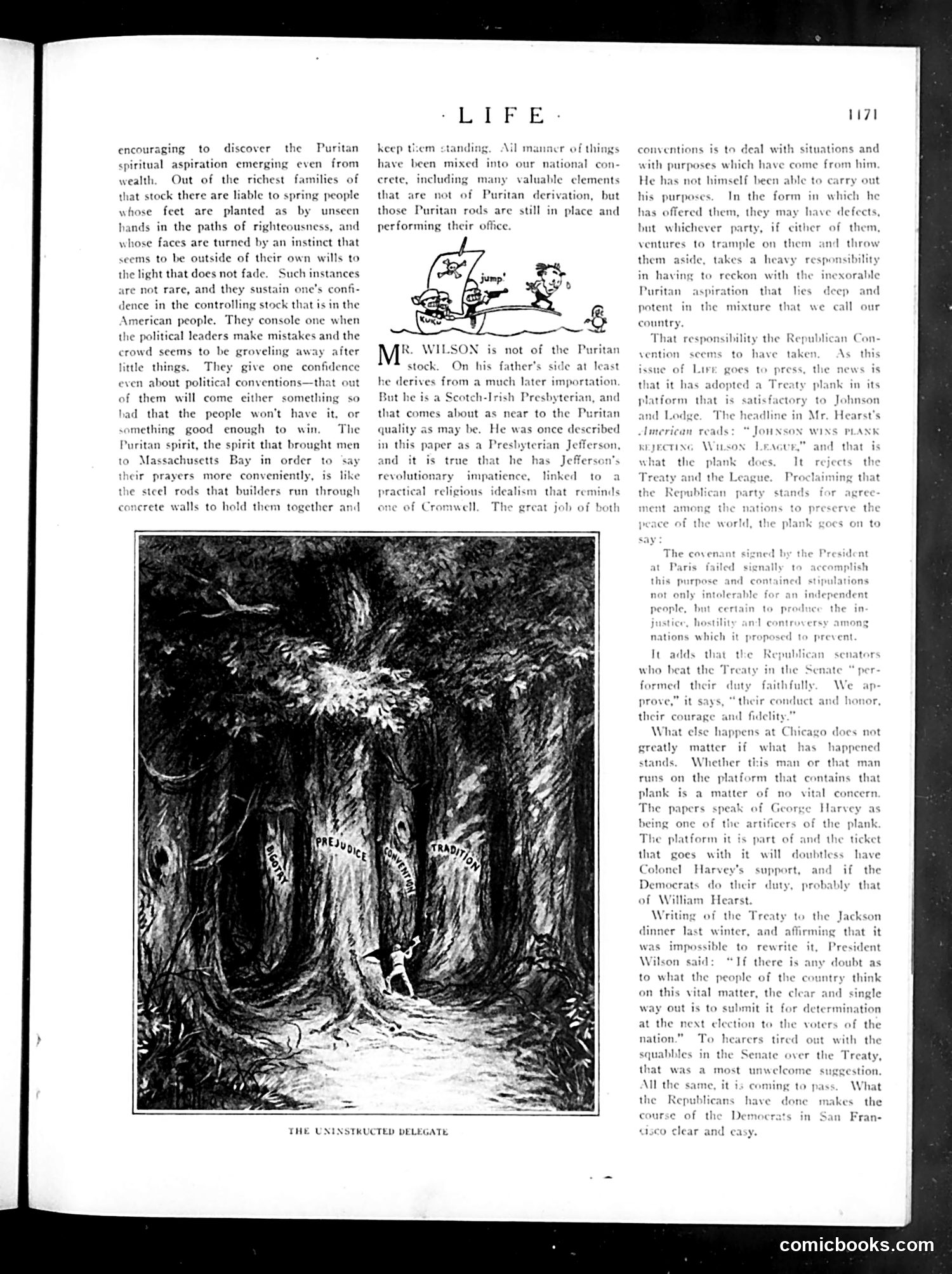
This political cartoon satirizes the 1920 Republican National Convention's debate over the League of Nations Treaty. The image shows a figure (labeled "THE UNINSTRUCTED DELEGATE") navigating through a dark forest of towering trees labeled "PREJUDICE" and "TRADITION"—representing entrenched political positions that obscure clear thinking. The accompanying article discusses how Mr. Wilson (President Woodrow Wilson) and Republican Senator Henry Cabot Lodge clash over Treaty language. The cartoon mocks convention delegates who lack independent judgment, instead following partisan prejudices rather than reasoned evaluation of the League proposal. The "uninstructed delegate" metaphor represents ordinary politicians swayed by party machinery rather than principle—unable to see the forest for the trees of political convention, particularly regarding whether America should join the League of Nations, a central 1920 election issue.
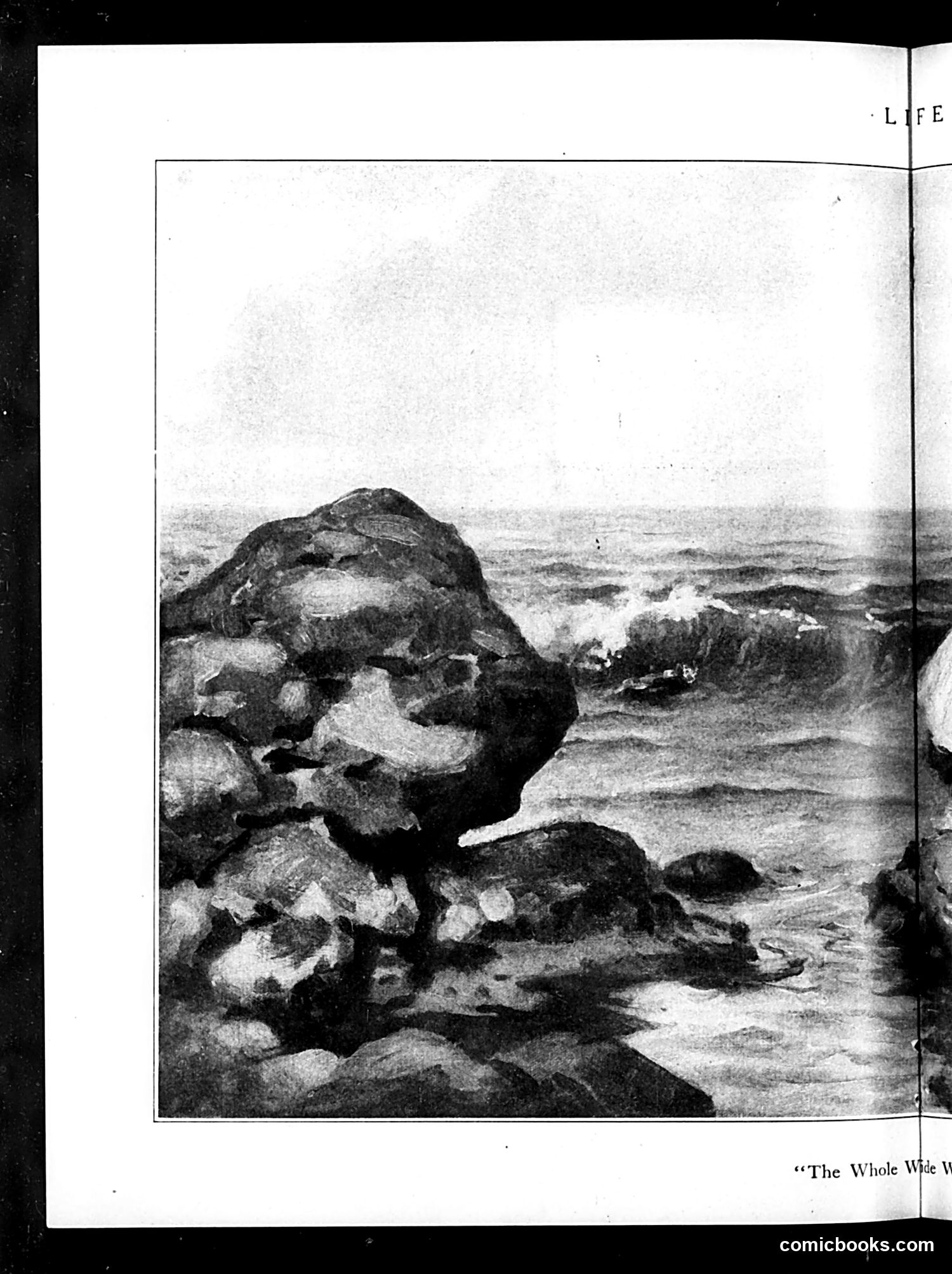
This appears to be a page from Life magazine featuring a photograph rather than a cartoon. The image shows a large rock formation on a beach with waves and ocean in the background. The rock's weathered surface creates what appears to be a human face or profile in pareidolia (seeing faces in objects). The visible caption reads "The Whole Wide V[orld]" (text is cut off), suggesting this is part of a feature or article rather than political satire. Without the complete caption or surrounding text, the specific point or joke is unclear. This style of photograph—finding human features in natural formations—was a common humorous device in early 20th-century magazines.
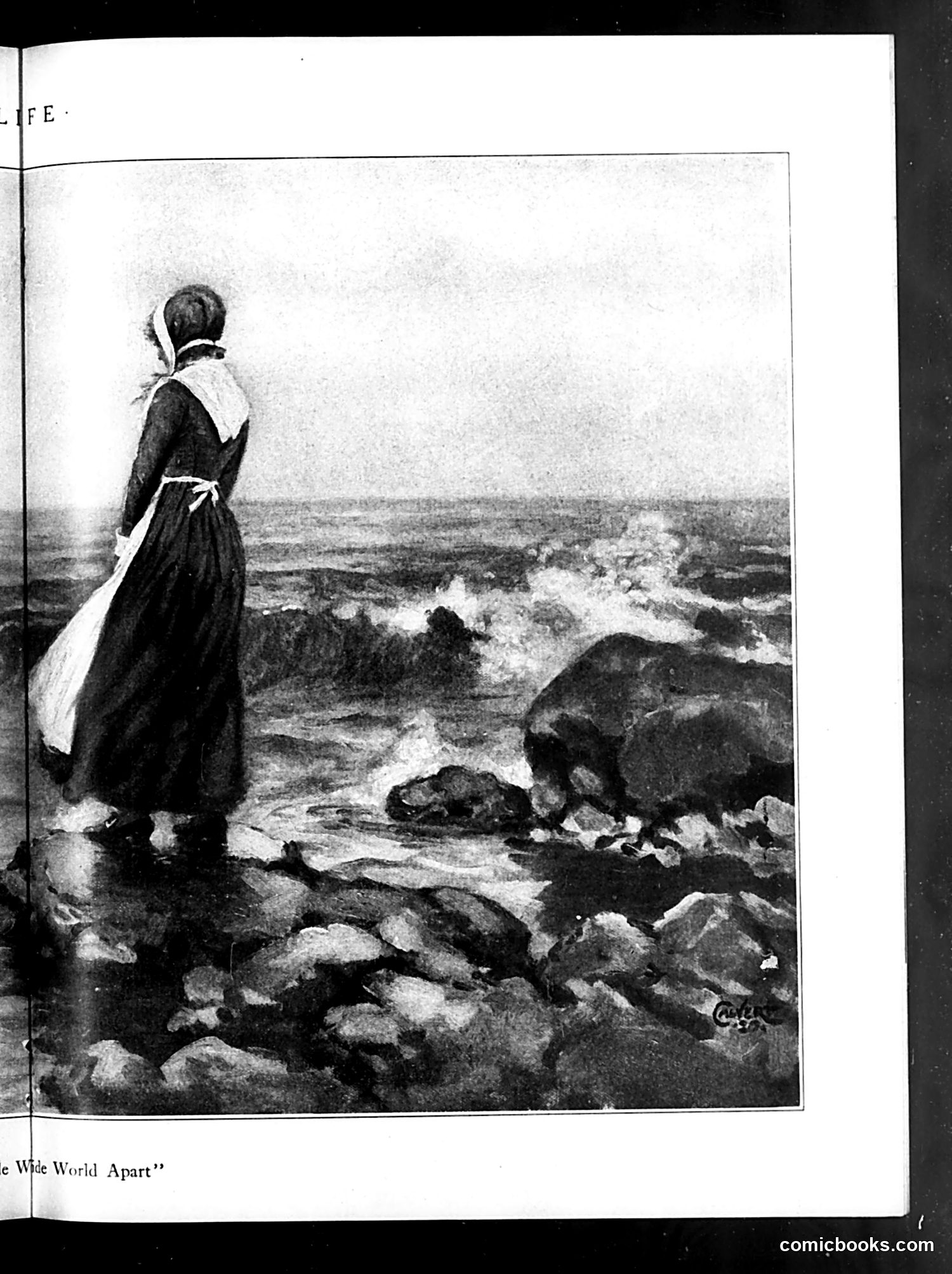
This appears to be an illustration (likely from early-to-mid 20th century Life magazine) showing a woman in dark clothing standing on rocky coastline, gazing toward distant horizons with waves and smoke visible in the distance. The title fragment "e Wide World Apart" suggests a romantic or melancholic theme about separation or distance. The image's emotional tone—a solitary figure contemplating a vast seascape—suggests themes of longing, separation, or geographic/social distance. Without the complete title and additional context, the specific satirical or political point remains unclear. The signature appears to be present but is not legible enough to identify the artist definitively.
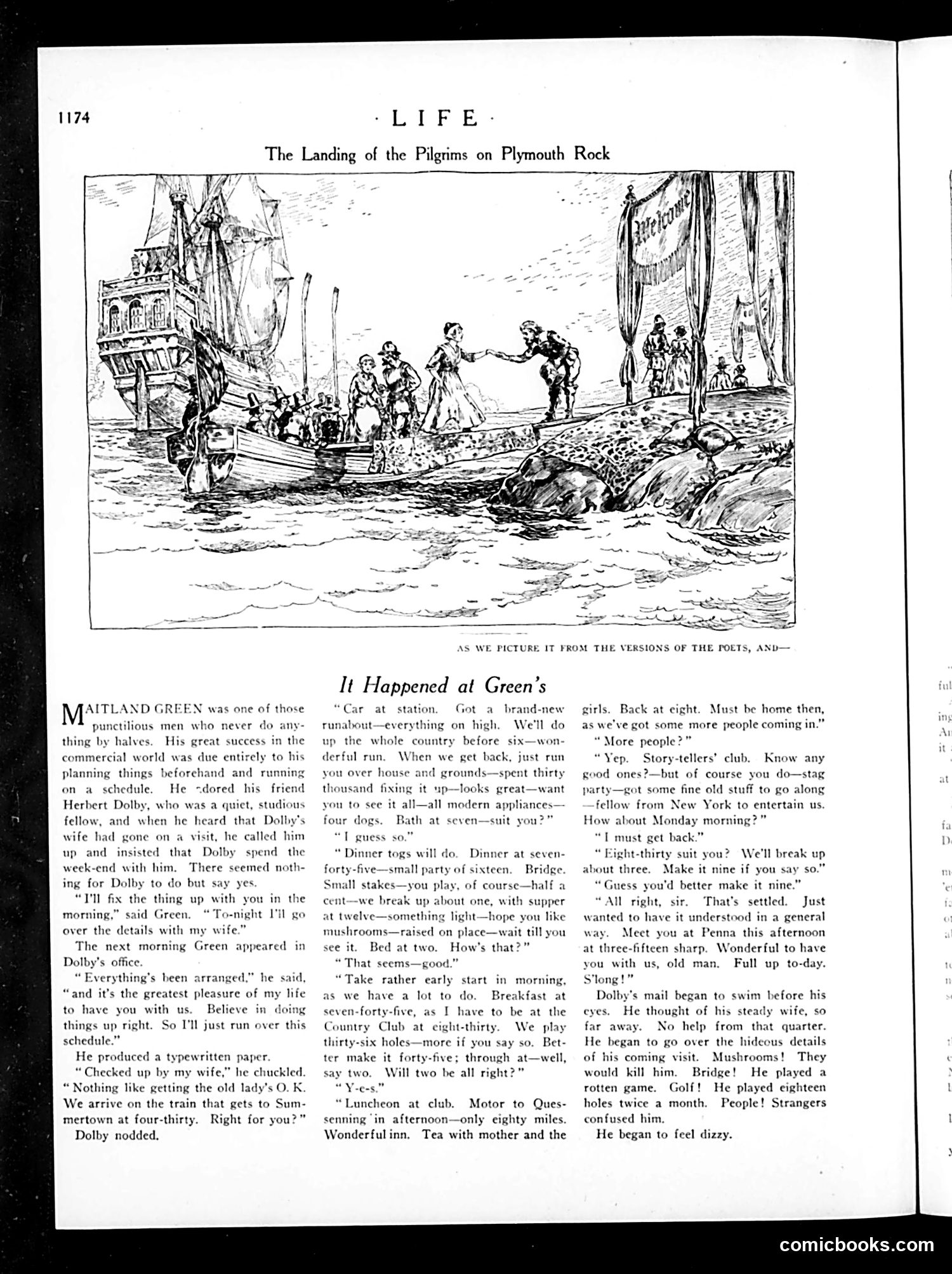
This page contains an illustrated story titled "It Happened at Green's," not a political cartoon. The woodcut at top depicts the Pilgrims landing at Plymouth Rock—a historical reference used ironically as the story's heading. The satire concerns **Maitland Green**, a compulsively over-planning businessman who invites his friend Herbert Dolby for a weekend visit, then exhausts him with a meticulously scheduled itinerary: train arrival at 4:30 p.m., car ride, house tour, dinner at 7:45 with sixteen guests, bridge until 1 a.m., early golf (36-45 holes), lunch, motor trip, evening socializing with his mother, late-night story-telling club, and another 8:30 a.m. departure Monday. The joke targets **early 20th-century upper-class American anxiety about leisure**: what should be relaxation becomes tyrannical scheduling. Dolby's growing panic—his mail "swims before his eyes," he feels "dizzy"—satirizes how the wealthy's obsessive organization and social climbing transforms hospitality into ordeal. The Pilgrims comparison suggests Green treats his guest like colonists facing relentless demands.
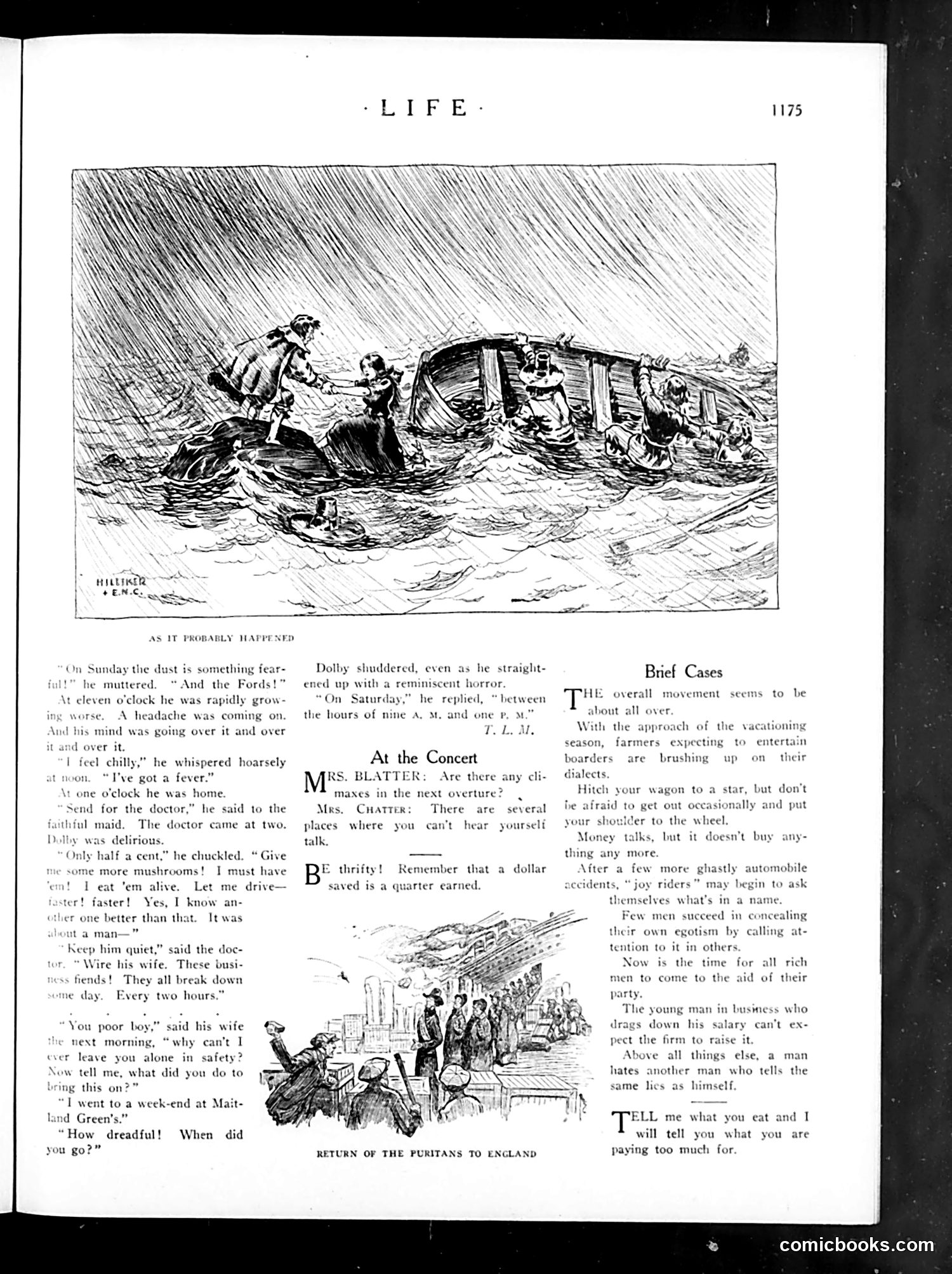
This page presents satirical commentary on early 20th-century American life through multiple formats. The top illustration depicts a shipwreck labeled "AS IT PROBABLY HAPPENED," accompanying a humorous narrative about a businessman named Dolby who becomes delirious after a weekend visit, repeatedly muttering about "the dust" and "the Fords"—likely referencing Ford automobiles and the dust they kick up, reflecting contemporary anxieties about reckless motorists. Below are three brief satirical pieces: "At the Concert" mocks chattering concert-goers who talk through performances; "Be thrifty!" offers ironic financial advice; and "Brief Cases" collects one-liners on modern social problems—automobile accidents and "joy riders," business ethics, wealth inequality, and consumerism. The illustration at bottom, "RETURN OF THE PURITANS TO ENGLAND," remains unclear without additional context but appears to reference historical or political commentary. Overall, the page satirizes contemporary urban anxieties: dangerous automobiles, economic inequality, deteriorating social manners, and conspicuous consumption.
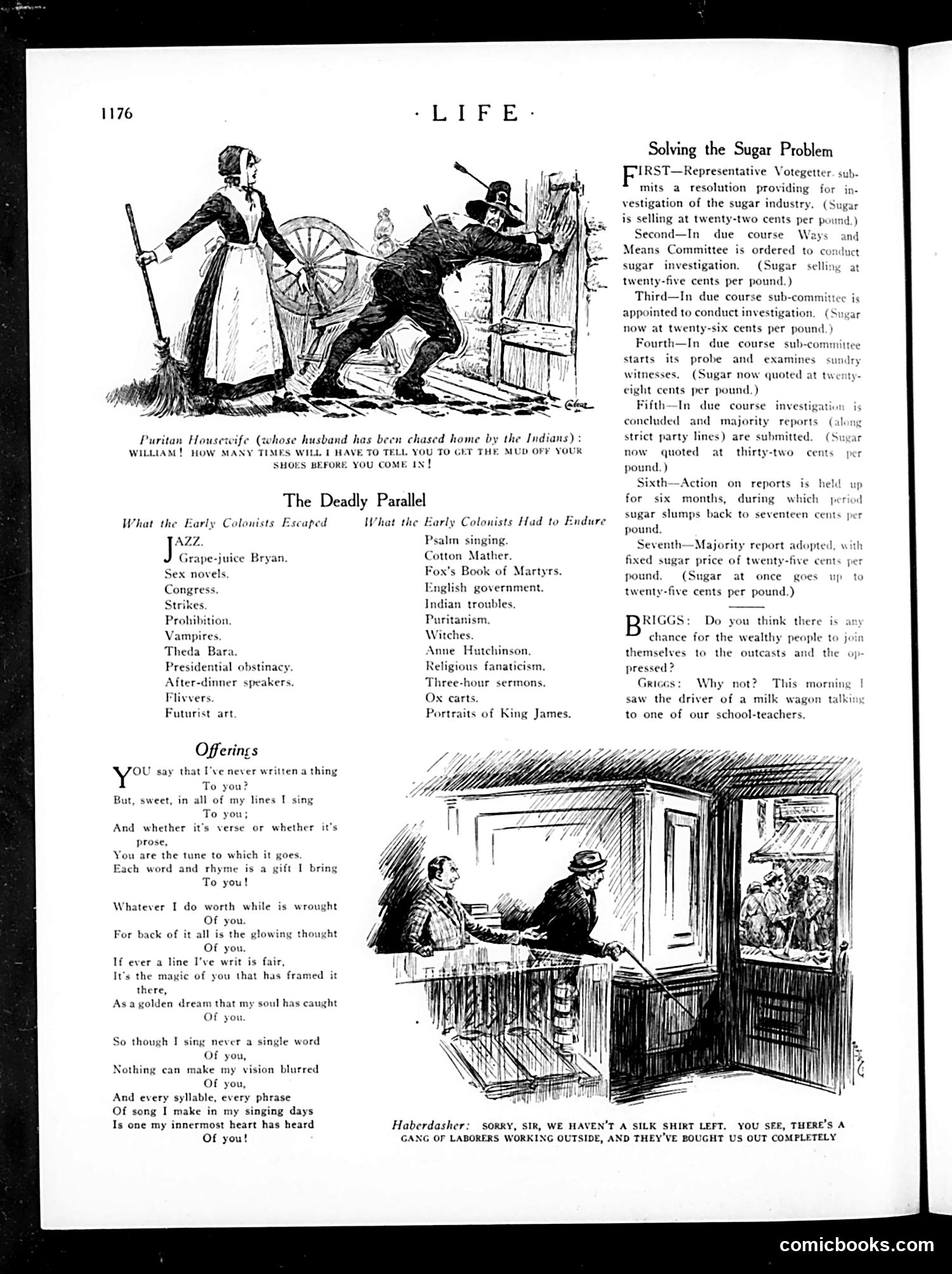
**"The Deadly Parallel"** satirizes American progress by contrasting colonial hardships with modern annoyances. Early colonists endured Indian attacks, strict Puritanism, and harsh conditions; contemporary Americans (circa 1910s-20s) suffer from "Grape-juice Bryan" (William Jennings Bryan's temperance advocacy), jazz, flivvers (cheap cars), and futurist art. The joke: modern life's trivial frustrations rival genuine historical suffering. **"Solving the Sugar Problem"** mocks governmental inefficiency. As politicians investigate sugar prices through multiple committees and sub-committees, prices continuously rise (22¢ to 32¢ per pound), then finally drop—only for the "fixed" price to spike back up. The satire exposes how bureaucratic investigation drags on while problems worsen, and how government intervention fails to solve economic issues. **The Puritan Housewife cartoon** makes a simple domestic joke about muddy shoes, requiring no political context.
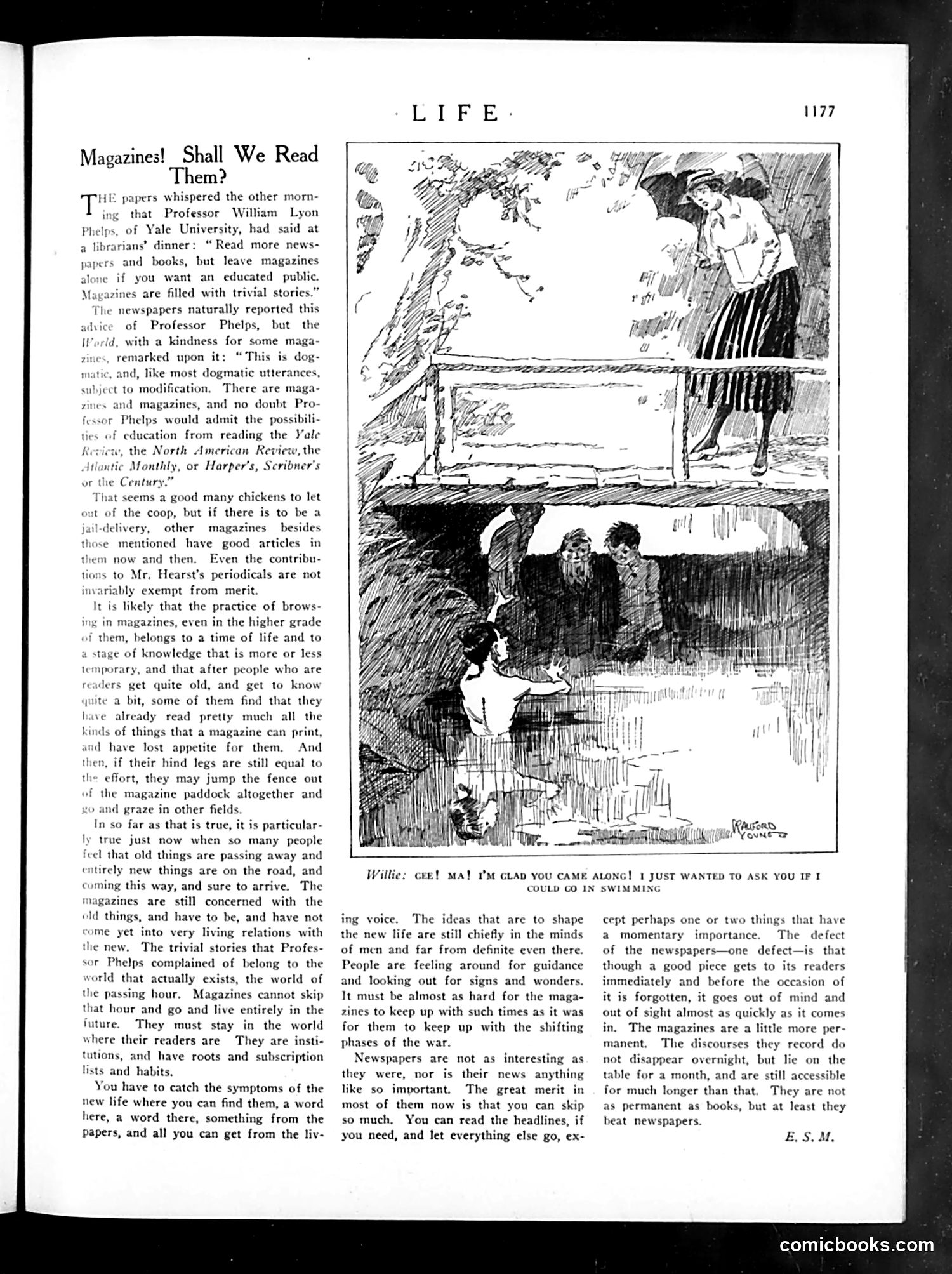
This page presents a debate about magazine reading's intellectual value, sparked by Yale Professor William Lyon Phelps's dismissal of magazines as filled with "trivial stories" unfit for educated readers. **The Argument:** The author defends magazines against Phelps's criticism, acknowledging that while some magazines deserve his scorn, prestigious publications like *The Atlantic Monthly*, *North American Review*, and *Harper's* contain substantive content. The piece argues magazines serve a transitional role for readers developing knowledge, and currently struggle to address "new life" and modern ideas while remaining rooted in present-day concerns. **The Cartoon:** The accompanying sketch shows "Willie" asking someone swimming in a pond whether they'd go swimming, likely satirizing the disconnect between magazine discussions and real life—people are actually *living* rather than debating reading habits. **Historical Context:** This reflects post-WWI uncertainty (mentioned in the text) about rapidly changing society, and the tension between traditional literary journals and mass-market publications—a debate that echoed real anxieties about modernism and public education circa 1920s America.
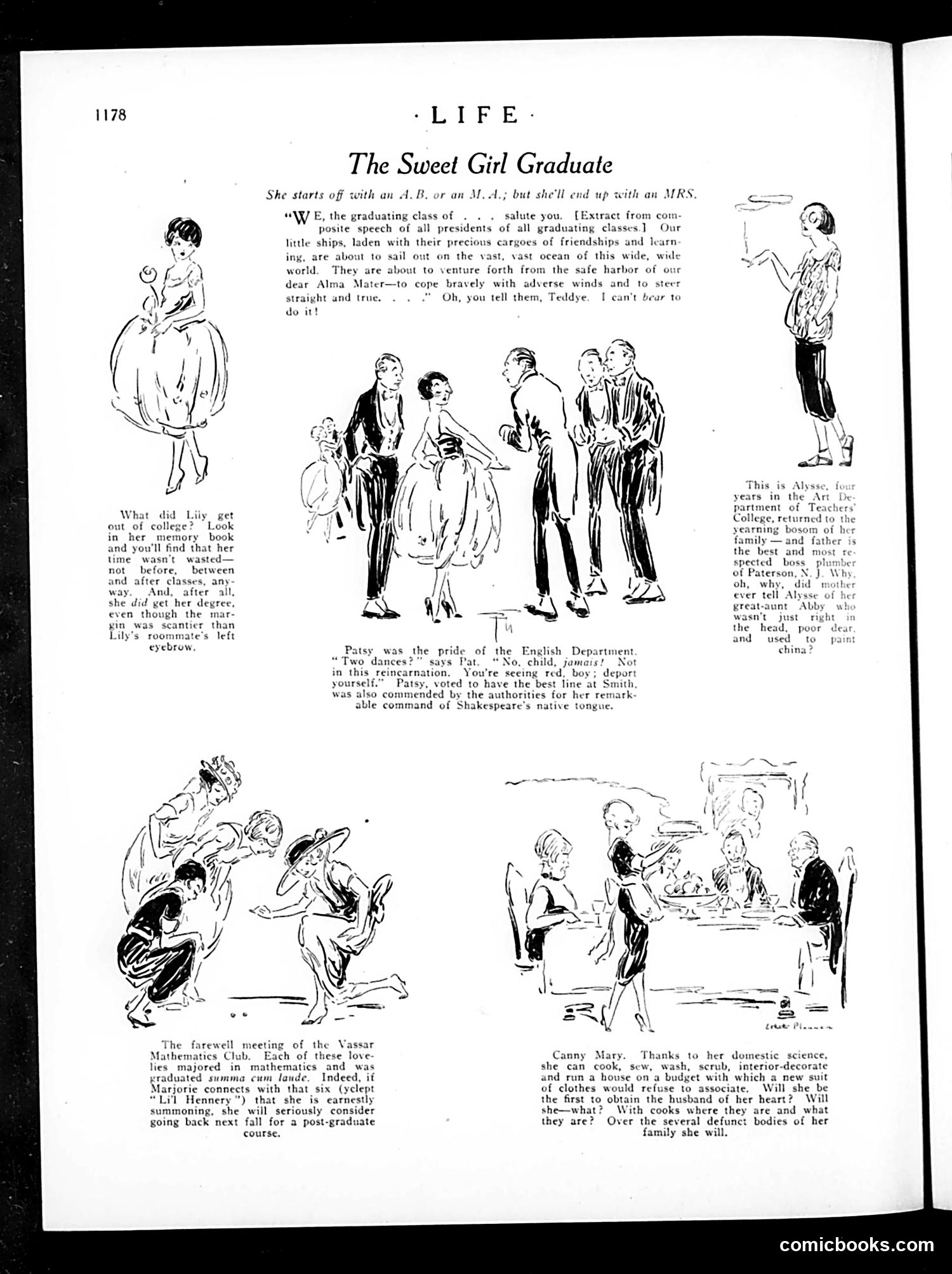
This page satirizes early 20th-century anxieties about educated women. The central joke, stated in the headline, is that despite earning degrees (A.B., M.A.), women graduates will ultimately become wives (MRS.). The accompanying sketches mock specific female graduate archetypes: - **Lily**: Despite academic success, her notable achievement was romance—her memory book contained a love note worth more than her degree. - **Alysse**: A teacher who returns home to her family, unmarried and seemingly destined for spinsterhood. - **Patsy**: Pride of the English Department, yet reduced to romantic prospects. - **Mathematics Club members**: Women serious about academics are depicted as comically rejecting romance. - **Canny Mary**: The "practical" graduate skilled in domestic tasks—cooking, cleaning, budgeting—positioned to finally "obtain the husband of her heart." The satire mocks both the pretense of women's higher education and the cultural expectation that marriage remains women's true destiny regardless of academic achievement. It reflects contemporary anxiety about changing gender roles.
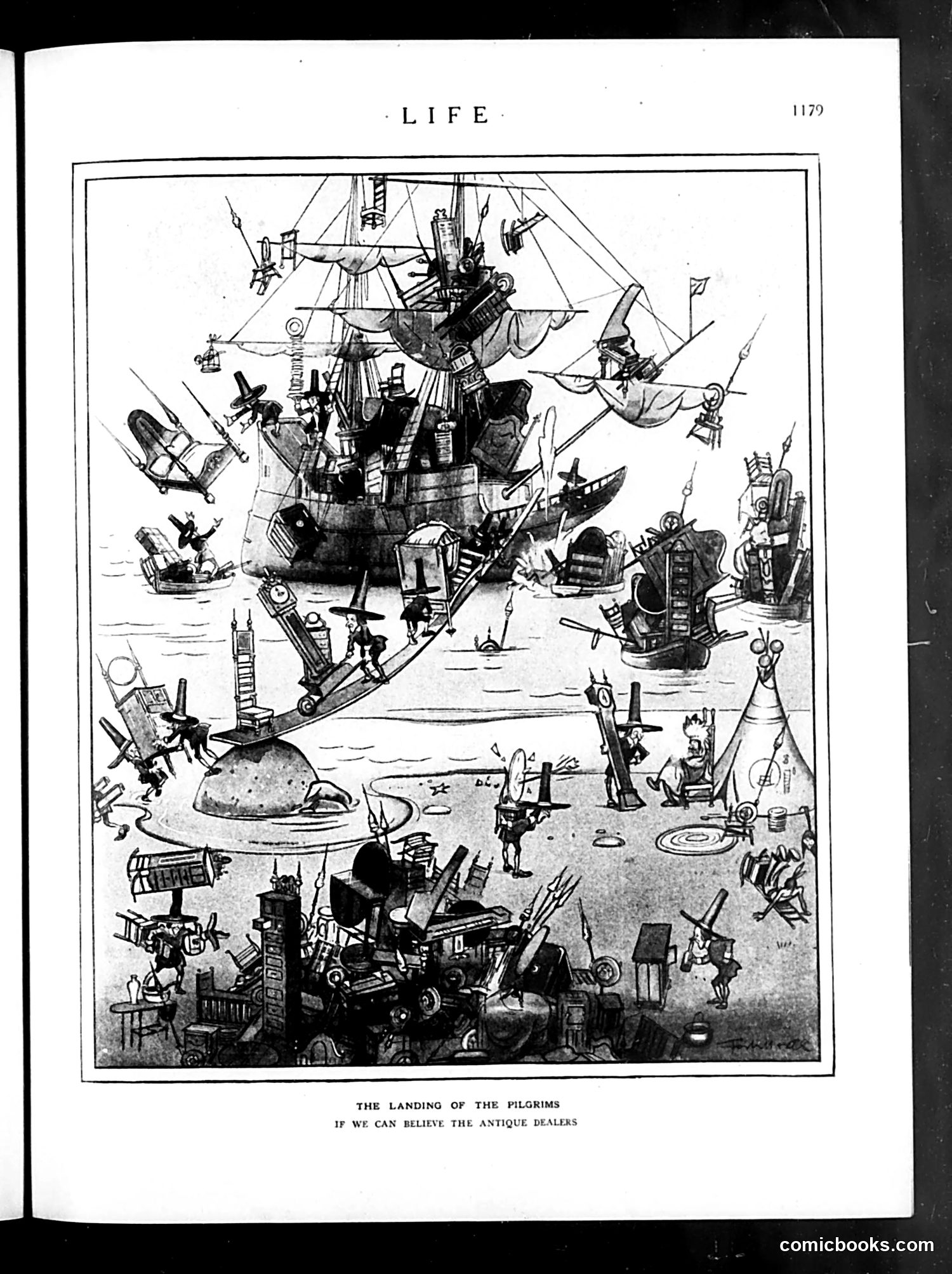
This is a satirical cartoon mocking antique dealers' claims about colonial American history. The image depicts a chaotic, anachronistic scene labeled "The Landing of the Pilgrims"—but populated with bizarre mechanical contraptions, futuristic devices, and nonsensical structures that clearly never existed in the 1620s. The joke targets antique dealers who allegedly misrepresent or fabricate the historical provenance of items they sell, claiming dubious connections to the Pilgrims and early America. By showing an absurdly impossible colonial scene filled with fantastical inventions, the cartoonist suggests that if we believed dealers' exaggerated claims about their wares' origins, history would look this ridiculous. The satire critiques commercial dishonesty in the antiques trade—a common target of early 20th-century humor about consumer fraud.
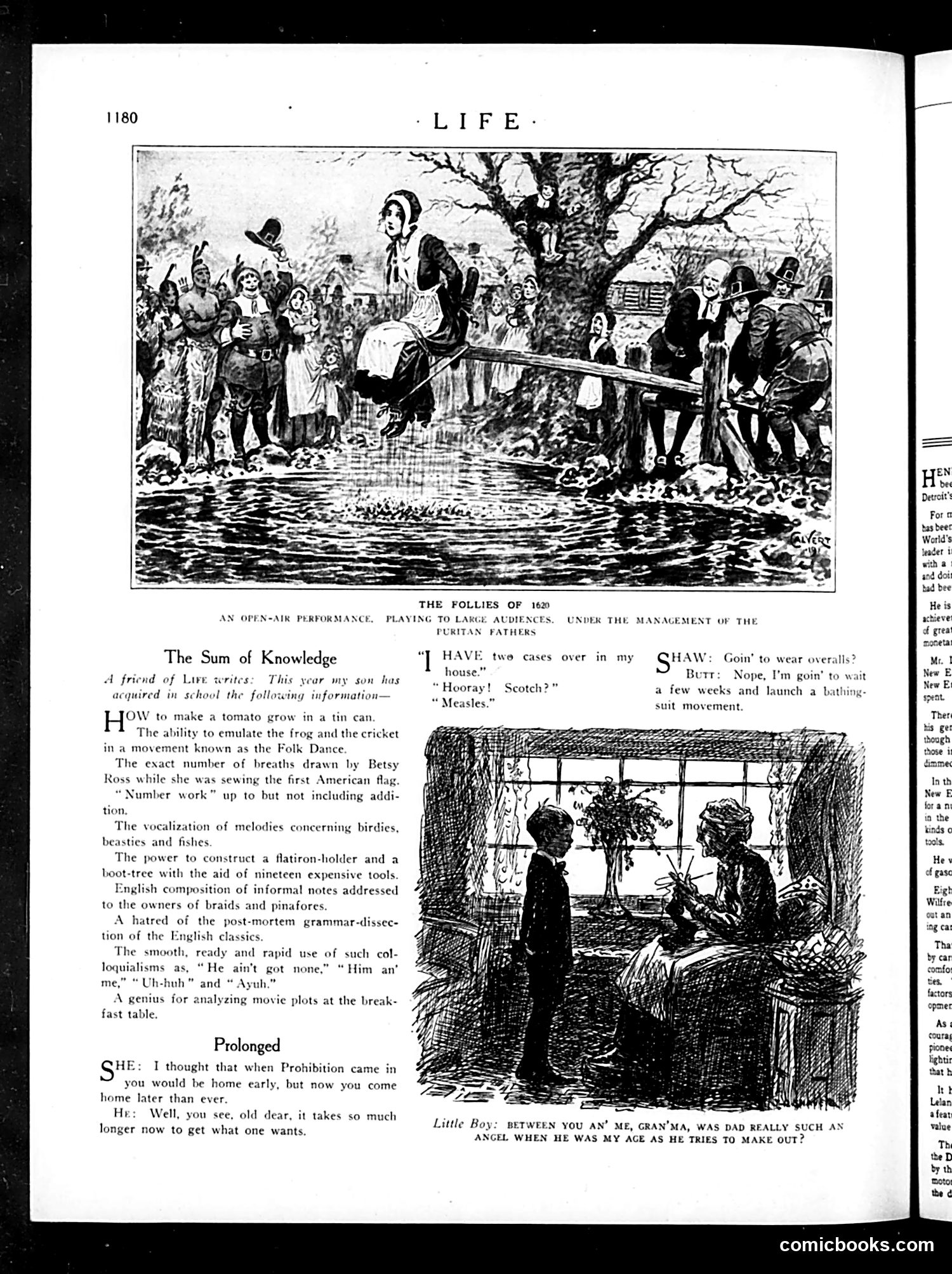
The top engraving satirizes Puritan New England settlers as theatrical performers staging an "open-air performance" for audiences. The caption's date appears garbled (likely meant to reference early colonial America), suggesting Life is mocking Puritan culture as performative hypocrisy. Below, three humorous pieces critique American life circa the magazine's publication: **"The Sum of Knowledge"** ridicules useless school curricula—teaching trivial facts (breaths drawn by Betsy Ross) and impractical crafts instead of genuine education. **"Prolonged"** jokes about Prohibition's unintended consequence: people now spend *more* time seeking alcohol illegally, making them come home *later*, not earlier as temperance advocates promised. **"Little Boy"** presents generational irony: a child questions whether his father was truly the angel he claims to have been in youth—suggesting adult hypocrisy about moral decline. All three pieces mock American institutions (education, Prohibition, family morality) as failures or pretense.
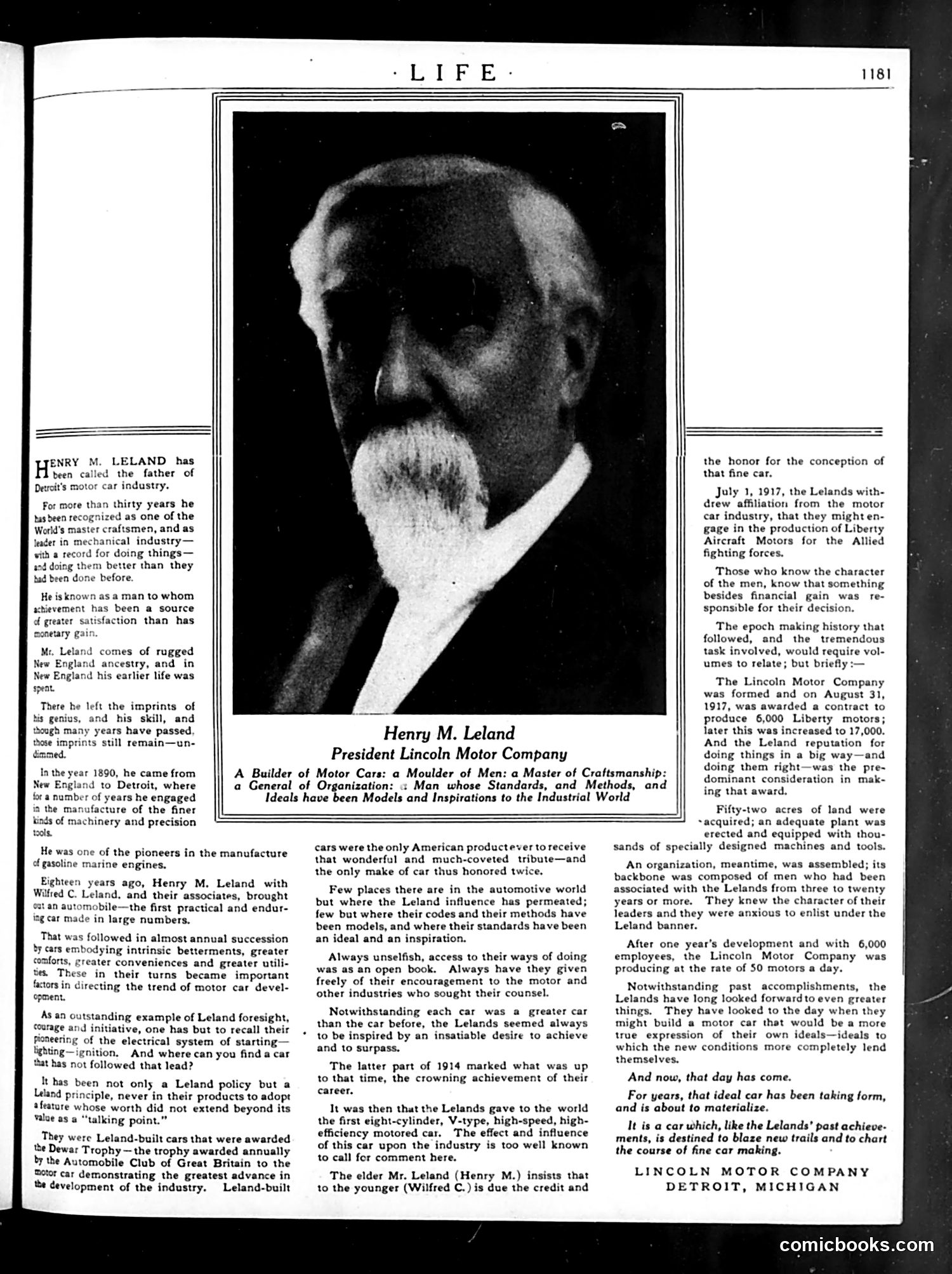
This is **not a cartoon or satire**—it's a straightforward biographical tribute to Henry M. Leland, founder of the Lincoln Motor Company, published during World War I. The page celebrates Leland as an industrial pioneer and moral exemplar. Key points: **The Subject**: Leland is presented as a self-made New England manufacturer who revolutionized automobile production through rigorous standards and craftsmanship. **The Patriotic Angle**: The text emphasizes that in July 1917, Leland withdrew from car manufacturing to produce Liberty Aircraft Motors for the Allied war effort—framing this as a sacrifice motivated by duty rather than profit. **The Implicit Message**: This is promotional content lionizing American industrial leadership during WWI, suggesting that capitalist enterprise and patriotism align. Leland represents the "right kind" of businessman—one whose standards and character make him trusted with military contracts. The page is essentially **corporate publicity dressed as journalism**, common in early-20th-century American magazines.
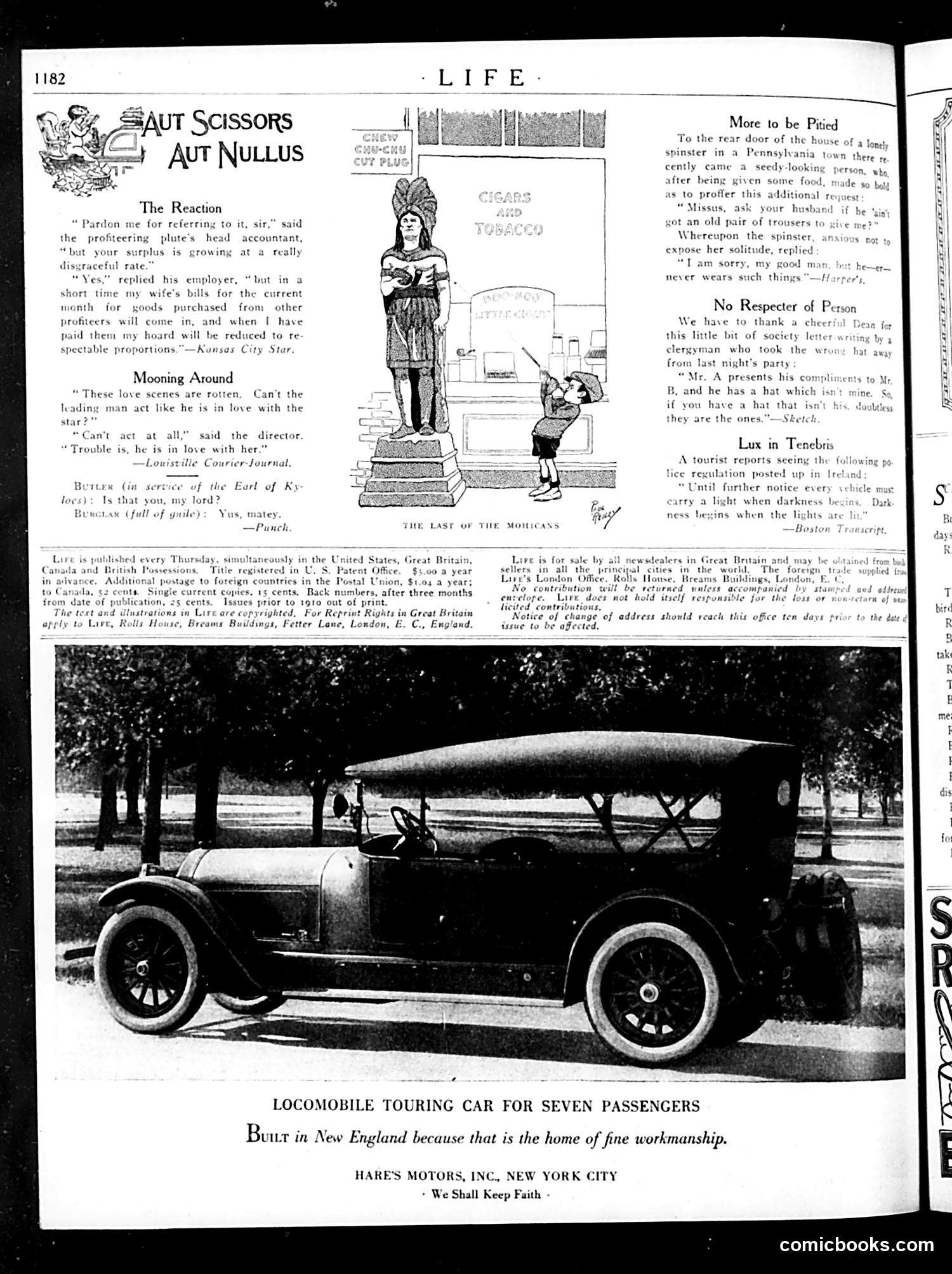
This page contains satirical short humor pieces typical of Life magazine's format, plus a car advertisement. **"The Reaction"** satirizes wartime profiteering: a wealthy businessman justifies his growing surplus by claiming his wife's spending will redistribute the money back through other profiteers—circular logic excusing excess wealth accumulation. **"Mooning Around"** is a Hollywood joke: a film director complains actors can't convincingly portray love scenes, until discovering the male lead is genuinely in love with his co-star, making him *too* authentic to act naturally. **"The Last of the Mohicans"** features a butler character—likely a comedic servant figure common to the era. The remaining humor pieces address social observations: a woman refusing trousers, a beggar without class discrimination, and an Irish police notice about carrying lights at night. The **Locomobile advertisement** emphasizes New England manufacturing as a mark of quality craftsmanship—appealing to American industrial pride and regional identity during the post-WWI automotive boom.
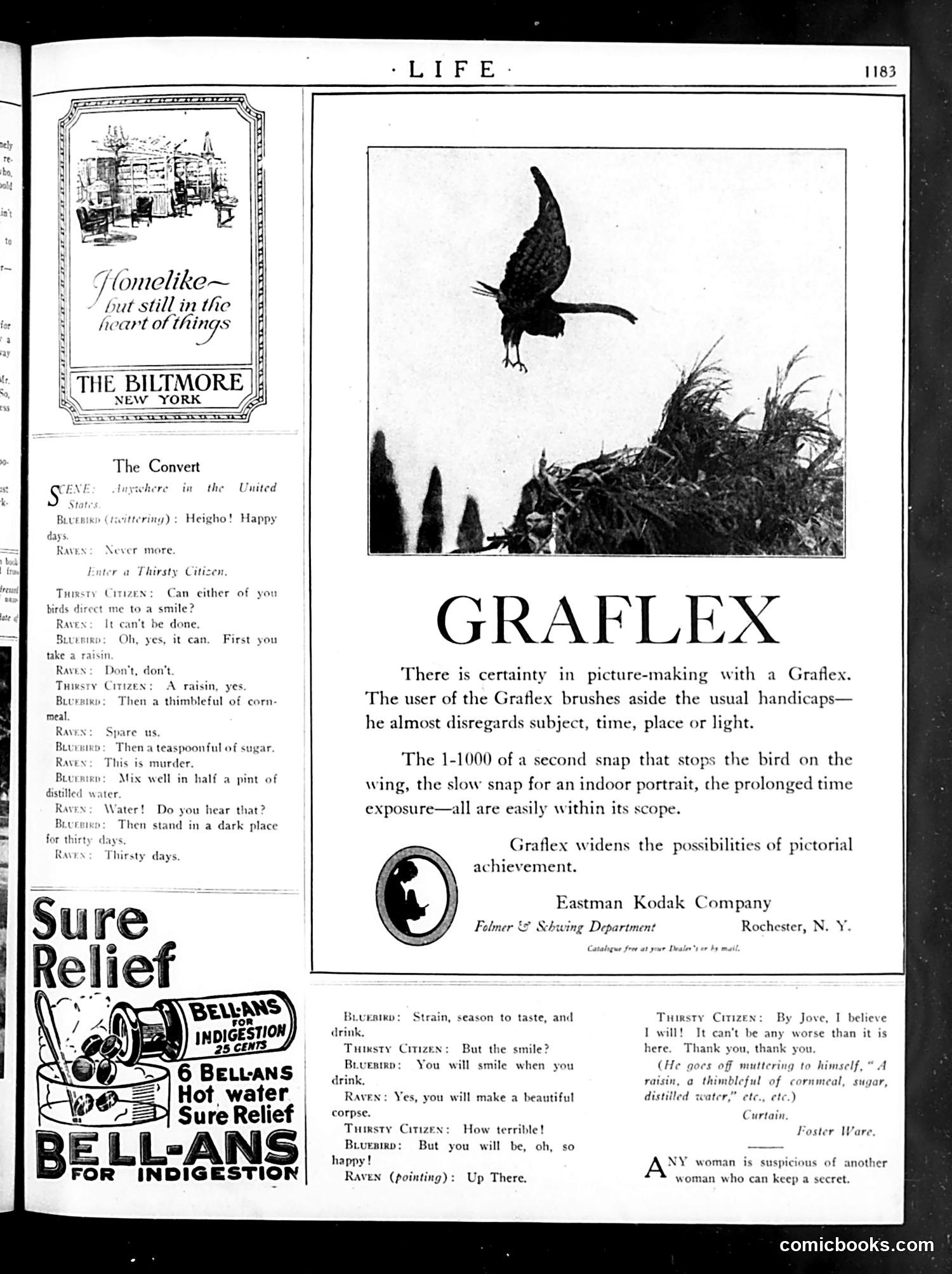
This is a satirical sketch about Prohibition-era bootlegging. A "Thirsty Citizen" seeks alcohol from two birds (likely representing a naive convert to bootlegging and a cynical raven). The convert enthusiastically explains how to make illegal liquor at home—combining a raisin, cornmeal, sugar, and distilled water over thirty days—while the raven repeatedly protests with dark humor ("This is murder," "you will make a beautiful corpse"). The joke mocks amateur home-brewing during Prohibition: the amateur bootlegger is earnest but incompetent, the resulting "smile" (drunkenness) comes with serious consequences, and even the cynic knows it's dangerous. The citizen leaves muttering the recipe, setting himself up for potential poisoning or legal trouble. The page also contains unrelated advertisements for Graflex cameras and Bellans antacid.
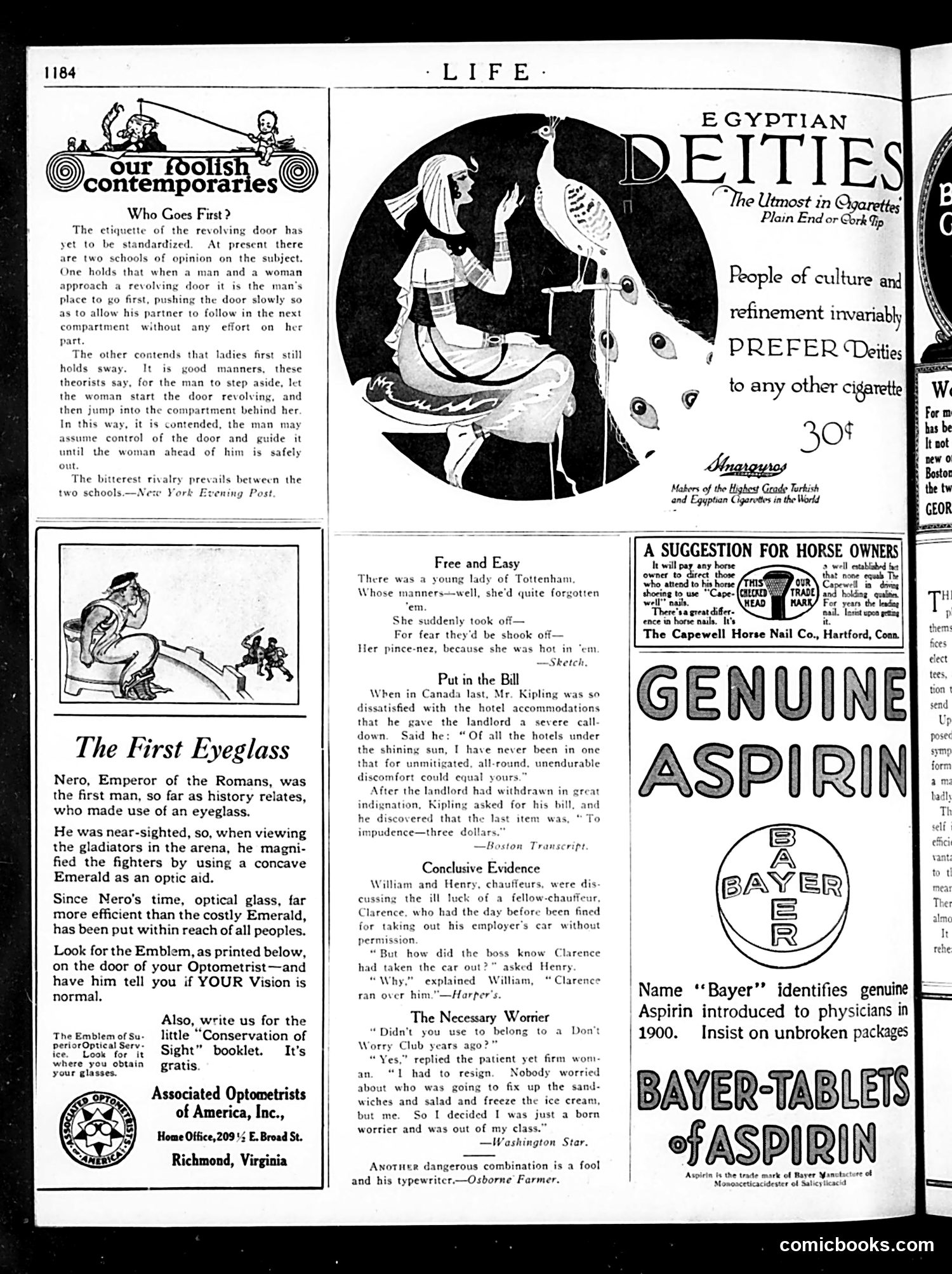
This page mixes satirical commentary with period advertising. The main cartoon "Who Goes First?" satirizes early 20th-century etiquette debates about revolving doors—specifically whether men or women should enter first. The humor targets the absurdity of having two competing "schools of opinion" on such a trivial matter, with the text noting "the bitterest rivalry prevails between the two schools," mocking how seriously people took these social conventions. Supporting content includes humorous anecdotes (like Kipling complaining about hotel conditions, or a woman worried about punch-bowl duty) that gently mock human foibles. The advertisements—Egyptian Deities cigarettes, Bayer Aspirin, and optometry services—reflect typical 1920s-era marketing, with cigarettes still openly advertised as products of "culture and refinement." The "First Eyeglass" section provides historical trivia about Nero, likely included to add intellectual veneer to the optometry ad.
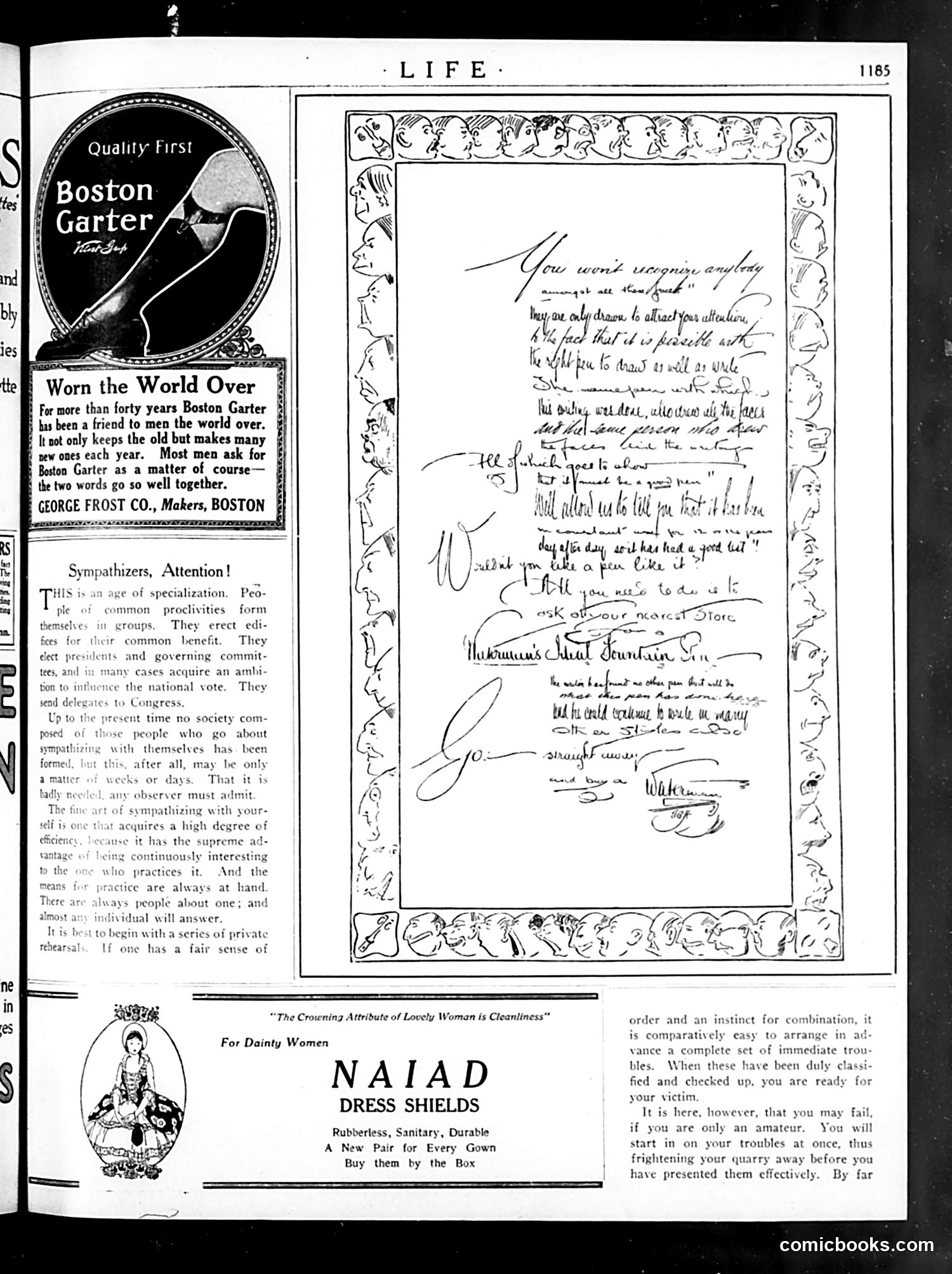
This page combines advertisements with an article titled "Sympathizers, Attention!" **Main Content:** The article discusses the rise of specialized interest groups and advocacy societies in American civic life. It critiques how people organize around shared causes, elect officers, and attempt to influence national politics through delegations to Congress. The piece appears satirical, suggesting that while such organizations proliferate, the actual effectiveness of amateur sympathizers is questionable—they may bungle their advocacy efforts. **Advertisements:** The Boston Garter ad (top left) promotes men's garters as a reliable product. Below, a Naiad Dress Shields ad targets women with sanitary undergarment accessories. **The handwritten letter** framed in decorative borders on the right appears to be fan correspondence, though the specific content is largely illegible in this reproduction. The overall tone is gently mocking of well-intentioned but potentially ineffectual civic participation—a common Life magazine theme of the era.
This page is primarily **advertising and subscription promotion**, not political satire. The main content includes: 1. **B.V.D. Underwear Advertisement** (top left): A conventional product ad emphasizing durability and the brand's signature red woven label. 2. **"Cow, Calf and Bird" Poem** (top right): A light, whimsical verse by John Tolman about farm animals making humorous sounds. The "flummadingoes" and punning wordplay ("cough/berred") are meant as gentle, nonsensical humor. 3. **Advice Column** (bottom left): Discusses social psychology and sympathy—how to get others to open up, then turn conversations toward yourself. This reflects early-20th-century etiquette and self-help culture. 4. **Life Magazine Subscription Pitch** (bottom right): Advertises the magazine as relief from "New England Conscience"—positioning *Life* as offering humor and lightness against Puritanical seriousness. This is *Life*'s actual marketing strategy, not satire. The page reflects the magazine's blend of advertising, light verse, and social commentary typical of 1920s publications.
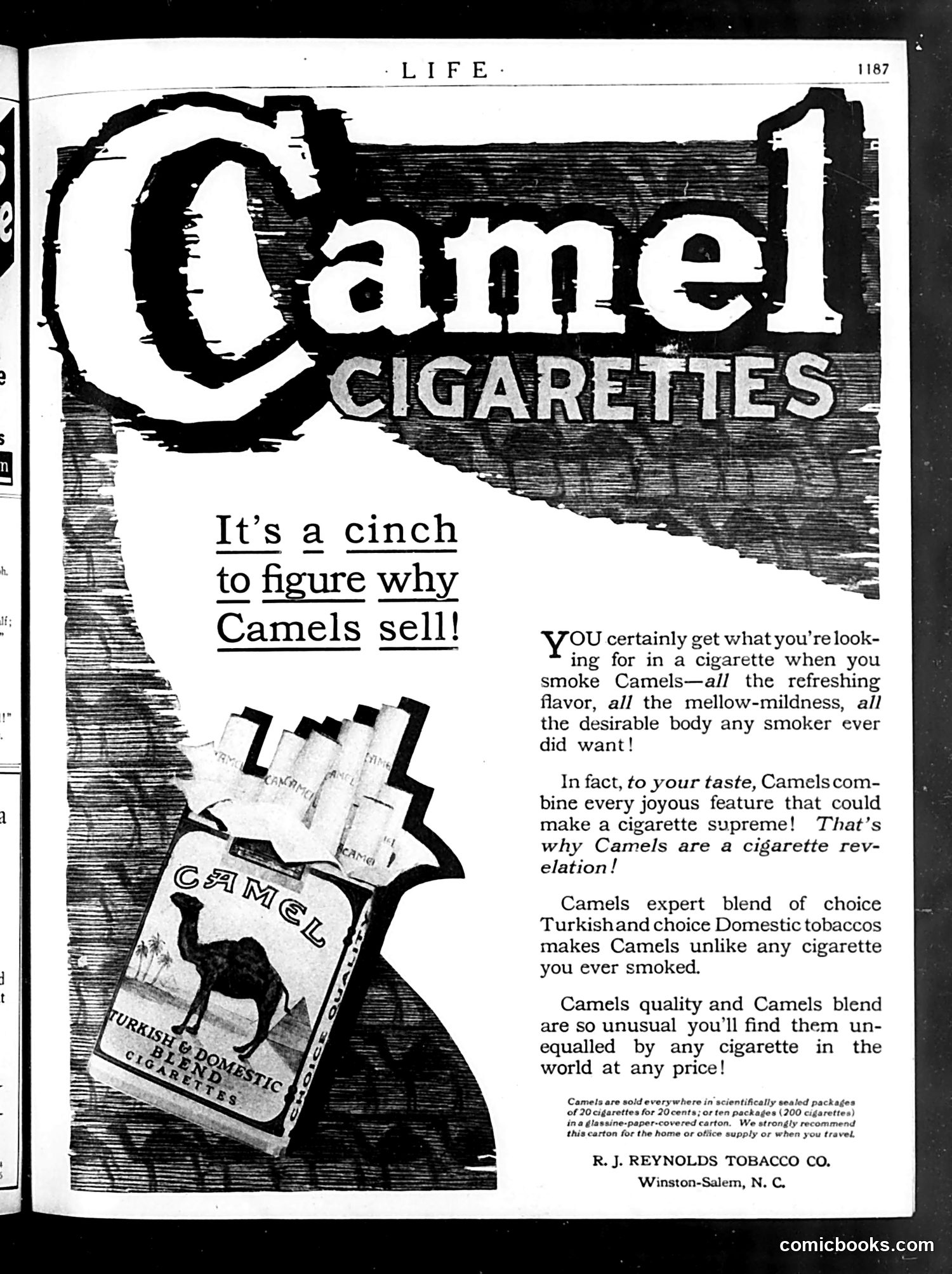
This is a **cigarette advertisement**, not political satire. It's a Camel brand ad from *Life* magazine promoting cigarettes to consumers. The visual shows a pack of Camels cigarettes with the brand's iconic camel logo. The headline "It's a cinch to figure why Camels sell!" is a pun playing on the word "cinch" (easy task). The ad makes marketing claims typical of early-20th-century tobacco advertising: superior "refreshing flavor," "mellow-mildness," and a special blend of Turkish and domestic tobaccos. It emphasizes Camels are "unequalled by any cigarette in the world at any price." **For modern readers:** This represents an era when cigarette companies advertised freely in mainstream magazines without health warnings. R.J. Reynolds (Winston-Salem, North Carolina) sold Camels at 20 cents per pack—standard pricing then. No irony or criticism is intended; this is straightforward product promotion before tobacco's health dangers were widely acknowledged or regulated.
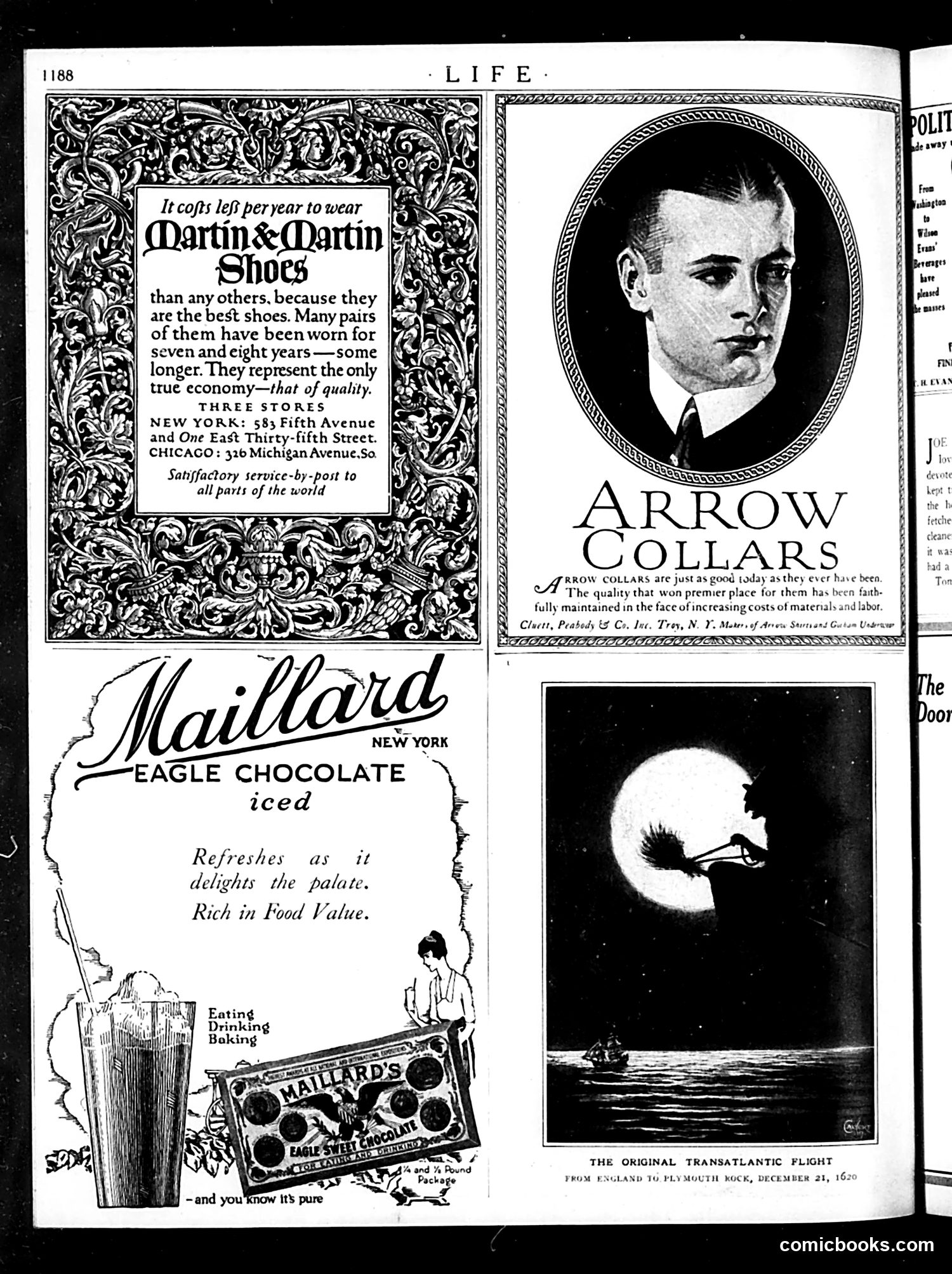
This page is primarily **advertisements** interspersed with one significant historical image. The ads promote Martin & Martin shoes, Maillard's Eagle chocolate, and Arrow collars—typical early 20th-century luxury goods emphasizing quality and durability. The notable content is **"The Original Transatlantic Flight"**—a photograph depicting the historic first nonstop transatlantic flight from England to Plymouth Rock, dated December 21, 1920. The image shows a silhouette of an aircraft against the moon over ocean, commemorating this technological achievement. The portrait above it appears to be of a pilot or aviator associated with this flight, though the specific identity isn't labeled. For modern readers: this celebrates a groundbreaking aviation milestone—the first successful nonstop crossing of the Atlantic by airplane, a major 1920s technological triumph that demonstrated aviation's expanding capabilities. The page treats this alongside consumer goods, reflecting how LIFE covered both cultural milestones and commercial life.
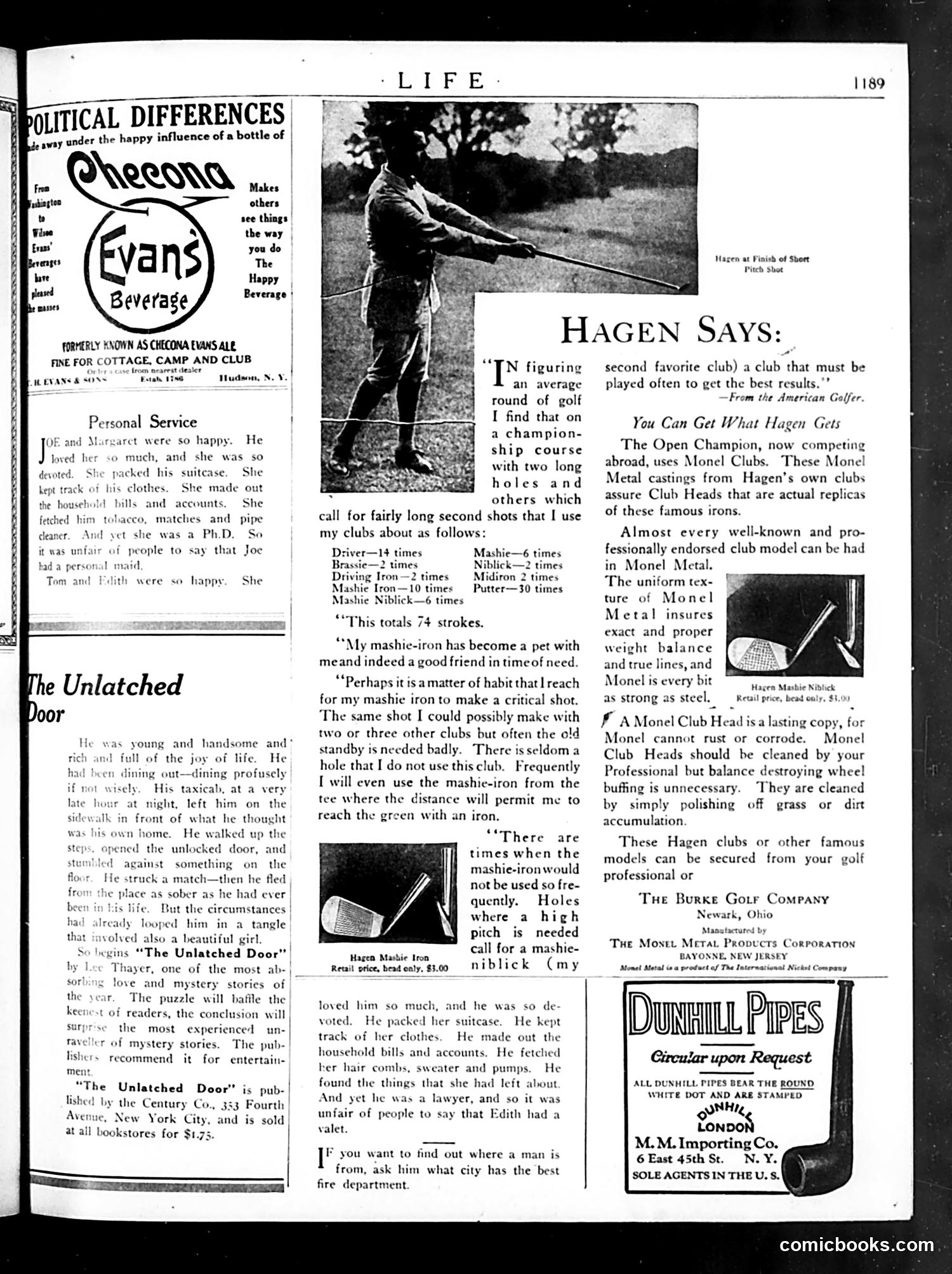
This page contains **advertising and light social commentary**, not political satire in the traditional sense. The "Political Differences" ad at top-left uses humor to suggest that Checcona Evans ale resolves disagreements—a common advertising trope of the era. The main content features "Personal Service," a short humorous piece contrasting two couples: one where a devoted wife manages her Ph.D. husband's domestic affairs, and another where a devoted husband handles his lawyer wife's tasks. The joke hinges on gender role reversal—the humor derives from the unusual situation of men performing "women's work" (domestic management, clothing care). This reflects 1920s social attitudes about gender roles. The bulk of the page is **golf equipment advertising** featuring endorsements by golfer Walter Hagen, including detailed advice on club usage and promotional material for Monel metal golf clubs and Dunhill pipes. The final item, "The Unlatched Door," advertises a mystery novel by Frank Thayer, playing on domestic intrigue and scandal themes popular in period fiction.
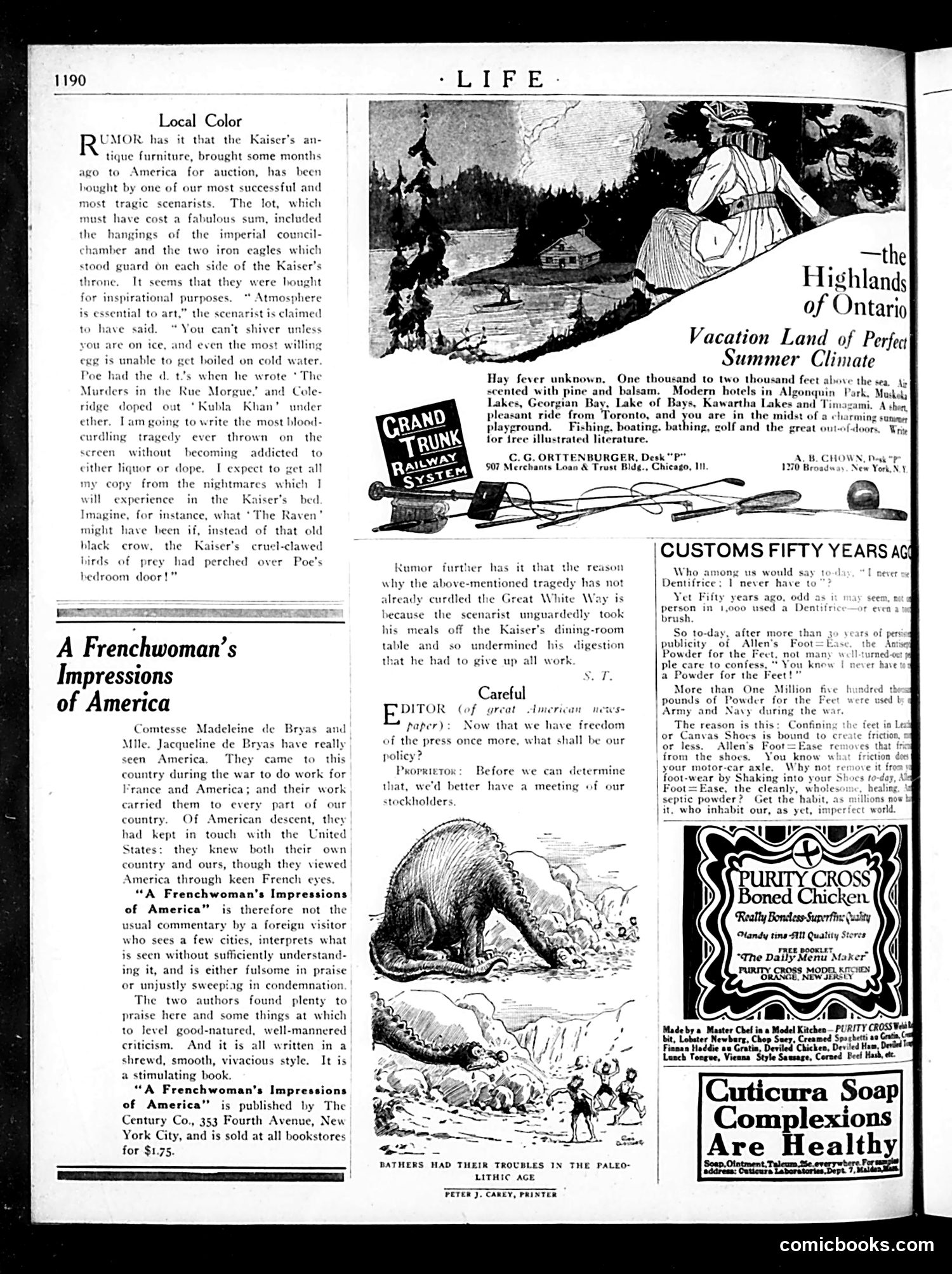
This page contains three distinct sections: **"Local Color"** satirizes a Hollywood screenwriter who purchased Kaiser Wilhelm II's antique furniture—including iron eagles from his throne—to inspire "atmosphere" while writing tragedies. The joke mocks the pretentiousness of using the deposed German emperor's possessions as creative fuel, comparing it to Poe's laudanum use. The humor plays on post-WWI sentiment toward Germany and questions whether nightmare-inducing décor actually aids artistic creation. **"A Frenchwoman's Impressions of America"** announces a book by French authors who observed America during wartime. The text notes it avoids typical shallow foreign commentary, instead offering "shrewd, smooth, vivacious" critique from authors with genuine understanding. **"Careful"** is a brief satirical dialogue where an editor and proprietor discuss newfound press freedom, only for the proprietor to insist they consult stockholders before determining policy—satirizing how commercial interests override editorial independence. The page also contains vintage advertisements for travel, food products, and toiletries typical of the era.
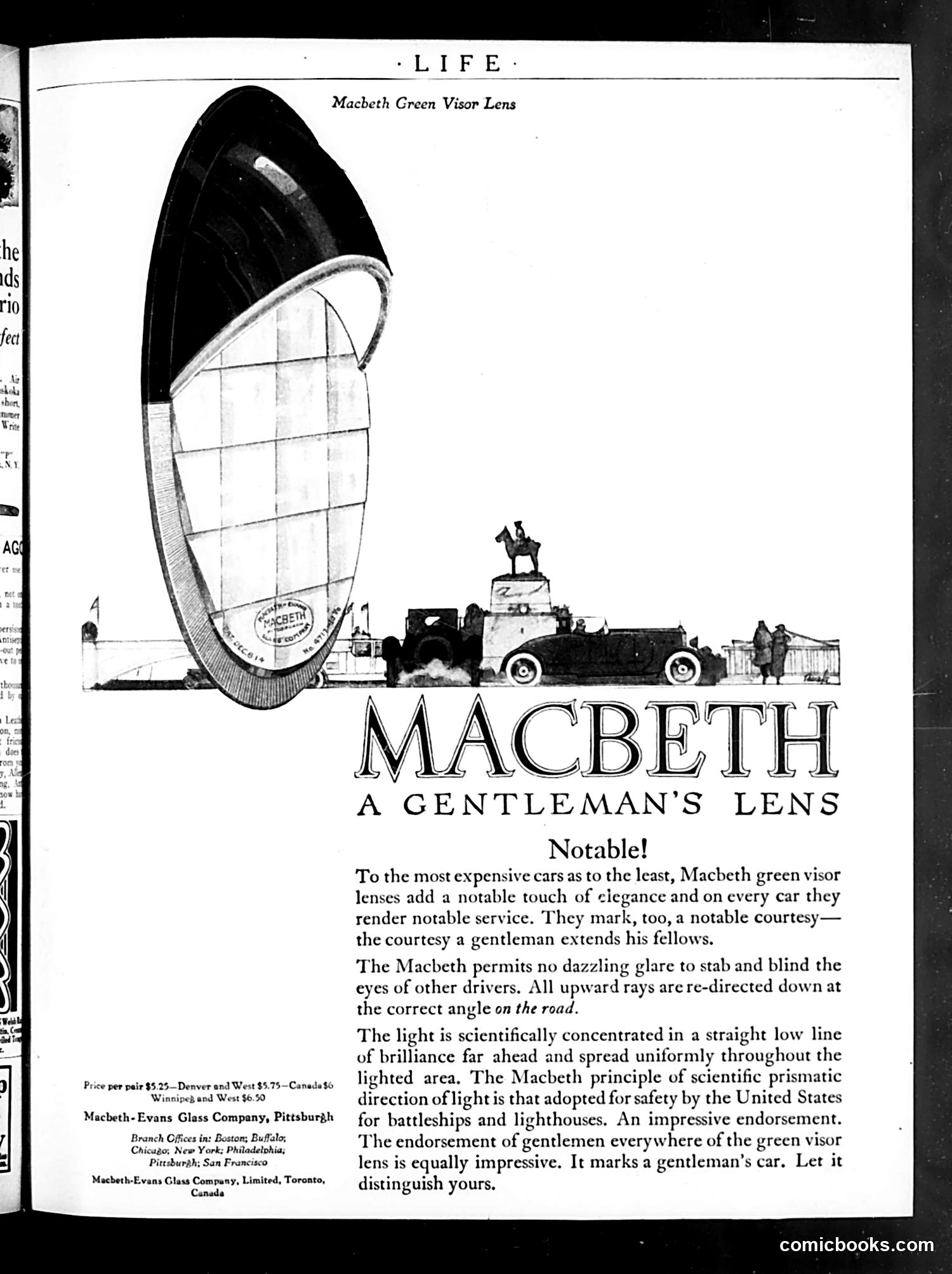
This is a **product advertisement**, not political satire. It promotes automobile headlight visors manufactured by Macbeth-Evans Glass Company. The ad appeals to early automobile owners by positioning the green visor lens as a marker of gentlemanly conduct and refinement. The central claim: these lenses redirect light downward to prevent blinding other drivers—framing traffic safety as a courtesy and social responsibility. The advertisement leverages prestige by noting the technology's adoption by the U.S. Navy for battleships and lighthouses, lending scientific credibility. The visual shows a stylized car with the large visor lens displayed prominently. The underlying pitch is aspirational: purchasing this product signals one's status as a "gentleman" and considerate motorist. For a 1920s audience transitioning to mass automobile ownership, such products offered a way to demonstrate social refinement through consumer choice.
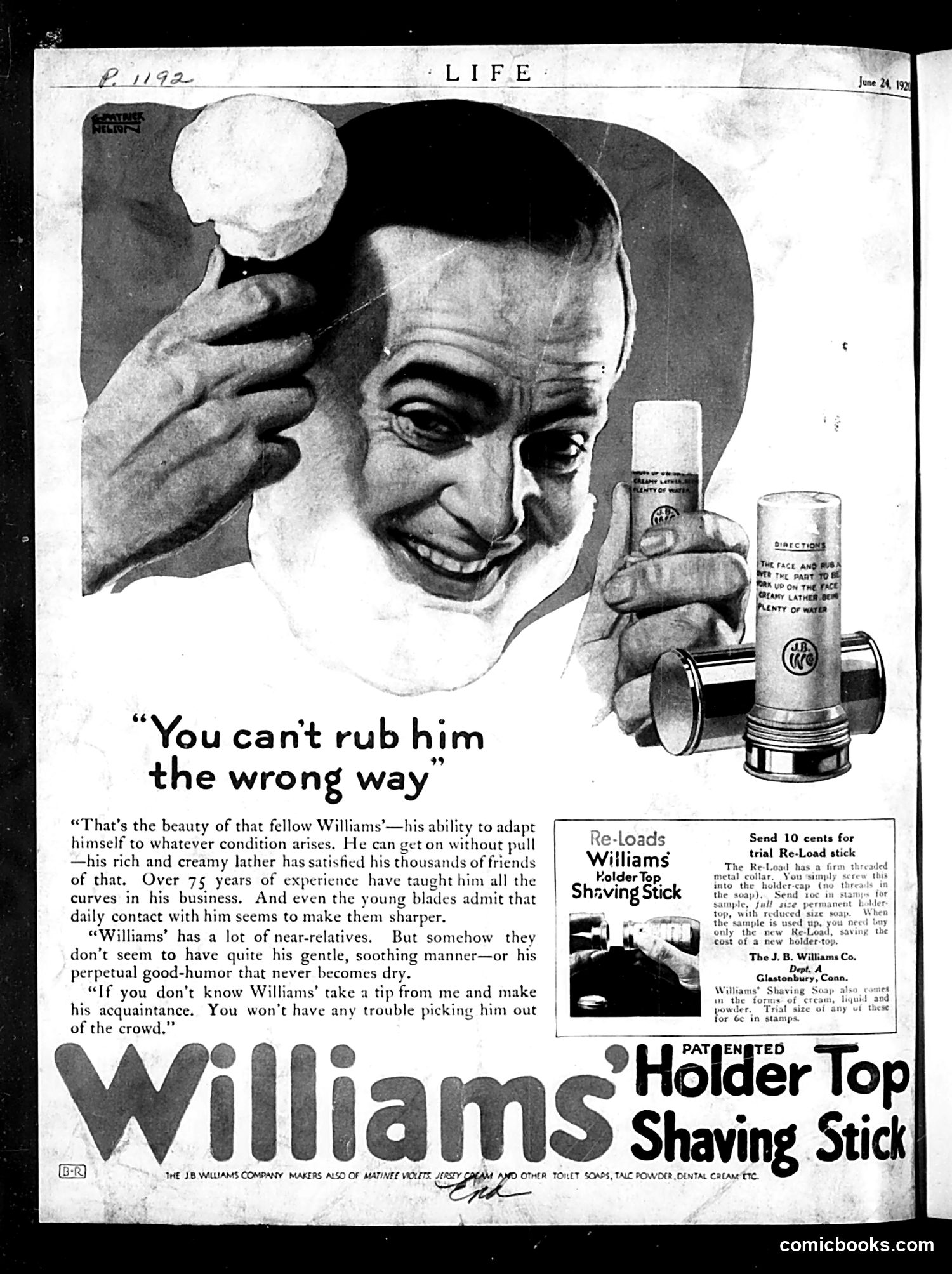
This is primarily a **product advertisement**, not political satire. It promotes Williams' Holder Top Shaving Stick through personification and testimonial. The central figure is "Williams"—not a real person but an anthropomorphized brand mascot depicted as a cheerful, bald man. The ad's humor relies on treating the shaving product as if it were a beloved, adaptable character with "75 years of experience" and a "gentle, soothing manner" that never becomes "dry" (a pun, since shaving products shouldn't dry skin). The joke is: "You can't rub him the wrong way"—meaning the product works reliably under any conditions, while also playing on the phrase as a personality trait. The ad compares Williams favorably to "near-relatives" (competing brands), claiming superior quality and a unique charm that makes it recognizable "in the crowd." This reflects early 20th-century advertising that gave brands human personalities to build consumer loyalty.
I can see this is a blank or nearly blank page from what appears to be a historical publication. The only visible text is "comicbooks.com" at the bottom, which is a modern watermark added during digitization and is not part of the original publication. Without any visible cartoon imagery, captions, articles, or other content on the actual page itself, I cannot identify any figures, political references, satirical points, or historical context. This appears to be either a blank page that was accidentally scanned, a page separator, or the image quality/contrast makes the original content unreadable. To provide meaningful analysis of the satire and historical context you're asking about, I would need a page with legible cartoon imagery or text visible.