
Life, 1920-06-24 · page 16 of 41
Life — June 24, 1920 — page 16: what you’re looking at
What you’re looking at
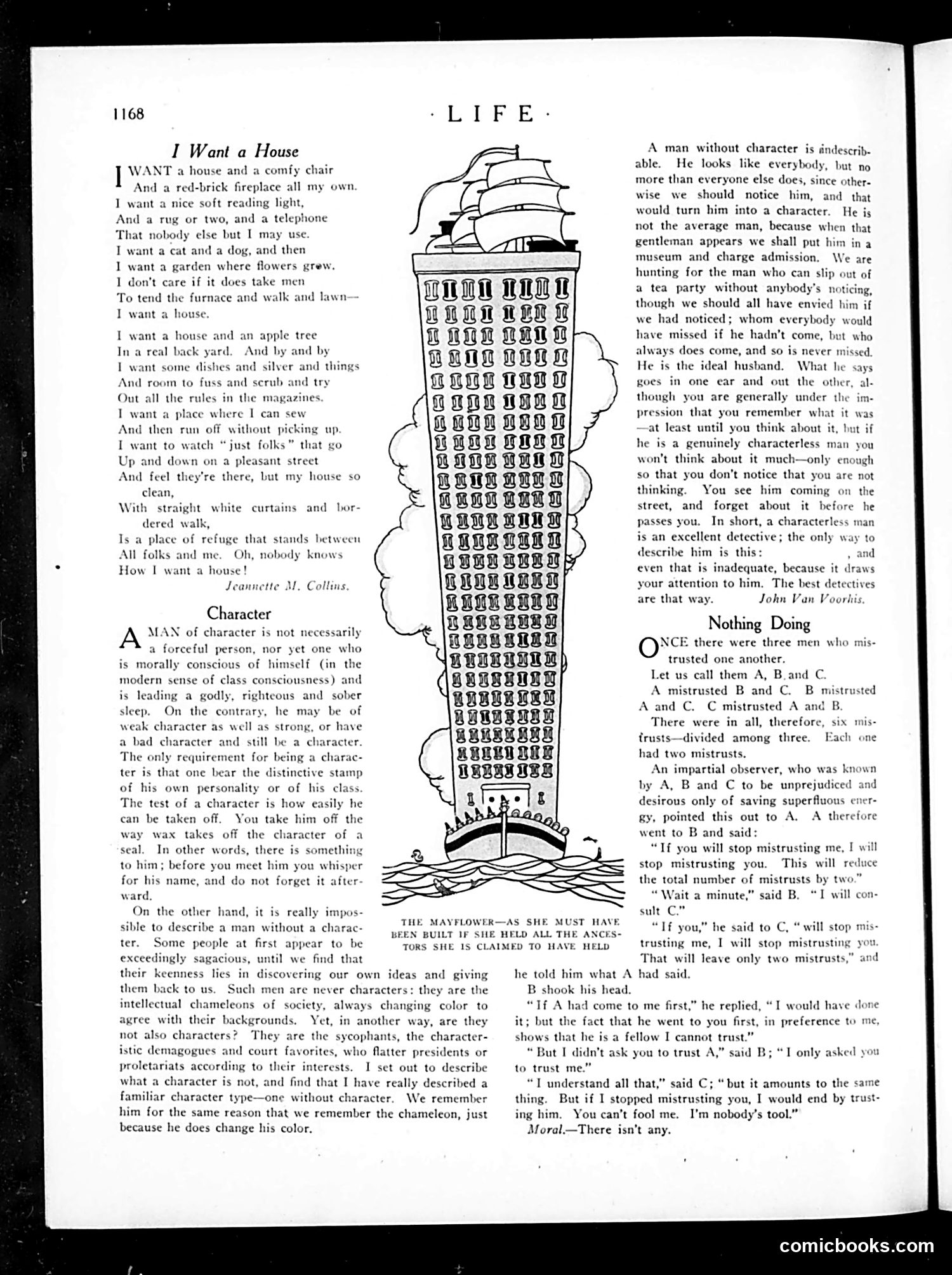
This page contains three literary pieces rather than political cartoons: 1. **"I Want a House"** by Jeannette M. Collins—a nostalgic poem listing domestic desires (furniture, pets, garden). 2. **"Character"** by John Van Voorhis—an essay defining what makes someone memorable, arguing that truly distinctive individuals are rare and valuable. 3. **"Nothing Doing"**—a humorous anecdote about three men (A, B, C) playing word games with trust and mistrust, ultimately revealing the logical paradox that stopping mutual distrust requires trust itself. The illustration shows a tall ship-topped building, likely representing ambition or achievement. The content emphasizes personal values—domesticity, character, and logical reasoning—typical of Life's satirical, middle-class readership interests.
📄 Transcribed text from this page (OCR, searchable)
Machine-transcribed from the original scan — historical spelling and the odd misread are preserved.
1168 I Want a House WANT a house and a comfy chair And a red-brick fireplace all my own I want a nice soft reading light, And a rug or two, and a telep! That nobody else but I may use. nd then I want a garden where flowers grew. I don't care if it does take men To tend the furnace and walk and lawn I want a cat and a dog I want a house. I want a house and an apple tree And by and by 1 want some dishes and silver and things In a real back yard And room to fuss and serub and try Out all the rules in the ma ines. I want a place where I can sew And then run off without picking up. I want to watch “just folks” that go Up and down on a pleasant street And feel th clean, With. straig! dered walk, re there, but my house so white curtains and bor- Is a place of refuge that stands between All folks and me. Oh, nobody knows How I want a house! Jeannette M. Collins. Character MAN of character is not necessarily a forceful person, nor yet one who is morally conscious of himself (in the modern sense of class consciousness) and is leading a godly, righteous and sober sleep. On the contrary, he may be of weak character well as strong, or have a bad character and still be a character. The only requirement for being a charac- ter is that one bear the distinctive stamp of his own personality or of his class The test of a character is how easily he can be taken off. You take him off the way wax takes off the character of a In other words, there is somethin, to him; before you meet him you whisper for his name, ward, nd do not forget it after On the other hand, it is really impos- sible to describe a man without a charac- ter. me people at first appear to be exceedingly sagacious, until we find that their keenness lies in discovering our own ideas and giving them back to us. Such men are never characters: they are the intellectual chameleons of society, always changing color to agree with their backgrounds. not also characters? Yet, in another way, are they They are the sycophants, the character- istic demagogues and court favorites, who flatter presidents or proletariats according to their interests. I set out to describe what a character is not, and find that I have really described a familiar character type—one without character. We remember him for the same reason that we remember the chameleon, just because he does change his color. BEQeEeeCQOerrerRm SER 2e22e02eEe8 222202 2ee8 URNA LITT HILL BLK As QUOw NET your attention to him. The best detectives HULL ELTG RRKKLVEH BAARIUTT URAKAWUA GRGTEIZT RABIR ELH 4 AUMBIIIH RARER ALY ABLLILIT URERINER THE MAYFLOWER—AS SHE MUST HAVE BUILT IF SHE HELD ALL TH TORS SHE 1S CLAIMED TO HAVE HELD A man without character is dndescrib- able. He looks like everybody, but no more than everyone else does, since other- wise we should notice him, and that would turn him into a character. He is not the average man, because when that gentleman appears we shall put him ii museum and charge admission, \V hunting for the man who can slip « a tea party without anybody's n: though we should all have envied him if we had noticed; whom everybody would have missed if he hadn't come, but who always does come, and so is never missed. He is the ideal husband. What he says goes in one ear and out the other, though you are generally under the im- pression that you remember what it was at least until you think about it, but if he is a genuinely characterless man you won't think about it much—only enough so that you don't notice that you are not thinking. You see him coming on the street, and forget about it before he passes you. In short, a characterless man is an excellent detective; the only way to describe him is this: , and even that is inadequate, because it draws are that way. John Van Voorhis Nothing Doing NCE there were three men who mis- trusted one another. Let us call them A, Band C. A mistrusted B and C. B mistrusted and C. C mistrusted A and B. There were in all, therefore, six mis- trusts—divided among three. Each one had two mistrusts. An impartial observer, who was known by A, B and C to be unprejudiced and desirous only of saving superfluous ener- gy, pointed this out to A. A therefore went to B and said “Tf you will stop mistrusting me, I will stop mistrusting you. This will red the total number of mistrusts by two. “Wait a minute,” said B, “I will con- sult C.” “Tf you,” he said to C, “ will stop mis- trusting me, I will stop mistrusting you That will leave only two mistrusts,” and he told him what A had said. 8 shook his head. “Tf Aha it; but the fact that he went to you first, in preference to me, shows that he is a fellow I cannot trust.” “But I didn’t ask you to trust A,” said B; “I only asked ye to trust me.” “T understand all that,” said C; “but it amounts to the same thing. But if I stopped mistrusting you, I would end by trust- ing him. You can’t fool me. I'm nobody’s tool.” Moral—tThere isn’t any. ANCES- come to me first,” he replied, “I would have done comicbooks.com