
Life, 1920-06-24 · page 29 of 41
Life — June 24, 1920 — page 29: what you’re looking at
What you’re looking at
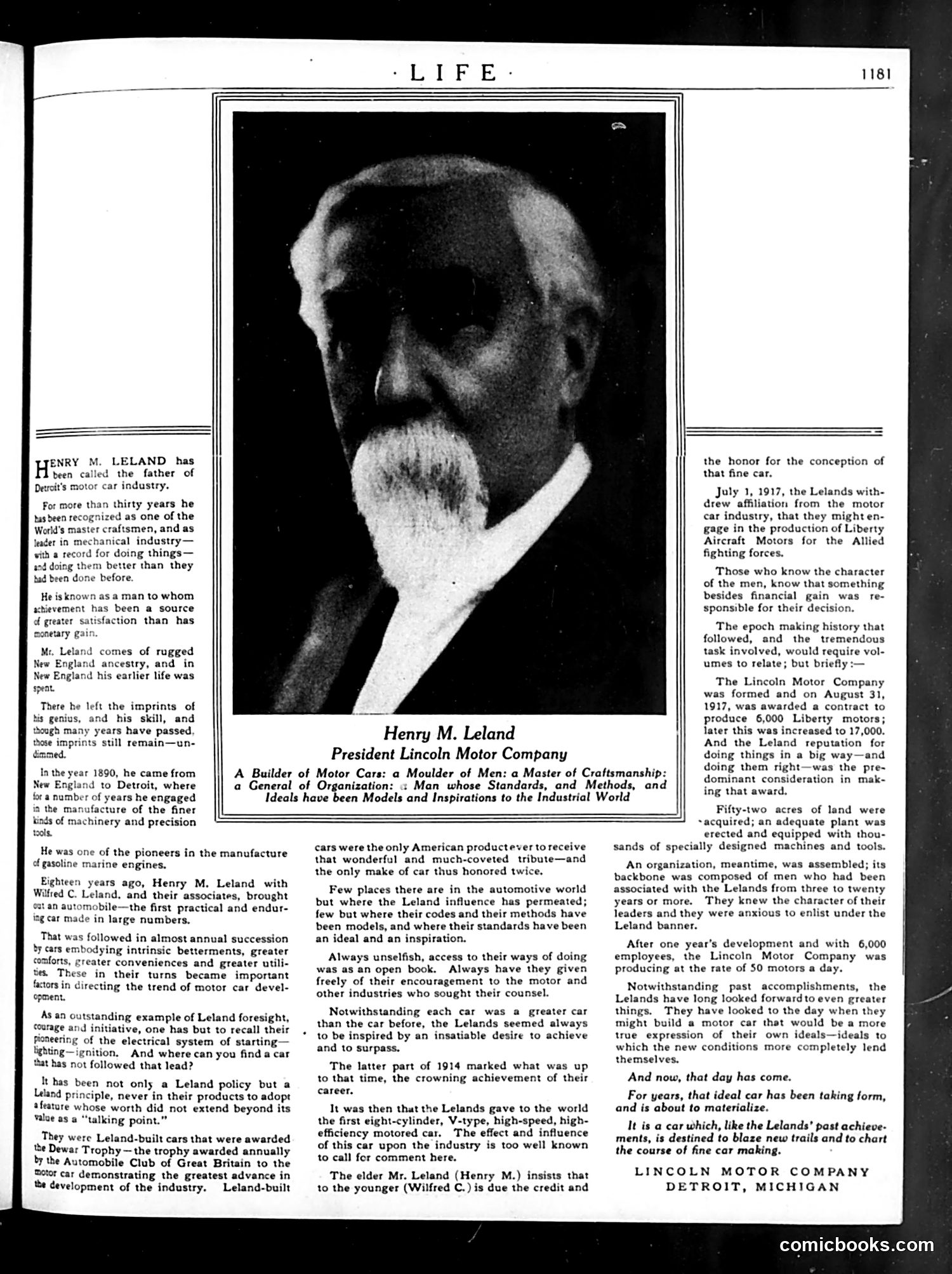
This is **not a cartoon or satire**—it's a straightforward biographical tribute to Henry M. Leland, founder of the Lincoln Motor Company, published during World War I. The page celebrates Leland as an industrial pioneer and moral exemplar. Key points: **The Subject**: Leland is presented as a self-made New England manufacturer who revolutionized automobile production through rigorous standards and craftsmanship. **The Patriotic Angle**: The text emphasizes that in July 1917, Leland withdrew from car manufacturing to produce Liberty Aircraft Motors for the Allied war effort—framing this as a sacrifice motivated by duty rather than profit. **The Implicit Message**: This is promotional content lionizing American industrial leadership during WWI, suggesting that capitalist enterprise and patriotism align. Leland represents the "right kind" of businessman—one whose standards and character make him trusted with military contracts. The page is essentially **corporate publicity dressed as journalism**, common in early-20th-century American magazines.
📄 Transcribed text from this page (OCR, searchable)
Machine-transcribed from the original scan — historical spelling and the odd misread are preserved.
M. LELAND has i the father of ar industry. For mote than thirty years he tus deen recognized as one of the World's master craftsmen, and as leader in mechanical industry — with a record for doing things— aed doing them better than they know achievement has been a source d greater satisfaction than has nonetary gain M:, Leland comes of rugged New England ancestry, and in New England his earlier life was spent There he left the imprints of bis genius, and his skill, and ough many years have passed still remain—un- ear 1890, he came from to Detroit, where of years he engaged a General of Organization: Henry M. Leland President Lincoln Motor Company A Builder of Motor Cars: a Moulder of Men: a Master of Craftsmanship: : Man whose Standards, and Methoi the honor for the conception of that fine car. July 1, 1917, the Lelands with- drew affiliation from the motor car industry, that they might en- gage in the production of Liberty Aircraft Motors for the Allied fighting forces. Those who know the character of the men, know that something besides financial gain was re- sponsible for their decision. The epoch making history that followed, and the tremendous task involved, would require vol- umes to relate; but briefly :-— The Lincoln Motor Company was formed and on August 31, 1917, was awarded a contract to produce 6,000 Liberty motors; later this was increased to 17,000. And the Leland reputation for doing things in a big way—and doing them right—was the pre- dominant consideration in mak- ing that award, Fifty-two acres of land were kinds of machinery and precision ols. He was one of the pioneers in the manufacture ef gasoline marine engines. Eighteen years ago, Henry M, Leland with fred C. Leland, and their associates, brought an automobile—the first practical and endur- car made in large numbers. That was followed in almost annual succession by cars embodying intrinsic betterments, greater comforts, greater conveniences and greater utili- tes, TI in their turns became important factors in Girecting the trend of motor car devel- opment, As an outstanding example of Leland foresight, courage and initiative, one has but to recall their Poneering of the electrical system of starting— lighting—ignition, And where can you find a car that has not followed that lead? It has been not only a Leland policy but a Leland ciple, never in their products to adopt feature whose worth did not extend beyond its alee as a “talking point.” They were Leland-built cars that were awarded the Dewar Trophy —the trophy awarded annually by the Automobile Club of Great Britain to the Sector car demonstrating the greatest advance in the development of the industry. Leland-built d Ideals have been Models and Inspirations to the Industrial Worl cars were the only American productever to receive that wonderful and much-coveted tribute—and the only make of car thus honored twic Few places there are in the automotive world but where the Leland influence has permeated; few but where their codes and their methods have been models, and where their standards have been an ideal and an inspiration. Always unselfish, access to their ways of doing was as an open book. Always have they given freely of their encouragement to the motor and other industries who sought their counsel. Notwithstanding each car was a greater car than the car before, the Lelands seemed always to be inspired by an insatiable desire to achieve and to surpass. The latter part of 1914 marked what was up to that time, the crowning achievement of their career. It was then that the Lelands gave to the world the first eight-cylinder, V-type, high-speed, high- efficiency motored car. The effect and influence of this car upon the industry is too well known to call for comment here. The elder Mr. Leland (Henry M.) insists that to the younger (Wilfred C.) is due the credit and sacquired; an adequate plant was erected and equipped with thou- sands of specially designed machines and tools. An organization, meantime, was assembled; its backbone was composed of men who had been associated with the Lelands from three to twenty years or more. They knew the character of their leaders and they were anxious to enlist under the Leland banner. After one year’s development and with 6,000 employees, the Lincoln Motor Company was producing at the rate of 50 motors a day. Notwithstanding past accomplishments, the Lelands have long looked forward to even greater things. They have looked to the day when they might build @ motor car thet would be a more true expression of their own ideals—ideals to which the new conditions more completely lend themselves. And now, that day has come. For years, that ideal car has been taking form, and is about to materialize. It is a car which, like the Lelands’ past achieve- ments, is destined to blaze new trails and to chart the course of fine car making. LINCOLN MOTOR COMPANY DETROIT, MICHIGAN comicbooks.com