
Life, 1920-06-24 · page 18 of 41
Life — June 24, 1920 — page 18: what you’re looking at
What you’re looking at
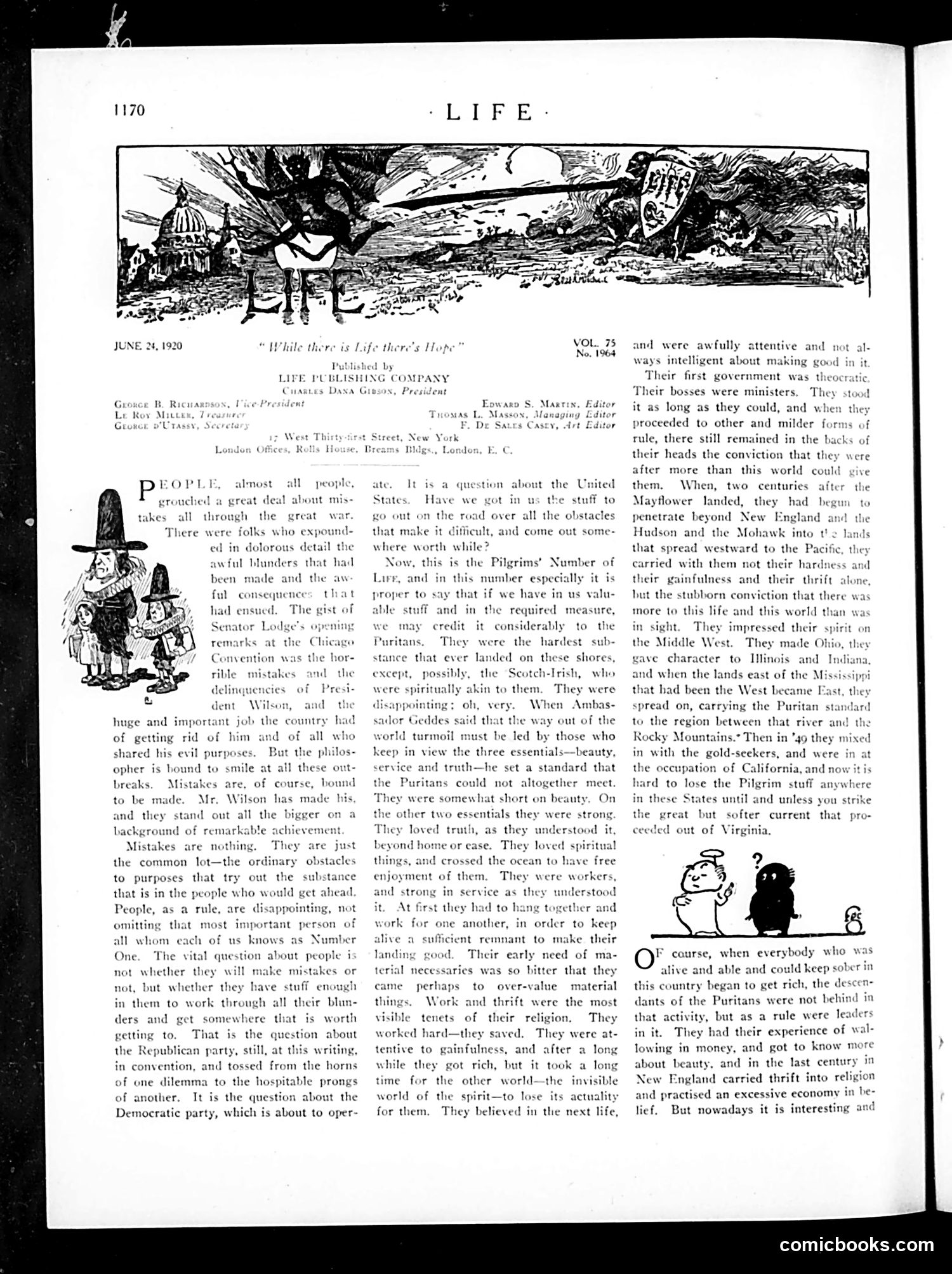
This is primarily editorial commentary rather than a traditional political cartoon. The page celebrates the Pilgrims as the subject of Life's "Pilgrims' Number," using them to comment on contemporary American character and governance. The text argues that the Pilgrims possessed essential virtues—hard work, thrift, spiritual conviction, and truth—that enabled them to overcome obstacles. The author draws parallels to current debates about whether Americans retain this "stuff" to navigate post-WWI challenges facing both the Republican and Democratic parties. The small cartoon vignette (lower right) appears unrelated—a simple comedic illustration about economic hardship ("Of course, when everybody who was able and able-bodied couldn't work either"). The piece uses Puritan mythology to argue implicitly that American success depends on inherited moral character, positioning this nostalgia for frontier/colonial virtues against modern political uncertainty circa 1920.
📄 Transcribed text from this page (OCR, searchable)
Machine-transcribed from the original scan — historical spelling and the odd misread are preserved.
OPLI almost Ny peor 2 great deal about m! all through the great There were folks who expo ed in dolorous detail the awful blunders that had th n made © consequences tha had ensued. The gist o at the Convention was remarks Chicage rible mistakes cies of 1 and deline dent huge and importar of getting rid of him shared his evil purt opher is bound to smile Mistakes are. course, Mr, Wilson has made the bigger on a breaks. to be made. and they sta out all background of remarkable a Mistakes the common lot—the ordinary obstacles are nothing. They just to purposes that try out the substance that Id get ahead People, as a rule, are di that most in the people who wo omitting impor all whom each of us knows as N One not whether they person The vital question out people i will ¢ mistakes or not, but whether they have stuff enoug in them to work throu all their blun- ders and get somewhere that is worth That is the question still, at this writing, and tossed from the horns getting to. about the Republican party, in conventio! of one dilemma to the hospita It is the questic e prongs of another, n about the Democratic party, which is about to oper- the U Have we 4 nous the stuff ate. is a qu States go out on the road over all the obsta that make it dificult, and come out some- where worth while Now, this is the Pilgrims’ Number of ally it that if we have in us valu- nd in this number espe to say stuff and in the required measure, it considerably to. the Puritans, They were the hardest sub- stance that ever landed on th shores, except, possibly, the Scotch-Irish, who kin to them. They were When Ambas- sador Geddes said that the way out of were spiritual uppointing ; oh, very. vorld turmoil must be led by those who in view the three essentials—beauty, set a standard that Puritans could not y were somewhat short on beauty, On service and truth—he altogether meet. other two essentials the: ere strong. hey loved truth, as they understood it, beyond home or ease. They loved spiritual th crossed the ocean to have free They in service as they enjoyment of them were workers, and s understood it. At first they had to hang together 1 work for one another, in order to keep alive a sufficient remnant to make their landing good. Their early need of ma- terial necessaries was so bitter that they material thi Work and thrift were the most visible ion, Thi They were at- ainfulness, and after a long while they got ri time for the came perhaps to over-value tenets of their rel rked hard—they saved , but it took a long other world—the invisible world of the spirit—to 1 for them, its actuality They believed in the next life, and were awfully attentive and + ways intelligent about making good Their first government was Their bosses were ministers. They it as long as they could, and y proceeded to other and milder fc rule, there still remained in the b their heads the conviction that they after more than this them. When, two centuries Mayflower landed, they had he world could after England Hudson and the Mohawk into t that spread westward to the Pacific. carried with th penetrate beyond New m not their har. their ygainfulness and their thrift: alone, but the stubborn conviction that there more to this life and this world than y in sight. They impressed their the Middle West. They made Ohi character to Hlinois and Inc and when the lands east of the Mi that had been the West be spread on, carrying the Pu it on they gave me East to the region between that river and the Rocky Mountains.* Then in "49 they mixed in with the gold-seekers, and were in the occupation of California, and nov ard to lose the Pilgrim stuff anywhere in these States until and unless you st but softer that f ceeded out of Virginia. the great current caurse, when everybody who alive and able and could keep sober in s country began to get rich, the desce dants of the Puritans were not behind that activity, but as a rule were leaders in it. They had their experience of ws lowing in money, and got to know about beauty, and in the last century 1” New England carried thrift into reli and practised an excessive economy i lie But nowadays it is interesting and comicbooks.com