
Life, 1920-06-24 · page 25 of 41
Life — June 24, 1920 — page 25: what you’re looking at
What you’re looking at
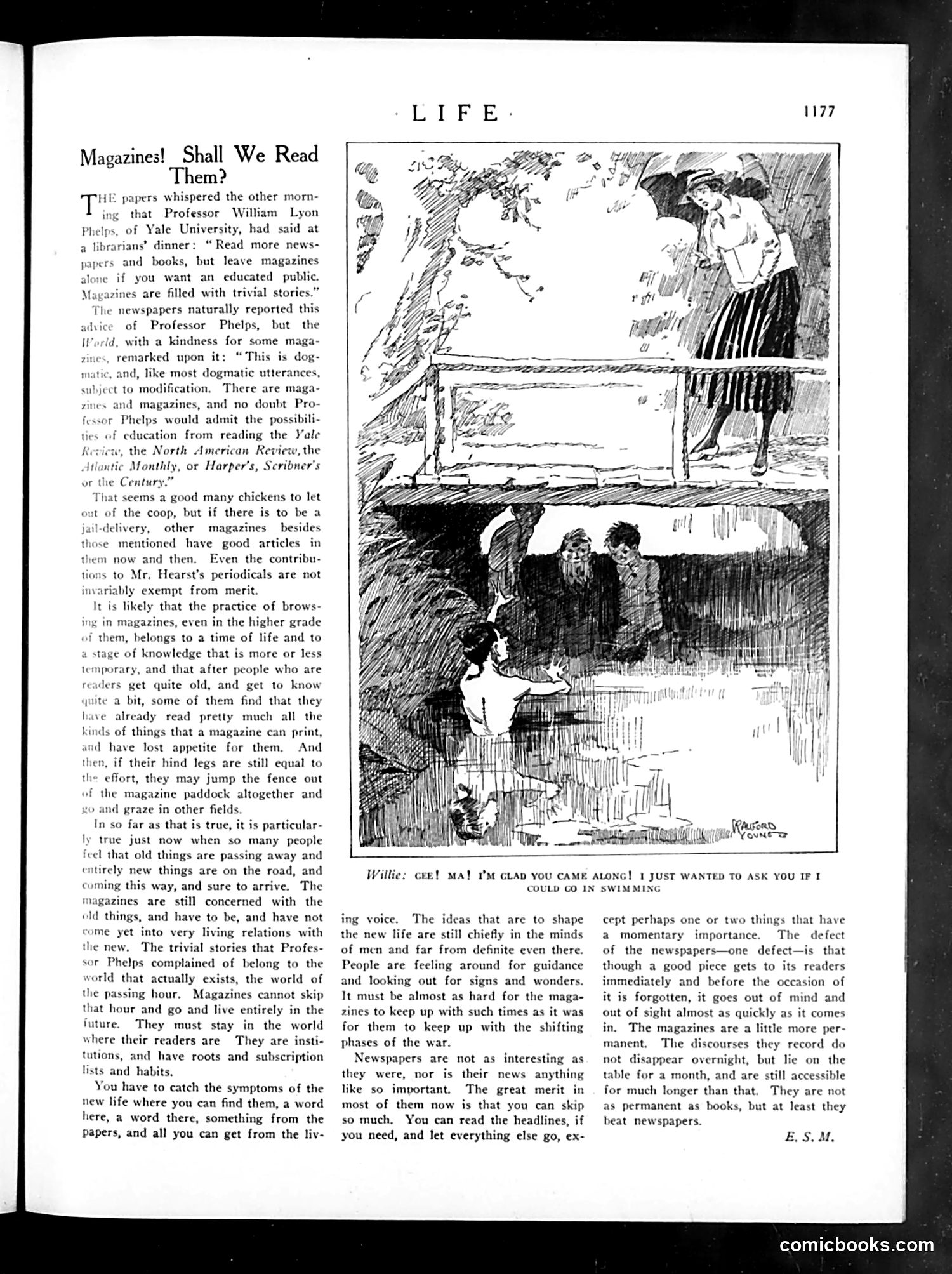
This page presents a debate about magazine reading's intellectual value, sparked by Yale Professor William Lyon Phelps's dismissal of magazines as filled with "trivial stories" unfit for educated readers. **The Argument:** The author defends magazines against Phelps's criticism, acknowledging that while some magazines deserve his scorn, prestigious publications like *The Atlantic Monthly*, *North American Review*, and *Harper's* contain substantive content. The piece argues magazines serve a transitional role for readers developing knowledge, and currently struggle to address "new life" and modern ideas while remaining rooted in present-day concerns. **The Cartoon:** The accompanying sketch shows "Willie" asking someone swimming in a pond whether they'd go swimming, likely satirizing the disconnect between magazine discussions and real life—people are actually *living* rather than debating reading habits. **Historical Context:** This reflects post-WWI uncertainty (mentioned in the text) about rapidly changing society, and the tension between traditional literary journals and mass-market publications—a debate that echoed real anxieties about modernism and public education circa 1920s America.
📄 Transcribed text from this page (OCR, searchable)
Machine-transcribed from the original scan — historical spelling and the odd misread are preserved.
Magazines! Shall We Read hem? HE papers whispered the other morn- T ing that Professor William Lyon Phelps, of Yale University, had said at a librarians’ dinner: “ Read more news- papers and books, but leave magazines if you want an educated public. Magazines are filled with trivial stories.” The newspapers naturally reported this of Professor Phelps, but the id, with a kindness for some maga- . remarked upon it: “This is dog- and, like most dogmatic utterances, subject to modification. There are maga- zines and magazines, and no doubt Pro- fessor Phelps would admit the possibili- ties of education from reading the Vale Ki , the North American Review, the Monthly, or Harper's, Scribner's vor the Century That seems a good many chickens to let f the coop, but if there is to be a ivery, other magazines besides mentioned have good articles in Atlantic Even the contribu- tions to Mr. Hearst's periodicals are not invariably exempt from merit. It is likely that the practice of brows- ing in magazines, even in the higher grade sf them, belongs to a time of life and to them now and then. a stage of knowledge that is more or less temporary, and that after people who are readers get quite old, and get to know quite a bit, some of them find that they have already read pretty much all the kinds of things that a magazine can print, and have lost appetite for them, And then, if their hind legs are still equal to the effort, they may jump the fence out of the magazine paddock altogether and so and graze in other fields. In so far as that is true, it is particular- ly true just now when so many people feel that old things are passing away and entirely new things are on the road, and coming this way, and sure to arrive. The magazines are still concerned with the old things, and have to be, and have not come yet into very living relations with the new. The trivial stories that Profes- sor Phelps complained of belong to the world that actually exists, the world of the passing hour. Magazines cannot skip that hour and go and live entirely in the future. They must stay in the world where their readers are They are insti- tutions, and have roots and subscription lists and habits. You have to catch the symptoms of the new life where you can find them, a word here, a word there, something from the Papers, and all you can get from the liv- ——~_—- —- — ral | DELS EEL DDL inn Rees — _ Saeed pul Ge DL Ly, ~ Willie: ¢ COULD GO IN ing voice. The ideas that are to shape the new life are still chiefly in the minds of men and far from definite even there. People are feeling around for guidance and looking out for signs and wonders. It must be almost as hard for the maga- zines to keep up with such times as it was for them to keep up with the shifting phases of the war. Newspapers are not as interesting as they were, nor is their news anything like so important. The great merit in most of them now is that you can skip so much, You can read the headlines, if you need, and let everything else go, ex- rE! MA! I'M GLAD YOU CAME ALONG! 1 JUST WANTED TO ASK YOU IF I SWIMMING cept perhaps one or two things that have a momentary importance. The of the newspapers—one defect—is that though a good piece gets to its readers immediately and before the occasion of it is forgotten, it goes out of mind and out of sight almost as quickly as it comes in, The magazines are a little more per- manent. The discourses they record do not disappear overnight, but lie on the table for a month, and are still accessible for much longer than that. They are not as permanent as books, but at least they beat newspapers. defect E.S.M. comicbooks.com