
Life, 1920-06-24 · page 15 of 41
Life — June 24, 1920 — page 15: what you’re looking at
What you’re looking at
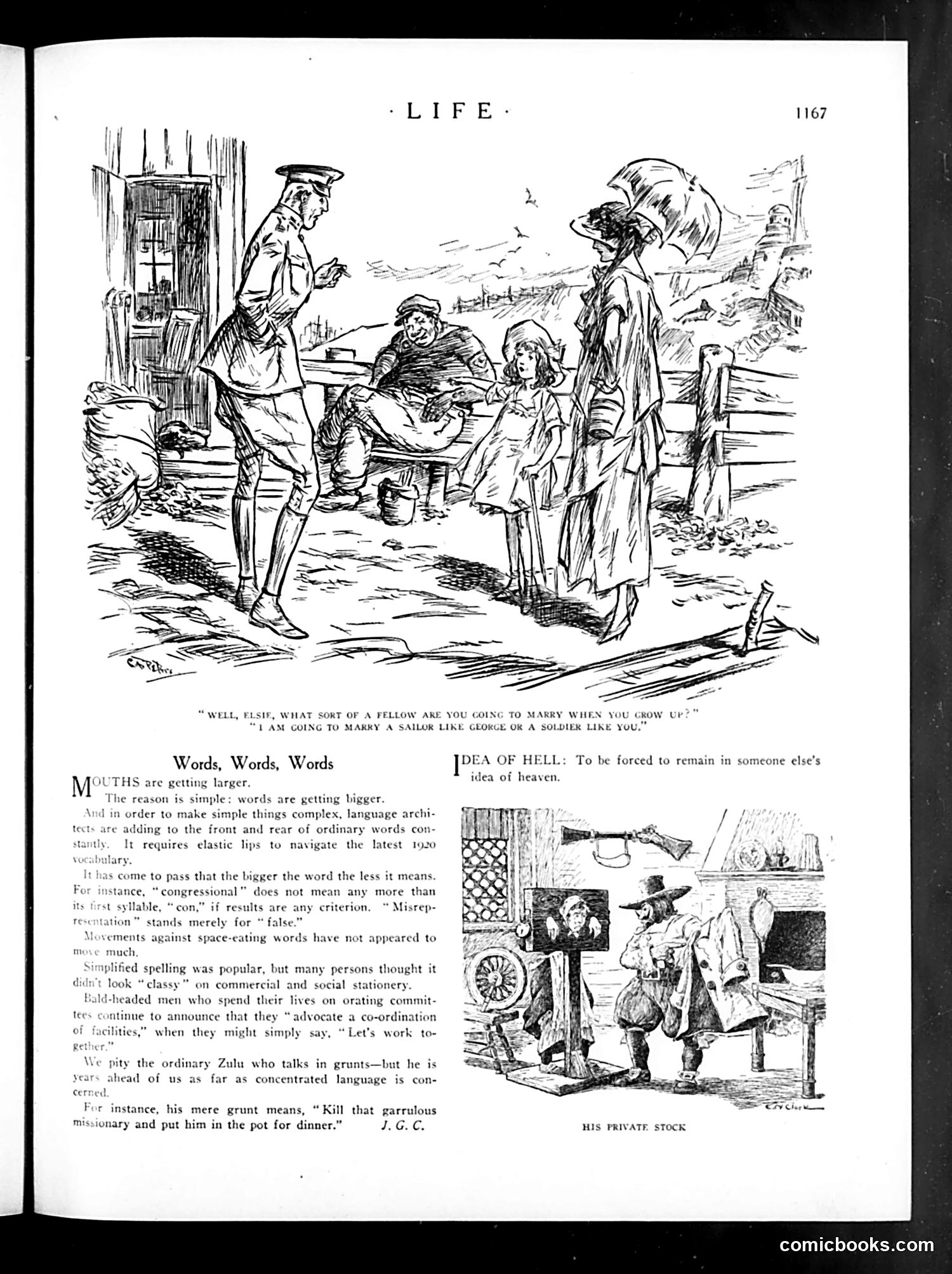
**Top Cartoon:** A military officer questions a young child about future marriage prospects. The child responds, "I am going to marry a sailor like George or a soldier like you." This satirizes early 20th-century militarism and gender expectations—children are already socialized to admire military figures and assume gendered romantic futures. **Article "Words, Words, Words":** Criticizes language inflation and verbosity in modern usage. The author argues that unnecessarily complex words obscure simple meanings, citing examples like "advocate a co-ordination of facilities" instead of "let's work together." The piece mocks pretentious speech among educated and commercial classes. **Bottom Illustration "His Private Stock":** Appears to depict a merchant or trader with goods, though its specific satirical point is unclear from the visible context.
📄 Transcribed text from this page (OCR, searchable)
Machine-transcribed from the original scan — historical spelling and the odd misread are preserved.
“WELL, ELSIF, WHAT SORT OF A FELLOW ARE YOU GOING TO MARRY WHEN YoU GROW UP?” “LAM GOING TO MARRY A SAILOR LIKE GEOKGE OK A SOLDIER LIKE YOU,” Words, Words, Words E i : To be forced to remain in someone else’s MOUTHS are geting larger lea of heaven. The reason is simple: words are getting bigger. order to make simple things complex, language archi- adding to the front and rear of ordinary words con- It requires elastic lips to navigate the latest 1920 come to pass that the bigger the word the less it means. nstance, “congressional” does not mean any more than syllable, “con,” if results are any criterion, “ Misrep- n” stands merely for “ false.” ments against space: ng words have not appeared to uch. ed spelling was popular, but many persons thought it t look “classy” on commercial and social stationery. neaded men who spend their lives on orating commit- ontinue to announce that they “advocate a co-ordination cilities,” when they might simply “Let's work to- y Zulu who talks in grunts—but he is ad of us as far as concentrated language is con- For instance, his mere grunt means, “Kill that garrulous missionary and put him in the pot for dinner.” GC. HIS PRIVATE STOCK comicbooks.com