
A complete issue · 48 pages · 1920
Life — May 20, 1920
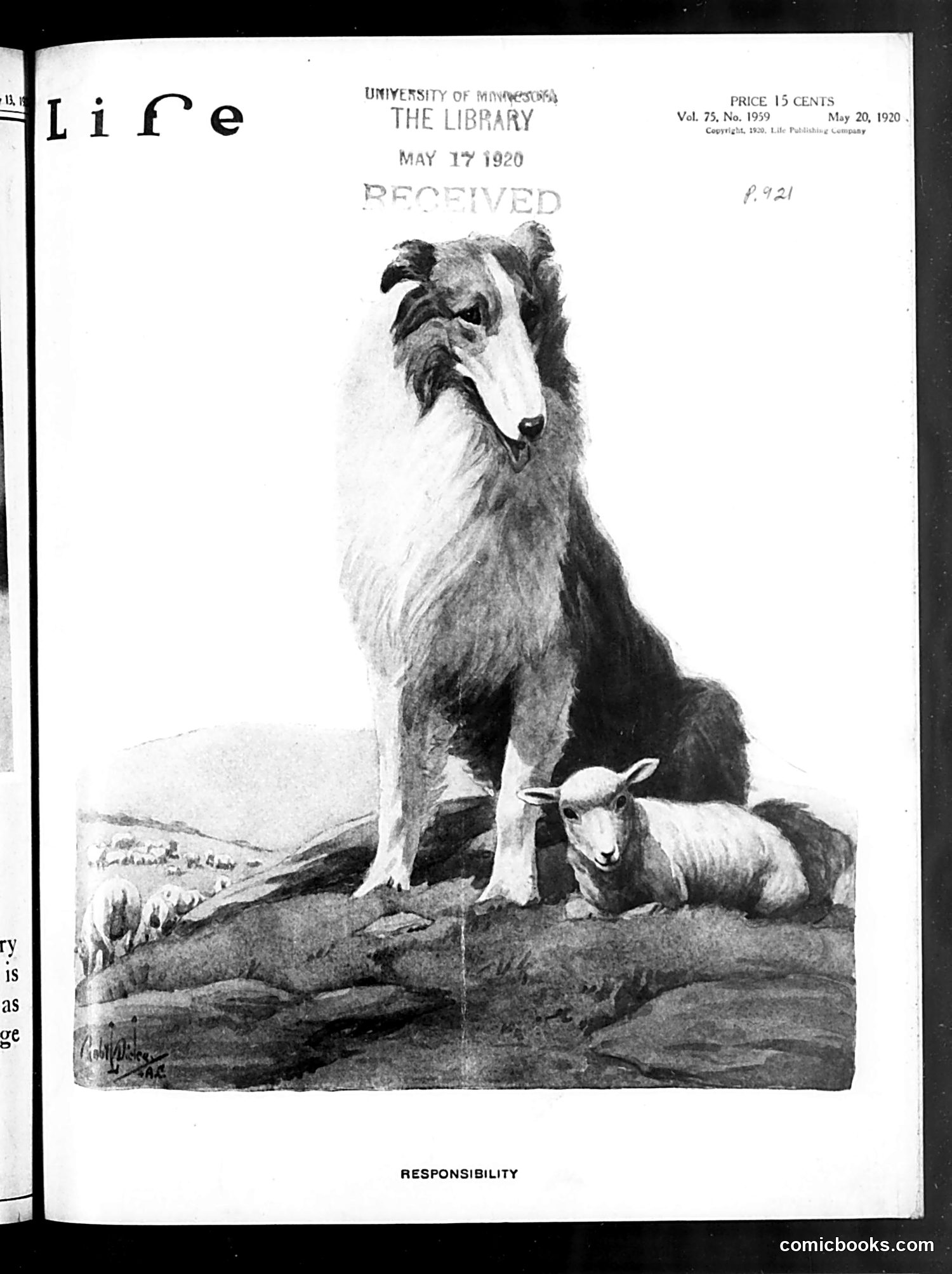
This illustration uses animals as political metaphor. A large dog (likely representing a leader or authority figure) stands protectively over a smaller lamb or sheep, which lies resting beneath it. The title "RESPONSIBILITY" suggests the image comments on duties of protection or guardianship. The pastoral landscape and the juxtaposition of the larger, vigilant animal with the vulnerable smaller one suggests themes of stewardship or obligation. In 1920 post-WWI context, this likely references leadership's duty to protect the nation or its citizens. The artwork's serious tone—contrasting with typical satirical cartooning—emphasizes the weight of such responsibility. Without additional context, the specific political figures or events referenced remain unclear.
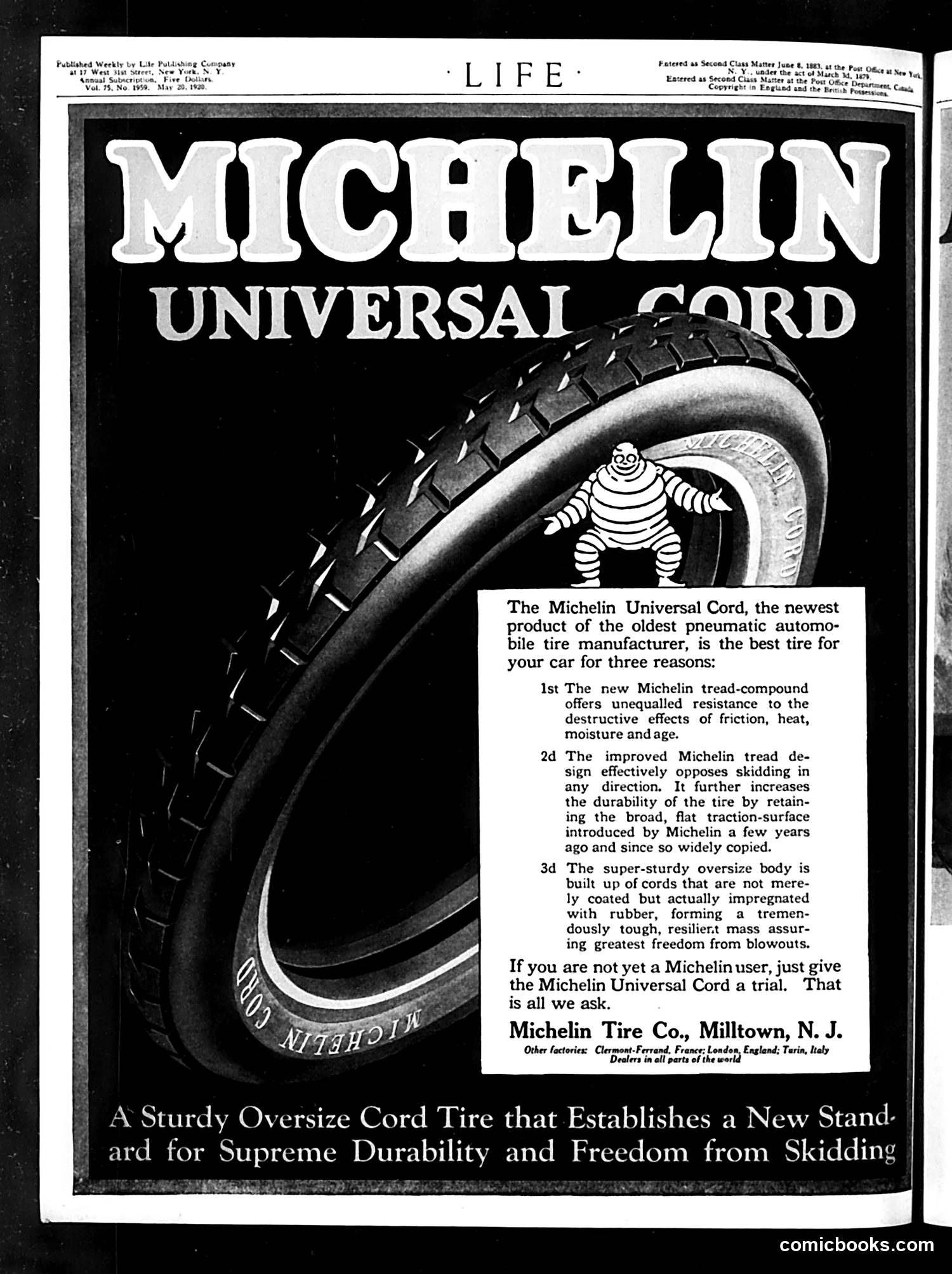
This page is primarily a **Michelin tire advertisement**, not political satire. It features the Michelin Man (Bibendum), the company's famous mascot—a rotund, anthropomorphic figure made of tire treads—positioned inside a tire cutaway illustration. The ad promotes the "Universal Cord" tire with three selling points: superior tread-compound durability, improved skid resistance, and a sturdy oversize cord body. The Michelin Man's presence is purely branding; there is no cartoon or political commentary. The only noteworthy element for historical context is the mascot itself—already an established advertising icon by 1920 (Bibendum debuted in 1898)—demonstrating how early 20th-century advertising used distinctive character mascots to build brand recognition.
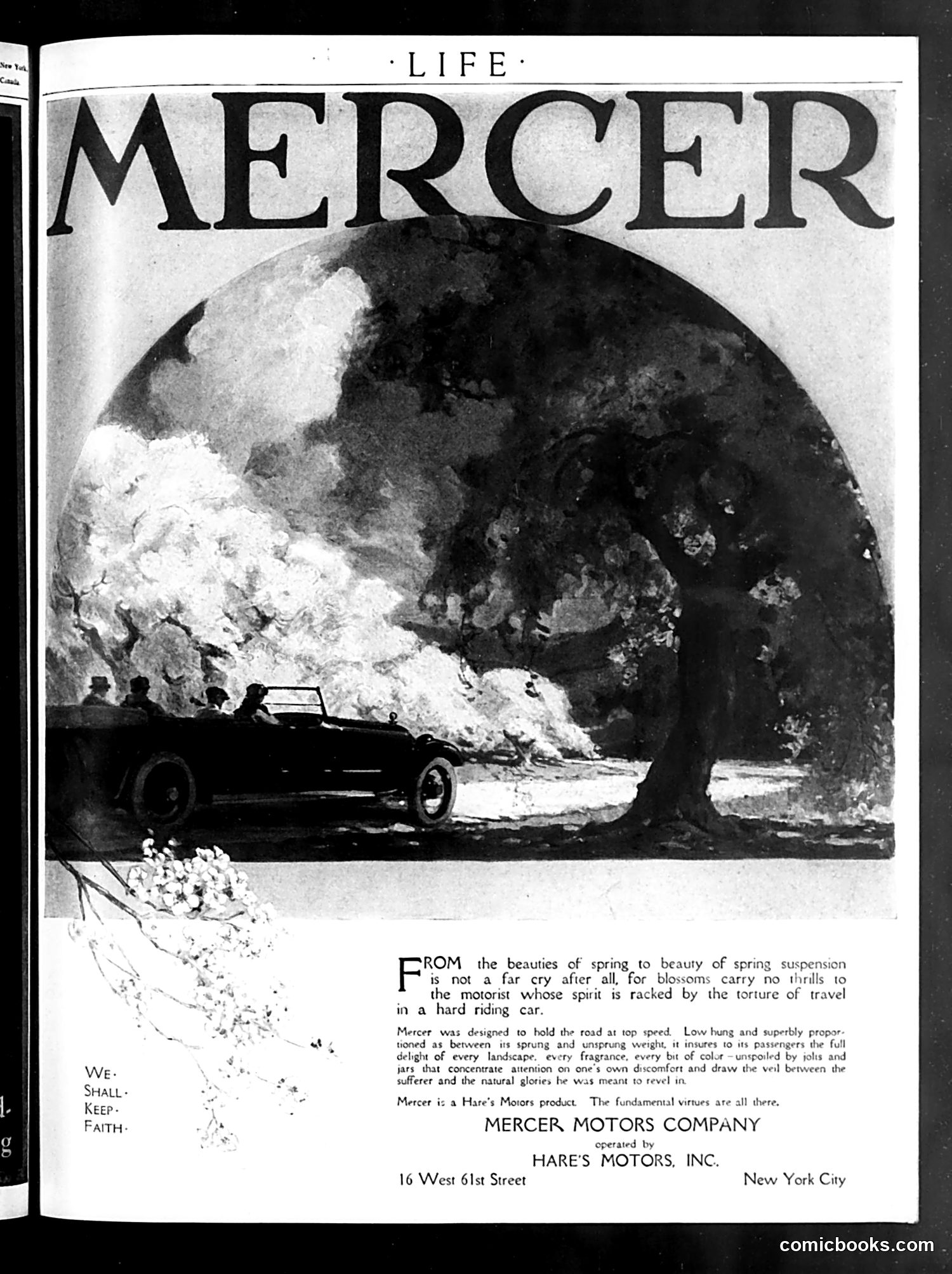
This appears to be primarily a **Mercer automobile advertisement** rather than political satire or comics. The page features a dramatic photograph of a luxury car parked beneath a large tree with flowing water or spring in the background. The ad's text emphasizes the Mercer's superior **suspension and riding comfort**—claiming it provides "the full delight of every landscape" and handles rough roads smoothly. The tagline "We Shall Keep Faith" suggests reliability and quality. The automobile is positioned as ideal for leisurely spring drives through scenic landscapes, appealing to affluent motorists. This represents typical early-20th-century automotive marketing: emphasizing engineering superiority and lifestyle aspirations rather than price or specifications. The page reflects the era when automobiles were luxury goods marketed to the wealthy.
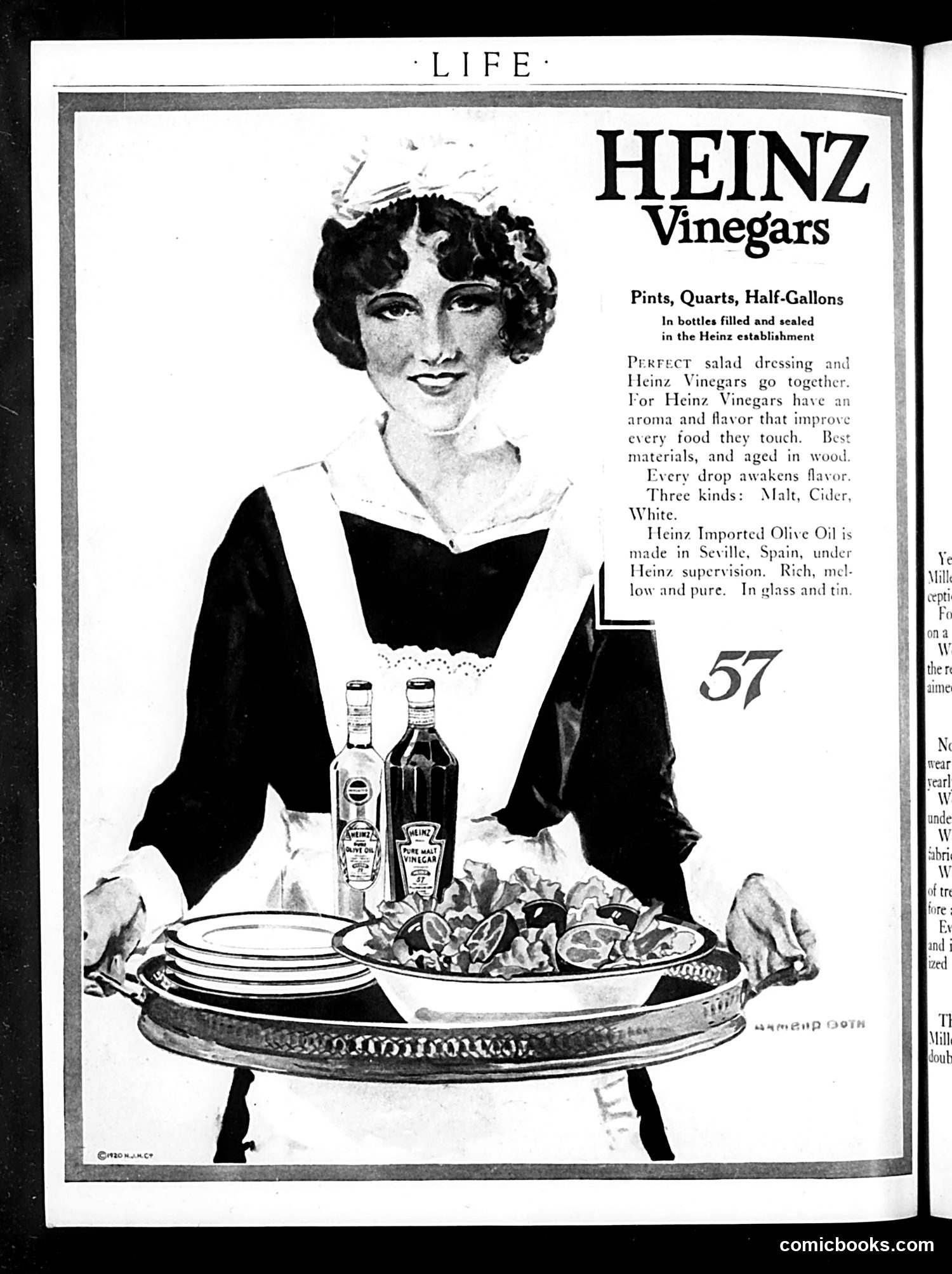
This page is **not a cartoon or satire** — it's a straightforward **advertisement for Heinz Vinegars**, appearing in Life magazine's advertising section. The ad features an elegantly dressed woman in 1920s attire holding a serving tray with salad, bottles of Heinz vinegar, and place settings. The ad copy emphasizes that Heinz Vinegars complement salad dressing and improve food quality. It highlights three vinegar varieties (Malt, Cider, White) and promotes Heinz Imported Olive Oil from Seville, Spain. The "57" visible in the image refers to Heinz's famous "57 Varieties" branding. The sophisticated presentation—featuring an upper-class woman as the aspirational consumer—reflects early 20th-century marketing that associated the product with refinement and proper homemaking.
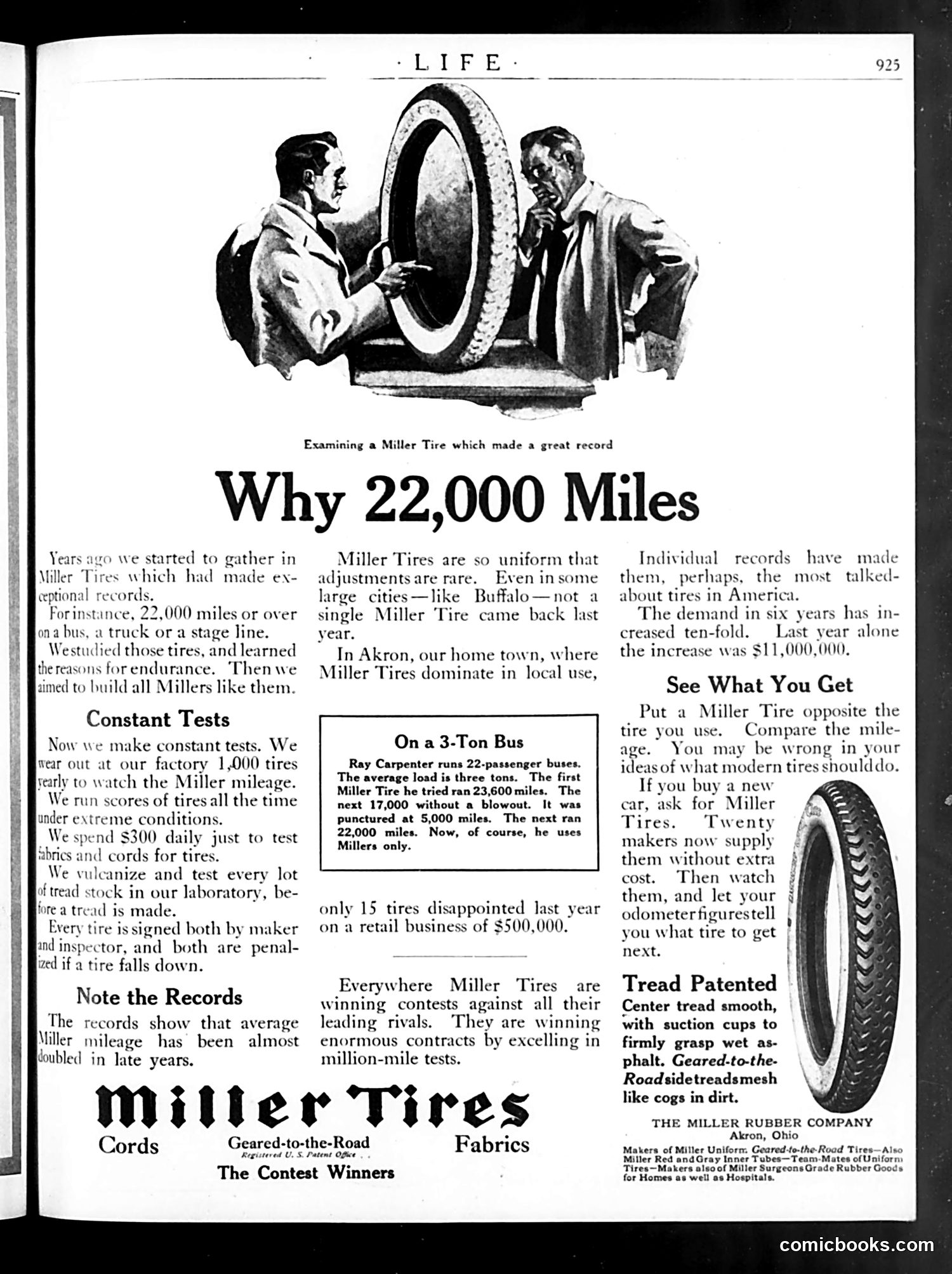
This page is primarily **advertising, not satire**. It's a Miller Tire Company advertisement from Life magazine (page 925). The central illustration shows two men in business attire examining a large tire—a straightforward product demonstration image, not political commentary or caricature. The ad emphasizes Miller Tires' durability through competitive testing: a bus achieved 22,000 miles on a single tire, and only 15 tires failed out of a $500,000 retail business. The copy stresses rigorous factory testing (1,000 tires tested constantly) and challenges consumers to compare Miller Tires against competitors. The tire illustration on the right displays the product's patented center tread design. This is standard commercial advertising highlighting manufacturing reliability and performance metrics—typical early 20th-century promotional strategy with no satirical element.
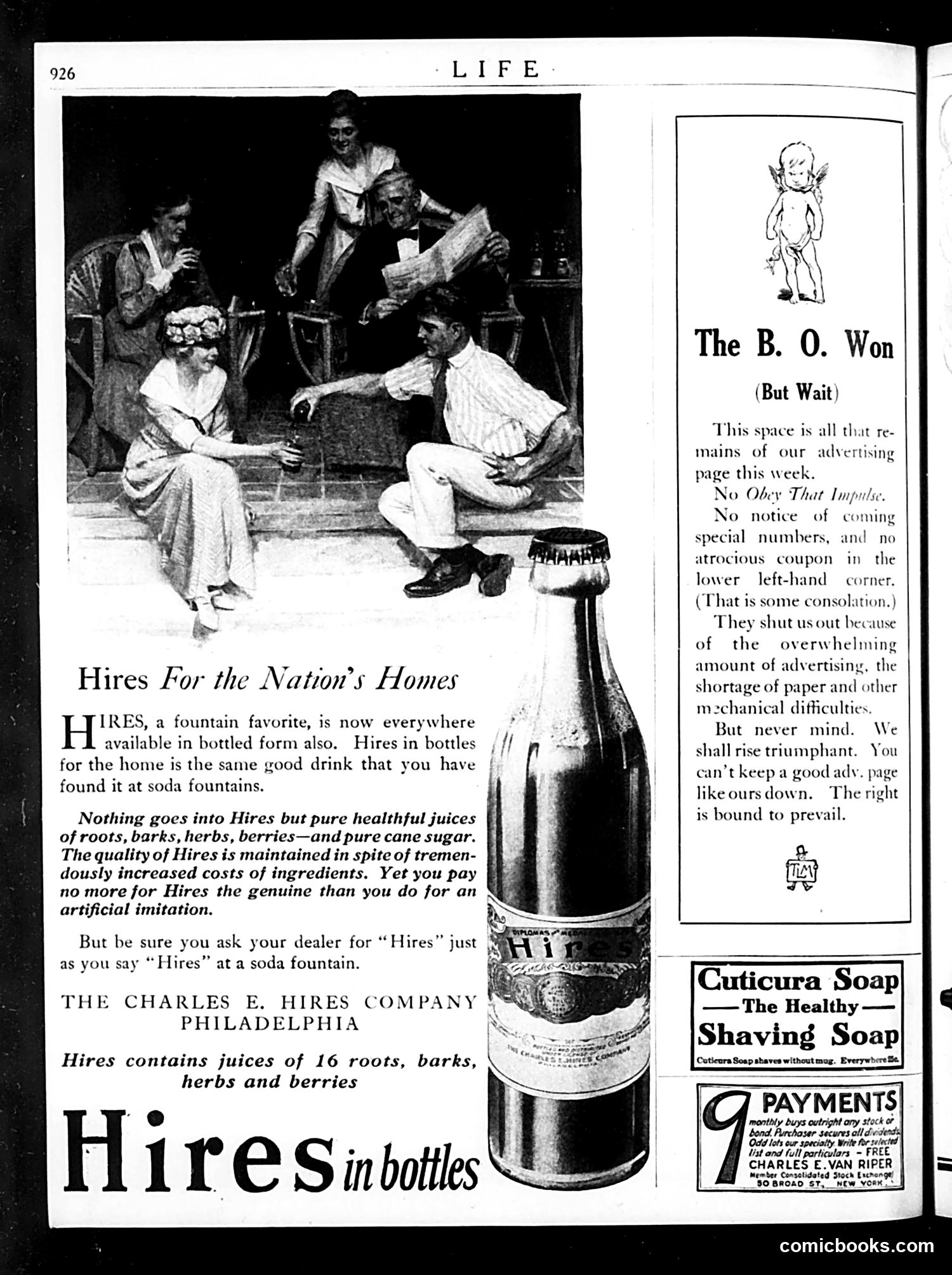
This page is primarily **advertising** rather than political satire. The main content promotes Hires root beer in bottled form for home consumption, emphasizing its pure ingredients (roots, barks, herbs, berries, cane sugar) and positioning it as equivalent to fountain drinks. The small cartoon titled "The B.O. Won (But Wait)" in the upper right is a humorous aside about advertising space itself—apparently an advertiser pulled out due to paper shortages and mechanical difficulties during what was likely World War I rationing. The editors joke that they'll "rise triumphant" despite these constraints. The remaining space contains ads for Cuticura shaving soap and a payment plan service. This is a typical Life magazine page blending editorial humor with commercial content.
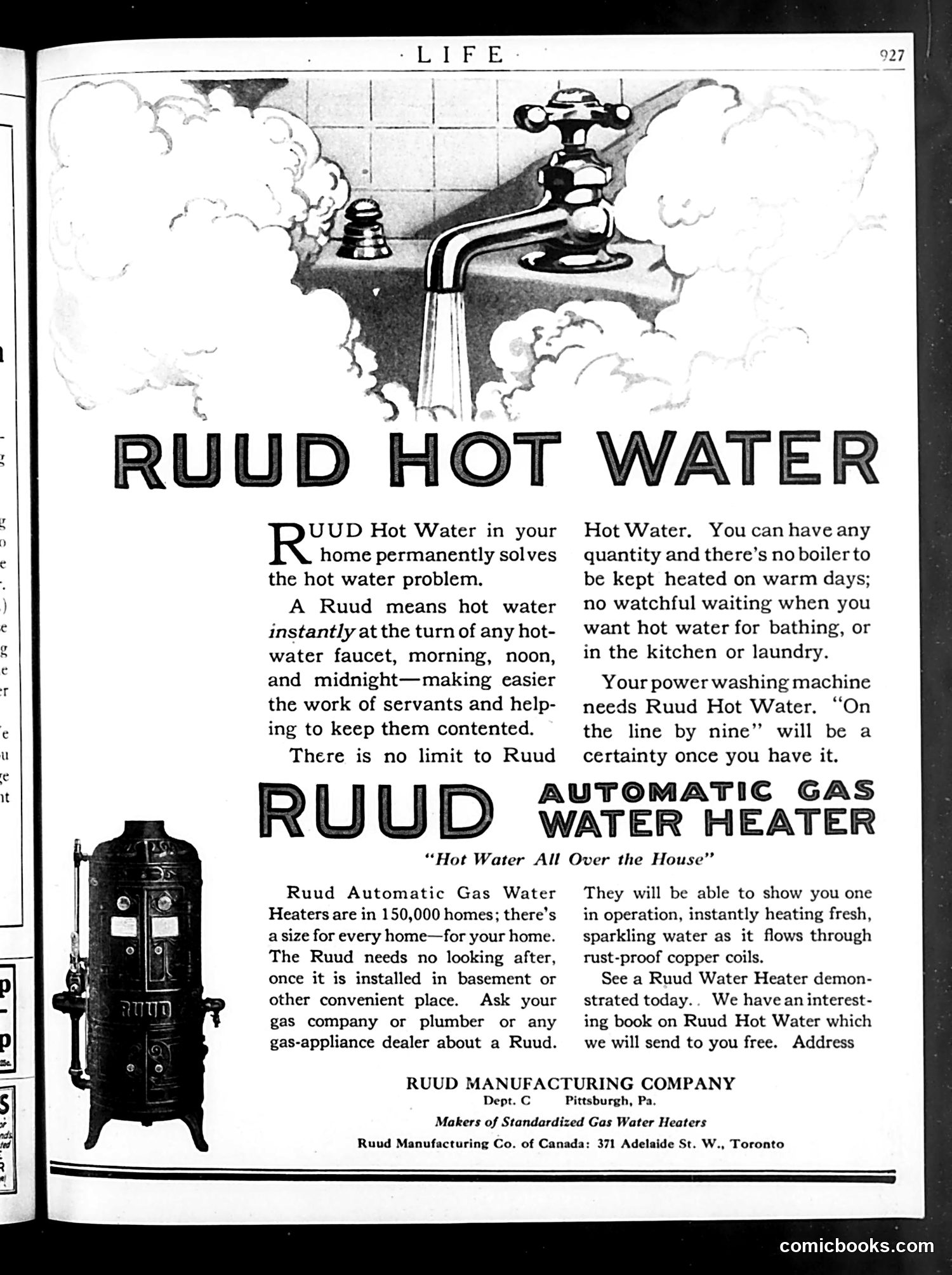
This page is primarily **advertising**, not satire or political commentary. It contains two advertisements for Ruud Hot Water heating systems—an automatic gas water heater marketed as a home convenience product. The illustrations are product advertisements, not political cartoons. The top image shows a faucet dispensing hot water amid clouds (symbolizing steam/heat), while the bottom shows the actual water heater device itself. The ads emphasize modern conveniences: instant hot water "at the turn of any hot-water faucet, morning, noon, and midnight." They highlight benefits for servants and household help, reflecting early 20th-century domestic labor concerns. The manufacturer (Pittsburgh, Pa., with Canadian offices) marketed these as luxury items for homes seeking automated comfort—a standard consumer advertisement of the era, not satirical commentary.
This is a **straightforward advertisement**, not satire or a cartoon. It's a full-page ad for White Trucks, manufactured by The White Company of Cleveland, appearing in Life magazine. The ad uses a marketing strategy common to the era: listing "firsts" and achievements to establish the brand's superiority. It emphasizes White Trucks' dominance in: - Diverse commercial applications - Long-term vehicle durability (100,000-300,000 mile records) - Profitability for owners - Fleet adoption - Service infrastructure There is no political satire, caricature, or joke intended. This represents standard early-20th-century industrial advertising in a general-interest magazine, designed to appeal to business owners and fleet operators considering truck purchases.
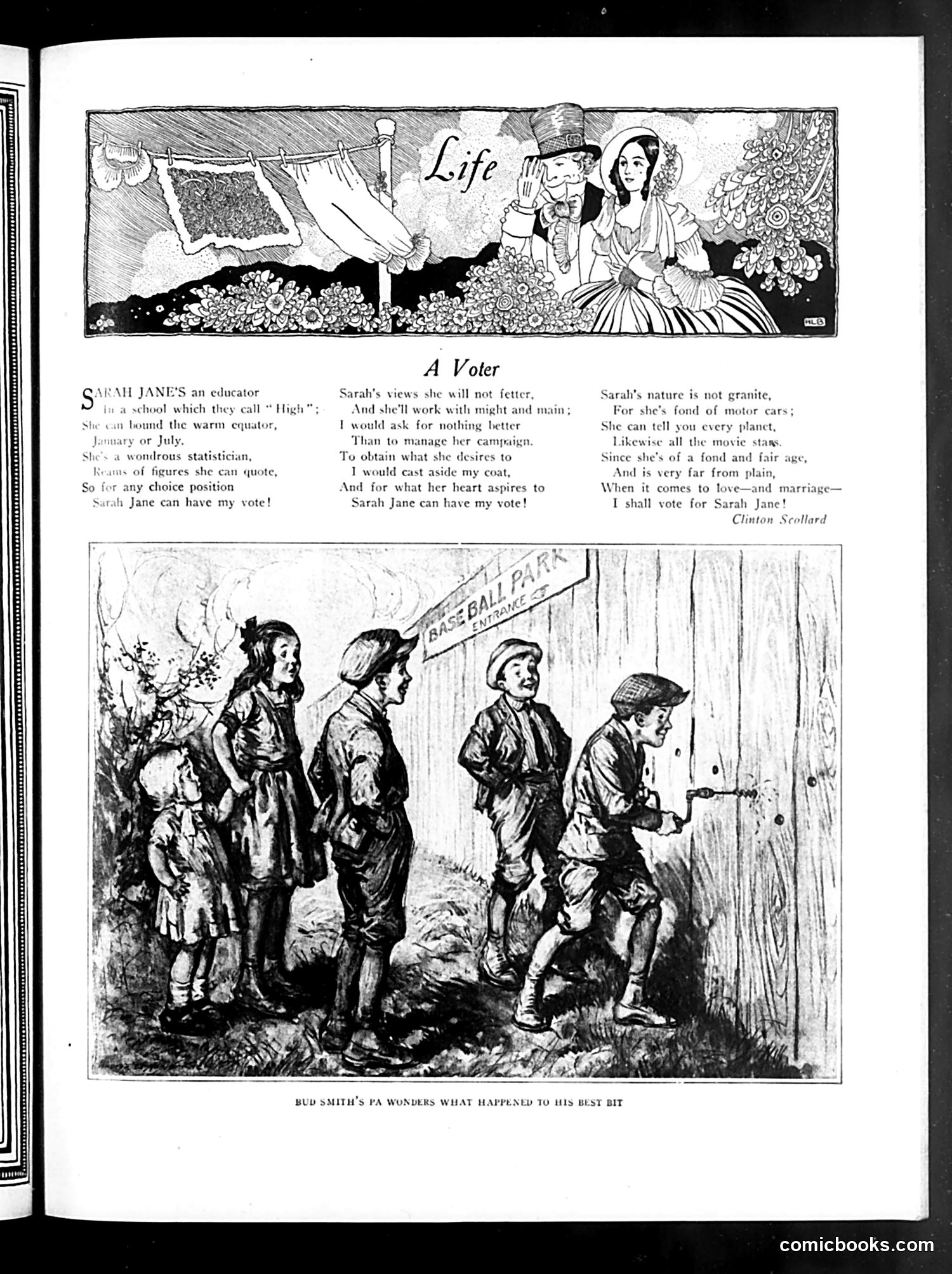
This page from *Life* magazine features a poem by Clinton Scollard endorsing "Sarah Jane" as a voter. The text praises her as an educator, statistician, and advocate for women's suffrage, arguing she deserves voting rights for her competence and character. The bottom illustration, titled "Bud Smith's Pa Wonders What Happened to His Best Bit," depicts children playing baseball near a park entrance. The joke appears to contrast the serious political advocacy above with a humorous domestic scene—likely suggesting that while debates about women's voting rights occur, ordinary life (children's games) continues unaffected. The "best bit" reference remains unclear without additional context.
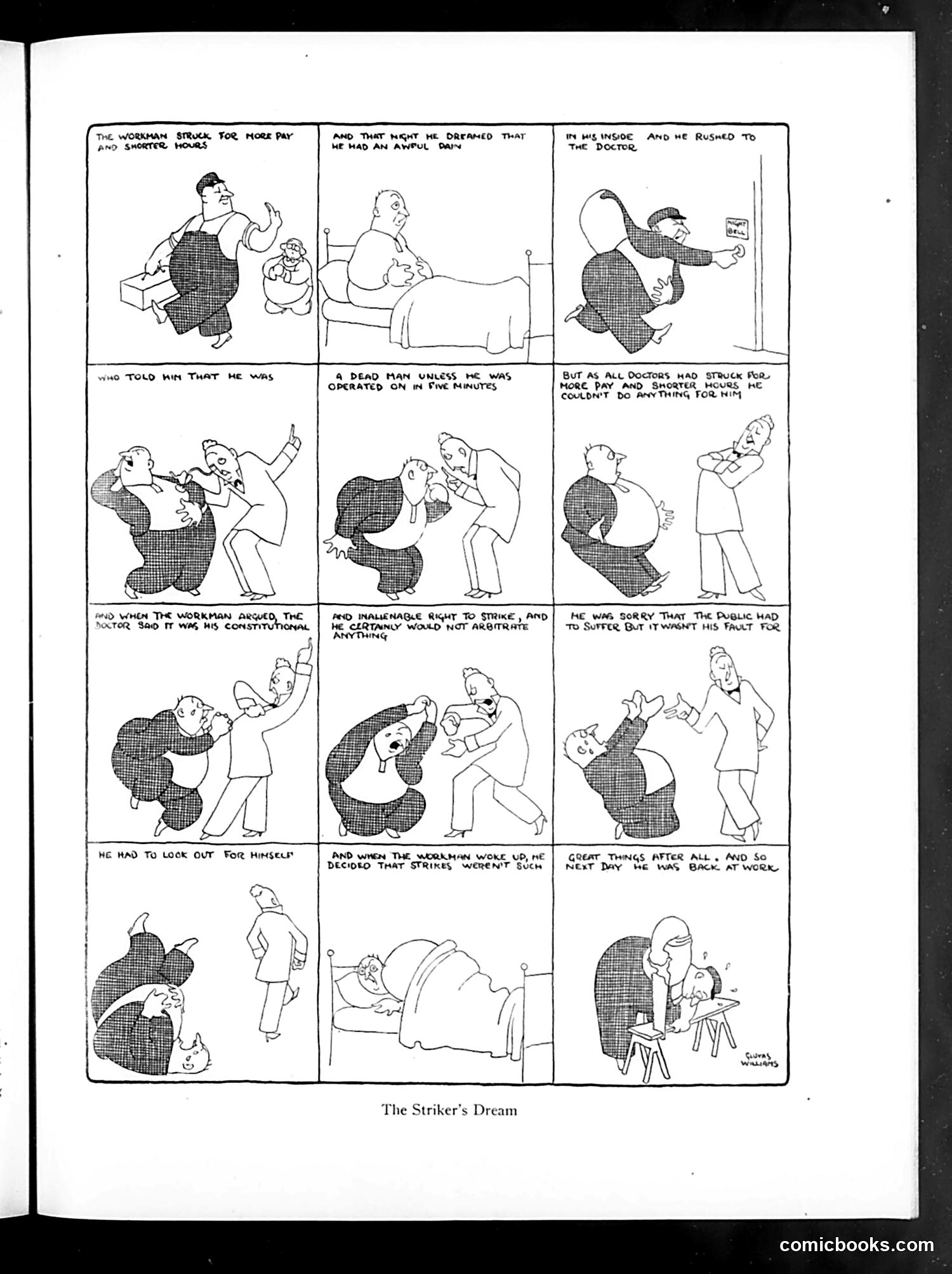
This comic satirizes labor strikes and doctors' ethics during an early 20th-century labor dispute (likely referencing a doctors' strike). A workman strikes for better pay and shorter hours, then dreams he has an accident requiring immediate surgery. The doctor refuses to operate because doctors are also striking for better pay and shorter hours—creating an ironic reversal where the striker experiences the consequences of strike action. The satire's point: strikes harm workers themselves, not just employers. The workman ironically becomes victim to the same labor action he supports. The comic argues that universal strikes create dangerous situations where essential services (medical care) become unavailable, even to strikers' own community members.
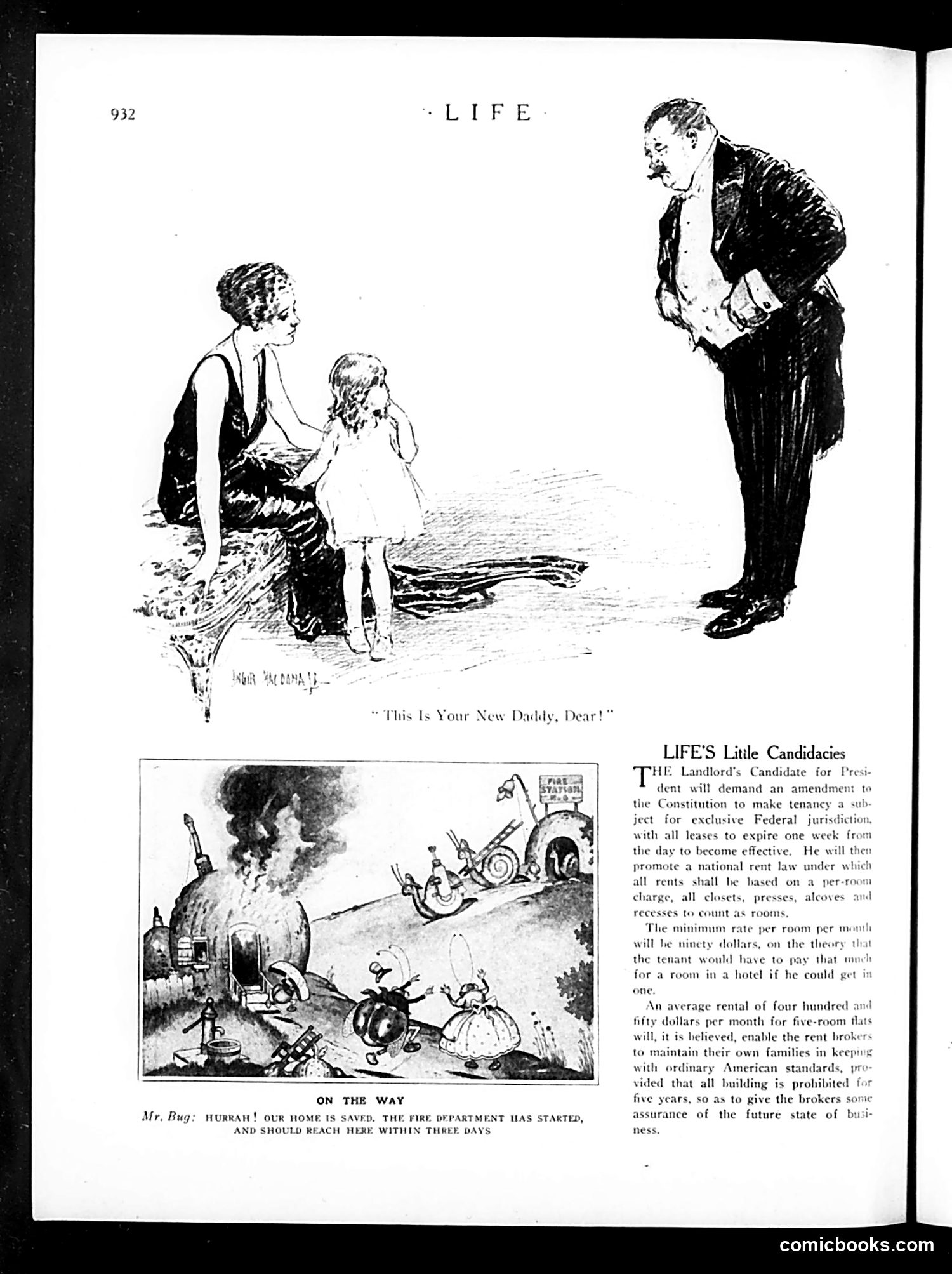
**Top Cartoon ("This Is Your New Daddy, Dear!"):** Shows a woman and child meeting a formally-dressed man. The caption suggests remarriage or a new family arrangement, likely satirizing social attitudes toward divorce and blended families. **Bottom Illustration ("On the Way"):** Depicts a chaotic scene with Mr. Bag celebrating as the fire department approaches his home. The caption reads: "Hurrah! Our home is saved. The fire department has started, and should reach here within three days." This satirizes slow emergency response times or government inefficiency—the fire department's glacial pace means his house will burn down before help arrives. **"LIFE'S Little Candidacies" Article:** Discusses a proposed constitutional amendment creating federal rent control, with specific minimum rates and room-counting provisions. This appears to address 1920s housing policy debates.
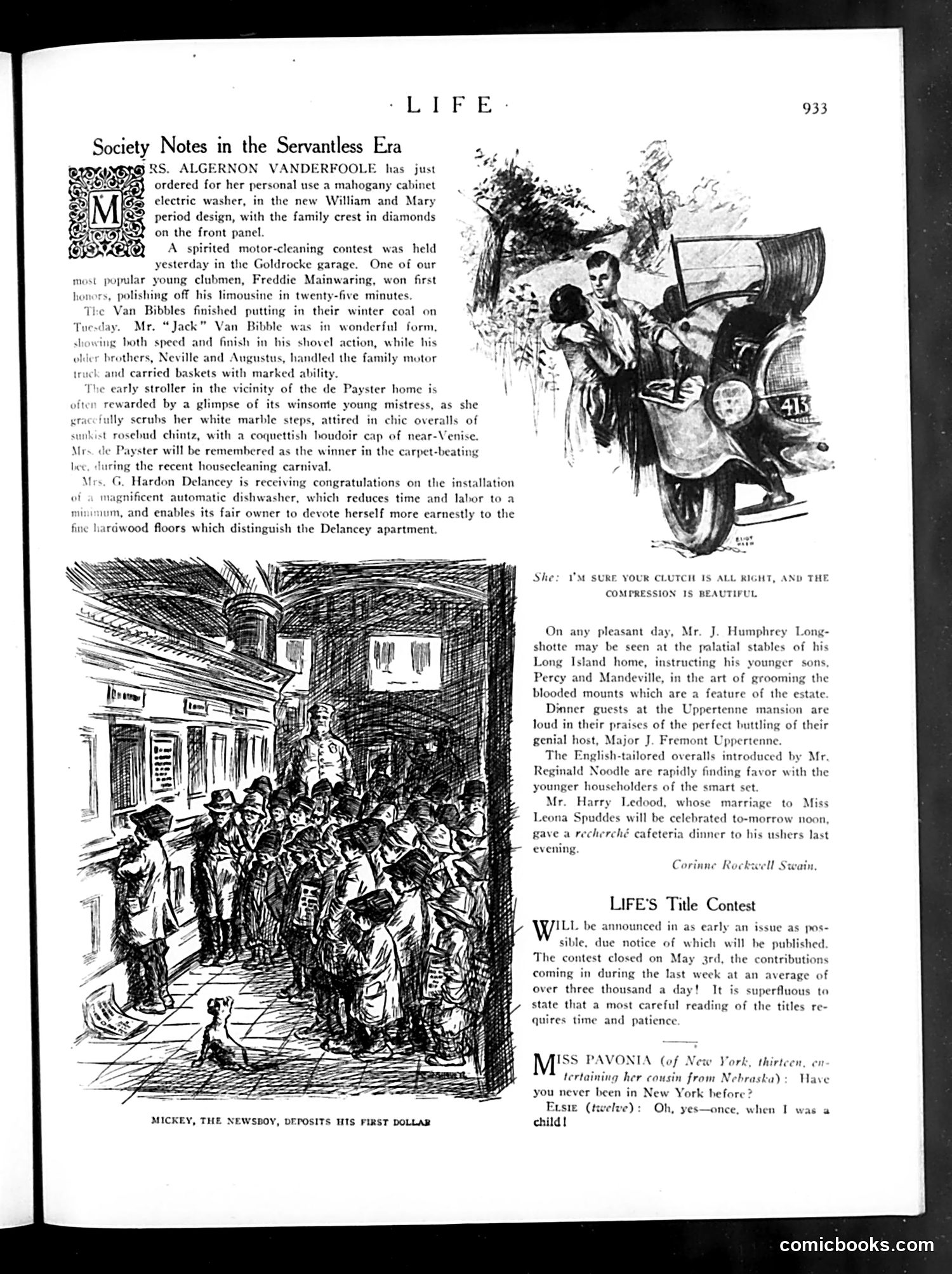
This page contains **society gossip and humor** rather than political satire. The "Society Notes in the Servantless Era" section reports on wealthy families' activities—new appliances, automobile competitions, and social events. The two illustrations are **humorous domestic scenes**: the upper cartoon shows a woman in a car making a comment about the clutch and compression; the lower, titled "Mickey, the Newsboy, Deposits His First Dollar," depicts a crowded street scene, likely satirizing a young newsboy's first earnings. The page's humor centers on **leisure-class concerns** (modern appliances, automobiles, servants) and the quaint idea of a newsboy's financial milestone. The "Servantless Era" title suggests post-WWI labor scarcity affecting wealthy households. No specific political figures or events are referenced.
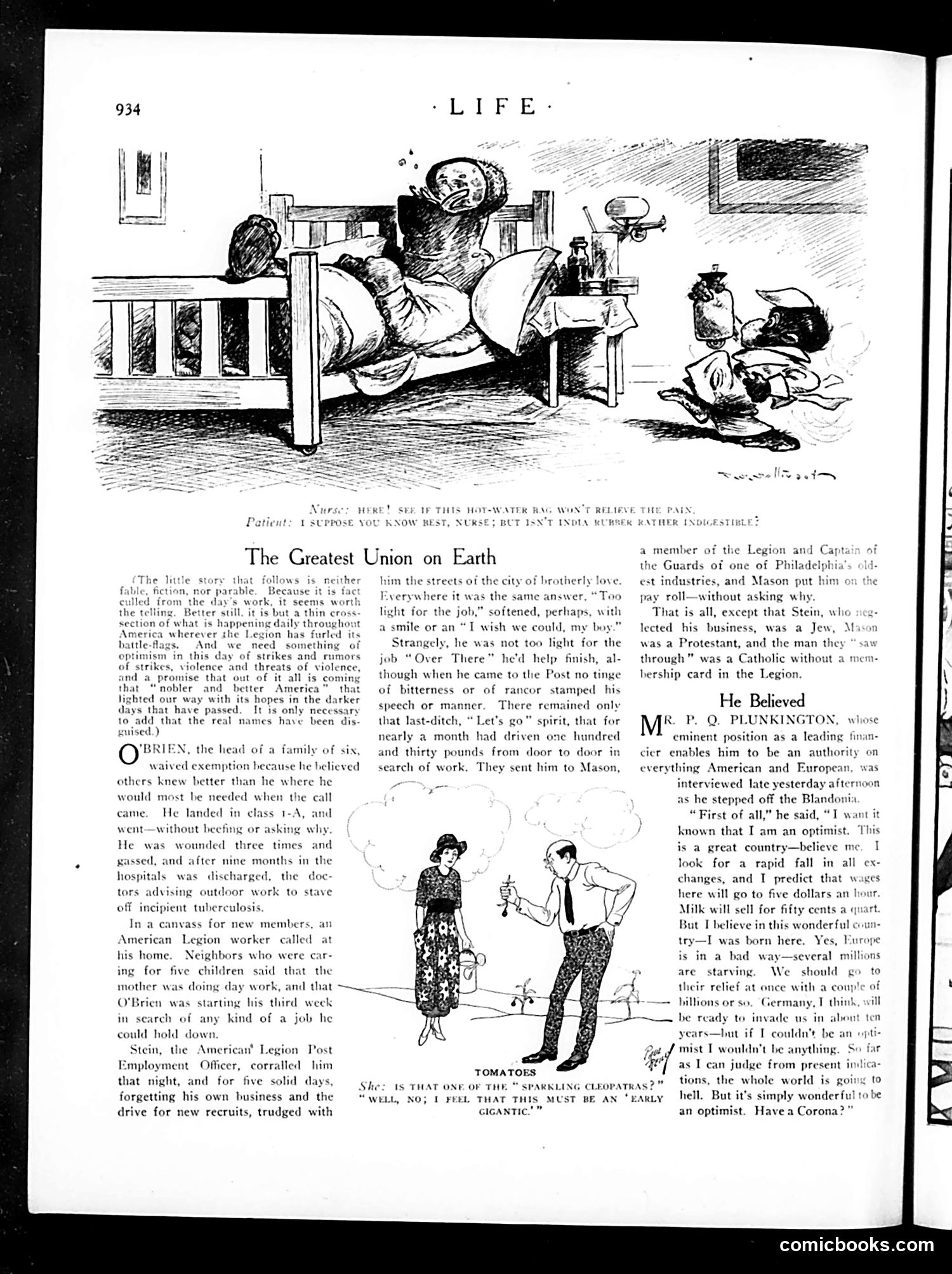
This page contains two distinct cartoons satirizing post-WWI American society. **Top cartoon**: Shows a nurse with a patient in bed using a hot-water bag. The caption mocks the patient's skepticism about pain relief, suggesting even unconventional remedies seem worth trying. **Bottom cartoon** ("Tomatoes"): Depicts a man and woman discussing large tomatoes. The woman asks if they're "sparkling cleopatra" varieties, and the man responds they must be "early gigantic"—likely satirizing exaggerated agricultural claims or seed catalog marketing of the era. The accompanying text, "The Greatest Union on Earth," discusses American Legion charitable work and includes an interview with M.P.O. Pilkington about American optimism regarding post-war economic recovery and labor conditions. The piece reflects 1920s concerns about unemployment and class tensions.
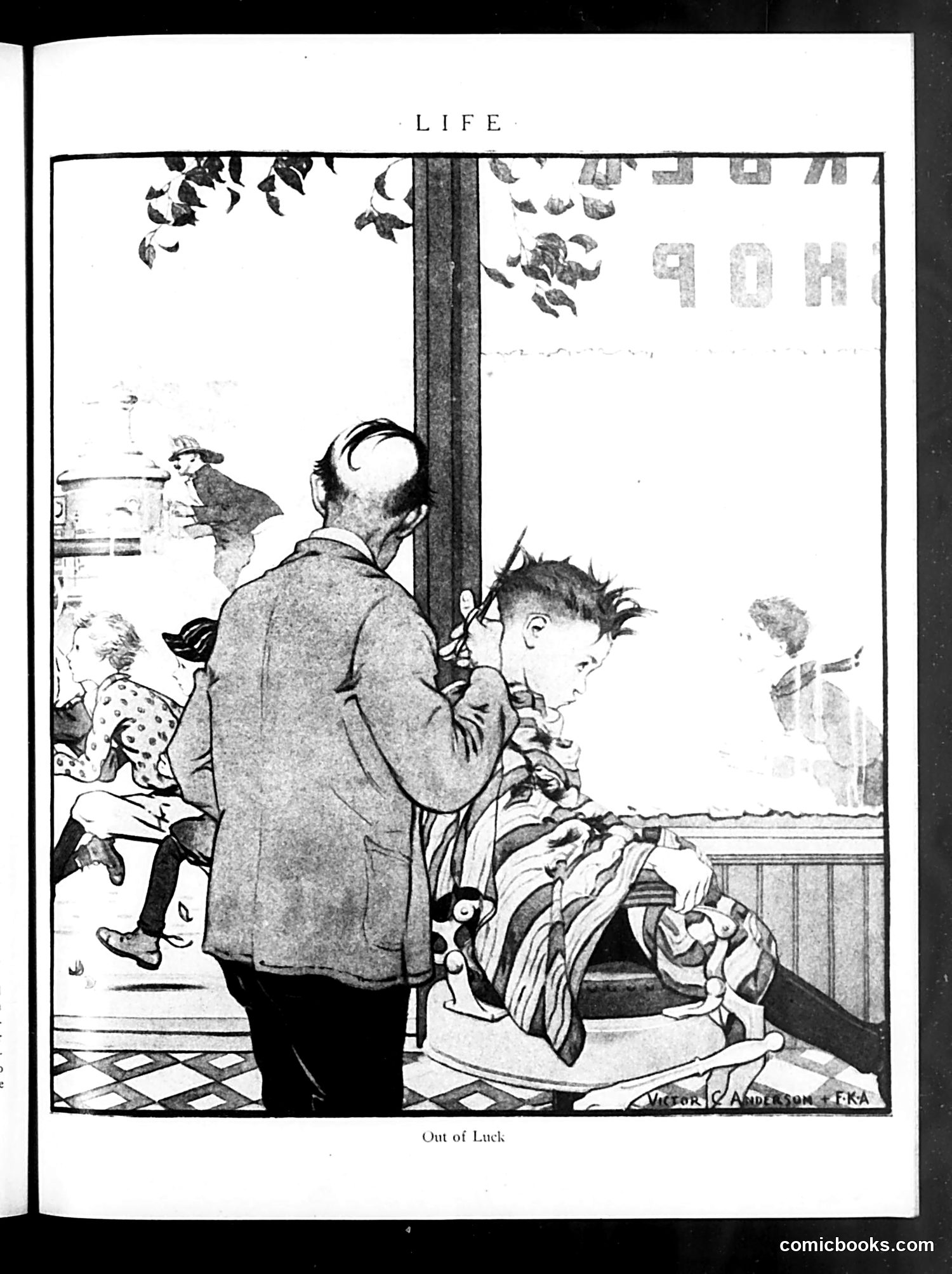
This cartoon by Victor C. Anderson depicts a domestic scene where a bald man stands at a window with a young boy, both looking outside. The caption "Out of Luck" suggests the figures are disappointed by something they observe. The drawing style and composition suggest this is satirizing a common domestic situation—likely a father and son unable to do something they wanted (fishing, playing outside, or attending an event). The window framing and their body language emphasize thwarted expectations. Without additional context about the specific publication date, the exact reference remains unclear. However, this appears typical of Life's humor: gentle domestic satire about ordinary people's everyday disappointments and minor misfortunes.
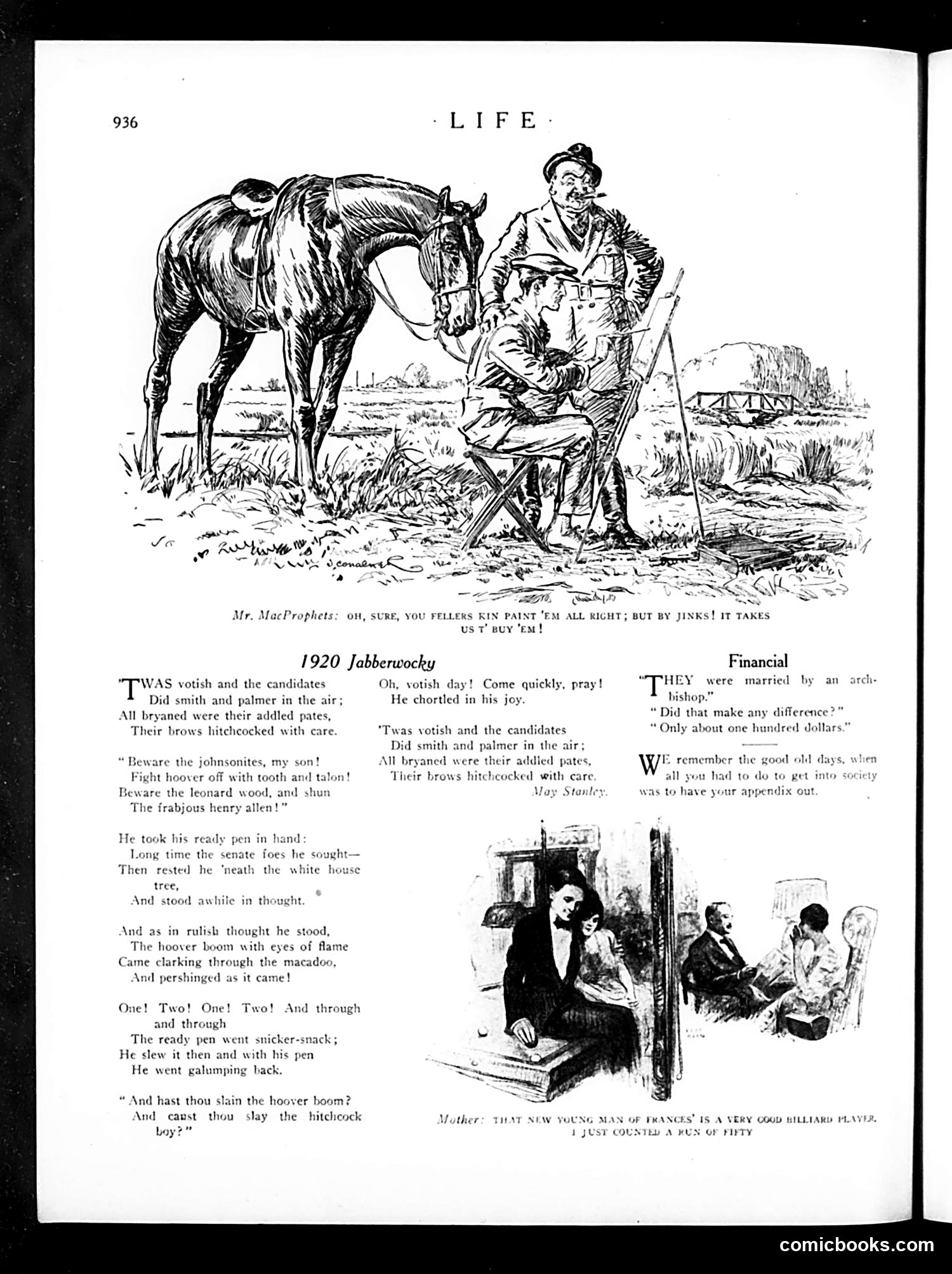
**Top Cartoon:** The caption "Mr. MacProphets" quotes someone saying fillers "paint 'em all right" but "by jinks it takes us t'buy 'em!" This appears to satirize post-WWI inflation and consumer frustration. A man with a horse (possibly representing a working-class or rural figure) confronts what seems to be a salesman or authority figure. The joke targets the gap between product quality and affordability—manufacturers can make goods acceptably, but prices have become unreasonably high for ordinary people. **"1920 Jabberwocky":** A humorous poem mocking political candidates (Smith and Palmer mentioned) using nonsense verse in the style of Lewis Carroll. **"Financial" section:** A brief joke about marriage costs, suggesting economic anxieties about domestic life.
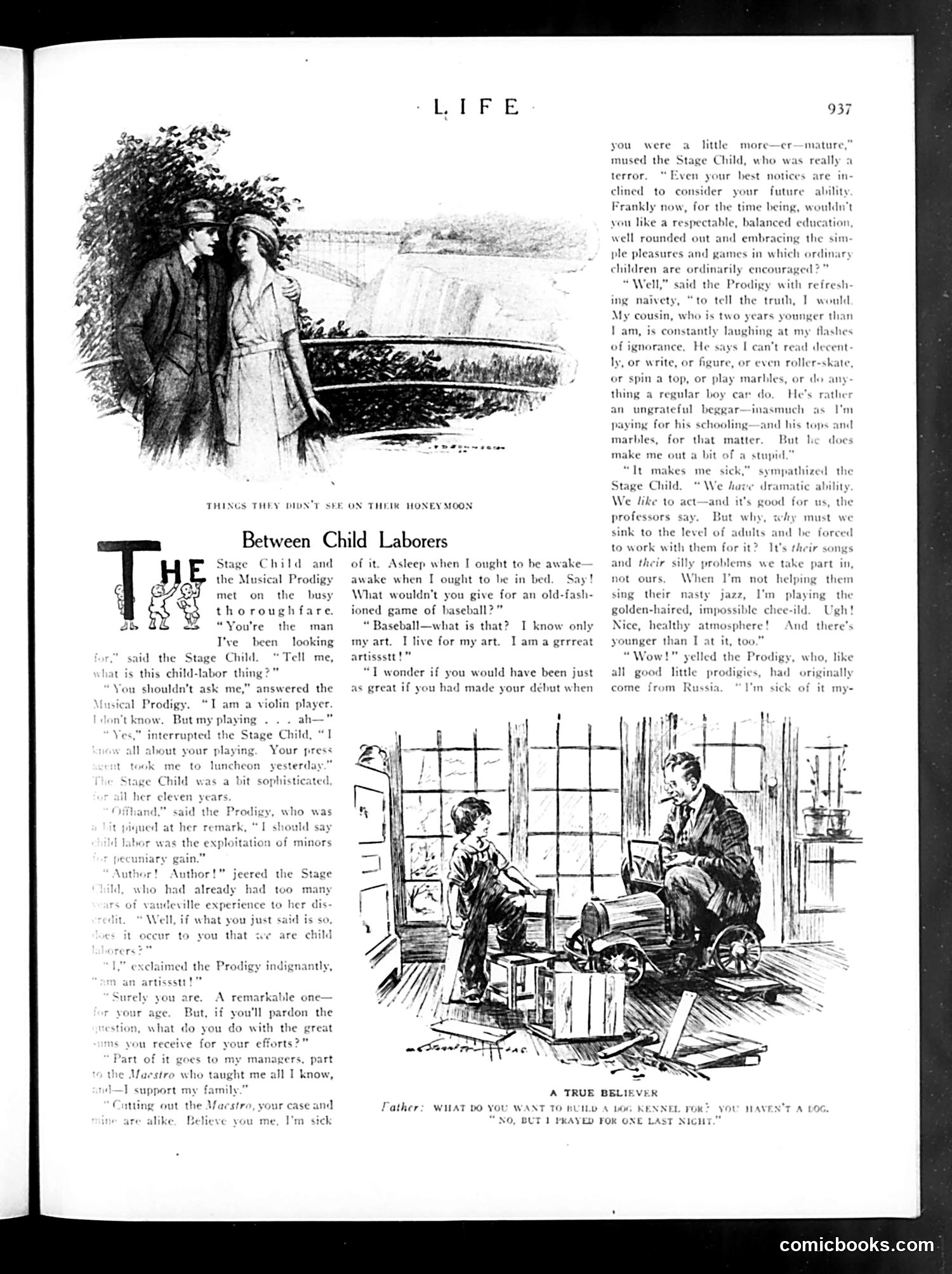
This satirical dialogue contrasts two exploited child performers: the "Stage Child" (an actor) and the "Musical Prodigy" (a violin virtuoso). Both are child laborers forced into professional performance rather than normal childhood. The satire mocks their inverted priorities. The Prodigy complains his younger cousin lacks "dramatic ability" and can't roller-skate—missing that ordinary children *should* play marbles and spin tops. The Stage Child romanticizes "nice, healthy atmosphere" while performing nasty jazz and "golden-haired, impossible" roles. The joke's bitter core: these children have been so professionally groomed they've lost perspective on what childhood means. They defend their exploitation as artistically necessary, while their earnings go to managers and teachers—not themselves. The bottom cartoon ("A True Believer") shows a child building a dog kennel after praying for a log, illustrating misplaced faith in divine provision. Both pieces critique child labor disguised as artistic opportunity.
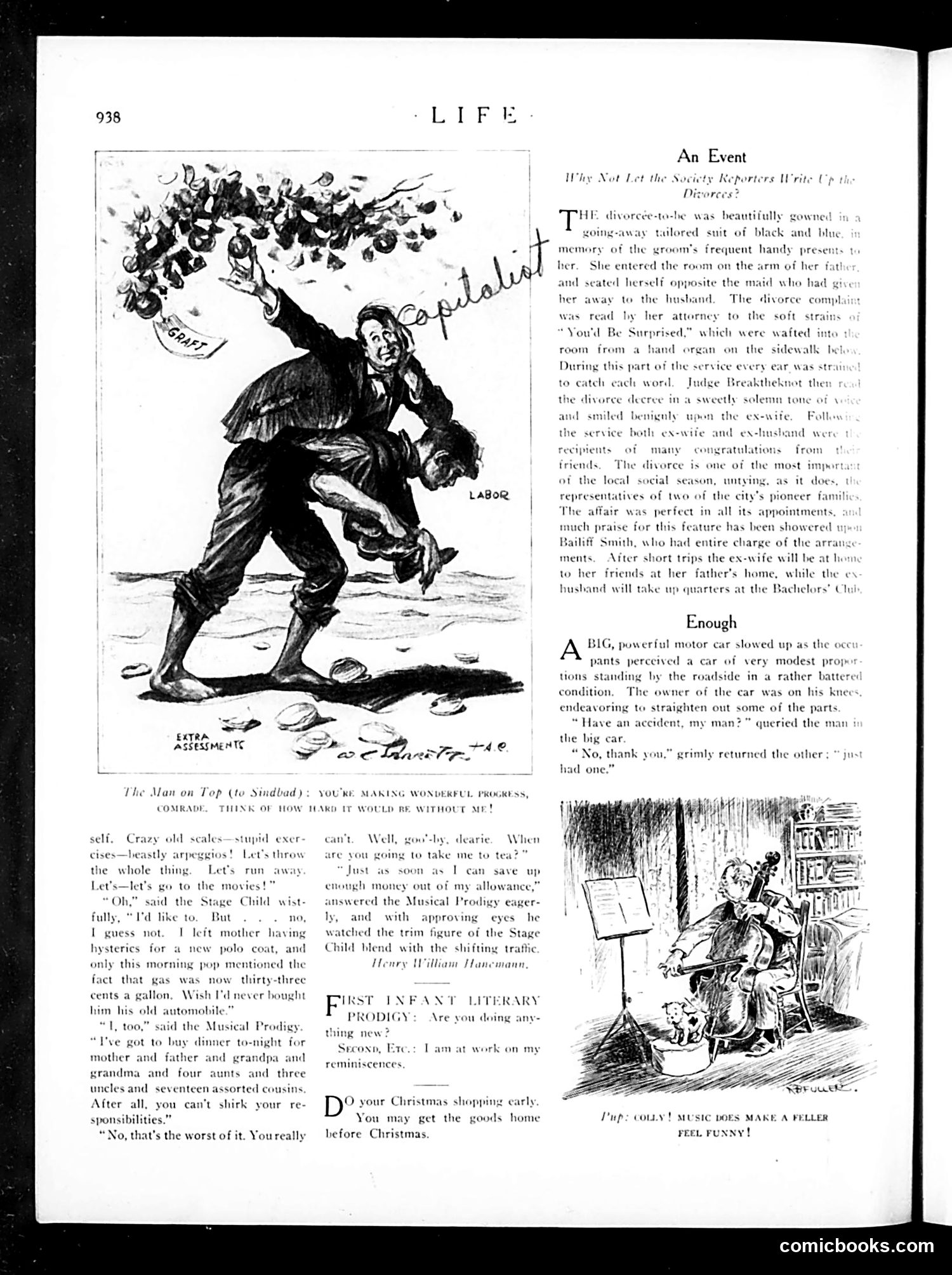
This page contains multiple satirical pieces mocking early 20th-century social conventions: **"The Man on Top"** cartoon shows a laborer being pelted by capitalist symbols (labeled "Capitalist" and "Labor") while struggling under their weight—criticizing class inequality and how working people bear society's burdens. **"An Event"** satirizes high-society divorce proceedings, describing a divorce treated as a fashionable social occasion complete with formal arrangements and socialite attendance. The satire lies in treating a serious legal matter as entertainment for the wealthy elite. **"Enough"** jokes about a wealthy motorist condescendingly offering help to a poor car owner, who curtly refuses—mocking class pretension and the gap between rich and poor. The smaller anecdotes about the "Musical Prodigy" and "Infant Literary Prodigy" mock privileged children burdened by familial financial expectations. Throughout, the satire targets wealth disparity, pretentious society manners, and class exploitation—typical Progressive Era *Life* magazine content critiquing American social structures.
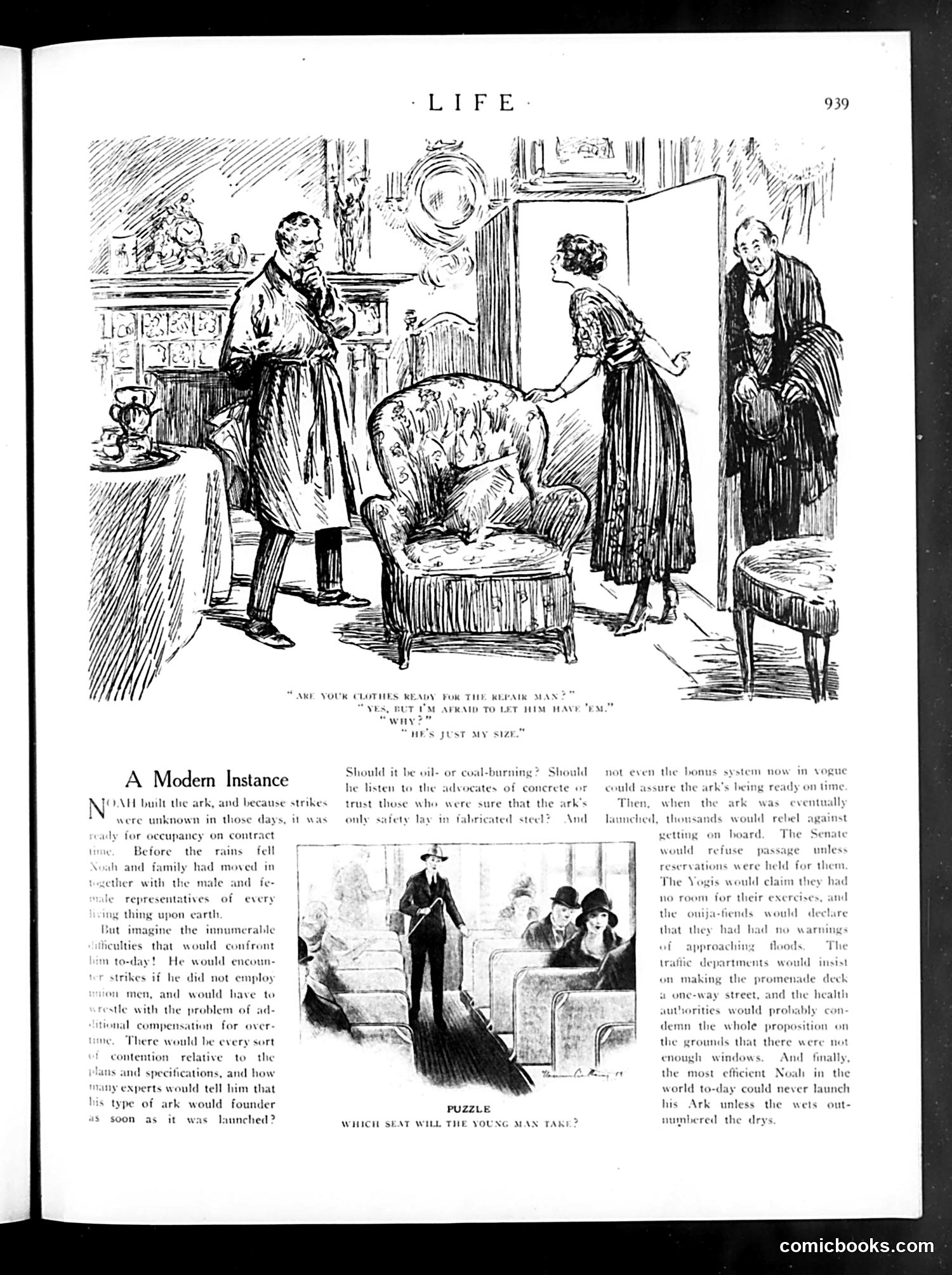
This page contains two separate satirical pieces from Life magazine: **Top Cartoon:** A domestic humor joke about a repairman visiting a home. The humor relies on a double meaning: the woman won't let the repairman take her clothes for repair because "he's just my size"—implying he might steal them or that there's an improper suggestion. **"A Modern Instance" Article:** A longer satire imagining Noah building the Ark in modern times. The piece mocks contemporary labor disputes, regulations, and social conflicts by contrasting them with the biblical story. It references strikes, union demands, compensation disputes, health inspectors, and "wets vs. drys"—the latter referring to Prohibition-era debates over alcohol. The satire suggests modern bureaucracy and labor complications would make even a divinely-mandated project impossible to complete. The embedded puzzle cartoon shows a crowded room with the caption asking which seat a young man will choose—likely another social commentary, though its specific reference is unclear.
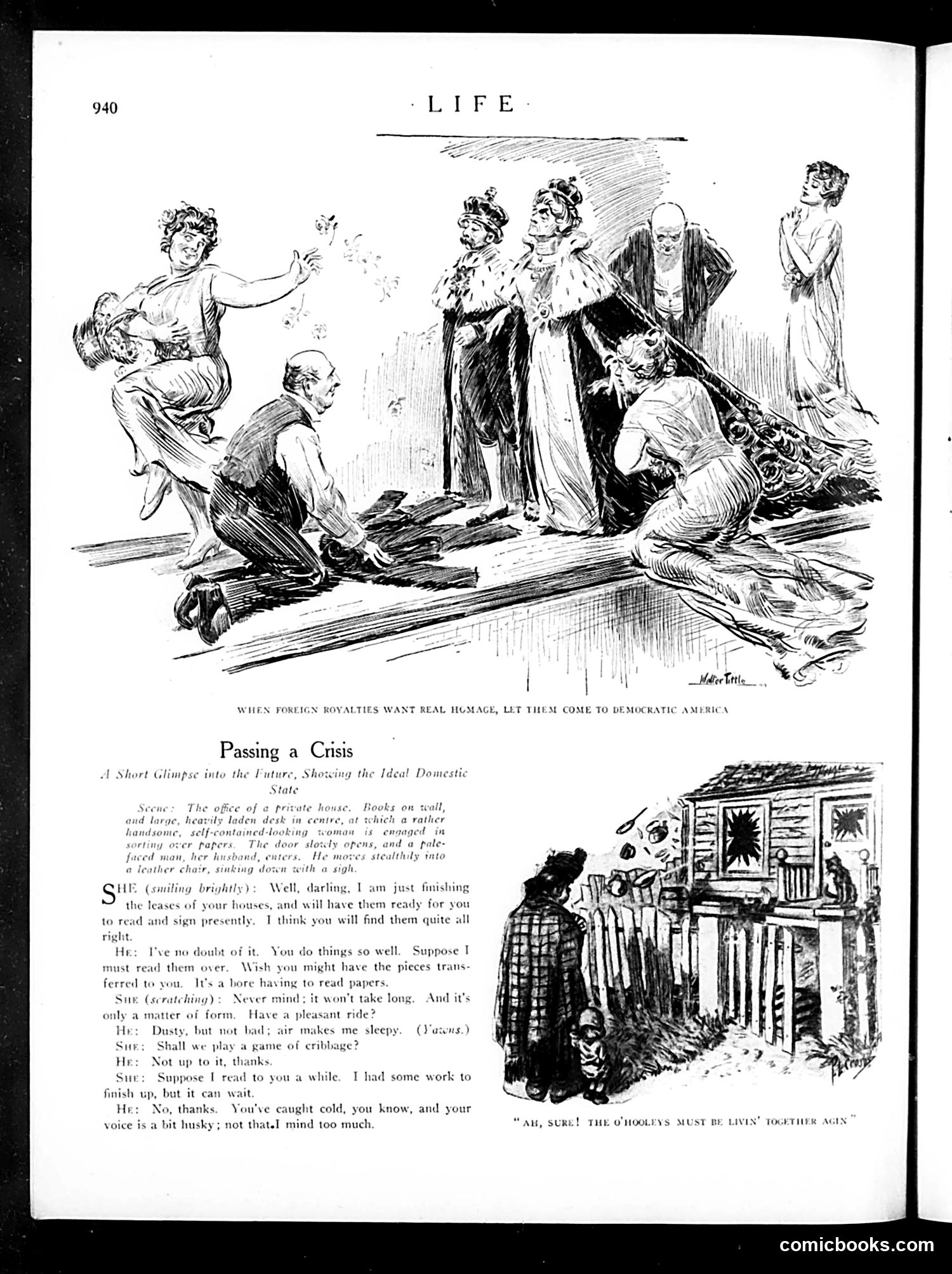
The top cartoon mocks European monarchy by showing foreign royalties literally bowing and scraping before common Americans, satirizing the notion that democratic America offers the "real homage" they seek—a jab at American obsession with foreign titles and aristocracy. The bottom sketch, "Passing a Crisis," depicts an "ideal domestic state" of the future. It shows a wife managing finances and property leases while her husband lounges passively. The satire targets anxieties about women's growing independence and economic power in early 20th-century America. The wife handles business matters, makes decisions, and reads to her husband—reversing traditional gender roles. The final caption about "the O'Hooleys" living together again suggests this role-reversal is scandalous enough to fuel neighborhood gossip, mocking both concerns about changing women's roles and working-class social dynamics.
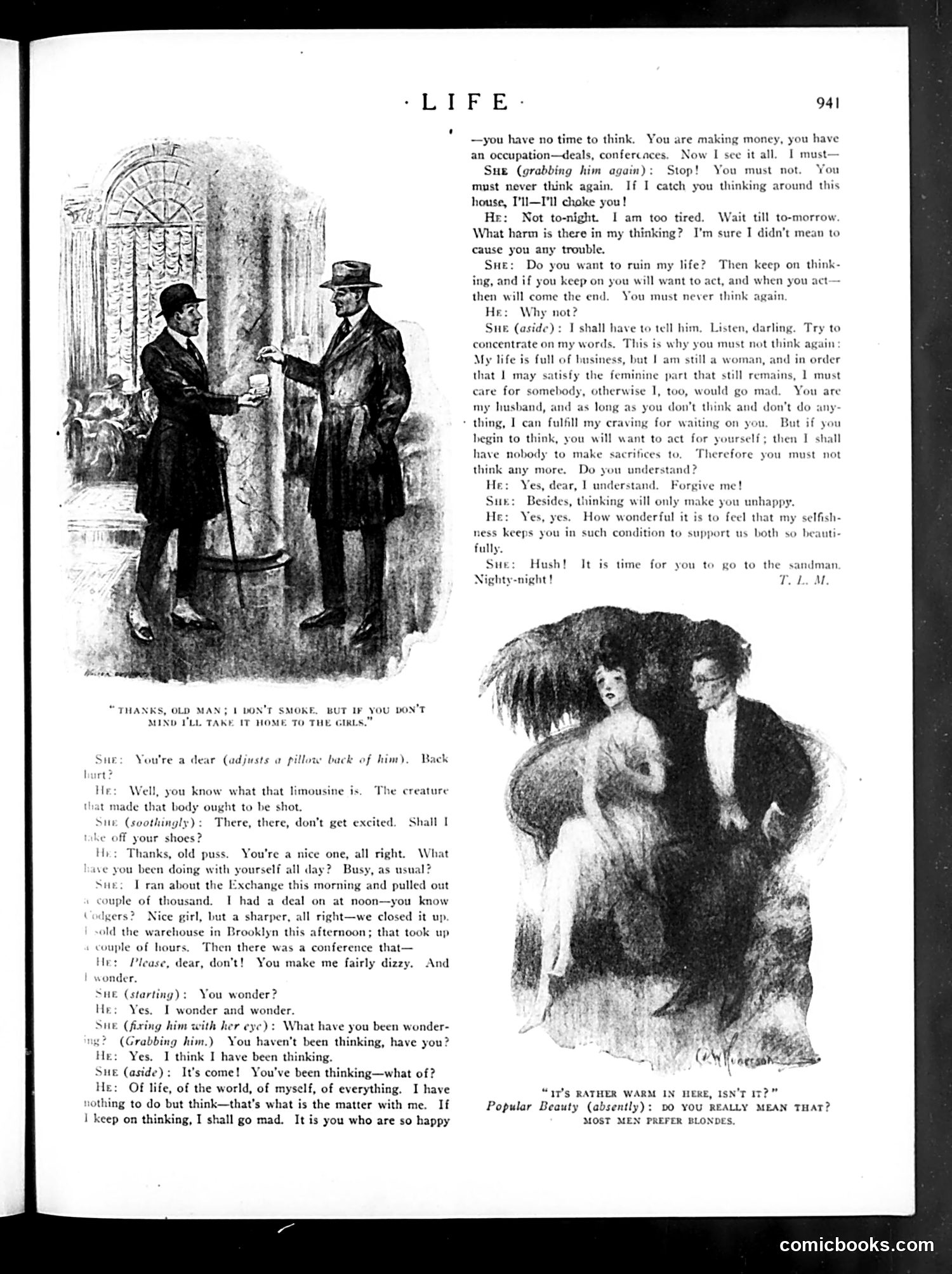
This page satirizes early 20th-century gender dynamics and marriage through a domestic comedy sketch. The main cartoon depicts a wife (Sue) actively *forbidding* her husband from thinking, arguing that his contemplation will lead to independence and action—which would rob her of her identity as a self-sacrificing caregiver. The satire targets several things simultaneously: the intellectual passivity expected of husbands in traditional marriages; women's economic dependence forcing them to manufacture elaborate justifications for control; and the absurdity of this dynamic itself. Sue ironically reveals that her "selfishness keeps you in such condition to support us both so beautifully"—exposing the parasitic nature of the arrangement while framing it as devotion. The lower cartoon about a "Popular Beauty" preferring blondes appears to be separate social commentary on beauty standards and female competition. The piece satirizes 1920s gender relations and economic dependence through dark humor, presenting marriage as mutually destructive theater.
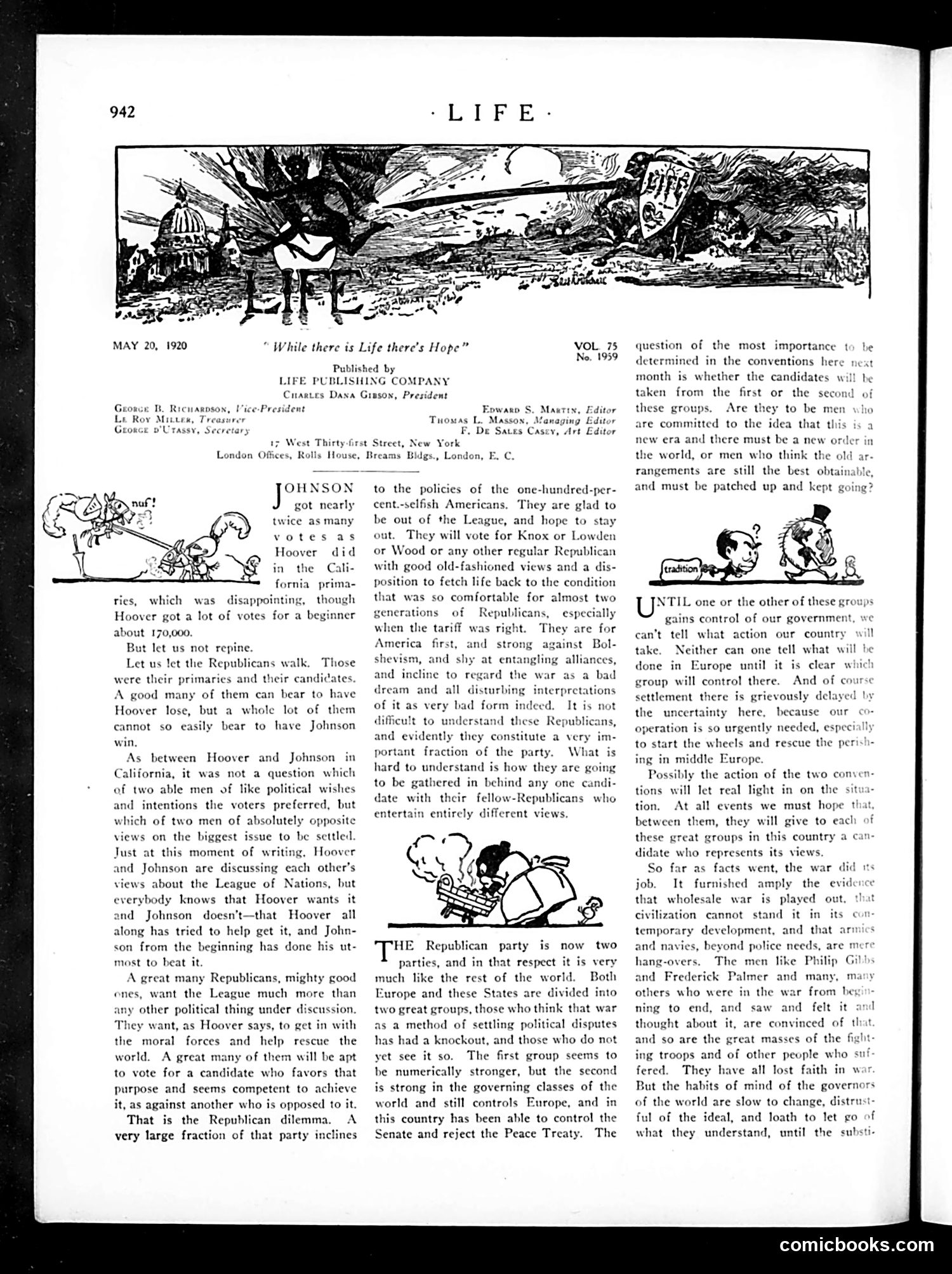
This editorial page discusses the 1920 Republican primary, where Herbert Hoover and Hiram Johnson competed in California. Johnson won unexpectedly, troubling many Republicans despite his party credentials. The article identifies a fundamental Republican split: between internationalists favoring the League of Nations (represented by Hoover) and isolationists opposing it (represented by Johnson and the "hundred-percent-selfish Americans"). The author notes the party comprises two irreconcilable factions—those accepting the post-war world order and those wanting pre-war normalcy, especially regarding tariffs and "entangling alliances." The cartoons (small illustrations throughout) satirize this internal conflict. The central concern: which faction will control the 1920 convention and select the presidential nominee? The article warns that without resolution, Republicans risk nominating someone satisfactory to neither group, potentially splitting the party before the general election.
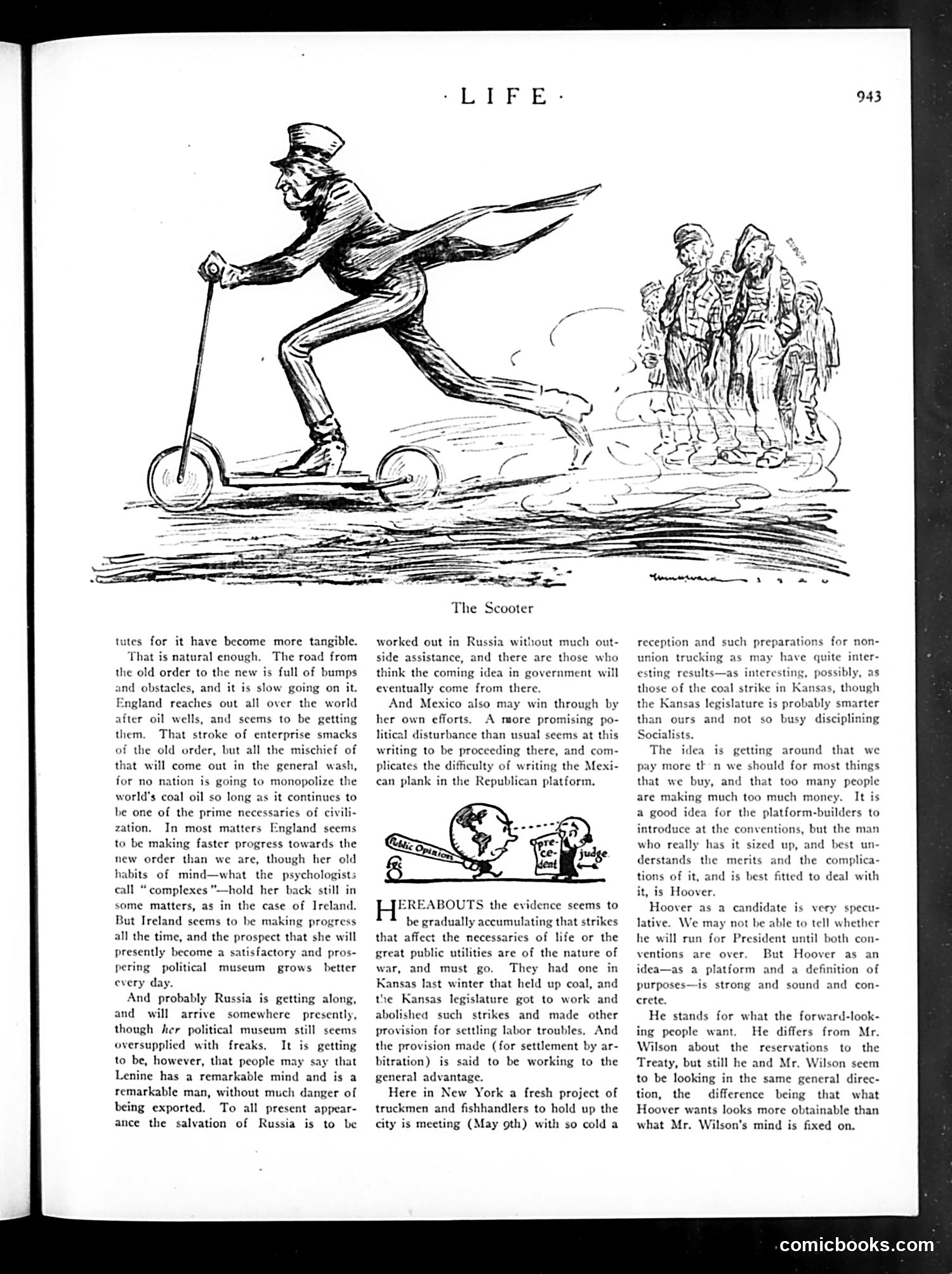
**The Cartoon:** A thin, elongated figure in a cap rides a child's scooter while balancing precariously, one leg extended. A group of ordinary citizens watches from the right. **The Satire:** This appears to be commentary on unstable or reckless leadership—likely referring to post-WWI political movements. The scooter (an undignified, toy-like vehicle) represents an unserious or unsustainable approach to governance. The precarious, exaggerated balance suggests danger and lack of control. **Context:** The surrounding text discusses Russia under Lenin, Mexico's political turmoil, and labor strikes. The cartoon likely satirizes radical or revolutionary leaders whose methods seem dangerously improvised rather than grounded in practical governance. **For Modern Readers:** This is early 20th-century visual mockery of revolutionary politics—suggesting that revolutionary leaders are reckless showmen riding unstable contraptions while ordinary people observe nervously, anticipating disaster.
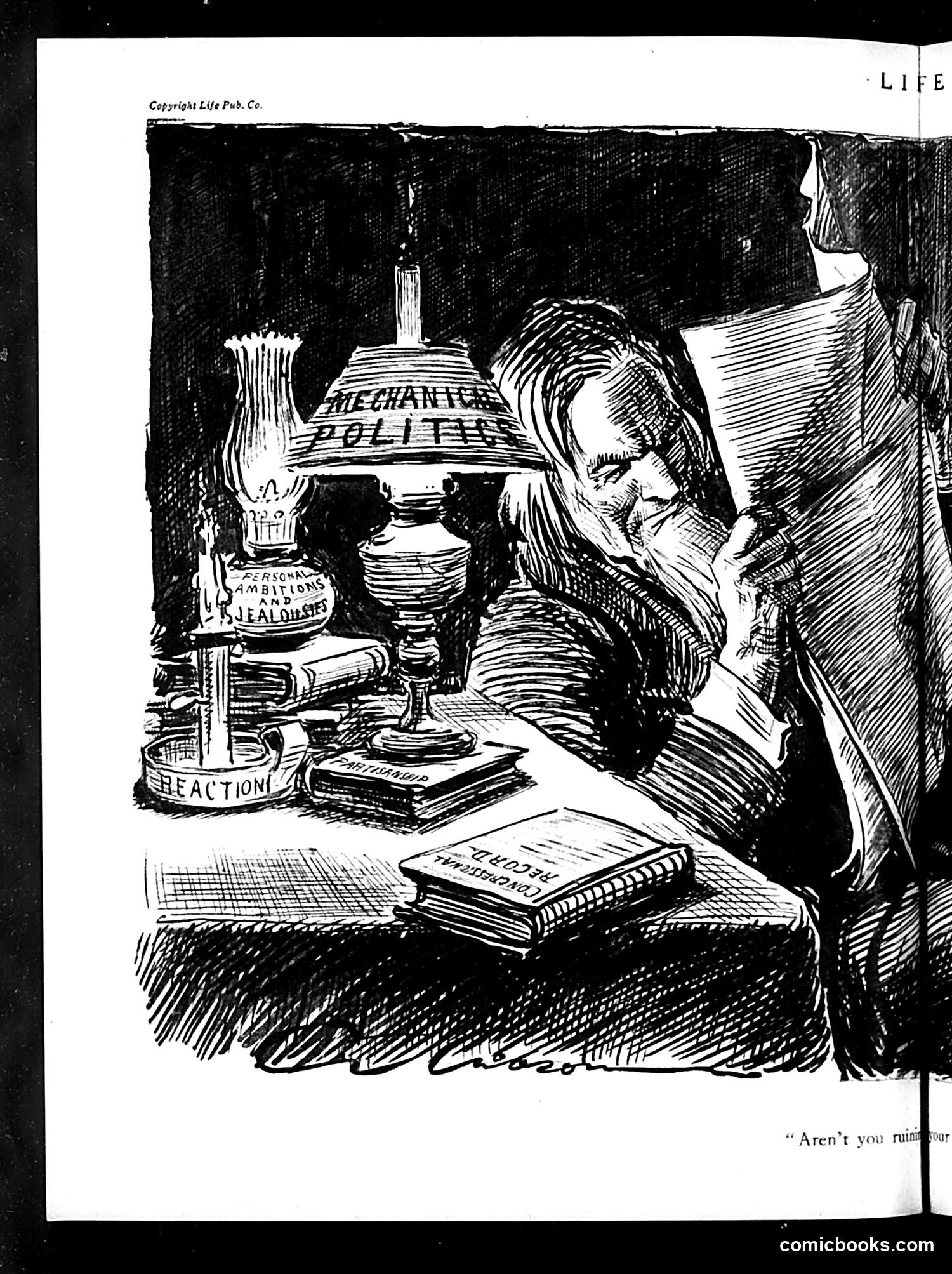
This satirical cartoon depicts a woman sitting at a desk surrounded by symbols of ambition and self-improvement: books labeled "Personal Ambitions and Realizations," a lamp labeled "Mechanized Politics," bottles suggesting personal development, and scattered papers. The figure appears introspective or troubled. The incomplete caption at bottom—"Aren't you ruinin..."—suggests someone is criticizing her pursuits. The cartoon likely satirizes early-20th-century women's increasing engagement in politics, education, and personal advancement. The "mechanized politics" reference suggests critique of how women's political participation had become bureaucratized or systematized. The joke appears to mock either the woman's ambitions themselves or the social criticism she faces for pursuing them—a commentary on gender expectations and women's changing social roles during this era.
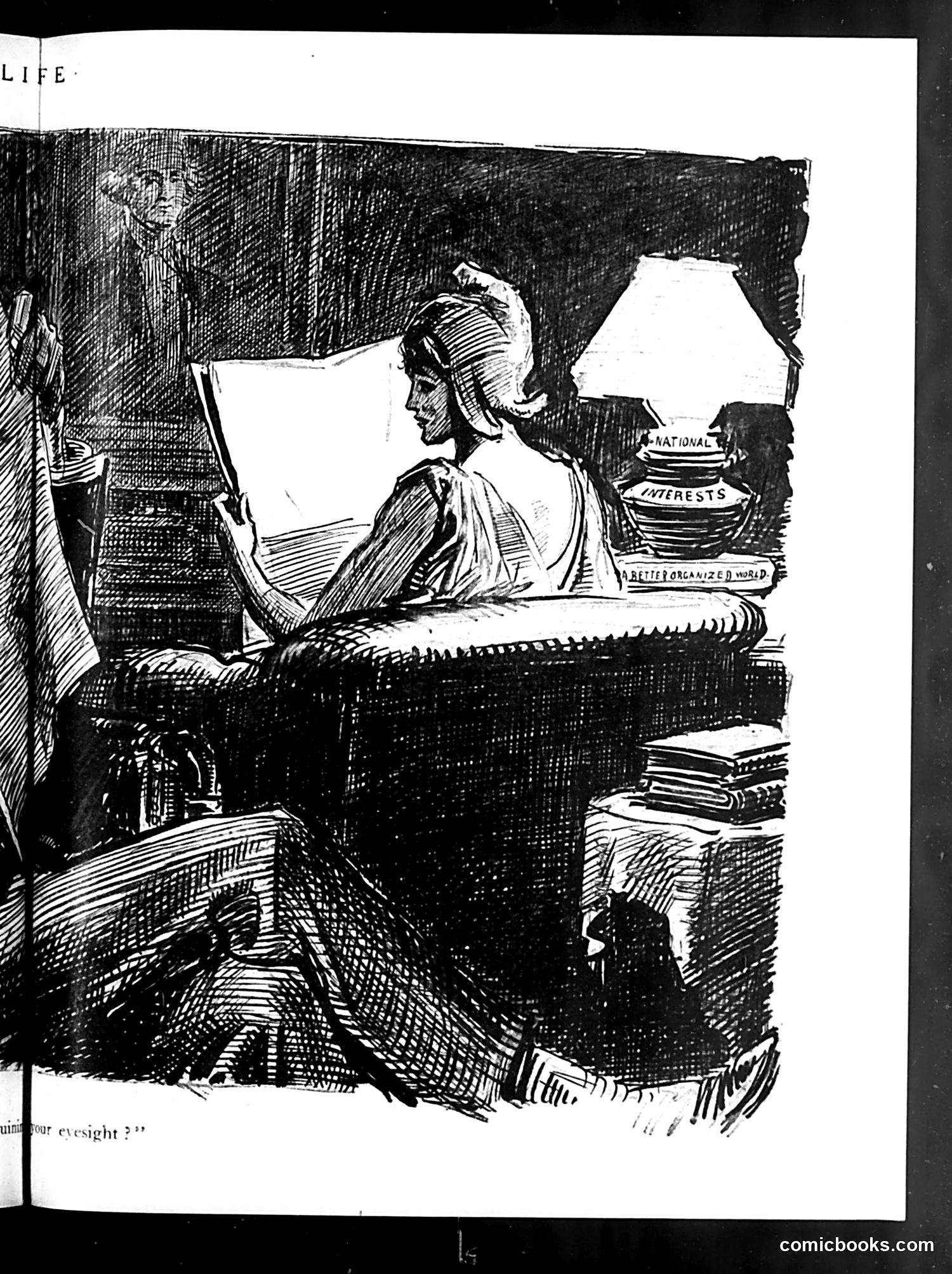
This sketch depicts a woman at a desk reading documents labeled "National Interests" and "Better Organized World." She appears to be engaged in serious study or work regarding international affairs. The cartoon likely satirizes women's increasing involvement in political and social governance during the early-to-mid 20th century. The partial caption at bottom—"Pour eyesight?"—suggests a joke about the strain of reading dense political documents, possibly mocking either women's newly expanded roles in public affairs or the complexity of international diplomacy itself. The stacked books visible suggest intellectual work. Without additional context about the specific issue date, the exact political event referenced remains unclear, though this appears to address women's political participation and international relations.
This page reviews three Broadway musical comedies: "Honey Girl," "The Girl from Home," and "Betty, Be Good." The critic evaluates their merits with typical early-1900s theater journalism—focusing on plots, music, and performances. Key points: "Honey Girl" recycles the old racetrack play "Checkers" with new music by Von Tilzer; it's entertaining but unremarkable. "The Girl from Home" (adapted from Richard Harding Davis's "The Dictator") stars Frank Craven and composer Silvio Hein but feels dated—ironically, like a production from 1905 despite being current. "Betty, Be Good" has pretty music but a terrible book (libretto). The critic values entertainment value over artistic merit, treating these as popular entertainments rather than high art. References to performers like Lynne Overman and period stars (Raymond Hitchcock, Frank Daniels) help date the review to approximately 1906-1907.
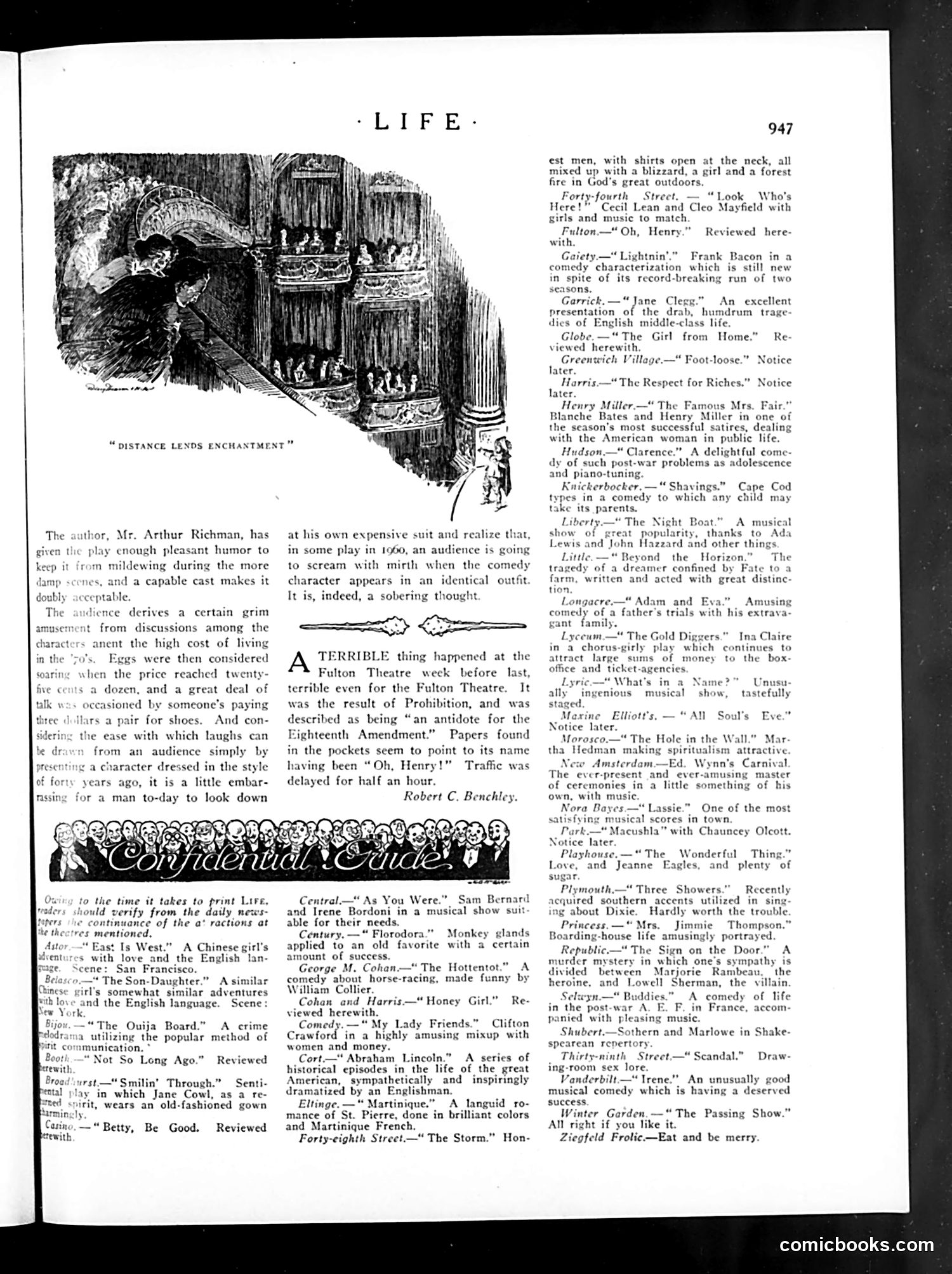
This page contains theatre reviews by Robert C. Benchley, with a cartoon illustrating his opening anecdote about the Fulton Theatre. **The Cartoon's Joke:** The sketch shows a man in formal evening wear from decades past, captioned "Distance Lends Enchantment." Benchley's accompanying text explains the satire: an actor at the Fulton Theatre wore an identical outfit to one from plays performed in 1960s—a costume so absurdly outdated that audiences laugh thinking it's intentional comedy rather than historical dress. The point is that theatrical fashion changes so dramatically that what once seemed normal becomes unintentionally funny. Benchley notes this is "a sobering thought"—meaning it's troubling to realize how quickly styles become ridiculous-looking. The cartoon also references a minor scandal: papers found at the theatre (apparently from an intoxicated incident during Prohibition era) bore the name "Oh, Henry!"—likely alluding to both the popular candy bar and contemporary plays with that title.
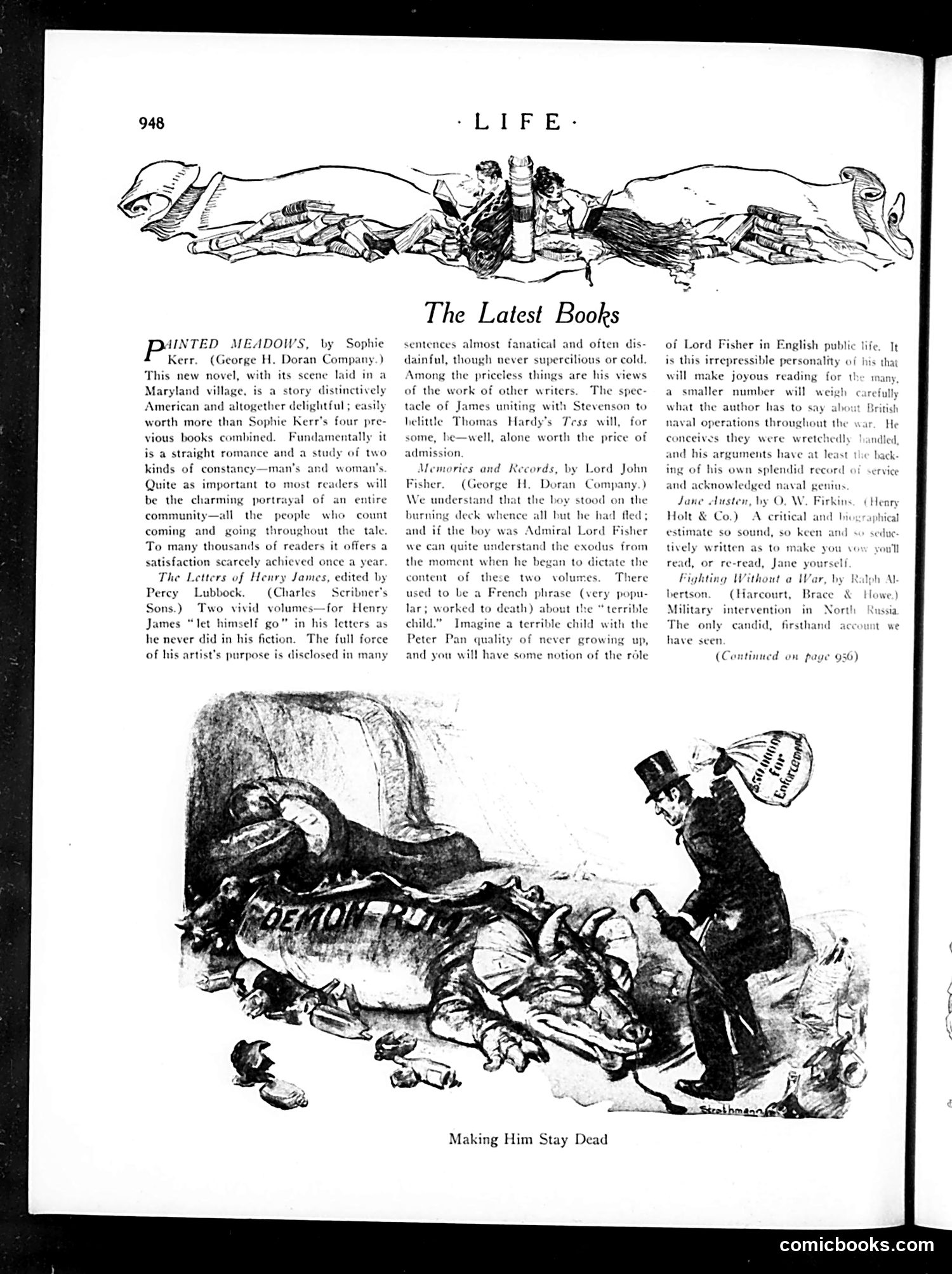
This page from *Life* magazine reviews new books, with one accompanying political cartoon titled "Making Him Stay Dead." The cartoon satirizes **Admiral Lord Fisher**, a controversial British naval figure. The illustration shows a man in top hat repeatedly striking a corpse labeled "MILITARISM," attempting to ensure it remains dead. The accompanying review of Fisher's memoir *Memories and Records* explains the satire: Fisher was known as an "irrepressible personality"—a disruptive, never-maturing force in British public life (compared to Peter Pan). The cartoon's dark humor suggests that despite efforts to kill militarism (particularly after World War I), figures like Fisher keep reviving it through their continued influence and writing. The joke targets both Fisher's persistent meddling in naval/military affairs and broader post-WWI anxieties about whether militaristic thinking could truly be eliminated.
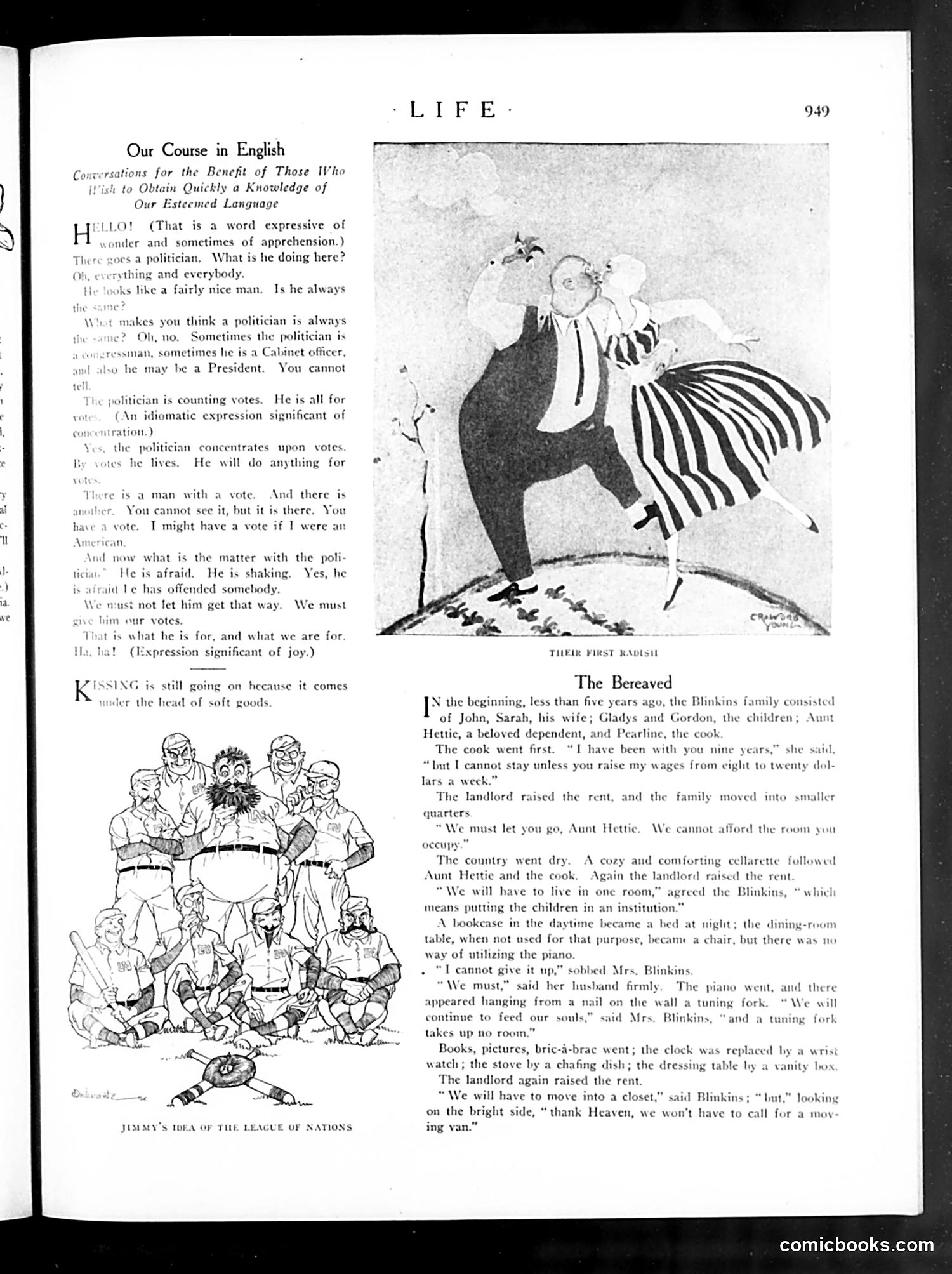
This Life magazine page contains two distinct satirical pieces: **"Our Course in English"** mocks politicians through a mock-educational dialogue. The satire depicts politicians as vote-obsessed operators willing to do anything to please constituents—they're afraid of offending anyone because votes determine their survival. The humor lies in treating this cynical truth as if it's a simple English lesson for foreigners. **"Jimmy's Idea of the League of Nations"** cartoon (lower left) shows a figure labeled Jimmy proposing the League of Nations as a human pyramid—likely satirizing either unrealistic idealism about international cooperation or Jimmy's (unclear which public figure) naive approach to global governance. **"The Bereaved"** story depicts economic hardship during Prohibition-era America. A middle-class family progressively loses possessions and space as costs rise—servants leave, rent increases, Prohibition eliminates the cellarette. The satire is darkly comedic: despite losing everything tangible, Mrs. Blinkins insists they'll "feed our souls" with a tuning fork. The title "Bereaved" suggests mourning one's former life.
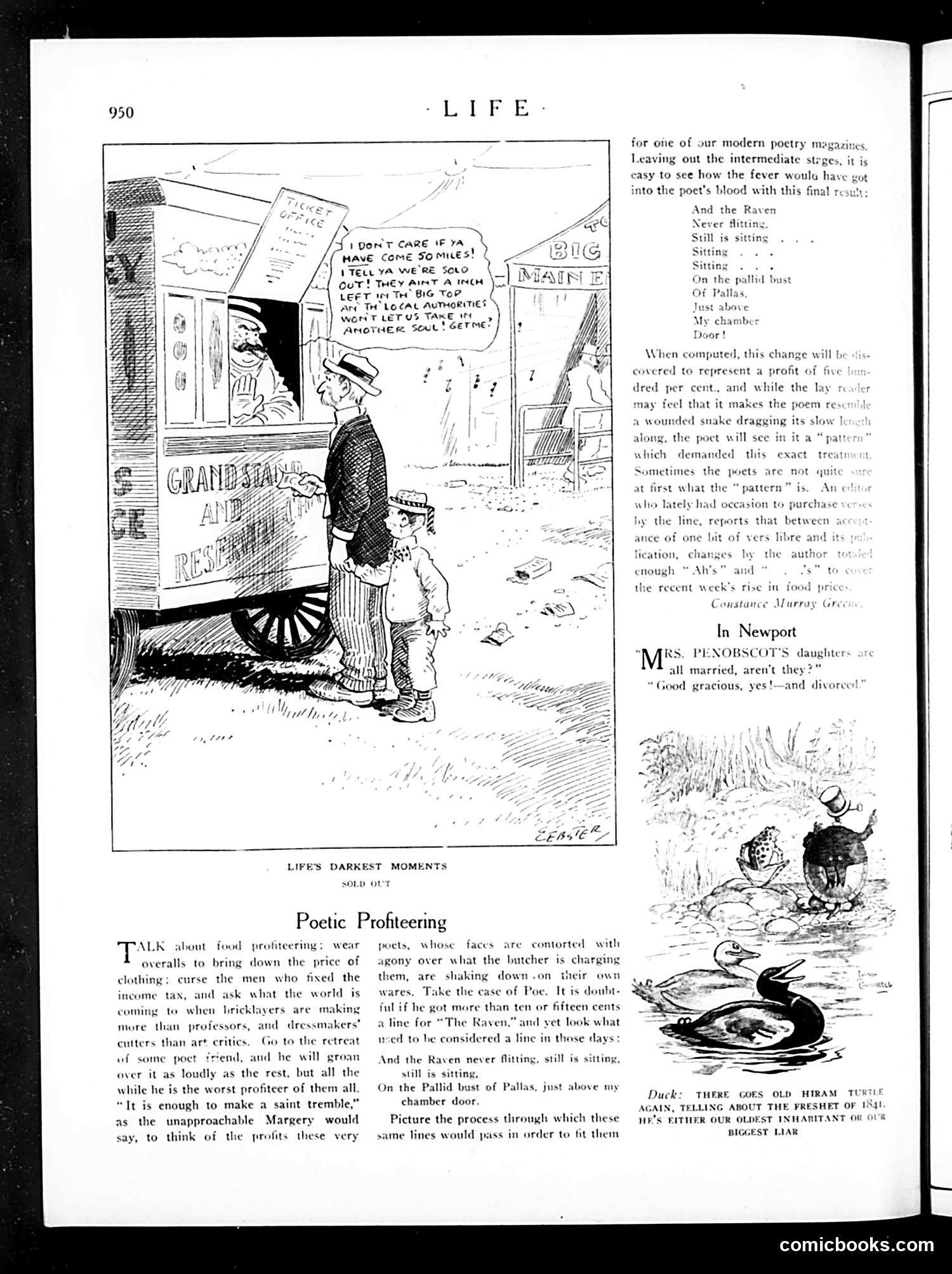
This page satirizes poets exploiting inflated food prices during wartime profiteering. The main article contrasts how people condemn butchers and tradesmen for price-gouging while ignoring that poets profit handsomely from their work. The cartoon "Life's Darkest Moments: Sold Out" (top) shows a circus barker turning away customers—a visual joke about scarcity and "sold out" signs during shortages. The satire's central example: Edgar Allan Poe's famous line "And the Raven never flitting, still is sitting" originally sold for perhaps 10-15 cents per line. Modern editors compress it to "And the Raven / Still is sitting" (fewer words, same price), doubling the poet's per-word earnings—a 500% markup. The author mocks how poets publicly lament food costs while secretly enjoying these "pattern" changes that pad their profits. The "In Newport" vignette jokes about wealthy society gossip, unrelated to the main theme.
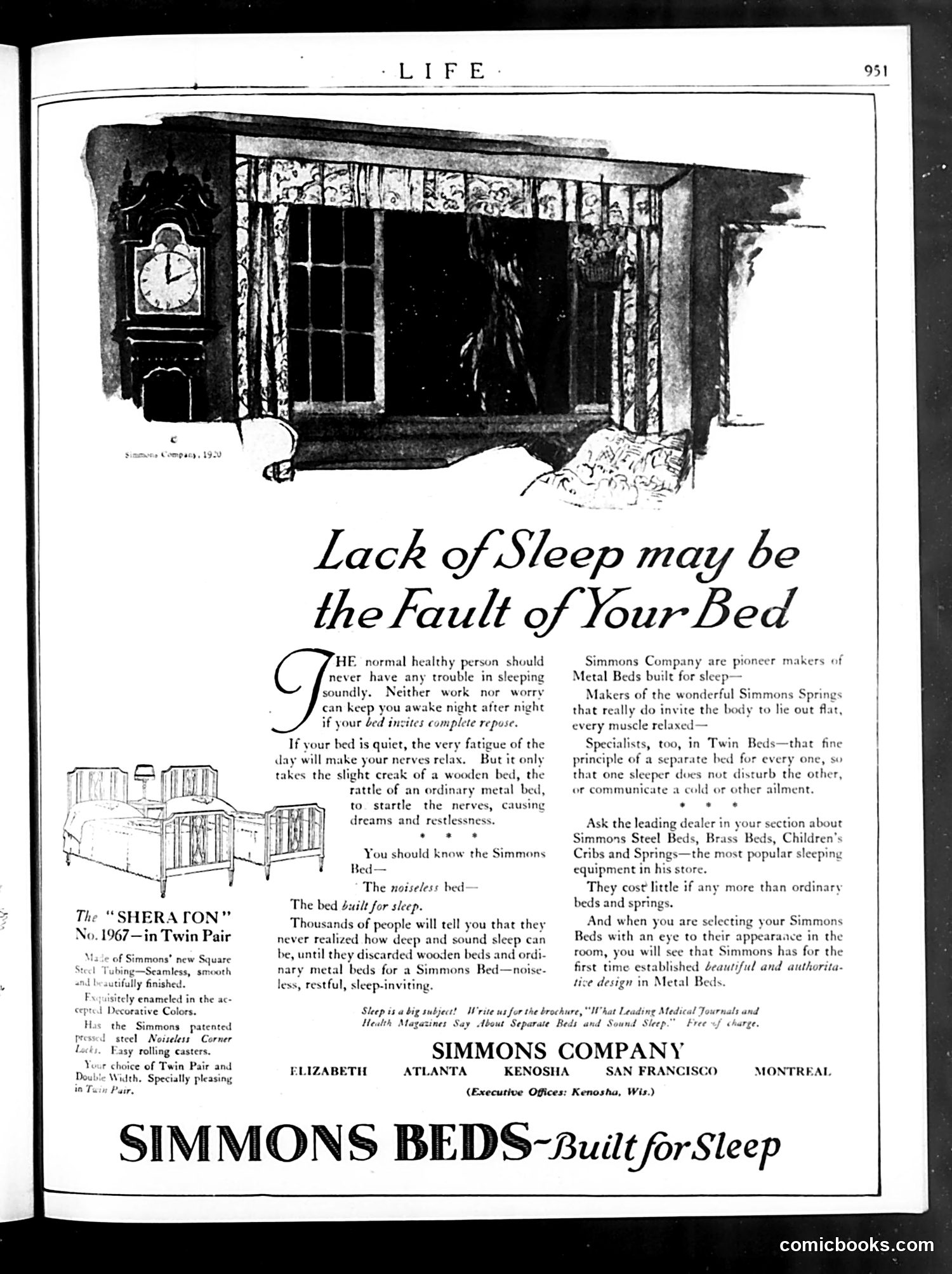
This page is **primarily a full-page advertisement** for Simmons beds, not political satire. It appears in *Life* magazine (page 951) and promotes the "Sheraton" metal bed model. The ad uses a common advertising strategy of the era: claiming health benefits. It argues that insomnia results from poor bed quality—specifically, that wooden or ordinary metal beds "rattle" and disturb sleep, while Simmons' "noiseless" metal beds promote "deep and sound sleep." The illustration at top shows a bedroom at night with a clock on the wall, establishing the sleep/insomnia theme. The text emphasizes the bed's "patented steel Noiseless Corner" and promotes Simmons' "Twin Beds" concept (separate beds for couples to prevent disturbing each other). There is **no political cartoon or satire here**—this is straightforward product marketing using pseudo-scientific health claims typical of early-20th-century advertising.
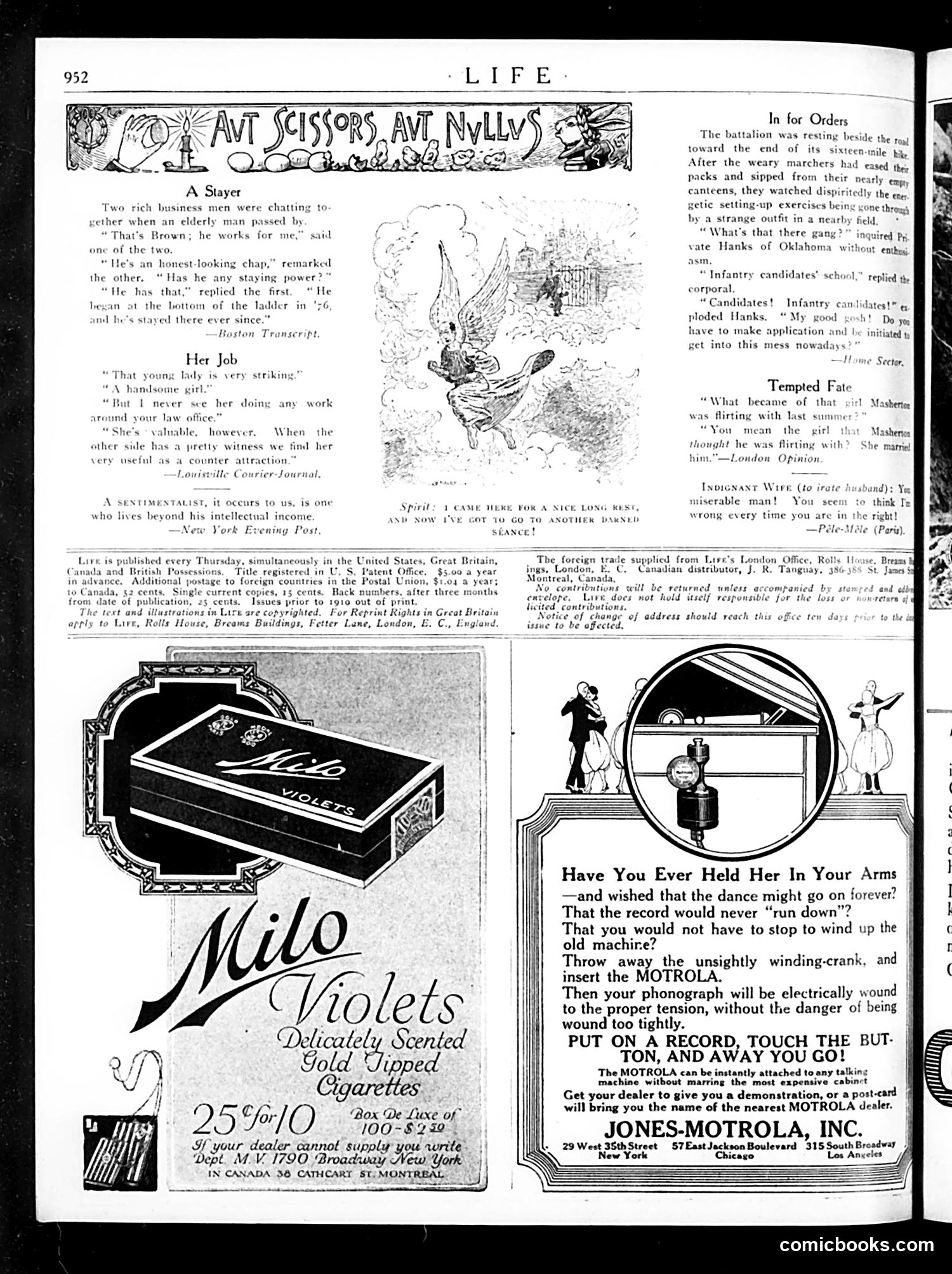
This page contains three brief satirical jokes typical of early 20th-century Life magazine humor: 1. **"A Stayer"**: Mocks class pretensions. A wealthy man boasts that his employee Brown has "staying power" since 1876—but clarifies he's literally stayed at the bottom of the ladder the entire time. The joke: what sounds like a compliment about loyalty is actually an insult about stagnation. 2. **"Her Job"**: A lawyer admits his attractive female employee does no actual legal work; she merely serves as a "counter attraction" when opposing counsel presents a pretty witness. Satirizes both courtroom theatrics and the era's casual sexism regarding women's workplace roles. 3. **"Spirit"**: A soldier complains he came for rest but must immediately relocate. The joke plays on military inefficiency and discomfort. The page also contains period advertisements for Milo Violets cigarettes and a Motrola phonograph motor attachment—products no modern reader would recognize.
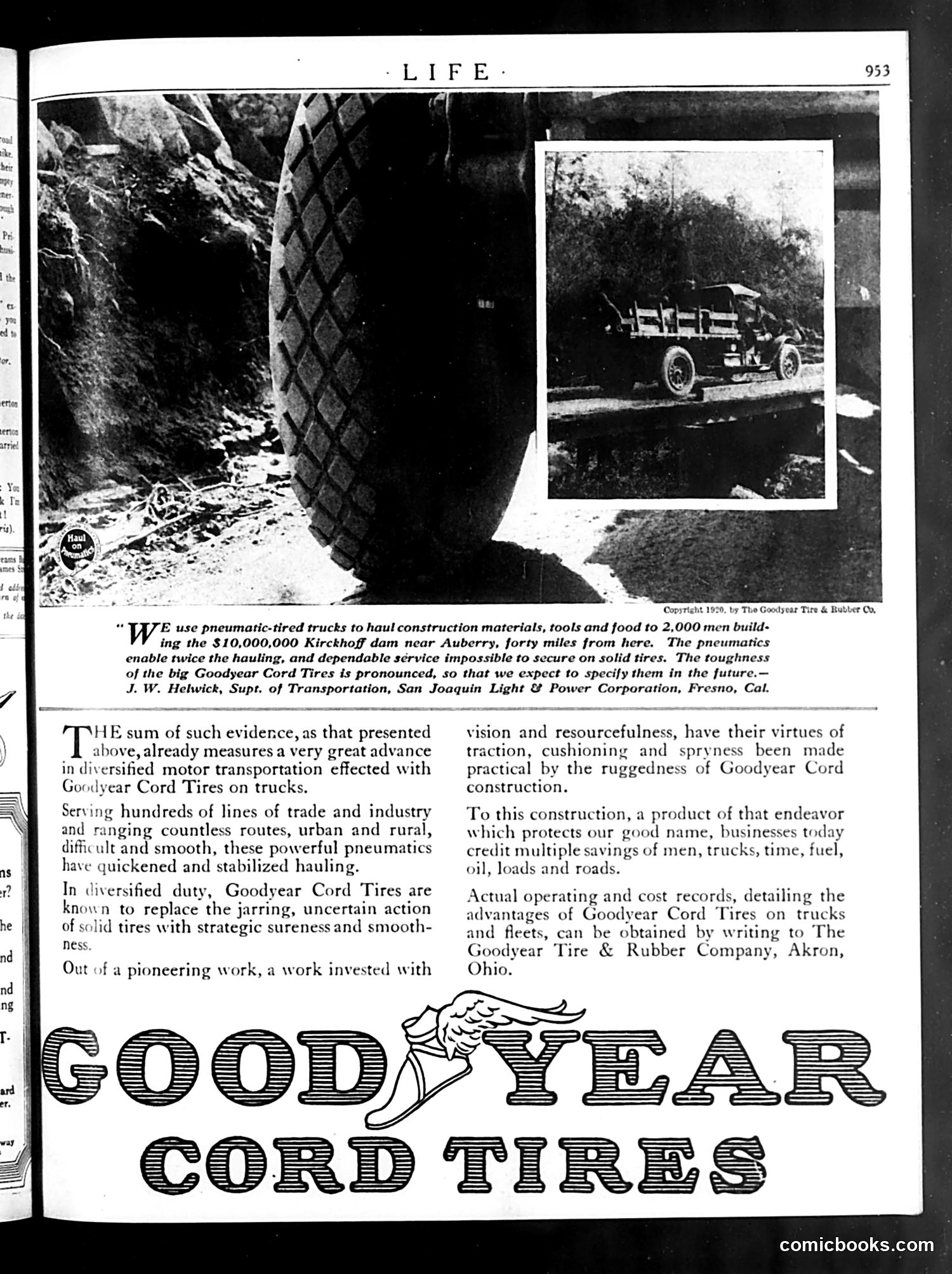
This is a 1920 Goodyear Cord Tires advertisement published in *Life* magazine. It features testimonial advertising rather than satire or cartooning. The page includes photographs of pneumatic truck tires and a truck hauling materials for the Kirchhoff Dam project near Fresno, California. A quote from J. W. Helwick, superintendent of transportation for San Joaquin Light & Power Corporation, endorses Goodyear tires for their superior hauling capacity and durability compared to solid tires. The text emphasizes how pneumatic tires have improved commercial transportation efficiency across diverse industries and terrain. The bottom half contains promotional copy about the tires' traction and cost-effectiveness, with an invitation for readers to request operating records from Goodyear's Akron, Ohio headquarters. There is no political satire or social commentary present—this is straightforward product marketing using early industrial photography and testimonials.
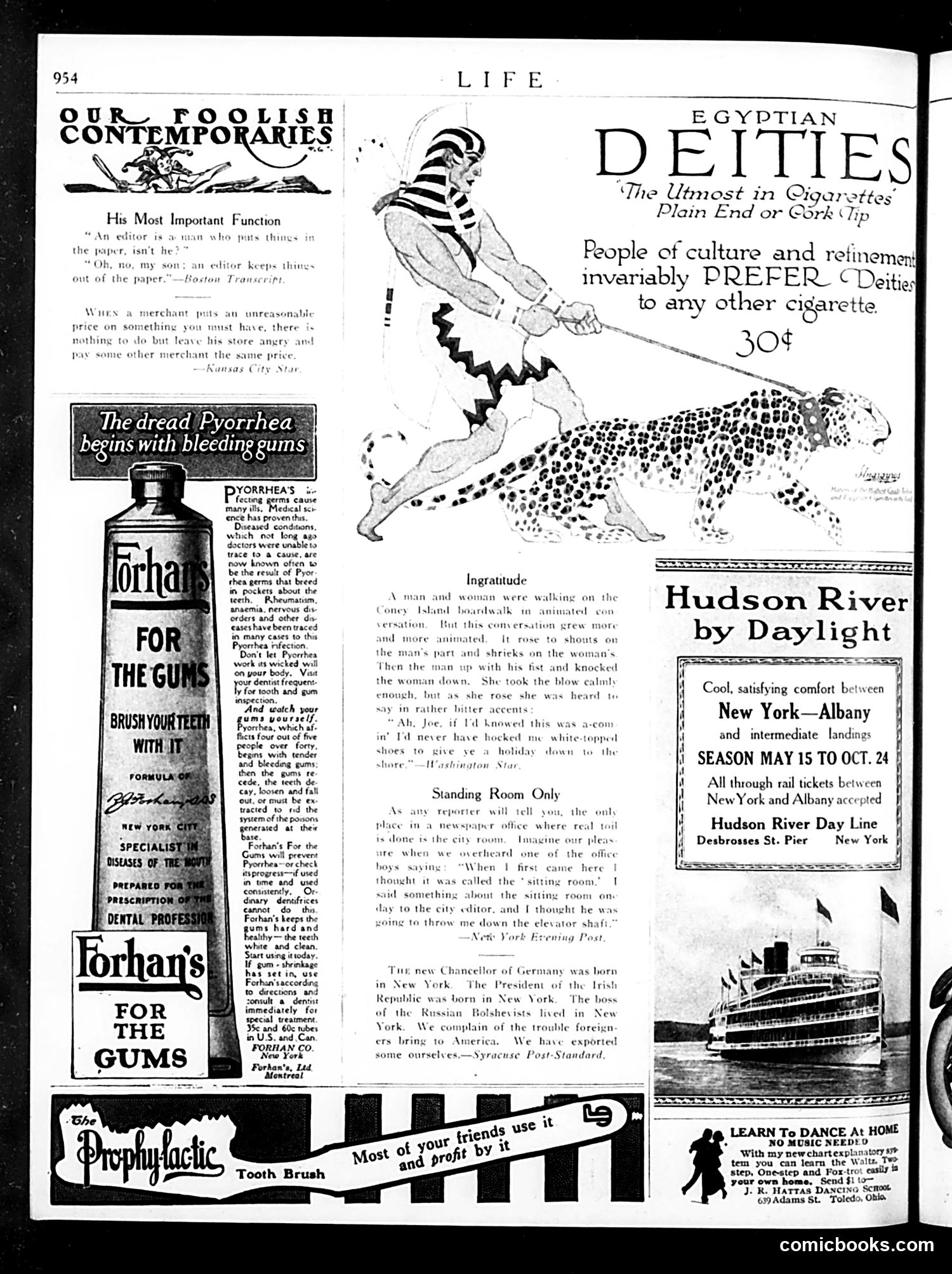
This is primarily an **advertising page** with a small satirical section. The main content includes: **Advertisements:** Forhans toothpaste (targeting dental disease), Egyptian Deities cigarettes (marketing "refined" taste), Hudson River Day Line steamship service, Prophylactic toothbrush, and dance instruction. **Satirical Content:** The page includes two brief humor pieces under "Our Foolish Contemporaries": 1. **"His Most Important Function"** – A editor's job is keeping things *out* of the paper (editorial discretion). 2. **"Ingratitude"** – A working-class couple's bitter exchange after a man strikes a woman; she's upset he "hocked" (pawned) her possessions for a holiday rather than improving their poverty. 3. **"Standing Room Only"** – A journalist describes newspaper offices as the only place where "real toil" happens, contrasting it with other workplaces. The satire reflects early 20th-century concerns: dental health, class tensions, and newspaper culture. The advertisements suggest the magazine's affluent readership.
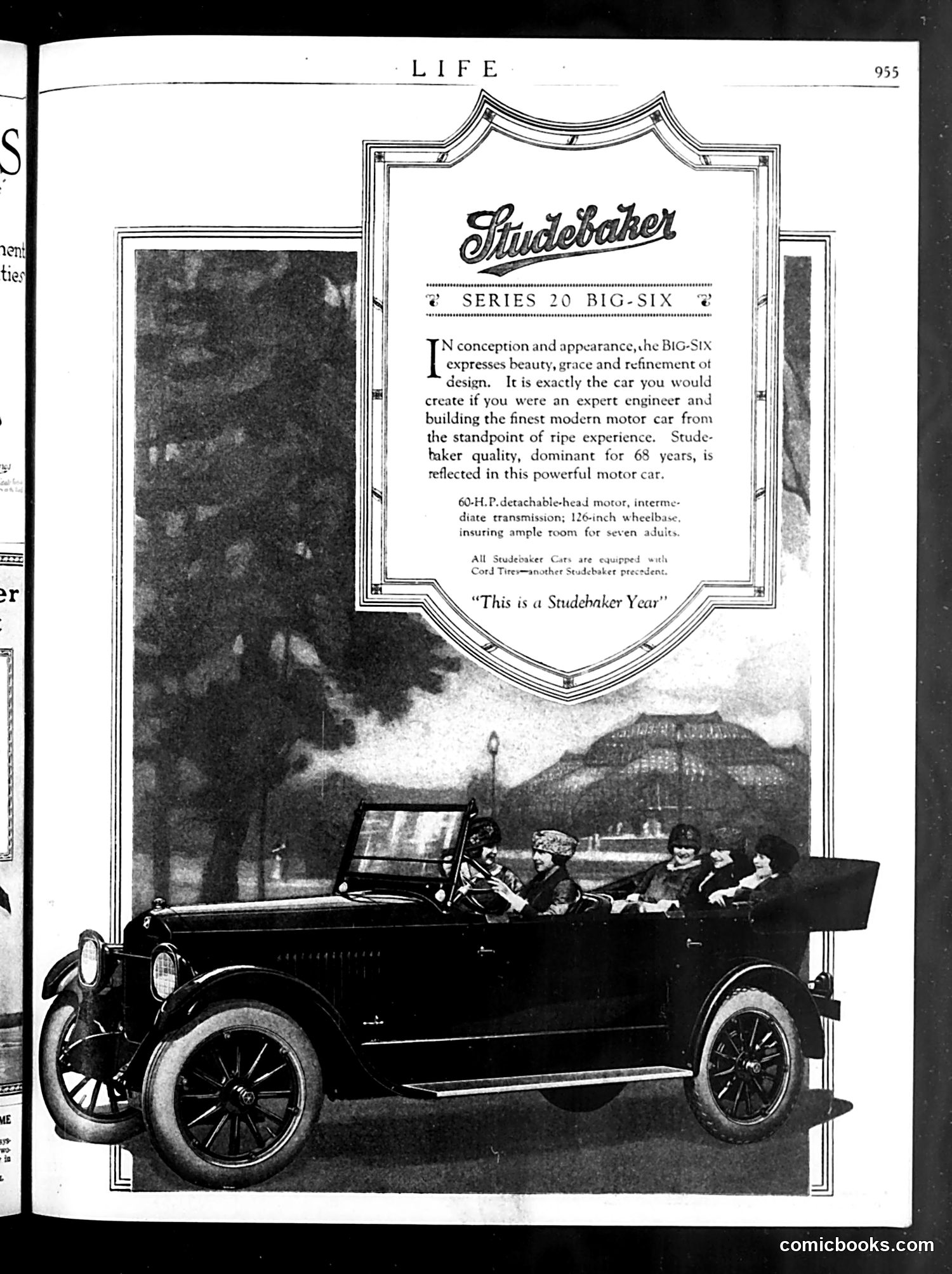
This is **not a cartoon or satire**—it's a straightforward automobile advertisement for the Studebaker "Big-Six" automobile, appearing in *Life* magazine (page 955). The page features a photograph of an open-air touring car with seven passengers and promotional text emphasizing the vehicle's engineering quality and refinement. The advertisement highlights specifications (60 H.P. motor, 126-inch wheelbase) and Studebaker's 68-year manufacturing reputation. The tagline "This is a Studebaker Year" suggests this advertisement appeared during a particular sales season. There is no political commentary or satire present—this is period advertising designed to appeal to middle-to-upper-class consumers interested in quality automobiles.
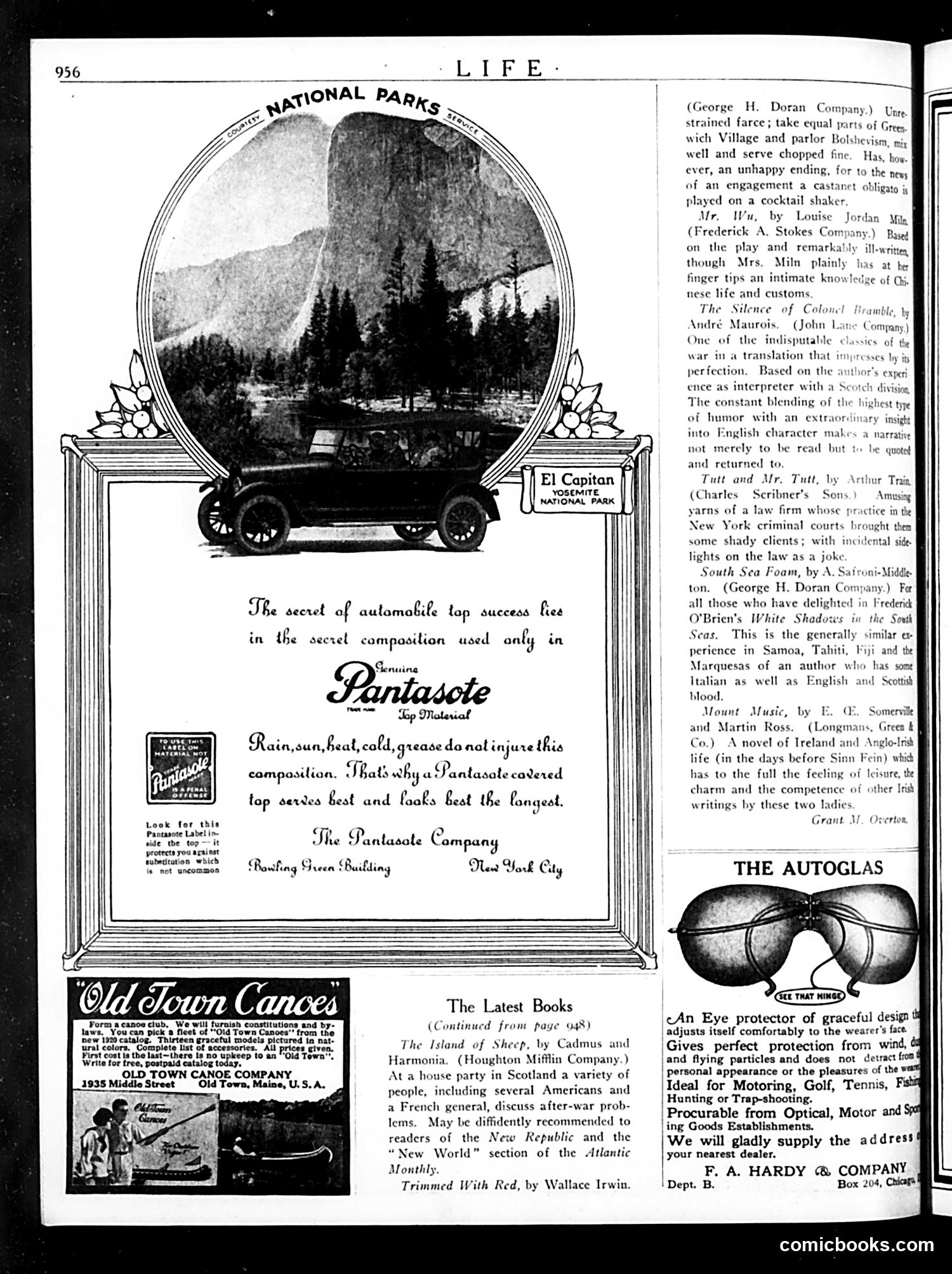
This page is primarily **advertising and book reviews**, not political satire. The main content features: 1. **Pantasote Advertisement**: A large ad for an automobile top coating material, featuring El Capitan in Yosemite National Park. The ad claims Pantasote protects car tops from weather and wear—a straightforward product pitch with no satirical intent. 2. **Book Reviews**: The right column reviews contemporary novels including works set in the South Seas, Ireland, and Scotland—typical literary coverage for the era. 3. **Secondary Advertisements**: Small ads for Old Town Canoes and AutoGlas eyewear appear at bottom. **No political cartoon or satire is present.** The page is a standard 1920s magazine layout mixing editorial content with paid advertising. The only visual interest is the scenic photograph in the Pantasote ad and the decorative frame around it. There are no caricatures, political references, or jokes to decode—it's simply a commercial magazine page documenting period consumer products and contemporary literature.
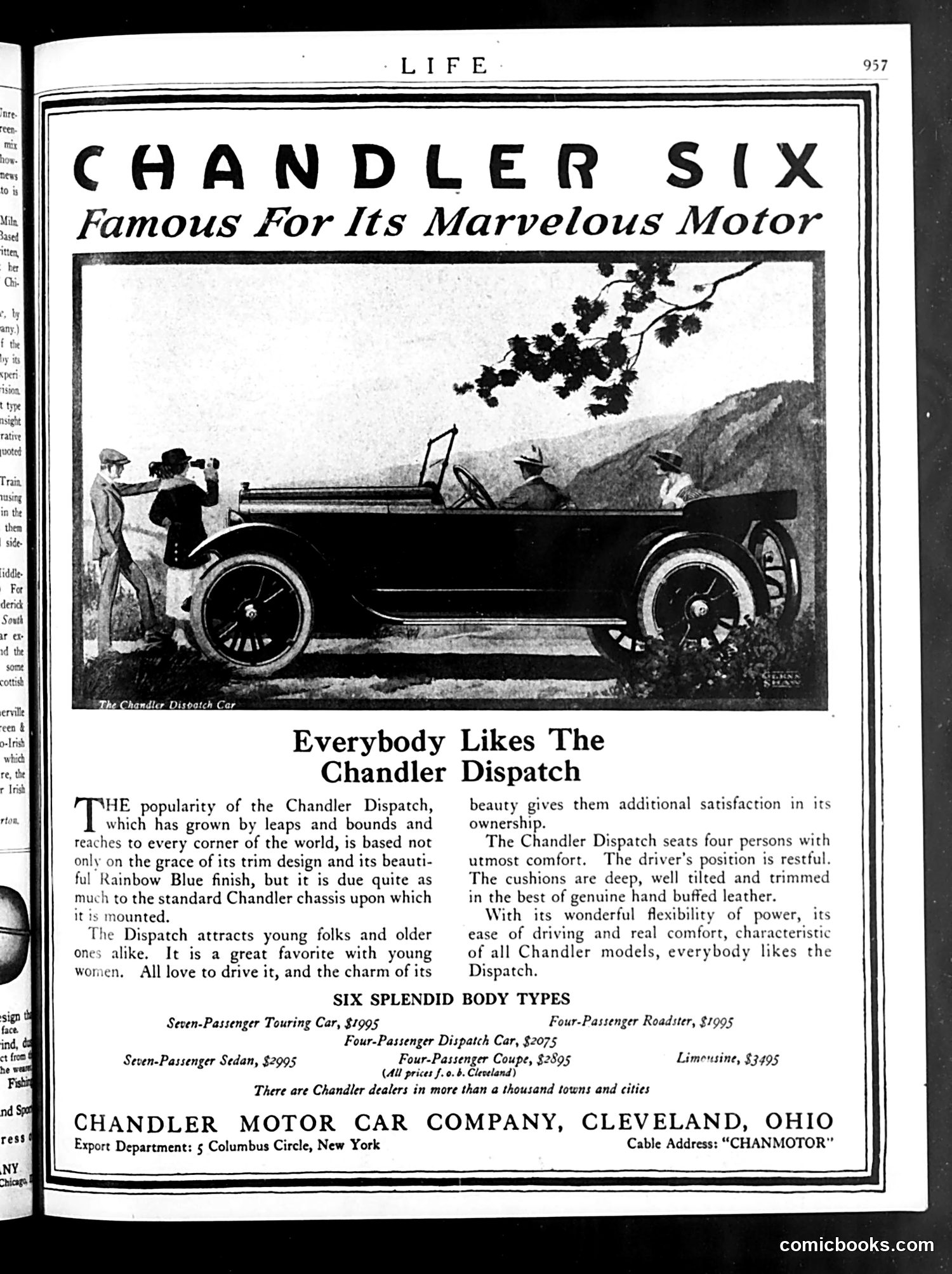
This is **not a cartoon or satire**—it's a straightforward automobile advertisement for the Chandler Motor Car Company of Cleveland, Ohio. The page advertises the "Chandler Dispatch," a popular touring car marketed as appealing to "young folks and older ones alike," particularly women. The ad emphasizes the vehicle's "Rainbow Blue finish," comfortable leather seating, and reliable Chandler chassis. Six body styles are listed with prices ranging from $1,995 to $3,495 (f.o.b. Cleveland), including touring cars, roadsters, sedans, coupes, and a limousine. The single photograph shows the Dispatch in profile with period-dressed passengers, positioned as aspirational lifestyle imagery typical of 1920s auto advertising. This represents standard commercial promotion from Life magazine's advertising section—no political or satirical commentary is present.
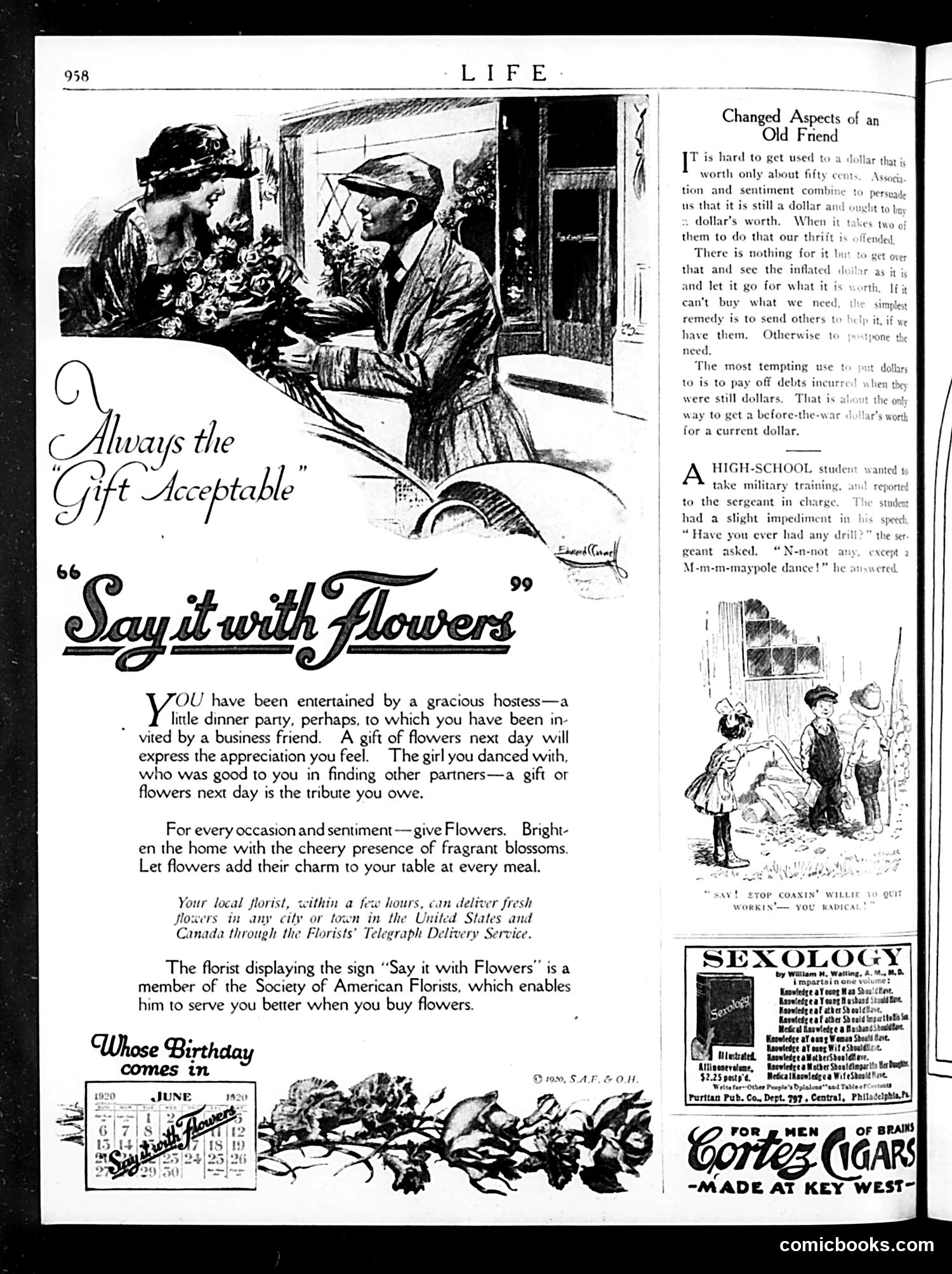
This page combines satirical commentary on post-WWI inflation with period advertising. **The Main Satire ("Changed Aspects"):** The article discusses the declining value of American currency. A dollar, once worth its face value, now buys significantly less due to inflation. The piece notes the psychological difficulty of accepting this reality—people cling to the sentimental idea that a dollar should retain its worth. The satire mocks Americans' reluctance to adjust to economic reality, suggesting the only remedy is to spend money quickly rather than save it. **The Cartoon Vignette:** The small sketch showing a military sergeant interviewing a high-school student with a speech impediment provides comic relief. The student claims he has "no drill experience except a M-m-m-maypole dance," satirizing both military recruitment standards and the student's nervous stammer. **The Advertisements:** The page also features standard period ads for flowers, a Sexology book, and Cortez cigars—unrelated to the satirical content but typical of Life's revenue model. The overall thrust critiques post-war economic anxiety among ordinary Americans.
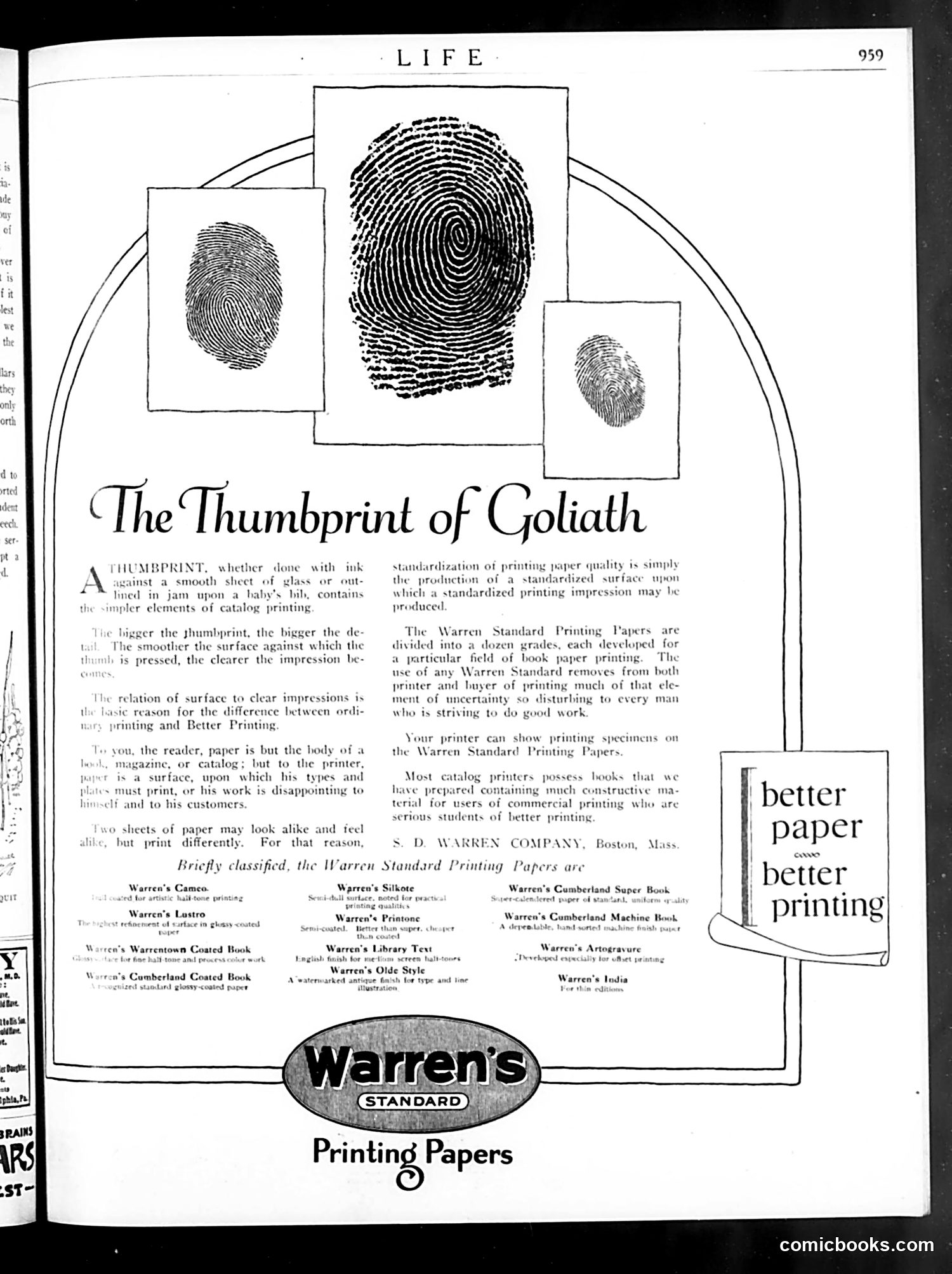
This is primarily a **print advertisement**, not a political cartoon. It appears on page 959 of *Life* magazine and promotes Warren's Standard Printing Papers. The "Thumbprint of Goliath" is a metaphor: the advertisement uses three fingerprint images of increasing size to illustrate how paper quality affects printing clarity. The larger the thumbprint, the more visible the detail—analogous to how superior paper stock produces clearer, sharper printed impressions. The text argues that while different papers may appear identical to readers, printers recognize crucial differences in surface quality and consistency. Warren's standardized paper grades eliminate uncertainty for professional printers. The piece targets commercial printing professionals and catalog printers, emphasizing that better paper quality equals better printing results. The biblical "Goliath" reference appears to be simply attention-grabbing wordplay, likely suggesting scale or impressiveness rather than carrying specific satirical meaning.
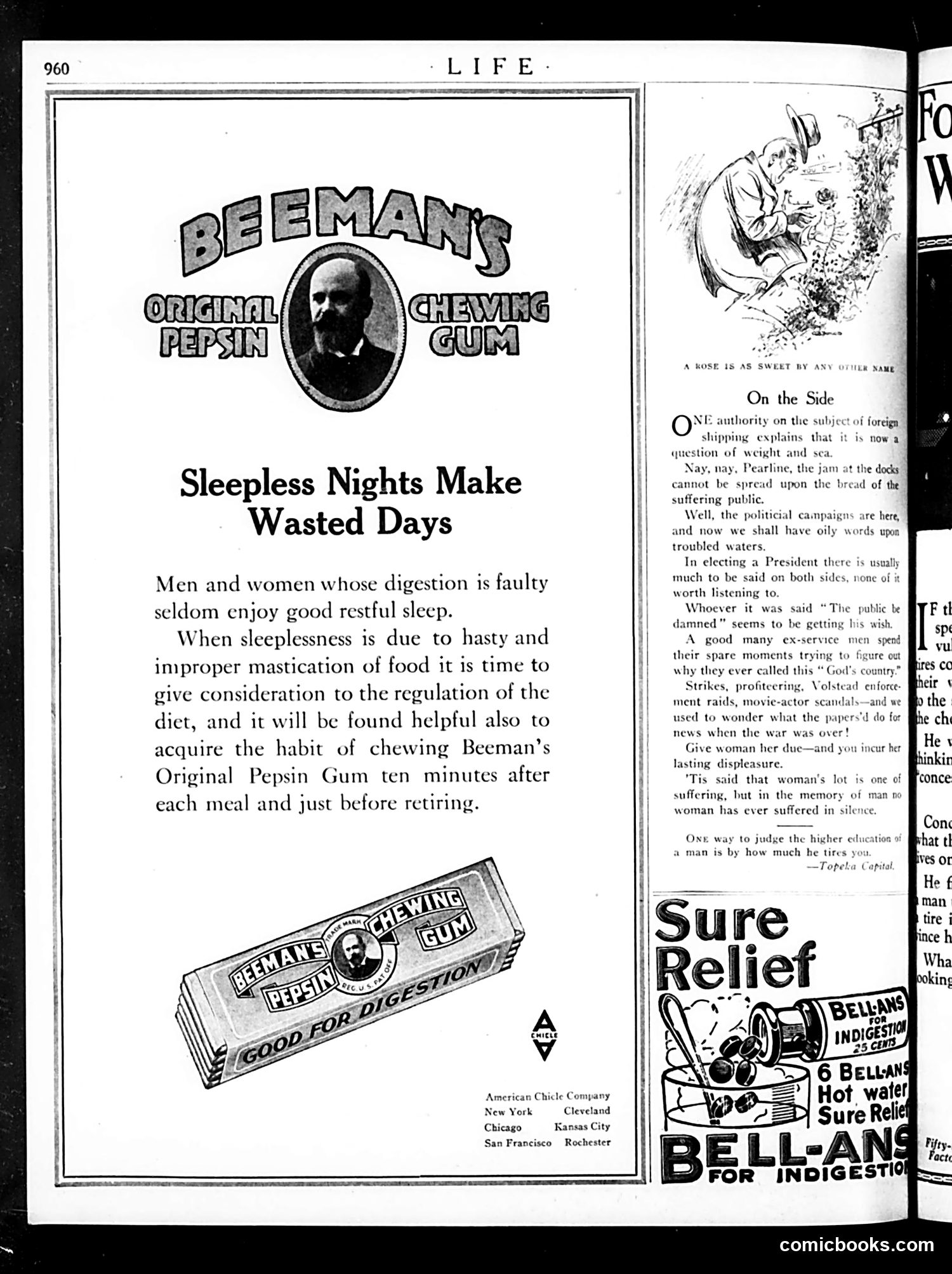
This page is primarily a **product advertisement** for Beeman's Original Pepsin Chewing Gum, not political satire. The main ad claims that chewing gum after meals aids digestion and improves sleep quality—a common health claim of early 20th-century consumer advertising. The right-side column labeled "On the Side" contains brief satirical commentary on contemporary topics: foreign shipping regulations, political campaigns (describing campaign rhetoric as "oily words"), ex-service men (likely WWI veterans) struggling post-war, and women's suffrage ("Give woman her due"). These are disconnected editorial observations rather than unified satire. The **Bell-Ans indigestion remedy advertisement** below also reflects the era's focus on digestive remedies as cure-alls. Both ads assume readers suffer from digestive complaints—a marketing strategy common to this period. No specific political figures or events are caricatured on this page.
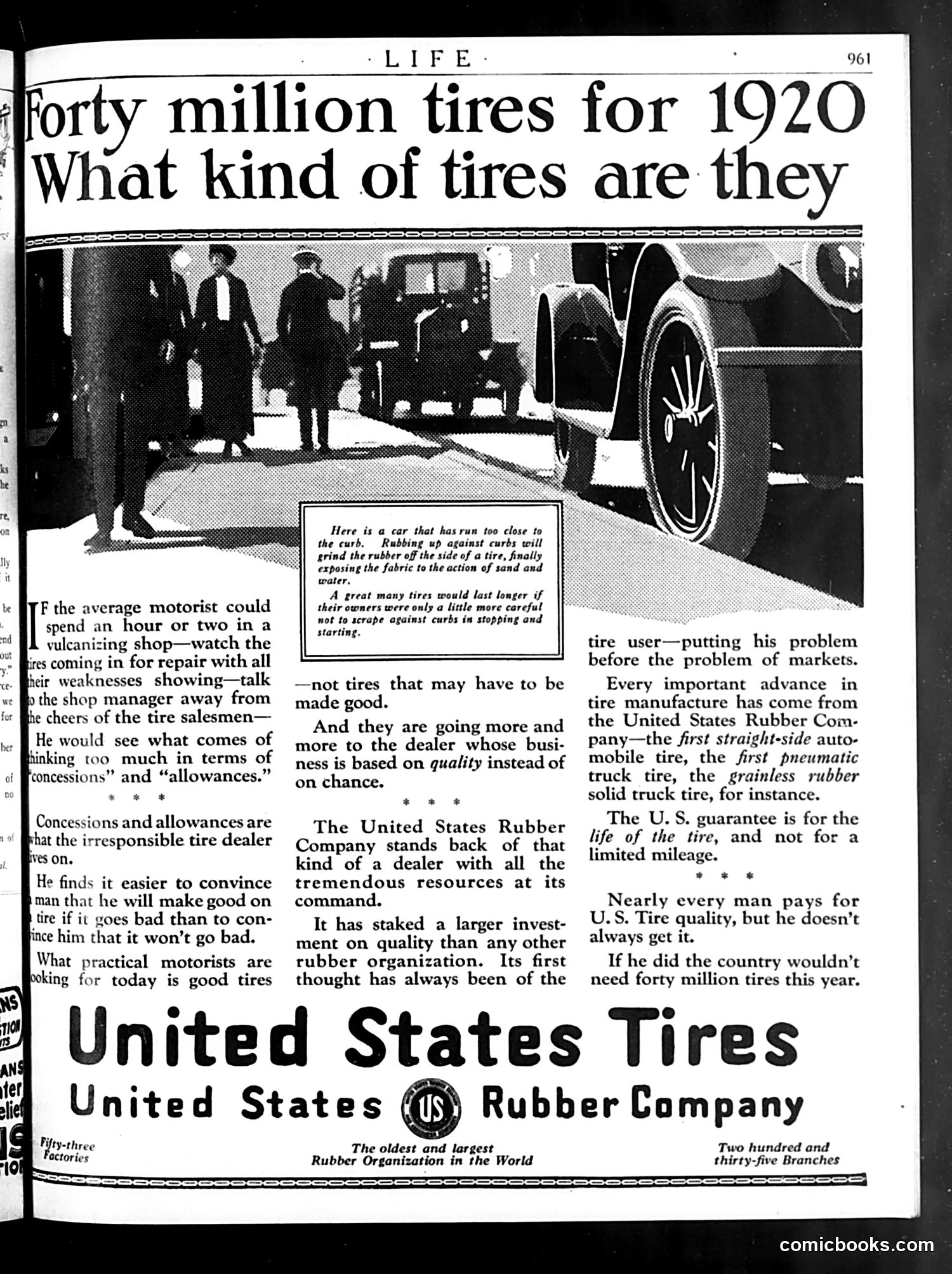
This is primarily a **United States Rubber Company advertisement** disguised as editorial content in Life magazine. The "cartoon" is a photograph showing tire damage from curb-scraping, accompanied by explanatory text. It's not satirical commentary but rather a **cautionary lesson** meant to justify tire replacement demand. The advertisement's argument is defensive: it addresses why the country needs 40 million tires in 1920 by blaming motorists themselves. The text criticizes "irresponsible tire dealers" who offer "concessions and allowances" on poor-quality tires, contrasting this with U.S. Rubber's commitment to quality. **The unstated message**: High tire replacement rates aren't the industry's fault—they result from poor driving habits (like rubbing curbs) and unethical competitors. U.S. Rubber stands apart by prioritizing durability and customer protection. This represents early 20th-century **corporate image-building**, using Life's editorial credibility to advance commercial interests while appearing to offer practical motorist advice.
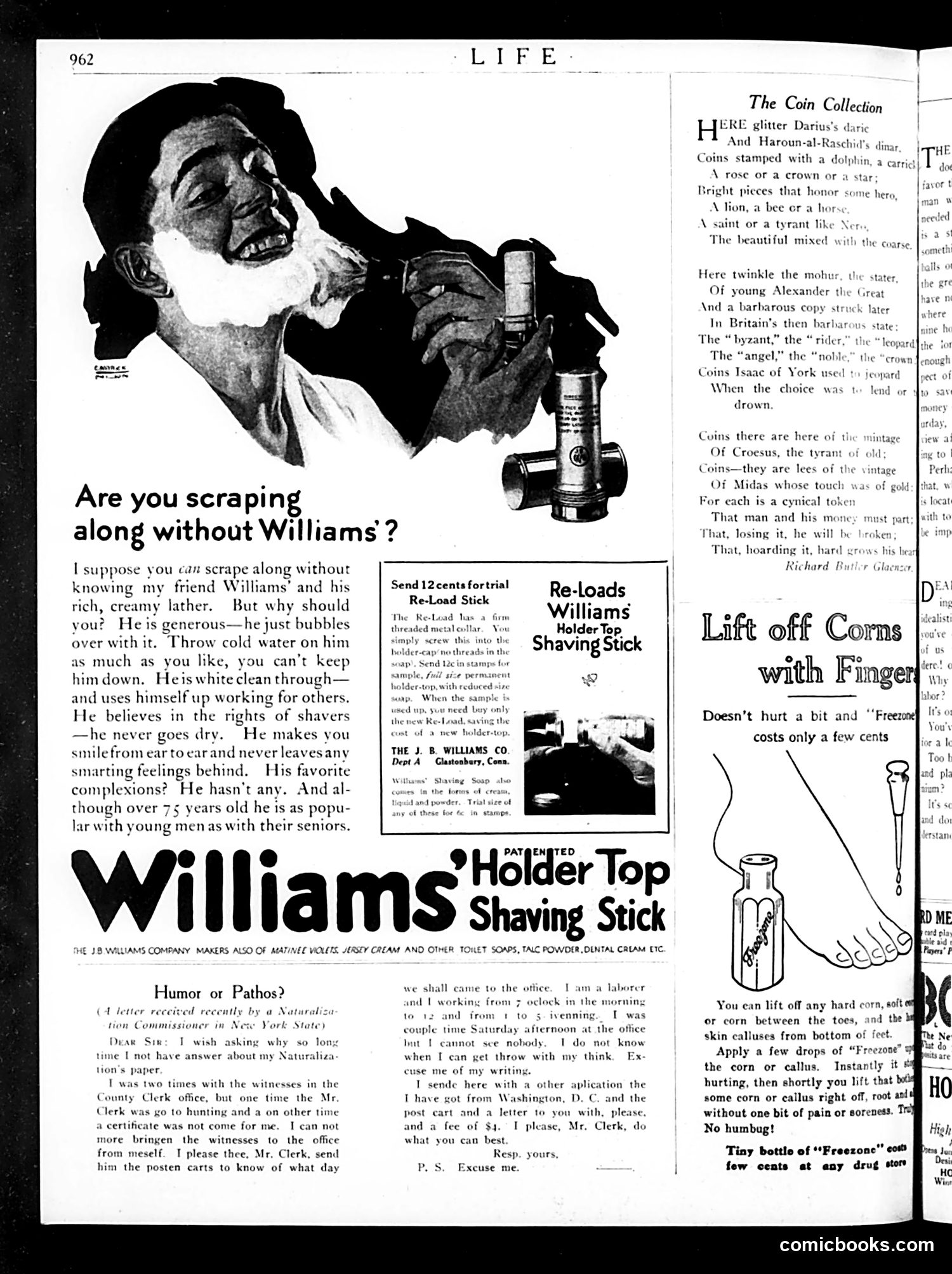
This page combines advertising with a humorous advice column. The large illustration shows a caricatured man's laughing face alongside a shaving stick—advertising Williams' "Holder Top Shaving Stick." The accompanying text humorously praises "Williams" (likely the product's mascot or brand personality) as generous, hardworking, and popular despite being over 75 years old. The page also features "The Coin Collection," a poem about historically significant coins, and "Humor or Pathos?"—a genuine letter from a confused immigrant seeking help with naturalization paperwork, written in broken English. The juxtaposition is deliberate: the polished advertising and literary poem frame this earnest but comically illiterate letter, creating satire about American bureaucracy and the immigrant experience. The corns/calluses advertisements complete the commercial nature of the page.
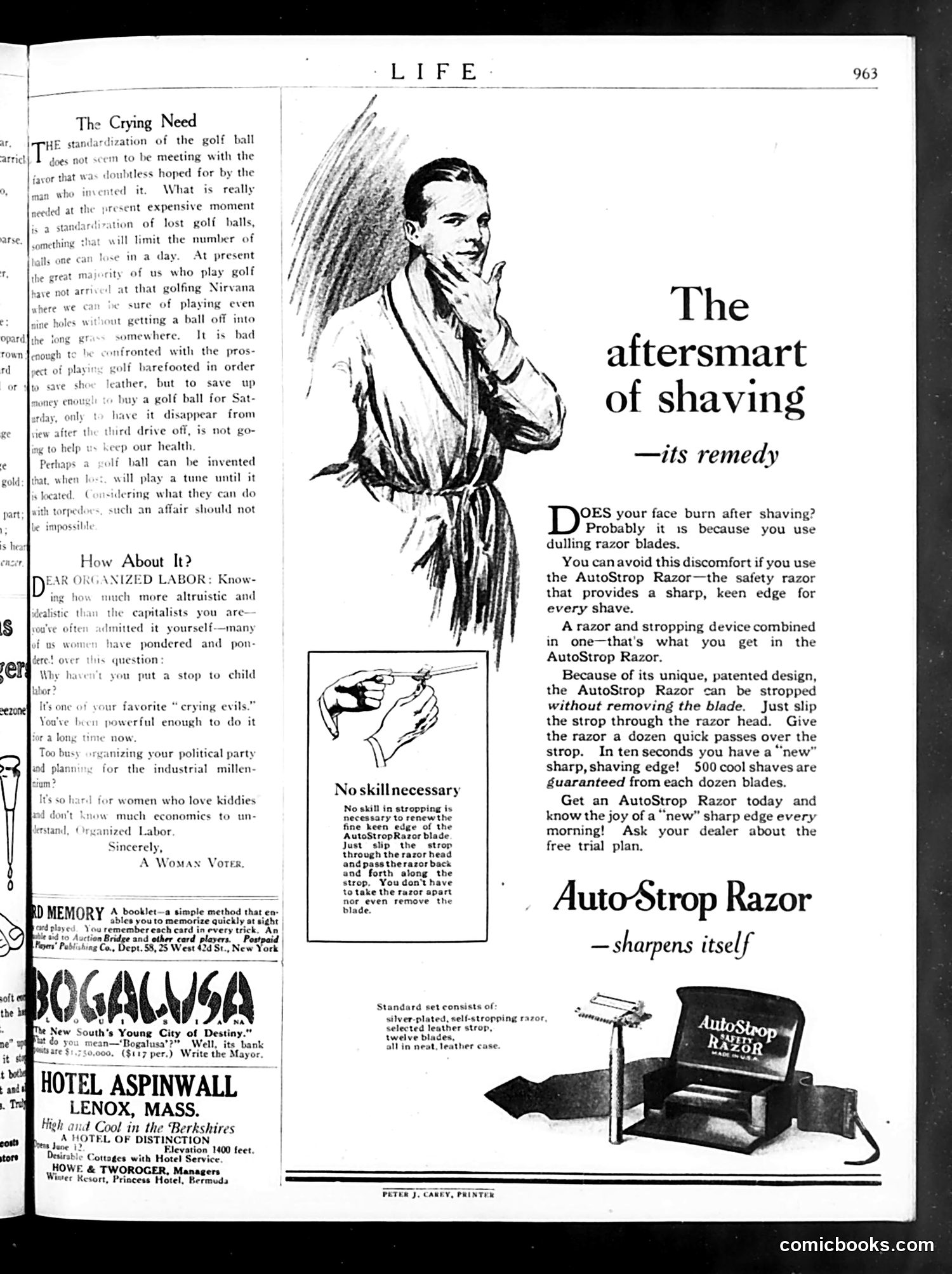
This page contains two distinct editorial sections plus advertising. **"The Crying Need"** is a humorous opinion column criticizing the standardized golf ball. The writer argues that while the invention fails to deliver promised benefits, the real problem is players losing too many balls daily. The piece sarcastically suggests inventing a golf ball that plays music when lost—a joke highlighting the absurdity of losing equipment constantly. **"How About It?"** is a letter from "A Woman Voter" challenging organized labor on child labor. She points out the apparent hypocrisy: labor unions claim to oppose child exploitation as a "crying evil," yet haven't actually stopped it. She questions why, if they're powerful enough to influence politics, they haven't used that power to protect children from labor. **The remainder is advertising**, primarily for the AutoStrop Razor, which features an illustration of a man applying aftershave, emphasizing the product's ability to prevent razor burn through consistent sharpness.
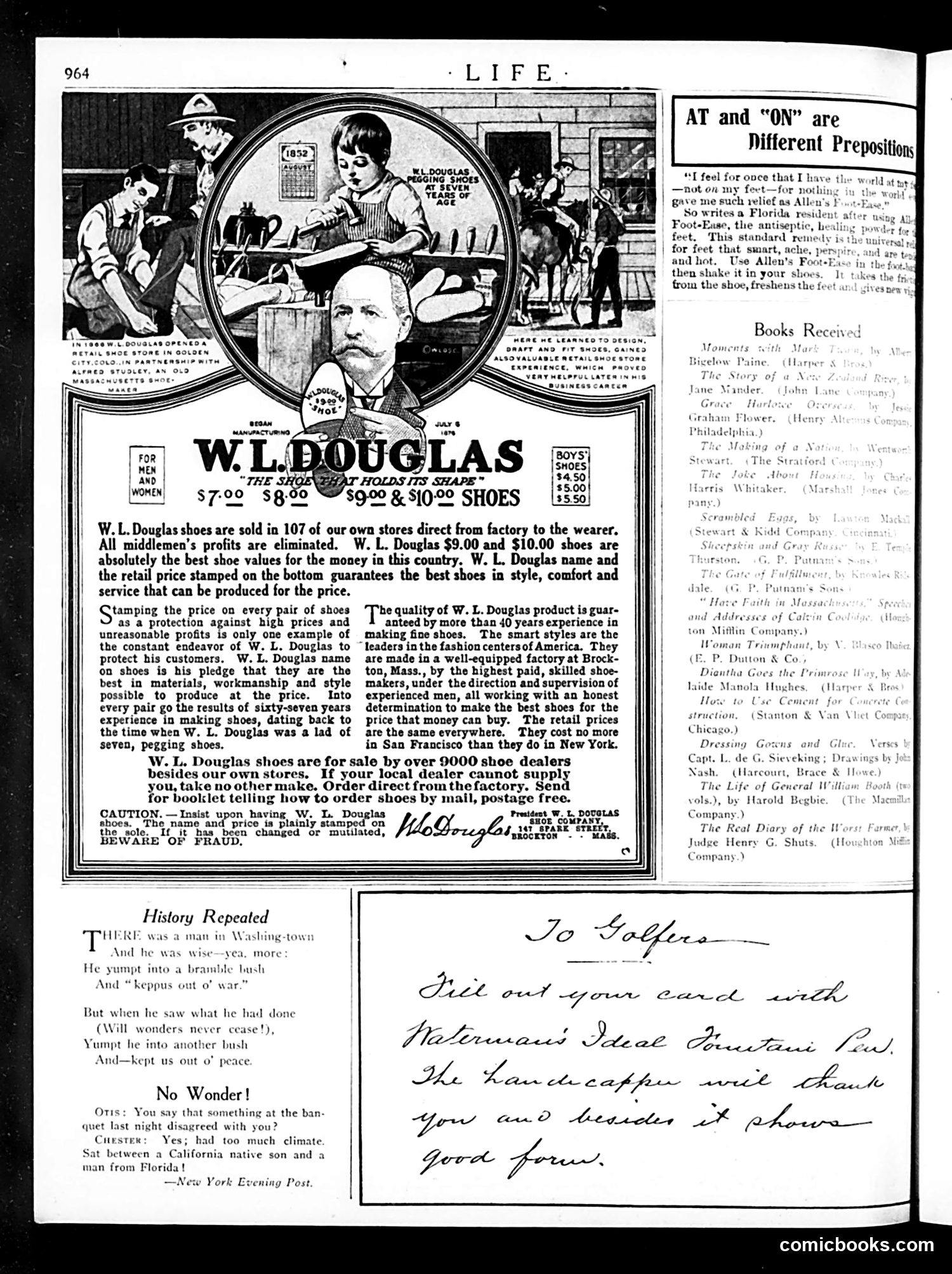
This page is primarily **advertising**, dominated by a large W.L. Douglas shoe company advertisement featuring the company founder's portrait. The ad emphasizes direct factory-to-consumer sales eliminating "middlemen's profits" and claims superiority through 67 years of shoemaking experience and fair pricing across all locations. The minor content includes: **"History Repeated"** — a poem satirizing American political isolationism. A Washington politician jumps into a bush to avoid war, then jumps into another to "keep us out o' peace," suggesting hypocritical or ineffectual foreign policy. **"No Wonder!"** — a brief joke about digestive discomfort from sitting between a Californian and Floridian, likely poking fun at regional American differences or stereotypes about those states' climates. The page also lists recent book publications and contains an advertisement for Allen's Foot-Ease powder, playing on the preposition distinction in the title.
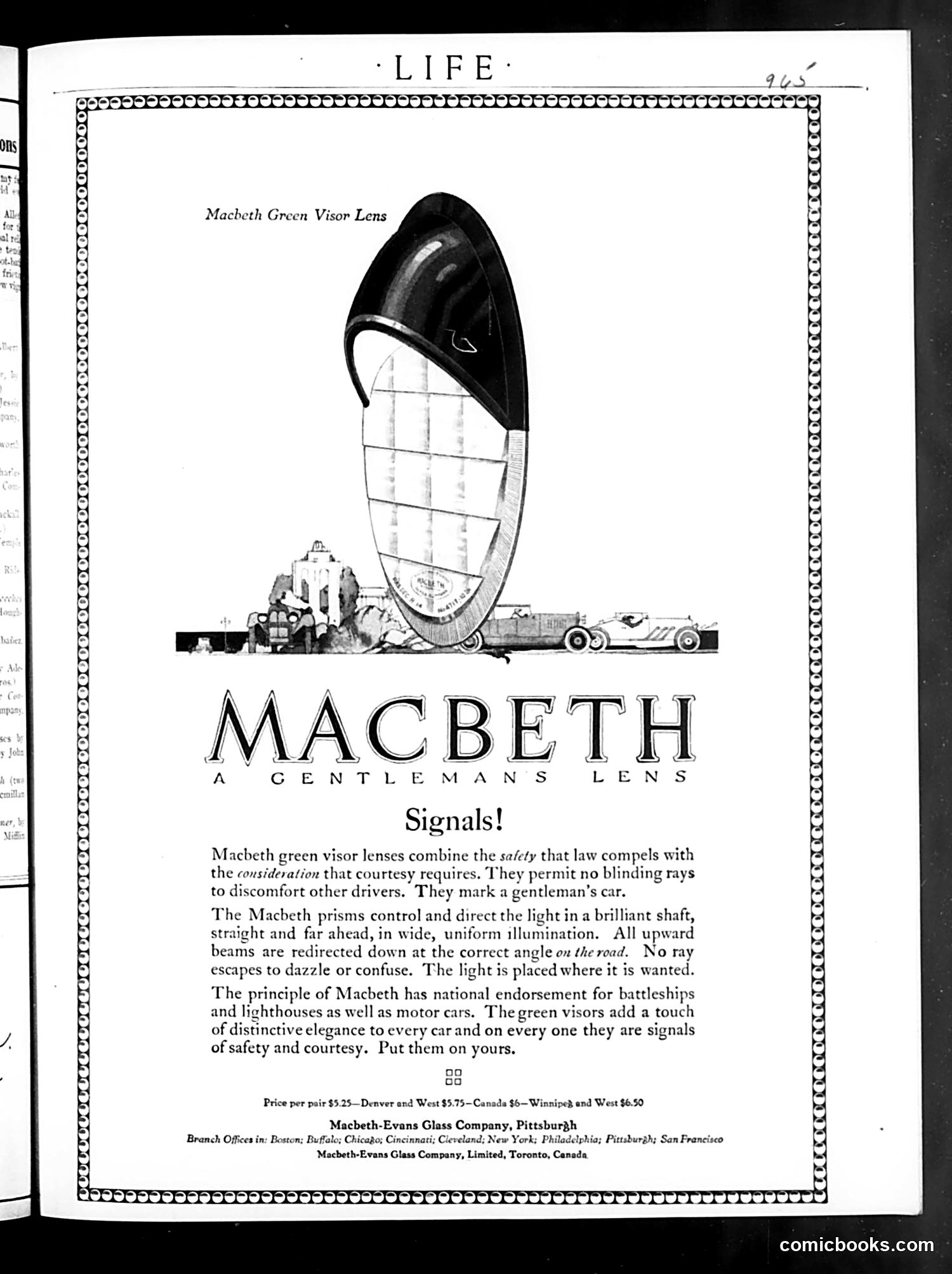
This is a **product advertisement**, not political satire. It promotes Macbeth-Evans Glass Company's "Green Visor Lens" automobile headlight covers, published in *Life* magazine. The illustration depicts an enormous green-tinted lens mounted on a stylized car chassis with industrial/mechanical imagery below it, emphasizing the product's engineering sophistication. The ad's appeal targets early automotive etiquette concerns: it frames the product as both legally compliant (meeting safety standards) and socially refined—a "gentleman's car" accessory. The copywriting emphasizes that green visors redirect upward light beams downward to avoid "blinding" other drivers, presenting safety as courtesy. The mention of "national endorsement for battleships and lighthouses" attempts to lend credibility through military/industrial applications. The pricing table indicates this was a premium product sold across North America. This reflects early 20th-century anxieties about automobile headlight glare and the emerging cultural expectation that car ownership implied social responsibility.
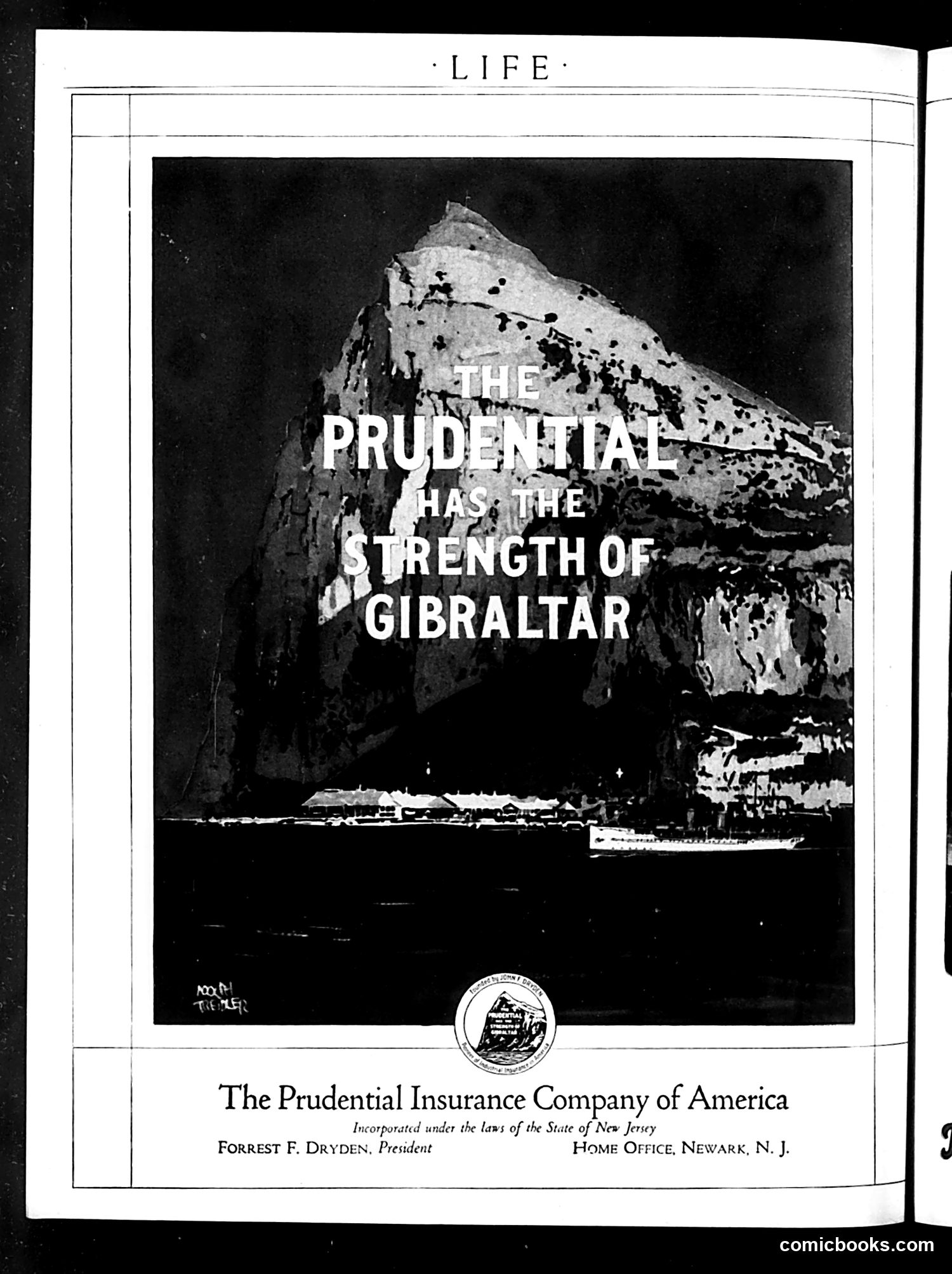
This is an advertisement for The Prudential Insurance Company of America, not a political cartoon. The page features an image of the Rock of Gibraltar with the company's slogan: "The Prudential has the Strength of Gibraltar." The advertisement uses the famous rock formation as a metaphor for stability and reliability—Gibraltar's geological permanence symbolizes the insurance company's dependability and financial security. The company's seal and president's name (Forrest F. Dryden) appear below. This represents early 20th-century advertising strategy, using a recognized natural landmark to build consumer confidence in financial services. The visual comparison suggests that choosing Prudential for insurance is as safe and solid as the ancient, immovable rock.
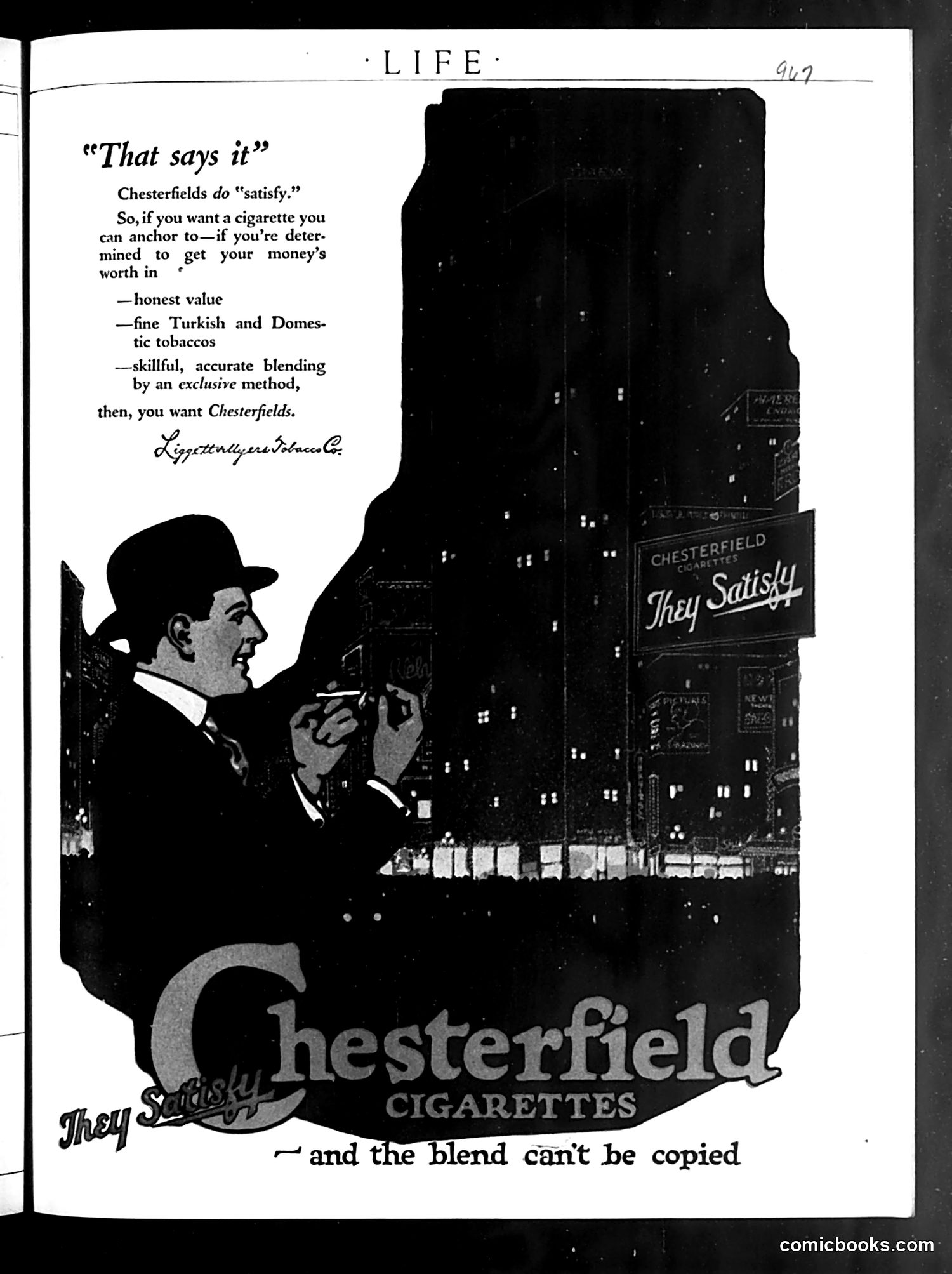
This is a **Chesterfield cigarette advertisement**, not political satire. It features a well-dressed man in a bowler hat smoking on what appears to be a city rooftop or high vantage point overlooking an urban skyline at night. The ad's pitch emphasizes that Chesterfields "satisfy" through: - Honest value - Quality Turkish and domestic tobacco - Exclusive blending method - An uncopiable blend The tagline "and the blend can't be copied" claims competitive advantage. The silhouetted urban backdrop suggests sophistication and urban aspirational living—common advertising imagery for the era. For modern readers: This represents pre-warning-label tobacco marketing that made health/quality claims freely. The "satisfaction" language and lifestyle imagery were standard cigarette advertising tactics of this period.
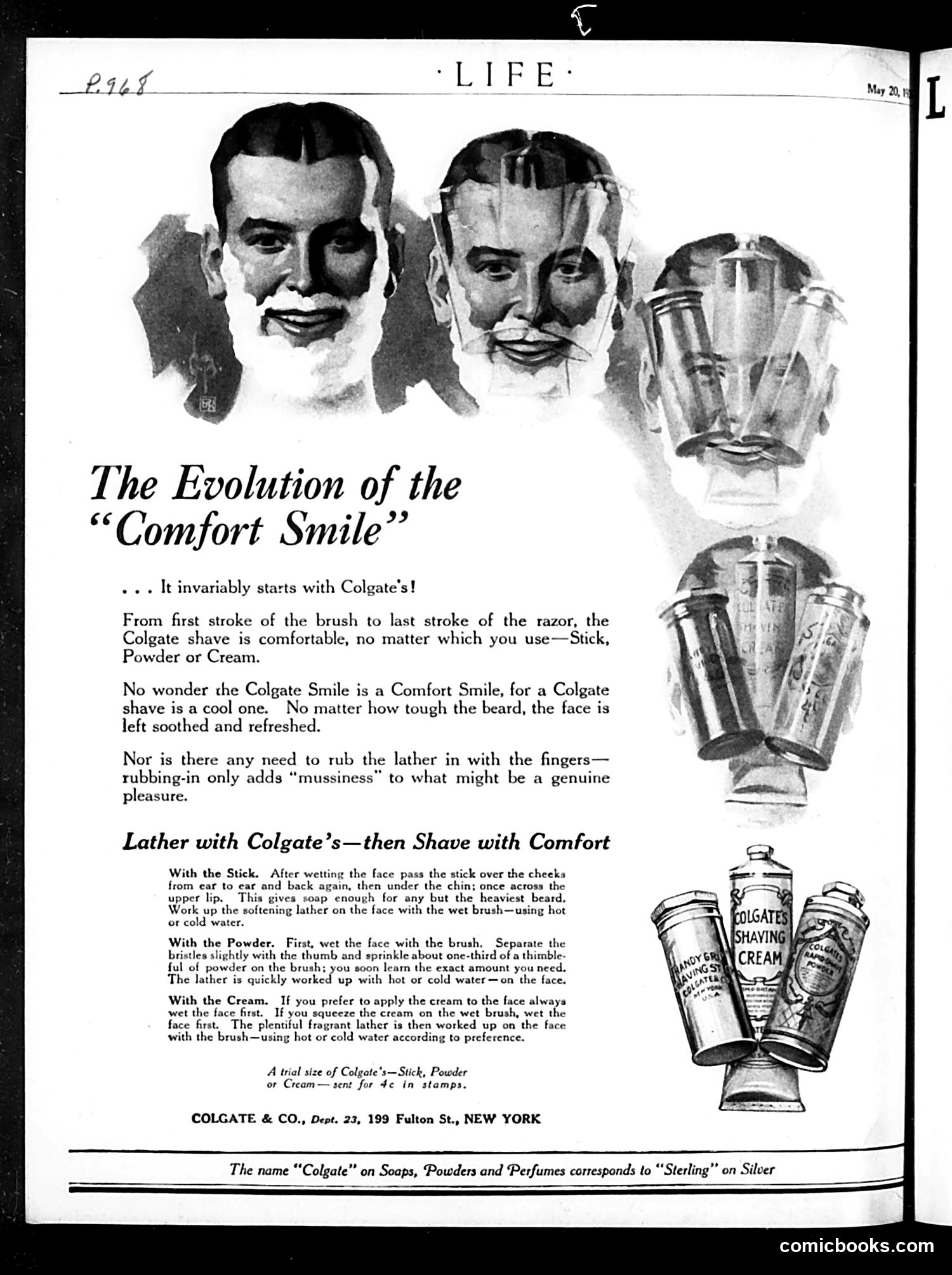
The page shows three illustrated male faces demonstrating the "evolution" of a satisfied expression—the "Comfort Smile"—as men progress through Colgate's shaving routine. The left shows initial satisfaction, center shows deepening contentment, and right shows a face obscured by lather. The accompanying text provides detailed instructions for using Colgate's three shaving product formats: stick, powder, or cream. It emphasizes comfort, smoothness, and the pleasant fragrance of the lather. The bottom displays bottles of the actual products being advertised. A trial size could be ordered for 4 cents in stamps. This represents early 20th-century advertising aimed at male consumers, promoting shaving comfort as a desirable luxury. The "smile" concept humorously suggests that proper grooming products literally make men happier—a common advertising strategy of the era.