
Life, 1920-05-20 · page 41 of 48
Life — May 20, 1920 — page 41: what you’re looking at
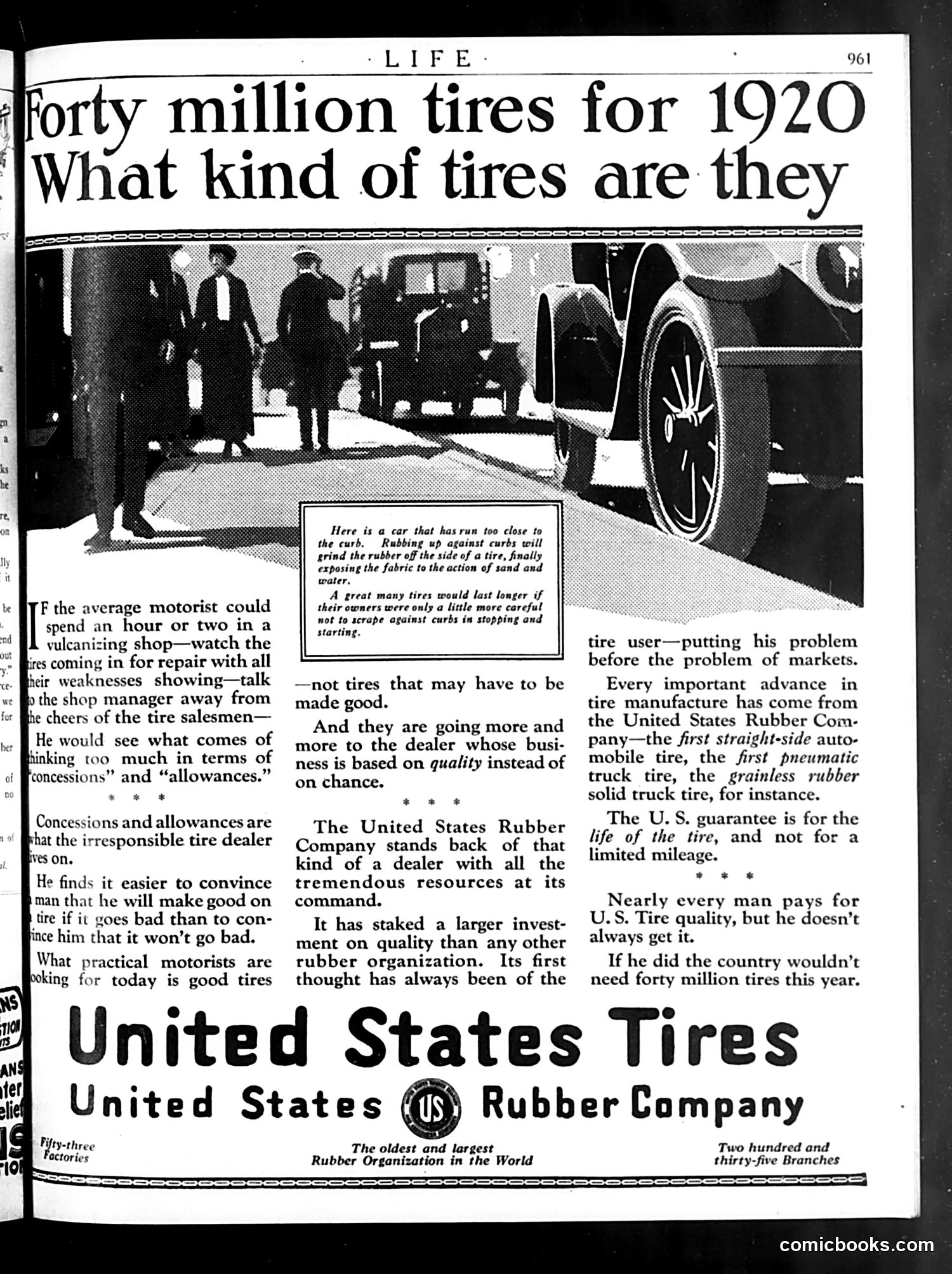
What you’re looking at
This is primarily a **United States Rubber Company advertisement** disguised as editorial content in Life magazine. The "cartoon" is a photograph showing tire damage from curb-scraping, accompanied by explanatory text. It's not satirical commentary but rather a **cautionary lesson** meant to justify tire replacement demand. The advertisement's argument is defensive: it addresses why the country needs 40 million tires in 1920 by blaming motorists themselves. The text criticizes "irresponsible tire dealers" who offer "concessions and allowances" on poor-quality tires, contrasting this with U.S. Rubber's commitment to quality. **The unstated message**: High tire replacement rates aren't the industry's fault—they result from poor driving habits (like rubbing curbs) and unethical competitors. U.S. Rubber stands apart by prioritizing durability and customer protection. This represents early 20th-century **corporate image-building**, using Life's editorial credibility to advance commercial interests while appearing to offer practical motorist advice.
📄 Transcribed text from this page (OCR, searchable)
Machine-transcribed from the original scan — historical spelling and the odd misread are preserved.
rty ~-LIFE- 961 orty million tires for 1920 What kind of tires are they spend an hour or two in a vulcanizing shop—watch the ires coming in for repair with all heir weaknesses showing—talk the shop manager away from he cheers of the tire salesmen— He would see what comes of hinking too much in terms of concessions” and “allowances.” * * [' the average motorist could Concessions and allowances are shat the irresponsible tire dealer bves on. He finds it easier to convince man that he will make good on tire if it goes bad than to con- ince him that it won’t go bad. What practical motorists are poking for today is good tires Here is a car that has run too close to the curb. Rubbing up against curbs will grind the rubber off the side of a tire, finally exposing the fabric to the action of sand and water. A great many tires would last longer if their owners were only a little more careful not to scrape against curbs in stopping and starting. —not tires that may have to be made good. And they are going more and more to the dealer whose busi- ness is based on quality instead of on chance. * * * The United States Rubber Company stands back of that kind of a dealer with all the tremendous resources at its command. It has staked a larger invest- ment on quality than any other rubber organization. Its first thought has always been of the tire user—putting his problem before the problem of markets. Every important advance in tire manufacture has come from the United States Rubber Com- pany—the first straight-side auto- mobile tire, the first pneumatic truck tire, the grainless rubber solid truck tire, for instance. The U.S. guarantee is for the life of the tire, and not for a limited mileage. * * * Nearly every man pays for U.S. Tire quality, but he doesn’t always get it. If he did the country wouldn’t need forty million tires this year. United States Tires Fifty-three ‘@ctories The oldest and largest Rubber Organization in the World United States @ Rubber Campany Two hundred and thirty-five Branches comicbooks.com