
Life, 1920-05-20 · page 22 of 48
Life — May 20, 1920 — page 22: what you’re looking at
What you’re looking at
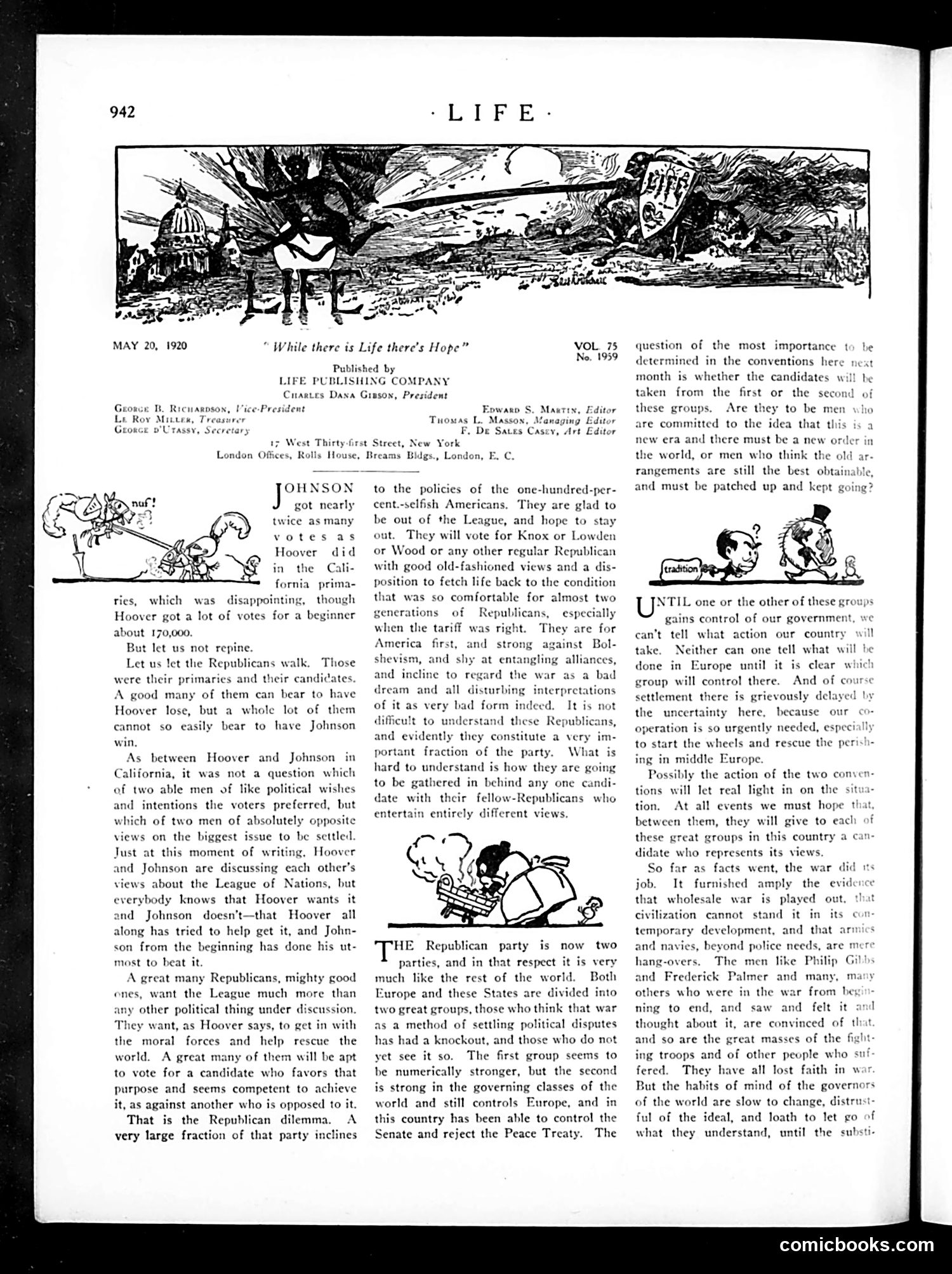
This editorial page discusses the 1920 Republican primary, where Herbert Hoover and Hiram Johnson competed in California. Johnson won unexpectedly, troubling many Republicans despite his party credentials. The article identifies a fundamental Republican split: between internationalists favoring the League of Nations (represented by Hoover) and isolationists opposing it (represented by Johnson and the "hundred-percent-selfish Americans"). The author notes the party comprises two irreconcilable factions—those accepting the post-war world order and those wanting pre-war normalcy, especially regarding tariffs and "entangling alliances." The cartoons (small illustrations throughout) satirize this internal conflict. The central concern: which faction will control the 1920 convention and select the presidential nominee? The article warns that without resolution, Republicans risk nominating someone satisfactory to neither group, potentially splitting the party before the general election.
📄 Transcribed text from this page (OCR, searchable)
Machine-transcribed from the original scan — historical spelling and the odd misread are preserved.
MAY 20, 1920 Publi LIFE “ While there is Life there’s Hope” hed by PUBLISHING COMP. NY Cuartes Dana Ginson, President Grosce B. Ricuarpson, Vice-President Le Roy Miter, T Grogce v'Ur Eowaro S. Masttx, Editor Twosas L. Masson, Managing Editor F, De Sates Casey, Art Editor 17 West Thirty-first Street, New York London Offices, Ro OHNSON got nearly twice as mai votes as did in the Cali- fornia prima- Hoover though iner ries, which was disappointing, Hoover got a lot of votes for a begi about 170,000. But let us not repine. Let us let the Republicans walk. Those were their primaries and their candidates. A good many of them can bear to have Hoover lose, but a whole lot of them cannot so easily bear to have Johnson win, As between Hoover and Johnson in alifornia, it was not a question which of two able men of like polit wishes and intentions the voters preferred, but which of two men of absolutely opposite views on the biggest issue to be settled. Just at this moment of writing, Hoover and Johnson are discussing each other's views about the League of Nations, but everybody knows that Hoover wants it and Johnson doesn’t—that Hoover all along has tried to help get it, and John- son from the beginning has done his ut- most to beat it A great many Republicans, mighty good ones, want the League much more than any other political thing under di hey want, as Hoover says, to get in with the moral world. cussion. forces and help rescue the A great m to vote for a candidate who favors that ny of them will be apt purpose and seems competent to achieve it, as against another who is opposed to it. That is the Republican dilemma. A very large fraction of that party inclines House, Breams Bldgs., London, E. C. to the policies of the one-hundred-per- cent.-selfish Americans, They are glad to be out of the L out. and hope to stay They will vote for Knox or Lowden or Wood or any other regular Republican with good old-fashioned views and a dis- position to fetch life back to the condition that was so comfortable for almost two generations of Republicans, especially when the tariff was righ They are for America first, and inst Bol- shevism, and shy at entangling alliances, and ir ¢ to regard the war as a bad dream and all disturbing interpretations It is not ublicans, strong y bad form indeed. ult to un and evident! of it as ve diffi erstand these I they constitute a very im- portant fraction of the party. What is hard to understand is how they are going to be gathered in behind any one candi- date with their fellow-Republicans who entertain entirely different views. aa HE Republican party is now parties, and in that respect it is very much like the rest of the world. Both Zurope and these States are divided into two great groups, those who think that war as a method of settling political disputes has had a knockout, and those who do not yet see it so. The first group seems to be numerically stronger, but the second two is strong in the governing classes of the world and still controls Europe, and in this country has been able to control the Senate and reject the Peace Treaty. The question of the most importance t determined in the conventions here 1 month is whether the candidates w taken from the first or the sec these groups. Are ‘y to be r are committed to the idea that this i new era and there must be a new the world, or men who think the ol rangements are still the best obtaina’ and must be patched up and kept goi NTIL one or the other of these gre gains control of our governmer can’t tell what action our country take. N done in Europe until it is clear witicl group will control there. And of cour settlement there is grievously delayed the uncertainty here, because our operation is so urgently needed, especi to start the wheels and rescue the per ing in middle Europe. ither can one tell what will | Possibly the action of the two conven- tions will let real light in on the tion. At all events we must hope t between them, they will give to each these great groups in this country a can- didate who represents its views, So far as facts went, the war did job. It furnished amply the that wholesale war is played out, civilization cannot stand it in its ¢ development, and that ar and navies, beyond police needs, are m hang-overs. The men like Philip and Frederick Palmer and many, others who were in the war from bey and felt it are convinced of tI evid temporar ning to end, and thought about it, and so are the great masses of the fi saw ing troops and of other people who fered. They But the habits of mind of the governe of the world are slow to change, distru ful of the ideal, and loath to let go what they understand, until the subs have all lost faith in war comicbooks.com